Showing posts with label shapeshifting. Show all posts

Wednesday, April 2, 2025

Celtic Shapeshifting


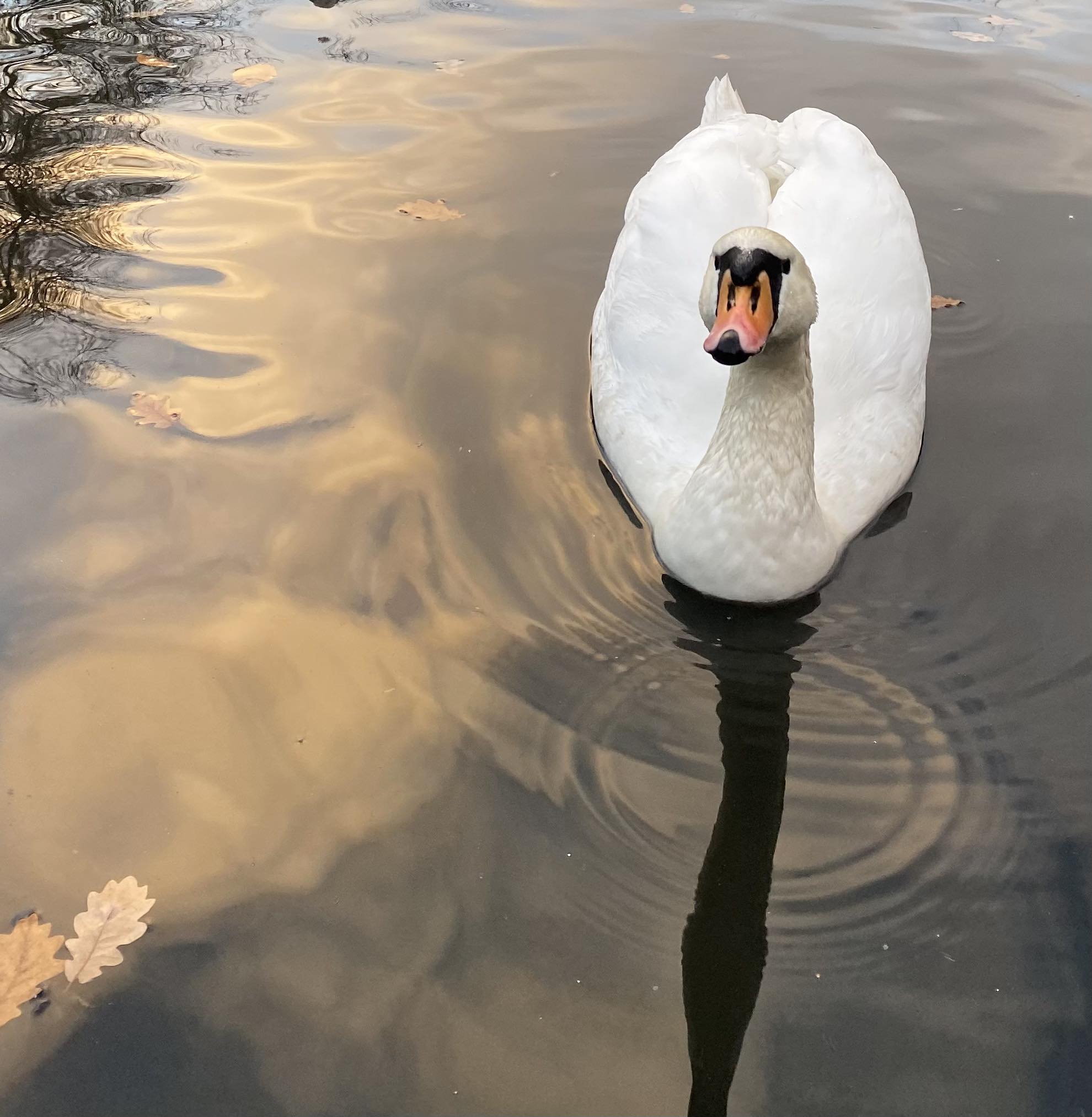
In the dream, I walk through a house, speaking with fervor about my plans for a new class on Celtic shapeshifting. I walk briskly between rooms, waving my arms like a swan on the water. Standing in the kitchen, I declaim the first lines of the Robert Graves version of the Song of Amergin

I am a stag: of seven tines,
I am a flood: across a plain,
I am a wind: on a deep lake,
I am a tear: the Sun lets fall. [1]

I repeat the phrase, "Celtic shapeshifting". I say it again as I leave the dream. The Song of Amergin claims affinity with all animate life, with the swan and the stars, with a tear the sun lets fall. I also feel breeze from the tale of Tuan mac Cairill, who survived the Flood as a mighty salmon, and became a hawk and many other creatures after. [2] How can I not recall his kinsman Fintan mac Bochra, who changed form when he changed his moods?

In his prose poem "Stone Boat", the poet John Moriarty gives us this grand Irish shifter of moods and forms. Once he has been paid with a story - in the Celtic way, you never come in to the good stuff without a story. sung more than spoken - Fintan reveals, "At Connla's otherworld well it was that I first realized that being human is a habit. It can be broken. Like the habit of going down to the river by this path rather than that, I broke it. And so it is that, although I always know who I am, I can never be sure that what I am going to sleep at night is what I will be when I wake up in the morning. In me the mutabilities of sleep survive into waking. What I'm saying is, my shape depends on my mood."

Then Fintan gives a lively poke: "You only need to break the habit once, the habit of being human I mean, and then you will be as you were between death and rebirth. Between death and rebirth our bodies are mind-bodies, and that means they are alterable. Alterable at will. We only have to will it and it happens, we flow from being a swan in Lough Owel into being a hind on Slieve Bloom into being a hare on Beara." [3]

Through the texts, we hear ancient bardic voices celebrating and affirming our connection with all living things in an animate, conscious world, and the shaman's ability to recruit allies in many realms and borrow their forms and their powers.


In his book Becoming Animal, David Abram tells us that "traditional tribal magicians or medicine persons seek to augment the limitations of their specifically human senses by binding their attention to the ways of another animal... The more studiously an apprentice magician watches the other creature from a stance of humility, learning to mimic its cries and to dance its various movements, the more thoroughly his nervous system is joined to another set of senses...Like anything focused upon so intently, the animal ally will begin visiting the novice shaman’s dreams, imparting understandings wholly inaccessible to her waking mind."[4]

Sometimes, of course, the forms are unwelcome, the result of a curse or of karma.

I have been in many shapes before I attained a congenial form. [5]

Now I am away with Aengus, following fire in the head into an enchanted apple orchard to catch a silver trout that becomes a lovely girl with apple blossom in her hair.....[6]


References

1. Robert Graves, The White Goddess: A Historical Grammar of Poetic Myth (New York: Farrar, Straus, Giroux 1986) p.13 2. Kuno Meyer “Tuan mac Cairill’s Story to Finnen of Moville”, appendix to The Voyage of Bran to the Land of the Living. (London: David Nut 1897), pp. 285–301
3.John Moriarty, "Stone Boat" in Dreamtime (Dublin: The Lilliput Press, 2020) p. 21
4. David Abram, Becoming Animal: An Earthly Cosmology (New York: Pantheon Books, 2010) pp. 217-8
5. Cad Goddeu, "The Battle of the Trees". Graves version, White Goddess p. 30.
6. W.B. Yeats, "The Song of Wandering Aengus" in Collected Poems (London: Macmillan, 1958) pp.66-7.


Illustrations: RM+AI

Saturday, February 22, 2025

Place of the Lion


The Dream

I am driving in a large open car along a once-grand avenue near the water in a city on the Black Sea. To our left are splendid buildings from the Belle Epoque that once housed department stores, hotels, restaurants. Everything has fallen into disrepair; signs are missing letters or hanging loose; some buildings look abandoned. Business is still being done though it doesn't correspond to the old signage.
     The person giving me this private tour explains that old magic is still alive in this fallen city. In particular, the ancient art of bonding with an animal familiar is practiced even in the best families, though proscribed by the church and frowned on by the state. Behind the columns of that now-shabby emporium, for example, is an establishment known to its clientele as Lion Inspiriting. Here the most awkward and tongue-tied can be learn to speak in a commanding voice, and the timid and cowardly can be infused with courage.
     I want to see how this works. Quick as thought, I am guided through a marble hall, up stairs to a half-lit parlor where I am invited to recline on a divan. I am aware that there is a stuffed lion in the room, so shabby and dusty I am sure it is an old taxidermy specimen rather than merely a prop or a toy. A black and white film starts to play. Grainy, silent. Nothing much happening for a long time except close ups of waving patterns in high glass. I am amazed at the detail. I can see every blade of glass. I realize the scene is not only on a screen. It is all around me. And it is not only black and white; There is some green and blue, and a glow of colors I can't normally see.
     Am I inside the night vision of a lion?
     The stuffed lion is no longer where I saw him before.

Feelings when I leave the dream: Excitement and delight.

Reality check: The city reminds me of Constanța, the Romanian city on the Black Sea where I led a fourt-day workshop years ago. The signs on the buildings are in the Roman alphabet, but I'm not certain they are in Romanian.

There is a villa in Constanța called the House of Lions. I don't recall seeing it when I was in the city and don't know whether it is the marbled building in my dream.

I love lions and have made a shamanic practice of connecting people with Lion spirit to claim their voice and find their courage. My original title for my book Active Dreaming was The Place of the Lion and there is a lion door knocker on the cover.

The werewolf is well-known in Romania (and is far more common than the vampire) but I have not heard of werelions here. However, I did once meet a werelynx in the Carpathian mountains. 

I find shifts between color and black and white (going either way) very significant in dreams.

I enjoy the slightly creepy Gypsy-Steampunk quality of the room where things go black-and-white. Of course Romania is famous for Romany. And in the middle of the night I was reading some hilarious chapters in Robertson Davies' novel The Rebel Angels about Gypsy magic in the heart of bourgeois Toronto.

What do I want to know?

Where does this story want to go next?

Bumper sticker

When the lion speaks everyone listens.

 Revisting the dream

When I look again to see how the story could develop, I imagine the narrator - now distinct from myself - discovering he is in the body of the taxidermy lion, which is now animated but shedding hair and bits of hide as it moves around awkwardly. To his horror, he finds that something else has taken the human body he left on the divan. It raises up and leave the premises. He is trying to track it but in this form people will flee from him or try to capture or kill him.

Dialogue with a dream character 

The Alteri

I ask the proprietess of the shapeshifting salon called Lion Inspiriting, Who are you?

She tells me, “We are Alteri”.

Does this mean alters, as in other personalities? 

Surely the lion isn’t native to these parts. She laughs at me for forgetting my history. The lions of the Hatti and of Ishtar, of Egypt and Africa. The cave lions of long ago. Her people are not captives of time or borders.

[Unedited entry form my joirnal for May 10, 2021]


Photo: House of Lions in Constanța.

Monday, November 11, 2024

Coming back from the dead as a dream shaman


My retelling of a wild tale of soul retrieval and shamanic initiation among the Kwakiutl of the Pacific Northwest. After putting a dead man's vital soul back in his body and telling him he will now be a shaman, the great wolf shaman explains how he will know how to heal: "I will always make you dream".

This is what the old ones say about Lebid. He was of the people called Kwakiutl or Gwasila. Their place was up in the north of Vancouver Island, where the winters can freeze your marrow. Lebid got pretty sick and no medicine could help him. His people watched him die. They couldn't bury him the old way, because the earth was frozen hard. They just laid him outside on the ice. They would deal with his remains when the ground thawed, if nothing took care of him first. In the meantime, the next snowfall made a blanket that covered him up. 
    Wolves came around after a couple of nights. The people heard them snuffling around Lebid's mound. The wolves started to howl, maybe calling the rest of the pack for free meat. What happened next was unexpected. A man's voice joined in, and the howls began to sound like a song. Nobody went outside to see what was going on.
     Time went by. Some days you could see the sun. One morning it showed a wolf pack nearing the village. The wolves scattered at the sight of the people, but one remained. He slowly rose up on two legs and became a man. The man was rail-thin and naked except for wreaths of dark  hemlock, round his neck and waist.
    When he came close to the lodges, people saw this was Lebid, the dead man. They saw he had become a skinwalker, a shapeshifter. Some thought he was also a zombie or a witch and wanted to drive him away, or burn him. A grandmother spoke up.
     "Bring him inside. Give him soup . Let him tell his story."
     "I was dead," Lebid started with what they knew "But the wolves dragged me to their place, and their great shaman. His name is Nau'alakume.He wears a crown of red cedar."
      He described how the wolves licked him all over his body. Then the wolf shaman vomited a crystal that he inserted in Lebid’s lower sternum. The shaman opened his palms to reveal something that might have been inside the crystal, a tiny fluttering creature the size of a fly or a lightning bug. Lebid understood that this was his vital soul, that had left his body with his last breath. The wolf shaman pressed down hard on the top of Lebid’s’ head, again and again, as if to loosen the bone. He blew the tiny soul throiugh the fontanel, and sealed the opening.
     He gave Lebid his own name, with its numonous power. He told Lebid that now he had died and come back, he, too, would be a shaman, "You will be a life bringer for your people."
    Then his followers rose up, put on their wolf masks, dropped to all fours, and and escorted Lebid home.
     The revenant sang a song to honor the wolf shaman who raised him from the dead, put his soul back in his body, and gifted him with his own powers. He sang of treasure again and again. 

They took me to the edge of the world by the magical power of heaven, the treasure
I was healed when the power of Nau’alakume, the life bringer, the treasure, was really thrown into me
I come to cure with this power of healing of Nau’alakume, the treasure. Therefore I will be a life bringer.
I come with the water of life given into my hand by Nau’alakume, the means of bringing to life, the treasures 

     If his people had any doubt that he now possessed the powers of a true shaman healer, a "life bringer", Lebid reassured them that he would operate under the wisest direction, delivered in what they all knew to be the most reliable way.
     He said that the great shaman, Nau'alakume, had told him, "I will always make you dream". Lebid told his people, "When you get sick, I will dream for you and my dreams will show me what you need to be healed."


Source: I have retold a report of the narrative of a Kwakiutl informant in Franz Boas' classic work The Religion of the Kwakiutl Indians. (New York: Columbia University Press, 1930) vol 2, pp. 46-50. It is worth noting that an elder of the Kwakiutl told Boas that "dreams are the news the soul brings us when it comes back from its journeys.". Franz Boas, "Ethnology of the Kwakiutl" in F. W. Hodge (ed.) Thirty-fifth annual report of the Bureau of American Ethnology to the Secretary of the Smithsonian Institution (Washington D.C.: Government Printing Office, 1921) pp. 724-725.


Wolf Mask. A Northwest Coast wolf dance headdress in Rayna Green, The British Museum Encyclopaedia of Native North America, Bloominton: Indiana University Press, 1999, p.177. 

Tuesday, September 26, 2023

Swan Inlet


For as long as I can remember, I have dreamed of swans. eyes closed and eyes open. Sometimes they lend me their forms. In a European city, in the twilight state before dawn, a swan rose from my third eye and we flew together over the river and the rooftops. 

This report I entered in my journal two years ago just flew out, seeking more attention. I will share it unedited: 

September 9, 2020

Dream

Swan Inlet

I stand in the woods near water's edge. The light over the bay is rosy gold, as are the waves. They move slowly. The water looks heavy and oleaginous. My guide explains that only swans are at home here. Other water birds avoid this inlet and don't swim in it. We watch a swan gliding into the swell, rocking with it, dipping its head and body after fish. 

Everything is suffused with that golden and rosy light. There is healing and magic here and the secret is with the swans.

Waking, I put myself back in the scene. I pick my way through roots and vines to stand at the edge of the bay. I take from it and the water in my cupped palm looks like olive oil in a spoon. It is lightly scented, a pleasing aroma. On my tongue it is warm and salted just right, like virgin dipping oil in an Italian restaurant. A swan is watching me closely. Will it share the secret? Can I rise on its wings as I did before?

I hope that the guide who was instructing me before will answer. But the only voice I hear now is my own. Swans fly over the oily waters in arrowhead formation toward the pink sun on the horizon.

                                                    ~

I think of Plato and the swans. There is a Greek tradition that Socrates dreamed the night before he met Plato that a young swan settled n his lap, developed at once into a full-grown bird and took off into the sky with a song that enchanted all hearers. [1]  In the Phaedo, Socrates says that swans sing most beautifully when they sense they are going to die. “They rejoice because they are about to approach the god whose servants they are.” This, we are told, should be a model for humans. 

Socrates says of himself that “like the swans” he is in the service of Apollo, “the holy property of a god.” Here, among swans, he gives the best definition of real philosophy, that it is “nothing other than practice for dying and being dead.” [2]

Before his death, Plato is said to have dreamed he shapeshifted into a swan.

I think of the swan in the Brihadaranyaka Upanishad, or "Great Forest Book", one of the oldest Upanishads, at least 2300 years old.. In a beautiful passage, the dreamer travels between worlds as "the lonely swan", flying in and out of the nest of the body. We are told that the dreamer is godlike in their ability to create in the dreamspace.

Here the dream state is described as a state of "emitting" [srj], a word that can also mean the ejaculation of semen. The dreamer "emits" [srjate] or projects "joys, happinesses and delights...ponds, lotus pools and flowing streams, for he is the Maker." We learn that as we grow the practice of dreaming, we can create realities. The word srj is also used to describe the way a turtle projects its head and paws from under its shell.

I think of the swan shamans of the Dane-zaa of the Pacific Northwest, who used to be called the Beaver Indians. Their word for a shaman is Naachin, which means Dreamer. As in the Upanishads, the Dane-zaa say that a powerful dreamer travels like a swan from and back to the nest of the body. ”The Dreamers are like swans in their ability to fly from one season to another. Like the swans that fly south in the winter, Dreamers fly to a land beyond the sky and bring back songs for the people on Earth.” [3]

I think of a shapeshifting Irish god who must become a swan to meet and mate with his dream lover. He is Aengus, and she is Caer Ibormeith, which means Yew Berry and hints at intimacy with death and the underworld. Yew Berry is under an enchantment, sometimes represented as a curse, sometimes - in the deeper tellings - as a gift. She does not stay in one form. She is a beautiful woman for one year. Then for the next year she is a white swan. Then the cycle repeats.  

The day of shapechanging is Samhain. Halloween. If Aengus would win the lady, he must find her on the liminal day, on a lake whose name is The Dragon's Mouth. At Samhain, Aengus goes to the Dragon's Mouth. He finds "three times fifty" white swans with silver chains around their necks, and one swan with a gold chain. He recognizes his love in the shape of the beautiful white bird, and calls to Yew Berry to fly to him. No, she tells him. You must change into my form.

Aengus changes, becoming the long-necked bird. They mate, in beating splendor, above the deeps of the Dragon's Mouth. They fly together back to the palace of Brugh na Boinne - Newgrange - and the love music they make in flight is so lovely and lulling that all the land is at peace and people drift into pleasant dreams and stay there for three days.  [4]


References

1. Patricia Cox Miller, Dreams in Late Antiquity (Princeton: Princeton University Press 1994) 3.

2. Phaedo 64a.

3.  Robin Ridington, “They Dream about Everything: The Last Dreamers of the Dane-zaa” in Ryan Hurd and Kelly Bulkeley (eds) Lucid Dreaming: New Perspectives on Consciousness in Sleep (Santa Barbara: Praeger, 2014) vol. 2, 194.

4. Jeffrey Gantz, trans. and ed., "The Dream of Óengus" in Early Irish Myths and Sagas (New York: Dorset Press, 1985) 107-112. I have used Yeats' preferred spelling for the name of the Irish god of love and dreams. For my full account of this story, see Robert Moss, The Dreamer's Book of the Dead (Rochester, Vermont: Destiny Books, 2005) 18-21. 


Photo by Romy Needham

Journal drawing by Robert Moss

Saturday, September 9, 2023

Celtic Metamorphoses


A horned god stands back to back with a second self. 
You pass the gatekeeper, into a field of metamorphoses. 
You turn into the curl of a wave, or a waterbird in flight. 
Fish becomes man, dog becomes dragon.
You reach for a flagon of unmixed wine
and the handle becomes the hound that is chasing the duck
that swims into your mouth on a red river. 

Long-beaked bird-men are alive on a Shetland cross.
Gold and silver and bronze glint at the throats
and on the forearms of queens and heroes.
Here everything is in connected, everything in flux,
vital energies change form and surge beyond form. 
A technology of enchantment captures minds
and binds them in tendrils, endlessly looping,
making knots without end, no strings you can pull. 

Are those the antlers of an ancient elk, bigger than moose.
on the head of that statue they brought from a warrior grave?
You try them on and look with his sight over a fertile valley,
proud of your kin, ready to fight for the deer and the forest.
You reach under the leaf-shaped shield that covers his abdomen.
You turn, as he did, the unseen handle that gathers the force
to embody and release your spirit double for its excursions.

The boar is everywhere, before you and around you. 
Be careful. You pause to hear the hot howl of war
from the throat of a boar-headed carnyx.
Swords and shields, iron and oak, ash and bronze.
Shields that are plain at the front but have hidden powers
at the back and in the coiling serpents at the grip.
Shields with glaring eyes and hidden faces of raging bulls.   
 

You find your end at last, craning over the cauldron from the bog,
braving the fierce stare of all those gods you cannot name.
You swim in bull's blood, plunging down to the scene of passion
where a naked woman warrior exults, sword in hand,
over the great body of the dying bull whose potency will pass,
with the rush of his blood, to the one who is called this way.


- Lines inspired by an exhibition of Celtic art at the British Museum


Photo: the base of the Gundestrup Cauldron, in the National Museum of Denmark. The silver cauldron, an immensely valuable offering in the society of the time, was dropped in a bog in Jutland but had been made somewhere far away.


Tuesday, February 28, 2023

The Fifty-Ninth Swan

I seem to be much with Swan People of late, drifting and winging between dream and myth. Yesterday I flew and swam, as swan and man, along a wild shore to high stony cliffs where a great swan's nest had been laid. I am going through my journals and books, gathering reports, turning some into drawings and drafts for a possible new book. I found a few paragraphs I published in a story titled "The Fifty-Ninth Swan" in Mysterious Realities. It evokes the sadness and the longing of the poet Yeats after his repeated rejection by Maud Gonne.


He is walking in the Seven Woods, at Coole Park. He comes to the lake, and sees that the swans have left sky and water and settled in a green meadow. Across the distance, they look like tufts of sheep’s wool. He can get near to them, perhaps, by crossing a field of cows. As he hoists myself over the stile, a red bull appears and challenges him, head down, steaming and potent, warning him away from his harem. Then the bull gets his scent and turns from him, shaking his rump, as if to say, You are no competition.
     He knows already what the count will reveal. There are fifty-nine swans on the grass, as there were fifty-nine on the water yesterday. He could not identify the solitary swan until now. He watched a mated couple drive the lone swan away with sounds like muffled bugles. He sees the solitary swan struggle through the wet grass. Clumsily, working pinions, he tries to lift off the ground. Perhaps his feathers are wet. It seems so hard for him to get airborne. Finally he wings his way above the lake towards the fairy hills, graceless and unloved.
    The poet flies with him, sharing his pain. Swans are not meant to live alone. They mate for life. I know the mate I would have if she would have me. In the stories I have gathered from the peasantry, and from old books, gods and heroes alike may turn into swans, or be forced to take their shapes under a curse. The love god Aengus, no less, must shapeshift into a swan to find and win the lady he desires, when she flies at Samhain in the company of swans, in their form, to be recognized by the golden chain round her neck.
    He wills myself, climbing higher, into the clouds, to find her spirit in a place of brightness. He couples with her in midair. He falls on her as Zeus comes to Leda. He will make this more than fantasy by carrying the lovely spirit he makes his above the clouds down to the body she has given to a red brute of a man, so she make wake from his spell and leave his cattle field and come to the poet in the green meadow.


Text adapted from Mysterious Realities; Adventures of a Dream Traveler in the Imaginal Realm by Robert Moss. Published by New World Library. 


Art: "Swan and Shadow" from the Swan People cycle of drawings by Robert Moss

Saturday, February 11, 2023

Proteus


Proteus


I am in many forms before I am bound.

I am the starwalker who won't come down.

I am the pond dweller who won't come up.

I am a hawk on a hill.

I am a bear in a berry wood.


I am the giant of the deep

who walked the Earth for ten thousand years

before he went back to the sea.

I am the sleeping king

who mated with the Earth

and dropped his horns in due season

and grew them back


I am the blasted oak that drew the lightning

I am the man in the Moon

I am the Hanged Man, and the Emperor, and the Fool.

I am medicine and I am poison.

I am the springing tiger and the quaking goat.

I am the one who makes a prison of the world

I am the one who makes the world his playground.

I am the death lord on his dark throne

I am a humming bird courting a flower.


I am the heaven bird in the World Tree

and the dragon coiled at its roots

and the squirrel that makes mischief between them.

I am a shard from a mirror

that was broken in transit from a blue star.


To release me, you must tie me down.


Published in Here, Everything is Dreaming: Poems and Stories by Robert Moss


Photo by RM


Friday, November 25, 2022

A Dreamer's Notes: Running with Tiger in the Twilight Woods


Running with Tiger in the Twilight Woods
 

I lay down to rest in the early afternoon. There is an immediate flow of imagery. 

I am moving faster and faster, along a road without defined scenery.

I speed towards a tunnel. I’m through it almost at once, and come out in a lightly wooded landscape. I hear water nearby. I try not to interpret what is happening mentally. I chant the syllables of a power song inwardly to shut off the talker in my mind.

Soon I am airborne. This happens effortlessly; there is no need to visualize the process before it begins. I’m flying over a thickly wooded scene.

From above, I see a man running through the woods. He’s almost or completely naked apart from some kind of face covering. This may be a mask. The main feature is long whiskers, fastened to his upper lip. The face is oblong; surely it’s a mask. 

He’s running from something. What is it?

I see a magnificent Bengal tiger loping effortlessly behind him.

Now the tiger is on him.

It doesn’t pause to kill or devour. It opens its jaws and simply swallows the masked runner, whole. They are now one. I sense that this is as it should be.

I cease to be a spectator.

The tiger’s huge face looms up, close to my own. I’m not scared of him. He is splendid.

He leaps at me. We become one. Instead of devouring me, he seems to have entered me.

 - from a 1995 journal


Image: Tiger Man by RM with AI assistance


Sunday, July 17, 2022

Dream archaeology at Bandelier


Bandelier National Monument, New Mexico


I was staying outside Santa Fe in an adobe house with extraordinary views across desert and mountains. The phrase Big Sky really applies here - you can watch the weather rolling in from fifty miles away. The night sky is extraordinary, a grainy, pulsing field full of animate energies. Nature feels quite personal here.

    I went out to the Bandelier State Monument, to visit the sites of the ancient and mysterious Anasazi people. I had two of those encounters with spirits of the land of the kind that are the stuff of dream archaeology.
    On the trail to the falls, I felt the mountain lion energy very strongly. Further along the trail, I lay down under ponderosa pines. I immediately sensed a presence. Scanning with my inner senses, I tracked it. Among the trees, a little person took form. He was very dark-skinned and no more than four feet tall. He was willing to give me a name, speaking the five syllables slowly and distinctly, so I could pick them up. I will not publish his name here; traditional peoples are very sensitive about the power of names.
    The name and the nature of the little man were connected with Rabbit. He could run like a jackrabbit. I saw him hunting small animals a long time ago, living very close to the earth. I asked to enter his Dreamtime and slipped inside the world of the animals. He belonged to a time when human and animal consciousness were not as separate as they are today, and when forms were not fixed. He seemed to be able to shapeshift his physical body as well as his energy profile into animal forms. I was attracted by his simplicity. There was even a sense of innocence in the just-so-ness of his relations with the land.
     I encountered a different presence as I stood  in front of the petroglyphs at the “longhouse” site - apartments built into the talus of a volcanic cliff - at the Anasazi village. A Gatekeeper figure emerged. He told me that white people still know next to nothing about what really went on here, but that he would show me certain things, under certain conditions.
    The wall opened to my vision like a window. I looked into the scene of an ancient rainmaking ceremony. The priest held up and vibrated a large stuffed serpent while a helper made the sound of thunder crashing with something resembling a mortar and pestle. I was shown the methods this ancient people used for appealing directly to the animate forces of nature. My tour expanded. I enjoyed looking into the everyday lives of these ancient ones, their foods and cooking methods, their rituals and their delight in theater and music.
     I recalled that the First Peoples of my native Australia talk of the Speaking Land. The spirits of the land are talking, talking. All we need to do expand our awareness, and listen without judgment. I felt privileged to have been invited into a space between the worlds to learn the ways of two ancient peoples of the American Southwest.

- from my dream archaeology casebook (2001).


Jackrabbit photo by Jim Harper

Wednesday, March 23, 2022

Causing a Bear, Scandinavian style


In my courses on healing through Active Dreaming and imagination, we call on Great Mother Bear as healer and protector. The Bear is the great medicine animal of North America and in Native tradition, the most powerful healers are those called by the Bear in dreams and visions. In ancient Europe, the Bear was the king of beasts, and there was a sacred kinship between bears and humans that we can trace from Paleolithic times. The Bear was a form of the Goddess and Athenian maidens danced in bearskins for Artemis, as She Bear, in the festival of Brauronia. Here, drawing on the Icelandic sagas, we recollect something of the warrior history of the Bear, and a shaman warrior of the North who could do much more than put on a bearskin and go wild.


His name is Bödvar Bjarki, which means "Warlike Little-Bear". He has a typical Scandinavian genealogy: his father Bjorn was a were-bear (as a result of a witch's curse); his mother's name, Bera, means "She-Bear". He casts a long shadow through the sagas of the North. He is the perfect warrior, stronger and fiercer than the berserkers ("bear-shirts") who are the champions and bodyguards of kings but must yield pride of place to Bodvar at the royal tables when he makes his entrance, often by knocking the door or wall down.
    While berserkers whip themselves into the fighting frenzy of an angry bear, Bodvar causes a bear. While his father was condemned by sorcery to turn into a bear of uncontrollable appetites in in the daytime, Bodvar is free from the curse of the were-bear; he chooses when to project a second body, in the shape of a warrior bear. This recalls the practice of Northern sorcerers who project fylgjur, "fetches" or shadow selves. The fylgjur are sometimes phantom figures, used to spy on adversaries or confuse their minds, but Bodvar's bear is entirely physical to those who meet it, and invincible among men in battle.   
     Bodvar is the hero of the last chapters of the Icelandic Saga of Hrólf Kraki. He is now the champion of King 
Hrólf of Denmark. who is leading a tiny force into battle against a vastly larger army that has invaded his lands. As the battle rages, a great bear advances in front of Hrólf's men. Always standing next to the king, the bear kills more of the enemy with a single sweep of its paw than five of the king's best warriors can despatch with swords and axes. The bear seems impervious to blows and missiles. It crushes men and horses with its weight, and rips enemies apart with its teeth.
     Against the odds, things are going well for King Hrólf until Hjalti - a boon companion of Bodvar - notices that his friend is missing from the field. He protests to the king that Bodvar should not be looking to his own safety in the midst of the fray. King Hrólf counsels that "Bodvar will be where he serves us best."
     Not grasping what this means, Hjalti runs back to the king's chamber, where he finds Bodvar apparently "sitting idle", or perhaps asleep. [1] Bodvar is in a state of shamanic trance. Not understanding, Hjalti seeks to rouse him, protesting that it is a disgrace that he is not fighting. "You should be using the strength of your arms, which are as strong as a bear's." In his outrage, Hjalti threatens to burn down the house, and Bodvar in it, unless his friend goes into battle.-
     With a deep sigh, Bodvar rises from his place and complies. After affirming that he is a stranger to fear, and fully aware of his obligations to the king, Bodvar cautions his friend that"By disturbing me here, you have not been as helpful to the king as you intended. The outcome of the battle was almost decided. You have acted out of ignorance...Now events will run their course, and nothing we can do will change the outcome. I can now offer the king far less help than before you woke me." [2]
     When Bodvar goes into battle, the giant bear disappears. Now King 
Hrólf's army is exposed to psychic as well as physical attack. When the bear was present, the dark arts of the invader's witchy wife Skuld were useless. Now she is able to project her own monstrous animal, a hideous boar that shoots arrows from its bristles. Bodvar Bjarki fights furiously, mowing down enemy warriors like grass. Yet their numbers do not diminish, and he begins to suspect that ghost warriors are fighting among the living. The champions fall, and after them King Hrolf. Because the bear shaman was torn from his trance when the bear was most needed.

[1] In a paraphrase of the famous (but otherwise lost) poem "Bjarkamal" appended by Saxo Grammaticus to his Gesta Danorum. Bodvar Bjarki (here called "Biarco") is in a deep "sleep" from which Hjalti has great difficulty in rousing him.
[2] Quotations are loosely based on Jesse L. Byock's translation of The Saga of King Hrolf Kraki (New York and London: Penguin Books, 1998).


Graphic: Bodvar's fetch on the field of battle in the shape of a bear, in "Hrolf Kraki's Last Stand" by Louis M. Moe (d.1945).

Saturday, October 30, 2021

The dream god and the faery lover at Halloween


We find beauty or terror in our contacts with the Otherworld - or our flight from it - according to our courage and the colors of our imaginations. 

How people respond to the banshee is an excellent example. The banshee is well-known in Celtic folk memory as a death messenger, whose appearance and weird cries are feared as the sign that death is near. The banshee is often depicted as a hag, or a crow, or a crow-woman.  

 But the banshee is actually the bean sidhe, which means "she-faery". She can appear as a being of amazing beauty. She can come as a personal or family guardian in tight situations - as a family banshee appeared to members of the royal house of Munster on the eve of the battle of Clontarf.  

Above all, the banshee comes to invite us or escort us on the Otherworld journey: not only the journey that follows physical death, but on journeys beyond the physical world from which we may return to the body with magic and power.  

Banshees are much abroad at Samhain, or Halloween.  

The story of Aislinge Óenguso, The Dream of Aengus,  turns the traditional fear of the banshee on its head. Instead of being scared of being caught by a banshee, the hero of this story is out to catch one, because night after night, she has been visiting him as his dream lover. This wild love story haunted Yeats all of his life and inspired him to write some of his most haunting verse. We'll call the hero Aengus, as the poet did.  

 Aengus is a lover and a friend of lovers. He is a trickster, a shaman and a soul healer. He is described as "mac Oc", the Young Son, forever young. He lives in the Brugh na Boinne, a palace beneath a Mound of Wonder that recent travelers know as Newgrange. Women everywhere dream of Aengus; his butterfly kisses graze their lips and their secret places.  

 But Aengus is no longer master of his own dreams. His dreams have a mistress. She first appeared by his bedside in a glory of red-gold hair, her long white body dancing through the veils to music that played him like a harp and shook him like a tambourine. Carried by the music and his surge of passionate desire, Aengus flies with her, like a wild swan, into a different landscape.

In the morning, exhausted, he can barely fall out of bed. He is listless, lethargic, not even interested in sex, his speciality. This goes on night after night, day after day. His mother is troubled. She sends for a famous doctor, so skilled he can diagnose what is wrong in a house before he walks through the door, by reading shapes in the smoke from the fire.  

The doctor sees at once that Aengus is away: a part of his soul has left his body to live with his dream lover. The cure is to put body and soul together again. This involves finding the girl, and putting the lovers together in their physical as well as their astral bodies.

Will Aengus please describe his dream mistress as exactly as possible? He aches for her as he speaks of the red-gold hair, the pearly skin.  

Very well, Aengus' mother has resources. She is a queen and a goddess of the Tuatha de Danaan. She will send out searchers to look for a girl who fits Angus's description.

This is not such an easy assignment, however, because the dream lover is of the Sidhe, and is hidden in the faery mists. A year passes, and she is not found.  

Now Aengus' father is called in. He is the Big Guy among the old gods, the Dagda, one end of whose outrageously huge eight-pronged club delivers instant death, while the other brings the dead back to life. But he can't or won't help with finding the dream lover, except to recommend the far-sighted Bodb the king of the Sidhe in Munster, as the faery for the job.  

 Bodb tracks the girl to yet another of the Mounds of Wonder. The girl is a bean sidhe, and she has the right kind of name for a banshee. Her name is Caer Ibormeith, which means Yew Berry. Of all trees in her landscape, the yew is most intimately associated with death.

It is agreed that Aengus must rally himself and go to Yew Berry's mound to spy on the banshee and make sure she is the one he has dreamed. She is. Her beauty shines beyond that of the "three times fifty" noble ladies about her, all wearing silver at their throats while Yew Berry wears gold.  

 At this point, in a different kind of story, we might expect the dream lovers to fall into each other's arms and elope. After all, they have been doing it every night for two years. But there are complications.

First off, Yew Berry's mound  is in the realm of the notorious Queen Maeve and her jealous husband Aillil, and they must not be scorned. They agree to help bring the lovers together, but Yew Berry's father won't hear of it. Even after the joined forces of the Dagda and King Aillil have stormed his faery fort, he clings to his daughter.  

 There are many tests and battles before the secret is learned. Yew Berry is under an enchantment, sometimes represented as a curse, sometimes - in the deeper tellings - as a gift. She does not stay in one form. She is a beautiful woman for one year. Then for the next year she is a white swan. Then the cycle repeats.  

The day of shapechanging is Samhain. If Aengus would win her, he must find her on the liminal day, on a lake whose name is The Dragon's Mouth. At Samhain, Aengus goes to the Dragon's Mouth. He finds "three times fifty" white swans with silver chains around their necks, and one swan with a gold chain. He recognizes his love in the shape of the beautiful white bird, and calls to Yew Berry to fly to him. No, she tells him. You must change into my form.

Aengus changes, becoming the long-necked bird. They mate, in beating splendor, above the deeps of the Dragon's Mouth. They fly together back to the palace of Brugh na Boinne - Newgrange - and the love music they make in flight is so lovely and lulling that all the land is at peace and people drift into pleasant dreams and stay there for three days.  

 It is an amazing story, a love god smitten by love, and seizing a moment of opportunity - at Halloween - to bring his lover from one realm into another.

In the best-known tellings of the Dream of Aengus, death is not mentioned. But the whole story is a dance with death, in several guises. It involves the death-in-life that we suffer when a part of our soul goes away, because of pain or abuse or heartbreak or - in this case - a longing for something beyond the familiar world. It involves the rescue of someone or something from the Land of the Dead. Yew Berry's name is a dead giveaway. Her mound  is actually a piece of the Underworld, her father one of the princes of the dead.  

Terror or beauty, banshee or faery lover. On the Night When the Veil Thins, we are especially reminded that we can never claim the treasures of the Otherworld - and a love bigger than the familiar world - unless we can brave up. 


Adapted from The Dreamer's Book of the Dead by Robert Moss. Published by Destiny Books.

Journal drawing by Robert Moss from a spontaneous night vision. A white swan took flight from my third eye and we went flying together lover a river in Europe.


Wednesday, August 25, 2021

Notes from a Reading Life: Jung's Dove Girl and the Black Books


 Just after Christmas 1912 Jung dreamed he was with his children in a tower, at a round table topped by a wonderful green stone, A seagull or dove flew in. It turned into a girl of eight who ran and played with his children among marvelous colonnades. The girl turned back into a bird and gave him a mysterious message.

He knew no way to find the meaning of the dream. He wrote later , “All I could do was just wait, go on with my life, and pay close attention to my fantasies.” [1] The bird dream also convinced him that the unconscious was populated with “living” entities, things with their own life.

So began the long experiment in wakeful fantasy (that he later called active imagination) chronicled in the Black Books. 

I wonder whether Jung knew at the time about the doves of Dodona. The priestesses of the famous oracle of the speaking oak, themsleves called Doves, told Herodotus that the oracle was created because a dove flew from Egypt and spoke from the tree in a human voice, announcing the will of the gods. Jung's dream of the shapeshifting bird girl has the uncanny, numinous quality of what we can easily imagine to have been the experience that brought pilgrims to such places over many centuries.

The call and the movement of birds were closely monitored at Dodona, as throughout the ancient world, and birds were recognized as companions and sometimes adopted forms of deities as well as lesser spirits: the eagle of Zeus, the dove of Aphrodite, the sea-bird and owl of Athena. Carrier pigeons - doves by a different name - were also an important communications system, and when oracles delivered early and accurate news, it may have been because something arrived on the wings of a bird as well as the wind of divine or daimonic inspiration.

I love Jung but am not a Jungian. (Neither was he.) I try to keep up with his literary afterlife in this world as Sonu Shamdasani and others bring out volume after volume of seminar notes and journals. I wrote from my visions of his afterlife in another world in my story "The Other Bollingen" in Mysterious Realities.


I have the Black Books and enjoyed the book-length introduction where I rediscovered the dove girl and her influence on Jung. However, I was exhausted halfway through one of the six volumes of transcriptions in which characters with big names in Jung's wakeful fantasies throw hissy fits at each other and make rude aspersions about each other's genealogy. Not to be read in a reverential way, at all, and generally lacking in the poetry (and the art) of the Red Book.

So I took a break from the Black Books and moved a more accessible posthumous publication,  Introduction to Jungian Psychology harvested from a 1925 seminar on analytical psychology and again edited by the indefatigable Shamdasani, to the top of the Jung section in my current reading piles. And I plunged deep into the sources for what was going on at the ancient oracle of the dove priestesses and the speaking oak at Dodona, using the skills of shamanic dreaming to travel through the texts and the archaeology and practice what Suhrawardi called "the knowledge of presence".


1. C.G. Jung, Memories, Dreams, Reflections. ed. Aniela Jaffé trans. Richard and Clara Winston. New York: Vintage Books, 1973, p.172.


Art: Pablo Picasso, "Child with a Dove" (1901)