Showing posts with label swan. Show all posts

Monday, July 28, 2025

On Swan Wings


The swan is a symbol of the soul in Indian literature, and a ride for Brahma the creator. In dreams, we read in the Upanishads, the soul flies back and forth from the nest of the body like a "lone swan". Paramahamsa, "Supreme Swan", is a title given to enlightened spiritual teachers. 

The swan features in moving scenes of soul remembering - recollecting other lives and connections with other members of our soul family. When they come at the right time, such memories return (says the poet Kalidasa) like flights of migrating swans. 

There is a beautiful encounter in the Bhagavata Purana between a king who has been reborn as a woman and a friend from his previous life. The friend says, "Don't you remember your old friend? You and I, my dear, were two swans who lived together in the lake of the mind, until you left me to wander on earth. I created the illusion that made you think you were a man or a woman. Our true nature is as two swans."


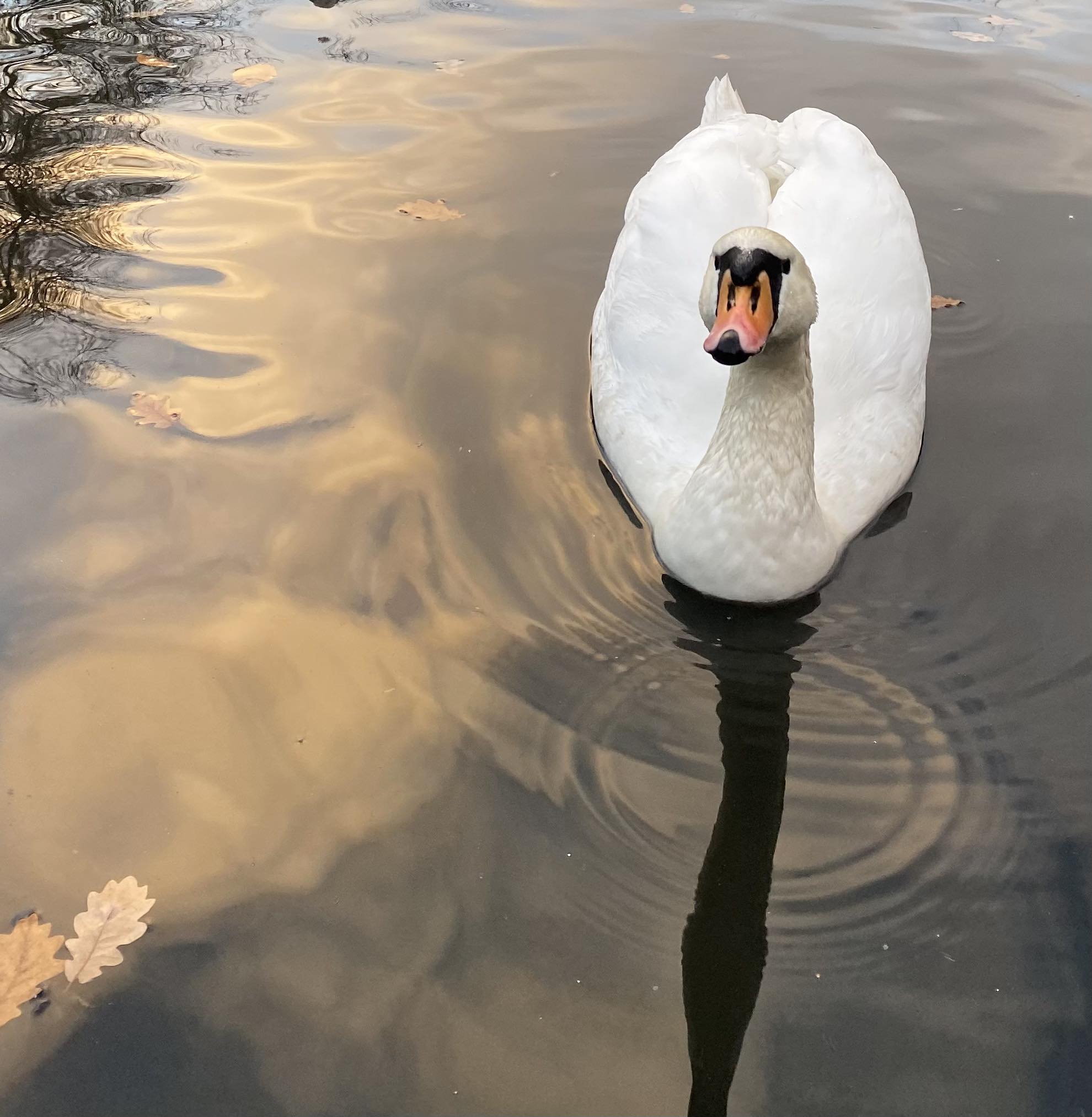
Photo by Romy Needham

Tuesday, November 12, 2024

The swan’s cure – a wonderful script for imaginal healing from Aldous Huxley


He's a cynical, worldly Englishman and right now his body is broken and screaming with pain. He's fallen from a cliff and he's on his back in a hut on an island in Southeast Asia, racked with fever. He is visited by a beautiful bronze-colored girl in a sarong who talks like she's been educated at Oxford before or after spending a year as assistant to a bodhisattva. She knows things about healing that his culture doesn't know and his mind is absolutely unwilling to accept. But she finds a chink in the closed door of that cynical mind, using memory.
    He is from England. Does he know the city of Wells? Of course he knows Wells, he snaps back at her.  She says she used to go walking there, by the water. There was an extraordinary sense of peace. And when she closes her eyes now she can see it all so clearly, green grass and golden sunlight on the stones of the church across the moat, and she can hear the bells and the jackdaws in the tower. Can he hear them too? Yes, he can hear the birds. 
    In this way, in her soft lilting voice, chanting more than speaking, she leads the patient inside a scene he remembers until he is there as well as on his sickbed. He can see the daisies and dandelions in the grass, the austere geometry of the cathedral tower challenging the tender blue of the sky.
    "And the swans."
     Yes, the swans. Impossibly beautiful, yet entirely real. He sees the curve of the swans' white breasts lifting and parting dark waters.
    "Effortlessly floating."
     The words give him deep satisfaction. As the dreamy voice leads him, he finds himself floating with the swans, on that smooth surface between darkness below and tender blue above, between here and far away, between one world and another. 
     Floating like a white bird on the water, he allows himself to slip into the flow of a great smooth silent river, allowing the sleeping river of life to carry him into a profound peace.
     The patient drifts off, contented, as the voice continues to chant. Above the river, he sees huge white clouds and at her suggestion, he floats up towards them until he is streaming on a river of air, up into the freshness of high mountains. He feels a delicious cool wind on his skin, and falls deeper into sleep, his fever broken.


I have paraphrased an extraordinary passage in Aldous Huxley's last novel,Island (first published in 1962) that is a magnificent description of imaginal healing. When Susila, the beautiful young healer, reports to her doctor father on what she did with the patient (the cynical journalist Will Farnaby) she says "he went off more quickly than expected" because she opened his imagination by calling him to a place in England that he knew. She explains that she worked with indirect rather than direct suggestions. "They're always better." She gave him a different body image, one that suggested grace and strength to carry him beyond his present injury, so it became "a miserable thing in revolt against a huge and splendid thing."
     There is a model here for how to grow a vision of healing for someone who is in need of images to make the body well. Start by taking them through the doorway of a life memory. Don't harp on physical symptoms. Give the body - as well as the mind - of the patient living images strong and graceful and fresh enough to shift it beyond its current complaints, as the swan glides on the water or lifts off to claim the sky.
     I teach a similar practice I call dream transfer, in the understanding that we can gift a dream - a healing image, a vision of possibility, even a road map to the afterlife - to someone in need of a dream. 


photo by Romy Needham

Tuesday, September 26, 2023

Swan Inlet


For as long as I can remember, I have dreamed of swans. eyes closed and eyes open. Sometimes they lend me their forms. In a European city, in the twilight state before dawn, a swan rose from my third eye and we flew together over the river and the rooftops. 

This report I entered in my journal two years ago just flew out, seeking more attention. I will share it unedited: 

September 9, 2020

Dream

Swan Inlet

I stand in the woods near water's edge. The light over the bay is rosy gold, as are the waves. They move slowly. The water looks heavy and oleaginous. My guide explains that only swans are at home here. Other water birds avoid this inlet and don't swim in it. We watch a swan gliding into the swell, rocking with it, dipping its head and body after fish. 

Everything is suffused with that golden and rosy light. There is healing and magic here and the secret is with the swans.

Waking, I put myself back in the scene. I pick my way through roots and vines to stand at the edge of the bay. I take from it and the water in my cupped palm looks like olive oil in a spoon. It is lightly scented, a pleasing aroma. On my tongue it is warm and salted just right, like virgin dipping oil in an Italian restaurant. A swan is watching me closely. Will it share the secret? Can I rise on its wings as I did before?

I hope that the guide who was instructing me before will answer. But the only voice I hear now is my own. Swans fly over the oily waters in arrowhead formation toward the pink sun on the horizon.

                                                    ~

I think of Plato and the swans. There is a Greek tradition that Socrates dreamed the night before he met Plato that a young swan settled n his lap, developed at once into a full-grown bird and took off into the sky with a song that enchanted all hearers. [1]  In the Phaedo, Socrates says that swans sing most beautifully when they sense they are going to die. “They rejoice because they are about to approach the god whose servants they are.” This, we are told, should be a model for humans. 

Socrates says of himself that “like the swans” he is in the service of Apollo, “the holy property of a god.” Here, among swans, he gives the best definition of real philosophy, that it is “nothing other than practice for dying and being dead.” [2]

Before his death, Plato is said to have dreamed he shapeshifted into a swan.

I think of the swan in the Brihadaranyaka Upanishad, or "Great Forest Book", one of the oldest Upanishads, at least 2300 years old.. In a beautiful passage, the dreamer travels between worlds as "the lonely swan", flying in and out of the nest of the body. We are told that the dreamer is godlike in their ability to create in the dreamspace.

Here the dream state is described as a state of "emitting" [srj], a word that can also mean the ejaculation of semen. The dreamer "emits" [srjate] or projects "joys, happinesses and delights...ponds, lotus pools and flowing streams, for he is the Maker." We learn that as we grow the practice of dreaming, we can create realities. The word srj is also used to describe the way a turtle projects its head and paws from under its shell.

I think of the swan shamans of the Dane-zaa of the Pacific Northwest, who used to be called the Beaver Indians. Their word for a shaman is Naachin, which means Dreamer. As in the Upanishads, the Dane-zaa say that a powerful dreamer travels like a swan from and back to the nest of the body. ”The Dreamers are like swans in their ability to fly from one season to another. Like the swans that fly south in the winter, Dreamers fly to a land beyond the sky and bring back songs for the people on Earth.” [3]

I think of a shapeshifting Irish god who must become a swan to meet and mate with his dream lover. He is Aengus, and she is Caer Ibormeith, which means Yew Berry and hints at intimacy with death and the underworld. Yew Berry is under an enchantment, sometimes represented as a curse, sometimes - in the deeper tellings - as a gift. She does not stay in one form. She is a beautiful woman for one year. Then for the next year she is a white swan. Then the cycle repeats.  

The day of shapechanging is Samhain. Halloween. If Aengus would win the lady, he must find her on the liminal day, on a lake whose name is The Dragon's Mouth. At Samhain, Aengus goes to the Dragon's Mouth. He finds "three times fifty" white swans with silver chains around their necks, and one swan with a gold chain. He recognizes his love in the shape of the beautiful white bird, and calls to Yew Berry to fly to him. No, she tells him. You must change into my form.

Aengus changes, becoming the long-necked bird. They mate, in beating splendor, above the deeps of the Dragon's Mouth. They fly together back to the palace of Brugh na Boinne - Newgrange - and the love music they make in flight is so lovely and lulling that all the land is at peace and people drift into pleasant dreams and stay there for three days.  [4]


References

1. Patricia Cox Miller, Dreams in Late Antiquity (Princeton: Princeton University Press 1994) 3.

2. Phaedo 64a.

3.  Robin Ridington, “They Dream about Everything: The Last Dreamers of the Dane-zaa” in Ryan Hurd and Kelly Bulkeley (eds) Lucid Dreaming: New Perspectives on Consciousness in Sleep (Santa Barbara: Praeger, 2014) vol. 2, 194.

4. Jeffrey Gantz, trans. and ed., "The Dream of Ă“engus" in Early Irish Myths and Sagas (New York: Dorset Press, 1985) 107-112. I have used Yeats' preferred spelling for the name of the Irish god of love and dreams. For my full account of this story, see Robert Moss, The Dreamer's Book of the Dead (Rochester, Vermont: Destiny Books, 2005) 18-21. 


Photo by Romy Needham

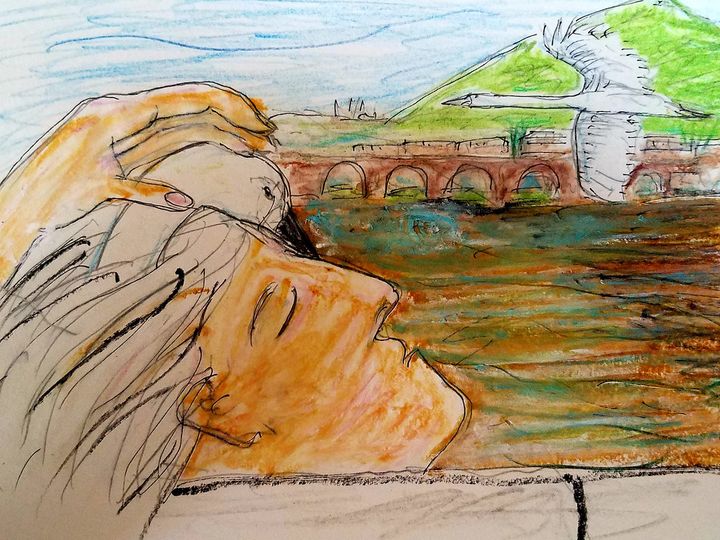
Journal drawing by Robert Moss

Monday, June 19, 2023

Birth of a Songline


A song is bursting from me. I sit on a rise overlooking the coast, and sing the first couplet:

We are singing till we're flying
We are flying till we're swimming

The last part comes in an easy flow

We are swimming till we're traveling
into the Land

A woman singer-songwriter is beside me now, carrying the melody in her lovely voice, laughing with me as I experiment with additional lines.

We are laughing till we're bouncing
We are bouncing till we're flying

Then comes the most important verse

We are sleeping till we’re dreaming
We are dreaming till awakening
We’re awakening for our homecoming
into the Land

I know what this is. It's a wing song, a journey song. I am excited to think that I can share it with the people who join me for adventures in the dreamtime and in the dream of everyday life.

I know what the Land of the song is. It is a happy Otherworld, a land of heart's desire. And the song can help to take us there. We are making songlines. 


- This account of how a song was born in one of my dreams is excerpt from my 2013 journal. We have sung the last verse of that song in many of my workshops and retreats, and it has helped us unfold our wings.


Photo (c) Romy Needham


Tuesday, February 28, 2023

The Fifty-Ninth Swan

I seem to be much with Swan People of late, drifting and winging between dream and myth. Yesterday I flew and swam, as swan and man, along a wild shore to high stony cliffs where a great swan's nest had been laid. I am going through my journals and books, gathering reports, turning some into drawings and drafts for a possible new book. I found a few paragraphs I published in a story titled "The Fifty-Ninth Swan" in Mysterious Realities. It evokes the sadness and the longing of the poet Yeats after his repeated rejection by Maud Gonne.


He is walking in the Seven Woods, at Coole Park. He comes to the lake, and sees that the swans have left sky and water and settled in a green meadow. Across the distance, they look like tufts of sheep’s wool. He can get near to them, perhaps, by crossing a field of cows. As he hoists myself over the stile, a red bull appears and challenges him, head down, steaming and potent, warning him away from his harem. Then the bull gets his scent and turns from him, shaking his rump, as if to say, You are no competition.
     He knows already what the count will reveal. There are fifty-nine swans on the grass, as there were fifty-nine on the water yesterday. He could not identify the solitary swan until now. He watched a mated couple drive the lone swan away with sounds like muffled bugles. He sees the solitary swan struggle through the wet grass. Clumsily, working pinions, he tries to lift off the ground. Perhaps his feathers are wet. It seems so hard for him to get airborne. Finally he wings his way above the lake towards the fairy hills, graceless and unloved.
    The poet flies with him, sharing his pain. Swans are not meant to live alone. They mate for life. I know the mate I would have if she would have me. In the stories I have gathered from the peasantry, and from old books, gods and heroes alike may turn into swans, or be forced to take their shapes under a curse. The love god Aengus, no less, must shapeshift into a swan to find and win the lady he desires, when she flies at Samhain in the company of swans, in their form, to be recognized by the golden chain round her neck.
    He wills myself, climbing higher, into the clouds, to find her spirit in a place of brightness. He couples with her in midair. He falls on her as Zeus comes to Leda. He will make this more than fantasy by carrying the lovely spirit he makes his above the clouds down to the body she has given to a red brute of a man, so she make wake from his spell and leave his cattle field and come to the poet in the green meadow.


Text adapted from Mysterious Realities; Adventures of a Dream Traveler in the Imaginal Realm by Robert Moss. Published by New World Library. 


Art: "Swan and Shadow" from the Swan People cycle of drawings by Robert Moss

Rilke’s Swan Song


A swan moves on the water,
 surrounded by itself, like a sliding picture.
 
 So at certain times the one you love

 is a moving space.


Your lover draws near, doubled

like the swan that swims on your troubled soul...


 adding to this being the trembling image

 of  joy and of doubt.


My free translation of one of Rilke's poems in French (Vergers No. 40)


Un cygne avance sur l'eau tout entouré

de lui-mĂªme, comme un glissant tableau;


ainsi Ă  certains instants

un Ăªtre que l'on aime est tout un espace mouvant.


Il se rapproche, doublé, comme ce cygne qui nage

sur notre Ă¢me troublĂ©e...


qui Ă  cet Ăªtre ajoute la tremblante image

de bonheur et de doute.


Photo by Romy Needham

Wednesday, October 21, 2020

Dreaming with Swans


Among the Dane-zaa of northern British Columbia,  respected spiritual elders or shamans are called Naachin, Dreamers. When young members of the People (Dane-zaa simply means The People) are sent into the wilderness on a vision quest, a Dreamer will watch over them, traveling in his astral body. The Dreamers are the givers of the songs that bring the People together in sacred ceremony in alignment with the spirits of the natural world. A song may be a bridge between worlds. It may confer the gift of understanding the language of birds and animals. 
    As in the Upanishads [1], the Dane-zaa say that a powerful dreamer travels like a swan from and back to the nest of the body. ”The Dreamers are like swans in their ability to fly from one season to another. Like the swans that fly south in the winter, Dreamers fly to a land beyond the sky and bring back songs for the people on Earth.” [2]

I have been looking through my journals for my dreams of swans. Here are a few:

Swan Prince

The great white bird lowers itself, wings outstretched, until it is suspended over the waters, whose currents stream purple and vermilion and royal blue. I hurry to meet it, swimming in air. Now the giant swan transforms into the semblance of a beautiful man. The beak becomes the golden noseguard of a helmet. Is this how the god appeared to Leda?  [February 5, 2012]


Swan Flies from My Third Eye


Drifting in bed between sleep and awake in a hotel in Prague, I feel the start of a headache. It is in the center of my forehead. There is a rush of wings. The pain is forgotten as the great white bird emerges from the area of my third eye. I leave my human body on the bed and fly with it over the Vltava river. [November 8, 2019]


Swan Inlet

I stand in the woods near water's edge. The light over the bay is rosy gold, as are the waves. They move slowly. The water looks heavy and oleaginous. My guide explains that only swans are at home here. Other water birds avoid this inlet and don't swim in it. We watch a swan gliding into the swell, rocking with it, dipping its head and body after fish. 
     Everything is suffused with that golden and rosy light. There is healing and magic here and the secret is with the swans.
    Waking, I put myself back in the scene. I pick my way through roots and vines to stand at the edge of the bay. I take from it and the water in my cupped palm looks like olive oil in a spoon. It is lightly scented, a pleasing aroma. On my tongue it is warm and salted just right, like virgin dipping oil in an Italian restaurant. A swan is watching me closely. Will it share the secret? Can I rise on its wings as I did before?
    I hope that the guide who was instructing me before will answer. But the only voice I hear now is my own. Swans fly over the oily waters in arrowhead formation toward the pink sun on the horizon. [September 21, 2020]


Swan Rising 

As I stir from sleep, I see with inner sight an old stone arched bridge over a green river. Not sure where. I am startled when I see a white swan standing, to my left, on the river bank. He is fierce and strong and definitely male. I think of Zeus and Aengus. He rises on beating wings and we fly together into a seascape of rosy light that reminds me of the light at Swan Inlet. Only Turner could do this scene justice in paint.[September 23,2020]


Notes


1. In the Brhadaranyaka Upanishad, or Great Forest Book, the dreamer moves between worlds and in and out of the nest of the body "like the lonely swan". The dreamer is godlike in the ability to create in the dream state. "In the state of dream, going up and down, the god makes many forms for himself." S. Radhakrishnan (ed) The Principal Upanishads (New Delhi: Indus, 1991) 259. A swan is the vehicle of Saraswati, goddess of wisdom and music. The Sanskrit title paramahamsa, "supreme swan", is reserved for the supremely enlightened.

2. Robin Ridington, “They Dream about Everything: The Last Dreamers of the Dane-zaa” in Ryan Hurd and Kelly Bulkeley (eds) Lucid Dreaming: New Perspectives on Consciousness in Sleep (Santa Barbara: Praeger, 2014) vol. 2,174.


Journal drawings by Robert Moss


Thursday, December 19, 2019

A solstice poem


Eyes of the Goddess

From a journey to Newgrange

The poet waits for me in his countryman’s cape
And shows me the map in the gateway stone:
Twin spirals to get you in, and out, of the place of bone;
Wave paths to swim you from shadow to dreamscape;
A stairway of stars for when you are done with earthing.
I am here to practice the art of rebirthing.

She calls me, into the belly of the land that is She.
But I play, like the poet, with the shapes of time:
I am a swimming swan on the River Boyne;
I am a salmon, full with the knowing of the hazel tree;
I wander with Angus, and know the girl I have visioned
in gold at the throat of a white swan, beating pinions.

Drawn by the old perfume of burned bones, I go down
and doze until solstice fire, bright and bountiful
quickens me for the return of the Lady, lithe and beautiful
In the form she has taken, flowing as liquid bronze.
Her face is veiled, so the man-boy called to her side
like the red deer in season will not die in her eyes.

I see beyond the veil, for I come from the Other.
Oh, I yearn for the smell of earth and the kiss of rain!
I leap with her on the hallowed bed, coming again.
She knows the deer-king, as I am child and lover
Her eyes are spiral paths; the gyre of creation whirls
And sends me in green beauty to marry the worlds.


This poem is included in my collection Here, Everything Is Dreaming: Poems and Stories. Published by Excelsior Editions/SUNY Press.


photo: Spirals on the kerb stone at Newgrange

Sunday, January 29, 2012

Black pond, white swan


I am drawn to the black pond and the white swan
Who turns with hieratic grace at the mid-point.
When I walk down to the water’s edge
She glides to me at once, so close I can touch her breast,
Her great wings, folded, make the shape of a heart.

When I try to read her dark and shining eyes
I see the sadness of a lovely woman in white
And in her eyes, mirrors within mirrors,
I find a blazing phoenix fire of many colors
And know this is reflected glory of the heaven bird
Who flies fearless through all the worlds.

“Where is your mate?” I ask the white swan.
Words swim back. How long have you made me wait?
And: How many dreams of me did you forget?
How many signs from me did you refuse?
I can only answer with truth, “I have been a fool,
Silly and forgetful, but I have always loved you.”