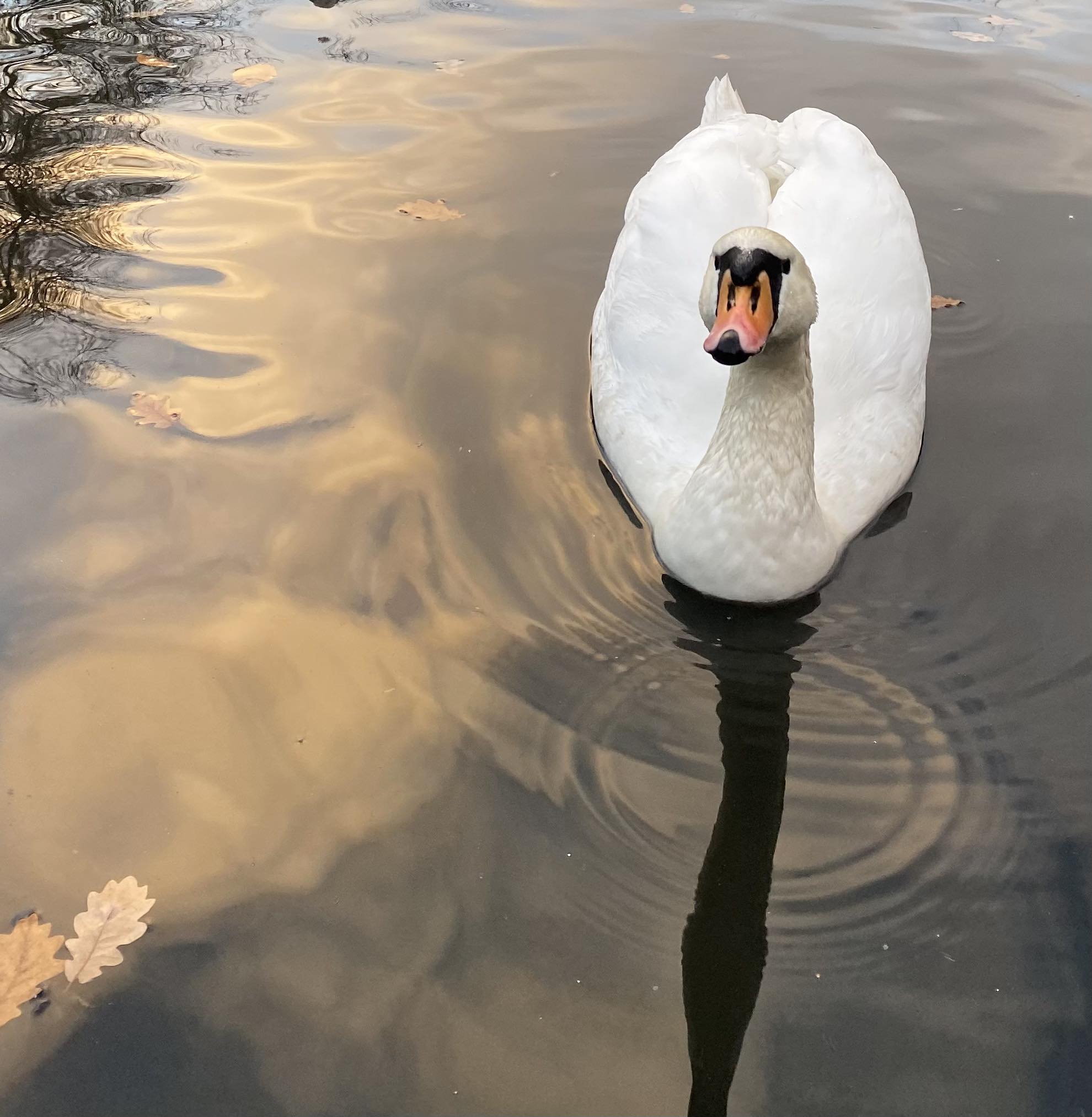
For as long as I can remember, I have dreamed of swans. eyes closed and eyes open. Sometimes they lend me their forms. In a European city, in the twilight state before dawn, a swan rose from my third eye and we flew together over the river and the rooftops.
This report I entered in my journal two years ago just flew out, seeking more attention. I will share it unedited:
September 9, 2020
Dream
Swan Inlet
I stand in the woods near water's edge. The light over the
bay is rosy gold, as are the waves. They move slowly. The water looks heavy and
oleaginous. My guide explains that only swans are at home here. Other water
birds avoid this inlet and don't swim in it. We watch a swan gliding into the
swell, rocking with it, dipping its head and body after fish.
Everything is suffused with that golden and rosy light.
There is healing and magic here and the secret is with the swans.
Waking, I put myself back in the scene. I pick my way
through roots and vines to stand at the edge of the bay. I take from it and the
water in my cupped palm looks like olive oil in a spoon. It is lightly scented,
a pleasing aroma. On my tongue it is warm and salted just right, like virgin
dipping oil in an Italian restaurant. A swan is watching me closely. Will it
share the secret? Can I rise on its wings as I did before?
I hope that the guide who was instructing me before will
answer. But the only voice I hear now is my own. Swans fly over the oily waters
in arrowhead formation toward the pink sun on the horizon.
~
I think of Plato and the swans. There is a Greek tradition that Socrates dreamed the night before he met Plato that a young swan settled n his lap, developed at once into a full-grown bird and took off into the sky with a song that enchanted all hearers. [1] In the Phaedo, Socrates says that swans sing most beautifully when they sense they are going to die. “They rejoice because they are about to approach the god whose servants they are.” This, we are told, should be a model for humans.
Socrates says of himself that “like the swans” he is in the service of Apollo, “the holy property of a god.” Here, among swans, he gives the best definition of real philosophy, that it is “nothing other than practice for dying and being dead.” [2]
Before his death, Plato is said to have dreamed he
shapeshifted into a swan.
I think of the swan in the Brihadaranyaka Upanishad, or "Great Forest Book", one of the oldest Upanishads, at least 2300 years old.. In a beautiful passage, the dreamer travels between worlds as "the lonely swan", flying in and out of the nest of the body. We are told that the dreamer is godlike in their ability to create in the dreamspace.
Here the dream state is described as a state of "emitting" [srj], a word that can also mean the ejaculation of semen. The dreamer "emits" [srjate] or projects "joys, happinesses and delights...ponds, lotus pools and flowing streams, for he is the Maker." We learn that as we grow the practice of dreaming, we can create realities. The word srj is also used to describe the way a turtle projects its head and paws from under its shell.
I think of a shapeshifting Irish god who must become a swan to meet and mate with his dream lover. He is Aengus, and she is Caer Ibormeith, which means Yew Berry and hints at intimacy with death and the underworld. Yew Berry is under an enchantment, sometimes represented as a curse, sometimes - in the deeper tellings - as a gift. She does not stay in one form. She is a beautiful woman for one year. Then for the next year she is a white swan. Then the cycle repeats.
The day of shapechanging is Samhain. Halloween. If Aengus would win the lady, he must find her on the liminal day, on a lake whose name is The Dragon's Mouth. At Samhain, Aengus goes to the Dragon's Mouth. He finds "three times fifty" white swans with silver chains around their necks, and one swan with a gold chain. He recognizes his love in the shape of the beautiful white bird, and calls to Yew Berry to fly to him. No, she tells him. You must change into my form.
Aengus changes, becoming the long-necked bird. They mate, in beating splendor, above the deeps of the Dragon's Mouth. They fly together back to the palace of Brugh na Boinne - Newgrange - and the love music they make in flight is so lovely and lulling that all the land is at peace and people drift into pleasant dreams and stay there for three days. [4]

References
2. Phaedo 64a.
3. Robin Ridington, “They Dream about Everything: The Last Dreamers of the Dane-zaa” in Ryan Hurd and Kelly Bulkeley (eds) Lucid Dreaming: New Perspectives on Consciousness in Sleep (Santa Barbara: Praeger, 2014) vol. 2, 194.
4. Jeffrey Gantz, trans. and ed., "The Dream of Óengus" in Early Irish Myths and Sagas (New York: Dorset Press, 1985) 107-112. I have used Yeats' preferred spelling for the name of the Irish god of love and dreams. For my full account of this story, see Robert Moss, The Dreamer's Book of the Dead (Rochester, Vermont: Destiny Books, 2005) 18-21.
Photo by Romy Needham
Journal drawing by Robert Moss


