Showing posts with label soul. Show all posts

Tuesday, May 27, 2025

When Her Husband Saw His Own Soul


After the Danish explorer Knud Rasmussen had lived for six months with the Netsilik Inuit, some of his hosts opened up about their dreams, their shamans and their sacred stories. The stories were only told to the right person at the right time, because, Rasmussen noted, “all that is described in them did really happen once, when everything in the world was different to what it is now. Thus these tales are both their real history and the source of all their religious ideas.” [1]
      Over long nights by the fire in an ice hut or a tent, the women were especially loquacious and some were formidable. Nalungiaq, a Netsilik woman, was married to her third husband, who had killed her second husband, who had killed her first husband, all from the desire to possess her. She described a time when there was no time, when the world was dark and there was no difference between humans and animals; they could take each other’s forms.
      She spoke of how the dead are alive in dreams. “We believe that dead people whom we see so vividly in dreams really are alive. In that way dreams have taught us that people live on after death. For very often our dear departed come to us while we sleep, and we see that they live, and that they are the same as when they lived together with us on earth.” [2]
      Rasmussen heard many stories of how souls wander beyond the body, and sometimes get lost or stolen, which is when the services of a shaman, an angakok. may be required.
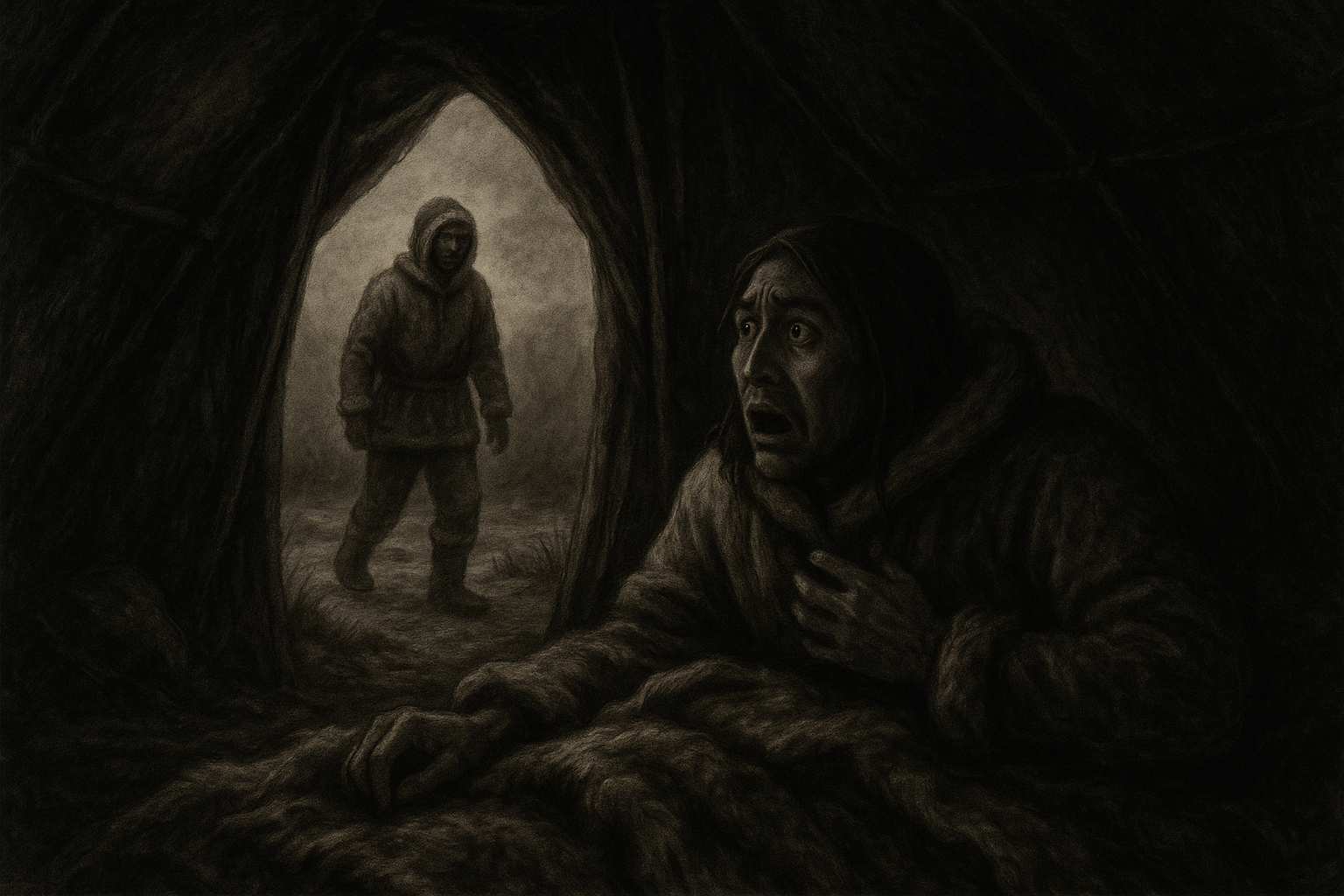
      Manelaq, the wife of Qaorssuaq, told how her husband once saw his own soul, wandering apart from his body, and where this led. Qaorssuaq had lain ill for a long time, and no one could understand what was wrong with him. Then one day, he saw "his own living self" a little way away.
      "No one else could see him. Seeing himself suddenly outside his own body he began to shiver all over. What he saw was his own soul, and it was owing to his illness that it had left his body. All trembling he stretched out his arms towards his soul and cried: 'Come nearer, come nearer. Come to me, come back to me!'
       " I could not understand what was happening to him and had to hold him by the hood when he kept on trembling. At the very moment I took hold of him the vision disappeared, but the soul did not return to his body. It had fled just at the moment it was perhaps on its way back to his body, for I was unclean and just in those days had my bleedings, and therefore the soul fled from me."
       Help came in the form of a couple who were both shamans. "When they heard what had happened, they insisted that 1 should go into a corner of the -tent, right over behind the fireplace; there I had to lie with my head hidden in a heap of caribou bones. While I remained concealed there, the two shamans conjured and summoned their helping spirits. They held a great seance in order to call the soul back to Qaorssuaq's body. And it was not long before he again saw his soul.
       "The two shamans, to whom nothing was impossible, could see it too. They uttered magic words and spoke with their helping spirits' own tongue until the soul came quite close to Qaorssuaq. Then they suddenly sprang to him and began to beat him here and there on his body, the consequence being that the soul was frightened and became so scared that it slipped into Qaorssuaq's body once more.
       "At the very same moment he was well again and I could hear him shouting and singing with joy. Only then did I venture to rise from the heap of animal bones where I had hidden my head till then, and we all sang with happiness. In that way Qaorssuaq got his soul back again." [3]
      It may seem odd that the vagrant soul was induced to get back in the body rather than go further away when the beating began, but it seems the shamans knew what they were doing. The magic words were certainly an important part of their operation. Inuit shamans have special language to do special things. Rasmussen later recounts a story of how magic words were used by an angakok to create a kind of Inuit golem , turning a neap of snow into a black bear. [4] Calling up helping spirits is central to Inuit shamanic practice, as in other traditions. An Inuit name for a spirit helper means "one that exists to be questioned" and the variety of entities that may play this role can be startling. Rasmussen mentions one shaman whose helping spirits included the moon, a sea scorpion, and one of his father’s living dogs. [5] 
     Inuit shamans were unwilling to share much of their training and practice with an outsider, and some told Rasmussen that the great shamans were no more; their tradition was in deep decay. Nonetheless, he was able to report how Inuit shamans are often called by the spirits in dreams. were prolific dreamers and "lived long in a dual world as real shamans must do". In the shaman’s calling, the spirits took the initiative, in dreams. If you could retain your dream experiences and apply them to the world around you, you had keys to mysteries impenetrable to others. [6]
     Rasmussen collected stories of shamanic soul flight, which Mircea Eliade, controversially, thought was the central feature of shamanic practice. [7] His most memorable tales came from Inuit recounting the deeds of illustrious ancestors. “I am a shaman myself,” an informant named Samik told him, “ but I am nothing compared with my grandfather Titqatsaq. He lived in the time when a shaman could go down to the mother of the sea beasts, fly up to the moon or make excursions out through space.”   
    Titqatsag was a frequent flyer. He loved spirit flight, and had a friendly rival, Muraoq, who also took to the air. They met in spirit flight over sea ice midway between their villages. As they converged, Muraoq spread his arms, like a bird gliding on its wings, but did not judge distance well and crashed violently into Tirqatsaq, who fell down onto the ice. He could not move until Muraoq called in helping spirits to get him up. Then the incident was mirrored. Back in the air, Tirqatsag crashed into Muraoq, who dropped to the ice and had to be rescued by his rival’s helping spirits in turn. Even shamans may need flight controllers. [8]


References

1.       Knud Rasmussen, The Netsilik Eskimo Social Life and Spiritual Culture. Report of the Fifth Thule Expedition 1921-24, (Copenhagen: Gyldendalske Boghhandewl, 1931) p. 207.
2. Ibid., p. 213
3. Ibid. p. 216
4. ibid., pp.288-91.
5. ibid., p. 294
6. ibid,, p.296
7. Mircea Eliade, Eliade. Shamanism: Archaic Techniques of Ecstasy. (Princeton: Princeton University Press, 1974).
8. Rasmussen op.cit., pp 299-300.


Illustration RM + AI


Friday, November 22, 2024

Where a Dog Is the Soul's Best Vehicle


I have always known that dogs are marvelous soul friends and can play a psychopomp role for those traveling beyond death. In my contunuing reserach into conceptions of soul among indigenous people, I came upon a note by a Catholic missionary suggesting that among the Inuit a dog could be not only a soul companion but a soul vehicle for the deceased.

Father Roger Buliard reported from his time among the Copper Inuit (called Eskimos in his day) that they took great care to propitiate the anernek - translated as "breath", soul or spirit - of the animals they hunted so that the caribou, for example, would remain friendly. They were no less solicitous in dealing with the anernek of dead Inuit.

"When a relative dies," Father Buliard reported, the Inuit "give his name quickly to a dog, so that the spirit will have a place to rest until a child is born to inherit it. The anernek is a fleeting thing, easily lost, and every artifice must be brought to bear to prevent its prowling and causing trouble.”

Other interesting revelations in this note (1) the breath soul is closely associated with the name; (2) the clear belief in metempsychosis, that at least one of the multiple souls of a human can occupy successive bodies.

Source: Roger Buliard, Inuk. New York: Farrar, Straus and Young, 1951. pp.264-65.


Illustration: "Esquimaux Dogs" by John James Audubon in The Quadrupeds of North America (1845-1848). Public domain.


Monday, November 11, 2024

Coming back from the dead as a dream shaman


My retelling of a wild tale of soul retrieval and shamanic initiation among the Kwakiutl of the Pacific Northwest. After putting a dead man's vital soul back in his body and telling him he will now be a shaman, the great wolf shaman explains how he will know how to heal: "I will always make you dream".

This is what the old ones say about Lebid. He was of the people called Kwakiutl or Gwasila. Their place was up in the north of Vancouver Island, where the winters can freeze your marrow. Lebid got pretty sick and no medicine could help him. His people watched him die. They couldn't bury him the old way, because the earth was frozen hard. They just laid him outside on the ice. They would deal with his remains when the ground thawed, if nothing took care of him first. In the meantime, the next snowfall made a blanket that covered him up. 
    Wolves came around after a couple of nights. The people heard them snuffling around Lebid's mound. The wolves started to howl, maybe calling the rest of the pack for free meat. What happened next was unexpected. A man's voice joined in, and the howls began to sound like a song. Nobody went outside to see what was going on.
     Time went by. Some days you could see the sun. One morning it showed a wolf pack nearing the village. The wolves scattered at the sight of the people, but one remained. He slowly rose up on two legs and became a man. The man was rail-thin and naked except for wreaths of dark  hemlock, round his neck and waist.
    When he came close to the lodges, people saw this was Lebid, the dead man. They saw he had become a skinwalker, a shapeshifter. Some thought he was also a zombie or a witch and wanted to drive him away, or burn him. A grandmother spoke up.
     "Bring him inside. Give him soup . Let him tell his story."
     "I was dead," Lebid started with what they knew "But the wolves dragged me to their place, and their great shaman. His name is Nau'alakume.He wears a crown of red cedar."
      He described how the wolves licked him all over his body. Then the wolf shaman vomited a crystal that he inserted in Lebid’s lower sternum. The shaman opened his palms to reveal something that might have been inside the crystal, a tiny fluttering creature the size of a fly or a lightning bug. Lebid understood that this was his vital soul, that had left his body with his last breath. The wolf shaman pressed down hard on the top of Lebid’s’ head, again and again, as if to loosen the bone. He blew the tiny soul throiugh the fontanel, and sealed the opening.
     He gave Lebid his own name, with its numonous power. He told Lebid that now he had died and come back, he, too, would be a shaman, "You will be a life bringer for your people."
    Then his followers rose up, put on their wolf masks, dropped to all fours, and and escorted Lebid home.
     The revenant sang a song to honor the wolf shaman who raised him from the dead, put his soul back in his body, and gifted him with his own powers. He sang of treasure again and again. 

They took me to the edge of the world by the magical power of heaven, the treasure
I was healed when the power of Nau’alakume, the life bringer, the treasure, was really thrown into me
I come to cure with this power of healing of Nau’alakume, the treasure. Therefore I will be a life bringer.
I come with the water of life given into my hand by Nau’alakume, the means of bringing to life, the treasures 

     If his people had any doubt that he now possessed the powers of a true shaman healer, a "life bringer", Lebid reassured them that he would operate under the wisest direction, delivered in what they all knew to be the most reliable way.
     He said that the great shaman, Nau'alakume, had told him, "I will always make you dream". Lebid told his people, "When you get sick, I will dream for you and my dreams will show me what you need to be healed."


Source: I have retold a report of the narrative of a Kwakiutl informant in Franz Boas' classic work The Religion of the Kwakiutl Indians. (New York: Columbia University Press, 1930) vol 2, pp. 46-50. It is worth noting that an elder of the Kwakiutl told Boas that "dreams are the news the soul brings us when it comes back from its journeys.". Franz Boas, "Ethnology of the Kwakiutl" in F. W. Hodge (ed.) Thirty-fifth annual report of the Bureau of American Ethnology to the Secretary of the Smithsonian Institution (Washington D.C.: Government Printing Office, 1921) pp. 724-725.


Wolf Mask. A Northwest Coast wolf dance headdress in Rayna Green, The British Museum Encyclopaedia of Native North America, Bloominton: Indiana University Press, 1999, p.177. 

Friday, October 25, 2024

In the Forest of Mirrors: Wanderings of the Yanomami Dream Image


At the moment of sleep, the body stays on the grid of the physical world, while the dreamer's living image [pei utupë] casts off and travels in the time of dreams (mari tëhë). This happens as it does at the moment of death: the image released from the body, becomes a specter (pore) that wanders the shores of heaven (hutu mosi). During the day, the image is confined in the body, at night, during dreams, it leaves its corporeal base and wanders far and wide, taking solid form, able to take other forms. As a living image, the dreamer can enter contact with other beings that inhabit the cosmos - with ancestors and gods, with animal and nature spirits. During the day, people take care of business. The business of the night is different. Around the close of day, the dream image begins to stir, getting ready for flight. The end of the afternoon is also the time of saudade, bittersweet nostalgia for a home in another world. .

This is a summary of the Yanomami view of dreaming. The Yanomami are a people of the rainforest on the borders of Barzil and Venezuela. For the Yanomami dreaming is what happens when the pei utupë is freed from the body at night. Pei utupë is usually translated as “image” but in a sense different from modern English language usage: the image that travels is like the Greek eidolon rather than a representation. It may be the “free soul” the Swedish school looks for in every aboriginal culture. [1] Hanna Limulja, a Brazilian anthropologist who lived with the Yanomami, makes herself their speaker in writing about these excursions:

By day we live and see what our eyes can see, it’s as if the daylight obscures what is hidden in the density of the body, the forest and the world. At night, the image, freed from the body, can truly see afar. Travelling to places where the body has never been, the pei utupë wanders, always at the risk of getting lost and making the body suffer. One does not dream during the day, because the day is of the living, of bodies, of matter that rots upon death. Night is the world of images, of the dead, of shamans’ helper spirits, the xapiripë. It is in the Yanomami person’s pei utupë, where what really matters is found.

You must be alive to dream, yet you must die a little each night in order to dream deep. The death experienced each night when the "image" goes wandering with the spirits is "the simulacrum and anticipation of the ultimate death that reaches everyone, the definitive death that separates the body from the image, the living from the dead." [2] 

Here is Yanomami shaman and spokesman Davi Kopenawa talking about relations between humans and ancestral spirits called xapiripë. "The xapiripë dance together on huge mirrors which come down from the sky. They are never dull like humans. They are always splendid."


The xapiripë descend to us perched on mirrors, which they keep suspended a little bit above the earth, so they never quite touch the ground. These mirrors come from their home in the sky.

     In a shaman’s house of spirits, these mirrors are propped, hung, piled and placed side by side. When the house is big, the mirrors are big. As the number of spirits increases, the mirrors multiply, one on top of the other.    The xapiripë don’t mix with each other. They have their own mirrors on the beams of the house: mirrors of warrior spirits, bird of prey spirits, and cicada spirits; mirrors of thunder spirits, lightning spirits, and storm spirits. There are as many mirrors as there are spirits, they are beyond number.

     We live among mirrors. Our forest belongs to the xapiripë and is made from their mirrors. [3] 

Mirrors not only hold and reflect images; they multiply them. Thus an ancestral spirit may reappear in many images:


When the name of a xapiripë is spoken, it is not a single spirit we evoke, but a multitude of similar spirits. Each name is unique, but the xapiripë it designates are very numerous. They are like the images in the mirrors I saw in a hotel. I was alone, but at the same time I possessed many images. Thus, there is just one name for the image of the tapir turned into spirit, but the tapir-spirits are very numerous...This is true of all the xapiripë. People think they are unique, but their images are innumerable. They are like me, standing in front of the hotel mirrors. They seem alone, but their images overlap each other as far as infinity. [4] 

This makes us reflect on the importance of mirrors in many shamanic and magical traditions. Looking into a reflective surface may reveal a world beyond the world. A shaman's mirror may be a soul catcher, or a shield, or a place in which to see.
     The night before I read this passage, a man told me he dreamed that his departed mother appeared to him, offering sage counsel. He described her as standing on a "glassy river" that went up into the sky.          
      I
n order to see and interact with the spirits, Yanomami shamans inhale yakoana, the powder of the yãkõanahi tree, "the food of the spirits".The snuff is prepared from resinof the virola elongata treewhich contains a powerful hallucinogenic alkaloid, dimethyltryptamine (DMT). It is said that by blowing yakoana snuff into a novice's nostrils, the shaman initiating him transmits the xapiri spirits with his "breath of life", wixia. [5] However, the spirit food is taken only during the day. Night is for dreaming, pure and simple. 

Kopenawa says, "When we truly want to know things we people of the forest try to see them in dream. This is our way of studying." There is a basic distinction between the dreaming of the maritima, one who dreams strong, and others. "Someone who is not looked upon by the spirits doesn’t dream. They just lie around in dumb sleep like an ax abandoned on the ground." The dream shaman flies with the spirits. [5]

References

1. Ernst Arbman, Untersuchungen zur primitiven Seelenvorstellung mit besonderer Rücksicht auf Indien in Le Monde Oriental, vol. 20 (1926) pp. 85-226; and vol 21 (1927) pp.1-185; Ake Hultkrantz, Conceptions of the Soul Among North American Indians: A Study in Religious Ethnology Stockholm: The Ethnographical Museum of Sweden. Monographic Series. no. 1, 1953.

2. Hanna Limulja “Notes on the Yanomami's Dreams” Revista de Antropologia. vol. 65 no.3. (Nov. 2022) p.17

 3. Davi Kopenawa and Bruce Albert, "Les ancêtres animaux" in B. Albert and H. Chandes (eds)Yanomami - l'esprit de la forêt Paris: Fondation Cartier / Actes Sud, 2003, pp.72-3.

4. ibid, p.73.

5. Davi Kopenawa and Bruce Albert, The Falling Sky Words of a Yanomami Shaman Trans. Nicholas Elliott and Alison Dundy. Cambridge Mass and London; Harvard University Belknap Press, 2013, p.492

6. Davi Kopenawa, "Sonhos das origens" in C.A.Ricardo (ed) Povos indígenas no Brasil (1996–2000), São Paulo: ISA, 2000.


Ilustration: RM with NightCafe


Friday, September 6, 2024

The soul is only partly confined to the body


One of Jung's great finds in his study of alchemy was a passage from de Sulphure, a tract by Michael Sendivogius, that Jung paraphrased as follows:


The soul is only partly confined to the body, just as God is only partly enclosed in the body of the world. [1]

In this conception the soul is "the vice-regent of God" and dwells in the life spirit of the blood. It rules the mind and this rules the body. Soul operates within the body, but the greater part of its function is outside the body. The power of the soul is that of imaginatio. Through its "imaginative faculty", the soul can operate in the deepest regions (profundissima) outside the body. It has absolute and independent power to do things beyond what the body can grasp.

When it so desires, it has the greatest power over the body, for otherwise our philosophy would be in vain. Thou canst conceive no greater, for we have opened the gate unto thee. [2]

The picture that emerges is of a lively, ever-shifting engagement between soul and the world of the body, an engagement that generates physical events from a deeper matrix. By implication, we see that individuals may be less separate than they supposed, joined in realms where soul is at home in overlapping fields of energy that may approximate group souls. It goes without saying that in this vision of reality, soul must survive the death of the body, since it exists and operates outside the body, as well as in it, during earthly life.

Jung's assistant Aniela Jaffé preserved the following thought from Sendivogius: 

The soul by which man differs from other animals operates inside his body, but it has greater efficacy outside the body, for outside the body it rules with absolute power. [3]


References


1. C.G.Jung, Psychology and Alchemy trans. R.F.C. Hull.  Collected Works volume 12 (Princeton University Press, 1968) p. 282
2. ibid, pp. 279-80.
3. Aniela Jaffé, Jung’s Last Years and Other Essays  (Dallas: Spring Publications, 1984) p.76


Sunday, June 16, 2024

When your dream soul goes flying


From the Teachings of Island Woman:

The memory of a dream is the memory of a journey. It may have been a short visit to a neighbor's place or a date with the lover you will meet three years from now. It may have been a journey to the spirits on the moon, or into a universe inside a stone that is as big as the universe out there.

When your dreamsoul goes flying, it visits the future and brings back memories of things that haven’t happened yet in the Shadow World. Sometimes you can stop those things from coming to pass. Sometimes you just have to live them out. Sometimes you can tame a future you don’t want by acting out a little piece of it, enough to contain the event that is trying to come through.
   Life is full of crossroads. Often you don’t even notice them until they are behind you, unless you know how to dream. Through dreaming, you can scout out the different trails you might follow and see where they lead. Through dreaming, you are already choosing the events that will take place in your waking life.

There is limitless power and beauty and healing available to us in the dreamworlds. To keep body and soul together in the surface world – and to live from the purposes of the soul – we need to bring that dream energy through. This requires action in the Shadow World.
    The first part of that action may be speech, but not the chatter of idle birds or village gossips. The speech required is an act that brings something new into a world. Dreaming gives us the songs and the magic words that can bring something up from a soupy ocean of possibilities to take root in the earth. That is why real men and women of power are poets, singers, storytellers, performers. With skeins of song and dancing needles of magic words, they reweave the fabric of reality.
   When we do this, we know that we are entertaining the spirits: our own vital spirits, the spirits of the ancestors, the great ones who reach to us from beyond space and time, the ancient and shining ones.

Nothing happens until it is dreamed. When we bring something good from the dreamworld into the surface world, we do the work of the Creator. We join in dancing a world into being, as Sky Woman danced on Turtle’s back.


-


"Island Woman" is the name I gave to an indigenous arendiwanen ("woman of power") who was born Huron and raised Mohawk some 300 years ago. She became Mother of the Wolf Clan of the Kanienkehaka, or Mohawk people, and a revered healer and dream shaman. She called me in lucid dreams in the late 1980s, after I moved to a farm on the edge of traditional Mohawk country and I had to study the Huron and Mohawk languages to understand and record her teachings. For her fuller teachings and my discoveries about her in historical records, see my book
Dreamways of the Iroquois

Drawing: "Island Woman" by Robert Moss

Saturday, April 13, 2024

The Soul throws an image before her


When the soul wishes to experience something she throws an image of the experience out before her and enters into her own image.

The words are from Meister Eckhart, the medieval German theologian and mystic who knew about the laws of the larger reality through direct experience. I first read then and jotted them down as an undergraduate, eons ago. They turn up now and then unexpectedly, as they did just now in an old journal. I went looking just now for the exact source (the history professor in me dies hard) and I see that you can order a Meister Eckhart Quote Bag with this inscription.

I'm tickled by the notion that instead of putting this quote in your bag of tricks, you might want to try packing what you carry through the day inside the thought.

It's a thought that demands walking meditation. Travel with it, and see how it shapes and illuminates your day. Then test it against your dreams.

The medieval master is telling us something vitally important about our relationship with time and about the secret of manifestation. He draws us to think about the confluence between what medieval theologians called the Aevum - the realm between time and eternity - and events in our world. It is in the Aevum that the incidents and circumstances of our physical lives are generated, in this understanding, through the agency of imagination, that great faculty of soul. On most days, most of us, sequestered from soul and its knowing, are merely receivers of the results of choices made in this realm that is hidden from the ordinary mind.

Who knew where we stood? 
In an aevum maybe, where time's conferred

with the beginning we gave it,
but with no end in sight.

These beckoning lines are from a poem titled "Aevum" by M.E.Caballero-Robb. They strengthen the enjoinder to walk through a day - why not today? - with Meister Eckhart's thought. That means asking, of whatever develops during the day, What image am I now entering? And, Where and how was this image created?

Then, energized by these reflections, we go the long step further, which is to seek to be present, as conscious co-creators, in the place where soul makes its choices on what we - as its vehicles - will experience in the world.

Do I sound like a mystic? Very well, you may call me a mystic, but I would say that I am a mystic of a very practical order. We are talking about how worlds are made.

By the way, a more famous Meister Eckhart quote is this: "If the only prayer you said in your life was Thank You, that would suffice." That is my own philosophy of prayer, and it is the practice of people who live close to the Earth as well as the heavens, and give thanks daily for its gifts. Oh yes, you can get that on a "quote bag" too.


Drawing by Robert Moss

Thursday, January 11, 2024

Open Secrets of the Dreamtime


Here are the open secrets of the Dreamtime, insights shared by many dreaming traditions and indigenous peoples that challenge the ruling paradigms of a culture that confuses the real with the physical

1. Dreams are real experiences.

There are big dreams and little dreams. “Bottom-line it for me,” bulled a radio host over the phone from North Dakota. “Aren’t dreamed caused by spicy pizza?” Well, yes, some dreams are. But we will not expend much space here on the surface bubbles of the dozing brain and belly.

In big dreams - in what Sri Aurobindo called “the sleep of experiences" - we are dealing with events, encounters, and challenges that are entirely real on their own level of reality. Our dream memories may be garbled or muddy, but the dream is a real experience whose meaning lies within the dreamscape itself. The dream experience, fully remembered, is its own interpretation. But we must do more than interpret dreams; we must manifest their energy and insight in our waking lives.

Shamanic dreamers tend to be quite literal-minded about dreams. If you dreamed you fell off a rock-face, you’d better remember to check your safety harness if there is any chance you might go rock climbing. If you flew with the eagle, you discovered a powerful spiritual ally — and your own ability to transcend the limitations of your physical body. If you dreamed of your dead uncle, before you start asking yourself what part of you he might represent, you should consider the possibility that you had a visit with him. Is he bothering you — maybe trying to cadge a drink or a smoke — or offering you help? If you dreamed you received instruction at a mountain shrine, you should be open to twin possibilities: that you may go there someday, in physical reality; and that you may have been called in your dreams to one of the many “invisible schools” where training and initiation on the higher planes are conducted.


2. Dreams are flights of the soul.

During one of the final presentations at a hectic conference in Berkeley, I regretted that I had not taken that Saturday morning off to explore the Bay area. I closed my eyes, slipped free from my physical focus, and felt myself gliding over the Bay on the wings of an eagle. It was a wholly tactile sensation. I was drawn to a wild, lightly wooded area with intriguing stone formations that looked from the air like volcanic rock. As I dipped into a fold in the hills to examine the area more closely, I saw another interesting formation, shaped by human hands: a circular labyrinth, or spiral, at the edge of a pond.

At lunch, I casually described the scene I had explored. “It could be the Sibley Volcanic Preserve,” one of the local conferees piped up. “I can take you out there this afternoon if you have time.” She did not know about the spiral path, but we found it fairly easily, at the edge of a swampy pond.

From a shamanic perspective, there was nothing extraordinary about my experience. It was just a routine scout — a Middle World journey — in which I moved beyond the range of my physical senses to check out my environment. I was traveling beyond my body, but I kept a firm connection with it, maintaining awareness of the activity in the lecture room even as I flew across the Bay.

Shamanic dreamers say that in real dreams (waking or sleeping) one of two things is happening. Either you are journeying beyond your body, released from the limits of space-time and the physical senses; or you receive a visitation from a being — god, spirit, or fellow dreamer — who does not suffer from these limitations. In the language of the Makiritare, a dreaming people of Venezuela, the word for dream, adekato, means literally a “flight of the soul.”

The open secret is that consciousness if never confined to the body and brain. We discover this in spontaneous night dreams and intuitive flashes, when our left-brain inhibitions are down. As we become active dreamers, we can hone the ability to make intentional journeys beyond the body at any time of day or night.


3. You have a dreambody as well as a physical body.

I am leading one of my Active Dreaming circles. We are squatting around a centerspread with a white candle. Someone asks whether there is any way to prove that we are not dreaming. I pick up the candle and pour hot wax onto my hand. I feel a sting of pain as the wax sears the web of skin between my thumb and forefinger, and I tell the group, “I guess that proves I’m not dreaming.” Then I wake up.

What is this dream telling me? That I am a nitwit because I can’t tell whether I’m dreaming? If so, I will take solace from the fact that in most sleep dreams, most people are completely unaware that they are dreaming. Actually, I think this dream has a more interesting and specific message, related to the theme that dreams are real experiences. In my dreambody, I can know pleasure and pain just as vividly as in my physical body. I have more than one body, or vehicle of consciousness, and when I go into the dreamworld and other worlds, I go embodied. And so do you.


4. Dreams may be memories of the future.

I dreamed of a silly little dog decked out with fake antlers for some kind of Christmas pageant. The dog ran out on the road and was killed, but was magically revived by a dubious, utterly amoral character who seemed remote from the normal range of human emotions.

The dream had a movielike quality. I had no idea what was going on here, but because I had no particular feelings about it, I was content to record it in my journal before rushing off to the airport to catch a plane to Denver.

I missed my connection and later found myself on a different flight form the one schedules. Whenever my travel planes come unstuck, I am alert for the play of the Trickster. On the “wrong” plane, I found myself seated next to a woman who turned out to be best friends with a person in publishing to whom I had been introduced only the day before, and I was able to glean some useful insights. Our conversation was interrupted by the screening of the in-flight movie. I looked up to see a silly little dog decked out in fake antlers for a Christmas pageant. Later in the movie, the dog is killed on the road and magically revived — by a low-flying angel portrayed by John Travolta. The title of the movie is Michael, and I highly recommend it. What interested me most was that I seemed to have attended an advance screening in my dream the night before.

We dream things before they happen in waking life. If you work with your dreams and scan them for precognitive content, you can develop a superb personal radar system that will help you to navigate in waking life. You can also learn to fold time and travel into the possible future by the methods explained in this book. For even the most active dreamers, however, the meaning of many dreams of the future may be veiled until waking events catch up with the dream.

If dreams are memories of the future, is much of waking like the experiencing in the physical body what we have already lived in the dreambody? What would we become if we participated more consciously in this process? There is an Iroquois story of a great hunter who always scouted ahead, in conscious dream journeys, to locate the game and rehearse the kill. In one of his dream scouts, he located an elk and sought its permission to take its life to feed his extended family. He killed the elk in his dream and noted the red mark on its chest where the arrow had gone in. The following day, he walked to the place he had visited in dreaming and identified his elk by the red mark on its chest. He then replayed an event that had already taken place, by killing the elk again with a physical arrow.


5. Dreaming, we choose the events that will be manifested in our waking lives.

The fact that we dream things before they happen does not mean everything is predetermined. People who are not active dreamers can get quite confused about what is going on when they wake up to the fact that we are dreaming future events, both large and small, all the time. I think it’s like this. If you do not remember your dreams, you are condemned to live them. (If you don’t know where you’re going, you will likely end up where you are headed.) If you remember some of your dreams and screen them for messages about the future, you will find yourself able to make wiser choices. You will discover that by taking appropriate action you can often avoid the enactment of a “bad” dream or bring about the fulfillment of a happy one. As you become a conscious dreamer, you will find yourself increasingly able to choose inside the dreaming the events that will be manifested in your waking life.

It’s not about predestination. It’s about the spiritual secrets of manifestation — and your ability to become cocreator of your life.

Meister Eckhart tells us how it is the razor-sharp clarity of the practical mystic who has seen and experienced for himself: “When the soul wishes to experience something, she throws an image of the experience out before her and enters her own image.”

Indigenous peoples tell a recurring story of how the material world is spun from the dream of a deity. For the Guajiro, the physical universe is the product of conscious dreaming. The Guajiro say that the Creator-god made this world after the divine Dreamgiver, Apusanai, made him aware that he was dreaming and he began to experiment with molding and solidifying the fluid forms he perceived endlessly aborning and transforming on another plane of reality.

It is not merely that we dream things (maybe everything) before they happen; dreams make them happen.


6. The path of the soul after death is the path of the soul in dreams.

Your dreambody does not die when your physical body loses it vital signs. You will live on in your dreambody for a shorter or greater time, according to your ruling passions and personal evolution. You will find yourself, as you do each night in dreams, in a realm where thoughts are things, and imagination, the great faculty of soul, can create whole worlds.

You come from the Dreaming, and you are released into the Dreaming when you drop your sack of meat and bones.

In a dream, I found myself walking in a pleasant cemetery. A voice said, "You must prepare your Houses of Death". I looked and saw brightly painted cabins. I chose one - blue with yellow trim - and stepped through the door that opened for me. There was no wall on the far side. The view was of a lovely cove with a white sand beach, A beautiful dark-skinned woman in a sarong was in the water beckoning to me.

I waded out to join her. She handed me a conch shell. When I held it to my ear, I received instructions for making a crossing an island that now appeared shimmering on the horizon. I understood that I had been given a departure point for a voyage to the Other Side. I have returned to that scene often, in lucid dreaming. I would not be surprised to find myself there again when it is time to leave the body behind.

Dreaming with growing consciousness is excellent preparation, not only for the challenges that lie before you on the roads in this life, but for the challenges of the journey you will make after physical death. How do you know for sure? By doing it.


Text adapted from Dreamgates: Exploring the Worlds of Soul, Imagination and Life Beyond Death by Robert Moss. Published by New World Library


Art by Robert Moss: "You Must Prepare Your Houses of Death"

Friday, December 22, 2023

Up All Night with the Daimon


My creative daimon is the most demanding of the spirits I seek to entertain. I use the word “daimon” as Yeats did, to describe a spirit that is forever driving me to do the most difficult things “among those not yet impossible.” Real angels (not the greeting cards kind) are forever saying, Get Up, Wake Up, Get On With It. My creative daimon operates the same way. He has never heard of a body clock. He has no interest in what time it is, or how much sleep I get, and knows that what I most need to do with this body is to create with passion, entertain the spirits, ignite creative and healing fire in others... and marry the worlds. 
    I felt the wind of his wings in the middle of the night in Paris in May, 2013. I was staying in a studio on the Street of the Moon Man and the Sun Woman, as I renamed this section of the Rue du Faubourg Saint-Denis because of the statues a couple of blocks away. After a long day leading an Active Dreaming workshop, followed by dinner at a pleasant brasserie opposite the Gare de l'Est, I rose at 1:00 a.m. and sat at a table to work on the  book that was published as The Boy Who Died and Came Back. 
      In France, it seemed natural to write about my "far memories" of other lives lived here, and to narrate how I have used the tools of dream archaeology - marrying shamanic dreaming to scholarly research - to investigate one life in particular: that of Charles d'
Orléans, the medieval poet-prince in whose name Joan of Arc went to war. Three hours later, I was satisfied with a fresh 3,000 word draft and had written a couple of shorter pieces, so I thought I might put my body back to bed in order to be rested for the morning workshop session.
     Flat on my back around 4:00 a.m., I found my body was nowhere near flirting with sleep. I considered my situation from the perspective of a greater entity I felt was with me in the space. I sensed the wind of his wings. I rose from my body to join him and look down at the Robert body sprawled under the sheet. From this perspective, I had no concern, no worries, about how much sleep the body in the bed might get, or what might be done with it, as long as it served my creative purpose. I agreed with the daimon: let’s get that body up. Let’s get on with the new book. So I did, and turned out another 2,000 words. When the time came to shower and dress and get myself to the workshop, I was charging on all cylinders. Writing is a workout, and the creative act is energizing and healing. And the extraordinary becomes easy when we entertain our creative spirits and borrow their wings.
     I have learned this:
- When we are passionately engaged in a creative venture - love, art or something else that is really worthwhile - we draw support from other minds and other beings, seen and unseen.- - -
-  We draw greater support the greater the challenges involved in our venture. Great spirits love great challenges.
- Whether we are aware of it or not, all our life choices are witnessed by that creative spirit that that Yeats called the daimon. The daimon lends or withholds its immense energy from our lives according to whether we choose the big agenda or the little one. The daimon is bored by our everyday vacillations and compromises and is repelled by us when we choose against the grand passion and our life Work, the “talent that is the call”.
- The daimon loves us best when we choose to attempt what is all but impossible, and may be perceived as quite impossible by the daily trivial mind.


Text adapted from The Boy Who Died and Came Back: Adventures of a Dream Archaeologist in the Multiverse by Robert Moss. Published by New World Library.


Photo: On the Street of the Moon Man and the Sun Woman


Sunday, October 15, 2023

Soul Sandwich


Last night, in my dream body, I went to a New York café for brunch and ordered The Alfred, a simple cheese sandwich on a garlic roll. The bread was incredibly delicious, a soft floury ciabatta. Deeply infused with garlic and olive oil, it still looked perfectly smooth and snow white. I separated the bread from the filling to savor every crumb.

The taste was in my mouth when I opened my eyes in bed. This was not an unusual experience for me. My taste buds often come alive in my dreams. I wonder whether this is related to different aspects of soul and the subtle body coming into play. The famous American psychic Edgar Cayce suggested that we need to discern whether a certain dream reflects the needs or wishes of the body, the mind or the spirit. Our dreams are often excursions, in which we travel beyond the physical body in a subtle vehicle, guided by whatever part of the self is in control.
Prior to sleep. my late night reading was the Book of Visions of the Kabbalist R. Hayyim Vital (1542-1620) , who writes at length about five levels of soul or consciousness (starting with nefesh, ruah, neshamah) and how they may follow separate trajectories between bodies and lives. He did not apply this closely to the 56 dream reports in his spiritual autobiography. However, the Persian mystic philosopher Shahabuddin Suhrawardi, whose followers called him Shaykh al-Ishraq, the Leader of Illumination, did.  He distinguished different levels of dreaming – with corresponding degrees of importance and reliability – according to which aspect of the self is the prime experiencer.

Clear dreams or “free revelation” [kashf] are experiences of soul [ruh] traveling beyond the body, or having clear communication with a visitor. The territory visited may be a separate reality or a situation in the future. “With the eye of the free soul, by the imagination, a person contemplates in dreams the state of things which is yet in the hidden.”
In this condition, the dreamer can have accurate foreknowledge of future events, and true clairvoyance. “After separation from the body, the soul knows even of the small things heard and seen of this world.” In clear dreams, the dreamer becomes a remote viewer.

This is a practice that can be developed in waking states of altered consciousness, or mukashafa. The Prophet Muhammad scouted out the progress of a caravan en route to Mecca in this way. The Caliph Umar, from afar, scouted an ambush that had been laid for his general Sariya (and sent his general a telepathic warning that was received).
The second of Suhrawardi's categories is symbolic dreams or “fancied revelations”. These he defines as dreams in which the lower self [nafs] is dominant. Clear vision is cloaked by the “fancy garments” of appetite and desire. Landscapes traveled in such dreams are “the stages of lust.” Interpretation is required to separate a message from the fancy dress.
Suhrawardi's lowest category is dreams of “pure fancy”. These unfold when “sensual thoughts” take over completely and higher consciousness [ruh] is “veiled from considering the hidden world.”
I'm pretty sure all levels of me love perfect bread - and garlic.

R. Hayyim Vital's Book of Visions  is available in Jewish Mystical Autobiographies, trans. Maurice M. Faierstein, ed. Isaac Safrin (Mahwah N.J.: Paulist Press, 1999)
Translations of Suhrawardi are from H. Wilberforce (ed. and trans.) A Dervish Textbook ('Awariful-Ma'arif) (London: Octagon Press, 1990). For more on Suhrawardi, see my book The Secret History of Dreaming.

Sunday, October 1, 2023

Soul growing and the courage to create


It’s not just about keeping soul in the body. It’s about growing soul, becoming more than we ever were, embodying more of the Higher Self. This requires courage. French architect and author Fernand Pouillon speaks beautifully about what this involves in his book The Stones of the Abbey:

Courage lies in being oneself, in showing complete independence, in loving what one loves, in discovering the deep roots of one's feelings....A real work is truth, direct and honest...You have to take the greatest possible risks; even recklessness seems a bit halfhearted. The best works are those that are at the limits of real life; they stand out among a thousand others when they prompt the remark: 'What courage that must have taken!' Enduring work follows from a leap into the void, into unknown territory, icy water or murderous rock.

    Now that’s a plan that will call in your boldest and juiciest self, and entertain the liveliest spirits!
    It requires the willingness to take the creator’s leap and bring something new into our lives and our worlds. If I want to encourage people to move gently in this direction, I might instruct them along the following lines:

Go deep into yourself and ask: What is something new that I want to bring into the world?
    When you have the answer to that, ask: What definite action will I take to bring that new thing into the world?

     But if I am in a hurry to see soul grow – and why wouldn’t we be eager to hurry this process along? – I might say:

Picture this: Your whole life has been preparing you to take a creative leap. Now you are at the edge of an abyss. You can’t bear to look down. The drop is immense – you can’t see how far it goes down, through the swirling mists.
    It’s your time to jump, but you’re paralyzed with fear. You shrink back from the edge, grasping after something solid and familiar. But there’s nothing worth holding onto. Everything smells stale behind you, and crumbles away under your clutching hands.
    So you jump…
    And you find that the abyss is no more and no less terrifying than the drop from the nest of a baby bird before its first flight.
   
    And you’ll work. You’ll work as you have never worked before. But this work is not the drudgery of offices and routines. This is the work - “the hardest among those not impossible” (as Yeats said) – that your creative spirit demands of you, and your growing soul requires. If you give yourself to this work, you will not only find that it is the very best kind of play. You will know rapture. Truly.


Painting by AE, the Irish mystic, poet and artist George Russell.

Sunday, September 17, 2023

Soul loss and soul recovery: Essential Q&A


Ø  What is soul loss?

When we suffer trauma or bitter disappointment or violent shock, soul may leave the body, to escape. This produces the phenomenon that psychologists call dissociation and shamans call soul loss. It can be seen as a survival mechanism. When you can’t take any more pain, you go away in order to make it through.
          A child who has been abused, a survivor grieving for a beloved partner who has died, a lover who has been betrayed and abandoned, a soldier who  is shell-shocked, and the victim of a terrible accident are all likely to have suffered major soul loss.
          Let’s notice that soul loss need not be major, or the result of violent events. We suffer a lesser degree of soul loss when we choose one direction in life over another, or when we put our energy and focus into one thing rather than another – like holding down the job instead of pursuing a creative project, or being a mom instead of a lover (or vice versa).  Soul loss may be merely temporary and transitional “soul drift”, as when we are jet-lagged and it takes a while for us to catch up with ourselves. 

Ø  What are the symptoms of soul loss?

Common symptoms of soul loss include:  chronic fatigue;  emotional numbness; chronic depression;  spaciness;  addictive behaviors; low self-esteem; inability to let go of past situations or people no longer in your life; dissociation and multiple personality disorder; obesity or unexplained weight gain;  abusive behaviors;  absence of dream recall;  recurring dreams of locations from earlier life, or of a self separate from your present self

Ø  What is the difference, in a practical sense, between someone with a lot of soul in their bodies and someone who does not?

For people with a lot of soul, or vital energy, in their bodies, most of the symptoms of soul-loss listed above would be rare, transient, or absent. For someone who has suffered significant soul loss, three or more of these symptoms are likely to be chronic.

Ø  Why does the soul have a hard time staying in the body?

We suffer pain or abuse, grief or shame, and part of us finds the world so cruel that we want to go away. Soul loss is also caused by wrenching life choices: we decide to leave a relationship, a home, a job, a country, a lifestyle — but part of us resists that choice, sometimes to the point of splitting away and withdrawing its energy from our lives. We also lose soul energy when we give up on our dreams and settle for a life of dull compromise, refusing to trust ourselves to love or to take that creative leap.

Ø  Where does soul go when it leaves?

Sometimes we find that a part of ourselves  is stuck in the old place, in Granma’s house, or in the apartment we shared with our first love. Sometimes a soul part we lost seems to be living in a separate reality, like the land of the Lost Boys in Peter Pan. When we wish ourselves dead, a part of our soul may go far way, as far as a Land of the Dead.

Ø  Are all aspects of soul recoverable?

There are parts that are so damaged we don’t want them back. Sometime they appear burned or charred, dark or addicted. Sometimes our life choices are so radical that a part of ourselves simply cannot be persuaded to share our present situation. My inner businessman is quite disgusted with the choices I have made, and won’t stay close to me unless I make money more of a priority than I am likely to do!

Ø  What is the first step that someone who would like to experience more soul in their life to take?

You do some cleanup, and you ask for help. In my book Dreaming the Soul Back Home, as in my retreats, I offer practical guidance for psychic cleansing and release. One of my favorites is a very simple fire releasing in which we cast out any heavy energies that are holding us back and clear a space for vital soul to come back in. It’s very important to remember that we have help available, including from our spiritual allies and our own Greater Self, and that it’s always a good idea to ask for help nicely.

Ø  What role does addiction play in soul loss?

Addiction can be both a cause and an effect of soul loss. Part of our brighter energy may leave us if we fall into habits and company it doesn’t like. When we are missing a part of ourselves, things come in to fill the gap, and we reach for things to fill that gap. From a shamanic viewpoint, addictions are often worsened by spirits of the dead who are seeking to feed their own cravings through a living person. I have never met a true alcoholic, for example, who has not (from my viewpoint) been accompanied by dead drunks. In the book, as in my programs, I offer practical guidance to create healthy psychic boundaries between the living and the deceased.

Ø  What is the difference between spirit and soul? 

We can’t lose spirit, when the term means mind, higher consciousness or our spark of the Godhead.  But we can lose contact with it, and block our own access to the Greater Self.  Soul is a different matter. Soul is quite mobile and soul energy is divisible; we can lose parts of it and take on parts from others that we really don’t want around.

Ø  You have developed an original approach to healing through what you call “soul recovery”. What are the key elements in this approach?

We use the core techniques of Active Dreaming to bring more of soul into the body and help others to become whole. By learning to share dreams with others in the right way, we create a safe space where our younger and brighter selves can draw closer, and we start to build communities of soul friends. By learning to use a dream as a doorway through which we can travel — in shamanic lucid dreaming — into a deeper space, we can go to the places where lost souls can be found and reclaimed, and we help each other to do this.

Ø  Are there other ways, in addition to working with our dreams, to experience soul recovery?  If so, what are they?

Soul retrieval, as opposed to soul recovery is a shamanic operation in which the practitioner makes a journey on behalf of a client to locate lost aspects of soul, brings them back, and transfers them to the client’s body, often by blowing them into energy centers such as the heart and the crown of the head. It can be a profoundly healing event. It reaches parts that Western psychology often does not reach, and may be essential in cases where people are missing so much of themselves that they are not equipped to become self-healers until an intervention has taken place. The limitation of this is approach is that nearly everything depends on the character and skill of the practitioner, on the reality of his or her connection with spirit helpers, and on the quality and motivation of those helpers.

Ø  You say that dreams not only show us what the soul wants, they also show us where it has gone.  Please elaborate and provide an example of this.

Our dreams can tell us which parts of ourselves may be missing, and when it is timely to bring them home. Recurring dreams in which we go back to a scene from our earlier lives may indicate that a part of us has remained there. Dreams in which we perceive a younger self as a separate individual may be nudging us to recognize and recover a part of ourselves we lost at that age. Sometimes we do not know who that beautiful child is – until we take a closer look
     A middle-aged woman recently approached me for help. She told me, "I feel I have lost the part of me that can give trust and know joy." As preparation for our meeting, I asked her to start a dream journal, although she had told me she had not remembered her dreams for many years. When she came to see me, she had succeeded in capturing just one tiny fragment from a dream. She remembered that she was standing over a table, looking at three large-size "post-it" notes. Each had a typed message. But the ink had faded and she could not read the messages.
    Slowly and carefully, I helped her to relax and encouraged her to try to go back inside her dream. Quite quickly, she found herself inside a room in the house where she had lived with her ex-husband prior to their divorce, almost twenty years before. Now she could read the typed messages. The first read in bold capitals, "YOU CAN DO IT." They were all about living with heart, and trusting life.
    She realized that she had left her ability to love and to trust in that room for nearly twenty years. I asked her what she needed to do. She told me, "I need to bring my heart out of that room and put it back in my body." She gathered up the messages and made the motion of bringing them into her heart. As her hands crossed over the place of her heart, we both saw a sweet and gentle light shine out from her heart center. She trembled, eyes shining, and told me, "Something just came back. Something that was missing for twenty years."


Bear creation by Tracy Cunningham. Bear is a great ally in soul recovery.