An indigenous people of British Columbia, the Dunne-za [1] say
that the first Dreamer (naachin) was called Swan and received his
gift of magical flight from the swans. Their Dreamers are their shamans and,
first and last, swan people. In songs and stories they are constantly compared
to swans or even equated with them. Like swans, Dreamers fly to heaven and
return without dying. Swans fly south as winter comes to a land where water
flows when northern lakes and rivers turn to ice. When they fly back the People
know there are Summerlands beyond their sight. In the same way when Dreamers
come back from heaven the People know that their dead relatives are alive in
another world.
In Canadian English the Dreamers are
often called Prophets. They are said to be able "to dream for all the
People", to lead the hunt in spirit, to see into the future. The great
Dreamer called Swan had another name, Makenunatane, which may be translated as “His
Tracks Circle the Edges of the Earth”. [2] As
swans migrate between seasons, Dreamers migrate between the phases and cycles
of life and death and rebirth.
The great swan Dreamer saw the
coming of white men before they arrived, when he was out flying beyond the
landscape the People knew. He had trouble finding words to describe their
weapons, their animals and the fish belly color of their skin. He dreamed the
hunt. He spoke to the spirits of the moose and persuaded them to give their
lives when the hunter came the next day, in return for a respectful send-off to
their next lives. He told the hunters how to form a human net with their bodies
so the game animal would be softly enfolded. This was before the People had
firearms. The most important thing to know about him is that, like all great
Dreamers, he was one who dreamed for all the People.
They called the great Dreamer Swan, but the People
knew that every Dreamer is also a swan. Dreamers, like swans, fly up to heaven
and come back without dying. When the cold comes down hard, the swans fly away
to Summerland, and they return. The rhythms of a Dreamer on the trail to heaven
are those of a swan or a boat on the water. Smooth easy motion. You know the
way and don’t have to worry about how to get there. Another swan Dreamer made a
map of the trail to heaven on a moose hide. [3] A Dreamer might take the trail to help the
spirit of a dead person get to the right place, or to rescue a soul of the
living that had become lost or stolen.
A Dreamer might go up to get a view
of things from a higher perspective, and to bring back knowledge and healing
power that is packed in songs. Dreamers store their knowledge that way; each
one is a walking music library, but their songs have nothing in common with
white men’s music. The Dreamers are the givers of the songs that bring the
People together in sacred ceremony in alignment with the spirits of the natural
world. A song may be a bridge between worlds. It may confer the gift of
understanding the language of birds and animals.
When young members of the People are
sent into the wilderness on a vision quest, a Dreamer will watch over them,
traveling in his astral body. The vision quest itself is called “seeking a
song”, shi kaa.
When a Dreamer is called to take the Trail to Heaven,
the People who remember the old ways make a cordon sanitaire. They station
themselves around the Dreamer’s cabin. They hush kids and dogs or shoo them
away. They try to keep all the noise down and won’t let anyone enter the house
until the Dreamer appears in the door. When a Dreamer’s soul is traveling
outside the body, you don’t mess with that body and you don’t startle the soul
into dropping from the sky too soon. It might be damaged or have a hard time
coming back. You remember that the Dreamer isn’t taking a nap; the Deamer is on
a mission for the People.
The powers of the Dreamers who fly
like swans are suggested by their names repeated in stories and songs, generation
to generation. There is Makenunatane, the legendary founder who makes tracks
around the earth and whose name also carries the possible meaning “He Opens the
Door”.
Atiskise is the name of another famous Dreamer. His name
literally means "Birch Bark". Birch bark is also “paper bark”, the
indigenous writing material of First Peoples of northern North America. Atiskise’s
name suggests he was regarded as a mailman carrying messages between the People
and the animals and between the living and the departed.
The name of another revered Dreamer, Aledze, means
"Gunpowder". He is said to travel from one place to another at the
speed of a bullet. [4]
Tales of the feats of great Dreamers were essential teaching stories among the People, and those who wished to learn were expected to sit quiet and listen, as did the white ethnographer. There is an edge of sadness to Ridington's reportng because we understand that a great tradition is dying out, unable to withstand the effects of colonization and what has followed. We need to hear these voices, which will resonate with real dreamers everywhere and which evoke the wisdom of all our ancestors if we reach back far enough.
Listening to the elders of a North American Indian people, we sometimes hear voices of ancient India. In the Brihadaranyaka Upanishad, we find that in dreams the soul flies to and from the nest of the body. The enlightened being who has transcended the wheel of rebirth is saluted as Paramahamsa, the "greatest swan". In the two syllables of the Sanskrit word hamsa [5] we hear the sounds of inhalation and exhalation, the breath of soul. I feel a similar soul breeze blowing through the three syllables of wabashu, the Dunne-za word for "swan" [6].
I am certain that the Dreamers of the Pacific Northwest and the sages of early India are in agreement with this statement in the Panchavimsa Brahmana: "Those who know have wings, those who are devoid of knowledge
are wingless." [7]
References
1. Dunne-za, also rendered as Dane-za, means “People” in the sense of Real People in their southern Athapascan language. They are related to the Dene-tha (yet another transliteration) of Alberta. Most indigenous North American peoples use this term for themselves in their own languages. The Dunne-za used to be called the Beaver Indians. Ethnographer Robin Ridington lived with the Dunne-za for many years, won the confidence of elderly Dreamers, and gave us remarkable and moving accounts of their practices. "To my astonishment," he reports, " I found myself learning from my subjects as well as about them....The Dunne-za assume, I came to learn, that events can take place only after people have known and experienced them in myths, dreams and visions." Robin Ridington. Trail to Heaven: Knowledge and Narrative in a Northern Native Community. (Iowa City: University of Iowa Press, 1988) pp. x-xi.
2. Ridington says that the name Makenunatane means literally "His Track, Earth, Trail" and comments that "the name suggests his tracks circle around the edge of the world to complete a circle." Ridington, Trail to Heaven p.78. I hope I did not step off the edge in turning this into the phrase “His Tracks Circle the Edges of the Earth”.
3.
ibid p.77. The map was made by a Dreamer named
Decula. .
4.
Robin Ridington, “They Dream about Everything:
The Last Dreamers of the Dane-zaa” in Ryan Hurd and Kelly Bulkeley (eds) Lucid
Dreaming: New Perspectives on Consciousness in Sleep (Santa Barbara:
Praeger, 2014) vol. 2, p 174.
5. Hamsa can mean "swan" or "goose". The water birds are related, both members of the subfamily Anserini in the tribe of Cygnini, both frequently featured as companions and vehicles of a goddess, as the swan serves Saraswati and Aphrodite and the swan or goose serves Nanshe of ancient Mesopotamia, a theme discussed with extraordinary care in Julia M.Asher-Greve, and Joan Goodnic Westenholz, Goddesses in Context: On Divine Powers, Roles, Relationships and Gender in Mesopotamian Textual and Visual Sources, Fribourg & Göttingen: Vandenhoeck & Ruprecht, 2013, pp.965-1011.
6. Ridington, Trail to Heaven, p. 189.
7. Panchavimsa Brahmana trans. W, Caland ( Calcutta: The Asiatic Soiciety of Bengal, 1931) chapter 14
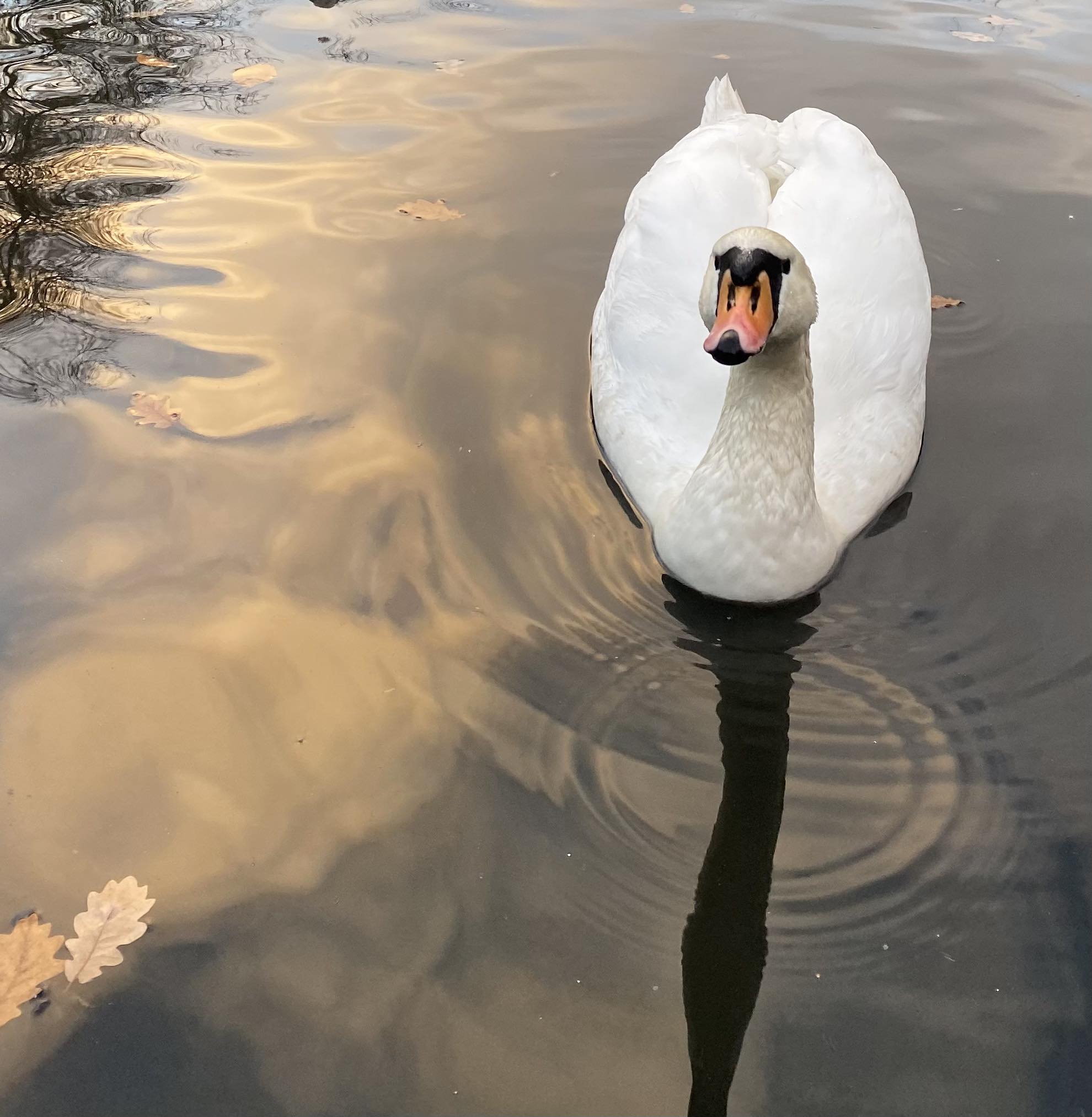
Swan Rising. Photo by Romy Needham