Showing posts with label journal keeping. Show all posts

Friday, March 7, 2025

The Traveler


I can only keep up with him by becoming him. When I come home from our travels, I am not quite myself and no longer him. When we part company, I am left to pore over scraps of memory like the things I find in my pockets and on my phone after a regular plane trip: a boarding pass, a bus ticket, a foreign banknote, a scribbled love note, random photos of far-away cities and beaches and train stations.

It is now one of my ongoing undertakings to track the Traveler through my journal reports. Here he seems to be very like my present self, just two days ahead of me, on my present probable event track. Sometimes he is much further ahead, or on a different – mildly or radically – event track, or he is in another body in another time or another world.

Is the traveler sometimes in a different body in this world, like the kids in the Japanese film Your Name? Perhaps. I think back to the body swapping dream of many years ago when the Traveler tries on at least three different bodies – of a black athlete, a rich Republican country club type, and finally an older, eccentric scholar whose legs don’t work well, much like my current self.

I think of the dream in which I am dressing up in a blue satin ballgown, excited by the prospect of turning on my boyfriend. I wake wondering whether I have been in a woman’s body. This doesn’t feel quite right. My excitement in the dream is surely male arousal, within a man’s anatomy. Confused, I look out the window and see a tall black transvestite, gorgeously attired in a long blue satin ballgown, teetering down the steps on stiletto heels on the arm of her boyfriend

The moment of lucidity, in a sleep dream, may be the moment when the self that has been dormant in bed – or somewhere else altogether – catches up with the Traveler. It may be a moment of self-possession, of taking control of a vehicle that has been traveling under the direction of an autonomous self, like the captain of a ship coming back on board and taking over from a junior officer or crew member. However, the person in the wheelhouse may decline to give over control, and a sudden rebuff may result in falling out of the dream (for the person who wakes in the bed) and the Traveler’s disappearance from radar. So it could be like a horse bucking a would-be rider.

As I seek to track the Traveler, I watch the person who is writing these lines. I see him fumbling with his nautical analogy. I like the bucking horse analogy better, though we lose the notion that there may be a second rider. I am not going to play editor or critic. The writer’s attempt to model and understand what is happening in his many lives is part of his story, the one on which I will put the name we use in the ordinary world.

The Traveler is a multilingual word player. I play with words in English. The Traveler plays with words in many languages. One morning I was left with an unlikely phrase in French, on acccable par les hochements. This could be a newly-minted saying with the sense of “yessing someone to death”, or a commentary on the storm surge of Hurricane Irma, or both. Now I remember the Traveler’s effort to find the right words to greet Stalin at lunch in Ufa in the midst of World War II. He sought an edge of humor while trying to avoid getting his throat cut. He managed, in the Georgian language.

When I am the Traveler the journey often begins at a certain threshold, a gap between the worlds, in a twilight of the mind. I may find myself floating upwards. I roll over and as I do so I feel something pulling loose from my physical body. Lights flash at the top of my head and I find myself being drawn up into a cone of light, like a pyramid with an opening at the top. 

There are days when, flat on my back under a tree, I fall upwards into the bowl of the sky, like Rumi. There are nights when I feel I am about to blast off like a rocket, or be blown from the mouth of a cannon, through circles of red within black. Or I find myself stripping off, shedding the body like a snake skin, dropping it like an old overcoat. When the travels begin, I often find myself looking at geometric pattern. It may be a glowing energy grid. It may resemble the weave of a carpet, or the strands of a net.


Saturday, February 22, 2025

Place of the Lion


The Dream

I am driving in a large open car along a once-grand avenue near the water in a city on the Black Sea. To our left are splendid buildings from the Belle Epoque that once housed department stores, hotels, restaurants. Everything has fallen into disrepair; signs are missing letters or hanging loose; some buildings look abandoned. Business is still being done though it doesn't correspond to the old signage.
     The person giving me this private tour explains that old magic is still alive in this fallen city. In particular, the ancient art of bonding with an animal familiar is practiced even in the best families, though proscribed by the church and frowned on by the state. Behind the columns of that now-shabby emporium, for example, is an establishment known to its clientele as Lion Inspiriting. Here the most awkward and tongue-tied can be learn to speak in a commanding voice, and the timid and cowardly can be infused with courage.
     I want to see how this works. Quick as thought, I am guided through a marble hall, up stairs to a half-lit parlor where I am invited to recline on a divan. I am aware that there is a stuffed lion in the room, so shabby and dusty I am sure it is an old taxidermy specimen rather than merely a prop or a toy. A black and white film starts to play. Grainy, silent. Nothing much happening for a long time except close ups of waving patterns in high glass. I am amazed at the detail. I can see every blade of glass. I realize the scene is not only on a screen. It is all around me. And it is not only black and white; There is some green and blue, and a glow of colors I can't normally see.
     Am I inside the night vision of a lion?
     The stuffed lion is no longer where I saw him before.

Feelings when I leave the dream: Excitement and delight.

Reality check: The city reminds me of Constanța, the Romanian city on the Black Sea where I led a fourt-day workshop years ago. The signs on the buildings are in the Roman alphabet, but I'm not certain they are in Romanian.

There is a villa in Constanța called the House of Lions. I don't recall seeing it when I was in the city and don't know whether it is the marbled building in my dream.

I love lions and have made a shamanic practice of connecting people with Lion spirit to claim their voice and find their courage. My original title for my book Active Dreaming was The Place of the Lion and there is a lion door knocker on the cover.

The werewolf is well-known in Romania (and is far more common than the vampire) but I have not heard of werelions here. However, I did once meet a werelynx in the Carpathian mountains. 

I find shifts between color and black and white (going either way) very significant in dreams.

I enjoy the slightly creepy Gypsy-Steampunk quality of the room where things go black-and-white. Of course Romania is famous for Romany. And in the middle of the night I was reading some hilarious chapters in Robertson Davies' novel The Rebel Angels about Gypsy magic in the heart of bourgeois Toronto.

What do I want to know?

Where does this story want to go next?

Bumper sticker

When the lion speaks everyone listens.

 Revisting the dream

When I look again to see how the story could develop, I imagine the narrator - now distinct from myself - discovering he is in the body of the taxidermy lion, which is now animated but shedding hair and bits of hide as it moves around awkwardly. To his horror, he finds that something else has taken the human body he left on the divan. It raises up and leave the premises. He is trying to track it but in this form people will flee from him or try to capture or kill him.

Dialogue with a dream character 

The Alteri

I ask the proprietess of the shapeshifting salon called Lion Inspiriting, Who are you?

She tells me, “We are Alteri”.

Does this mean alters, as in other personalities? 

Surely the lion isn’t native to these parts. She laughs at me for forgetting my history. The lions of the Hatti and of Ishtar, of Egypt and Africa. The cave lions of long ago. Her people are not captives of time or borders.

[Unedited entry form my joirnal for May 10, 2021]


Photo: House of Lions in Constanța.

Wednesday, February 5, 2025

If you can't remember your dreams


 "I can't remember my dreams."

1. Ask your cat to share a dream.
2. Be kind to wisps. You may have a tiny something from a dream if you don't close the door right away.
3. Write in your journal every day, whether or not you have a dream to report.
4. Wake up to the fact that you don't need to go to sleep in order to dream. The world around you will speak to you in the manner of dreams- through signs, symbols and synchronicity - if you pay attention.
5. Try to assure the beautiful bright dreamer in you that you are safe and you are fun. She may have been in hiding for a long time.
6. Find friends with whom you can share dreams and personal stories in a fast, fun way that leads to action to embody creative and healing energy from another world in ordinary life. Make dreamwork socially rewarding, and you have a strong incentive to bring a new story to the table every day.
7. .Learn the Lightning Dreamwork process. Accept no substitutes!

Thursday, May 30, 2024

In praise of bricolage


I've given up trying to translate the marvelous French word bricolage, sometimes rendered as "tinkering". It's about putting together bits and pieces on a whim, rather than approaching a project as a solid, stolid work of engineering. It's about following oneiric logic rather than plans and structures.
     Claude Lévi-Strauss,who made the word at home in French, found that this approach is central to the making of myths and the workings of "the savage mind". In his celebrated book La pensée sauvage he observed that the bricoleur employs "devious means". His game is "always to make do with whatever is at hand, that is to say with a set of tools and materials which is always finite and is also heterogeneous because what it contains bears no relation to the current project, or indeed to any particular project, but is the contingent result of all the occasions there have been to renew or enrich the stock or to maintain it with the remains of previous constructions or destructions."[1]
     Found objects, junk shops, storage basements, words overheard from strangers...these are materials for bricolage. So are your journals. I love to go through old journals plucking out curious and shiny things and arranging them on fresh pages. I was encouraged to learn that this was a regular practice for Thoreau, a dedicated journal keeper. He liked to forage through old journals plucking out promising bits and pieces - observations in nature, quotes from his reading, dreams and reflections. He copied excerpts and married them up as fresh drafts. It became his habit “to work back over his journals…to reengage old subjects in the light of new interests, to revise and recopy his own earlier journal work,measuring, weighing, culling and sorting his materials…taking up earlier threads, reweaving and combining them.”[1]
     For any writer, as for Thoreau, it opens treasuries of material and above all it supports the writing habit. Playing around with old notes removes the terror of the blank page. When you dip into an old journal, you are never at a loss for a theme. The simple processes of selection, arrangement and retitling will fire the imagination. Before you know it, you’ll be in the midst of writing something new. However, the practice of journaling from journals is not only for writers. It is a marvelous tool for self-observation, for life navigation, and for constructing a personal encyclopedia of symbols.  
     Ah, but what is best is the pure bricolage. I might start working through old journals with a specific agenda, using the search engine to pull up items from my digital files, arranging materials in orderly folders, setting production schedules. Then I am distracted or enchanted by a note I made after a concert:

Barber's Adagio for Strings: The sad and lovely waves of sound carried me effortlessly into vision: of an island in the mist, of the grace of swimming swans, and the loneliness of a solitary swan, of a bright winged being towering above the many-colored waters. Meeting me halfway in the crossing, the swan prince made me know what is required to be enfolded in his knowing. I remember how Aengus, dream god and love god, took the form of a swan.

or a quote that stuns me awake:

Plotinus on the personal guardian: "“Our guardian is the power immediately superior to the one we exercise, for it presides over our life without itself being active…Plato truly said that ‘we choose our guardian’, for, by the kind of life that we prefer, we choose the guardian that presides over our life.’

or a dream of any kind, calling me into fields of memory, mystery and delight:

The Thumbelina Exchange: A young woman has mastered the art of entering another universe by becoming incredibly small.This may have been intentional; she may have wished herself out of her life situation, at least for a fling. Not clear if she is able to return at will.

Soon the pleasure of simply playing with my finds as they come up and come back, takes over. I forget my agendas, and play with the pieces that catch my eye, arranging and fitting them together without expecting them to snap into prearranged place like a jigsaw puzzle. I don't count on it, I don't try to program it, but I am open to finding again that it is in these moments of dickering and tinkering and playing without thought of consequences that fresh and unexpected creation bursts through, as I once saw an apple tree rise from an abandoned core in a heap of compost.  


References
1. Claude Lévi-Strauss, La pensée sauvage (Paris: Plon, 1962)
2. Robert D. Richardson Jr., Henry Thoreau: A Life of the Mind (Berkeley: University of California Press, 1986)

Saturday, February 25, 2023

Time and Madeleine L'Engle


Time and Madeleine L'Engle

I have lost and found myself many times in in the wonderful worlds created by Madeleine L'Engle. Her literary biography confirms things I know to be profoundly important in a writing life: to survive rejection, to be ready for inspiration and opportunity o come in unexpected ways and to journal, journal, journal.  She failed to find her audience as a writer, while her family struggled with its finances, and so decided to stop writing on her 40th birthday, in 1958. 

However, she had kept a journal since she was eight, and the habit was impossible to erase. She went on a long camping trip and conceived, on the road, the idea for A Winkle in Time. She shopped it around to publishers and was rejected more than thirty times before this extraordinary sci fantasy novel was acquired by Farrar, Straus and Giroux; it was published in 1962.

  We see how in her story the obstacle may prove to be the way, in two senses: it can prompt you to try a different way, and then to develop the grit and persistence to win through when you are on the right path. Through it all, you must journal, journal, journal. I don't how anyone can become a writer - or lead an examined life - without keeping a journal.


Digital art by RM


Sunday, October 9, 2022

Rules of Coincidence - Streamlined


I have formulated the rules for navigating by synchronicity several times in slightly different ways, for example in my books The Three "Only" Things and Sidewalk Oracles. Playing the game of opening old journals at random, I found a "streamlined version" I recorded in 2008 and I rather like it. Here are the ten rules, in this simple version:

1. Read the signs all around you

2. Put your question to the world

3. Get moving

4. Work with the Library Angel

5. Notice that life rhymes

6. Look for opportunity in every setback

7. Don't be afraid to get lost

8. Notice what's showing through your slip

9. Identify your personal omens

10. Follow your star (the passions of the soul work magic)


Of course I could not resist dipping again and again into that old journal. I found a passage on the joy of watching herons nesting in May, and a poem I wrote on paths taken and untaken in life:

The berries were bluer on the path ahead
but she was drawn to huckleberry red
and familiar landscapes on the more traveled road...

I found my note on Artemidorus' report of a man who dreamed that the god Serapis - a deity of death, dreams and healing - placed him inside his calathos, a crown shaped like a tall food basket, symbolizing abundance and fertility. 

I found notes I had made from Jung's correspondence with the pioneer quantum physicist Wolfgang Pauli, including this New Year's declaration:

"In fact, the archetype represents nothing else that the probability of psychical events." [Jung to Paul, January 1, 1951]

I found my note I made from Bascom's Ifa Divination on the dream calling, via his father, of a Yoruba king's diviner who became the most renowned babalawo of his time. The father of Agboubou (died in 1947) told him:

"You were not made to be a farmer; you were made to be a babalawo. I have seen this many times during my dreams."

I found my dream travel reports from that spring and reports of group adventures, fueled and focused by my shamanic drumming, that I led at wonderful retreat centers - to a Blue Lake of Healing, to a scholar-city in the Imaginal Realm, to the astral realm of Luna. I harvested rich material for fresh writing and teaching, and saw some cases where waking events are just now catching up to things dreamed fourteen years ago. 

And I found index cards that were written and played in rounds of my Coincidence Card Game, including this, written in a clear hand I can't now identify:

What is the end, 
what is the beginning?
The cycle continues
Joy sparkles in the snow
while the budding branches
of the tree 
stand, long patient. 

Saturday, January 9, 2021

Journal excavation and the magic of hand writing


I find there is magic in writing by hand. I prefer to write with a fountain pen, or in pencil. In the old days I used to carry rather fancy fountain pens.

In a village cafe where I was signing for a catered lunch that was going to be delivered to one of my workshop groups, I signed the bill with a fountain pen.

The man behind me said, "You're a writer!"

"How do you know?"

"Who but a writer uses a fountain pen. What's your name?"

When I told him, he gasped, "Robert Frost? Oh, I'm gonna die!"

"Robert Frost has done that already."

Things have changed. I am far less at risk of being mistaken for Robert Frost because in these times of pandemic you won't find me out and about signing for things. Also,I got lazy about fountain pen maintenance so instead of those fancy ones I use disposable Pilot Varsity pens and just throw them out when they run out of ink or get hopelessly clogged.

The biggest change, however,is that I'm not writing much by hand because my writing has become largely illegible, even to me. So at home, where I have been nearly all the time since March, when I follow my practce of starting the day by wrting dream reports or writing from my dreams, I go to a keyboard and type. I will often do a sketch a little later in the morning.

I was writing by hand every day during my pre-pandemic travels, which had me on the road roughly half the days of the year. I am still in process of transcribing what is in all those travel diaries - and in the big college-ruled five subject notebooks where I used to record my dreams thirty years ago.

When I embark on tne task of transcribing handwritten pages, I frequently find I am digging up real treasure. Here's an example. In a travel journal from six years ago I found a dream report that came alive in glorious color, pulsing with energy and mystery today, as it did them, when I made a sketch from it. This is the transcription, unedited:

January 17, 2015. Walnut Creek, CA

dream

Ready to Paint It Red

I am wandering through an immense and beautiful art museum. In one of the rooms, the ceilings are beyond cathedral height, and as far up as I can see there are enormous paintings in softly glowing pastel hues. I know these images are sacred and they have something to do with ascension towards successive levels of a Higher Self.
    I am carrying an open can of red paint in one hand and a paint brush in the other. The paint is bright crimson, fire engine red. The brush is large enough for a house painter but I think it is the kind an artist would use to cover a wide area very quickly.
    Through an open doorway, I look at a small group of people clustered around a professor who is talking to them about the large framed painting in front of them. This is a special invited group. The picture shows a stone tub, possibly limestone, that looks like it could be filled with water. Hooded figures in white and light-colored robes are around it, evidently waiting for some event.
    In mid-sky, in the picture, there is an arc of light. Figures are moving along this arc in the sky. Some are mounted, some on foot. They appear to be in many sizes. They are golden, and glowing.
    There is something of the quality of the Journey of the Magi about this painting, but the images are not explicitly Christian.
    I am fascinated by the stone "tub". I can't find the right word for it. It could be a sarcophagus, but the feeling is of coming birth or baptism rather than of death.
    My high excitement and curiosity are with me as I become fully lucid inside the scene.
    I hear these words streaming through my mind:


From life to life, from day to day, I bring essence from the world of soul into the world of time.


I rise into the California morning charged with energy and excitement.
    I want to know what my dream self means to do with that red paint. I think of it now as life blood, blood of spirit. I feel I want to fill that hollow tub with this blood of spirit and see whether this will provide a medium of manifestation for those glowing spirits in the sky.
    I am reminded of a big dream from many years ago in which I led a special group of invited guests along a spiral path, past a great stone lion with a huge carnelian on his back, into a gallery space with an immensely high ceiling. We studied an unfinished painting of incalculable size. Within it, a life size human figure was as small as a candle flame in proportion to the shapes that rose around and above him. I understood that this was an unfinished portrait of the Higher Self. I was the professor in that dream. In the new one, I am watching my second self - I am almost certain - play professor while I get ready to lay on the red paint.


Saturday, April 11, 2020

Why you want to keep a journal


When a lusty, ambitious young Scot named James Boswell first met Dr. Samuel Johnson, Johnson advised him to keep a journal of his life. Boswell responded that he was already journaling, recording "all sorts of little incidents." Dr Johnson said, "Sir, there is nothing too little for so little a creature as man."

Indeed, there is nothing too little, or too great, for inclusion in a journal. If you are not already keeping one, I entreat you to start today. Write whatever is passing through your mind, or whatever catches your eye in the passing scene around you. If you remember your dreams, start with them. If you don't recall your dreams, start with whatever thoughts and feelings are first with you as you enter the day, or that interval between two sleeps the French used to call dorveille ("sleep-wake"), a liminal space when creative ideas often stream through.

If you have any hopes of becoming a writer, you'll find that journaling is your daily workout that keeps your writing muscles limber. If you are already a writer, you may find that as you set things down just as they come, with no concern for editors, critics or consequences, you are releasing descriptive scenes, narrative solutions, characters - even entire first drafts - quite effortlessly. Some of the most productive writers have also been prodigious journal-keepers. 

Graham Greene started recording dreams when he was sixteen, after a breakdown in school. His journals from the last quarter-century of his life survive, in the all-but-unbreakable code of his difficult handwriting. First and last, he recorded his dreams, and - as I describe in detail in my Secret History of Dreaming, they gave him plot solutions, character development, insights into the nature of reality that he attributed to some of his characters, and sometimes bridge scenes that could be troweled directly into a narrative. Best of all, journaling kept him going, enabling him to crank out his daily pages for publication no matter how many gins or how much cloak-and-dagger or illicit amour he had indulged in the night before.

You don't have to be a writer to be a journaler, but journal-keeping will make you a writer anyway. In the pages of your journal, you will meet yourself, in all your aspects. As you keep a journal over the years, you'll notice the rhymes and loops or cycles in your life. Mircea Eliade, the great Romanian-born historian of religions, was a great journaler. In the last volume of his published journals, he reflects, during a visit to Amsterdam in 1974, on how a bitter setback to his hopes at the time he first visited that city nearly a quarter-century before had driven him to do his most enduring work.

He had been hoping that his early autobiographical novel, published in English as
 Bengal Nights, would be a big commercial success, enabling him to live as a full-time novelist. Sales were disappointing. Had it been otherwise, "I would have devoted almost all my time to literature and relegated the history of religions to second place, even though Shamanism was at the time almost entirely drafted." The world would have gained a promising, and perhaps eventually first-class, novelist; but we might have lost the scholar who first made the study of shamanism academically respectable and proceeded to breathe vibrant life, as well as immense erudition, into the cross-cultural study of the human interaction with the sacred.

Synesius of Cyrene, a heterodox bishop in North Africa around 400, counseled in a wonderful essay On Dreams that we should keep twin journals: a journal of the night and a journal of the day. In the night journal, we would record dreams as the products of a "personal oracle" and a direct line to the God we can talk to. In the day journal, we would track the signs and correspondences  through which the world around us is constantly speaking in a symbolic code. "All things are signs appearing through all things. They are brothers in a single living creature, the cosmos." The sage is one who "understands the relationship of the parts of the universe" - and we deepen and focus that understanding by recording signs in our day journal.

Partly because I keep unusual hours, and am often embarked on my best creative work long before dawn, I don't separate my night journal from my day journal. All the material goes into one book - a leather-bound travel journal, when I am on the road. I try to type up my entries before my handwriting (as difficult as Greene's) becomes illegible and put the printouts in big ringback binders. I save each entry with a date and a title in my data files, so I automatically have a running index and (with Word) a search engine. I like to draw pictures from my dreams and some of these go in separate art journals.

One of the things you'll come to see clearly, as you journal dreams over a considerable period of time, is that your dream self travels ahead of your waking self, scouting the ways. You'll find you are creating a personal dictionary of symbols, far superior to any of that hand-me-down stuff you'll find in dream dictionaries in stores, because the snake in your dreams is not necessarily the snake in my dreams. You'll have starter dough for creative writing and art and a wish list for shamanic shopping.

Share what you wish to share with those who are primed to hear and give you feedback in a respectful, non-intrusive way, following the "If it were my dream" protocol but keep the journal strictly private. This is your secret book. What you write in it is between you and your soul, and you write without fear of judgment or consequences. Go back to old entries and see what is looking at you now, as dreams spill into everyday life.

Continue and deepen your practice for long enough, and you may come to feel -as Eliade did -that your journal is the most important book you will ever write, and one of the most important you will ever read.


For practical guidance on keeping a journal, and many games to play with it, please see  my book Active Dreaming.


Thursday, January 2, 2020

Want to get good at dreaming? Practice, practice, practice


All of us have access to dreams, if we are willing to make space for them in our lives, and the gifts that come from dreaming can be immense. They range from course correction to wild entertainment, from contact with a Higher Self or departed loved ones, from time travel to access to a secret laboratory where we find creative solutions that escape the routine everyday mind.
   When we hear others share dreams, maybe starting just with the title or an opening line, we usually recognize something of ourselves. Yet as the details emerge, we also realize that each dream is distinct and must not be tossed into a suitcase of categorization. This is part of the beauty of dreaming. As we listen to each other's dreams, we recognize universal themes, something of our common humanity and our access to the limitless repository of shared knowledge and experience that Jung once called the collective unconscious and later, the objective psyche. At the same time, when we attend to details and feelings and context around them, we find that individual dreams are exquisitely tailored to the character and circumstances of the dreamer.
    Of course we dream in different ways and on different levels, even in a single night in the mind of a single person. And there are many levels of dream practice. When you begin to understand all that dreaming can be, you come to know that it is a discipline, a fun one, with friendlier hours than most jobs of work -since you can do so much of it during sleep. However, as with any other discipline, from piano to particle physics, you get really good through practice, practice, practice.
    As a teacher of Active Dreaming, my original synthesis of dreamwork, shamanism and creative imagination, you could say I am a full-time dreamer. As personal practice, however, I like to keep things simple and fun. My daily engagement with my night dreams is sometimes no more than this easy one-two:


1. Whatever time I surface from sleep, I check whether I have any dream recall. If I think I don't, I hit any inner pause button and wait for something to come back. At the very least I am likely to receive a stream of hypnopompic images, which may be returning dreams or new material. When I have something,I pick up my phone and I record one or more entries. I used to pick up a bedside pad but con no longer read my handwriting. Using the phone causes minimal disturbance in the bedroom and gives me a text I can transfer to my digital database later on. I may repeat this through two or three cycles of sleep-wake on any given night.

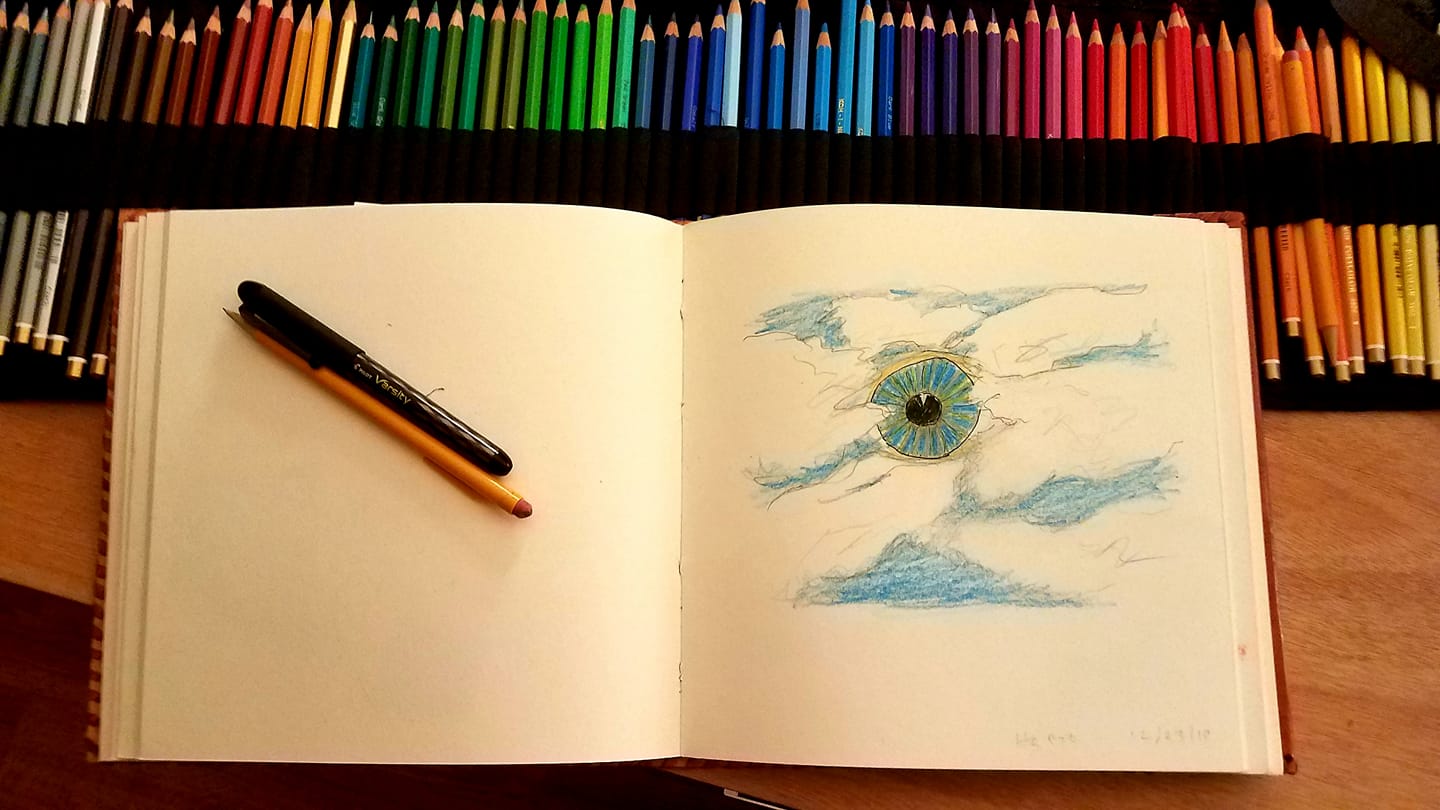
2. When I get up, before coffee and while my little dog (who has excellent manners) waits patiently for me to shower and dress and take him out for his first walk, I open a sketchbook and draw an image from my dreams. I start in pencil. I give the drawing a title, of course. I often feel wonderfully satisfied and charged with creative energy when I complete this little task, and the boy artist inside me claps his hands.

The dream may require further action. This may range from shamanic shopping to researching a curious word or phrase, to going back inside the dream (in a wide-awake exercise in shamanic lucid dreaming) to clarify information or continue the story. My action might be to turn a glimpse of the possible future into a travel advisory or to road-test a new exercise that I dreamed with a workshop group.
    Any day of the week, however, the two simple steps of recording in bed when things are fresh and then turning a dream into a quick sketch are basic and sufficient practice. If you want to get really good at dreaming, I recommend them.


Monday, November 26, 2018

Keep Books of Night and Day and be your own dream interpreter


We have direct access to sacred knowledge, in our dreams. Our dreams are a personal oracle that reveals the future and helps us prepare for it. We must not let anyone tell us what our dreams mean or stand between us and the direct experience of the sacred that is available in dreaming. We want to pay attention to signs from the world around us in the knowledge that everything in the universe is interconnected and constantly interweaving. We need to journal both our dreams and our waking experiences in our Books of Night and Day.
     These insights come from a fifth-century bishop of Ptolemais (in what is now Libya), Synesius of Cyrene. His treatise On Dreams is one of the wisest books ever written on how to work with dreams and synchronicity. He wrote that "Dream divination is available to all, the good genius to everyone" and that is no wonder that dreams show us the future, because dreams are experiences of soul and "the soul holds the forms of things that come into being".
      Synesius used dreams for practical navigation; he describes how dreams alerted him to plots by his enemies, counseled him on his literary style and (as a young man) on the hunt, and helped him win the ear of a Roman emperor with the right oration. He also observed, correctly, that the energy derived from dreams can be more valuable than their content; through dreams God "makes us fruitful with his own courage."

It is written, 'Others even in their dreams He made fruitful with his courage.' Do you see? One man learns while awake, another while asleep. But in the waking state man is the teacher, while it is God who makes the dreamer fruitful with His own courage, so that learning and attaining are one and the same. Now to make fruitful is even more than to teach.

He despised dream dictionaries, as popular in his time as in ours: "I laugh at all those books and think them of little use." He strongly counseled that we must not assign the interpretation of dreams to "experts" other than the dreamer: "It would be shameful for those who have lived ten years beyond adolescence to stand in need of any other diviner."
      He wrote that dreams carry us into higher worlds, and put us in direct contact with the God we can talk to. He hinted that the road of dreams is the road of the soul, on both sides of death, noting that "the soul's way of life in another world is similar to the imaginings of the dream condition."
       He was a great proponent of navigating by synchronicity, though the word he used was "sympathy". The wisest of humans are those who navigate life by reading the sign language of the world. We should keep a "day book" for our observations of signs and synchronicities as well as a "night book" for dreams.

"All things are signs appearing through all things...they are brothers in a single living creature, the cosmos...they are written in characters of every kind". 

The deepest scholarship lies in reading the sign language of the world; the true sage is a person "who understands the relationship of the parts of the universe".
     We can learn from Synesius how to practice dreamwork as real church, and track coincidence as "God's way of remaining anonymous". He deserves to be much better remembered, as a great dream teacher from the world of the early Church, one who spoke eloquently against those who seek to stand between people and the direct experience of the sacred. He wrote about dreams not on the authority of his excellent education (he studied under Hypatia in Alexandria), nor his contacts with the great, nor any high office that he held, but on the authority of his prolific first-hand experience.
     Synesius speaks to us across the centuries with the authority of experience, understanding - as do all true dreamers - that the best guides to dreaming are frequent flyers who do a lot of it.

-

Partly because I keep unusual hours, and am often embarked on my best creative work long before dawn, I don't separate my night journal from my day journal. All the material goes into one book — a leather-bound travel journal, when I am on the road. I try to type up my entries before my handwriting becomes illegible and put the printouts in big ring-back binders. I save each entry with a date and a title in my data files, so I automatically have a running index.


For more on Synesius of Cyrene, see my book The Secret History of Dreaming.

Art: Fresco from Pompeii showing a young woman with a wax tablet and stylus, cerca 50 c.e. We don't know her name. Her hair net of gold threads, as well as her literacy, suggest an upper-crust family. Today the fresco is maintained by the National Archaeological Museum of Naples (Inventory number 9084).


Sunday, June 3, 2018

On making the most important book you'll ever read

When a lusty, ambitious young Scot named James Boswell first met Dr. Samuel Johnson, Johnson advised him to keep a journal of his life. Boswell responded that he was already journaling, recording "all sorts of little incidents." Dr Johnson said, "Sir, there is nothing too little for so little a creature as man."
    Indeed, there is nothing too little, or too great, for inclusion in a journal. If you are not already keeping one, I entreat you to start today. Write whatever is passing through your mind, or whatever catches your eye in the passing scene around you. If you remember your dreams, start with them. If you don't recall your dreams, start with whatever thoughts and feelings are first with you as you enter the day, or that interval between two sleeps the French used to call dorveille ("sleep-wake"), a liminal space when creative ideas often stream through.
    If you have any hopes of becoming a writer, you'll find that journaling is your daily workout that keeps your writing muscles limber. If you are already a writer, you may find that as you set things down just as they come, with no concern for editors, critics or consequences, you are releasing descriptive scenes, narrative solutions, characters - even entire first drafts - quite effortlessly. Some of the most productive writers have also been prodigious journal-keepers.
     Graham Greene started recording dreams when he was sixteen, after a breakdown in school. His journals from the last quarter-century of his life survive, in the all-but-unbreakable code of his difficult handwriting. First and last, he recorded his dreams, and they gave him plot solutions, character development, insights into the nature of reality that he attributed to some of his characters, and sometimes bridge scenes that could be troweled directly into a narrative. Best of all, journaling kept him going, enabling him to crank out his daily pages for publication no matter how many gins or how much cloak-and-dagger or illicit amour he had indulged in the night before.

    You don't have to be a writer to be a journaler, but journal-keeping will make you a writer anyway. In the pages of your journal, you will meet yourself, in all your aspects. As you keep a journal over the years, you'll notice the rhymes and loops or cycles in your life.
    Because I am leading teach workshops in Romania, I have been re-reading Mircea Eliade, the great Romanian-born historian of religions. Opening the last volume of his published journals, I found him reflecting during a visit to Amsterdam in 1974 on how a bitter setback to his hopes at the time he first visited that city nearly a quarter-century before had driven him to do his most enduring work. He had been hoping that his early autobiographical novel, published in English as Bengal Nights, would be a big commercial success, enabling him to live as a full-time novelist. Sales were disappointing. Had it been otherwise, "I would have devoted almost all my time to literature and relegated the history of religions to second place, even though Shamanism was at the time almost entirely drafted." The world would have gained a promising, and perhaps eventually first-class, novelist; but we might have lost the scholar who first made the study of shamanism academically respectable and proceeded to breathe vibrant life, as well as immense erudition, into the cross-cultural study of the human interaction with the sacred.

    Synesius of Cyrene, a heterodox bishop in North Africa around 400, counseled in a wonderful essay On Dreams that we should keep twin journals: a journal of the night and a journal of the day. In the night journal, we would record dreams as the products of a "personal oracle" and a direct line to the God we can talk to. In the day journal, we would track the signs and synchronicities through which the world around us is constantly speaking in a symbolic code. "All things are signs appearing through all things. They are brothers in a single living creature, the cosmos." The sage is one who "understands the relationship of the parts of the universe" - and we deepend and focus that understanding by recording signs in our day journal.
    Partly because I keep unusual hours, and am often embarked on my best creative work long before dawn, I don't separate my night journal from my day journal. All the material goes into one book - a leather-bound travel journal, when I am on the road. I try to type up my entries before my handwriting (as difficult as Greene's) becomes illegible and put the printouts in big ringback binders. I save each entry with a date and a title in my data files, so I automatically have a running index.
    Here are some games I enjoy playing with my journals that you may want to play too:

BIBLIOMANCY

"Bibliomancy" is the fancy name for opening a book at random to get guidance on a theme, or simply the quality and content of the day. I often use old journals in this way. For example, one Christmas Eve, after learning that a friend had developed a serious illness and was having other major troubles in her life, I reached blindly into a shelf of 30+ old travel journals, grabbed one without looking at the date, and opened it at random, I found myself looking at a short dream report from December 2003, just over five years before. The dream was about my friend. It stated that she had "accepted Purgatory for a year. This Purgatory is a room in her home that opens into the same realm." I shared this report with my friend, and we began to work with the meaning of "acceptance" and of "Purgatory". I also shared other reports in that old journal on tbe page before and after the "Purgatory" entry, since I have often noticed that when events start to catch up with an "old" dream, other "old" material around that dream can prove timely and helpful. The neighboring entry in that old journal involved ways of delivering spiritual nourishment, which we found highly relevant.

DEVELOPING YOUR OWN BOOK OF SYMBOLS

Tracking how symbols feature and evolve in your dreams and your experience of the world around you will give you your own encyclopedia of symbols, better than any of those dream dictionaries, because the snake or the train in your dream is yours not theirs. While it may open into the archetypal data banks of the collective unconscious, or super-conscious, those links are for you to explore and not to receive on a hand-me-down plan.

COLLECTING YOUR OWN ANTHOLOGY OF QUOTATIONS

When I was an undergraduate, writing book reviews for a local newpaper, I was fortunate to be assigned one of the first English-language editions of the Carnets of Albert Camus. I was struck by how the great French writer was fired up by the quotes he recorded from his eclectic reading. Etched in my memory is a grim exchange in the Carnets from a Russian source. Avvakum, an archpriest, and his wife, are trudging through a frozen waste. The wife asks, "How far must we journey?" "Until death, daughter of Mark." "Then, son of Peter, we must hurry on."
    My own journals are peppered with quotes from all over, from sources celebrate an utterly obscure, ranging from the message I may have spotted in the first vanity plate I saw on a certain morning (BCRE8V) to a spell from the Egyptian Book of the Dead or a "snapper" from Mark Twain.

HELPING KIDS TO JOURNAL

If we are privileged to have access to young children, one of the greatest gifts we can give them - and in the process, ourselves - is to encourage them to record dreams and stories in a boom that will become a journal. I did this with my own daughters. When they were very young, they would do the pictures and I would write the words for them. They took over more and more of the writing, as they got older, until, at age nine, they were keeping their journals by themselves and for themselves. Then the same thing happened in each case. They said to me, in effect: "That's it, Dad. This is my secret book and you can't read it anymore."
   Now that's a journal. The secret book of your self and your soul, not to be shared with anyone without permission, which should not be given lightly.

When life deals you a tough hand, you'll find that as you write your journal, you are practicing spontaneous self-therapy. You may be able to write your way through whatever ails you. There's a great release, perhaps a catharsis, in saying what you need to say in the safe space your journal provides. When you see and state things as they are, you already begin to change them. Keep your hand moving, and you may manifest the power to re-name and re-vision symptoms, challenges and difficult situations in the direction of resolution and healing.
    As you keep your secret book, you'll discover more, and more will discover you. You'll find yourself straying off the tame and settled developments of the everyday mind, into the wilder borders of imagination, where the Big story of your life can find you.

For more games to play with your journal, please see my book Active Dreaming. For a template for keeping a dream journal, please see chapter 7 of my book Dreaming True.


Friday, August 11, 2017

Through the Skylight: Adepts who take on bodies


The light comes on at the top of my head. It is bright, white and steady and I know there is no cause for alarm. It is like the opening of a skylight. I sense that a circle of benign tutelary presences has been formed, and is beaming a communication to me. The theme is the deliberate incarnation of a succession of adepts who teach and inspire humanity. I am able to record the following:
     “This is truth: there is a line of spiritual masters, known to each other across the ages, who watch over humans and are alert to the stirrings of spiritual understanding and intellectual achievement. From time to time they take on bodies voluntarily. Their descent into the body is both mourned and honored.
     “Born remembering, they are nonetheless exposed to the phenomenon of memory loss. Unless closely supported and protected, they are feared and resented, as unnatural, as “demons”, as illegitimate bastards. Hence the stories of efforts to put them to death: of Moses in the rushes, of Asklepios exposed on the mountain. Alternatively, in some traditions they are welcomed and even worshiped, but may become pawns for greedy and ambitious theocracies.”

Origin: This journal entry, from New Year's morning, 1999, surfaced during one of my bouts of bibliomancy (divination by book) in my old journals. It describes an experience unfolding in the hypnopompic zone, the place between sleep and awake - prime real estate for adventurers in consciousness. 

Skylight photo by RM

Wednesday, March 15, 2017

A Writer's Way


Writing, like anything else you want to do well, is a practice. Having something you really want to say is important, but it may never come through without a practice that supports delivery. I thought I would share some of the elements of practice that work for this writer.

A WRITER'S WAY

1. Show Up. Make time to write something EVERY DAY. What writers do is write.


2. Borrow Habits That Worked for You in Other Areas of Life. As you look over your personal history, do you find you were most productive when working regular hours, among other people? Or when you were solitary, seeking to fulfill an assignment under deadline? Apply the habits that worked before to your writing practice.

3. Keep a Journal. This is essential practice for any well-lived life, not only a writing life. This is a place for you to commune with your Self, compose your personal encyclopedia of symbols, store quotes and ideas, and gather the raw materials for what may become a script or story.

4. Warm Up. Journaling, blogging, writing literate Facebook posts or  email letters - as long as they are real letters, not just office stuff - are excellent ways to start working those writing muscles, and material you can rework in a story or essay may just pop up. 

5. Set a Time Limit (until you are on a roll and simply can't stop). 30 minutes is great. So you can't finish something in half an hour - even greater, because the next time you sit down you don't have to start with a blank page. I have a 15-minute "hourglass" on my desk. I find I am often amazed by how much I can get down in a quarter hour.

6. Sideline the Editor and Avoid Feedback Felons. Don't judge or evaluate what you are writing until it's done. And do not let others play editor or critic - avoid Feedback Felons (anyone who gives you less than positive encouragement or saddles you with wrong or premature expectations or is simply jealous because you are creating and they are not).

7. Keep Your Fingers Walking. Don't agonize over trying to perfect any part of what you are writing until you have sketched out the whole thing.

8. Relax - and Pay Attention. The flow state is one of relaxed attention, or attentive relaxation. You are stretching yourself, and your ability to receive and bring through, without forcing anything on the level of the control freak in the ego. If you're stuck, put on some music, take a shower or a swim - getting in flow with water always helps - take a walk for five unscheduled minutes and see what the world gives you.

9. Gag the Demon of Expectations. You want fame and fortune from this, or at least some respect from your friends? Fine. But don't let your expectations damn your performance. Write for the heck of it, have a good time doing this for its own sake.

10. Put Yourself Where the Big Story Can Grab You. Writing, at its core, is about releasing a story. Never forget that the Big story is hunting YOU. The whole art of telling it is to keep moving - further and further from the tame and settled lands - until you get deep enough into the bush for the Big story to jump on you. Then everything will be different, and fabulous.

11. Remember Your Writing Partner. You may have various writing partners, but right now I am talking about the big one, the creative spirit the Romans called the genius. The more you are willing to give yourself to your writing for its own sake, to dare something new, the closer you draw this guiding power and its limitless energy.

12. If You Must Work to Deadline, Make Sure It's an All-But-Impossible Deadline. Our genius loves us best - and helps us most - when we take on the greatest challenges, and play the game hardest.


Photo: RM in Yeats' tower, Thoor Ballylee, in County Galway.