Showing posts with label Plato. Show all posts

Tuesday, September 26, 2023

Swan Inlet


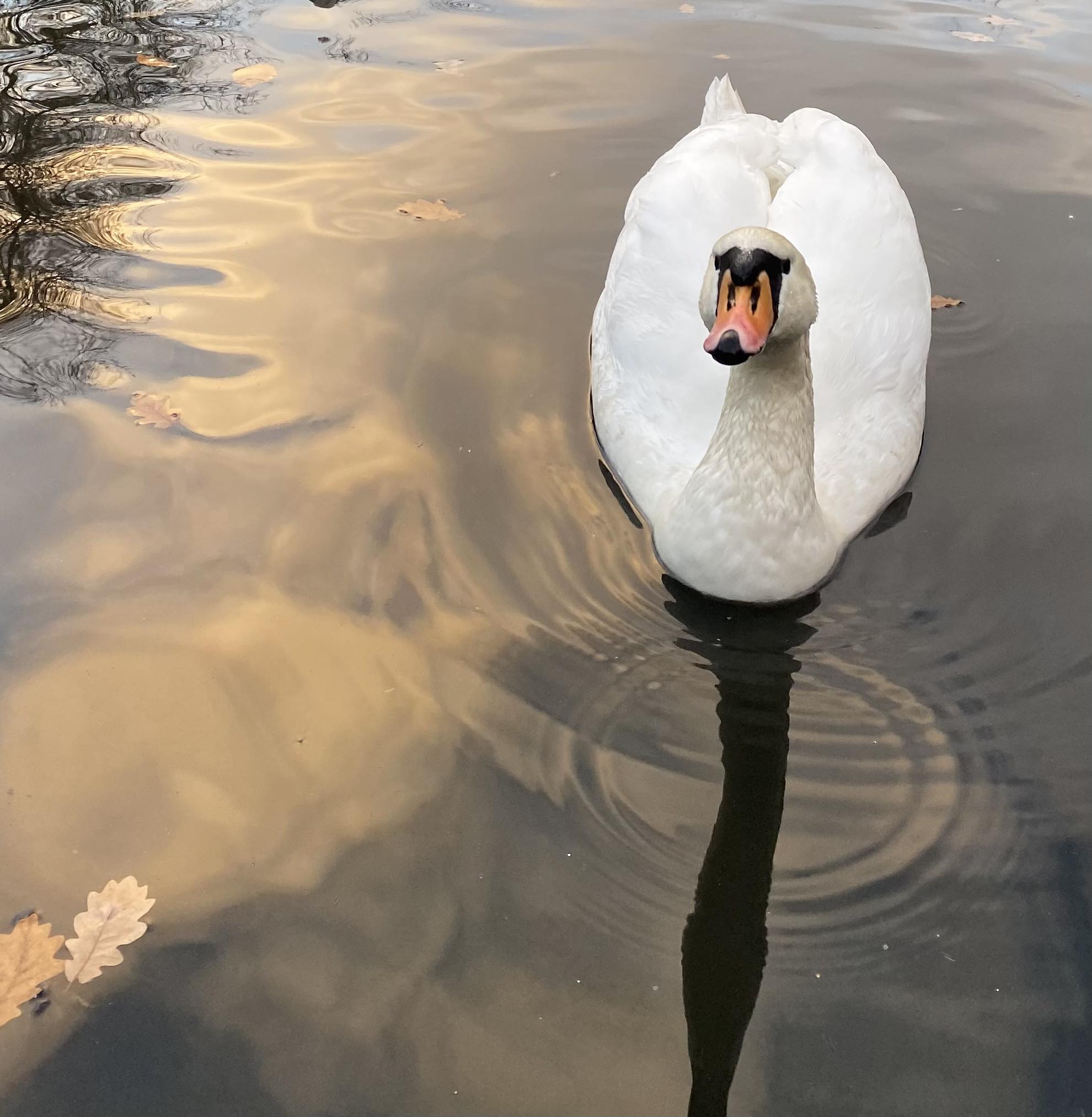
For as long as I can remember, I have dreamed of swans. eyes closed and eyes open. Sometimes they lend me their forms. In a European city, in the twilight state before dawn, a swan rose from my third eye and we flew together over the river and the rooftops. 

This report I entered in my journal two years ago just flew out, seeking more attention. I will share it unedited: 

September 9, 2020

Dream

Swan Inlet

I stand in the woods near water's edge. The light over the bay is rosy gold, as are the waves. They move slowly. The water looks heavy and oleaginous. My guide explains that only swans are at home here. Other water birds avoid this inlet and don't swim in it. We watch a swan gliding into the swell, rocking with it, dipping its head and body after fish. 

Everything is suffused with that golden and rosy light. There is healing and magic here and the secret is with the swans.

Waking, I put myself back in the scene. I pick my way through roots and vines to stand at the edge of the bay. I take from it and the water in my cupped palm looks like olive oil in a spoon. It is lightly scented, a pleasing aroma. On my tongue it is warm and salted just right, like virgin dipping oil in an Italian restaurant. A swan is watching me closely. Will it share the secret? Can I rise on its wings as I did before?

I hope that the guide who was instructing me before will answer. But the only voice I hear now is my own. Swans fly over the oily waters in arrowhead formation toward the pink sun on the horizon.

                                                    ~

I think of Plato and the swans. There is a Greek tradition that Socrates dreamed the night before he met Plato that a young swan settled n his lap, developed at once into a full-grown bird and took off into the sky with a song that enchanted all hearers. [1]  In the Phaedo, Socrates says that swans sing most beautifully when they sense they are going to die. “They rejoice because they are about to approach the god whose servants they are.” This, we are told, should be a model for humans. 

Socrates says of himself that “like the swans” he is in the service of Apollo, “the holy property of a god.” Here, among swans, he gives the best definition of real philosophy, that it is “nothing other than practice for dying and being dead.” [2]

Before his death, Plato is said to have dreamed he shapeshifted into a swan.

I think of the swan in the Brihadaranyaka Upanishad, or "Great Forest Book", one of the oldest Upanishads, at least 2300 years old.. In a beautiful passage, the dreamer travels between worlds as "the lonely swan", flying in and out of the nest of the body. We are told that the dreamer is godlike in their ability to create in the dreamspace.

Here the dream state is described as a state of "emitting" [srj], a word that can also mean the ejaculation of semen. The dreamer "emits" [srjate] or projects "joys, happinesses and delights...ponds, lotus pools and flowing streams, for he is the Maker." We learn that as we grow the practice of dreaming, we can create realities. The word srj is also used to describe the way a turtle projects its head and paws from under its shell.

I think of the swan shamans of the Dane-zaa of the Pacific Northwest, who used to be called the Beaver Indians. Their word for a shaman is Naachin, which means Dreamer. As in the Upanishads, the Dane-zaa say that a powerful dreamer travels like a swan from and back to the nest of the body. ”The Dreamers are like swans in their ability to fly from one season to another. Like the swans that fly south in the winter, Dreamers fly to a land beyond the sky and bring back songs for the people on Earth.” [3]

I think of a shapeshifting Irish god who must become a swan to meet and mate with his dream lover. He is Aengus, and she is Caer Ibormeith, which means Yew Berry and hints at intimacy with death and the underworld. Yew Berry is under an enchantment, sometimes represented as a curse, sometimes - in the deeper tellings - as a gift. She does not stay in one form. She is a beautiful woman for one year. Then for the next year she is a white swan. Then the cycle repeats.  

The day of shapechanging is Samhain. Halloween. If Aengus would win the lady, he must find her on the liminal day, on a lake whose name is The Dragon's Mouth. At Samhain, Aengus goes to the Dragon's Mouth. He finds "three times fifty" white swans with silver chains around their necks, and one swan with a gold chain. He recognizes his love in the shape of the beautiful white bird, and calls to Yew Berry to fly to him. No, she tells him. You must change into my form.

Aengus changes, becoming the long-necked bird. They mate, in beating splendor, above the deeps of the Dragon's Mouth. They fly together back to the palace of Brugh na Boinne - Newgrange - and the love music they make in flight is so lovely and lulling that all the land is at peace and people drift into pleasant dreams and stay there for three days.  [4]


References

1. Patricia Cox Miller, Dreams in Late Antiquity (Princeton: Princeton University Press 1994) 3.

2. Phaedo 64a.

3.  Robin Ridington, “They Dream about Everything: The Last Dreamers of the Dane-zaa” in Ryan Hurd and Kelly Bulkeley (eds) Lucid Dreaming: New Perspectives on Consciousness in Sleep (Santa Barbara: Praeger, 2014) vol. 2, 194.

4. Jeffrey Gantz, trans. and ed., "The Dream of Óengus" in Early Irish Myths and Sagas (New York: Dorset Press, 1985) 107-112. I have used Yeats' preferred spelling for the name of the Irish god of love and dreams. For my full account of this story, see Robert Moss, The Dreamer's Book of the Dead (Rochester, Vermont: Destiny Books, 2005) 18-21. 


Photo by Romy Needham

Journal drawing by Robert Moss

Saturday, May 27, 2023

Socrates' Dream Woman


She was beautiful and shapely (καλή καὶ εὐειδής), Socrates tells Crito, the wealthy friend who has come to his prison cell. Crito bribed the guards to get in and has been waiting since before dawn for Socrates to wake up. Socrates has been waiting for nearly a month for his death, having been condemned on charges of impiety and corrupting the young. Execution of the death sentence will be caried out when a state ship that carried offerings for the festival of Apollo and Artemis at Delos returns from the island. Crito has dreadful news. The ship has been sighted off Cape Sounion. It will soon be in harbor and Socrates will die. However, Crito has the money and connections to arrange Socrates' escape to Thessaly, beyond the reach of Athenian justice. They are going to have a discussion about whether it is moral to resist the unjust application of just laws. But first, Socrates wants to correct the timeline. He is sure he won't die the next day, even if the ship from Delos is back. How can he know?

Crito: Where do you get your evidence for this?
Socrates: My evidence is something I saw in a dream a little while ago, during the night. It's probably a good thing you did not wake me.

Crito: What was the dream?
Socrates: A woman appeared, coming towards me, beautiful and shapely, wearing white garments. She called to me, 'Socrates, you shall arrive in fertile Phthia on the third day.'
Crito: What a strange dream, Socrates.
Socrates: It seems obvious to me.

Phthia was in wild Thessaly, home of Achilles. The phrase about arriving there on the third day was used in the Iliad when Achilles, piqued by Agamemnon's theft of a beautiful captive he had wanted for his prize, was threatening to abandon the siege of Troy and go home.
Home for the warrior might be a refuge for the philosopher, if he were willing to flout the laws. (Socrates, of course, is not.) But surely the shapely woman in white was preparing Socrates for his journey to a different home in a different world, as dream visitors often do. When his time comes, Socrates does willingly, discoursing on the immortality of the soul as he raises the cup of lethal hemlock to his lips.

Based on Plato's Crito 44ab. This is regarded by scholars as one of the most realistic of Plato's dialogues. It has only two speakers: Socrates and Crito. Curiously, it says little overtly about the soul. Illustration: "Socrates' Dream Visitor" by Robert Moss.

Tuesday, July 26, 2022

The dream calling of a Neoplatonist philosopher


Proclus (412-485) , one of the greatest of the Neoplatonist philosophers, taught that the true philosopher should become "a priest of the entire universe", honoring all forms of the divine. He was an immensely prolific author, whose collected works - many of which were destroyed by religious book burners - were longer than those of Plato and Aristotle combined. He instructed that there are two basic aspects of soul in each human being: the "fallen" terrestrial soul, focused in physical reality, and the "celestial" soul or "true self" that transcends time and space and is the source of creativity and spiritual wisdom. As a teacher, he sought to guide his students into ever-closer alignment with this higher self, or "good daimon". 

According to Marinus, his student and biographer, Proclus was called to his vocation in dreams. It was not an easy calling, since it connected him with gods and goddesses the triumphant Church was seeking to proscribe. But he believed that his dreams put him in contact with a lineage of teachers - the "hermetic chain" - who were able to communicate with each other across time and space.

The goddess Athena "appeared to him in a dream inducing him to follow philosophy". Proclus was born in Constantinople, but spent his early years at his family home in Lycia, the country of Homer's hero Sarpedon, beloved of Zeus. He had moved on to the great university city of Alexandria and was embarked on a promising career as a rhetorician when he accepted a friend's invitation to accompany him on a trip back to Constantinople. When Proclus reached his native city, the goddess Athena appeared to him in a dream in the form in which she was traditionally worshipped in the eastern capital. She instructed him to devote himself to philosophy and prepare himself for admission to the great school of Plato in Athens.

He had already received the gift of dream healing. When he was suffering from a serious illness as a child, a radiant boy appeared above his head. Leaning over Proclus' bed, his visitor announced his name - Telesphoros - and touched the child's head, releasing him from his sickness. 

On his return to Alexandria from Constantinople, Proclus applied himself to the study of philosophy and mathematics under new teachers. Later he followed his dreams of the goddess to Athens, and studied with Plutarch, Syriacus, and other renowned philosophers. When he had completed his apprenticeship, he applied himself to seeking to understand the mythologies and Mystery traditions of both East and West through direct visionary experience. Much of his creative work flowed directly from meditative states, conscious dreaming and the twilight zone of hypnagogia. Long before he rose to greet the sun, "alone, in his bed, he composed hymns, and examined certain theories, and searched for ideas, which he later committed to writing at the coming of the day." [1]

Proclus continued to be guided by Plutarch after his teacher's death. In dreams, Plutarch gave him advice on the commentaries Proclus was writing on the Chaldean Oracles - and on the probable length of his own life. His later teacher, Syriacus, with whom he had disagreed over the interpretation of Orphic materials, appeared in a second cycle of dreams that deterred him from continuing with his work in this area. [2]

In other dreams, Proclus communed with earlier philosophers and received training in the school of Pythagoras. These powerful dreams convinced him that he had experienced a previous incarnation as a member of Pythagoras' circle.

Through dream travel, he experienced dimensions beyond the physical and evolved a personal model of the subtle bodies as vehicles of consciousness. At the age of 42, he returned from one of his dream excursions shouting these lines:

I am possessed by a spirit that breathes into me the forms of fire, which, enfolding and entrancing my spirit in a whirl of flame, flies towards the aether, and with its immortal vibrations reaches in the starry vaults. [3]

In his later years, racked by arthritis, severe headaches and bouts of depression - partly induced by Church attempts to suppress the cult of the old gods and Plato's Academy - Proclus again received the gift of dream healing. His headaches and his despair were lifted when a serpent sacred to Asklepios wrapped itself around his head. When he asked for a healing dream to relieve extreme pains in his legs, he was rewarded by a dream in which "someone returning from Epidaurus" (the most famous temple of Asklepios) kissed his knees. He woke free of pain and reportedly did not suffer "even a twinge" of arthritis throughout the rest of his life.

When he traveled, Proclus asked his dreams to guide him. He especially sought dream guidance on the spirits of the land: on the names, rites and sacred sites of the guardian spirits of each place. In Lydia, the gods or daimons of a defunct shrine revealed lost rituals to him through a dream.

Proclus even allowed dreams to dictate the manner of his burial. His old teacher Syriacus appeared in a dream to remind him that though they had had disagreements, they had once lived together as family and had agreed to share a double grave. Proclus gave the appropriate instructions and their remains were interred together in a double sepulchre. 

While Proclus' major life choices and most enduring work were inspired by dreams, his biographer notes that he did not allow himself much conventional sleep, regarding long periods of sleep as a symptom of "psychic laziness". His most powerful experiences appear to have unfolded in hypnagogia - the fertile space between sleep and awake - and in conscious dream excursions beyond the body.

In his commentary on Plato's Timaeus and in other surviving works, Proclus left us a precise anatomy of soul and spirit, a Western counterpart to descriptions of subtle bodies or "sheathes of soul" in Eastern literature. Proclus may have been the first writer to use the term "astral body" though its meaning for him was different from its common usage today. For Proclus, the astral or "starry" body (astroeides) is a vehicle in which the soul descends from higher planes to animate a physical body, and also a vehicle in which it ascends after death or in transcendent experiences. 

In its descent towards physical incarnation, the soul takes on various garments (chitones) or vehicles (ochemata). These are material, as the body of flesh and bone is material, but woven of finer stuff. Among them is a subtle body associated with the breath (soma pneumatikon) that is also a vehicle of appetite and desire. It survives physical death but will decompose, in the natural course of thigs, when the soul has moved higher in its "starry" form. In this view, what follows physical death is a kind of spiritual striptease: an ascending soul casts off garments one by one, to rise higher in its vehicle of light. [4]

Proclus' insights are not the product of abstract speculation. He seeks to describe what he has experienced through direct vision, especially in the most natural form of altered consciousness: dreams and half-dream states. His language is difficult, but it is well worth the effort too recover the essence of his teachings. He is one of the lost teachers who can help us relate our contemporary adventures in the multiverse to ancient Mystery traditions and the kind of philosophy that is truly the love of Sophia. 


References

1. Marinus of Samaria, The Life of Proclus trans. Kenneth S. Guthrie (Grand Rapids MI: Phanes Press, 1986) 41.

2. ibid 43-44.

3. ibid 45

4. cf. E.R. Dodds, "The Astral Body in Neoplatonism". Appendix 2 to Proclus, Elements of Theology (Oxford: Clarendon Press, 1992. For a pioneer attempt to restore these teachings, see G.R.S. Mead, The Doctrine of the Subtle Body in the Western Tradition (London: John M. Watkins, 1919).