Showing posts with label shamanism. Show all posts

Tuesday, August 26, 2025

Lick the sky and rule China

The future of an empress of ancient China was foreshadowed by a dream in which she rose to the sky and drank from it. The crucial role of dreams and shamanic experience in imperial China is another chapter in the history we weren't taught in school.
   Deng Sui (81-121) ruled China as dowager empress in the Later Han Dynasty. As a young girl, she dreams that she rises up to the sky. It is beautiful, flawlessly blue. She touches it, moving her hand lightly across the smooth, rounded surface. Her exploring fingers find something shaped like “the nipple on a bronze bell”. She puts this in her mouth and sucks on it like a baby, feeling herself fed and nourished. 
    When she tells the dream to her parents, her father, a high official and royal tutor, calls in a dream interpreter. The professional draws on precedents. He recalls that two of the legendary “sage kings” of ancient China dreamed of rising to the sky before they rose to take the throne. Yao dreamed that he climbed up to the sky. Tang dreamed he rose to the sky and licked it. Both dreamers became emperors, ranked among the “sage kings” because of their wisdom and innovation. The dream interpreter declared that Deng Sui’s dream was “unspeakably auspicious.”
    For a second opinion, a face reader was called. He studied Deng Sui’s physiognomy and pronounced that her features closely resembled those of the sage king Cheng Tang. Therefore her destiny would be tremendous, as the dream seemed to promise.
    Still in her teens, Deng Sui was selected as a consort of the young Emperor He. A slightly older consort, Yin, was raised to the status of empress. Jealous and scheming, Yin hired sorcerers to attack Deng Sui with black magic. When this was discovered, Yin was deposed and Deng Sui took her place on the throne. When the emperor died, she became the regent for his child successor, and ruled China as dowager empress for several years, fulfilling the dream  prophecy.
     My source for Deng Sui's dream is an excellent scholarly study of shamanism, religion and poetry in early China: Gopal Sukhu, The Shaman and the Heresiarch: A New Interpretation of the Li sao. (Albany: State University of New York Press, 2012). This is the first book-length study in English of the Chinese poetic classic, the Li sao, attributed to Qu Yuan, a high official of the kingdom of Chu in the 3rd century BCE who lost his position thanks to the jealous intrigues of rivals.
    The title is translated here as Encountering Sorrow”. It might also be rendered as "Departing from Sorrow". In his sorrow, the poet contemplates suicide; according to tradition Qu Yuan drowned himself in a river in 278 BCE, an event memorialized by the Duanwu or Dragon Boat festival. Yet the force of the poet's violent emotions is also the departure lobby for vividly described shamanic journeys between the worlds. He rides on dragons and phoenix-like birds, summons elemental powers, talks with gatekeepers of heaven worlds.

I sent Wangshu, the moon's charioteer, ahead as my herald,
And Feilian, the wind god, to the back as rear guard.
Male huan birds were my fore-runners,

And the Lord of Thunder would warn me of the unforeseen.

    The long poem is full of challenges for modern readers, especially in its elaborate floral codes (have as many flowers and herbs ever been named in another poem?) and in the gender-twisting narrative voice; Gopal Sukhu deftly traces the rival paths of interpretation and contributes a new translation with detailed notes.

Graphic: Chinese postcard depicting Deng Sui in Han dynasty hairdo.


Tuesday, May 27, 2025

When Her Husband Saw His Own Soul


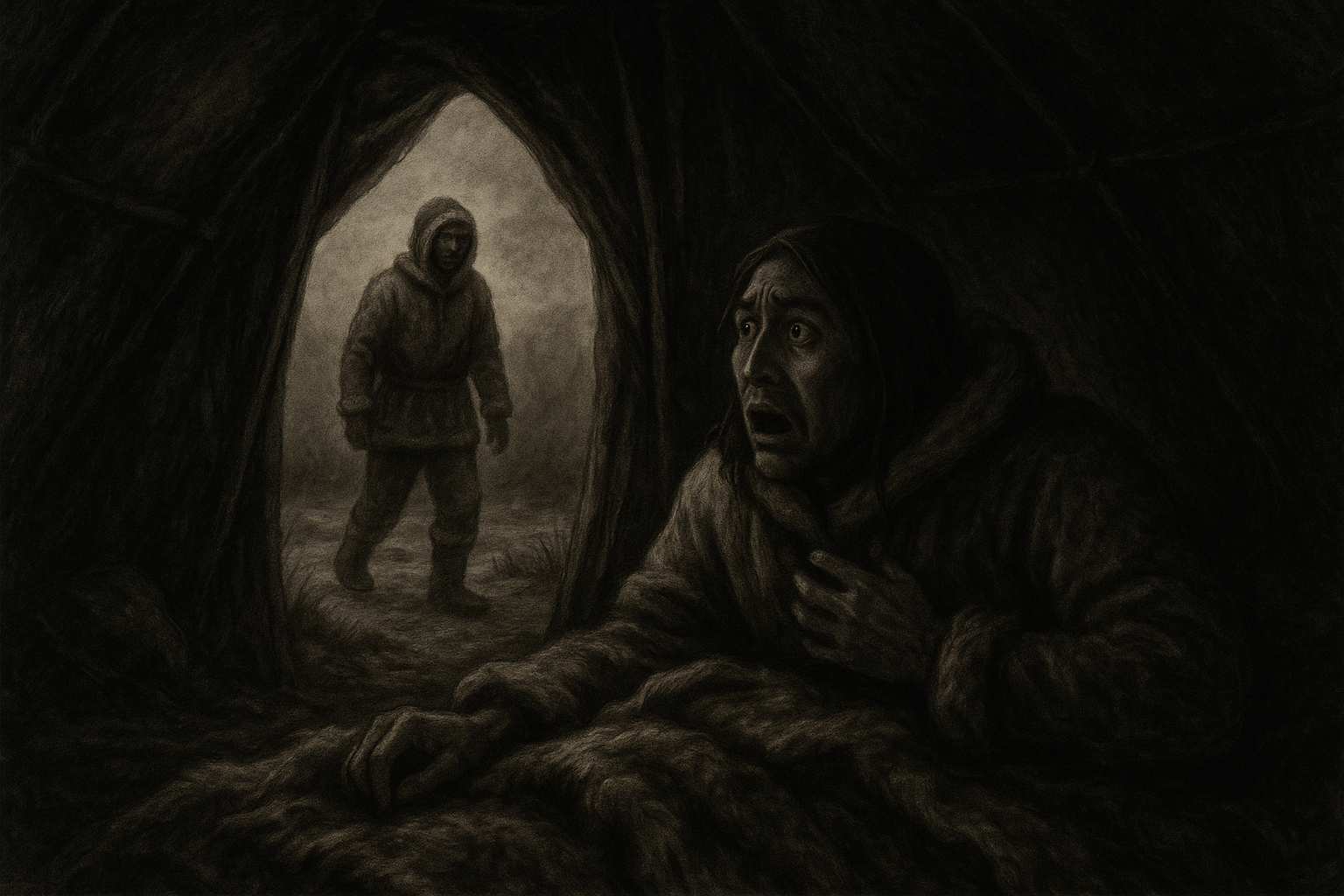
After the Danish explorer Knud Rasmussen had lived for six months with the Netsilik Inuit, some of his hosts opened up about their dreams, their shamans and their sacred stories. The stories were only told to the right person at the right time, because, Rasmussen noted, “all that is described in them did really happen once, when everything in the world was different to what it is now. Thus these tales are both their real history and the source of all their religious ideas.” [1]
      Over long nights by the fire in an ice hut or a tent, the women were especially loquacious and some were formidable. Nalungiaq, a Netsilik woman, was married to her third husband, who had killed her second husband, who had killed her first husband, all from the desire to possess her. She described a time when there was no time, when the world was dark and there was no difference between humans and animals; they could take each other’s forms.
      She spoke of how the dead are alive in dreams. “We believe that dead people whom we see so vividly in dreams really are alive. In that way dreams have taught us that people live on after death. For very often our dear departed come to us while we sleep, and we see that they live, and that they are the same as when they lived together with us on earth.” [2]
      Rasmussen heard many stories of how souls wander beyond the body, and sometimes get lost or stolen, which is when the services of a shaman, an angakok. may be required.
      Manelaq, the wife of Qaorssuaq, told how her husband once saw his own soul, wandering apart from his body, and where this led. Qaorssuaq had lain ill for a long time, and no one could understand what was wrong with him. Then one day, he saw "his own living self" a little way away.
      "No one else could see him. Seeing himself suddenly outside his own body he began to shiver all over. What he saw was his own soul, and it was owing to his illness that it had left his body. All trembling he stretched out his arms towards his soul and cried: 'Come nearer, come nearer. Come to me, come back to me!'
       " I could not understand what was happening to him and had to hold him by the hood when he kept on trembling. At the very moment I took hold of him the vision disappeared, but the soul did not return to his body. It had fled just at the moment it was perhaps on its way back to his body, for I was unclean and just in those days had my bleedings, and therefore the soul fled from me."
       Help came in the form of a couple who were both shamans. "When they heard what had happened, they insisted that 1 should go into a corner of the -tent, right over behind the fireplace; there I had to lie with my head hidden in a heap of caribou bones. While I remained concealed there, the two shamans conjured and summoned their helping spirits. They held a great seance in order to call the soul back to Qaorssuaq's body. And it was not long before he again saw his soul.
       "The two shamans, to whom nothing was impossible, could see it too. They uttered magic words and spoke with their helping spirits' own tongue until the soul came quite close to Qaorssuaq. Then they suddenly sprang to him and began to beat him here and there on his body, the consequence being that the soul was frightened and became so scared that it slipped into Qaorssuaq's body once more.
       "At the very same moment he was well again and I could hear him shouting and singing with joy. Only then did I venture to rise from the heap of animal bones where I had hidden my head till then, and we all sang with happiness. In that way Qaorssuaq got his soul back again." [3]
      It may seem odd that the vagrant soul was induced to get back in the body rather than go further away when the beating began, but it seems the shamans knew what they were doing. The magic words were certainly an important part of their operation. Inuit shamans have special language to do special things. Rasmussen later recounts a story of how magic words were used by an angakok to create a kind of Inuit golem , turning a neap of snow into a black bear. [4] Calling up helping spirits is central to Inuit shamanic practice, as in other traditions. An Inuit name for a spirit helper means "one that exists to be questioned" and the variety of entities that may play this role can be startling. Rasmussen mentions one shaman whose helping spirits included the moon, a sea scorpion, and one of his father’s living dogs. [5] 
     Inuit shamans were unwilling to share much of their training and practice with an outsider, and some told Rasmussen that the great shamans were no more; their tradition was in deep decay. Nonetheless, he was able to report how Inuit shamans are often called by the spirits in dreams. were prolific dreamers and "lived long in a dual world as real shamans must do". In the shaman’s calling, the spirits took the initiative, in dreams. If you could retain your dream experiences and apply them to the world around you, you had keys to mysteries impenetrable to others. [6]
     Rasmussen collected stories of shamanic soul flight, which Mircea Eliade, controversially, thought was the central feature of shamanic practice. [7] His most memorable tales came from Inuit recounting the deeds of illustrious ancestors. “I am a shaman myself,” an informant named Samik told him, “ but I am nothing compared with my grandfather Titqatsaq. He lived in the time when a shaman could go down to the mother of the sea beasts, fly up to the moon or make excursions out through space.”   
    Titqatsag was a frequent flyer. He loved spirit flight, and had a friendly rival, Muraoq, who also took to the air. They met in spirit flight over sea ice midway between their villages. As they converged, Muraoq spread his arms, like a bird gliding on its wings, but did not judge distance well and crashed violently into Tirqatsaq, who fell down onto the ice. He could not move until Muraoq called in helping spirits to get him up. Then the incident was mirrored. Back in the air, Tirqatsag crashed into Muraoq, who dropped to the ice and had to be rescued by his rival’s helping spirits in turn. Even shamans may need flight controllers. [8]


References

1.       Knud Rasmussen, The Netsilik Eskimo Social Life and Spiritual Culture. Report of the Fifth Thule Expedition 1921-24, (Copenhagen: Gyldendalske Boghhandewl, 1931) p. 207.
2. Ibid., p. 213
3. Ibid. p. 216
4. ibid., pp.288-91.
5. ibid., p. 294
6. ibid,, p.296
7. Mircea Eliade, Eliade. Shamanism: Archaic Techniques of Ecstasy. (Princeton: Princeton University Press, 1974).
8. Rasmussen op.cit., pp 299-300.


Illustration RM + AI


Wednesday, April 2, 2025

Celtic Shapeshifting


In the dream, I walk through a house, speaking with fervor about my plans for a new class on Celtic shapeshifting. I walk briskly between rooms, waving my arms like a swan on the water. Standing in the kitchen, I declaim the first lines of the Robert Graves version of the Song of Amergin

I am a stag: of seven tines,
I am a flood: across a plain,
I am a wind: on a deep lake,
I am a tear: the Sun lets fall. [1]

I repeat the phrase, "Celtic shapeshifting". I say it again as I leave the dream. The Song of Amergin claims affinity with all animate life, with the swan and the stars, with a tear the sun lets fall. I also feel breeze from the tale of Tuan mac Cairill, who survived the Flood as a mighty salmon, and became a hawk and many other creatures after. [2] How can I not recall his kinsman Fintan mac Bochra, who changed form when he changed his moods?

In his prose poem "Stone Boat", the poet John Moriarty gives us this grand Irish shifter of moods and forms. Once he has been paid with a story - in the Celtic way, you never come in to the good stuff without a story. sung more than spoken - Fintan reveals, "At Connla's otherworld well it was that I first realized that being human is a habit. It can be broken. Like the habit of going down to the river by this path rather than that, I broke it. And so it is that, although I always know who I am, I can never be sure that what I am going to sleep at night is what I will be when I wake up in the morning. In me the mutabilities of sleep survive into waking. What I'm saying is, my shape depends on my mood."

Then Fintan gives a lively poke: "You only need to break the habit once, the habit of being human I mean, and then you will be as you were between death and rebirth. Between death and rebirth our bodies are mind-bodies, and that means they are alterable. Alterable at will. We only have to will it and it happens, we flow from being a swan in Lough Owel into being a hind on Slieve Bloom into being a hare on Beara." [3]

Through the texts, we hear ancient bardic voices celebrating and affirming our connection with all living things in an animate, conscious world, and the shaman's ability to recruit allies in many realms and borrow their forms and their powers.


In his book Becoming Animal, David Abram tells us that "traditional tribal magicians or medicine persons seek to augment the limitations of their specifically human senses by binding their attention to the ways of another animal... The more studiously an apprentice magician watches the other creature from a stance of humility, learning to mimic its cries and to dance its various movements, the more thoroughly his nervous system is joined to another set of senses...Like anything focused upon so intently, the animal ally will begin visiting the novice shaman’s dreams, imparting understandings wholly inaccessible to her waking mind."[4]

Sometimes, of course, the forms are unwelcome, the result of a curse or of karma.

I have been in many shapes before I attained a congenial form. [5]

Now I am away with Aengus, following fire in the head into an enchanted apple orchard to catch a silver trout that becomes a lovely girl with apple blossom in her hair.....[6]


References

1. Robert Graves, The White Goddess: A Historical Grammar of Poetic Myth (New York: Farrar, Straus, Giroux 1986) p.13 2. Kuno Meyer “Tuan mac Cairill’s Story to Finnen of Moville”, appendix to The Voyage of Bran to the Land of the Living. (London: David Nut 1897), pp. 285–301
3.John Moriarty, "Stone Boat" in Dreamtime (Dublin: The Lilliput Press, 2020) p. 21
4. David Abram, Becoming Animal: An Earthly Cosmology (New York: Pantheon Books, 2010) pp. 217-8
5. Cad Goddeu, "The Battle of the Trees". Graves version, White Goddess p. 30.
6. W.B. Yeats, "The Song of Wandering Aengus" in Collected Poems (London: Macmillan, 1958) pp.66-7.


Illustrations: RM+AI

Monday, March 31, 2025

The Mudang Rides a Red Horse


She is newly initiated as a mudang, or shaman, and is expected to lead a big ritual - a gut - to win the favor of gods and spirits. And she is sick and has lost her voice. Her grandmother, a well-known mudang or manshin herself - asks what she dreamed on the last night of the lunar month.
     She remembers riding a red horse. A swing swayed in front of her. She climbed on to it and the swing carried her to a mountain where she saw a twisted pine. She jumped off the swing and climbed the tree. Grandma gets her to clarify that the swing went forward, then assures her this is a good dream, "foretelling immense blessings. Wait and see." The young manshin's voice comes back and the ritual is a success. [1]
    This is one of the many dream incidents reported in a memoir by well-known Korean shaman Kim Keum-Hwa titled I Have Come on a Lonely Path. Her dreams helped to bring her through appalling hardship - poverty, near-starvation, domestic abuse, police brutality - and to follow her calling as “a mediator between humans and gods”.
     Early in life, she was compelled to learn a mode of lucid dreaming in order to survive horrifying nightmares. Far from riding a red horse, she felt herself in danger of being trampled under the hooves of red horses that rushed at her from the sky, along with tigers and other menacing beings. Again and again, she woke exhausted and dripping with sweat. She managed to tell herself that because she was dreaming, she could choose to respond to these night invasions in some other way than fleeing in terror. When she faced her invaders, they welcomed her to their sky. She flew with them, played with them traveled with them to other worlds. ."I would mingle and play with the people in my dreams, ride clouds and cross streams in a Milly Way mist, and traverse completely different worlds. When I awakened after wholeheartedly playing in my dream, my head stopped aching and my heart felt more at ease.”
     The ecstatic sky journey, central to the shaman's calling and practice in many cultures - and seen by Eliade as universal [2] - is not featured in most accounts of Korean shamanism. In Korea the mudang is typically made in one of two ways: either the ritual tools and skills are passed down through the family or the shaman-to-be is claimed by the spirits in Shinbyeong, the notorious shaman sickness. Kim Keum-Hwa's vocation was announced in both ways. She came from a family of female shamans, and her near-death experiences in childhood lead one mudang to say that her only cure would be the purple headscarf, a badge of a senior shaman. During a full moon ritual when she was still a girl she felt she was going to be hit by stars pouring from the sky. She ran towards a creek, fainted, and the gods entered her body - a wild and typical case of initiation by possession or what her family liked to call "embodiment".
      In her first years as a mudang, she barely escaped starvation performing rituals of propitiation and exorcism. She tried to get evil spirits out of her mother’s body by feeding her grains of rice - one for each year of her age - and getting her to spit them out. She then forced the rice into the beak of a chicken that was sacrificed and buried with her mother's old clothes. . 
      Life became easier when Kim Keum-Hwa was awarded well-publicized prizes, and prize money, as a champion traditional dancer, welcomed onstage in the United States as well as her own country. This did not save her from a disastrous marriage and family tragedies. 
     Throughout her life, however, she had her dreams as counselors. She often dreamed the future. She dreamed the exact location of the body of a man who had drowned himself in a river. She communicated with the ancestors in dreams and conveyed their wishes and messages to their survivors. 
    A mudang, she tells us, is "a person who must embrace all the han and tears of others. Because I have been deeply hurt and suffered in this human life, I can understand others' pain and heal their suffering."
     She also declares that "mudangs dream much more than the average person. They not only dream during their sleep but also witness dream-like visions during their waking hours....The dreams of manshins are special - dreams that can feel like reality, while the reality of a manshin can unfold like a dream." 
    The gift of her dreams might be specific information like the best date for a ritual or a diagnosis for a patient. "Sometimes the spirits inform me of certain events in advance through dreams." Sometimes the gift of a dream is pure energy. In a big dream, she is teetering on the edge of an abyss but finds the courage to jump. Her leap of faith takes her to a lush landscape an she rises from sleep surging with confidence that caries her through the challenges presented by a series of difficult clients the next day.
     She describes how dreams helped her and those close to her through the passage from life to death. Before her mother died, she appeared in a dream, waving her thin hand at the dreamer, and said, "Do not follow". This led Keum-Hwa to give her mother special care, and to pray for her safe and easy passage. Her dream told her she must let go. One night, Keum Hwa was inspired to call to her mother, across a distance, "Fly away like a crane, like a butterfly". In the morning she received word that her mother had passed. 

Coda: Dreaming Beyond the Veil

Summarizing his careful study of the long history of Korean Muism - Korean shamanism - eminent  Korean  scholar Tongshik Ryu observed that "the religious structure of shamanism is in the creation of a new world and new human lives...By negations of secular ego and history human beings return to a primordial mythic world to dream a new creation through free meeting with the spirits. For the restoration of the mythic world the negation of the realistic world is absolutely necessary, i.e. death is required. Shamanism learned the skillful art of death in drink, song and dance." [3]
     In Kim Keum-Hwa's memoir we are present at many meetings with the spirits and we see the central role of "drink, song and dance" in the folk rituals that survive in the cities and still employ - at least part-time - an estimated 200,000 mudangs in South Korea. We are taken further. In the rituals the spirits are called through the veil. In dreams, the dreamer penetrates the veil and meets them on their own ground.
     In Kim's history of her dream life we see again  and again how in dreaming  supernormal faculties - precognition, clairvoyance, telepathy - are entirely normal. We see how dreams can diagnose and prescribe for specific conditions. And how dreaming is a field of interaction between the living and the dead, and between the human and the more than human. 
    

References

1. Kim Keum-Hwa. I Have Come on a Lonely Path: Memoir of a Shaman trans. Peace Pyunghwa Lee. Alpharetta GA: Alpha Sisters Publishing, 2024, p.75. All quotations from Kim Keum-Hwa are from this autobiography. She died in 2019.

2 Mircea Eliade. Shamanism: Archaic Techniques of Ecstasy. Princeton: Princeton University Press, 1974.

3. Ryu, Tongshik. The History and Structure of Korean Shamanism trans. Jong-il Moon. Seoul: Yonsei University Press, 2012.

Illustration: RM + AI


Sunday, March 2, 2025

Cosmos of the Makiritare Dream Shamans


In the origin story of the Makiritare (or Yekuana), a dreaming people of Venezuela, there was chaos and suffering in the world after the departure of Wanadi, a primordial being, before the dream shamans arose. People ceased to have direct contact with the other world, the realms where the akato (soul) travels and the masters of animals dwell. They could no longer rescue souls of the living or send souls of the dead to the right place. Without dreams, they were helpless in a world of illusion, trapped in delusions of the day and manipulations of other beings. Rescue could only come through the journey of a dream shaman who could reenter the invisible world and change things there and bring home the souls trapped in illusory realities.

Medatia is the one who turned himself into a dream shaman. He traveled to seven worlds beyond this one and brought skills and insight from all of them. He could then travel to the houses of the spirits and the animals – even the house of Odosha, the Dark One – and retrieve the people held captive there. At one point in his journey through Upper Worlds, he had to leave his second body dead in a lake, while a guide like a huge humanoid blue butterfly helped him to rise in another body. There are lots of anacondas in the story, though not in the picture.


Source: Marc de Civrieux, “Medatia: A Makiritare Shaman’s Tale”, translated by David M. Guss in The Language of the Birds ed Guss )San Francisco: North Point Press, 1985) 55-75

Images: (top) Cosmos of the Makiritare Shaman (bottom) "Lake in the Sky" by Robert Moss


Monday, November 11, 2024

Coming back from the dead as a dream shaman


My retelling of a wild tale of soul retrieval and shamanic initiation among the Kwakiutl of the Pacific Northwest. After putting a dead man's vital soul back in his body and telling him he will now be a shaman, the great wolf shaman explains how he will know how to heal: "I will always make you dream".

This is what the old ones say about Lebid. He was of the people called Kwakiutl or Gwasila. Their place was up in the north of Vancouver Island, where the winters can freeze your marrow. Lebid got pretty sick and no medicine could help him. His people watched him die. They couldn't bury him the old way, because the earth was frozen hard. They just laid him outside on the ice. They would deal with his remains when the ground thawed, if nothing took care of him first. In the meantime, the next snowfall made a blanket that covered him up. 
    Wolves came around after a couple of nights. The people heard them snuffling around Lebid's mound. The wolves started to howl, maybe calling the rest of the pack for free meat. What happened next was unexpected. A man's voice joined in, and the howls began to sound like a song. Nobody went outside to see what was going on.
     Time went by. Some days you could see the sun. One morning it showed a wolf pack nearing the village. The wolves scattered at the sight of the people, but one remained. He slowly rose up on two legs and became a man. The man was rail-thin and naked except for wreaths of dark  hemlock, round his neck and waist.
    When he came close to the lodges, people saw this was Lebid, the dead man. They saw he had become a skinwalker, a shapeshifter. Some thought he was also a zombie or a witch and wanted to drive him away, or burn him. A grandmother spoke up.
     "Bring him inside. Give him soup . Let him tell his story."
     "I was dead," Lebid started with what they knew "But the wolves dragged me to their place, and their great shaman. His name is Nau'alakume.He wears a crown of red cedar."
      He described how the wolves licked him all over his body. Then the wolf shaman vomited a crystal that he inserted in Lebid’s lower sternum. The shaman opened his palms to reveal something that might have been inside the crystal, a tiny fluttering creature the size of a fly or a lightning bug. Lebid understood that this was his vital soul, that had left his body with his last breath. The wolf shaman pressed down hard on the top of Lebid’s’ head, again and again, as if to loosen the bone. He blew the tiny soul throiugh the fontanel, and sealed the opening.
     He gave Lebid his own name, with its numonous power. He told Lebid that now he had died and come back, he, too, would be a shaman, "You will be a life bringer for your people."
    Then his followers rose up, put on their wolf masks, dropped to all fours, and and escorted Lebid home.
     The revenant sang a song to honor the wolf shaman who raised him from the dead, put his soul back in his body, and gifted him with his own powers. He sang of treasure again and again. 

They took me to the edge of the world by the magical power of heaven, the treasure
I was healed when the power of Nau’alakume, the life bringer, the treasure, was really thrown into me
I come to cure with this power of healing of Nau’alakume, the treasure. Therefore I will be a life bringer.
I come with the water of life given into my hand by Nau’alakume, the means of bringing to life, the treasures 

     If his people had any doubt that he now possessed the powers of a true shaman healer, a "life bringer", Lebid reassured them that he would operate under the wisest direction, delivered in what they all knew to be the most reliable way.
     He said that the great shaman, Nau'alakume, had told him, "I will always make you dream". Lebid told his people, "When you get sick, I will dream for you and my dreams will show me what you need to be healed."


Source: I have retold a report of the narrative of a Kwakiutl informant in Franz Boas' classic work The Religion of the Kwakiutl Indians. (New York: Columbia University Press, 1930) vol 2, pp. 46-50. It is worth noting that an elder of the Kwakiutl told Boas that "dreams are the news the soul brings us when it comes back from its journeys.". Franz Boas, "Ethnology of the Kwakiutl" in F. W. Hodge (ed.) Thirty-fifth annual report of the Bureau of American Ethnology to the Secretary of the Smithsonian Institution (Washington D.C.: Government Printing Office, 1921) pp. 724-725.


Wolf Mask. A Northwest Coast wolf dance headdress in Rayna Green, The British Museum Encyclopaedia of Native North America, Bloominton: Indiana University Press, 1999, p.177. 

Thursday, October 10, 2024

A short history of soul flight


The science of dream travel is ancient: in the evolution of our species, it probably predates speech and may have helped to generate language. Dream travel has a fascinating pedigree.

In many human cultures the most profound insights into the nature of the divine and the fate of the soul after physical death have been attributed to ecstatic journeys beyond the body in waking dream or vision. In most human cultures, the existence of parallel worlds inhabited by gods, daimons, and spirits of the departed has been accepted as simple fact, a fact of extraordinary importance. Visiting these other worlds was a top priority for our ancestors, as it still is wherever there is living spirituality. From the travel reports of the boldest and most successful journeyers between the worlds, mythologies and religions are born. Soul journeying was understood to be the key to orders of reality, hidden from the five physical senses, that are no less “real” than ordinary reality and may be more so.

 For the Jivaro people of South America, everyday life is regarded as “false.” “It is firmly believed the truth about causality is to be found by entering the supernatural world, or what the Jivaro view as the ‘real’ world, for they feel that the events which take place within it are the basis for many of the surface manifestation and mysteries of daily life.”

Among dreaming peoples, the reality of the soul journey and the objective, factual nature of the travelogues brought back are not in doubt. The travel reports will be compared with those of previous explorers.

Shamans ride their drums to the Upper and Lower Worlds to gain access to sources of insight and healing, to commune with the spirits and rescue lost souls. Aboriginal spirit men journey to the Sky World, climbing a magic cord projected from their own energy bodies, at the solar plexus or the tip of the penis.

Before compass and sextant, before charts, the great open-sea navigators guided their shipmates across the oceans by fine attunement to the patterns of waves and wind and stars and by the ability to scout ahead and consult a spiritual pilot through dream travel. Traditional navigators in the Indian Ocean reputedly had the power to travel ahead of their vessels in the form of seabirds or flying fish to set a safe course. 

The ancient Daoist masters were known as the feathered sages because of their reputed power of flight, which sometimes involved shape-shifting into the form of cranes.

In ancient Greece, shaman-philosophers were renowned for their ability to travel outside the body, appear in two or more locations at the same time, and commune with their colleagues. The Pythagoreans taught and practiced soul travel and believed that spiritual masters born centuries apart could communicate by this means.

The ability to project consciousness beyond the physical body, to fold space-time, influence events at a distance, and project a double are all recognized siddhis — or special powers — of advanced spiritual practitioners in Eastern traditions. Vedic literature from India is full of vivid accounts of soul-flight by humans and beings-other-than-human. In the Mahabharata, the dream-soul, or suksma atman, is described as journeying outside the body while its owner sleeps. It knows pleasure and pain, just as in waking life. It travels on “fine roads” through zones that correspond to the senses, the wind, the ether, toward the higher realms of spirit.

Shankaracharya, the ascetic exponent of Advaita Vedanta, practiced soul-flight and the projection of consciousness to another body. Challenged to a debate on sex — a subject of which he was woefully ignorant at the time — he is said to have left his body in a cave under the guard of his followers while he borrowed the body of a dying king, whose courtesans schooled him in all the arts of the Kama Sutra.

Soul travel was well understood in the Sacred Earth traditions of Europe, from the earliest times until the murderous repression associated with the witch craze. One of the most fascinating accounts — less reliant than most on confession extracted under torture — is Carlo Ginzberg’s monograph on the Benandanti, or “good-farers” of the Friuli region, who journeyed to defend the health of the community and the crops.

Soul journeying is also central to Christian spirituality. In II Corinthians, Paul refers to his own soul journey when he speaks of “a man who was caught up into the third heaven, whether in the body or out of the body I know not.” St. Columba, the founder of the great monastery at Iona, regularly traveled outside his body to scout developments at a distance.

St Anthony of Padua was renowned for his ability to travel outside the body and appear in two places at once. There are reports of him preaching in two churches at the same time.

In Jewish tradition, the story of Elijah’s chariot of fire is the model for visionary ascent to higher realms. Among the Kabbalists, soul-flight to the higher planes was held to be the reward for long years of study and solitary meditation. A key element in Kabbalist meditation (hitboded) was the chanting and correct vibration of sacred texts. Rabbi Isaac Luria (1534–72) recited phrases from the Zohar over and over, as Eastern meditators use their mantras. He entered and altered state in which he received visitations from spiritual teachers — notably Elijah — and could travel freely outside the body, to visit “heavenly academies.”

Soul-flight is not an art reserved for yogis, mystics, and shamans. The projection of consciousness by “remote viewing” or “ traveling clairvoyance” has been central to the history of warfare. Go back through the old battle sagas and you will find tales of warrior shamans who shape-shifted to spy out enemy positions. The druid MacRoth, in the Irish epic the Tain, performs this service for his royal patron, flying over the enemy ranks in the shape of a black warbird. Native American sorcerers were employed by both the French and the English to carry out similar scouts during the French and Indian War.

One of the most famous soul journeyers in European history was the Swedish scientist Emanuel Swedenborg (1688–1772), the son of a Lutheran bishop. He was in his fifties when powerful visitations by the spirits transformed his life; he then embarked on repeated journeys into their realms. He encountered angels who escorted him on guided tours of many kinds of heavens and hells..

It is not surprising that the dream explorer who coined the term lucid dreaming was another soul journeyer. Dr. Frederik can Eeden (1860–1932) was a Dutch writer, physician, and member of the British Society for Psychical Research (SPR). In 1913, he gave a lecture to the SPR in which he reported “lucid dreams” in which the dreamer retains the memory of his waking life, remained conscious, and could carry out “different acts of free volition.” He observed that the phenomenon of multiple consciousness and “double memory” — of both waking and dream events — “leads almost unavoidably to the conception of a dream-body.” He later wrote a novel, The Bride of Dreams, about dream travel outside the body.

Frequent flier Robert Monroe asserted with reason that “a controlled out-of-body experience is the most efficient means we know to gather Knowns to create a Different Overview” — a new definition of reality.


Text adapted from Dreamgates: Exploring the Worlds of Soul, Imagination and Life Beyond Death by Robert Moss. Published by New World Library.


Illustration: "Green Flight" by Robert Moss

Sunday, June 9, 2024

Australian names of the shaman, and astral apprenticeship


Anthropologist R.M. Berndt visited the Menindee Aboriginal Station on the Darling River in New South Wales in 1943 and sat with two Wuradjeri elders who were willing to talk to him in detail about the qualities and practices of "native-doctors". Jack King belonged to the mallee hen totem, Joe Biggs to the bandicoot. Berndt's informants told him that you can always tell a medicine-man by the intelligent look in his eyes, and that great ones are enveloped in a peculiar atmosphere which causes people to feel different. In his lengthy field report Berndt noted that

"A Wuradjeri native-doctor was called wiri:nan ('powerful man') bugi:nja ('spirit' or 'spirit of the whirlwind') since it was the custom of his spirit-self to travel in a whirlwind; ki:ka:wi:lan, or more generally walemira, translated as 'the clever one.' The word walemira meant not only clever in the ordinary manner of speaking, but also intellectually clever, and having the ability, with the help of spirit and psychic agencies, to perform wondrous feats, the way in which these were carried out being incomprehensible to the lay observer.
He was also called walemira'talmai (i.e. "one to whom cleverness has been handed on" or "the passing on of cleverness") which refers to the 'power' which his forebears, through their own extraordinary capabilities and guidance, had passed on or handed down to him." Berndt observed that this language laid stress on the fact that "the initiation of the native-doctor was insufficient without the possession of that 'power' which had been derived from one's predecessors and which had its orogin in the far-distant past." [1]

The psychic power of the clever man "enabled him to thrust his mind forward into the future, into the spirit-world, or over great distances, purely for its own exercise.  With his power  he could know of some incident taking place a great distance away, at the very moment of its occurrence." [2]

The apprenticeship of a clever man began in early childhood, when the elders noticed signs of vocation - something in the eyes, dreams of the departed, how birds and bush animals behaved around the kid, lizard-quick intelligence and ability to disappear. By the age of ten, the apprentice's most important lessons were conducted in dreaming, through astral encounters with a clever man who agreed to play mentor and guardian. The guardian met the spirit (waranun) of the candidate and guided it on excursions beyond the body. One of Berndt's informants told him, "when the little fellow is asleep, the father [guardian, not necessarily a close relative] takes him every night; he has got to fix him up when the child is young. His spirit takes the spirit of the child and they go away together. Their bodies are still lying alseep in the camp." [3]

Preparation for the day when the guardian would sing one of his own spirit animals into the novice's body, joining the totem animal he had from birth. The spirit animal was visible to the receiver, who might see it being pressed betwen his ribs or into his abdomen. Master and novice could now go dreamwalking together in the form of their companion animals. 

The candidate was not yet a made man, a clever man. He would normally be between twenty and thirty years old when his guardian received a dream of calling on his behalf - a dream in which Baiami, a creation being who came from the sky and was regarded as the master of all master shamans, announced his will. Other clever men received similar dreams on behalf of postulants under their care. They met together in a special place and sang for Baiami to come out of the sky. The sky Ancestor showed himself, looking no different from other clever man except for the light that blazed from his eyes, and the sacred fluid (kali) that streamed from his mouth like liquid crystals to bathe all the candidates. As it dried, feathers sprouted from their arms, turning them into wings. 

One by one, they were called from the camp to meet Baiami up close. He gave them flying lessons. He performed shamanic implant surgery on them. He sang crystals into the third eye, so they could see inside things and across any distance. He sang fire into their chests. 

Back at the camp, they each had a magic cord, probably made from human hair (Berndt does not say) twisted around their necks, ends touching their feet. The cord was sung inside them. They learned to let it out, like a snake, and shoot it in any direction like a spider's webbing thread. On nights when there was no important clever work to be done, they could show off by seeming to walk on air, with the cord stretched invisibly between trees.  [4] Not for show was how they might use it as a psychic lasso.

Berndt observed that among the Wuradjeri there were "clever women" as well as "clever men". He stated that their roles appeared to be more restricted but then there were no doubt aspects of a female shaman's business a male white anthropologist was not permitted to see.


1. R.M. Berndt, "Wuradjeri magic and 'clever men'" Oceania vol. 17 no.4 (June, 1947) 331-2..
2. ibid, 331. 
3. ibid, 333.
4. ibid, 342 


Top: Satellite photo of Menindee Lakes. It looks so much like an Aboriginal painting that you might wonder whether some of those artists rendered landscapes they had seen in ecstatic flight. 
Botton: Eastern barred bandicoot by John Goold.

Sunday, September 24, 2023

Dream readers and Raven shamans


I always scratch my head when I see dream researchers reporting that reading is a rare activity in dreams, or that if you start to read in a dream the text will blur and you won't be able to bring anything away. Perhaps these conclusions are based on the fact that the typical survey group is college kids, who may be less enthusiastic about reading than other sections of the population. Anyway, for as long as I can recall I have read at least as much in dreams as in ordinary reality and this have given me extraordinary leads for my own research, mystery words that prove to be keys to previously unsuspected cultural treasuries, and paragraphs - sometimes pages - of fresh material for my books.

Opening an old journal at random, as I often do., I found an entry from 1996 that put me on the trail of an ancient Hellenic shaman who was reputed to be able to take flight from his own mouth in the form of a raven. Here is my journal entry, edited only for length:

January 28, 1996

Dream Archaeology: Keys from Mantis

I am greatly excited because I have discovered several relief carvings from Mantis, an Egyptian site. Their images were separated in an exhibition or catalog. When brought together, they hold the key to an ancient mystery. Some are fragmentary.
    I go through dictionaries and reference books, working out the connections. I look up meanings for the words Diva (or Deva), Divina and Drostic (“to do with defense of lost causes”). One of the reference books contains verses and a heroic genealogy derived from the Arimaspea.

Waking, I recognize the last reference. The Arimaspea is a lost epic poem attributed to Aristeas of Proconnesus. It describes a people of the north, the Arimaspi, who live in mountains that may be the Carpathians and battled with griffins for access to gold. We know the work through fragments preserved by Herodotus, who says that Aristeas journeyed to fierce northern peoples, “possessed by Apollo”.

 Aristeas was a Greek shaman, living on an island near modern Istanbul, who projected a second body from his mouth in the form of a raven, and was credited with the power of bilocation. I own a book about him by an English classical scholar.

Aristeas was said to have dropped down dead in a fuller’s shop in Proconnesus, on the Sea of Marmara. At the same time, he was seen alive and well at Cyzicus, four hours away by boat, on the mainland. When the news reaches his town, his body – already prepared for burial – is found to have disappeared. 

 In book IV of  the Histories, Herodotus reported of "the birthplace of Aristeas, the poet who sung of these things", 


I will now relate a tale which I heard concerning him both at Proconnesus and at Cyzicus. Aristeas, they said, who belonged to one of the noblest families in the island, had entered one day into a fuller's shop, when he suddenly dropped down dead. Hereupon the fuller shut up his shop, and went to tell Aristeas' kindred what had happened. The report of the death had just spread through the town, when a certain Cyzicenian, lately arrived from Artaca, contradicted the rumor, affirming that he had met Aristeas on his road to Cyzicus, and had spoken with him. This man, therefore, strenuously denied the rumor; the relations, however, proceeded to the fuller's shop with all things necessary for the funeral, intending to carry the body away. But on the shop being opened, no Aristeas was found, either dead or alive. Seven years afterwards he reappeared, they told me, in Proconnesus, and wrote the poem called by the Greeks The Arimaspeia, after which he disappeared a second time. This is the tale current in the two cities above-mentioned. [trans. George Rawlinson]


Two centuries after his death, Aristeas appeared in Metapontum in southern Italy. He commanded that a statue of himself be set up and a new altar dedicated to Apollo, declaring that since his death he had been travelling with Apollo in the form of a sacred raven.

Other details from the dream remain obscure or mysterious. Mantis is a familiar word. In Greek, a mantis is "one who divines, a seer, prophet,"(from mainesthai "be inspired," related to menos "passion, spirit"). But does this correspond to a site in Egypt? Seventeen years after I journaled my report, I have not found confirmation of the meaning of "drostic" (not drastic) that was given in the dream. 


Illustration: "From the Mouth of Aristeas" by Robert Moss


Sunday, September 17, 2023

Soul loss and soul recovery: Essential Q&A


Ø  What is soul loss?

When we suffer trauma or bitter disappointment or violent shock, soul may leave the body, to escape. This produces the phenomenon that psychologists call dissociation and shamans call soul loss. It can be seen as a survival mechanism. When you can’t take any more pain, you go away in order to make it through.
          A child who has been abused, a survivor grieving for a beloved partner who has died, a lover who has been betrayed and abandoned, a soldier who  is shell-shocked, and the victim of a terrible accident are all likely to have suffered major soul loss.
          Let’s notice that soul loss need not be major, or the result of violent events. We suffer a lesser degree of soul loss when we choose one direction in life over another, or when we put our energy and focus into one thing rather than another – like holding down the job instead of pursuing a creative project, or being a mom instead of a lover (or vice versa).  Soul loss may be merely temporary and transitional “soul drift”, as when we are jet-lagged and it takes a while for us to catch up with ourselves. 

Ø  What are the symptoms of soul loss?

Common symptoms of soul loss include:  chronic fatigue;  emotional numbness; chronic depression;  spaciness;  addictive behaviors; low self-esteem; inability to let go of past situations or people no longer in your life; dissociation and multiple personality disorder; obesity or unexplained weight gain;  abusive behaviors;  absence of dream recall;  recurring dreams of locations from earlier life, or of a self separate from your present self

Ø  What is the difference, in a practical sense, between someone with a lot of soul in their bodies and someone who does not?

For people with a lot of soul, or vital energy, in their bodies, most of the symptoms of soul-loss listed above would be rare, transient, or absent. For someone who has suffered significant soul loss, three or more of these symptoms are likely to be chronic.

Ø  Why does the soul have a hard time staying in the body?

We suffer pain or abuse, grief or shame, and part of us finds the world so cruel that we want to go away. Soul loss is also caused by wrenching life choices: we decide to leave a relationship, a home, a job, a country, a lifestyle — but part of us resists that choice, sometimes to the point of splitting away and withdrawing its energy from our lives. We also lose soul energy when we give up on our dreams and settle for a life of dull compromise, refusing to trust ourselves to love or to take that creative leap.

Ø  Where does soul go when it leaves?

Sometimes we find that a part of ourselves  is stuck in the old place, in Granma’s house, or in the apartment we shared with our first love. Sometimes a soul part we lost seems to be living in a separate reality, like the land of the Lost Boys in Peter Pan. When we wish ourselves dead, a part of our soul may go far way, as far as a Land of the Dead.

Ø  Are all aspects of soul recoverable?

There are parts that are so damaged we don’t want them back. Sometime they appear burned or charred, dark or addicted. Sometimes our life choices are so radical that a part of ourselves simply cannot be persuaded to share our present situation. My inner businessman is quite disgusted with the choices I have made, and won’t stay close to me unless I make money more of a priority than I am likely to do!

Ø  What is the first step that someone who would like to experience more soul in their life to take?

You do some cleanup, and you ask for help. In my book Dreaming the Soul Back Home, as in my retreats, I offer practical guidance for psychic cleansing and release. One of my favorites is a very simple fire releasing in which we cast out any heavy energies that are holding us back and clear a space for vital soul to come back in. It’s very important to remember that we have help available, including from our spiritual allies and our own Greater Self, and that it’s always a good idea to ask for help nicely.

Ø  What role does addiction play in soul loss?

Addiction can be both a cause and an effect of soul loss. Part of our brighter energy may leave us if we fall into habits and company it doesn’t like. When we are missing a part of ourselves, things come in to fill the gap, and we reach for things to fill that gap. From a shamanic viewpoint, addictions are often worsened by spirits of the dead who are seeking to feed their own cravings through a living person. I have never met a true alcoholic, for example, who has not (from my viewpoint) been accompanied by dead drunks. In the book, as in my programs, I offer practical guidance to create healthy psychic boundaries between the living and the deceased.

Ø  What is the difference between spirit and soul? 

We can’t lose spirit, when the term means mind, higher consciousness or our spark of the Godhead.  But we can lose contact with it, and block our own access to the Greater Self.  Soul is a different matter. Soul is quite mobile and soul energy is divisible; we can lose parts of it and take on parts from others that we really don’t want around.

Ø  You have developed an original approach to healing through what you call “soul recovery”. What are the key elements in this approach?

We use the core techniques of Active Dreaming to bring more of soul into the body and help others to become whole. By learning to share dreams with others in the right way, we create a safe space where our younger and brighter selves can draw closer, and we start to build communities of soul friends. By learning to use a dream as a doorway through which we can travel — in shamanic lucid dreaming — into a deeper space, we can go to the places where lost souls can be found and reclaimed, and we help each other to do this.

Ø  Are there other ways, in addition to working with our dreams, to experience soul recovery?  If so, what are they?

Soul retrieval, as opposed to soul recovery is a shamanic operation in which the practitioner makes a journey on behalf of a client to locate lost aspects of soul, brings them back, and transfers them to the client’s body, often by blowing them into energy centers such as the heart and the crown of the head. It can be a profoundly healing event. It reaches parts that Western psychology often does not reach, and may be essential in cases where people are missing so much of themselves that they are not equipped to become self-healers until an intervention has taken place. The limitation of this is approach is that nearly everything depends on the character and skill of the practitioner, on the reality of his or her connection with spirit helpers, and on the quality and motivation of those helpers.

Ø  You say that dreams not only show us what the soul wants, they also show us where it has gone.  Please elaborate and provide an example of this.

Our dreams can tell us which parts of ourselves may be missing, and when it is timely to bring them home. Recurring dreams in which we go back to a scene from our earlier lives may indicate that a part of us has remained there. Dreams in which we perceive a younger self as a separate individual may be nudging us to recognize and recover a part of ourselves we lost at that age. Sometimes we do not know who that beautiful child is – until we take a closer look
     A middle-aged woman recently approached me for help. She told me, "I feel I have lost the part of me that can give trust and know joy." As preparation for our meeting, I asked her to start a dream journal, although she had told me she had not remembered her dreams for many years. When she came to see me, she had succeeded in capturing just one tiny fragment from a dream. She remembered that she was standing over a table, looking at three large-size "post-it" notes. Each had a typed message. But the ink had faded and she could not read the messages.
    Slowly and carefully, I helped her to relax and encouraged her to try to go back inside her dream. Quite quickly, she found herself inside a room in the house where she had lived with her ex-husband prior to their divorce, almost twenty years before. Now she could read the typed messages. The first read in bold capitals, "YOU CAN DO IT." They were all about living with heart, and trusting life.
    She realized that she had left her ability to love and to trust in that room for nearly twenty years. I asked her what she needed to do. She told me, "I need to bring my heart out of that room and put it back in my body." She gathered up the messages and made the motion of bringing them into her heart. As her hands crossed over the place of her heart, we both saw a sweet and gentle light shine out from her heart center. She trembled, eyes shining, and told me, "Something just came back. Something that was missing for twenty years."


Bear creation by Tracy Cunningham. Bear is a great ally in soul recovery.

Monday, August 7, 2023

Open Secrets of the Dreamtime


Here are the open secrets of the Dreamtime, insights shared by many dreaming traditions and indigenous peoples that challenge the ruling paradigms of a culture that confuses the real with the physical


1. Dreams are real experiences.

There are big dreams and little dreams. “Bottom-line it for me,” bulled a radio host over the phone from North Dakota. “Aren’t dreamed caused by spicy pizza?” Well, yes, some dreams are. But we will not expend much space here on the surface bubbles of the dozing brain and belly.

In big dreams — in what Sri Aurobindo called “the sleep of experiences” — we are dealing with events, encounters, and challenges that are entirely real on their own level of reality. Our dream memories may be garbled or muddy, but the dream is a real experience whose meaning lies within the dreamscape itself. The dream experience, fully remembered, is its own interpretation. But we must do more than interpret dreams; we must manifest their energy and insight in our waking lives.

Shamanic dreamers tend to be quite literal-minded about dreams. If you dreamed you fell off a rock-face, you’d better remember to check your safety harness if there is any chance you might go rock climbing. If you flew with the eagle, you discovered a powerful spiritual ally — and your own ability to transcend the limitations of your physical body. If you dreamed of your dead uncle, before you start asking yourself what part of you he might represent, you should consider the possibility that you had a visit with him. Is he bothering you — maybe trying to cadge a drink or a smoke — or offering you help? If you dreamed you received instruction at a mountain shrine, you should be open to twin possibilities: that you may go there someday, in physical reality; and that you may have been called in your dreams to one of the many “invisible schools” where training and initiation on the higher planes are conducted.


2. Dreams are flights of the soul.

During one of the final presentations at a hectic conference in Berkeley, I regretted that I had not taken that Saturday morning off to explore the Bay area. I closed my eyes, slipped free from my physical focus, and felt myself gliding over the Bay on the wings of an eagle. It was a wholly tactile sensation. I was drawn to a wild, lightly wooded area with intriguing stone formations that looked from the air like volcanic rock. As I dipped into a fold in the hills to examine the area more closely, I saw another interesting formation, shaped by human hands: a circular labyrinth, or spiral, at the edge of a pond.

At lunch, I casually described the scene I had explored. “It could be the Sibley Volcanic Preserve,” one of the local conferees piped up. “I can take you out there this afternoon if you have time.” She did not know about the spiral path, but we found it fairly easily, at the edge of a swampy pond.

From a shamanic perspective, there was nothing extraordinary about my experience. It was just a routine scout — a Middle World journey — in which I moved beyond the range of my physical senses to check out my environment. I was traveling beyond my body, but I kept a firm connection with it, maintaining awareness of the activity in the lecture room even as I flew across the Bay.

Shamans say that in real dreams (waking or sleeping) one of two things is happening. Either you are journeying beyond your body, released from the limits of space-time and the physical senses; or you receive a visitation from a being — god, spirit, or fellow dreamer — who does not suffer from these limitations. In the language of the Makiritare, a dreaming people of Venezuela, the word for dream, adekato, means literally a “flight of the soul.”

The open secret is that consciousness if never confined to the body and brain. We discover this in spontaneous night dreams and intuitive flashes, when our left-brain inhibitions are down. As we become active dreamers, we can hone the ability to make intentional journeys beyond the body at any time of day or night.


3. You have a dreambody as well as a physical body.

I am leading one of my Active Dreaming circles. We are squatting around a centerspread with a white candle. Someone asks whether there is any way to prove that we are not dreaming. I pick up the candle and pour hot wax onto my hand. I feel a sting of pain as the wax sears the web of skin between my thumb and forefinger, and I tell the group, “I guess that proves I’m not dreaming.” Then I wake up.

What is this dream telling me? That I am a nitwit because I can’t tell whether I’m dreaming? If so, I will take solace from the fact that in most sleep dreams, most people are completely unaware that they are dreaming. Actually, I think this dream has a more interesting and specific message, related to the theme that dreams are real experiences. In my dreambody, I can know pleasure and pain just as vividly as in my physical body. I have more than one body, or vehicle of consciousness, and when I go into the dreamworld and other worlds, I go embodied. And so do you.

As we will soon discover, the importance of this statement — in relation to our ability to operate in nonordinary reality and to access spiritual sources of insight and healing — can hardly be overstated.


4. Dreams may be memories of the future.

I dreamed of a silly little dog decked out with fake antlers for some kind of Christmas pageant. The dog ran out on the road and was killed, but was magically revived by a dubious, utterly amoral character who seemed remote from the normal range of human emotions.

The dream had a movielike quality. I had no idea what was going on here, but because I had no particular feelings about it, I was content to record it in my journal before rushing off to the airport to catch a plane to Denver.

I missed my connection and later found myself on a different flight form the one schedules. Whenever my travel planes come unstuck, I am alert for the play of the Trickster. On the “wrong” plane, I found myself seated next to a woman who turned out to be best friends with a person in publishing to whom I had been introduced only the day before, and I was able to glean some useful insights. Our conversation was interrupted by the screening of the in-flight movie. I looked up to see a silly little dog decked out in fake antlers for a Christmas pageant. Later in the movie, the dog is killed on the road and magically revived — by a low-flying angel portrayed by John Travolta. The title of the movie is Michael, and I highly recommend it. What interested me most was that I seemed to have attended an advance screening in my dream the night before.

We dream things before they happen in waking life. If you work with your dreams and scan them for precognitive content, you can develop a superb personal radar system that will help you to navigate in waking life. You can also learn to fold time and travel into the possible future by the methods explained in this book. For even the most active dreamers, however, the meaning of many dreams of the future may be veiled until waking events catch up with the dream.

I dreamed of a garden in Manhattan, modest in size, but beautifully designed. A place for quiet meditation, a refuge from big-city noise and hustle. A place where I felt I could do good work with good people. I was intrigues by this dream, which came to me at a time when I was quite resistant to leading programs in New York City because of the energy required to clear out all the static and psychic clutter and create a safe space for soulwork. The dream left me feeling bright and happy. I was curious about the location of my dream garden. Did it exist in ordinary reality? When I reentered the dream, I found myself on a block in the East Fifties, between Third and Second. This satisfied me that I had visited a locale that existed in physical reality. Lacking an exact address, I forgot about the dream after logging it in my journal. 

Yet the dream continued to exercise an influence: to my mild surprise, I said yes when several groups subsequently invited me to conduct workshops in New York. Nine months after the dream — the period of an average pregnancy — I entered the meeting room of the New York Theosophical Society, on East Fifty-third Street, for the first time. I stopped short. Through the picture window at the end of the room, I looked out into the garden from my dream. As I stepped out into the garden, an austerely elegant man in a black tunic followed me out. He introduced himself as the society’s program director, who had invited me. He explained that he had also designed and now tended my dream garden.

If dreams are memories of the future, is much of waking like the experiencing in the physical body what we have already lived in the dreambody? What would we become if we participated more consciously in this process? There is an Iroquois story of a great hunter who always scouted ahead, in conscious dream journeys, to locate the game and rehearse the kill. In one of his dream scouts, he located an elk and sought its permission to take its life to feed his extended family. He killed the elk in his dream and noted the red mark on its chest where the arrow had gone in. The following day, he walked to the place he had visited in dreaming and identified his elk by the red mark on its chest. He then replayed an event that had already taken place, by killing the elk again with a physical arrow.


5. Dreaming, we choose events that will manifest in our waking lives.

The fact that we dream things before they happen does not mean everything is predetermined. People who are not active dreamers can get quite confused about what is going on when they wake up to the fact that we are dreaming future events, both large and small, all the time. I think it’s like this. If you do not remember your dreams, you are condemned to live them. (If you don’t know where you’re going, you will likely end up where you are headed.) If you remember some of your dreams and screen them for messages about the future, you will find yourself able to make wiser choices. You will discover that by taking appropriate action you can often avoid the enactment of a “bad” dream or bring about the fulfillment of a happy one. As you become a conscious dreamer, you will find yourself increasingly able to choose inside the dreaming the events that will be manifested in your waking life.

It’s not about predestination. It’s about the spiritual secrets of manifestation — and your ability to become cocreator of your life.

Meister Eckhart tells us how it is the razor-sharp clarity of the practical mystic who has seen and experienced for himself: “When the soul wishes to experience something, she throws an image of the experience out before her and enters her own image.”

Indigenous peoples tell a recurring story of how the material world is spun from the dream of a deity. For the Guajiro of Ecuador, the physical universe is the product of conscious dreaming. The Guajiro say that the Creator-god made this world after the divine Dreamgiver, Apusanai, made him aware that he was dreaming and he began to experiment with molding and solidifying the fluid forms he perceived endlessly aborning and transforming on another plane of reality.<6>

It is not merely that we dream things (maybe everything) before they happen; dreams make them happen.


6. The path of the soul after death is the path of the soul in dreams.

Your dreambody does not die when your physical body loses it vital signs. You will live on in your dreambody for a shorter or greater time, according to your ruling passions and personal evolution. You will find yourself, as you do each night in dreams, in a realm where thoughts are things, and imagination, the great faculty of soul, can create whole worlds.

You come from the Dreaming, and you are released into the Dreaming when you drop your sack of meat and bones.

Conscious dreaming is excellent preparation, not only for the challenges that lie before you on the roads in this life, but for the challenges of the journey you will make after physical death. How do you know for sure? By doing it.


Text adapted from Dreamgates: Exploring the Worlds of Soul, Imagination and Life Beyond Death by Robert Moss. Published by New World Library. 


Illustration: "Green Flight" by Robert Moss