Showing posts with label doubles. Show all posts

Monday, April 7, 2025

News from The Secret Commonwealth


In a book titled The Secret Commonwealth of Elves, Fauns and Fairies, Robert Kirk (1644-1692), a Gaelic scholar and Anglican vicar at Aberfoyle in Scotland,  describes a secret way of correspondence with the invisible world: a means of crossing between ordinary and nonordinary reality at will. Kirk subtitled his work An Essay of the Nature and actions of the Subterranean and for the most part Invisible People, heretofore going by the names of Elves, Fauns and Fairies and the like.

Subtle bodies The inhabitants of these realms are not disembodied. They have “light changeable bodies, like those called Astral, somewhat of the nature of a condensed cloud. They shape-shift and can make their “bodies of congealed air” appear and disappear at will.

Middle nature: The fairies are “of a middle nature betwixt man and Angel,” like the daimons of the ancient world. Kirk discusses rival opinions in his parish about whether the “good people” are spirits of the departed, clothed in their subtle bodies; “exuded forms of the man approaching death”; or “a numerous people by themselves.” He suggests that all these descriptions may be valid for different groups.

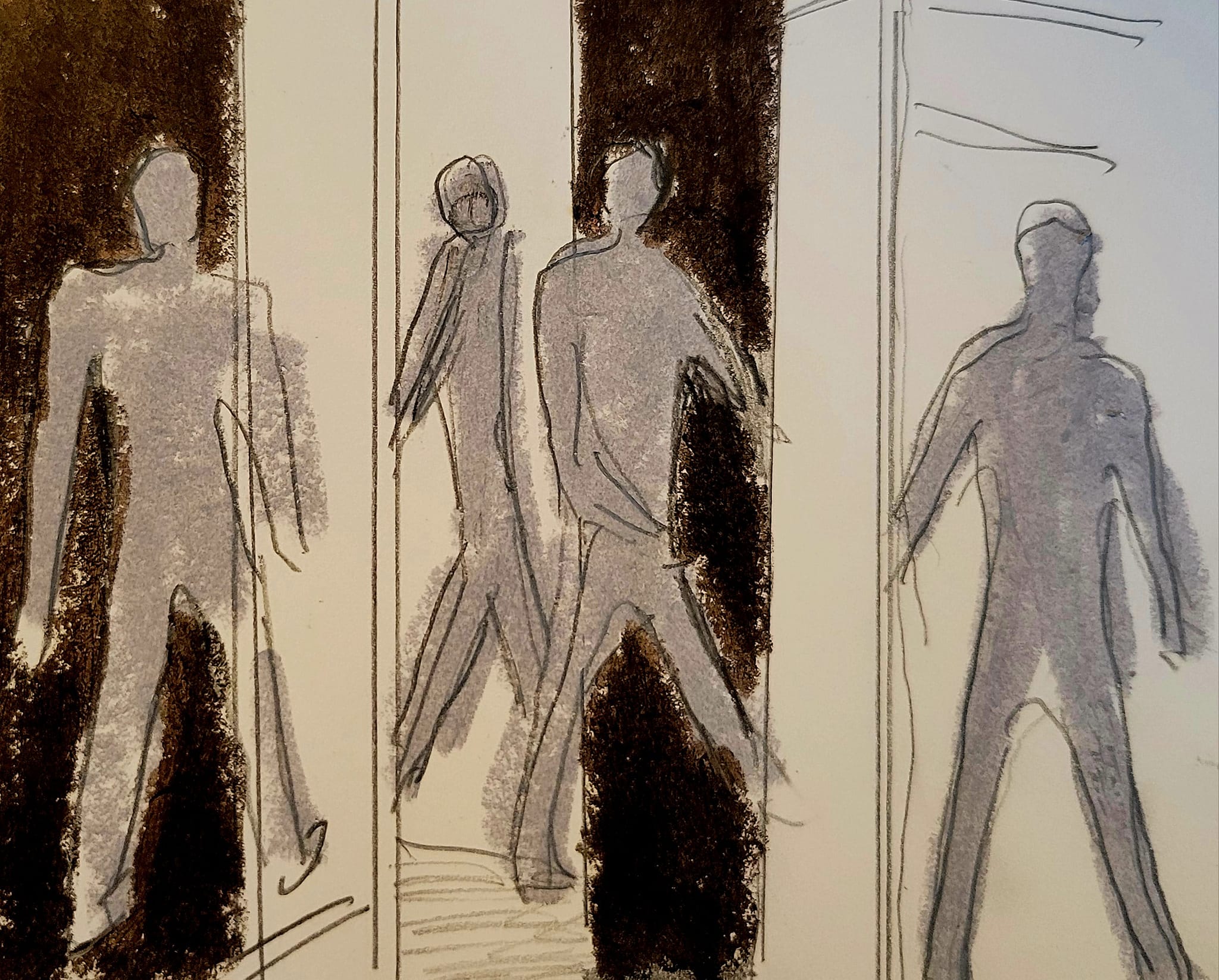
Doubles. Kirk reports that each of us has a double who is fully at home in the Otherworld. The old Scots Gaelic term for this double is coimimeadh (pronounced “coy-me-may”), which means “co-walker.” Kirk improvises a series of synonyms for the double, including: twin, companion, echo, “reflex-man, and living picture. The double resembles the living person both before and after she or he dies. The double survives physical death, when the co-walker “goes at last to his own land.” When invited, the co-walker will make itself “known and familiar.” But most people are unaware that they have a double. Since it lives in a different element, it “neither can nor will easily converse” with the everyday waking mind.

As natural as fishing As a man of the Church, Kirk goes to great lengths to argue that there is nothing ungodly about “correspondence” with Otherworld beings, quoting reports of visionary experiences in the Bible. He also contends that it is as “natural” to encounter the inhabitants of the Otherworld as it is to go fishing; both involve moving into another element. Yeats brings this to poetic life in "The Song of Wandering Aengus", where a man fishing with a hazel rod catches a little silver trout that becomes a girl with apple-blossom in her hair.  

Kirk reassures us that we are dealing with “an invisible people, guardian over and careful of man,” whose “courteous endeavor” is to convince us of the reality of the spiritual world and of “a possible and harmless method of correspondence betwixt men and them, even in this life.” 

However, local legend has it that members of the Secret Commonwealth found the minister too mouthy about them and carried him away one summer evening when he was walking on a dun-shi, a fairy hill behind his house.  He was taken before his book was published. It remained for Sir Walter Scott to discover and publish it in 1815. The frontispiece is a watercolor drawing  hy Sir D.Y. Cameron depicting the Hill of the Faitries at Aberfoyle. Bailie Nicol Jarvie describes this hill and its legends in Rob Roy.

Kirk's successor as minister at Aberfoyle, the Rev. Dr. Grahame, in his Sketches of Picturesque Scenery, recounted that as Kirk was walking on the fairy hill, he sunk down in a swoon, which was taken for death. “After the ceremony of a seeming funeral,” Scott continued the story in Demonology and Witchcraft , “the form of the Rev. Robert Kirk appeared to a relation, and commanded him to go to Grahame of Duchray. ‘Say to Duchray, who is my cousin as well as your own, that I am not dead, but a captive in Fairyland; and only one chance remains for my liberation. When the posthumous child, of which my wife has been delivered since my disappearance, shall be brought to baptism, I will appear in the room, when, if Duchray shall throw over my head the knife or dirk which he holds in his hand, I may be restored to society; but if this is neglected, I am lost for ever." According to this story, Kirk did appear at the christening, and “was visibly seen;” but Duchray was so gobsmacked that he did not throw his dirk  and Kirk went away again.

Kirk lived in a world not yet "dispeopled of its dreams" as Andrew Lang wrote in his introduction to a 1893 edition of The Secret Commonwealth. Lang proceeded to discuss experiences of the co-walker:  "All things universally have their types, their reflex: a man’s type, or reflex, or ' co-walker' may be seen at a distance from or near him during his life—nay, may be seen after his death. The gifted man of second sight can tell the substantial figure from the airy counterpart."

Lang was especially interested in the kind of double that goes ahead of you for which the Norwegians use the term vardøger, who "was often seen of old to enter a House, by which the people knew that the Person of that Likeness was to visit them in a few days....It may have occurred to most of us to meet a person in the street whom we took for an acquaintance. It is not he, but we meet the real man a few paces farther on. Thus a distinguished officer, at home on leave, met a friend, as he tells me, in Piccadilly. The other passed without notice: the officer hesitated about following him, did not, and in some fifty yards met his man. There is probably no more in this than resemblance and coincidence, but this is the kind of thing which was worked by the Highlanders into their metaphysics."


Illustration: Robert Kirk Goes Away. RM+AI

Sunday, March 30, 2025

The Two Lilas and the Endless Worlds


Your life and your dreams are both made of stories. You won't forget this if you immerse yourself in one of the greatest storybooks ever made. The earliest version of the Yogavasistha was probably compiled in the seventh century. Its original title was the Mokshapaya, or Way of Release. Authorship has been attributed to the sage Valmiki, also credited with producing the epic Ramayana. The voice we hear is that of another sage, Vasistha. He takes on the task of restoring the spirits and the will to action of the boy prince Rama of Ayodhya. Hence the full title of the text, The great story of Rama as told by the sage Vasistha in order to expound his philosophy of Yoga. Rama’s services are urgently required to defend gods and humans against an army of demons, but he has slumped into lethargy and despair. 
    Rama asks the sage, “What is the point and purpose of this useless existence?” The whole dialogue that follows - filling more than 27,000 verses and powered by sixty-four extraordinary stories - is a response to that question. Vasistha charts the path to release from vasanas, the habitual tendencies and karmic traces that hold the soul in bondage to the wheel of repetition. He describes the way of ascension through higher worlds to the realm of pure consciousness. But this is not only a guide to moksha, or liberation. It is a call to re-engagement with the world, to live the bigger story.
    Vasistha is my kind of teacher. He offers real philosophy, deep as Advaita Vedanta or the Upanishads, but he does not teach through admonishment or abstraction; he teaches by telling really good stories. 
    One of his core teachings is that "this universe is but a long dream...There is no real difference between the waking state of reality and the dream state. What is real in one is unreal in the other - hence, these states are essentially of the same nature." [1]
     Beyond other systems of yoga, the yoga of Vasistha hinges on seeing the world as a dream. [2] In order to be truly awake, one must fully understand sleep and dream. The world appears and disappears, realities come and go like dream states.
    Make that worlds. There are countless worlds, including universes concealed inside stones or subatomic particles. "In every atom there are worlds within worlds." The Sanskrit term is jagadanantya, which literally means "the endlessness of worlds".[3] 
Hugh Everett III might want to join the conversation at thsi point; he was the atheist proponent of the Many Worlds Interpretation in quantum mechanics which holds that the universe is constantly splitting into parallel versions.
    The sage continues: "No one can count the number of universes (and consequent creations) that are arising at this minute from the Supreme Being. The mind that humans possess is ever fluctuating and gives rise to all things in these visible worlds. This external appearance which exists as a reality is a creation of human desires. It is as unreal as a goblin shown to terrify children. This world is as unstable as a stool made of banana leaves.”
    The longest story in the Yogavasistha, and one of the most wildly entertaining, is the tale of Lila, or rather The Two Lilas. Queen Lila, fearing the death of her beloved husband, King Padma, prays to the goddess Sarasvati that they should not be separated. When the goddess appears after the death of the king, she shows Lila how to preserve his body while traveling to find his soul essence in different realms. Lila is excited though incredulous when the goddess tells her than among other life experiences she and her husband have shared is the partnership of Visastha - no less - and his wife in a universe within a tiny space. How can Lila know this for sure? The goddess explains that she can go there and see for herself. But for this kind of travel, Lila must affirm to herself, “I shall leave my body here and take a body of light. With that body, like the scent of incense, I shall go to the house of the holy man." 
    Once Lila learns to drop her physical body and travel in a subtle body, she embarks on a series of fantastic journeys, involving parallel lives, reincarnation, mind-created worlds and the ascent to pure consciousness beyond the illusions of form. Lila and Sarasvati "roamed freely in their wisdom bodies. Though it seemed that they had traveled millions of miles in space, they were still in the same 'room' but on another plane of consciousness." 
   They fly to the top of Mount Meru, they see spaceships ang gods and celestial dancers and the abode of the creator. In a marvelous skirl of humor, the narrator tells us "like a couple of mosquitoes they roamed all these planes."
    In a scene made for big-screen sci fantasy, Lila meets her double - also a queen, in another life story - in a palace where they watch a futuristic battle. Rockets burst into a thousand warheads and gunships like elephants rain fire from the sky. "What looked like elephants had been propelled into the air from the battlefield and they were raining fire on the city." It seems a ninth century author is able to foresee twenty-first century battles or Star Wars scenarios from the ancient future. In this world at war King Padma is embodied as another king, Viduratha, who will be slain in battle because he has set his mind on liberation, not victory. “Whatever vision arises within one’s self is immediately experienced." 
    Lila wants to know why there is an exact double of herself in this scene. They can see and interact with each other though others may see only one of therm. Sarasvati explains that it was the longing of her deceased husband, Padma, that generated Lila’s double in this world where Padma has been reborn as Viduratha. “Due to excessive love towards you your husband Padma thought, at the moment of death, of enjoying your company without being ever separated. Accordingly he was able to get you here. Whatever is thought of by one at the time of his agonizing death, that will be realized by him afterwards."
    We are given a fascinating description of soul transfer, or body swapping. After the death of Viduratha, Sarasvati puts his jiva - his soul - into the embalmed corpse of the first Lila’s dead husband, Padma.


             Through the nose

Saraswati, removed the grip she had on the jiva of Viduratha which therefore entered into the nasal orifice of Padma's body in the form of prana and permeated the whole parched up body. Whereupon blood began to circulate freely throughout and the deceased king woke up, rubbing his eyes. Padma woke up and asked who they were.

     Lila is eventually able to remember eight hundred of her past lives and step in and out of lives that her parallel selves are living beyond the wheel of time.
     We are given hints as to the nature of the true life teacher. Sarasvati tells Lila she is more than a goddess; she is higher consciousness. Beyond the play of reality and illusion, waking and dreaming, there is the limitless nondual field of pure consciousness. This is the only reality. Both liberation and enlightened reengagement with the world require the jiva to understand this fully.
     Which brings us to Vasistha's most important teaching You must transcend the world but then return and embrace it. The aim is to become the jivanmukta, the living liberated being, who can engage with the world without being entangled with it. Lila means play. Beyond the gloom of the world, seek the divine play. If life is a dream, grow your ability to change the dream or create a new one.
     Vasistha’s purpose in telling stories to Rama is not only to awaken him to the fluid interplay of reality and illusion, and the conditions for moksha (liberation) but to help him acquire the non-attachment that will enable him to act in the world without succumbing to its entrapments “doing yet not doing what has to be done” The stories show that our lives are shaped by the mind’s capacity to create and sustain reality. Existence is a dreamlike projection of consciousness. Boundaries between waking life, dreams, past and future lives, and parallel realities are fluid.
     So, reality is not as fixed as we tend to tell ourselves. When we recognize that much of what we accept as real is a mental construct, we can change the construct.
    
 If we see life and death as illusions, perhaps we can bring more clarity and courage to our actions. Why fear death? And why get stuck in the conditions of a single life experience? We are many. Lila identified eight hundred incarnations before she stopped counting. How many doubles and counterparts does any one of us have, whether as aspects of our present personality or transpersonal counterparts in different times or dimensions?
    We are led to assume that all of this will bring Rama into the field to fight the demons. Be in the world not of it. Knowing that the world is an illusion does not mean withdrawing from it. We want to navigate with awareness and to live with awareness and non-attachment, lucid in the dream of life, taking part in life’s play while remembering that it is a playground
     
Vasistha teaches us that will (paurusa) can overcome fate (daiva) when exerted by a mind that has awakened. “Those who have removed the veil from reality can imagine things so precisely that those mental perceptions are actually experienced.” Certain people, of whom Vasishtha is one, have the power of making their dreams, become physical objects- objects that did not existed until a powerful dreamer dreamed them into reality. [4] Don't forget

Your real life is a dream and the dream is real

Your real life is an illusion and the illusion is real


CODA: A Crown Prince Recommends a Book of Stories to Take You Beyond This World

In the Chester Beatty Library in Dublin is a Persian translation of the Yogavasistha with 41 miniature paintings, probably commissioned by the first Mughal emperor Akbar and completed under the patronage of his son and successor Jahangir. There is a fascinating note in Jahangir's own hand in the margin of folio 1b. A recent translator gives us this version:

"God is great! - This book Ğög Bäsistha [sic] which belongs to the stories of the ancients, (and) which I translated in the time when I was crown-prince ...is a very good book. Whenever somebody hears it with the ear of understanding, and if he considers only one percent of it, it is surely to be hoped that he will make the bațin ['what is beyond this world'] his destination by the instrument of the zahir ['what belongs to the apparent world']" [5]

From his time as crown prince, Jahangiir not only claims full credit for the translation but pierces to the main intent of this astonishing Hindu text, where philosophy is animated by amazing tales of doubles, parallel worlds and oneiric adventures. The yoga of Vasistha leads to awakening to ultimate reality "beyond this world" through the magic of story - and then guides the hearer to act in the world with the clarity and courage of non-attachment. To hear or read just one of Vasistha's stories, it's been said, is to become enlightened.


References: 

1. Swami Venkatesananda. Vasistha’s Yoga. (Albany NY: SUNY Press 1993) p. 71. Unless otherwise mentioned, all quotations from the Yogavasistha in this essay are from this 800-page abridgment.

2. Christopher Key Chapple gives an elegant summary of the seven states in Vasistha’s yoga: “Vasiṣha’s sevenfold Yoga begins with restraint from activity (nivtti) leading to deep thinking (vicāraa) and non-attachment (asasaga). After these three preliminaries Vasiṣha proclaims that in the fourth state one sees the entire world as if it were a dream. For Vasiṣha, this process of dissolution holds great lessons. Is the world real? According to Vasiṣha, the answer is a resounding no. Once one sees through the fixity of any given circumstance. In the fifth Yoga, one can descend (or ascend) into the realm of an experience of non-duality, wherein one operates as if in a state of deep sleep, translucent and transparent (advaita suṣupta). This catapults the individual into a state of true freedom (jīvan mukta), preparing one for the seventh Yoga, one’s final release from the body (videha mukta) at the time of death. Unlike any of the other Yoga systems, the Yogavāsiṣha process hinges on seeing the world as a dream.” Christopher Key Chapple.  “Worlds of Dream in the Yogavāsiṣṭha: Virtual and Virtuous Realities” Embodied Philosophy 2020 

3. Garth Bregman. “The Existence of an Endless Number of Worlds Jagadānantya in Mokṣopāya and the Many-Worlds Interpretation of Quantum Mechanics” in  Christopher Key Chapple and Arindam Chakrabarti (eds) Engaged Emancipation: Mind, Morals, and Make-Believe in the Moksopāya (Yogavāsistha) (Albany: SUNY Press, 2015) p.97.

4. Wendy Doniger O’Flaherty.“The Dream Narrative and the Indian Doctrine of Illusion in Daedalus  vol. 111, no. 3 (Summer, 1982),p.102

5. Heike Franke. “Akbar's Yogavāsiştha in the Chester Beatty Library” Zeitschrift der Deutschen Morgenländischen Gesellschaft 161(2) (January 2011) 359-375


Illustration: Two Lilas with the Goddess. RM + AI


Friday, March 7, 2025

The Traveler


I can only keep up with him by becoming him. When I come home from our travels, I am not quite myself and no longer him. When we part company, I am left to pore over scraps of memory like the things I find in my pockets and on my phone after a regular plane trip: a boarding pass, a bus ticket, a foreign banknote, a scribbled love note, random photos of far-away cities and beaches and train stations.

It is now one of my ongoing undertakings to track the Traveler through my journal reports. Here he seems to be very like my present self, just two days ahead of me, on my present probable event track. Sometimes he is much further ahead, or on a different – mildly or radically – event track, or he is in another body in another time or another world.

Is the traveler sometimes in a different body in this world, like the kids in the Japanese film Your Name? Perhaps. I think back to the body swapping dream of many years ago when the Traveler tries on at least three different bodies – of a black athlete, a rich Republican country club type, and finally an older, eccentric scholar whose legs don’t work well, much like my current self.

I think of the dream in which I am dressing up in a blue satin ballgown, excited by the prospect of turning on my boyfriend. I wake wondering whether I have been in a woman’s body. This doesn’t feel quite right. My excitement in the dream is surely male arousal, within a man’s anatomy. Confused, I look out the window and see a tall black transvestite, gorgeously attired in a long blue satin ballgown, teetering down the steps on stiletto heels on the arm of her boyfriend

The moment of lucidity, in a sleep dream, may be the moment when the self that has been dormant in bed – or somewhere else altogether – catches up with the Traveler. It may be a moment of self-possession, of taking control of a vehicle that has been traveling under the direction of an autonomous self, like the captain of a ship coming back on board and taking over from a junior officer or crew member. However, the person in the wheelhouse may decline to give over control, and a sudden rebuff may result in falling out of the dream (for the person who wakes in the bed) and the Traveler’s disappearance from radar. So it could be like a horse bucking a would-be rider.

As I seek to track the Traveler, I watch the person who is writing these lines. I see him fumbling with his nautical analogy. I like the bucking horse analogy better, though we lose the notion that there may be a second rider. I am not going to play editor or critic. The writer’s attempt to model and understand what is happening in his many lives is part of his story, the one on which I will put the name we use in the ordinary world.

The Traveler is a multilingual word player. I play with words in English. The Traveler plays with words in many languages. One morning I was left with an unlikely phrase in French, on acccable par les hochements. This could be a newly-minted saying with the sense of “yessing someone to death”, or a commentary on the storm surge of Hurricane Irma, or both. Now I remember the Traveler’s effort to find the right words to greet Stalin at lunch in Ufa in the midst of World War II. He sought an edge of humor while trying to avoid getting his throat cut. He managed, in the Georgian language.

When I am the Traveler the journey often begins at a certain threshold, a gap between the worlds, in a twilight of the mind. I may find myself floating upwards. I roll over and as I do so I feel something pulling loose from my physical body. Lights flash at the top of my head and I find myself being drawn up into a cone of light, like a pyramid with an opening at the top. 

There are days when, flat on my back under a tree, I fall upwards into the bowl of the sky, like Rumi. There are nights when I feel I am about to blast off like a rocket, or be blown from the mouth of a cannon, through circles of red within black. Or I find myself stripping off, shedding the body like a snake skin, dropping it like an old overcoat. When the travels begin, I often find myself looking at geometric pattern. It may be a glowing energy grid. It may resemble the weave of a carpet, or the strands of a net.


Saturday, September 14, 2024

Dreams and Doubles – Thorstein and the Fylgja


I am back in the Iceland of the sagas. In the Vatnsdal Saga, the chronicle of a Norwegian family that moved to northern Iceland before Christianization, we read about dream visitations and the need to listen to a dream advisory, especially when it comes from a fylgja, or companion spirit. 
     Groa the witch invites Thorstein to a banquet. However, three nights before he is due to leave home, he dreams he receives a visitation from a fylgja, in this case his family's protective spirit. She appears in human form and asks him not to go to the witch's house. He objects that he promised to be at the feast. She responds, "It seems unwise to me, and harm will befall you from this." She appears for three nights in succession, scolding him for not heeding her warning. She touches his eyes as if to tell him he must open them and see clearly. 
     Thorstein must have listened, because on the day of his departure he says he is sick and tells the people who were going to travel with him to go home. At her place, Groa walks backwards around the house chanting spells. A rockfall on the house kills everyone inside. "Ever afterwards the place where Groa lived seemed haunted, and men had no wish to live there from that time on."
    Although fylgja is sometimes translated as "follower" we know from other tales - and from first-hand experience today - that it often travels ahead of its protege, and may be seen by others before a traveler reaches their destination.   


Quotations are from Andrew Warn's traslation of Vatnsdal Saga, chapter 36, in The Sagas of the Icelanders: A Selectuon (New York: Viking, 2000) with one significant change.  Warn turns the Icelandic word fylgja into "fetch". This is not satsfactory,  since in English "fetch" is usually taken to mean a personal double, whose appearance is ominous since it often heralds death. The fylgjur ("those who accompany") are constant companions, most visible and especially active in dreams. A fylgja is a guardian spirit rather than a shadow self, though the term has shiftng meaning in different contexts. in and out of the Old Norse polypsychic houses of selves. The 
fylgja watches over an individual but may also protect a whole family and be passed down through generatons. The fylgja is often seen in animal form. When it appears as human, it is apparently always female, which leads some to suggest that it be a matriarchal presence.


Photo: Vatnsdalsá River, in the landscape of the Vatnsdal Saga


Wednesday, November 29, 2023

The Traveler


Sometimes, lying in the drifty state near sleep, I sense that as I grow drowsy, a second self, back to back with me on the bed, is stirring awake, ready to prowl. I call him the Traveler.

I can only keep up with him by becoming him. When I come home from our travels, I am not quite myself and no longer him. When we part company, I am left to pore over scraps of memory like the things I find in my pockets and on my phone after a regular plane trip: a boarding pass, a bus ticket, a foreign banknote, a scribbled love note, random photos of far-away cities and beaches and train stations.

I track the Traveler by recording his exploits – the ones I manage to catch – in my journal. In one report he seems to be very like my present self, just two days ahead of me, on my present probable event track. Sometimes he is much further ahead, or on a different – mildly or radically – event track, or he is in another body in another time or another world.

When I am the Traveler the journey often begins at a certain threshold, a gap between the worlds, in a twilight of the mind. I may find myself floating upwards. I roll over and as I do so I feel something pulling loose from my physical body. Lights flash at the top of my head and I find myself being drawn up into a cone of light, like a pyramid with an opening at the top. 

There are days when, flat on my back under a tree, I fall upwards into the bowl of the sky, like Rumi. There are nights when I feel I am about to blast off like a rocket, or be blown from the mouth of a cannon, through circles of red within black. Or I find myself stripping off, shedding the body like a snake skin, dropping it like an old overcoat. When the travels begin, I often find myself looking at a geometric pattern. It may be a glowing energy grid. It may resemble the weave of a carpet, or the strands of a net.

This has been going on for as long as I can remember. You might say I got a jump start by being thrown out of my body and into other worlds at an early age. At age 3 and again at age 9 I was pronounced clinically dead in hospitals during crises of illness. Today we talk about near-death experiences but I still think of this as dying and coming back, which is what Australian doctors told my parents I had done. During one of these experiences, during a few minutes under a surgeon’s knife, I seemed to live a whole lifetime with a different people in another world. So I have always understood that there are worlds beyond the physical world that are no less real – and possibly more real – and that we can travel there by shifting consciousness.


Art: "Traveler" by Robert Moss


Wednesday, March 29, 2023

A Dreamer's Notes: Meeting Doubles on the Many Roads of Time


I am leading another workshop, in the dream, and people are wildly excited by the new experiments I have constructed, for which I am using my own life - or rather, my own lives - as a demonstration model. I am demonstrating how it is possible to step in and out of the bodies and life situations of doubles on parallel event tracks, and how this can be used for healing and mutual empowerment. To show how this works, I have chosen doubles from my present life continuum, alternate Roberts who made different choices and have traveled since on separate timelines that split off when those choices were made. I want to show that all times are accessible through our Active Dreaming techniques.

I jump into situations that belong both to a parallel past, a parallel present, and a possible future, but the time in each scene is always Now. I can make choices in all these situations. When my consciosuness enters the situation of an alternate Robert, for example, I choose to behave with kindness and compassion in an unhappy episode involving a former partner. I repeat the exercise with other parallel selves who made different life choices, large and small.

I allow the group to watch my moves, which look to them as if I am stepping in and out of sliding and revolving  doors. We proceed to develop a simple new model of doubling and travel between parallel universes. We prepare for a group journey in which they can experiment with jumping into the situation of their own alternate selves.

Feelings: I returned from this dream excursion excited, almost elated. 

Reality check: I lead workshops in my dreams several times a week. The main theme here has featured in many of my dreams. Several much more detailed dream reports from the past week seemed to involve jumps of this kind, into the situation of doubles on alternate event tracks. I found two of these experiences, involving former partners, to be very healing and resolving - beautiful, really - and woke from them energized and happy. I have crafted and led a number of group experiments in visiting doubles in parallel universes, and I am interested in developing a model of understanding that will bring together current speculation in physics (where is is now widely hypothesized that we are living in one of possibly infinite parallel universes) with the experience of dreamers, who go to parallel worlds (by my experience and observation) most nights. 

Follow-up: When I got online after this dream, I found an announcement for the English translation of a book by French physicist Jean-Pierre Garnier Malet. He has developed a "theory of doubling" In his Théorie du dédoublement, Garnier Malet suggests that the "doubling" of time and space is a "law of physics" that offers us "temporal openings" - opportunities to step in and out of time and by so doing, change our possible future for the better. These opportunities are enhanced when we become conscious of the existence of our doubles and draw on their superior knowledge. Garnier Malet urges us to learn to "drink time", as a thirsty animal drinks from a stream. He explains that this means "drinking information from the past and the future during sleep. Dreams are there to allow us to do this. Haven't you noticed that dreams put us in a different kind of time?."


Journal diving: I like to do bibliomancy with my own journals. This report popped up today and I am posting it unedited. It is dated August 22, 2011, and has the same title as this article: "Meeting Doubles on the Many Roads of Time". I made the illustration today. I intend to conduct further group experiments similar to what I was leading in the workshop. 


Illustration: "Many Doors, Many Timelines" by Robert Moss


Friday, November 25, 2022

"Your dreams say more than anything you can tell me"


You greet someone by asking what they dreamed. If you want news of someone you care about at a distance, you ask how they have been dreaming. You see the future in your dreams and you talk to the dead.

This is how it is in the family of Colombian American writer Ingrid Rojas Contreras. Her dead Nono - her grandfather - appeared to her in a dream and showed her a river, a river she needed to know about. He appeared in dreams the same night to her mother, Mami, and two of her aunts, telling them all that he needed to be disinterred. He couldn’t bear to stay longer in the place where he was buried. His daughters did not understand why, but they knew the dream required action.

This is a shared dream, and shared dreams are gospel, because unlike dreams you experience on your own, shared dreams have the validity of being peer-reviewed.

At some danger and expense, the women of the family acted on his wishes. They traveled to Bucaramanga, the town where he was buried, and raised money to have his body exhumed. They found the reason for his discomfort. People had smuggled encargos – demands for Nono’s help - inside his casket, burdening him in the afterlife with their needs and desires. A typical encargo, scrawled on a piece of paper, might read, “You will have no rest until I get a new house.”

So the family took the remains of Nono’s body, in his white suit, and had them burned. They made their way eventually to the river from Ingrid’s dream and released the ashes to the waters there. “My dream gave us the river.”

Nono was a curandero, a healer and seer, both an illiterate rogue and a person of real gifts he called “secrets,” like the ability to talk to move clouds (and so change the weather) foresee events, or negotiate with the dead.

When Nono was treating an illness, he asked his dreams to guide him to the herbs he needed, and when he roused from sleep, he hiked until the landscape matched his vision, and there he gathered the medicine

His daughter Sojaila, “Mami”, Ingrid’s mother, had similar gifts, though women were not supposed to be curanderos. Her gifts burgeoned after a dreadful incident when she was eight, in which she fell down a well and remained amnesiac for eight months. After that, as well as knowing “secrets”, she had the ability to bilocate: to project a double visible to other people. This often happened when her regular body was in deep sleep or she was tossing in fever. Ingrid saw Mami’s double reading tarot cards at the kitchen table while her body lay in bed. Mami would often go to visit her husband in her second body – which she called her “clone” - when he was working in another country. He would see her doing his housekeeping, sweeping the floor, scrubbing the walls and leaving them wet.

The doubling theme is central to the book. Ingrid, too, suffered amnesia (for eight weeks) after an accident in Chicago in her early twenties, and the gift she found in the wound is a remarkable story in itself.  And she is a dead ringer for her mother, causing endless confusion among Mami’s relatives and former lovers.

Enter the world of The Man Who Could Move Clouds and you will find yourself in a landscape teaming with the wild fauna of magical realism. You may need to shake yourself to remember this isn’t just magical realism: it’s magical reality. You are in a realm full of ghosts. The ghosts may be restless spirits of the dead, or conditions that Western doctors label complexes or disorders, or  energy doubles, or the product of leaving a part of yourself behind when you make a sudden or wrenching life choice. Listen to this:

We have a hand in creating our own ghosts. We think we are done with a place , or a person, and wrest ourselves away. But when leaving happens in a wave of distress, when we leave what we still love, we conjure our own ghost walks into being.

And this:

A circle is a straight line haunted by something living at its middle – a ghost that causes it to bend and bend,

Ingrid Rojas Contreras showed us her astonishing power with words in a novel titled Fruit of the Drunken Tree, which brings vividly alive the struggle of women and girls for survival in the era of constant war between guerillas, paramilitaries, drug dealers and police.  The violence is always there, in the offing, in the memoir, along with heartbreak, deception and the brutality of men towards women. Yet there is a dancing spirit that sashays us through, the fascination of local customs – sleep with a mirror under your pillow in order to remember, watch for the glow in the earth where a guaca (haunted treasure) is buried - and all the everyday magic.

Maladies and misfortunes are caused by “stories that have not healed inside you.” The heart of healing is changing your life story for the better. Mami heals people by mumbling incantations over a bottle of tap water and giving them a story as they drink it. She tells fortunes the same way. "You have to tell a story that will allow the client to experience the truth without your ever having to name it."

In the world of Ingrid's family in three mountain towns in Santander department, we see what it means to live in a family where everyone dreams and therefore everyone is a little bit of a shaman. Ingrid’s Papi dreams of death under a piece of falling machinery on a walkway at the site where he is employed as an engineer. He’s arguing with a worker when this happens. Later, in ordinary life, he starts arguing with a worker on that walkway. He recognizes that the dream is starting to play out and steps back – escaping the death he dreamed when a piece of machinery fell at the exact spot where he was standing.

The boundary between dreaming and waking, like that between the living and the dead, is porous, if frailer than the ratty shower curtain Nono was gripping when he fell and died in the bathroom. Things bleed through. On the night of Nono's death, Nona - his estranged wife - dreams she has passionate sex with him. Bit when he asks her forgiveness, she won't give it. She wakes to find she is covered in mud and there are clods of earth on the bed. She knows this is because she threw their marriage bed away in the woods, leaving it to mud and muck. 

In my family, we study dreams and seek to decode their architecture. 

Waking life was a constant state of confusion "but our dreams were grounding”. 

Mami says, “Your dreams say more than anything you can tell me.”


A Dreamer's Notes: Running with Tiger in the Twilight Woods


Running with Tiger in the Twilight Woods
 

I lay down to rest in the early afternoon. There is an immediate flow of imagery. 

I am moving faster and faster, along a road without defined scenery.

I speed towards a tunnel. I’m through it almost at once, and come out in a lightly wooded landscape. I hear water nearby. I try not to interpret what is happening mentally. I chant the syllables of a power song inwardly to shut off the talker in my mind.

Soon I am airborne. This happens effortlessly; there is no need to visualize the process before it begins. I’m flying over a thickly wooded scene.

From above, I see a man running through the woods. He’s almost or completely naked apart from some kind of face covering. This may be a mask. The main feature is long whiskers, fastened to his upper lip. The face is oblong; surely it’s a mask. 

He’s running from something. What is it?

I see a magnificent Bengal tiger loping effortlessly behind him.

Now the tiger is on him.

It doesn’t pause to kill or devour. It opens its jaws and simply swallows the masked runner, whole. They are now one. I sense that this is as it should be.

I cease to be a spectator.

The tiger’s huge face looms up, close to my own. I’m not scared of him. He is splendid.

He leaps at me. We become one. Instead of devouring me, he seems to have entered me.

 - from a 1995 journal


Image: Tiger Man by RM with AI assistance


Tuesday, August 16, 2022

Henry James' time traveling doubles


Henry James embarked on a curious novel of time traveling doubles, The Sense of the Past, but left it unfinished. It held my attention through one of my overnight reading binges. The theme is deliciously creepy and the twist in the tale is well done. 

The protagonist, Ralph Pendrel, is a young independent American scholar who has published one small book, An Essay in Aid of the Reading of History. An aged English relative, reading this before his death, was moved by the author's "ear for stilled voices " to leave him his old London house. Ralph finds this stroke of luck "a violation of the law of prose”; this is "poetry undefiled"  

We feel the pull of the house for this 30-year-old American with a passion for history. "I dream of making it speak" Ralph declares on arrival at Mansfield Place. He wants to "remount the stream of time really to bathe in its upper and more natural waters to risk even, as he might say, drinking of them.” He wants to hear the old stopped clocks ticking again. He feels the house is "a museum of held reverberations". 

We walk the place with him, feeling the staring eyes of the family portraits and then the deeper and creepier mystery of the portrait of a man with his back turned to the viewer, the lone picture in the smallest of three drawing rooms. At 2 in the morning, Ralph enters the room again. The figure in the painting has now turned. And the face is his own. 

We are given to understand, obliquely, that the man in the picture is not only his ancestor but his counterpart or double in an earlier time, as keen to enter the future as Ralph is to enter the past. He steps through the frame and they are together in the same space and time. For a while they travel London together though only Ralph seems able to see his double. We realize, little by little that they are swapping lives. 

Henry James is a subtle seducer. He is a page puller not a page turner. He pulls you in. And slows you down. You can't rush. Either you walk at his pace or you give it up. His command of words doesn't often involve unusual words but using words in unusual ways. The word "congruity", not altogether usual, is used in a most unusual way in an early description of Mrs. Aurora Coyle, the lady Ralph has been courting unsuccessfully for ten years when the story begins. “Beautiful, different, proud, she had a congruity with things that were not as the things surrounding her." Some of James’ sentences sound like philosophy problems as well as grammatical tests: "the only way to not remain is to not go". 

He provides little description of people or places and much less dialogue than we might expect. There is little forward motion. Yet he had me, again. I was reading with an agenda - I wanted to see how he managed the themes of time travel, doubles and haunted houses. As I reached the end of Book One, a natural place to pause, at 5:30 a.m., a sensible time to sleep, I wanted more. I went to bed with the book and reentered the 1710 house on Maitland Square in the grey London light that might better be called shadow, to watch Ralph stare at the utter familiarity of the chessboard tiles of the lobby, so aged that the white squares are yellow and the black squares are blue. 

I looked again, through his eyes, at the painting in the inner room of a youngish man from the age of rakes with his back turned. Ralph indulges in the fantasy that the figure may turn to face him. He thinks of the faithful in an Italian church hoping for the miracle of a sculpted saint or Madonna shedding a tear. On a night of wild rain, he prowls his house and returns to the paneled room  and finds the miracle has taken place. The man in the picture has turned to show his face "but the face - miracle of miracles, yes - confounded him as his own." 

"I am not myself,” Ralph confesses later in the story. We learn that we are dealing with trans-temporal doubles, one obsessed by the past, the other fascinated by the future, who agree to trade places in different times.


Sunday, June 12, 2022

Scottish Crossings to Fairyland


Robert Kirk, a seventeenth-century Anglican vicar at Aberfoyle in Scotland, wrote a remarkably detailed account of the Otherworld, its inhabitants, and their intercourse with living human beings. He wrote it by hand, as magical texts need to be written, with the greatest of  care, in 1691. Kirks Secret Commonwealth is not another collection of folklore and popular beliefs but a rigorous study, scientific by the standards of its day, that is clearly grounded in experience. Its main interest today is that it describes a secret way of correspondence with the invisible world: a means of crossing between ordinary and nonordinary reality at will.

Kirk subtitled his work “An Essay of the Nature and actions of the Subterranean and for the most part Invisible People, heretofore going by the names of Elves, Fauns and Fairies and the like.” By “subterranean,” he does not mean creatures living in dark, gloomy places in the bowels of the earth. Their realm is full of light, though it is not lit by any sun. They live in “cavities” and may pass wherever air may go. The earth is “full of cavities and cells,” and everywhere is inhabited; there is “no such thing as pure wilderness in the whole Universe.”

Though invisible to most humans, the inhabitants of these realms are not disembodied. They have “light changeable bodies, like those called Astral, somewhat of the nature of a condensed cloud.” They are best seen at twilight. They shape-shift and can make their “bodies of congealed air” appear and disappear at will.

The fairies are “of a middle nature betwixt man and Angel,” like the daimons of the ancient world. They are mortal, in the sense that they pass from their existing state, but they live far longer than a human life span. They are strongly connected to the earth and special places within the earth. They tend to show themselves in the costume of the country and speak its language. Kirk discusses rival opinions in his parish about whether the “good people” are spirits of the departed, clothed in their subtle bodies; “exuded forms of the man approaching death”; or “a numerous people by themselves.” He suggests that all these descriptions may be valid for different phenomena. Just beyond the borders of everyday perception is a vast and varied population.

Encounters with the fairies can be dangerous. They are known to abduct humans into their realm Those who enter the Otherworld willingly may have a hard time getting back. Some inhabitants of the invisible realm are hostile to humans, and some seek to feed on the energy of the living. However, the peoples of the Secret Commonwealth take a close interest in human affairs, and our lives are closely related to theirs. 

One of Kirk’s most intriguing observations is that each of us has a double who is fully at home in the Otherworld. The old Scots Gaelic term for this double is coimimeadh (pronounced “coy-me-may”), which means “co-walker.” Kirk improvises a series of synonyms for the double, including: twin, companion, echo, “reflex-man, and living picture. The double resembles the living person both before and after she or he dies. The double survives physical death, when the co-walker “goes at last to his own land.” When invited, the co-walker will make itself “known and familiar.” But most people are unaware that they have a double. Since it lives in a different element, it “neither can nor will easily converse” with the everyday waking mind.

Your double may be seen by others. Kirk gives several examples: of someone’s double entering a house shortly before the person himself arrived; of sightings of the double of a person who had just died or was soon to die; of the perception of the subtle form of a lover or spouse standing close to the loved one; of a woman who observed her second self walking ahead of her as she left her home. Kirk also offers clues to the possible influence of the co-walker — even unrecognized and unperceived — in a person’s life. He cites the Scots belief that someone who eats great quantities of food without putting on weight is being joined in the gourmandise by a “joint eater” or geirt coimitheth. Maybe there is a tip here for a new weight-loss program!

Rereading The Secret Commonwealth, I asked for dream guidance to clarify exactly what Robert Kirk means by “co-walker.” In my dream, I acquired a suede coat identical to the coat I most often wear when flying around the world or traveling to my Active Dreaming workshops. In my dream, I carried both these garments, swapping them according to circumstances. The dream confirmed my suspicion that Kirk is writing about the dream double; unfortunately, he tells us little about dreaming, where the double is most easily perceived.

Kirk speculates that everything may have its double — a tantalizing hint of the existence of what I have called counterpart reality.

How can we know the truth about these things? Through the art and science of seeing. Robert Kirk describes the practice of the Scottish seer as he was able to understand and enter it. The seer is able to make spirits visible to himself and others. He is able to cross into the Otherworld and return at his choosing. Kirk includes a curious report of a seer who was seen to vanish, body and soul, from a certain spot and reappear an hour later some distance from the point of his crossing. 

The gift of seeing runs in certain families, but many of the most powerful seers receive their calling directly from the spirits. Their initiatory visions are often wild and shamanic; they gall into “fits and Raptures.” The gift of seeing brings the ability to look into subtler orders of reality and perceive things “that for their smallness or subtlety and secrecy are invisible to others” even though they are intermeshed with them. The seer is accompanied by an inner light that can be focused and directed, “a beam continually about him as that of the sun.” Kirk’s description of the taibhsear’s “beam” closely parallels Inuit accounts of the “shaman-light” of the angaqok.

Kirk provides an interesting account of a seer’s initiation. He winds a cord of human hair around his middle in the shape of a helix. He bends down and looks backward between his legs. The object of his gaze may be a funeral procession, moving over a border crossing. Or it may be a hole in a tree — like the hole left in a fir tree when a knot has gone.

Kirk describes how a seer can provide a layman with temporary access to the Sight. The apprentice places one foot on the seer’s foot, while the seer lays a hand on the apprentice’s head, so that the would-be seer is enclosed within the taibhsear’s body space as well as his energy field. as he looks over the seer’s right shoulder, the apprentice is suppose to see “a multitude” of beings rushing toward him through the air.

The gifts of seeing include the ability to fold time and space. Kirk cautions — as any good practitioner would — about the difficulty of interpreting and working with some of these sightings. He recounts the case of a woman with the Sight who foresaw a seaborne attack on her island in the Hebrides but was confused about whether the soldiers in the boat were hostile or friendly and even whether they were coming or going — with good reason, since they had stolen a barge from her island and were rowing toward it with their backs to the shore.

As a man of the Church, Kirk goes to great lengths to argue that there is nothing ungodly about “correspondence” with Otherworld beings, quoting reports of visionary experiences in the Bible. He also contends that it is as “natural” to encounter the inhabitants of the Otherworld as it is to go fishing; both involve moving into another element. He reassures us that we are dealing with “an invisible people, guardian over and careful of man,” whose “courteous endeavor” is to convince us of the reality of the spiritual world and of “a possible and harmless method of correspondence betwixt men and them, even in this life.”

According to local tradition, Robert Kirk paid for his knowledge. He was reputedly taken by the fairies in 1692 into a fairy knoll across a little valley from his church; villagers were still pointing out the site centuries later. Were the fairies annoyed with him for revealing their secrets? Or had they fallen in love with him? Maybe the tale was concocted by people who wanted to “spook” their neighbors into keeping away from personal exploration of the unseen. Some say the fairies took Kirk’s body and soul; some say only the soul. A related tradition says that he had a means of coming back from the Otherworld that depended on the actions of a cousin to whom he announced it in a dream. But the cousin lost his nerve when he saw the clergyman’s double appear in the church at a baptism. So Robert Kirk remained on the other side.


Text adapted from Dreamgates: Exploring the Worlds of Soul,Imagination and Life Beyond Death by Robert Moss. Published by New World Library


Art: A Fairy Ring’ by Walter Jenks Morgan (1847-1924)


Sunday, July 7, 2013

Victorian Ghost Hunter Shows Me the Spiral Castle


"Go up on the mountain," said an inner voice I have come to know as I lay under the sheet, preparing to let my body sleep. "Meet me there."
    I knew that voice, and smiled because it echoed something my dream double had said recently to a friend in a green valley, far away. He told her that he could not spend time with her because he had to go up on a mountain to meet his elder brother, who had sent him a message that he wanted to share an important secret. I have no brothers in ordinary life. I suspect that my elder brother on the mountain, in my friend's dream, is a second self who lives just above my world, able to read patterns that escape me. I often think of him as my Double on the Balcony.
    So around 2:00 a.m. I relaxed, and enjoyed the sense of slipping free from the body, the noise of the fan, and the muggy heat of the town. I arrived at a castle on a rise that did not seem to be a mountain, but may have looked mountain-high to medieval travelers or besiegers. The castle was entirely constructed of red brick, in northern "Brick Gothic" style.
    I now had a companion. He did not look like my Double on the Balcony, and if there was a family resemblance I suspect it would be shared interests. He looked like one of the Victorian ghost-hunters who intrigue me and are quite often the theme of my studies and sometimes my dreams. He had a dark, full beard and wore a frock coat.
    He was eager to show me the design of the castle. It had been constructed and expanded in three phases. The core of the castle, its inner keep, combined the oldest and the newest part of the structure. The builders had worked out from this center, in an expanding spiral, and then returned to the center in the final phase, spiraling back in. From the air, the spiral pattern was clear.
    I had no idea, until now, that a castle could be both strong and so fluid. As my guide escorted me around the walls, he was almost skipping as he helped me to understand the spiral patterns. I clapped my hands with delight. He showed me there were friendly pubs and cafes in each of the three sections of the castle, and that I could take a break whenever I liked.
    I returned to my body from this excursion full of good cheer and confidence, quite sure that certain issues of structure and construction I've been facing in a current book project will be easily resolved, if I hold to that spiral design. I don't remember how my traveling self got to the castle. The red bricks remind me of castles I have visited in the Baltic, especially Trakai and Kaunas in Lithuania, and there will be more about my adventures in Lithuania in my new book.
     The Victorian-style gentleman reminds me of 
W.T. (William Thomas) Stead, the newspaper editor, radical reformer and eager psychic researcher. Along with F.W.H. Myers, Stead is a great favorite of mine among the Victorian ghost-hunters; he was well acquainted with Robert Louis Stevenson, Henry James and William James.
    I was reading a collection of essays by Stead just before going to bed last night, so I may have invited his attentions - or encouraged one of my own doubles to do some Victorian dress-up. Stead was fascinated by "ghosts of the living": by the possibility that, wittingly or unwittingly, all of us are capable of projecting astral doubles or rather tangible "thought forms" that can interact with others. 

    He came to think that we may be leading continuous lives outside our present physical bodies, and that dreams can be memories of those other lives. In his essay "The Ghost That Dwells in Us", Stead reports the case of a man who claimed that whenever he closed his eyes he woke up in another body in a life that was completely different from his ordinary reality. He enjoyed both lives, but preferred the one he was living while his body was asleep.
     Stead speculated that "it is not impossible to conceive the possibility of a continuous series of connected dreams, which would result in giving us a realizing sense of leading two existences." I think this is exactly right. If we fail to notice this, it is because of our imperfect memories. In our dream situations, we forget what we are in the world of the sleeping body. When we return to the body, we forget most of what we experiences when we were out of it, or living in other bodies in other realities. But when we acquire a "realizing sense" (in Stead's quaint and attractive phrase) of what may be going on here, we may start to remember more of what it means to be alive in the multiverse.
    By the way, Stead gets around. He was renowned for his personal psychic gifts when he was alive. He communicated with an assistant by pure telepathy, beaming thoughts to her and then letting his hand record her responses - which were usually quite specific and accurate - through semi-automatic writing. Before he went down on the Titanic, he had promised to report on conditions on the Other Side after death. He kept his promise. He returned (via a medium) to give one of the best and (to my mind) most reliable accounts of what happens after death in a marvelous little book published as The Blue Island.


For more on Stead and the Victorian psychic researchers, please see The Dreamer's Book of the Dead.

Sunday, February 12, 2012

Split collusion, or the Fight Club of dreams


I am both protagonist and observer in a drama involving a contest between two men who are more than human. They fight their battles in different situations as two distinct individuals, possibly changing bodies. We are now approaching the climactic battle. They are no longer physically separate. They are warring inside one body. The stakes involved are now enormous. The final battle could result in "split collusion", which would emit a force greater than a thermonuclear explosion.
     The drama is unfolding in an area behind a busy commercial street, where a narrow road or alley leads to an area of garages, lofts and storage spaces. Special forces and SWAT teams have gathered, with snipers on the rooftops, but nobody knows how to handle this situation and any misstep could set off this human (or inhuman) bomb with devastating results.
     Watching the behavior of the subject from the outside is a bit like watching the Brad Pitt/Edward Norton character in the movie "Fight Club" when it's revealed that he has been fighting himself. I am aware of this when in observer mode. The figure clutches and pounds at his own body. But the real battle is going on inside.
      I am seeking to contain this by stepping in and out of the double mind. While "split collusion" could produce a terrible explosion, it could also - if harnessed and contained - turn this fellow into a prodigy for the good. As with the contest of the cosmic Twins, I don't think either element within him can be allowed to destroy the other.

I woke from this dream this weekend thrilled with excitement. So many possible threads to follow for self-understanding, and for understanding a larger theme, the eternal battle of the Dark and Light which cannot end unless the world is rolled up. I am intrigued by the previous unknown term "split collusion." Beyond analysis, I want to create from this.