Showing posts with label F.W.H. Myers. Show all posts

Tuesday, July 16, 2024

Vardøger: Tracking the Double Who Goes Ahead of You


I am glad to have tracked down a published source for the name of a special kind of doppelganger I have encountered a few times: a double who goes ahead of you, arriving early at a place where you will appear later - and is perceived by others. I had been told that the name in Norwegian is vardøger, but that is hard to find in any dictionary, even of the Norwegian language. [1]

In an old book about the paranormal I found a detailed account of an "apparition of the living" who showed up in Oslo a few months before its host traveled there for the first time. He was an importer with an unusual name - Gorique - and to his amazement he was welcomed by the hotel clerk as a familiar guest, and told he had stayed at the hotel months before. He was welcomed again by the wholesaler he had come to visit. who told him he had come to that office months before, though their business had not been concluded.

When he explained to his business associate that he had never been to Oslo before, the Norwegian told him that “the experience of having a vardøger or 'forerunner' as they call an apparition of this sort in Norway, was not too rare as psychic phenomena go, and that heshould not let the whole thing disturb him unduly.” [2]
The mammoth early publication of the Society for Psychical Research, Apparitions of the Living, contains several reports that appear to be examples of this phenomenon, but a specific term for them is not provoded. F.W.H. Myers, one of the coauthors of that foundational work, attributed phenomena of this kind to the effects of psychorrhagy, one of many terms he invented that has not (unlike "telepathy", or "subliminal", also his coinage) made it into our household or even professional vocabulary. He described p
sychorrhagy as the  bursting through of psychic phenomena. The word literally means a bursting or breaking loose of the psyche, as a hemorrhage is a bursting of blood. In his fuller definition psychorrhagy is “a special idiosyncrasy which tends to make the phantasm of a person easily perceptible; the breaking loose of a psychical element, definable mainly by its power of producing a phantasm, perceptible by one or more persons, in some portion of space.” [3] This might be caused by strong emotion, such as grief or fear. It may also happen under calmer circumstances, as in the case of David Leiter and some of my own experiences. 

I was delighted to find an article by Leiter, a Pennsylvania mechanical engineer in the Journal of Scientific Exploration where he describes two episodes in which his "early arriving" self was seen clearly by family members and office colleagues. In the first incident, he took the highway home on a pleasant sunny afternoon and felt completely relaxed at the wheel, almost on autopilot. When he got home, his wife was surprised. Why had he gone out again? She explained that he had come in ten minutes before. Unusually for him he had skipped his usual greeting and kiss on the cheek and gone straight upstairs. She called their son to confirm her story. Worried that there might be an intruder in the house, they checked upstairs and found no one. In the second incident, a colleague was amazed to see him in the  parking lot in a dark pinstripe suit, not usual attire for that office, on a day when he had announced he would skip work to attend a memorial service - where he was wearing the dark pinstripe suit,

Leiter speculates that these projections were the effect of (1) thinking intensely about people and places at a distance while (2) lapsing into a light state of "road trance" while driving along open roads. The Australian editor of the Journal at the time added a couple of likely vardøger sightings from his own experience. [4]

The last time I encountered a vardøger, it was the double of a woman of Norwegian descent who arrived at an airport ten minutes before her physical self. The doppelganger was so real that someone in our welcoming party went running after her. On a previous occasion, reported here, I was startled to encounter a friend of Norwegian descent in my bedroom the night before he was due to arrive as a guest. I told his double firmly that he had come a day too soon. Something about those Norwegians?


My last question received a response after I posted this blog. A Norwegian friend recalled that when he was five or six he often heard the noise of a car door closing and someone approaching the house fifteen minutes or so before his father came home. His mother had similar impressions. They both found confirmation that such things were possible in the television appearances of an "elegant professor" who talked very reasonably about paranormal phenomena. Because of "this wise, humorous and charismatic old man, we could have such experiences and recognize what is was and at the same time have some kind of explanation." His name was Georg Hygen.
I find that Professor Hygen was both a respected botanist, a leading figure in the Norwegian Parapsychological Society, and the author of a book on the vardøger published in 1987. [5] His Norwegian pride is showing when he declares in his subtitle that the vardøger is "our national paranormal phenomenon" (vårt paranormale nasjonalsfenomen).

1.
The vardøger is a specific form of the double, which takes many forms and has sevefral names in Old Norse literature. "Harbinger", "forerunner", and psychic predecessor" have been suggested as kennings of vardøger. "Advance guard" or "spirit guard" might be closer to the Old Norse roots. The derivation is from Old Norse varðhygi which combines two names for aspects of our composite nature: (1) a protector, a "guard" or watchman" (vǫrð) and (2) a mobile, separable aspect of "mind" or spirit (hugr).

2. F.S. Edsall, The World of Psychic Phenomena. New York: David McKay, 1982, p.13.
3. F.W.H. Myers, Human Personality and Its Survival of Bodily Death (London: Longmans, Green, 1903) vol.1, xx.
4. David  Leiter, L.,“The Vardøgr, Perhaps Another Indicator of the Non-Locality of Consciousness” Journal of Scientific Exploration, Vol. 16, No. 4 (2002) 621–634.
5. Georg 
Hygen. Vardøger: Vårt paranormale nasjonalsfenomen. Oslo: Cappelen, 1987.


Drawing: "Vardøgr at the Airport" by Robert Moss

Friday, December 30, 2022

Fred and the Phantasms


“The question for man most momentous of all is whether or not he has an immortal soul; or . . . whether or not his personality involves any element which can survive bodily death.” Frederic W.H. Myers, the great Victorian psychic researcher and classical scholar, made this magnificent statement 120 years ago, on the first page of his major opus Human Personality and Its Survival of Bodily Death, published posthumously in 1903. He made it his life cause to gather evidence of the existence of a spiritual world from which soul comes into the body and to which it returns. He followed a rigorously empirical approach, declaring that “if a spiritual world exists, and if that world has at any epoch been manifest or even discoverable, then it ought to be manifest or discoverable now”. [1]

He saw "supernormal" faculties  - one of many terms he invented - as evidence that spirit operates beyond the body and therefore survives it. Telepathy and telaesthesia (clairvoyance) are “survivals from the powers which that spirit once exercised in a transcendental world” [2] ). “So soon as man is steadily conceived as dwelling in this wider range of powers, his survival of death becomes an almost inevitable corollary” [3] 

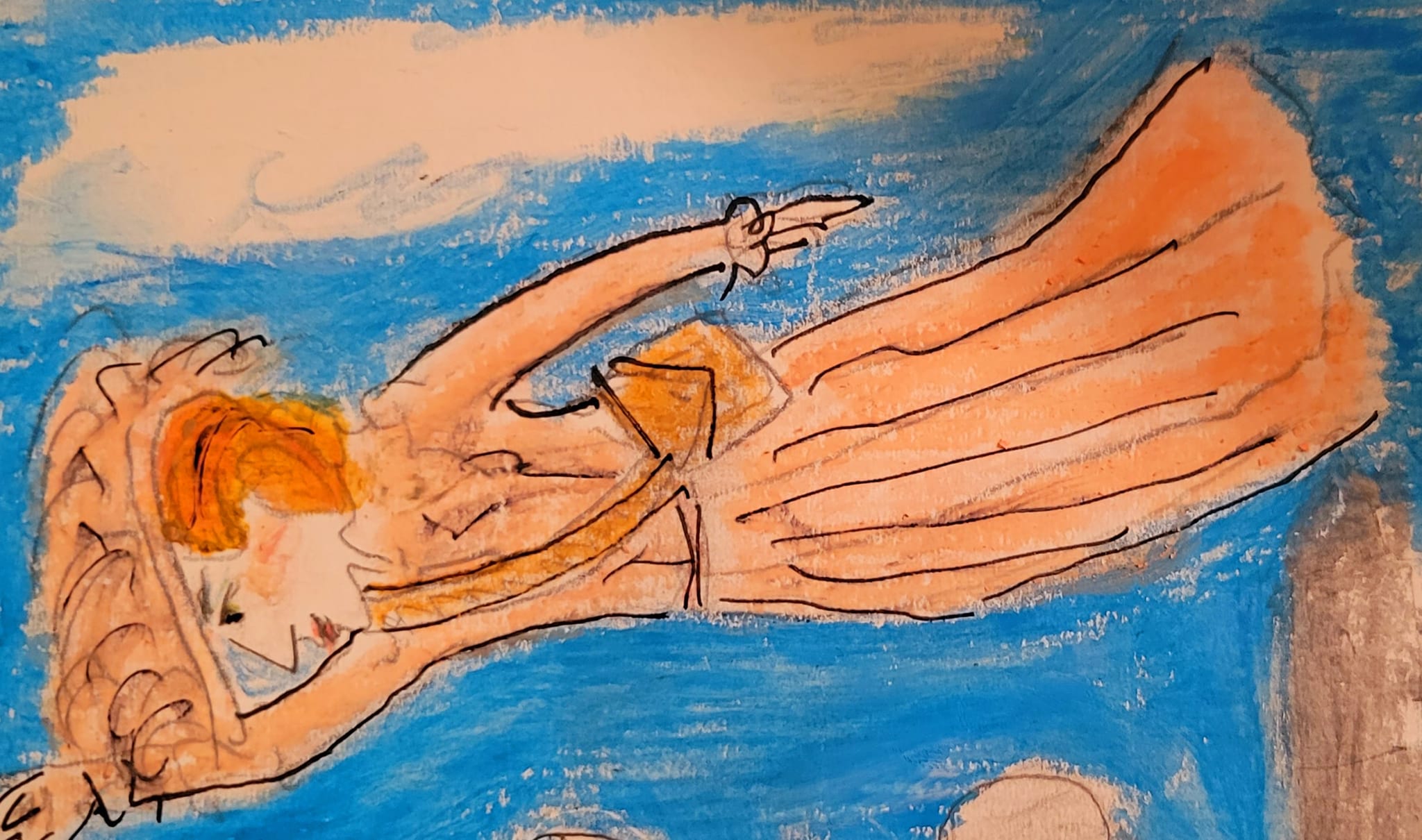
He thought that "psychical excursions" in which an aspect of the self travels beyond the body and may be perceived by others are primary evidence that consciousness is not confined to a physical vehicle and will therefore survive death. To refer to what we might call an OBE or astral projection,  Myers coined the scary term “psychorrhagy,” and referred to a propensity for this experience as a “psychorrhagic diathesis” [4] . At the high end this might be an ecstasy giving access to a spiritual world and to “communities higher than any which this planet knows” [5]

Myers described “self-projections” as “the one definitive act which it seems as though a man might perform equally well before and after bodily death” [6] 

The first major public work by Myers, with Edmund Gurney and Frank Podmore, was titles Phantasms of the Living. Based on thousands of cases collected and analyzed by the  Society for Psychical Research, this huge book was devoted to "apparitions of persons still living", received through any or all of the senses. Myers declares in his introduction that "we have no wish either to mystify or startle mankind". Yet the sheer volume of first-hand testimony of encounters with "ghosts of the living" would startle many audiences..

Myers says the authors are not aiming at any “paradoxical reversion of established scientific conclusions” but rather “working in the main track of discovery” and “assailing a problem which, though strange and hard does yet stand next in order among the new adventures on which science must needs set forth” [7]  Trying to walk a middle path between the Spiritualists and the evolutionists, Myers continues, “We held it incumbent upon us… to conduct our inquiries in the ‘dry light' of a dispassionate search for truth” [8]  

Some of my favorite cases involve experiences in the hypnagogic zone, between sleep and awake, sometimes when a visitor steps from a dream into the dreamer's physical space. Thus a minister from Bradford, the Rev. E.H.Sugden, reports a vivid dream of a person he knows well. Waking suddenly, he finds the man in his room. "I saw him in the light of early morning, standing by my bedside in the very attitude of the dream." The minister gives him a good kick and he vanishes. [9]

Myers' published oeuvre spanned a wide spectrum. He published poetry and essays on classical literature and a fascinating short autobiography that was unfortunately bowdlerized before publication by his widow. [10] Then there is all he has to tell us from the other side of death, especially the scripts recorded via two remarkable women mediums, Winifred Coombe- Tennant ("Mrs. Willett") and Geraldine Cummins. In his communications with Winifred, Myers gives the impression of a well-organized Club of psychic researchers working indefatigably to deliver evidence of the survival of physical death - from the other side of death. [11] Via Geraldine, Myers authored books describing several stages of the soul' s transitions beyond the physical plane, a comprehensive Western Bardo.  


I feel tremendous affinity for "Fred" Myers across time, and gratitude for his work, which continued after death. While I was rereading 
Phantasms of the Living I made a comment about it to a friend who exclaimed,  "Those Victorian ghost hunters really rock". I couldn't resist fooling around with an AI image generator to see what that might look like. 


References

[1] Frederic W.H. Myers, Human Personality and Its Survival of Bodily Death (London: Longmans. Green, 1903) Vol. 1, p.7
[2] ibid, Vol. 2, p. 267
[3] ibid, Vol. 2, p. 274
[4] ibid Vol. 1, p. 264
[5] ibid Vol. 2, p. 194. 
[6] Vol. 1, p. 297). 
[7] Edmund Gurney, Frederic W.H. Myers and Frank Podmore,  Phantasms of the Living (London: Society for Psychical Research/Trübner & Co, 1886) Vol. 1, p.xxxvi
[8] ibid p.xlix
[9] ibid  Vol1, pp.390-1
[10] Frederic W.H. Myers, Fragments of Prose & Poetry edited by Eveleen Myers (London: Longmans, Green, 1904)
[11] Gerald William, Earl of Balfour, "A Study of the Psychological Aspects of Mrs. Willett’s Mediumship, and of the Statement of the Communicators Concerning Process" in Proceedings of the Society for Psychical Research, Vol 43., 1935) 43-317. Geraldine Cummins, Swan on a Black Sea, A Study in Automatic Writing: The Cummins-Willett Scripts (London: Routledge and Kegan Paul, 1965
[12] Geraldine Cummins, The Road to Immortality: Being a description of the afterlife purporting to be communicated by the late F.W.H. Myers (London: Ivor Nicholson and Watson, 1933)

Illustrations 

Top: "Psychical Excursion: Edwardian Lady in Astral Flight" Drawing by Robert Moss

Bottom: "Fred and the Phantasms". Digital art by RM


Tuesday, November 22, 2022

A Dreamer's Notes: Under the Threshold


Less can be more. I am going to start sharing brief notes from my commonplace book (aka my journal) on this blog, ranging from current movie reviews to snippets of ancient philosophy.


 Soul in Slumberland 

The movie Slumberland, available on Netflix, is getting rave reviews and deserves them. It's deeply moving and visually stunning, sad and scary at times but relieved by flashes of wild humor and with a deeply satisfying ending. We travel through many dream doors and learn how it might be possible to enter the dreams of others. We see that loving contact with the departed is possible in dreams. We learn what can be gained when we brave up to nightmare fears. We are drawn to think about whether there are dream producers and dream regulators who try to give us the dreams they think we need and apply certain rules.

Most exciting, for me, is the vivid depiction of what can happen if we lose a vital part of ourselves - the beautiful bright dreamer - through soul loss and it goes off to live in another world, leaving us bereft of dreams and their magic in regular life. And what it means to get that dreaming self back in the body.


Beneath the Threshold

"Out of slumber proceeds each fresh arousal and initiation of waking activities....To some extent at least the abeyance of the supraliminal must be the liberation of the subliminal. To some extent the obscuration of the noonday glare of man's waking consciousness must reveal the far-reaching faint corona of his unexpected and impalpable powers."
- Frederic W.H. Myers, in his masterwork Human Personality and its Survival of Bodily Death. Myers, a classical scholar and poet as well as one of the founders of the Society for Psychical Research, is using language he invented. In the Glossary at the start of Human Personality, he defines "subliminal" as follows: "Of thoughts, feelings, &c,, lying beneath the ordinary threshold (limen) of consciousness, as opposed to supraliminal, lying above the threshold...The threshold (Schwelle) must be regarded as a level above which waves may rise - like a slab washed by the sea - rather than as the entrance to a chamber."


“She walks into a dream like you walk into another room."

A few lines from a fantasy novel by a popular author who understands dream travel:
“They go journeying by dream all the time. She can't understand why I make such a fuss about it."
"So you dream of your woman?"
"She is not my woman. Never talk about a woman [of her people] that way. And I don't dream about her. She comes into my dreams."
"What's the difference?"
"In the world you and I grew up in, nothing at all. In her world, she walks into a dream like you walk into another room."
- This passage is from Forest Mage, the second novel in Robin Hobb's Soldier Son trilogy. She gives us clear, simple insight into the nature of dream travel, as experienced by ancient and indigenous shamans and Active Dreamers today: the essential dimension missing from any number of psychology and sleep research books.

Stoic Divination through Sympathy and Soul Travel 

The Stoics had an optimistic belief in divine pronoia: that the gods sent forewarning to humans out of benevolence. They defined divination as “the foreknowledge and foretelling of things that happen fortuitously” (Cicero De Divinatione2.13). The future that cane be foreseen for them is not predetermined.

Two modes of divination described by the far-traveled philosopher Posidonius are observation of the "affinity of al things" and the close study of dreams. He spent time with druids in Gaul and wrote five books on divination, of which only fragments survive, mostly in the pages of De Divinatione, a philosophical dialogue by Cicero. The concept of sympatheia - the  "affinity of all things” (συμπάθεια τον όλον) – presents the world, including the gods, as a unified organism with mutually interrelated parts that turn on each other. Everything is part of a cosmic body. Just as your whole body may respond to the lightest touch on your little toe, what happens to any part of the cosmos may resonate with the whole and generate an event far away. 

Posidonius taught that the soul travels free from the body during sleep. “Divination finds a positive support in nature, which teaches us how great is the power of the soul when it is divorced from the bodily senses as it is especially in sleep and in times of frenzy or inspiration: (Cicero de div 1.129). The Stoics held that dream divination is open to all, a view resoundingly espoused by Synesius of Cyrene in his wonderful little book On Dreams around the year 404.


Image: "Subliminal" by RM with AI assistance


Tuesday, October 4, 2022

Talking through Frosted Glass: a Psychic Researcher Tries to Communicate after Death


An eminent psychic researcher, trying to communicate with the living from his new residence on the Other Side, complained that getting through is as difficult as trying to dictate to an obtuse secretary through frosted glass. The whole quotation is marvelous: 

"The nearest simile I can find to express the difficulties of sending a message - is that I appear to be standing behind a sheet of frosted glass - which blurs sight and deadens sound - dictating feebly - to a reluctant and very obtuse secretary. A feeling of terrible impotence burdens me - I am so powerless to tell what means so much - I cannot get into communication with those who would understand and believe me."

The speaker is the Victorian classicist, poet and pioneer parapsychologist Frederic W.H. Myers, one of the founders of the Society for Psychical Research. He used his language skills and poetic imagination to give us a rich vocabulary for the workings of consciousness, from "subliminal" and "supernormal" to "telepathy" and "psychorragy" (the last one did not catch on). He dedicated himself to producing evidence admissible by the scientific establishment of his day that would prove of the survival of consciousness after physical death. 

Like several of his colleagues engaged in psychic research around the beginning of the 20th century, he promised to report back from the other side of death after he got there. He came through to many mediums, and some of the transcriptions are fascinating. He was credited as the author of several books on conditions in the afterlife channeled by receivers such as the gifted Irish medium Geraldine Cummins.

The frustration "Fred" Myers expressed above was part of a session with the medium the S.P.R. identified as "Mrs. Holland"; she just happened to be Rudyard Kipling's sister.

I found the quote in an extraordinary book, The Eager Dead: A Study in Haunting, by Archie Roy, a founder of the Scottish Society for Psychical Research. The odd title The Eager Dead is derived from the statement of one of the early luminaries of the Society for Psychical Research (the Australian Richard Hodgson) that he could not wait to get to the afterlife in order to report from there. The book includes a passage from Jean Balfour describing a family home where there was the sense of the dead pressing in eagerly to feel out and communicate with certain visitors – and hiding away in the presence of a certain guest, the medium “Mrs. Willett” (Winifred Coombe-Tennant) who is a principal in the main story.

Roy was both a distinguished Scottish astronomer, a researcher of the paranormal, and an author of horror fiction (Devil in the Darkness). I am delighted by the novelistic skills he brings to the long prologue to The Eager Dead (“Shears of Atropos”) in which he presents his characters in vignettes, starting with Queen Victoria always sleeping with a picture of Albert on his deathbed on her own headboard.   

Archie Roy beavered away for years tracking the famous “Cross Correspondences” by which Myers and other Victorian ghosts gave partial messages to mediums in different places that made sense only when the transcripts were put together by the psychic detectives of the S.P.R.  Thus Myers gave partial notes on a place in Florence, larded with bits of Greek and Latin, to a medium in England and another in America who had no knowledge of each other. Put together, the notes made a coherent message. This sort of thing was taken to be evidence of authentic communication by a specific individual from the Other Side.

The astonishing central plot of The Eager Dead appears to be an endeavor by the dead ghost hunters to put a spirit into a body on this side – by arranging for the spirit of Edmund Gurney to be born to a spirited young woman in a conventional marriage to a much older man, whose natural psychic gifts had been enhanced through the tragic loss of her infant daughter. The woman was “Mrs. Willett”. Conception would require a living male, and Gerald Balfour, brother of  Arthur Balfour, a British Prime Minister, was chosen. A deep love affair blossomed, with a spiritual marriage in a chapel, and the result was a child who was named Augustus Henry. He grew up in ignorance of his supposed origins, was decorated for valor, escaped a Nazi P.O.W. camp and presented himself as a skeptic about survival when he enlisted a medium to talk to his mother after her death. (He is the subject of a recent biography by Welsh historian Bernard Lewis, Soldier, Spy, Monk: The Life of Henry Coombe-Tennant.) 

Archie Roy had access to a vast amount of material from the Balfour family that was not fully available to previous writers. Though all the detail on the Cross Correspondences experiments is exhausting as well as exhaustive there are gems in his book, like Fred Myers' complaint about frosted glass. 

In the spirit of his subjects, Archie Roy was quoted in his Times obituary (published on January 16, 2013) saying “If when I die, I find out I have not survived, I’ll be very surprised.”


Photo by RM

-          


Thursday, November 29, 2018

Psychorrhagy, or the Origin of Ghosts and Doppelgangers


I am walking near a neighborhood store. From a block away, I see a friend who works in the store walking a dog, a German shepherd. It would be more accurate to say that she is walking him; he is struggling to keep up as she pulls on the leash. I don’t call out because they are quite some distance away, and cars are moving between us on a busy street. But as I return home from my walk, I stop by the wine shop. My friend is behind the counter, and I notice he has changed his clothes.
    “Where’s your dog?” I ask him.
    “She’s at home. I never bring her into the store.”
    “She’s a German shepherd, right?”
    “Right.” He stares at me. “How did you know?”
    “I thought I saw the two of you outside just now.” I describe the scene – including the checked shirt and brown pants I saw the man in the street wearing, which my friend recognizes – and especially my vision of the dog pulling him as if she wanted to take him somewhere,
    My friend turns pale. “I know where that might be,” he allows.
    He tells me, haltingly, that the woman with whom he lived for many years recently took her own life. He has not seen her since they broke up, did not go to her funeral and has not – yet – visited her gravesite.
    I get the impression that such a visit is now very much on his agenda.
    I find it fascinating that my friend’s doppelganger appeared with the double of his dog, which seemed to be leading him on an important mission – perhaps into the realm of the dead. Cross-culturally, dogs play an important role as conductors of souls in mythology, folklore and shamanic practice: as fierce boundary guardians (like Virgil’s Cerberus), as hellhounds that seize the wicked (like the red-eyed hounds of Annwn, a Celtic underworld), but above all as psychopomps (like Anubis or the dogs of Nehallenia, a Celtic patron of Otherworld voyagers) who can safely escort travelers between realms.
    This incident is quite instructive about the origin and nature of ghosts – ghosts of both the living and the dead, subtle ghosts that are perceptible only to the inner senses and heavy ghosts that are audible and visible to the physical senses.
    In its heyday around 1900, the Society for Psychical Research (SPR) took a keen interest in “phantasms of the living”, ghosts, and dreams of the dead, correctly fining common elements in these phenomena. One of the founders of the SPR, the great Victorian psychic researcher Frederic Myers, coined a word to describe the origin of the kind of doppelganger I saw on the street. He called an episode of this kind a psychorrhagy. The word literally means a bursting or breaking loose of the psyche, as a hemorrhage is a bursting of blood. In Myers’full definition, psychorrhagy is “a special idiosyncrasy which tends to make the phantasm of a person easily perceptible; the breaking loose of a psychical element, definable mainly by its power of producing a phantasm, perceptible by one or more persons, in some portion of space.” [1] This might be caused by strong emotion, such as grief or fear.
    Myers was a classicist and a poet as well as a parapsychologist. He was relentless not only in his quest for evidence of psychic events – and especially of the soul’s survival of physical death – but in his efforts to provide an exact vocabulary to describe such events. Drawing on his command of Greek and Latin, he coined the now familiar term telepathy as well as many other terms that are still in use by researchers in these fields – supernormal and retrocognition among others. Some of Myers’ coinages have caught on; psychorrhagy has not. It is rather hard on the eye of the average nonclassicist reader, especially when couples with diathesis, a medical term used to define a constitutional tendency towards certain ailments or symptoms. Psychorrhagic diathesis, in Myers’ lexicon, is “a habit or capacity of detaching some psychical element, involuntarily and without purpose, in such a way as to produce a phantasm.” [2]
      Translation? Think of my sighting of the double and his dog in front of the wine shop. Some of the psychic energy of my friend seems to have “broken loose” and produced a double – dense enough to be mistaken for his physical self even under the midday sun. For a living person to go on missing so much dense etheric energy for any length of time would be likely to produce fatigue, debility, and illness – and later, possibly physical death. Hence the old popular belief that seeing someone’s fetch (an English and Irish term for this kind of doppelganger could portend death. The uncanny nature of the double is reflected in Dante Gabriel Rossetti's painting "How They Met Themselves" in which a couple in a dark wood are astounded to meet their second selves are react accordingly - the woman by fainting, the man by drawing his sword. [3]
     Ghosts, in our usual parlance, are already dead, in the sense that the physical bodies from which they were projected have died. But a ghost may have originated before the physical death of its unconscious maker, through the unwitting projection or psychorrhagy of dense energy.
      Ghost that remain stuck in one place for years after death are rarely very interesting. Either they have lost their minds or their awareness is smothered by a heavy energy sheath, like something wrapped in used chewing gum. Of ghosts in this sense, Andrew Lang observed correctly, “Since the days of ancient Egypt, ghosts have learned, and have forgotten, nothing”. [4]

References
      1.F.W.H. Myers, Human Personality and Its Survival of Bodily Death (London: Longmans, Green, 1903) vol.1, xx.
      2. ibid. 
      3. Rossetti was fascinated by the double, and painted and drew several versions of this picture. He drew the first version when he was 23 and called it his Bogie Drawing. He painted his first watercolor version during his honeymoon with his model,Elizabeth Siddal, who died two years later from a laudanum overdose. When I was nineteen, I played Dante Gabriel Rossetti in a repertory performance titled "An Evening with the Pre-Raphaelites".
      4.Andrew Lang, Dreams and Ghosts (Hollywood CA: Newcastle Publishing,1972) 13-15


Text adapted from The Dreamer’s Book of the Dead by Robert Moss. Published by Destiny Books.


Art: Dante Gabriel Rossetti, "How They Met Themseves" (1864 watercolor version)

Wednesday, March 23, 2016

Feeling for Brussels: presentiment and prayer


I've been hearing from people who seem to have dreamed the horror in Brussels at the time of the tragedy, or before it. F.W.H. Myers, the Victorian researcher who coined the word "telepathy", defined it as "fellow-feeling at a distance". As humans, we are connected to all things human and it is natural that some of us will dream and sense what others are suffering, even half a world away, especially if we have a personal connection to the places and people involved. Mass events throw a shadow before them that touches many, in dreams and in other ways.   
      Since the news of the terrible events in Brussels, I have been reflecting on my own strange experiences at Brussels airport last month, when I was changing planes. I was overwhelmed by horrible feelings of dread. As I walked to my departure gate, I started sweating more violently than ever before in my life. I told a friend afterwards that I was "sweating bullets". I slumped into a seat feeling that the world was about to end.I found my imagination lurching into a vivid fantasy of what it would mean to die here, in transit and in a state of confusion, and what it might take to make the right connection after death.
   
     I am not a nervous flyer, and I catch many planes every month, generally relaxed and open to what the adventures may bring. I am now inclined to think that my terrible feelings and sensations at Brussels airport were an example of presentiment - of knowing something in the body before the event takes place that might cause those somatic conditions. And that my fantasy may have been advance knowledge of the immediate after-death condition of some of those who suffered untimely deaths. I will pray for them to find the right guides and the right paths on the Other Side.

Sunday, July 7, 2013

Victorian Ghost Hunter Shows Me the Spiral Castle


"Go up on the mountain," said an inner voice I have come to know as I lay under the sheet, preparing to let my body sleep. "Meet me there."
    I knew that voice, and smiled because it echoed something my dream double had said recently to a friend in a green valley, far away. He told her that he could not spend time with her because he had to go up on a mountain to meet his elder brother, who had sent him a message that he wanted to share an important secret. I have no brothers in ordinary life. I suspect that my elder brother on the mountain, in my friend's dream, is a second self who lives just above my world, able to read patterns that escape me. I often think of him as my Double on the Balcony.
    So around 2:00 a.m. I relaxed, and enjoyed the sense of slipping free from the body, the noise of the fan, and the muggy heat of the town. I arrived at a castle on a rise that did not seem to be a mountain, but may have looked mountain-high to medieval travelers or besiegers. The castle was entirely constructed of red brick, in northern "Brick Gothic" style.
    I now had a companion. He did not look like my Double on the Balcony, and if there was a family resemblance I suspect it would be shared interests. He looked like one of the Victorian ghost-hunters who intrigue me and are quite often the theme of my studies and sometimes my dreams. He had a dark, full beard and wore a frock coat.
    He was eager to show me the design of the castle. It had been constructed and expanded in three phases. The core of the castle, its inner keep, combined the oldest and the newest part of the structure. The builders had worked out from this center, in an expanding spiral, and then returned to the center in the final phase, spiraling back in. From the air, the spiral pattern was clear.
    I had no idea, until now, that a castle could be both strong and so fluid. As my guide escorted me around the walls, he was almost skipping as he helped me to understand the spiral patterns. I clapped my hands with delight. He showed me there were friendly pubs and cafes in each of the three sections of the castle, and that I could take a break whenever I liked.
    I returned to my body from this excursion full of good cheer and confidence, quite sure that certain issues of structure and construction I've been facing in a current book project will be easily resolved, if I hold to that spiral design. I don't remember how my traveling self got to the castle. The red bricks remind me of castles I have visited in the Baltic, especially Trakai and Kaunas in Lithuania, and there will be more about my adventures in Lithuania in my new book.
     The Victorian-style gentleman reminds me of 
W.T. (William Thomas) Stead, the newspaper editor, radical reformer and eager psychic researcher. Along with F.W.H. Myers, Stead is a great favorite of mine among the Victorian ghost-hunters; he was well acquainted with Robert Louis Stevenson, Henry James and William James.
    I was reading a collection of essays by Stead just before going to bed last night, so I may have invited his attentions - or encouraged one of my own doubles to do some Victorian dress-up. Stead was fascinated by "ghosts of the living": by the possibility that, wittingly or unwittingly, all of us are capable of projecting astral doubles or rather tangible "thought forms" that can interact with others. 

    He came to think that we may be leading continuous lives outside our present physical bodies, and that dreams can be memories of those other lives. In his essay "The Ghost That Dwells in Us", Stead reports the case of a man who claimed that whenever he closed his eyes he woke up in another body in a life that was completely different from his ordinary reality. He enjoyed both lives, but preferred the one he was living while his body was asleep.
     Stead speculated that "it is not impossible to conceive the possibility of a continuous series of connected dreams, which would result in giving us a realizing sense of leading two existences." I think this is exactly right. If we fail to notice this, it is because of our imperfect memories. In our dream situations, we forget what we are in the world of the sleeping body. When we return to the body, we forget most of what we experiences when we were out of it, or living in other bodies in other realities. But when we acquire a "realizing sense" (in Stead's quaint and attractive phrase) of what may be going on here, we may start to remember more of what it means to be alive in the multiverse.
    By the way, Stead gets around. He was renowned for his personal psychic gifts when he was alive. He communicated with an assistant by pure telepathy, beaming thoughts to her and then letting his hand record her responses - which were usually quite specific and accurate - through semi-automatic writing. Before he went down on the Titanic, he had promised to report on conditions on the Other Side after death. He kept his promise. He returned (via a medium) to give one of the best and (to my mind) most reliable accounts of what happens after death in a marvelous little book published as The Blue Island.


For more on Stead and the Victorian psychic researchers, please see The Dreamer's Book of the Dead.

Friday, March 30, 2012

Dream legacy from a Victorian psychic researcher


Dreams give us assignments. In my first cycle of sleep, I dreamed I discovered a rich trove of materials from Frederic (F.W.H.) Myers, the great Victorian researcher of the paranormal. The materials were both manuscripts and recordings. Some of the transcriptions were faulty and needed to be revised; some of the recordings sounded as if the speaker had a cleft palate. But there were riches here quite unknown to the public. Walking a familiar city street,  I announced to a friend, with high excitement, that I intended to produce a corrected version and make them known. I sensed a stir of spirits around me as I talked, fluttering like birds or bats. There was nothing sinister about these lively shades; their presence added to my enthusiasm for my project.
     This dream will drive me back to my study of Myers; I wrote a little about him in my Dreamer's Book of the Dead. The quest that drove him was to provide evidence of the soul's survival of physical death, evidence that would pass muster with the scientists of his time. "To prove that man survives death would be to transform and transfigure his whole life here now," he wrote in Human Personality and Its Survival of Bodily Death. That masterwork was unfinished at the time of his death and was published posthumously.
     Some believe that Myers continued his work on the Other Side, and fulfilled his promise to his colleagues in the Society for Psychical Research in England to supply first-hand information once he got there by dictating a series of new works via psychic mediums in the years after he passed over. The most interesting of these channeled works, received via Geraldine Cummins, are titled The Road to Immortality and Beyond Human Personality, and describe a series of transition zones after physical death.

     I have long felt an affinity for Myers not only because of his quest, but because of his love of words and of wordplay. A poet and classical scholar, he tried to give us a fresh vocabulary to describe interactions of mind and matter, levels of consciousness, and transits of spirit. His love of words and his sense of the importance of how we name things was so great that he inserted a glossary at the beginning, rather than at the end, of his magnum opus Human Personality. It is studded with terms that are his own invention. Some of his coinages, like "telepathy" have become household words. Some will probably never enter common English or even the technical lexicons of parapsychology, but stimulate all sorts of ideas, as with:

           Psychorragy – a bursting through of psychic phenomena. 
Cosmopathic – Open to the access of supernormal knowledge or emotion, apparently from the transcendental world, but whose precise source we have no way of knowing.
Methectic – of communications between one stratum of a man’s intelligence and another; as when he writes message whose origin is in his own subliminal self.

     So, dream-directed, I return to what Myers has left us, in his own hand or through the hands of others. My eye falls on a passage in Beyond Human Personality, the second of the works received by Geraldine Cummins, in which he speaks of how we create our after-death environments according to our imagination. Speaking from the Other Side, Myers declares that it is through the imagination (or lack thereof) that man approaches paradise or falls into situations far short of that:

Imagination plays an important part in his conceptions of paradise. If it has become perverted through his deeds and thoughts when he was a man, it may create sinister surroundings for him, or perhaps, kindle the old fires of hate till they blaze again and continue to flame until their folly becomes apparent and thus, in time, he wearies of the sameness, of the monotony, of this particular kind of experience. Love, on the other hand, will draw about the soul the conditions necessary for its fulfilment. And in this world beyond death, very beautiful surroundings may be built up by the imaginations of those who truly love. These latter are not, however, as numerous as is commonly believed. If there be any soil or stain, any weakness in their love, the picture which they have created as their background will in some way be faulty, and, though it furnish temporary satisfaction, be far from the ideal of the seeker of Heaven.

All good stuff, but the style is inferior to the best of Myers' writings when he was still on the earthly plane. Maybe, as in my dream, there is need for a better transcription.


Illustration: "Fred" Myers. Drawing by Robert Moss with digital effects