Showing posts with label soul loss. Show all posts

Tuesday, May 27, 2025

When Her Husband Saw His Own Soul


After the Danish explorer Knud Rasmussen had lived for six months with the Netsilik Inuit, some of his hosts opened up about their dreams, their shamans and their sacred stories. The stories were only told to the right person at the right time, because, Rasmussen noted, “all that is described in them did really happen once, when everything in the world was different to what it is now. Thus these tales are both their real history and the source of all their religious ideas.” [1]
      Over long nights by the fire in an ice hut or a tent, the women were especially loquacious and some were formidable. Nalungiaq, a Netsilik woman, was married to her third husband, who had killed her second husband, who had killed her first husband, all from the desire to possess her. She described a time when there was no time, when the world was dark and there was no difference between humans and animals; they could take each other’s forms.
      She spoke of how the dead are alive in dreams. “We believe that dead people whom we see so vividly in dreams really are alive. In that way dreams have taught us that people live on after death. For very often our dear departed come to us while we sleep, and we see that they live, and that they are the same as when they lived together with us on earth.” [2]
      Rasmussen heard many stories of how souls wander beyond the body, and sometimes get lost or stolen, which is when the services of a shaman, an angakok. may be required.
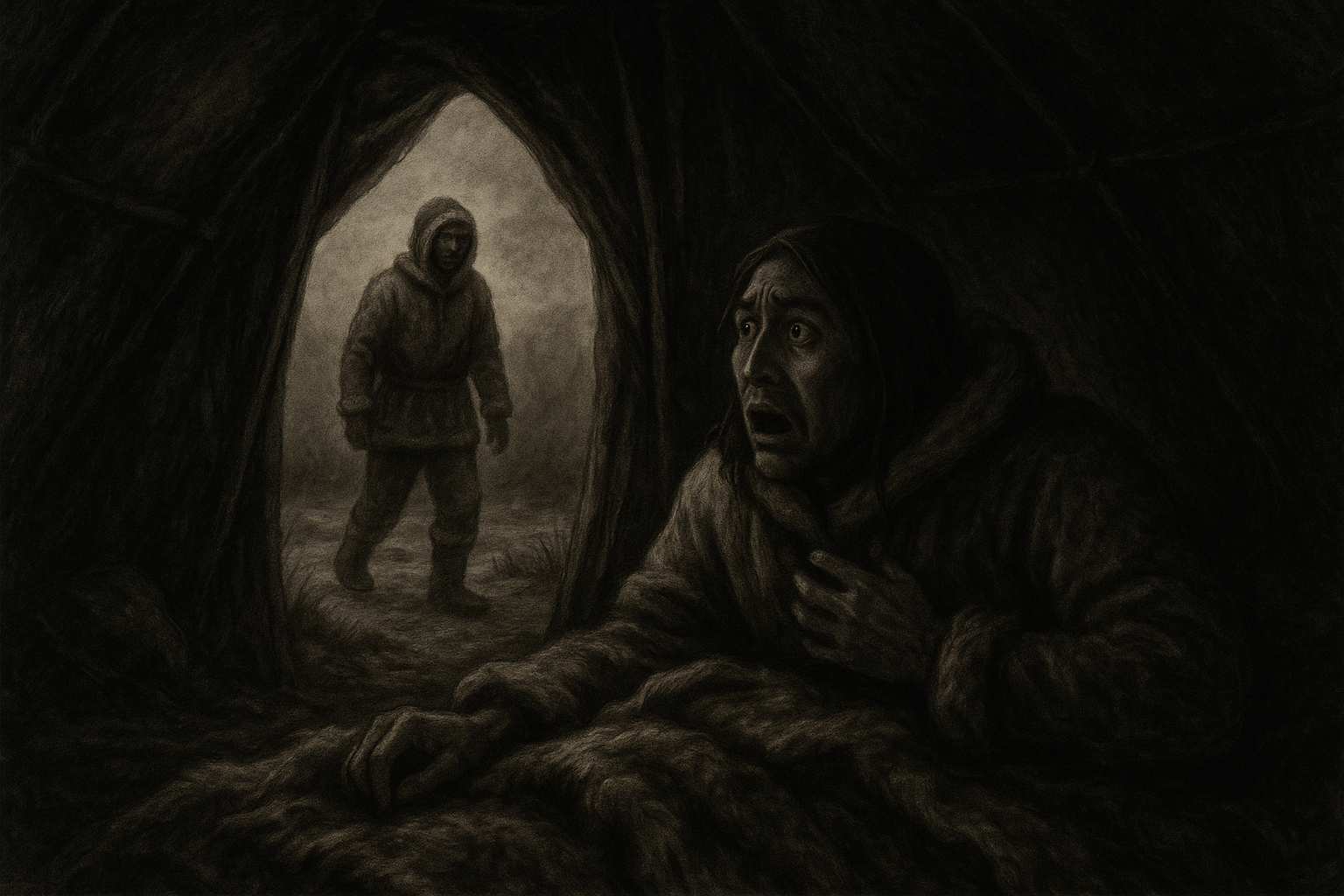
      Manelaq, the wife of Qaorssuaq, told how her husband once saw his own soul, wandering apart from his body, and where this led. Qaorssuaq had lain ill for a long time, and no one could understand what was wrong with him. Then one day, he saw "his own living self" a little way away.
      "No one else could see him. Seeing himself suddenly outside his own body he began to shiver all over. What he saw was his own soul, and it was owing to his illness that it had left his body. All trembling he stretched out his arms towards his soul and cried: 'Come nearer, come nearer. Come to me, come back to me!'
       " I could not understand what was happening to him and had to hold him by the hood when he kept on trembling. At the very moment I took hold of him the vision disappeared, but the soul did not return to his body. It had fled just at the moment it was perhaps on its way back to his body, for I was unclean and just in those days had my bleedings, and therefore the soul fled from me."
       Help came in the form of a couple who were both shamans. "When they heard what had happened, they insisted that 1 should go into a corner of the -tent, right over behind the fireplace; there I had to lie with my head hidden in a heap of caribou bones. While I remained concealed there, the two shamans conjured and summoned their helping spirits. They held a great seance in order to call the soul back to Qaorssuaq's body. And it was not long before he again saw his soul.
       "The two shamans, to whom nothing was impossible, could see it too. They uttered magic words and spoke with their helping spirits' own tongue until the soul came quite close to Qaorssuaq. Then they suddenly sprang to him and began to beat him here and there on his body, the consequence being that the soul was frightened and became so scared that it slipped into Qaorssuaq's body once more.
       "At the very same moment he was well again and I could hear him shouting and singing with joy. Only then did I venture to rise from the heap of animal bones where I had hidden my head till then, and we all sang with happiness. In that way Qaorssuaq got his soul back again." [3]
      It may seem odd that the vagrant soul was induced to get back in the body rather than go further away when the beating began, but it seems the shamans knew what they were doing. The magic words were certainly an important part of their operation. Inuit shamans have special language to do special things. Rasmussen later recounts a story of how magic words were used by an angakok to create a kind of Inuit golem , turning a neap of snow into a black bear. [4] Calling up helping spirits is central to Inuit shamanic practice, as in other traditions. An Inuit name for a spirit helper means "one that exists to be questioned" and the variety of entities that may play this role can be startling. Rasmussen mentions one shaman whose helping spirits included the moon, a sea scorpion, and one of his father’s living dogs. [5] 
     Inuit shamans were unwilling to share much of their training and practice with an outsider, and some told Rasmussen that the great shamans were no more; their tradition was in deep decay. Nonetheless, he was able to report how Inuit shamans are often called by the spirits in dreams. were prolific dreamers and "lived long in a dual world as real shamans must do". In the shaman’s calling, the spirits took the initiative, in dreams. If you could retain your dream experiences and apply them to the world around you, you had keys to mysteries impenetrable to others. [6]
     Rasmussen collected stories of shamanic soul flight, which Mircea Eliade, controversially, thought was the central feature of shamanic practice. [7] His most memorable tales came from Inuit recounting the deeds of illustrious ancestors. “I am a shaman myself,” an informant named Samik told him, “ but I am nothing compared with my grandfather Titqatsaq. He lived in the time when a shaman could go down to the mother of the sea beasts, fly up to the moon or make excursions out through space.”   
    Titqatsag was a frequent flyer. He loved spirit flight, and had a friendly rival, Muraoq, who also took to the air. They met in spirit flight over sea ice midway between their villages. As they converged, Muraoq spread his arms, like a bird gliding on its wings, but did not judge distance well and crashed violently into Tirqatsaq, who fell down onto the ice. He could not move until Muraoq called in helping spirits to get him up. Then the incident was mirrored. Back in the air, Tirqatsag crashed into Muraoq, who dropped to the ice and had to be rescued by his rival’s helping spirits in turn. Even shamans may need flight controllers. [8]


References

1.       Knud Rasmussen, The Netsilik Eskimo Social Life and Spiritual Culture. Report of the Fifth Thule Expedition 1921-24, (Copenhagen: Gyldendalske Boghhandewl, 1931) p. 207.
2. Ibid., p. 213
3. Ibid. p. 216
4. ibid., pp.288-91.
5. ibid., p. 294
6. ibid,, p.296
7. Mircea Eliade, Eliade. Shamanism: Archaic Techniques of Ecstasy. (Princeton: Princeton University Press, 1974).
8. Rasmussen op.cit., pp 299-300.


Illustration RM + AI


Tuesday, December 17, 2024

Play First, Work Later (& delight your inner child)


Like puppies or lion cubs or dolphins spinning silver lariats of bubbles, children play for the joy of playing. Young children are masters of imagination, since they know the magic of making things up. Our first and best teacher of conscious living is our inner child.
     But that inner child may have gone into hiding, under a glass dome or in a room in Grandma’s house, because of shame or abuse, ridicule or loneliness, because the world wasn’t safe or it wasn’t fun. If we have lost our dreams, if our imagination is stuck in a groove, it’s because we have lost our inner child. To live as active dreamers in everyday life, we have to bring that child home. This requires a quest, a negotiation, and fulfillment of a promise. 
     The quest will lead us down halls of memory to a place and time where our wonder child went missing. We can embark on the quest as a guided journey to a real place in the imaginal realm, or through the portal of a dream or memory from childhood.
     T
he negotiation requires us to convince our child selves that we are safe and we are fun to be around. Fulfilling the promises we make will require us to remember to play without scheduling it.
     Play first, work later, our child selves will insist. The cautious dutiful adult self will protest. But if we are to keep our inner children at home in our bodies and our lives, we’ll need to fulfill our promises to be fun as well as safe. If we play well enough, then before we quite know it, we’ll fall in love with our work because it will be our play. 


Text adapted from Active DreamingJourneying Beyond Self-Limitation to a Life of Wild Freedom 
by Robert Moss. Published by New World Library. 


Wednesday, November 20, 2024

The Dreams Are Coming Back


In contemporary society, dream drought is a widespread affliction, almost a pandemic. This is deadly serious, because night dreams are an essential corrective to the delusions of the day. They hold up a mirror to our everyday actions and attitudes and put us in touch with deeper sources of knowing than the everyday mind. If you lose your dreams, you may lose your inner compass. If your dreams are long gone, it may be because you have lost the part of you that is the dreamer.
     As I describe in Dreamways of the Iroquois, traditional elders of the First Peoples of North America say bluntly that if we have lost our dreams, it is because we have lost a vital part of our soul. This may have happened early in life through what shamans call soul loss, when our magical child went away because the world seemed to cold and cruel. Helping the dream-bereft to recover their dreams may amount to bringing lost souls back to the lives and bodies where they belong. In my story “Dreamtakers”in Mysterious Realities I describe a shamanic journey to help return dream souls to people who have lost them. This is something I teach and practice.
     There are several ways we can seek to break a dream drought any night we want to give this a try. We can set a juicy intention for the night and be ready to record whatever is with us whenever we wake up. We can resolve to be kind to fragments. The wispiest trace of a dream can be exciting to play with, and as you play with it you may find you are pulling back more of the previously forgotten dream. 
     If you don’t remember a dream when you first wake up, laze in bed for a few minutes and see if something comes back. Wiggle around in the bed. Sometimes returning to the body posture we were in earlier in the night helps to bring back what we were dreaming when our bodies were arranged that way.

     If you still don’t have a dream, write something down anyway: whatever is in your awareness, including feelings and physical sensations. You are catching the residue of a dream even if the dream itself is gone. As you do this, you are saying to the source of your dreams, “I’m listening. Talk to me.”
     You may find that, though your dreams have flown, you have a sense of clarity and direction that is the legacy of the night. We solve problems in our sleep even when we don’t remember the problem-solving process that went on in our dreaming minds.
      And remember that you don’t need to go to sleep in order to dream. The incidents of everyday life will speak to us like dream symbols if we are willing to pay attention. Keep a lookout for the first unusual or striking thing that enters your field of perception in the course of the day and ask whether there could be a message there. When we make it our game to pay attention to coincidence and symbolic pop-ups in everyday life, we oil the dream gates so they let more through from the night

Dream recovery may be soul recovery. Call back your dreams and you may find you are bringing back a beautiful bright dreamer who left your body and your life when the world seemed too cold and too cruel. Maybe she has been hiding out in Grandma's cottage, or a garden behind the Moon. Sometimes the right song will help to bring back that Magical Child with all the dreams fluttering like fireflies in her hair. I wrote a song in this cause and you are welcome to try it:


The dreams are coming back.
Slow down and feel their firefly glow.
Stay still and hear the rustle of their wings.
Open like a flower
and let them feed from your heart.
Don’t be afraid to remember
that your soul has wings
and you have a place to go flying.
The dreams are coming back


Tuesday, November 14, 2023

In the Garden Behind the Moon


I've been rereading The Garden Behind the Moon, by Howard Pyle, originally published in 1895. This may be quite my favorite story for younger readers.

    My friendly daimon of Luna concurs. He especially approves of the fact that a beautiful but terrible entity “whom so many people know by a different name and are so afraid of” is called the Moon-Angel. Around his face, it is bright like sunlight. He “never brings something but he takes something away from him again” - and we come to learn that this is most often the soul of someone who has died. The Moon-Angel of the story is also called the Master Cobbler, which appears to reflect the preferences of an old cobbler in a fishing village who “knows less than nothing” and thereby more than those around him. We see the old cobbler pegging soles to uppers on his last. My daimon points out that there is a crafty allusion here to Sandalphon, the Sandal-Angel or Shoe-Angel who gives and takes away soul bodies for transits to and from the Moon.

So to the story:

   A boy called David, who is not yet twelve, and is regarded as dreamy and simple (a “moon-calf”) by his peers, learns from the old cobbler that a moon-path opens across the sea a day or two after the moon is at its full. Close to shore, the first steps float in the tide as bars of light, slippery underfoot. But if you persist, the moon-path becomes a gravel road, and finally a broad shining field, until you get to the Moon.

    After an initial mishap, the boy gets to the Moon, where a man-in-the-Moon pulls him up a stair. From each window of the Moon house, he sees into different scenes, into the inside as well as the outside. He is set to polishing stars with lamb's wool, for nights when the Moon is waning. He earns a little break; he is allowed down a back stair into a lovely garden where he plays with other children. He has his time in the garden for three days every month, and falls in love with a little princess, but is then told that he cannot return to the garden because he is turning twelve, and will be too old.

     Now he is called to the Quest: to win his girl, he must find the Know All book in the Wonder Box that has been hidden since Eve and Adam (note the order) were driven form the garden. To do this, he must “go behind” the Moon-Angel, something that has almost never been done. When he confronts the Moon-Angel, we begin to feel his terror as well as his beauty. In effect the boy has to step through  his form, through unbearable cold that transforms to unbearable heat. He bursts through a great iron door into the landscape of the Quest. He is no longer a boy; he has aged ten years.

    He finds his local guide - a woman in a red shift who cleans souls and leaves them out to dry. She tells him what he will need to do to capture the black winged horse that will take him to the Iron Castle of the Iron Man where the Wonder Box has long been locked up. He catches the black horse by the forelock (like Kairos - opportunity - time). It can no longer fly with a human on its back, but it can run fast. David manages to enter the Iron Castle, and steals the Wonder Box, and rediscovers the girl - escapes from the Iron Castle, and kills the Iron Man with a stone from the sea shore.

    David and his beloved return to the “brown world” on the moon path, but find that the path branches to take each to their separate homes. So now there is another test, for the princess (she's a real one) to find her hero and for the Wonder Box she took from him to be opened with the key that he retained. A happy and triumphant ending, of course. 

     In which the most interesting feature (as my daimon observes, pointing a finger up under his left eye) is that nobody knew that David was missing all the time he spent in the house of the Moon and the lands beyond it. And nobody in Princess Aurelia's kingdom knew she was gone either; they had merely found her, from birth, strangely mute and emotion-less. She's fully alive now that her soul has come home from the Garden Behind the Moon. 

    So we may catch the hint that the story is about soul loss, when people around you may not notice you are missing, only that you are duller and quieter. And that there are places where lost souls go, from which they may be brought home by those who can muster the courage and imagination to get through some version of the Moon-Angel.


Monday, November 13, 2023

Jung and the Woman Who Lived on the Moon


Jung worked with a woman patient who said she had been living on the Moon for many years. Investigating her life history, Jung discovered that she had suffered terrible and multiple abuse of the kind that might make any of us want to check out of life on Earth. as a result of terrible abuse.

When Jung spoke of this in a public lecture, he declared matter-of-factly that she really was living on the Moon. The young Marie Louise von Franz , in the lecture audience, was shocked. How could the distinguished Herr Professor Dr. Jung talk in this way? She confronted him at the end of his talk. He couldn’t be serious, surely.

Marie-Louise suggested to Jung that what he meant to say that the patient's situation was “as if” she lived on the Moon.

Jung replied, “No, not ‘as if’. She did live on the Moon.”

By her own account, Marie-Louise thought at the time that the famous psychologist must be crazy. Later she came to understand that Jung recognized that when we suffer intolerable conditions in this world, part of us may part company with us in order to survive. Shamans call this phenomenon soul loss.

Jung did not use that language, but clearly he understood it well. If part of that young woman's soul had left her because the ordinary world seemed too cold and too cruel, why should it not go to the astral realm of Luna, which in ancient and indigenous traditions - as we reviewed - is recognized to be "thickly settled" by spirits who take a close interest in human affairs? 

Von Franz tells the story of The Woman Who Lived on the Moon in Animus and Anima in Fairy Tales (Toronto: Inner City Books, 2002). She talks about the same episode in the documentary film "The Wisdom of the Dream".


Illustration from Jung's Red Book

Sunday, October 29, 2023

Story for Samhain: The dream god and the swan maiden


We find beauty or terror in our contacts with the Otherworld - or our flight from it - according to our courage and the colors of our imaginations. 

How people respond to the banshee is an excellent example. The banshee is well-known in Celtic folk memory as a death messenger, whose appearance and weird cries are feared as the sign that death is near. The banshee is often depicted as a hag, or a crow, or a crow-woman.  

 But the banshee is actually the bean sidhe, which means "she-faery". She can appear as a being of amazing beauty. She can come as a personal or family guardian in tight situations - as a family banshee appeared to members of the royal house of Munster on the eve of the battle of Clontarf.  

Above all, the banshee comes to invite us or escort us on the Otherworld journey: not only the journey that follows physical death, but on journeys beyond the physical world from which we may return to the body with magic and power.  

Banshees are much abroad at Samhain, or Halloween.  

The story of Aislinge Óenguso, The Dream of Aengus,  turns the traditional fear of the banshee on its head. Instead of being scared of being caught by a banshee, the hero of this story is out to catch one, because night after night, she has been visiting him as his dream lover. This wild love story haunted Yeats all of his life and inspired him to write some of his most haunting verse. We'll call the hero Aengus, as the poet did.  

 Aengus is a lover and a friend of lovers. He is a trickster, a shaman and a soul healer. He is described as "mac Oc", the Young Son, forever young. He lives in the Brugh na Boinne, a palace beneath a Mound of Wonder that recent travelers know as Newgrange. Women everywhere dream of Aengus; his butterfly kisses graze their lips and their secret places.  

 But Aengus is no longer master of his own dreams. His dreams have a mistress. She first appeared by his bedside in a glory of red-gold hair, her long white body dancing through the veils to music that played him like a harp and shook him like a tambourine. Carried by the music and his surge of passionate desire, Aengus flies with her, like a wild swan, into a different landscape.

In the morning, exhausted, he can barely fall out of bed. He is listless, lethargic, not even interested in sex, his speciality. This goes on night after night, day after day. His mother is troubled. She sends for a famous doctor, so skilled he can diagnose what is wrong in a house before he walks through the door, by reading shapes in the smoke from the fire.  

The doctor sees at once that Aengus is away: a part of his soul has left his body to live with his dream lover. The cure is to put body and soul together again. This involves finding the girl, and putting the lovers together in their physical as well as their astral bodies.

Will Aengus please describe his dream mistress as exactly as possible? He aches for her as he speaks of the red-gold hair, the pearly skin.  

Very well, Aengus' mother has resources. She is a queen and a goddess of the Tuatha de Danaan. She will send out searchers to look for a girl who fits Aengus's description.

This is not such an easy assignment, however, because the dream lover is of the Sidhe, and is hidden in the faery mists. A year passes, and she is not found.  

Now Aengus' father is called in. He is the Big Guy among the old gods, the Dagda, one end of whose outrageously huge eight-pronged club delivers instant death, while the other brings the dead back to life. But he can't or won't help with finding the dream lover, except to recommend the far-sighted Bodb the king of the Sidhe in Munster, as the faery for the job.  

 Bodb tracks the girl to yet another of the Mounds of Wonder. The girl is a bean sidhe, and she has the right kind of name for a banshee. Her name is Caer Ibormeith, which means Yew Berry. Of all trees in her landscape, the yew is most intimately associated with death.

It is agreed that Aengus must rally himself and go to Yew Berry's mound to spy on the banshee and make sure she is the one he has dreamed. She is. Her beauty shines beyond that of the "three times fifty" noble ladies about her, all wearing silver at their throats while Yew Berry wears gold.  

 At this point, in a different kind of story, we might expect the dream lovers to fall into each other's arms and elope. After all, they have been doing it every night for two years. But there are complications.

First off, Yew Berry's mound  is in the realm of the notorious Queen Maeve and her jealous husband Aillil, and they must not be scorned. They agree to help bring the lovers together, but Yew Berry's father won't hear of it. Even after the joined forces of the Dagda and King Aillil have stormed his faery fort, he clings to his daughter.  

 There are many tests and battles before the secret is learned. Yew Berry is under an enchantment, sometimes represented as a curse, sometimes - in the deeper tellings - as a gift. She does not stay in one form. She is a beautiful woman for one year. Then for the next year she is a white swan. Then the cycle repeats.  

The day of shapechanging is Samhain. If Aengus would win her, he must find her on the liminal day, on a lake whose name is The Dragon's Mouth. At Samhain, Aengus goes to the Dragon's Mouth. He finds "three times fifty" white swans with silver chains around their necks, and one swan with a gold chain. He recognizes his love in the shape of the beautiful white bird, and calls to Yew Berry to fly to him. No, she tells him. You must change into my form.

Aengus changes, becoming the long-necked bird. They mate, in beating splendor, above the deeps of the Dragon's Mouth. They fly together back to the palace of Brugh na Boinne - Newgrange - and the love music they make in flight is so lovely and lulling that all the land is at peace and people drift into pleasant dreams and stay there for three days.  

 It is an amazing story, a love god smitten by love, and seizing a moment of opportunity - at Samhain - to bring his lover from one realm into another.

In the best-known tellings of the Dream of Aengus, death is not mentioned. But the whole story is a dance with death, in several guises. It involves the death-in-life that we suffer when a part of our soul goes away, because of pain or abuse or heartbreak or - in this case - a longing for something beyond the familiar world. It involves the rescue of someone or something from the Land of the Dead. Yew Berry's name is a dead giveway. Her mound  is actually a piece of the Underworld, her father one of the princes of the dead.  

Terror or beauty, banshee or faery lover. On the Night When the Veil Thins, we are especially reminded that we can never claim the treasures of the Otherworld - and a love bigger than the familiar world - unless we can brave up. 


Text adapted from The Dreamer's Book of the Dead by Robert Moss published by Destiny Books.


 Art: "Swan People" by Robert Moss

Sunday, October 1, 2023

Active Dreaming for Soul Recovery


Shamans understand that soul loss is the root of much illness and confusion in our lives. It may be caused by pain or trauma or heartbreak, by wrenching life choices, or by wimping out on our best and bravest dreams. It can reduce us to the condition of the walking dead, passionless and dreary, forever trying to fit in with other people's needs and expectations, lost to our own deeper purpose.


Soul retrieval is a shamanic operation in which the practitioner journeys to bring back lost soul-parts and puts them into the client's body (typically by blowing into one or more of the energy centers, most often the heart or the crown of the head). Soul recovery is a practice in which we help each other to become self-healers and function as our own shamanic practitioners - to gather and integrate our own families of selves and bring wholeness and vital energy into our lives.

Dream reentry frequently opens the road to soul recovery, because our dreams show us where our missing parts may have gone, and invite us to reach in and bring them back. When we dream again and again of the "old place" (maybe a childhood home, maybe a space we shared with a former partner) we may be learning that a part of ourselves - a part scared away by trauma, or a part that resisted a choice we made - is "stuck" in that place, or went missing at the time we lived there.

By going back inside the dream of the "old place" in a lucid shamanic journey, we may be able to locate that lost aspect of our own identity and energy and find the way to bring it back into our hearts and our lives. Typically, soul recovery of this kind will require reassurance and negotiation. Our younger self may need to be reassured that she is not going to be hurt in the way she was hurt before. She may need to be convinced that we will include things in our lives that she will enjoy and will engage her passions.

In the practice of soul recovery, we support each other without necessarily playing shamanic practitioner for each other – since the heart of this practice is to assist everyone who is able to become a self-healer. The core technique is dream reentry and tracking. This is a method of interactive shamanic lucid dreaming explained in depth in my books, especially Dreaming the Soul Back HomeAs applied for soul recovery, we place the focus on locating and reclaiming lost aspects of soul energy that may have surfaced in a dream or a life memory.

The tracker may be required to play an activist role - for example, by helping the dreamer to move beyond a fear, by running interference if there are negative entities in the field, by bringing in the tracker's own animal guardians, or by negotiating directly with some of the dreamer's younger or "other" selves. Before undertaking the soul recovery journey, dreamer and tracker should try to reach a clear agreement on how far the tracker should go (or not go) in assisting the healing.

What do we do for a person who has suffered soul loss and does not have a dream? This is of course a common condition. The Onkwehonwe, or Iroquois, say that if we have lost our dreams, we have lost our souls - at least, the part of our soul-self that is the dreamer and remembers the deeper life. Several Active Dreaming techniques can help the dream-deprived to open a gateway to soul recovery – and reclaim part of themselves that is the beautiful dreamer. 

We can encourage them to call up the last dream that they remember. It may be a dream or nightmare from early childhood. I have been privileged to help facilitate profound soul recovery healing by getting an adult bereft of their dreams to revisit a dream from thirty years ago, or longer. We can help a dreamless, soul-damaged person to revisit a life memory in the same way that they might reenter a dream.

We can perform dream transfer in the service of soul recovery for someone who has lost their dreams. We journey for them and grow a dream for them that they can be helped to enter and can provide an authentic portal for self-healing. Active dreamers know we can bring a dream to someone in need of a dream.


Art: "Many Selves" by Robert Moss

Sunday, September 17, 2023

Soul loss and soul recovery: Essential Q&A


Ø  What is soul loss?

When we suffer trauma or bitter disappointment or violent shock, soul may leave the body, to escape. This produces the phenomenon that psychologists call dissociation and shamans call soul loss. It can be seen as a survival mechanism. When you can’t take any more pain, you go away in order to make it through.
          A child who has been abused, a survivor grieving for a beloved partner who has died, a lover who has been betrayed and abandoned, a soldier who  is shell-shocked, and the victim of a terrible accident are all likely to have suffered major soul loss.
          Let’s notice that soul loss need not be major, or the result of violent events. We suffer a lesser degree of soul loss when we choose one direction in life over another, or when we put our energy and focus into one thing rather than another – like holding down the job instead of pursuing a creative project, or being a mom instead of a lover (or vice versa).  Soul loss may be merely temporary and transitional “soul drift”, as when we are jet-lagged and it takes a while for us to catch up with ourselves. 

Ø  What are the symptoms of soul loss?

Common symptoms of soul loss include:  chronic fatigue;  emotional numbness; chronic depression;  spaciness;  addictive behaviors; low self-esteem; inability to let go of past situations or people no longer in your life; dissociation and multiple personality disorder; obesity or unexplained weight gain;  abusive behaviors;  absence of dream recall;  recurring dreams of locations from earlier life, or of a self separate from your present self

Ø  What is the difference, in a practical sense, between someone with a lot of soul in their bodies and someone who does not?

For people with a lot of soul, or vital energy, in their bodies, most of the symptoms of soul-loss listed above would be rare, transient, or absent. For someone who has suffered significant soul loss, three or more of these symptoms are likely to be chronic.

Ø  Why does the soul have a hard time staying in the body?

We suffer pain or abuse, grief or shame, and part of us finds the world so cruel that we want to go away. Soul loss is also caused by wrenching life choices: we decide to leave a relationship, a home, a job, a country, a lifestyle — but part of us resists that choice, sometimes to the point of splitting away and withdrawing its energy from our lives. We also lose soul energy when we give up on our dreams and settle for a life of dull compromise, refusing to trust ourselves to love or to take that creative leap.

Ø  Where does soul go when it leaves?

Sometimes we find that a part of ourselves  is stuck in the old place, in Granma’s house, or in the apartment we shared with our first love. Sometimes a soul part we lost seems to be living in a separate reality, like the land of the Lost Boys in Peter Pan. When we wish ourselves dead, a part of our soul may go far way, as far as a Land of the Dead.

Ø  Are all aspects of soul recoverable?

There are parts that are so damaged we don’t want them back. Sometime they appear burned or charred, dark or addicted. Sometimes our life choices are so radical that a part of ourselves simply cannot be persuaded to share our present situation. My inner businessman is quite disgusted with the choices I have made, and won’t stay close to me unless I make money more of a priority than I am likely to do!

Ø  What is the first step that someone who would like to experience more soul in their life to take?

You do some cleanup, and you ask for help. In my book Dreaming the Soul Back Home, as in my retreats, I offer practical guidance for psychic cleansing and release. One of my favorites is a very simple fire releasing in which we cast out any heavy energies that are holding us back and clear a space for vital soul to come back in. It’s very important to remember that we have help available, including from our spiritual allies and our own Greater Self, and that it’s always a good idea to ask for help nicely.

Ø  What role does addiction play in soul loss?

Addiction can be both a cause and an effect of soul loss. Part of our brighter energy may leave us if we fall into habits and company it doesn’t like. When we are missing a part of ourselves, things come in to fill the gap, and we reach for things to fill that gap. From a shamanic viewpoint, addictions are often worsened by spirits of the dead who are seeking to feed their own cravings through a living person. I have never met a true alcoholic, for example, who has not (from my viewpoint) been accompanied by dead drunks. In the book, as in my programs, I offer practical guidance to create healthy psychic boundaries between the living and the deceased.

Ø  What is the difference between spirit and soul? 

We can’t lose spirit, when the term means mind, higher consciousness or our spark of the Godhead.  But we can lose contact with it, and block our own access to the Greater Self.  Soul is a different matter. Soul is quite mobile and soul energy is divisible; we can lose parts of it and take on parts from others that we really don’t want around.

Ø  You have developed an original approach to healing through what you call “soul recovery”. What are the key elements in this approach?

We use the core techniques of Active Dreaming to bring more of soul into the body and help others to become whole. By learning to share dreams with others in the right way, we create a safe space where our younger and brighter selves can draw closer, and we start to build communities of soul friends. By learning to use a dream as a doorway through which we can travel — in shamanic lucid dreaming — into a deeper space, we can go to the places where lost souls can be found and reclaimed, and we help each other to do this.

Ø  Are there other ways, in addition to working with our dreams, to experience soul recovery?  If so, what are they?

Soul retrieval, as opposed to soul recovery is a shamanic operation in which the practitioner makes a journey on behalf of a client to locate lost aspects of soul, brings them back, and transfers them to the client’s body, often by blowing them into energy centers such as the heart and the crown of the head. It can be a profoundly healing event. It reaches parts that Western psychology often does not reach, and may be essential in cases where people are missing so much of themselves that they are not equipped to become self-healers until an intervention has taken place. The limitation of this is approach is that nearly everything depends on the character and skill of the practitioner, on the reality of his or her connection with spirit helpers, and on the quality and motivation of those helpers.

Ø  You say that dreams not only show us what the soul wants, they also show us where it has gone.  Please elaborate and provide an example of this.

Our dreams can tell us which parts of ourselves may be missing, and when it is timely to bring them home. Recurring dreams in which we go back to a scene from our earlier lives may indicate that a part of us has remained there. Dreams in which we perceive a younger self as a separate individual may be nudging us to recognize and recover a part of ourselves we lost at that age. Sometimes we do not know who that beautiful child is – until we take a closer look
     A middle-aged woman recently approached me for help. She told me, "I feel I have lost the part of me that can give trust and know joy." As preparation for our meeting, I asked her to start a dream journal, although she had told me she had not remembered her dreams for many years. When she came to see me, she had succeeded in capturing just one tiny fragment from a dream. She remembered that she was standing over a table, looking at three large-size "post-it" notes. Each had a typed message. But the ink had faded and she could not read the messages.
    Slowly and carefully, I helped her to relax and encouraged her to try to go back inside her dream. Quite quickly, she found herself inside a room in the house where she had lived with her ex-husband prior to their divorce, almost twenty years before. Now she could read the typed messages. The first read in bold capitals, "YOU CAN DO IT." They were all about living with heart, and trusting life.
    She realized that she had left her ability to love and to trust in that room for nearly twenty years. I asked her what she needed to do. She told me, "I need to bring my heart out of that room and put it back in my body." She gathered up the messages and made the motion of bringing them into her heart. As her hands crossed over the place of her heart, we both saw a sweet and gentle light shine out from her heart center. She trembled, eyes shining, and told me, "Something just came back. Something that was missing for twenty years."


Bear creation by Tracy Cunningham. Bear is a great ally in soul recovery.

Wednesday, September 13, 2023

Soul Loss: The Shaman’s Diagnosis of Our Existential Complaints


The greatest contribution of the ancient shamans to our medicine and healing today is the understanding that in the course of any life we are liable to suffer soul loss - the loss of parts of our vital energy and identity - and that in order to be whole and well, we must find the means of soul recovery.

     On a visceral level, we all know how soul loss comes about. We suffer pain or trauma or abuse, we are overwhelmed by grief or guilt or shame, and part of us goes away because it doesn't want to stay in a world that seems so harsh and cruel. We are compelled to make a wrenching life choice, leaving a partner or a job or a home, and part of us resists that choice and parts company with our dominant personality, clinging to the old relationship or the old place. Soul loss deepens when we fall into depression or addiction or make compromises with the world as we understand it, giving up on our big dreams of life. Lacking the courage and confidence to make that creative leap, or to trust ourselves to love, we wimp out - and part of our bright spirit, disgusted with us, goes away.

    Good analysts and therapists can help us to recognize parts of ourselves we have repressed and denied, including the famous Shadow, the term especially favored by Jungians for what we have tried to relegate to the basement of the personal unconscious because we would rather not own it as a part of ourselves. The shamanic concept of soul loss reaches further. It recognizes that soul healing is not only about recognizing and integrating aspects of the self that we have buried or denied; it is retrieving pieces of soul that have literally gone missing and need to be located and persuaded to return and take up residence in the body where they belong.

    In my own practice, I have come to distinguish five forms of soul loss or disconnection that call for healing. I have yet to encounter a human being who is immune to any of these.


Loss of vital energy

You suffer from chronic fatigue. You find yourself torpid and listless, reluctant to get out of bed. Your days seem drab and gray and joyless. Your immune system in blown and you seem to pick up every passing bug. There is something missing in you and you try to stuff the whole with sugar or booze.


Loss of younger selves

You have lost younger versions of yourself - the young child with abounding energy and that beautiful imagination, that fine romantic who was hurt or betrayed as a teen, that inner poet or businessman who wanted to make different life choices from the ones you made. These younger selves have gifts and energy you can use in your life today if only you can find out where they are and discover how to bring them back.


Loss of animal spirits

Indigenous and ancestral shamans know that we are all connected to the world of the animal powers, and that by recognizing and nurturing our relation with animal spirits, we find and follow ther natural path four eneries. Yet many of us have lost this primal connection, or know it only as a superficial wannabe symbolic thing that we look up in books and medicine cards without feeding and living every day.


Loss of ancestral soul

This is a two-edged affair. When we live oblivious to the fact that we are always in the presence of the ancestors - those of our bloodlines, those of the land where we live, and those of our spiritual kin in a broader sense - we are likely to be the plaything and even the tenement for entities we don't necessarily want to have near us. When we awaken to ancestral soul, we become ready to claim the connection with wisdom-keepers and protectors who can help us to re-establish healthy psychic boundaries and clear out what does not belong with us.


Loss of connection with the Greater Self

Ultimately we can only make peace between the many aspects of our selves, and follow a path of true spiritual evolution by opening or re-opening a direct and conscious connection with the Self on a higher level - the Self that is no stranger. When we clear the right space within our embodied selves, we may be ready for the deep and beautiful act of soul growing that I call spiritual enthronement, bringing a part of the Higher Self to live in our bodies and infuse our lives and our life choices with its radiance.


I have learned that dreams often show us where soul had gone, and offer paths by which it can be reached and encouraged to come home. Through the techniques of Active Dreaming, we can learn to help each other to become the shamans of our own souls and the healers of our own lives.


For much more on soul loss and soul recovery, please see Dreaming the Soul Back Home by Robert Moss. Published by New World Library.


Art: "Wrapped in Butterflies" by Robert Moss

Wednesday, June 21, 2023

A Mirror for the Sun Goddess


At the solstice, a story from Japan about the sun goddess. In Japan, as in many world cultures, the sun is feminine. The tale is a profound teaching story about soul loss and soul recovery comes from Japan. It is a mythic tale of Amaterasu Omikami, the Japanese sun goddess, and it offers a wonderful script for soul healing. Perhaps you can find yourself - and more of your soul - inside it.
     The beloved sun goddess Amaterasu is shamed and abused by a raging male, her stormy brother/consort Susanowo, who is a hero when is comes to fighting monsters but is no hero in the family home. They have had children together, born magically from gifts they have given each other – three girls from Susanowo’s sword and five boys from the jewels of Amaterasu.
     But Susanowo plays spoiler, smearing excrement where Amaterasu made fertile fields and crops, throwing a horse that is sacred to the goddess into the midst of her intimate weaving circle, and so on. The storm god’s violence reaches the point where Amaterasu takes refuge in a rock cave. And the light goes from the world.
      In her dark cavern the once radiant goddess sits brooding on the past, sinking deeper and deeper into feelings of guilt and shame. Maybe she starts telling herself that what has happened is somehow her fault, that she failed her consort in some important way, that she failed to give what was needed. In the depths, she has lost her inner light, while the world has lost her radiance. The myriad gods and goddesses are desperate to call the sun back.
     They try many ruses to lure Amaterasu out of the dark cave. They call on a wise god, whose name means Keeper of Thoughts, to advise them. He usually keeps his best ideas to himself, but the cold and darkness in the world have got him worried too. So he counsels the gods to gather all the roosters than can be relied to crow at dawn. He tells the gods to hang a mirror with strands of jewels on the branches of a Sakaki tree at the entrance of Amaterasu’s cave. The gods do this, decorating the tree with bright cloth banners, without fully understanding the plan. The cocks crow, the gods whoop and howl. And Amaterasu stays in her cave.
      Now one of her sister goddesses, Uzume, comes up with a plan of her own. Uzume is the goddess of mirth and revelry. She is also called the Great Persuader and the Heavenly Alarming Woman. Now we see why. Uzume overturns a tub near the mouth of the rock cave, strips off her clothes like a professional, and moves into a wild, sexy dance that has the gods laughing and bellowing with delight. Amaterasu is curious. Why is everyone having so much fun? She approaches the mouth of her cave and demands to know what is going on. Uzume calls back to her, “We’ve found you the perfect lover. Come and see.”
     Suspicious, Amaterasu peeks around the edge of the boulder she placed at the cave mouth to shut out the world. And she is awed and fascinated to see a figure of radiant beauty looking back at her. She is drawn, irresistibly, to this beauty, and comes up out of the darkness – to discover that the radiant being is her own beautiful self, reflected in the mirror the gods have hung in a tree near the cave. Now the god of Strength rushes out and holds Amaterasu, gently but firmly, to restrain her from going back into the dark. Another god places a magic rope across the entrance to the cave.
    Gods of passion and delight lead Amaterasu back into the assembly of the gods, and her light returns to the world. This is a marvelous collective dream of how soul recovery and soul healing become possible when we help each other to look in the mirror of the greater Self.
     Mirrors hang in the temples of Amaterasu today, to remind us to look for the goddess or god in ourselves. When we locate the drama of Amaterasu in our own lives, we begin to make a mirror for the radiance of the larger Self that can help to bring us, and those we love, up from the dark places.
     In some of my workshops, we have taken the story of Amaterasu's descent to the Underworld and turned it into a shamanic theater of soul recovery, with amazing results. However, the unfortunate cast as Susanowo must be depossessed of his role, and then welcomed back into the circle as a "new man", healed and enlightened. This can be profoundly healing too.

Illustration (c) Robert Moss

Tuesday, May 2, 2023

Where's the rest of me?


I am looking for the rest of me
the one who goes barefoot in lush grass
the one who’s been off-planet most of my life
the one who is living in an old TV series
and needs a cowboy with a big lasso to get her out
the one who was buried under old archives
growing mold in a dirt floored basement
the one who is dancing with a fox
the one who won’t put on an asbestos necklace
the one who is hiding behind the sun
the one who lives in the beauty of flowers and plants
the one who jumps through the pictographs
on the walls of a deep cave, with a white rabbit
the one who might be at the end of a golden tunnel
I’m scared to enter
the one who’s in the room with the No Entry sign
the one who is right here, waiting for me to see her
and hug her and play with her
the one who whispers in dreams you can't quite forget,
“When you are your true self, I’ll be there”

Hey! The flag is up on the magic mailbox
where the dirt road ends in a field
Let’s try again. You open the box
when you answer the question,
“Where is the rest of you?”

“I thought you asked, ‘Where is the restroom key?’
I’ll have to get back to you.”

How about now?

I’ve been riding a rocking horse since I was three
I am trying to block my family ghosts
with a dream catcher made in China
I am shamanic shopping for the Golden Fleece
I am looking for a Thai restaurant that isn’t open
I am reading an email from a dead friend
I am in an enchanted apple orchard with my fairy lover
I am dancing on the dark side of the Moon
I am in my mind, which is everywhere
I am trying to go home to a blue star
I am stuck in a book only I can write my way out of.

-          - Robert Moss 


     This could be called a community poem. I wove it from the dreams and memories that came from members of my Soul Recovery Training at Mosswood Hollow when I suggested they journey on the question, "Where's the rest of me?"

      Photo: Hedge Gate at Mosswood Hollow by RM

P