Showing posts with label presentiment. Show all posts

Wednesday, September 13, 2017

We dream the future, all the time


Our dreams are constantly coaching us for challenges and opportunities that lie ahead of us on the roads of life. It’s possible that we rehearse everything that will take place in the future in our dreams, though we forget most of it. Across human evolution, dreaming has been a vital survival mechanism. In the days when we were naked apes without good weapons, our dream radar – our ability to scout across both space and time – often enabled us to avoid becoming breakfast for saber-toothed tigers or leathery raptors.
     A recent theory posits that dreaming prepares us for challenges by putting us through frequent workouts in threat simulation, helping us to develop the reflexes and responses that will get us through. Our relationship with the future in dreams is much deeper and more important than this. In dreaming, we have access to the matrix in which the events and circumstances that will manifest in our physical lives have their origins. We can not only see future events; we can choose – to varying degrees, and according to our level of consciousness – which among many possible future events will manifest.
     It’s my impression that we are dreaming the future all the time. If you adopt the practice of recording your dreams and comparing the dream data with subsequent events, it won’t take long for you to notice some match-ups. The incidents you preview in your dreams may be trivial or terrifying, blah or wonderful. They may be events in your own life, or events in the future history of the world.
         In our dreams, we have several kinds of engagement with the future.  

Precognitive Dreams

Through precognition, we see events and circumstances ahead of time, as they will be played out. A precognitive dream may be literal, or symbolic or both. For example, a dream of a tsunami might turn out to be both a preview of a literal disaster and advance notice of an emotional storm that will hit with the force of a tsunami. We may not understand what we have seen in a precognitive dream until a physical event catches up with that dream. It may also be difficult for us to understand what we have seen because we are looking at things from a certain angle, perhaps the perspective of a different person. But with practice, we can learn to recognize markers that a dream relates to future events, and we can then move to clarify and use the dream information.
      Such practice becomes very interesting when our dreams show us possible future events that can be changed for the better.

Early Warning Dreams 

Dreams may contain early warnings of a possible future development we may not want – a crisis at work, the bust-up of a relationship, a health problem, a car accident. We may not want to focus on any of these unpleasant possibilities. But if we are willing to study what an early warning dream is telling us, we will often find that it is giving us vital information that can help us avoid a possible future problem if we take appropriate action.
     Sometimes we dream the future for the benefit of another person, even a great cause. What will then happen depends whether we can find an effective way to get the dream information to the person who can best act upon it.

Early Opportunity Dreams 

Early opportunity dreams may also require action if we are going to manifest a future we’ll enjoy. You dream you are in your ideal home, or doing the work that nourishes your soul and your bank account, or you are with your soulmate, who is someone you have not yet met in the regular world. These dreams may be inspiring and encouraging, but you won’t want to leave them floating away from your physical life like helium balloons that have lost their strings. You’ll want to figure out what practical action you can take to move decisively in the direction of that happy dream.

Choosing Alternate Event Tracks

Any future we can see (in dreams or through wakeful intuition) is a possible future. We can influence the odds on the manifestation of a specific future event. While it may seem impossible for an individual to change certain future events perceived in dreams – like a natural disaster or death at an advanced age – it may still be possible to work with the dream information in a useful way: for example, to alert friends not to go on vacation in the place where the dreamed hurricane will hit, or to help someone whose death is near, and the family, to meet that situation with grace and closure.
     We not only travel to past and future; we travel between alternate timelines. With growing awareness, we can develop greater and greater ability to choose the event track – maybe one of infinite alternative possible event tracks – that will be followed through a certain life passage, or even the larger history of our world. This may be a case of the observer effect operating on a human scale. It is well understood that at quantum levels, deep within subatomic space, the act of observation causes plucks a specific phenomenon out of a bubbling cauldron of possibilities. It may be that, in the cauldron of our dreaming: through the act of observation, we select a certain event track that will begin to be manifested in the physical world. By a fresh act of observation, or re-visioning, we can then proceed to alter that event track, or switch to an entirely different one.

Practical advice on dreaming the future

1. Record your dreams. Date them and give them titles. Note your feelings right after each dream.
2. Ask, of any dream: Is it remotely possible that some part of this dream could manifest in the future, literally or metaphorically?
3. Learn to reenter your dreams to clarify information.
4. Come up with an action plan.  If you don't like the possible future event you have dreamed, create an action plan to avoid it or contain it, or at least be fully prepared. If you do like a possible future you have dreamed, come up with an action plan to make it more likely that it will manifest.
5. Note when a later event seems to fulfill a dream. Try to identify personal markers that are telling you that a dream is about the future.
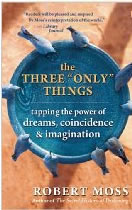
Adapted from The Three “Only” Things: Tapping the Power of Dreams, Coincidence and Imagination by Robert Moss. Published by New World Library.

Friday, December 30, 2016

Déjà vu, how about you?

You walk into a room and meet a long-lost friend. You may smile and embrace, before you realize that you have never met before, in ordinary reality. You pull back, embarrassed. You may tell each other that you were both thinking about someone else. And yet, and yet...somehow you know each other. You drive to an intersection and stop at a red light. You don't hit the gas pedal when the light turns green because you know that behind that white car that is running the red light right in front of you is that truck, not yet visible to your ordinary sight, that is going to barrel through after it. I walk into a workshop space and recognize, in addition to my regulars, eight people who have definitely been in one of my circles before, though I have forgotten their names and the exact circumstances. I greet them one by one, and ask if they have come to a previous workshop with me. In each case, the answer is No, but we agree that we already know each other. The reason for this is not mysterious to me. We have been together in dreams, where I spend more time leading workshops than I do in ordinary reality. These are examples of what we call déjà vu. I'm sure you can add your own. The French term means “already seen”, but often the experience may better be called déjà rêvé, “already dreamed”. Maybe you dreamed an incident before it manifested in the physical world. You may have forgotten the dream completely, but as it starts to play out, you remember something. By my observation, the dream self is forever tracking ahead of the ordinary self, scouting challenges and opportunities that lie in the future.the roads ahead. Its expeditions leave trace memories of the future that come alive when we enter a scene we have dreamed. For some, the experience is so strong that they feel that they have entered a scene they have lived before in the physical sense, perhaps in a previous life. If we are going to continue to talk about these things in French, the correct term would now be déjà vécu, "already lived". While déjà vécu involves the sense of remembering the past — maybe a past lifetime or historical era — déjà rêvé often involves the phenomenon of remembering the future. A dream that is playing out in the world can now can be recognized as a memory of the future.
The edgiest and most exciting possibility is that your sense of déjà vu is generated by your recognition of a situation you have encountered in a parallel life that is now converging or overlapping with your present one. That can bring gifts or challenges, as you take on the karma - good, bad or mixed - of what you have been doing on a different event track that is now converging with your present life path. If you are keeping a journal (if not, start one today) you are poised to have serious fun growing your personal reality. Start by going back through your life memories and jotting down the incidents of déjà vu that you remember, or may have already logged. Study what followed each of these incidents. Now you are ready for your next experience of déjà vu. As it unfolds, you want to trust your immediate feelings. They may give you the sense that you are in the right place at the right time, but they may tell you something quite different. Does this feel like a blessing, a confirmation, a joyous reunion - or like something darker, that makes you uneasy, ready to back off or take cover? Ask yourself whether this could be a dream that is manifesting in external reality. If a dream is playing out, you may find you can now reach back into that dream - even if it was forgotten until now - and capture details that can offer your precious navigational guidance in a developing situation. If this feels like an encounter with a person or place from a "past" life, or like stepping into a scene from a parallel life, then try to pull up more information from that other life - and decide where you want to go with that connection in your present life. photo (c) Robert Moss
Partly adapted from Sidewalk Oracles: Playing with Signs, Symbols and Synchronicity in Everyday Life by Robert Moss. Published by New World Library.

Wednesday, March 23, 2016

What the bleep the body knows before the mind does

A phenomenon that has long intrigued me is how the body sometimes seems to “know” about a future event and responds as if that event has already taken place. This is sometimes called presentiment. In my last post here, I described how I seemed to experience presentiment in relation to the horrific terror attacks in Brussels while changing planes at Brussels airport a month earlier.
     Here I will start with a more benign example, one for which there is also solid evidence, as recorded during a visit to my doctor's office. Here presentiment amounts to experiencing anticipatory symptoms.
     I went to my doctor’s office for an annual physical. A new medical assistant took my blood pressure to get us started. Though she did not faint, but my blood pressure was much higher than normal in the initial reading, much higher even than it had been when I had hobbled into that office two months before with a serious knee injury that had not yet been diagnosed.
    I was startled by the blood pressure reading, since I was in excellent spirits and feeling no anxiety about this visit to the doctor.
    “What do you want to do next?” the assistant asked. “The bloodwork or the EKG?”
“Let’s go for the blood and get a little color.” We briefly discussed how people react to having blood drawn. Personally, I have never minded the needle or the sight of the blood.
     The assistant found the right place and stuck a needle in my left arm. As she extracted the needle after filling the syringe, she started a gusher. I had never seen anything like it in all my years of giving blood or blood specimens. In an instant, my whole left arm was covered in blood, and blood was spattered all over my freshly laundered linen pants.
     The assistant squealed and rushed about, trying to stop the blood flow at the same time as she attempted to treat my pants with hydrogen peroxide.
     “You’re upset!” she panted. The odd thing was that I really wasn't upset at all. I responded quite philosophically, as if the incident had taken place in the past, even as the blood was still spurting and spattering.
     When things were under control, and she calmed down, I asked her to check my blood pressure again. “I want to test a hypothesis,” I told her. “There’s hard laboratory research that suggests that subjects can exhibit physical responses to events before the actual events take place. I want to check whether the spike in my blood pressure came about because - in some way - my body knew what was going to happen and had an anticipatory response.”
     She gaped at me, her eyebrows climbing her forehead, but she obliged.
     She gasped when she gave me the new reading after releasing the pressure cuff. The first number had dropped by fifteen points; the second number had dropped by thirty points. She was amazed because she thought that after the crazy turmoil of the blood gusher, my readings should have gone up, not down.
    “Not if my body knew and reacted to what was going to happen ahead of time,” I suggested quietly.
     When the doctor - a careful, conservative practitioner - came in and heard the data, he was quite impressed. “Maybe there's something in that theory,” he allowed. He decided to check my blood pressure himself. The numbers dropped even lower.
     To my mind, this is pretty persuasive first-hand evidence of the possibility that the body, through its own ways of knowing, may anticipate and respond to an event that has not yet taken place.
     In my book Dreaming True I call this “The White Queen Gambit.” As you may remember, in Through the Looking-Glass the White Queen screams before she pricks her finger. When her brooch-pin subsequently flies open and she does prick her finger, she doesn’t need to scream. “I’ve done all the screaming already,” says the Queen. “What would be the good of having it all over again?”
     It seems that the body, or the energy field around it, has intricate antennae that are constantly scanning for changes that will affect it. Most of us know about this from everyday experience. You have a “gut feeling” about something. You feet a sense of dread or elation, a lifting of the heart or a churning in the stomach that has no evident explanation until a subsequent event takes place that would cause such physical reactions. When the event catches up with the anticipatory symptoms, you and your body may be quite calm and detached – because you’ve done the screaming or the hyperventilating already.
     Scientific research into this phenomenon, sometimes described as “time-reversed interference”, has been going on since the 1990s. Dean Radin ran tests in a University of Nevada lab at Las Vegas that involved showing subjects a series of photographs on a screen that were calculated to produce vividly contrasting somatic reactions, read by scanning heartbeat, perspiration, and so on. A photo of a peaceful rustic scene might be followed by hard porno or a picture of a gruesome crime scene. The very interesting finding was that many times subjects had the physical reactions a certain picture would be expected to produce moments before the image came up on the screen.
    I told the story of my gusher in the doctor’s office to Larry Dossey MD, one of the trailblazers for mind-body medicine in America, and asked him what he thought of my theory that the spike in my blood pressure was an anticipatory symptom. Dossey commented, “I think your interpretation is right on target.  People need to know that these ‘presentiment’ effects are not just laboratory curiosities but are phenomena that get played out in real life zillions of times, under our very noses, quietly, often without our realizing they’re happening.”
    Maybe we can all do a little better if we let our bodies tell us what’s going down. This is a case of “what the bleep we know” that we don’t usually recognize that we know. In my book Sidewalk Oracles I suggest rules for playing the White Queen Gambit. Here they are:

GAME RULES FOR PLAYING THE WHITE QUEEN GAMBIT

1.Pay attention to any sudden change in what you feel in your body.
2.Self-scan to check the source of the shift. If it does not seem to reflect the current state of your body or your feelings, ask whether it is possible that your body’s sensors are picking up something that is happening at a distance, in space or time. You may be experiencing presentiment. Alternatively, you could be experiencing telepathy, which literally means “fellow-feeling at a distance.”
3. Check for subsequent events or discoveries that may reflect that shift in your body.
4. Develop a personal code for signals of this kind. For example, you may find that a certain kind of sudden, sharp and brief pain in the head is a message that someone is trying to contact you. Or you may notice when you smell a certain aroma that is not emanating from your immediate environment, that is a signal that someone at a distance who is connected to you has opened a link. Notice exactly how your body acts in anticipation of a subsequent physical event.

5. Log your findings in your journal. 


Game rules adapted from Sidewalk Oracles: Playing with Signs, Symbols and Synchronicity in Everyday Life by Robert Moss. Published by New World Library.

Feeling for Brussels: presentiment and prayer


I've been hearing from people who seem to have dreamed the horror in Brussels at the time of the tragedy, or before it. F.W.H. Myers, the Victorian researcher who coined the word "telepathy", defined it as "fellow-feeling at a distance". As humans, we are connected to all things human and it is natural that some of us will dream and sense what others are suffering, even half a world away, especially if we have a personal connection to the places and people involved. Mass events throw a shadow before them that touches many, in dreams and in other ways.   
      Since the news of the terrible events in Brussels, I have been reflecting on my own strange experiences at Brussels airport last month, when I was changing planes. I was overwhelmed by horrible feelings of dread. As I walked to my departure gate, I started sweating more violently than ever before in my life. I told a friend afterwards that I was "sweating bullets". I slumped into a seat feeling that the world was about to end.I found my imagination lurching into a vivid fantasy of what it would mean to die here, in transit and in a state of confusion, and what it might take to make the right connection after death.
   
     I am not a nervous flyer, and I catch many planes every month, generally relaxed and open to what the adventures may bring. I am now inclined to think that my terrible feelings and sensations at Brussels airport were an example of presentiment - of knowing something in the body before the event takes place that might cause those somatic conditions. And that my fantasy may have been advance knowledge of the immediate after-death condition of some of those who suffered untimely deaths. I will pray for them to find the right guides and the right paths on the Other Side.

Tuesday, September 23, 2014

Anubis loses his right knee: A cautionary tale


I have a little plastic figure of Anubis I like to carry around with me. Anubis is the canine-headed god of ancient Egypt who is most closely associated with dreaming and travel between the worlds. He's the one you want with you, in friendly mode, at the gates of the world-behind-the-world. In early Egypt, children were given figures of Anubis as guardians of the night and as encouragement to dream strong.
    The fact that my favorite Anubis talisman is just a $5 toy from the children's section of a museum shop tickles me, and brings a warm fuzzy sense of connection with both my Boy Roberts and the big black dog I loved fiercely. When his ears pricked up, he was a dead ringer for Anubis in his full canine form. After he was killed on the road, he returned to me again and again as an impeccable guide, in dreams and visions.
   Yesterday, noticing that Anubis was not on my desk, I went looking for him, and found him in the cargo pocket of the shorts I was wearing on a hot day, leading an adventure in "Dreaming Like an Egyptian" at Mosswood Hollow. When I placed the little figure at my right hand, next to my computer keyboard, I noticed that he was missing part of his right leg. It had broken off just above the knee. I felt even more affection for the little figure, remembering a beloved childhood story of a one-legged toy soldier ("The Steadfast Tin Soldier"). I did not dwell for long on the symbolism of the damage to the right leg, around the knee.
    In the afternoon, I was lugging a heavy burden down the stairs in my home. Since I suffered a knee injury six years ago, I take stairs very carefully, usually holding on to the railing. But the awkward load I was carrying required both hands. At the top of the lower staircase, I had a sudden, vivid vision of myself falling down the stairs. I brushed this aside, not wanting to step into an anxiety projection.
    I made it most of the way down the stairs when I fell, landing heavily on elbows and knees. Blood gushed from my right arm, just below the elbow, but the worst damage was to my right knee. This was the knee that I injured six years ago, when I managed to sever one of the muscles in the quad that holds the kneecap in place. I managed to avoid surgery, but I have needed to be very careful on slopes and stairs, especially going down.
    My knee creaked and complained, and was soon swollen to twice its regular size. Several Aleve tablets and icepacks later, the swelling had subsided and I could get around, limping a bit. I reflected on the fact that I was wearing the same Orvis polo shirt I was wearing on the day, six years before, when I first injured my right knee.
    I went online in the evening and saw that a friend who has taken my dream teacher training fell down stairs - on her face - about the same time.
    I picked up my Anubis figurine and touched the stump of its right leg. There really are things that like to happen together, as the Chinese say.
    Limping around the lake in the park with my little dog this morning, I think about lessons to be drawn. My fall down the stairs was eminently avoidable. I paid the price for failing to pay close enough attention to the kind of coincidence the ancients might have seen as a message from the realm of the gods, and then for confusing presentiment (my vision of the fall) with projection.
    A jogger passes me on the path around the lake. On the back of her tee-shirt is a spiral that forms a question mark. Another wink from the universe.

   To walk the spiral path in life is to notice each time you come to a choice or a situation that resembles one you have encountered before, and then apply what you can learn from the past experience to avoid repeating mistakes. I have seen, again and again, that the secret logic of our lives is revealed through resemblances. Yet I failed to apply the resemblance between Anubis' injury and my already wounded knee. I have experienced presentiment on hundreds of specific occasions, and have learned that my body often reacts to events before the events take place. Yet I brushed aside my vision of the fall.
    In the school of life lessons are repeated until we graduate from each class.
    For now, the fall day is as crisp as a Mackintosh apple just plucked from the tree. The sun is warm on my face, the breeze is cool in my hair, and my busted knee is working well enough to get me round the lake, though much more slowly than the runner with the spiral question mark.
    I'll be on the look out for the next spiral question that is put to me in life class. And I'll keep Anubis, missing his knee and his foreleg, closer to me than ever, to remind me not to fail to apply the logic of resemblances.