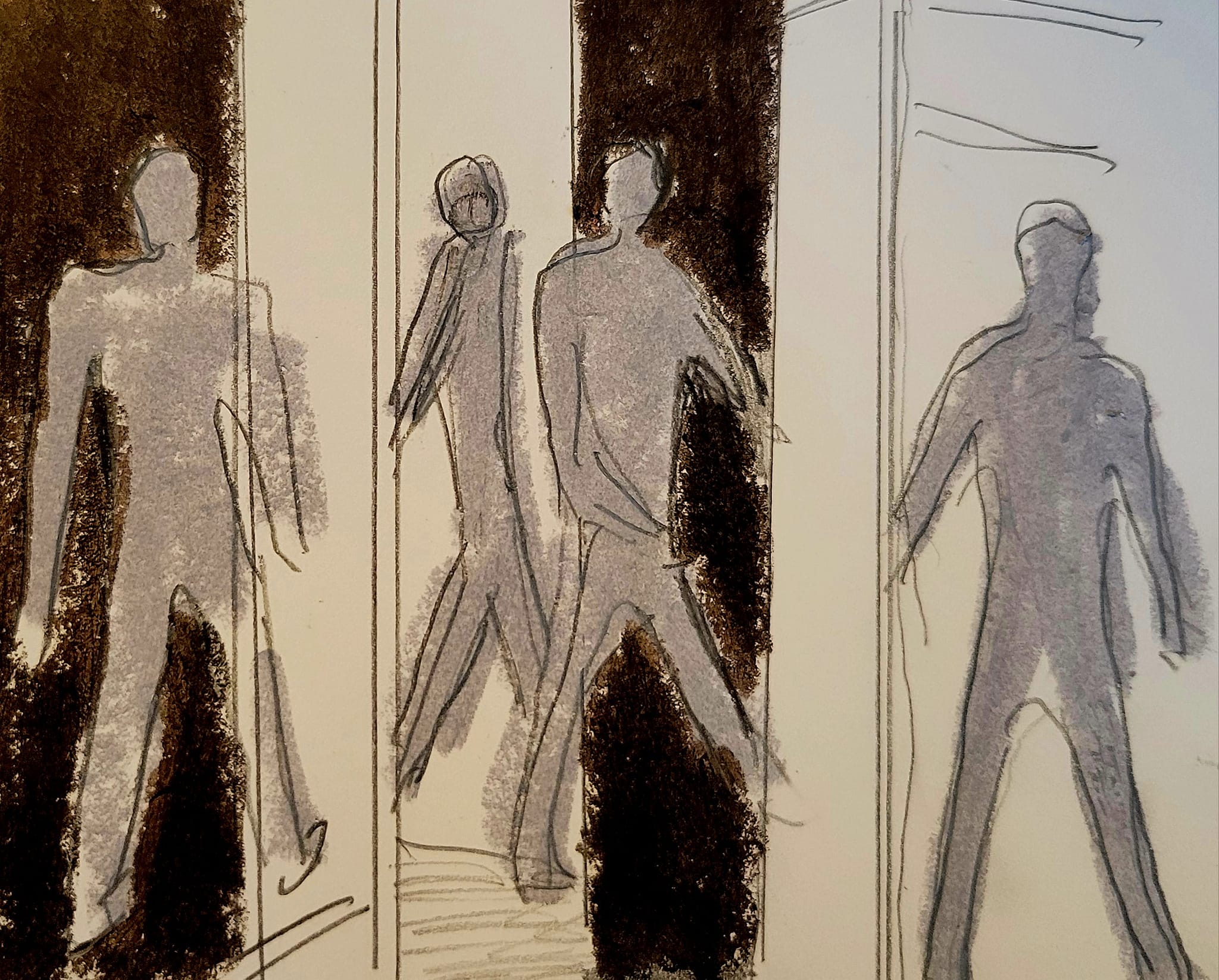
Showing posts with label doppelganger. Show all posts

Saturday, August 17, 2024

Huge and Hugr: The Norse Polypsychic Self


"The air and the paths were alive with magic." The words come from the Volsunga saga, which excited Richard Wagner and Tolkien and still excites the Marvel Cinematic Multiverse. They are spoken when völvas – seers, forest witches - are doing some body swapping. They are arranging for two men to swap bodies for sex in one case and for deception in the other. Swapping bodies, how is that possible? 

We are deep in a world of sorcery and magic, of dreaming and dream travel, in which the self is not recognized as some kind of unitary thing. There are four members in the polypsychic family. They travel in and out of bodies where they reside and can take different forms. They can become animals or birds or aquatic creatures. They can change gender. Gods do this. Giants do it. Seers and sorcerers do it. Any human may release one of their parts to wander beyond the body, in one form or another, in their dreams. 

In early Scandinavia a human body was a house for at least four separable and mobile aspects of energy and identity: the hamr (“shape" or "form”), the hugr (“thought” as in the name of Odin's raven), fylgja (“follower”, a double in animal, human or hybrid form), and hamingja (“luck”, sometimes like a personal god). Human identity is interwoven with both gods and animals.

The Norse self is a family, not a unity: different members come and go their own ways, leaving the body at will or under direction. This generates several forms of the double, such a key feature of this mindscape that a leading scholar of Old Norse traditions, Régis Boyer, titled a book about them Le monde du double. None of the Norse terms translate as “soul” in the sense of a unique and nontransferable core self. The Old Norse word for “soul,” sál, was a Christian import. [1]   

Hamr (pronounced like “hammer”) is literally “shape” or “skin.” The hamr is the form that others perceive. It can be changed. Shapeshifting is skipta hömum, “changing hamr.” One who can do this is called hamramr, “of strong hamr.” [2] If the hamr of an individual os injured, the physical body receives the same wound.  

Hugr is “thought” or “mind.” It corresponds to a person’s conscious cognitive processes. It can perhaps be called the ego-self.  The hugr generally stays in the house of the body, but can reach across distance as a mental act and have notable effects. Someone with strong hugr reaches and changes things with their mind.  

Fylgja, literally “follower”, is generally perceived in an animal form by those with second sight, although human fylgjur are also mentioned in literature. The fylgja is a companion spirit whose fortunes and that of its owner are intimately connected; wound or kill the fylgja and you wound or kill its owner. Though its name means “follower” it is depicted traveling ahead of its owner, like the vardøger who arrives ahead of its person. The fylgja may appear in the dreams of someone who will encounter its owner in the future. Mysteriously, the term is also applied to the afterbirth.[3]

Hamingja is the fourth of these separable selves. The word is used in the abstract to signify “luck”. [4] However, hamingja is a personified and transferable force. It can be passed on within  families. It can be loaned to someone to help them in danger or sickness. [5] It may be comparable to the personified shimtu of Mesopotamian sacred psychology. When a person dies, his or her hamingja is often reborn in one of their descendants, particularly if the child is named after them. In Viga-Glum’s Saga, the hamingja bequeaths itself to a relative, without special naming. In the sagas the action is often driven by prophetic dreams, 'voices from destiny' conveyed through the hamingja. 

Apart from language differences, none of this would seem strange to many ancient and indigenous cultures, which also regard humans as composite beings. The work of Swedish anthropologist Ernst Arbman sent legions of anthropologists in quest of "free souls", "vital souls", and "ego souls" among aboriginal peoples. [6] The recent work of German Assyriologist Annette Zgoll may help us to understand what is going on in the sagas and the Eddas through lenses from a more ancient civilization that have been brilliantly reground.

In ancient Mesopotamia, Zgoll observes, humans are "permeable beings full of beings" [7], open structures through which permanent residents and transients, including personal deities, protective spirits, dream doubles and demonic intruders, come and go. A human is like a house. The body is a defined structure that gives space to a variety of entities - some more external than internal - that work in humans. 
So why not call the composite self what it is - oikonomorphic, which is to say, "house-like"? [8] It's a great suggestion, though I doubt that "oikonomorphic" is going to become a household word; for now, you won't even find it on Google. However the description plays well when applied to the Norse polypsychic self.  

With or without the old names, the double is still very much part of folk practice as well as belief in Northern lands. Girls at midsummer hope to call up the image of a potential lover or husband. Psychics are credited with helping police by summoning the double of a criminal. Forest witches talk of sending a double in animal form at a distance to gather information or support someone in need of strength.

Then we have the phenomenon of the vardøger, the double who goes ahead of you. "Harbinger", "forerunner", and psychic predecessor" have been suggested as kennings of vardøger. "Advance guard" or "spirit guard" might be closer to the Old Norse roots. The derivation is from Old Norse varðhygi which combines two names for aspects of our composite nature: (a) a protector, a "guard" or watchman" (vǫrð) and (b) a mobile, separable aspect of "mind" or spirit (hugr). Georg Hygen, a Norwegian scientist and psychic researcher, wrote a book om the vardøger that he subtitled "our national paranormal phenomenon.” [9]


References

[1] Raudvere, Catharina. “Trolldómr in Early Medieval Scandinavia” in Bengt Ankarloo and Stuart Clark, Witchcraft and Magic in Europe, Volume 3: The Middle Ages. Philadelphia: University of Pennsylvania Press, 2002. 

[2] Price, Neil S. The Viking Way: Religion and War in Late Iron Age Scandinavia. 2nd edition. Oxford: Oxbow Books, 2013.

[3] Price op cit p. 59, Raudvere op cit, p. 102

[4] Ellis, Hilda Roderick. 1968. The Road to Hel: A Study of the Conception of the Dead in Old Norse Literature. New York: Praeger, 1968. p. 132.

[5] Ellis pp. 132-3.

[6]Ernst Arbman, Untersuchungen zur primitiven Seelenvorstellung mit besonderer Rücksicht auf Indien in Le Monde Oriental, vol. 20 (1926) pp. 85-226; and vol 21 (1927) pp.1-185. Arban's most famolus dstudent, felow-Swede Åke Hultkrantz, gave us tyhe spendid work Conceptions of the Soul Among North American Indians: A Study in Religious Ethnology Stockholm: The Ethnographical Museum of Sweden. Monographic Series. no. 1, 1953. 

[7]Annette Zgoll, “Der oikomorphe Mensch Wesen im Menschen und das Wesen des Menschen in sumerisch-akkadischer Perspektive” in Bernd Janowski (ed) Der ganze Mensch Akademie Verlag, 2012. p.86

[8] ibid., p.91

[9] Georg Hygen. Vardøger: Vårt paranormale nasjonalsfenomen. Oslo: Cappelen, 1987.


Illustration: "Leaving the Body in Uppsala". Text by RM+DALL-E 3

Tuesday, July 16, 2024

Vardøger: Tracking the Double Who Goes Ahead of You


I am glad to have tracked down a published source for the name of a special kind of doppelganger I have encountered a few times: a double who goes ahead of you, arriving early at a place where you will appear later - and is perceived by others. I had been told that the name in Norwegian is vardøger, but that is hard to find in any dictionary, even of the Norwegian language. [1]

In an old book about the paranormal I found a detailed account of an "apparition of the living" who showed up in Oslo a few months before its host traveled there for the first time. He was an importer with an unusual name - Gorique - and to his amazement he was welcomed by the hotel clerk as a familiar guest, and told he had stayed at the hotel months before. He was welcomed again by the wholesaler he had come to visit. who told him he had come to that office months before, though their business had not been concluded.

When he explained to his business associate that he had never been to Oslo before, the Norwegian told him that “the experience of having a vardøger or 'forerunner' as they call an apparition of this sort in Norway, was not too rare as psychic phenomena go, and that heshould not let the whole thing disturb him unduly.” [2]
The mammoth early publication of the Society for Psychical Research, Apparitions of the Living, contains several reports that appear to be examples of this phenomenon, but a specific term for them is not provoded. F.W.H. Myers, one of the coauthors of that foundational work, attributed phenomena of this kind to the effects of psychorrhagy, one of many terms he invented that has not (unlike "telepathy", or "subliminal", also his coinage) made it into our household or even professional vocabulary. He described p
sychorrhagy as the  bursting through of psychic phenomena. The word literally means a bursting or breaking loose of the psyche, as a hemorrhage is a bursting of blood. In his fuller definition psychorrhagy is “a special idiosyncrasy which tends to make the phantasm of a person easily perceptible; the breaking loose of a psychical element, definable mainly by its power of producing a phantasm, perceptible by one or more persons, in some portion of space.” [3] This might be caused by strong emotion, such as grief or fear. It may also happen under calmer circumstances, as in the case of David Leiter and some of my own experiences. 

I was delighted to find an article by Leiter, a Pennsylvania mechanical engineer in the Journal of Scientific Exploration where he describes two episodes in which his "early arriving" self was seen clearly by family members and office colleagues. In the first incident, he took the highway home on a pleasant sunny afternoon and felt completely relaxed at the wheel, almost on autopilot. When he got home, his wife was surprised. Why had he gone out again? She explained that he had come in ten minutes before. Unusually for him he had skipped his usual greeting and kiss on the cheek and gone straight upstairs. She called their son to confirm her story. Worried that there might be an intruder in the house, they checked upstairs and found no one. In the second incident, a colleague was amazed to see him in the  parking lot in a dark pinstripe suit, not usual attire for that office, on a day when he had announced he would skip work to attend a memorial service - where he was wearing the dark pinstripe suit,

Leiter speculates that these projections were the effect of (1) thinking intensely about people and places at a distance while (2) lapsing into a light state of "road trance" while driving along open roads. The Australian editor of the Journal at the time added a couple of likely vardøger sightings from his own experience. [4]

The last time I encountered a vardøger, it was the double of a woman of Norwegian descent who arrived at an airport ten minutes before her physical self. The doppelganger was so real that someone in our welcoming party went running after her. On a previous occasion, reported here, I was startled to encounter a friend of Norwegian descent in my bedroom the night before he was due to arrive as a guest. I told his double firmly that he had come a day too soon. Something about those Norwegians?


My last question received a response after I posted this blog. A Norwegian friend recalled that when he was five or six he often heard the noise of a car door closing and someone approaching the house fifteen minutes or so before his father came home. His mother had similar impressions. They both found confirmation that such things were possible in the television appearances of an "elegant professor" who talked very reasonably about paranormal phenomena. Because of "this wise, humorous and charismatic old man, we could have such experiences and recognize what is was and at the same time have some kind of explanation." His name was Georg Hygen.
I find that Professor Hygen was both a respected botanist, a leading figure in the Norwegian Parapsychological Society, and the author of a book on the vardøger published in 1987. [5] His Norwegian pride is showing when he declares in his subtitle that the vardøger is "our national paranormal phenomenon" (vårt paranormale nasjonalsfenomen).

1.
The vardøger is a specific form of the double, which takes many forms and has sevefral names in Old Norse literature. "Harbinger", "forerunner", and psychic predecessor" have been suggested as kennings of vardøger. "Advance guard" or "spirit guard" might be closer to the Old Norse roots. The derivation is from Old Norse varðhygi which combines two names for aspects of our composite nature: (1) a protector, a "guard" or watchman" (vǫrð) and (2) a mobile, separable aspect of "mind" or spirit (hugr).

2. F.S. Edsall, The World of Psychic Phenomena. New York: David McKay, 1982, p.13.
3. F.W.H. Myers, Human Personality and Its Survival of Bodily Death (London: Longmans, Green, 1903) vol.1, xx.
4. David  Leiter, L.,“The Vardøgr, Perhaps Another Indicator of the Non-Locality of Consciousness” Journal of Scientific Exploration, Vol. 16, No. 4 (2002) 621–634.
5. Georg 
Hygen. Vardøger: Vårt paranormale nasjonalsfenomen. Oslo: Cappelen, 1987.


Drawing: "Vardøgr at the Airport" by Robert Moss

Tuesday, May 28, 2024

Dogs, doppelgangers and dream assignments


I dreamed that a writer or publisher named Grenier was important to me. An internet search brought me, very quickly, to Roger Grenier, a celebrated editor at Gallimard who also wrote many books. Two days later (there is no cure for a bibliophile, at least none I wish to consider) a copy of his book Les larmes d'Ulysse arrived at my door, It is a treasury of short-form reflections on literature and the treatment of dogs in literature.
    I enjoyed being reminded that Baudelaire said there is paradise for dogs; he was correct. I was moved by Grenier's memories of his walks with his pointer, Ulysses - and then stirred by a moment when Grenier saw a man who appeared to be his doppelganger across the street, and his dog saw and sniffed the same thing.

"Walking along the rue Saint-Dominique, I saw a man on the opposite sidewalk who looked a lot like me, my double. Ulysses noticed him. He too was struck by the resemblance. For a second he pulled at his leash. Then he remembered he was with me. He looked at the double, he looked at me. He was totally bewildered, just as we would be, in the grip of what Freud called 'the uncanny'."


I never regret taking on the research assignments my dreams set for me, or being reminded that dogs are wonderful companions on the roads of many worlds. Best of all, dogs love you no matter what. Maybe his dogs helped Roger Grenier live in creative health to the ripe old age of 98; he died in November 2017.


Wednesday, November 29, 2023

The Traveler


Sometimes, lying in the drifty state near sleep, I sense that as I grow drowsy, a second self, back to back with me on the bed, is stirring awake, ready to prowl. I call him the Traveler.

I can only keep up with him by becoming him. When I come home from our travels, I am not quite myself and no longer him. When we part company, I am left to pore over scraps of memory like the things I find in my pockets and on my phone after a regular plane trip: a boarding pass, a bus ticket, a foreign banknote, a scribbled love note, random photos of far-away cities and beaches and train stations.

I track the Traveler by recording his exploits – the ones I manage to catch – in my journal. In one report he seems to be very like my present self, just two days ahead of me, on my present probable event track. Sometimes he is much further ahead, or on a different – mildly or radically – event track, or he is in another body in another time or another world.

When I am the Traveler the journey often begins at a certain threshold, a gap between the worlds, in a twilight of the mind. I may find myself floating upwards. I roll over and as I do so I feel something pulling loose from my physical body. Lights flash at the top of my head and I find myself being drawn up into a cone of light, like a pyramid with an opening at the top. 

There are days when, flat on my back under a tree, I fall upwards into the bowl of the sky, like Rumi. There are nights when I feel I am about to blast off like a rocket, or be blown from the mouth of a cannon, through circles of red within black. Or I find myself stripping off, shedding the body like a snake skin, dropping it like an old overcoat. When the travels begin, I often find myself looking at a geometric pattern. It may be a glowing energy grid. It may resemble the weave of a carpet, or the strands of a net.

This has been going on for as long as I can remember. You might say I got a jump start by being thrown out of my body and into other worlds at an early age. At age 3 and again at age 9 I was pronounced clinically dead in hospitals during crises of illness. Today we talk about near-death experiences but I still think of this as dying and coming back, which is what Australian doctors told my parents I had done. During one of these experiences, during a few minutes under a surgeon’s knife, I seemed to live a whole lifetime with a different people in another world. So I have always understood that there are worlds beyond the physical world that are no less real – and possibly more real – and that we can travel there by shifting consciousness.


Art: "Traveler" by Robert Moss


Wednesday, March 29, 2023

A Dreamer's Notes: Meeting Doubles on the Many Roads of Time


I am leading another workshop, in the dream, and people are wildly excited by the new experiments I have constructed, for which I am using my own life - or rather, my own lives - as a demonstration model. I am demonstrating how it is possible to step in and out of the bodies and life situations of doubles on parallel event tracks, and how this can be used for healing and mutual empowerment. To show how this works, I have chosen doubles from my present life continuum, alternate Roberts who made different choices and have traveled since on separate timelines that split off when those choices were made. I want to show that all times are accessible through our Active Dreaming techniques.

I jump into situations that belong both to a parallel past, a parallel present, and a possible future, but the time in each scene is always Now. I can make choices in all these situations. When my consciosuness enters the situation of an alternate Robert, for example, I choose to behave with kindness and compassion in an unhappy episode involving a former partner. I repeat the exercise with other parallel selves who made different life choices, large and small.

I allow the group to watch my moves, which look to them as if I am stepping in and out of sliding and revolving  doors. We proceed to develop a simple new model of doubling and travel between parallel universes. We prepare for a group journey in which they can experiment with jumping into the situation of their own alternate selves.

Feelings: I returned from this dream excursion excited, almost elated. 

Reality check: I lead workshops in my dreams several times a week. The main theme here has featured in many of my dreams. Several much more detailed dream reports from the past week seemed to involve jumps of this kind, into the situation of doubles on alternate event tracks. I found two of these experiences, involving former partners, to be very healing and resolving - beautiful, really - and woke from them energized and happy. I have crafted and led a number of group experiments in visiting doubles in parallel universes, and I am interested in developing a model of understanding that will bring together current speculation in physics (where is is now widely hypothesized that we are living in one of possibly infinite parallel universes) with the experience of dreamers, who go to parallel worlds (by my experience and observation) most nights. 

Follow-up: When I got online after this dream, I found an announcement for the English translation of a book by French physicist Jean-Pierre Garnier Malet. He has developed a "theory of doubling" In his Théorie du dédoublement, Garnier Malet suggests that the "doubling" of time and space is a "law of physics" that offers us "temporal openings" - opportunities to step in and out of time and by so doing, change our possible future for the better. These opportunities are enhanced when we become conscious of the existence of our doubles and draw on their superior knowledge. Garnier Malet urges us to learn to "drink time", as a thirsty animal drinks from a stream. He explains that this means "drinking information from the past and the future during sleep. Dreams are there to allow us to do this. Haven't you noticed that dreams put us in a different kind of time?."


Journal diving: I like to do bibliomancy with my own journals. This report popped up today and I am posting it unedited. It is dated August 22, 2011, and has the same title as this article: "Meeting Doubles on the Many Roads of Time". I made the illustration today. I intend to conduct further group experiments similar to what I was leading in the workshop. 


Illustration: "Many Doors, Many Timelines" by Robert Moss


Saturday, February 18, 2023

Borges, the Double and Dreams Deferred


I return again and again to the works of Jorge Luis Borges, my favorite essayist and short story writer and one of my favorite poets. I share his fascination with the theme of the double. Like Borges, I am intrigued by the possibility that we can encounter our past, future and parallel selves. For me, based on my social life in dreaming, this is a certainty. I and once published a story ("The Other Again") which borrows the structure of Borges" story "The Other", just as he borrowed the ideas and form of a story by Kurd Lasswitz ( which he reviewed in an essay titled "The Total Library") in order to to craft his celebrated "Library of Babel".*

Borges attributed his fascination with the double to his love of R.L.Stevenson. In one Borges story (“Borges and I”), he feels empty and abandoned, while watching a second self write his stories and claim his fame. In another (“August 25, 1983”), as a man already 70, he walks from a station to a hotel at night to find he has already checked in, to room 19, a number with great significance. The clerk recognizes him with difficulty. 

He goes up to the room and finds his older self, now blind and 84, staring up at the ceiling, with an empty bottle nearby. His older self tells him he has come here to die – he says to commit suicide – and tells Borges things he will do before he arrives at the same situation. When Borges denies that this is what his future holds, his older self insists that things will proceed as he says, but that when the younger Borges reaches this point, he will remember the encounter, if at all, only as a faded dream.

In stories like this, Borges is dreaming on paper. He gives us his opinions about dreams in an essay misleadingly titles "Nightmares" (since nightmares are not the main content). Here he teases us with the thought that life itself is a dream, La vida es sueño:

"For the savage and for the child, dreams are episodes of the waking life; for poets and mystics, it is not impossible for all of the waking life to be a dream. This was said, in a dry and laconic fashion, by Calderón: 'Life is a dream.' It was said, with an image, by Shakespeare: 'We are such stuff as dreams are made on.' And splendidly by the Austrian poet Walter von der Vogelweide, who asked, 'Ist mein Leben geträumt oder ist es wahr?' – have I dreamed my life or is it real?"

Yet as far as I am aware we don't have Borges' dream journal, perhaps because he did not keep one. I read Edwin Williamson’s long biography of Borges and found that the dreams are mostly missing. There’s mention of an early and recurring nightmare, in which Borges does not know where he is or who he is, a dream that may have anticipated his blindness but extends to his existential condition. There are a couple of references to nightmares in his later years – of being terrified by a dream that oppressed him in a book-lined basement in a professor’s house in East Lansing, so he had to be moved to a hotel; of a terrible dream in which he is crucified and glimpses a she-wolf as his oppressor. But nothing, really, about the dreams that may have inspired and fueled the poems and stories. 

Did Borges really dream only on paper? If so, this might account for his uncertainty about whether there is an afterlife, something that weighed on him into his final days. His father – who went blind long before him – sometimes spoke of his longing for death in the sense of being totally “extinguished”. Borges, bitterly and recurringly rejected by women and disappointed in love, and tied to the clumsy body of a failing, eventually sightless animal, also yearned for this, and often thought of suicide. Feeling close to his own death, three years after the death of his boyhood friend from Geneva, Maurice Abramowicz, Borges wrote 

I cannot tell whether you are still someone
I cannot tell whether you can hear me  [2]

Yet the next year in a Greek taverna in Geneva, when a certain song was playing, Borges experienced an epiphany. The song declared that while the music played, you could enjoy the love of Helen of Troy; while the music played, Ulysses could go home to Ithaca. In this moment, Borges knew that Maurice was alive and present, and raised his glass in a toast to his friend. “Tonight I can weep like a man,” he wrote that same night, “ because I know there is not a single thing on this earth which is mortal and which does not project its shadow. Tonight you have told me without words, Abramowicz, that we should enter death as we might enter a fiesta.” [3] 

Borges was now released to imagine – in a burst of visionary optimism after all the black despair – a world created by dreamers. In his prose poem “Someone Shall Dream” (“Alguien sonará”) the future “shall dream dreams more vivid than our waking life today. It shall dream that we can work miracles, and that we won’t carry them out because it will be more real to imagine them. It shall dream worlds so intense that the voice of a single bird could kill us.” 


References

1. Jorge Luis Borges, "Nightmares" in Seven Nights trans. Eliot Weinberger (New York: New Directions, 2009)

2. "Elegy" quoted in Edwin Williamson, Borges: A Life (New York: Viking 2004) p.468

3.“Abramowicz” in Los Conjurados. Quoted in Williamson p. 470


My story "The Other Again" is published in Here, Everything is Dreaming: Poems and Stories by Robert Moss (Excelsior Editions). 


"Borges Twinned": Digital play by RM

Wednesday, January 25, 2023

Tales of the Double: Bilocation, Second Bodies, Parallel Selves


I was attending a conference in the Boston area when I was approached by a pleasant-looking couple who might have been in their early forties. The husband, David, introduced himself as a medical equipment salesman from Connecticut; his wife as a registered nurse. They seemed intelligent, articulate, and well-grounded; they had brought a cooler full of provisions they offered to share over lunch. The only oddity was that they seemed unusually deferential to someone who was simply another conference attendee.

“We want to thank you for that workshop we attended last fall,” David said. “You changed our lives.”

“Which workshop do you mean?”

“The weekend workshop in upstate New York.”

“What was I teaching?”

David looked puzzled as he told me how my workshop had brought shamanism and dreamwork together. “You showed us how to journey through the images from our sleep dreams.”

I was flabbergasted. I had been thinking about going public with the approach I now call Active Dreaming. I had dreamed on several nights of leading workshops in shamanic dreaming. But I had not yet held one in physical reality — at least, not in my physical reality.

I told David, “You must have confused me with someone else.”

David looked at his wife, who knitted her eyebrows.

“That’s impossible,” she protested. “Your voice, your white hair, your whole way of being — ”

“You’re a pretty hard guy to mistake for someone else.”

“And we spent the whole weekend with you,” his wife came back.

“I’ll never forget it.”

“That’s very interesting,” I told them. “I’ve dreamed of holding a workshop like the one you describe. But I haven’t done it yet, not in this reality.”

“You’re kidding.”

I shook my head. David looked at his wife, who made a face and tugged at his arm. As they walked away, she scowled back at me, obviously convinced that I was toying with them. Later in the day, when David passed me on the way to the cooler, he gave me a conspiratorial wink and said in a stage whisper, “Shamans are tricky characters.”

What was going on here? Did my dream reality somehow become waking reality for that earnest couple from Connecticut? Dreaming, could I have projected a double who seemed solid enough — un hombre de carne y hueso — to students at a holistic center? Were we caught up in some kind of time loop, so that in their reality the Connecticut couple went to a workshop that I gave two years later in my physical reality (in which they were not present — at least, not yet). Did they meet my parallel self on a different timeline that had now converged with my current trajectory? Or were the three of us somehow caught up in a collective, confusing hallucination?

If I had been quicker off the mark, I suppose I might have asked the Connecticut couple if they had a receipt for the workshop they attended. Maybe the center where it was held owes me money!


There are doubles and doubles. St. Augustine left us the intriguing story of a philosopher who urgently wanted to consult a colleague living several hundred miles away. To his great delight, his friend called on him that night, and they had a long conversation in which the philosopher was able to clarify his thinking in areas critical to his work. He wrote to his colleague afterward to thank him for his providential visit — and was astonished to receive a letter back in which his friend told him that he had never left his hometown, but remembered conversing with the philosopher in a dream.

The Capuchin monk Padre Pio rarely left his cloister but reportedly turned up on scores of occasions at other locations in a second body to preach sermons or counsel those in need. He attributed these feats to what he called “prolongation of the personality.”

St. Anthony of Padua was credited with similar gifts. As he lay on his deathbed, he appeared to a friend hundreds of miles away, in seemingly corporeal form, and informed him that he had left his “donkey” — his physical body — in Padua.

In her remarkable book, Dancing in the Shadows of the Moon, Machaelle Small Wright describes her experience of a “split molecular process” resulting in bilocation in two separate orders of reality. “My soul operates out of two separate, but related physical bodies.” One is her own; the other belongs to a servicewoman who was killed in World War II and now lives with a group headed by “Eisenhower” in an (astral?) locale called the Cottage. Machaelle says the Cottage is situated in the “England equivalent” of “a planet that exists in a sister dimension of reality…within a band of form identical to our own.” She travels there by picturing the locale and willing herself to go. She insists that this is something distinct from a dream or an “out-of-body” experience, because “real” time elapses, she eats “real” food, and she is subject to “real” pleasure and pain.

While the sight of one’s energy double, or doppelgänger, arouses fear in many cultures — especially the fear of impending death — the double may be something more. In Charles Williams' novel, Descent into Hell, Pauline goes in fear of her “double” all her life — so terrified she avoids walking alone — only to discover it is no horror, but her spiritual self, her “unfallen self” as originally conceived in heaven. When the two come together, she can begin to live her true destiny, which includes helping to release earthbound souls.


Text adapted from 
DREAMGATES: Exploring the Worlds of Soul, Imagination, and Life Beyond Death by Robert Moss. Published by New World Library


Illustration by Robert Moss


Wednesday, September 28, 2022

Borges, again


I go back again and again, to Jorge Luis Borges and his jewel-like stories, essays and poems. So many glinting facets in such elegant, miniature creations! So much effortless mastery of literature and philosophy, such love of English poetry, so many tigers.

 El tiempo es un río que me arrebata, pero yo soy el río; es un tigre que me destroza, pero yo soy el tigre; es un fuego que me consume, pero yo soy el fuego. El mundo, desgraciadamente, es real; yo, desgraciadamente, soy Borges.

"Time is a river that sweeps me away, but I am the river; it is a tiger that destroys me, but I am the tiger; It is a fire that consumes me, but I am the fire. The world, unfortunately, is real; I, unfortunately, am Borges."

At the start of Borges' story "Ragnarök" there is this excellent counsel for those who must deal with sleep monsters:

"The images in dreams, wrote Coleridge, figure forth the impressions that our intellect would call causes; we do not feel horror because we are haunted by a sphinx, we dream a sphinx in order to explain the horror that we feel."

He is fascinated with the theme of the double, and blames this on his love of R.L.Stevenson). A couple of his stories of the double made an especially strong impression on me because I came to them just after re-reading Gérard de Nerval’s Aurélia where – in his descent into madness – he thinks that his dark double is getting married to the woman he loves, though she is already dead.

In one Borges story (“Borges and I”), he feels empty and abandoned, while watching a second self write his stories and claim his fame. In another (“August 25, 1983”), as a man already 70, he walks from a station to a hotel at night to find he has already checked in, to room 19, a number with great significance. The clerk recognizes him with difficulty. 

He goes up to the room and finds his older self, now blind and 84, staring up at the ceiling, with an empty bottle nearby. His older self tells him he has come here to die – he says to commit suicide – and tells Borges things he will do before he arrives at the same situation. When Borges denies that this is what his future holds, his older self insists that things will proceed as he says, but that when the younger Borges reaches this point, he will remember the encounter, if at all, only as a faded dream.


Watercolor by Gisela Robinson. 


Monday, May 9, 2022

White Shadows


White Shadows


When you walk usually you don't see
the white shadow walking beside you
who may stray behind a hedgerow
or veer away into a dark wood
or a tall city full of thrusting agendas
different from your own, or into a love bower
you left behind, or never made.

Your co-walker may swap places
with another white shadow, and another.
This is a parallel self who made other choices,
who stayed with your former lover,
or still works in the old job, or never crossed the sea,
or chose pancakes instead of waffles for breakfast.

Though the veil between you is thinner
than shrink-wrap, you rarely see through it
except in your dreams, where you enter the life
of an alternate self who has trouble remembering
the alternate self you inhabit this side of the dreamlands.

Yet when your paths converge with a parallel self
you feel something, obscurely, a tilt to the day,
and may notice you are drawing events and encounters
in a different way. People praise you or put you down
in ways you can't fathom unless you awaken to how
you are loaded now with karma of your white shadow
incurred in adventures you can't know about
until you follow the tracks of your multitudinous self.


- from Here, Everything Is Dreaming: Poems and Stories by Robert Moss. Published by Excelsior Editions. 


Photo by RM: "My Double Walks Before Me"

Friday, April 16, 2021

On the Trail of My Bookish Dream Double


I am constantly tryng to keep up with my traveling dream self. A friend in Europe recently reported a dream in which he visited a Paris bookshop and leafed through an interesting novel about dreams and reality titled L'agent de change. He left the bookstore without purchasing the book. When he mentioned this to my double, in his dream, Dream Robert reprimanded him for not buying the book.

After waking, he went online and discovered that there is a novel called L'agent de change with similar content to the one he looked over in his dream. The author is a veteran French writer with an interesting name, Jacques Bellefroid ("Beautiful Cold").

Well, of course I could not refuse a book recommendation from my dream self. I ordered the novel and it arrived today. There is a mystery involving a tiny picture of a schooner (goélette) on a postage stamp that starts sailing on a lively sea when the narrator looks at it. The writing is spare and crisp and doesn't make me go to the dictionary often. So I'll add it to my current reading. I smiled when I came to these lines:
On me dit que les écrivains ont peur de la page blanche. Grâce à Dieu, je ne suis pas écrivain
"I am told that writers are scared of the blank page. Thank God I am not a writer."
Agent de change means "stockbroker" in French, and that is the narrator's profession. He thinks his job requires him to "trust in only quantifiable things that keep him at a distance from dreams and surprises ". We can be sure the author was conscious of the double entendre in his title.
Everything changes in the stockbroker's perception of reality when he sees and feels the spray bursting over the stem of the two-masted schooner in the ocean of a postage stamp he was given by his wife, who sees nothing except a pretty picture.


Reading in Dreams: Don't trust any of those dream researchers who tell you that you can't read in dreams. Nonsense. I read as much in my dreams as in regular life, that is to say, enormously. While I may sometimes bring back only a few lines or just a title (of books that may or may not exist in regular life) I can sometimes bring through several pages. My friend was reading, too, in that Paris bookshop,and brought back a title and a summary of content.

Saturday, February 6, 2021

Tales of the Double: his doppelganger is being walked by his dog


I want to report another of my encounters with someone else's doppelganger. It has a feature I have not seen mentioned in the literature that makes it deeply mysterious and potentially revelatory about travel in a subte body and what may guide and protect us in such outings.
    My story unfolds in a small city in the Northeast. I was in the habit of walking from my home to the local branch of my bank in the era when that branch was still open. Along the way I passed a wine shop with a friendly owner. I would often stop in to say hello even when I was not in need of supplies. That morning, I came to the wine shop half an hour before opening time. 
    I was pleased and surprised to see the owner coming up the next street with his dog. I had never met his dog and was not even aware that he had one. I saw a fine German shepherd that was clearly in the lead. He was holding the leash but it seemed his dog was walking him. He was wearing a mauve plaid shirt, louder than his usual style. He looked vaguely in my direction but did not appear to recognize me so I continued my walk to the bank.
    On my walk back, the wine shop was just opening. The owner greeted me at the door.
    “Where’s your dog?” I asked.
    He was puzzled. “Sally? She’s at home. I never bring her to the shop.”
    “I saw you walking her a few minutes ago, just round the corner. Actually it looked like she was walking you.”
    His expression suggested he was finding me even stranger than usual. “Describe my dog.”
    “German shepherd. Beautiful. Great energy, really leading the way.”
    “That’s Sally. But you’ve never met her. I mean, you didn’t even know I had a dog.”
    “Not until half an hour ago. By the way, I see you changed your shirt.”       
    He was now wearing a quiet monochrome polo. When I described the loud mauve shirt he said, “I’ve got that shirt. It’s at home too.”
    By this stage, I was starting to feel some concern for my friend. There’s an old superstition that if you see someone’s double as large as life, that could indicate coming death. Had I seen my friend’s fetch? I had the feeling it might be risky to have that much energy traveling outside the body while the owner was oblivious to his condition. I wondered if he had been thinking or feeling something so strongly that it might have set part of him off on a journey in a certain direction.
    I was cautious in opening this area of discussion. However he was soon in tears, talking about the recent death of someone close to him. He had not gone to the funeral but now felt the need to make amends for old troubles. “I’ve been thinking about going to the cemetery.”
     “I might think that my dog was leading me that way,” I suggested. Dogs are psychopomps – soul guides – in many traditions. Maybe that German shepherd was what the Norwegians call the  vardøgr, the advance guard of the soul that goes to places ahead of you, on this occasion.


 Drawing by Robert Moss