Showing posts with label psychical excursions. Show all posts

Friday, May 9, 2025

The Question on the Bridge


After midnight, I lie on my back and close my eyes. I do much of my best work in bed but not when I approach it in the spirit of work. I tell my friends who are serious meditators that my favorite spiritual practice is horizontal mediation, but I don’t say this seriously. No mantras, no breathwork by the numbers, no specified body postures, no fixed agenda. I’ll just let my body get comfy and be open to what flows in my mind and my inner senses. Relaxed attention, or attentive relaxation. That’s all I require of myself. Sometimes it enables me to maintain continuity of consciousness through all the phases of the night. 
     When images come, I may let them rise and fall, content to see what is surfacing from my subconscious or looking in from the limitless universe outside me. If no images come, I’ll be content to drift off into industrial sleep and let my body rest. I may wake up to the fact I am dreaming inside a dream, or not. I may not recall my dreams from the first sleep cycle, though I will check and pay attention to my feelings and sensations when I am missing a story. I can usually detect a dream hangover even when I have lost the dream that caused it. Most often it’s the sense of being jet lagged, or travel worn. I know where that comes from. With or without travel plans, my dreams are often excursions. I get out and about. I visit places on the other side of this world, and in parallel worlds, and in worlds where the dead and the living rub shoulders. The Society for Psychical Research called such outings psychical excursions. A Moroccan dream interpreter calls them exits of the soul.
      For now, though, I’m just lying on my back. My right leg is bent at the knee, giving me the look of the Hanged Man in the Tarot. I straighten it out and give it a good stretch. Shreds and blotches of color float by on my mental screen. There’s a wriggling something pushing in from the edge that could be a giant millipede if I let it, but I wish it to become a lovely many-leaf plant. Geometric patterns form and reform, then textures, weaving and netting, then a parade of faces – some like cartoons or kids’ drawings, many realistic, so many. For a while, it’s like rush hour at a subway station. Everything is changing and racing fast and there are constant popups and inserts. It’s hard to hold onto anything much. I remember William James saying that in ten minutes in the liminal space of hypnagogia, he saw a thousand images. That sounds about right.
      Things are still busy on my mental screen, but there are two notable changes. First, the scene is slowing and stabilizing. Second, I am in it. I’m no longer a voyeur. I’m out and about, on a bridge, with streams of pedestrians moving both ways on either side of me. I smell salt water, engine oil, and fish. The people on the bridge are mostly dark skinned. Many of the women wear hijabs and long form-concealing dresses. A few are in full burkas. A boy on a bicycle is selling round breakfast rolls. I can smell the poppy seeds.
     I am happy when my senses come alive as they are doing now. It means I’m there, in a real place I may or may not be able to name. It means I have bilocated, because while I am walking on the bridge, wishing for one of the poppyseed rolls,  I am perfectly aware that my body is in bed, and I can look in on it. I can wave to myself if I like, though that might confuse the people on the bridge. Or rather, it wouldn’t, because there is no sign that they can see me or are remotely aware of my presence.
   I know exactly where I am now. I am in suspension. I am on the Bosphorus Bridge, a steel suspension bridge that joins the continents of Europe and Asia. Before me and behind me are the two halves of the enormous world-city, Istanbul.  I see boats of all sizes on the water, monstrous container ships from the Black Sea, ferries from the Princes Islands, fishing dhows and floating restaurants.
     I'm not conscious of cars or trucks on the bridge, just the stream of pedestrians walking both ways, of varied ethnicity and dress.
      A woman steps out of the crowd. With a few steps, she is in front of me. She wears a long white silk garment, streaming to her ankles. Her matching hijab covers her face except for her dark shining eyes. In this simple Muslim garb, she is unspeakably elegant, and I know she is very beautiful. There is a faint smell of roses. She looks hard at me and asks, "Are you Turkish - or Romanian?"
     I am so surprised by the question, cadenced by the pause, that I fall out of the dream and am fully back in the body on the bed.
     Fortunately, I have some experience of revisiting dreams.
     I will myself back to the bridge, and wish the woman in white to still be there.
     There is a shimmer where she stood, then she reappears. It’s a little like watching an image emerge from a blur of pixels. But now she seems fully present. I smell roses, and the long dark hair she keeps covered. I told her I am amused by her question. I have friends in both Turkey and Romania. I taught and traveled in both countries and flew back and forth between Istanbul and Bucharest.
      She has brought me a message. She speaks for a Sufi order – she names it - that is interested in my work and would like to meet me. Will I be coming to Turkey soon?
       I would be honored to meet, I tell her.


The next day, I receive an invitation from a friend to return to Turkey to lead a workshop. Does my friend know the Sufi order that was mentioned on the bridge? Yes. It is famous for accepting women as equals with men, and for incorporating some shamanic methods for shifting consciousness.
      There are dreams that spill into the world.


Illustration: "Are You Turkish or Romanian?" RM + AI

Friday, March 10, 2023

A Dreamer's Notes: Currency of Psychical Excursions


He is wearing what look like tennis whites from an earlier era. He is brisk, upper-crust, charming - and ready to show his credential immediately. He hands me a 500 euro bill with the words "psychical excursions" written across it in a neat hand. 

I recognize the phrase. It was a term employed by the early researchers for the Society for Psychical Research to describe journeys beyond the body in which the traveler appeared to others as a "phantasm of the living". 

The tennis player's mode of introduction suggests that though the language may sound antiquated, this line of inquiry is valid today, and valuable. He did not allow me to return the banknote. I fold it and put it in my pocket. 

After returning from my dream excursion, I reopen Phantasms of the Living, the first major published work from the S.P.R. I find myself at once in the thick of accounts of "psychical excursions", in which the traveler is dreaming and is perceived by others in their own dreams - and sometimes with their physical eyes. 

One report involves a man who was on the steamship Limerick on a rough Atlantic crossing. Worried about him, his wife spontaneously projected herself from her bedroom to embrace him as he lay on his lower birth in his stateroom thousands of miles away. For him, this was a delightful dream - as it was for his wife, when she shared matching details after the trip. 

For one Mr. Tate, a librarian from Cleveland who occupied the upper berth in the cabin, it was a scandalous flouting of the rules. "You're a pretty fellow," he chastised the dreamer in the lower bunk in the morning, "inviting a woman to our room like that." Awake during the night, Mr. Tate had witnessed the visitation with open eyes. 

Next I went looking for tennis players in the early S.P.R. I seemed to recall that the Australian-born psychic investigator Richard Hodgson (famous for his sleuthing after Madame Blavatsky at one point Secretary of the Society) was a champion tennis player. I soon confirmed that he loved a hard game of hardball and died of a heart attack in an especially violent game at Boston’s Union Boat Club.


This is an unedited report from my journal dated January 6, 2023. I drew the illustration on March 10, 2023. I make a daily practice of making at least one sketch from my dreams, old and new. 


Friday, December 30, 2022

Fred and the Phantasms


“The question for man most momentous of all is whether or not he has an immortal soul; or . . . whether or not his personality involves any element which can survive bodily death.” Frederic W.H. Myers, the great Victorian psychic researcher and classical scholar, made this magnificent statement 120 years ago, on the first page of his major opus Human Personality and Its Survival of Bodily Death, published posthumously in 1903. He made it his life cause to gather evidence of the existence of a spiritual world from which soul comes into the body and to which it returns. He followed a rigorously empirical approach, declaring that “if a spiritual world exists, and if that world has at any epoch been manifest or even discoverable, then it ought to be manifest or discoverable now”. [1]

He saw "supernormal" faculties  - one of many terms he invented - as evidence that spirit operates beyond the body and therefore survives it. Telepathy and telaesthesia (clairvoyance) are “survivals from the powers which that spirit once exercised in a transcendental world” [2] ). “So soon as man is steadily conceived as dwelling in this wider range of powers, his survival of death becomes an almost inevitable corollary” [3] 

He thought that "psychical excursions" in which an aspect of the self travels beyond the body and may be perceived by others are primary evidence that consciousness is not confined to a physical vehicle and will therefore survive death. To refer to what we might call an OBE or astral projection,  Myers coined the scary term “psychorrhagy,” and referred to a propensity for this experience as a “psychorrhagic diathesis” [4] . At the high end this might be an ecstasy giving access to a spiritual world and to “communities higher than any which this planet knows” [5]

Myers described “self-projections” as “the one definitive act which it seems as though a man might perform equally well before and after bodily death” [6] 

The first major public work by Myers, with Edmund Gurney and Frank Podmore, was titles Phantasms of the Living. Based on thousands of cases collected and analyzed by the  Society for Psychical Research, this huge book was devoted to "apparitions of persons still living", received through any or all of the senses. Myers declares in his introduction that "we have no wish either to mystify or startle mankind". Yet the sheer volume of first-hand testimony of encounters with "ghosts of the living" would startle many audiences..

Myers says the authors are not aiming at any “paradoxical reversion of established scientific conclusions” but rather “working in the main track of discovery” and “assailing a problem which, though strange and hard does yet stand next in order among the new adventures on which science must needs set forth” [7]  Trying to walk a middle path between the Spiritualists and the evolutionists, Myers continues, “We held it incumbent upon us… to conduct our inquiries in the ‘dry light' of a dispassionate search for truth” [8]  

Some of my favorite cases involve experiences in the hypnagogic zone, between sleep and awake, sometimes when a visitor steps from a dream into the dreamer's physical space. Thus a minister from Bradford, the Rev. E.H.Sugden, reports a vivid dream of a person he knows well. Waking suddenly, he finds the man in his room. "I saw him in the light of early morning, standing by my bedside in the very attitude of the dream." The minister gives him a good kick and he vanishes. [9]

Myers' published oeuvre spanned a wide spectrum. He published poetry and essays on classical literature and a fascinating short autobiography that was unfortunately bowdlerized before publication by his widow. [10] Then there is all he has to tell us from the other side of death, especially the scripts recorded via two remarkable women mediums, Winifred Coombe- Tennant ("Mrs. Willett") and Geraldine Cummins. In his communications with Winifred, Myers gives the impression of a well-organized Club of psychic researchers working indefatigably to deliver evidence of the survival of physical death - from the other side of death. [11] Via Geraldine, Myers authored books describing several stages of the soul' s transitions beyond the physical plane, a comprehensive Western Bardo.  


I feel tremendous affinity for "Fred" Myers across time, and gratitude for his work, which continued after death. While I was rereading 
Phantasms of the Living I made a comment about it to a friend who exclaimed,  "Those Victorian ghost hunters really rock". I couldn't resist fooling around with an AI image generator to see what that might look like. 


References

[1] Frederic W.H. Myers, Human Personality and Its Survival of Bodily Death (London: Longmans. Green, 1903) Vol. 1, p.7
[2] ibid, Vol. 2, p. 267
[3] ibid, Vol. 2, p. 274
[4] ibid Vol. 1, p. 264
[5] ibid Vol. 2, p. 194. 
[6] Vol. 1, p. 297). 
[7] Edmund Gurney, Frederic W.H. Myers and Frank Podmore,  Phantasms of the Living (London: Society for Psychical Research/Trübner & Co, 1886) Vol. 1, p.xxxvi
[8] ibid p.xlix
[9] ibid  Vol1, pp.390-1
[10] Frederic W.H. Myers, Fragments of Prose & Poetry edited by Eveleen Myers (London: Longmans, Green, 1904)
[11] Gerald William, Earl of Balfour, "A Study of the Psychological Aspects of Mrs. Willett’s Mediumship, and of the Statement of the Communicators Concerning Process" in Proceedings of the Society for Psychical Research, Vol 43., 1935) 43-317. Geraldine Cummins, Swan on a Black Sea, A Study in Automatic Writing: The Cummins-Willett Scripts (London: Routledge and Kegan Paul, 1965
[12] Geraldine Cummins, The Road to Immortality: Being a description of the afterlife purporting to be communicated by the late F.W.H. Myers (London: Ivor Nicholson and Watson, 1933)

Illustrations 

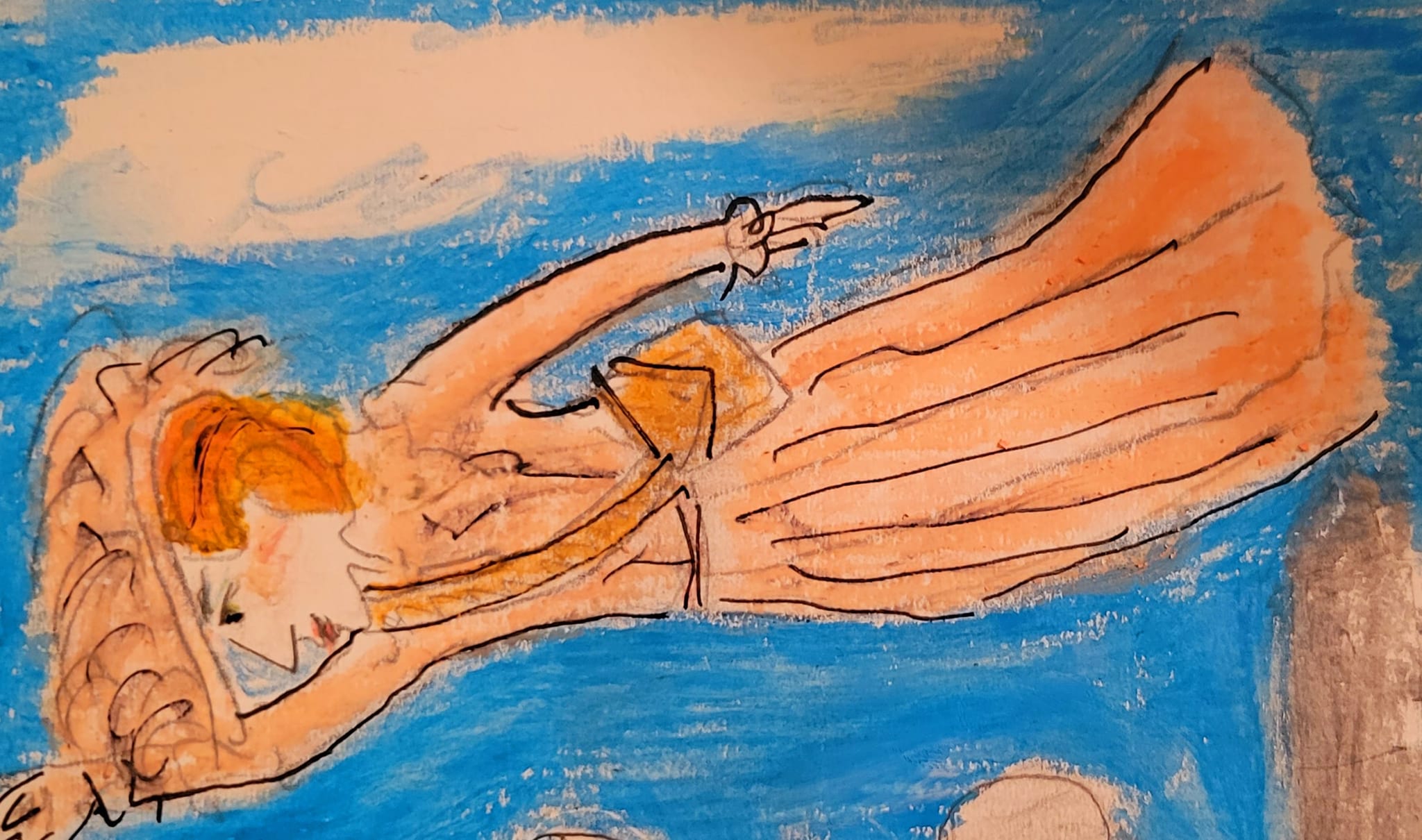
Top: "Psychical Excursion: Edwardian Lady in Astral Flight" Drawing by Robert Moss

Bottom: "Fred and the Phantasms". Digital art by RM