Showing posts with label Society for Psychical Research. Show all posts

Thursday, August 31, 2023

Bridegroom of Dreams


"The seventh type of dreams, which I call lucid dreams, seems to me the most interesting and worthy of the most careful observation and study. Of this type I experienced and wrote down 352 cases in the period between January 20, 1898, and December 26, 1912.

"In these lucid dreams the reintegration of the psychic functions is so complete that the sleeper remembers day-life and his own condition, reaches a state of perfect awareness, and is able to direct his attention, and to attempt different acts of free volition. Yet the sleep, as I am able confidently to state, is undisturbed, deep and refreshing."

- Frederik van Eeden “A Study of Dreams” [1] in Proceedings of the Society for Psychical Research, Vol. 26, 1913

The dream explorer credited with coining the term lucid dreaming [2] was a dedicated soul journeyer.  Dr. Frederik van Eeden (1860–1932) was a Dutch writer, physician, and member of the British Society for Psychical Research (SPR). In 1913, he gave a lecture to the SPR in which he reported “lucid dreams” in which the dreamer retains the memory of his waking life, remained conscious, and could carry out “different acts of free volition.” He observed that the phenomenon of multiple consciousness and “double memory” - of both waking and dream events - “leads almost unavoidably to the conception of a dream-body.”

His first attempt to give full expression to what he had experienced took the form of a novel De nachtbruid: De gedenkschriften van Vico Muralto ("The Night Bride: The Memoirs of Vico Muralto") first published in Dutch in 1892. An English language edition, retitled The Bride of Dreams, was published in 1913, the year he spoke at the SPR. He told the SPR that "the fictitious form enabled me to deal freely with delicate matters, and had also the advantage that it expressed rather unusual ideas in a less aggressive way - esoterically, so to speak."

He had many interests: as a writer, he belonged to a prominent Dutch literary group and found an international audience with his novel Hedwig’s Journey in 1900; as a physician, he worked on a cure for TB; as a pacifist he founded a society called Walden; as a reformer he worked for compensation for dismissed strikers; as a spiritual seeker, he looked East, and back to Western mystics like Boehme before immuring himself in the Catholic church in 1922 (which may have been foreshadowed by all the tortured theological musings in Bride of Dreams and his belief in demons, shared with the SPR), He took on Freud, rejecting his  theory of dreams as wish fulfilment. He had two wives, Martha (divorced in 1907) and Geertruida, with him till his death. Two children from each marriage.

Van Eeden’s autobiographical novel The Bride of Dreams, features a protagonist and narrator dressed up rather unconvincingly as an Italian aristocrat, Count Muralto.  The book is tedious and talky – and occasionally seemingly antisemitic - until we get to chapter 12 when the Count begins to discuss his dream life. The chapter starts with an account of detailed dream observation of a tree he is sure he could not invent, the incident van Eeden mentioned in his paper for the SPR. There are dream encounters with the dead, including a reunion with the protagonist’s father, who shows the love and compassion lacking in life, when the father tried to kill them both on a boat and died cursing his son.

We learn about the Count’s experiments in becoming conscious inside his dreams, and sustaining consciousness as he passes between waking and dream states. There is convincing material on how the dream body, which has its own sensorium, experiences pleasure and pain. In a lurch back to medievalism, the narrator blames “demons” for terrors and confusion, including the phenomenon of false awakening. The book trumpets the idea that out truest life, and clearest knowing, may be attained in dreams. "The solution of the secret of our lives lies in our dreams."

Here is his account of the blossoming tree:

one night while dreaming of a blossoming orchard in Italy, I succeeded in observing with thorough consciousness. I saw the branches as they crossed one another, and the festoons of vines stretching from tree to tree, whilst I soared through, a few yards from the ground, with a pale blue sky above me. And while observing yet more closely I pondered how it was possible to reproduce so exactly and minutely in a vision obviously emanating from myself and which I had myself created, the apparent motions of these myriad crossing twigs and the confusion of the young foliage. And in my dream, and realizing that I was dreaming, I came to the conclusion that this vision must be a reality, an objective reality as the philosophers of reason would say, because to me - the observer - it manifested a distinctly personal existence. As I soared by, the twigs described their apparent motions exactly as I had observed by day, and how should I, who could not even draw a tree, be able to create these extraordinarily compiled moving images? 

He found himself “thoroughly wide awake in the midst of… deep sound sleep”

As the Count, he expresses his desire to master continuity of consciousness and double his life

In my first elation I hoped that I might sometime reach the point where I could pass from waking to sleeping without loss of conscious- ness, and night after night contemplate the dream-sphere with all the calmness of day - thus doubling my entire life.

As we follow the Count’s experiments in lucid dreaming, we see him planning destination travel:

In order actively to carry out a thing in the dream world, I must resolve upon it betimes and definitely determine upon the plan. During the actual dream the time is usually too short, the incidents pass too fleetingly. Sometimes I soar on in swift flight so that everything rushes by me without my being able to delay the pace. It is usually after one of these happy dreams with full consciousness, that I plan out, that very morning before getting up, what I shall do the next time in my dream. And then, every evening before falling asleep, it is once more distinctly formulated and stamped upon the memory

He finds himself leading a double life, with the certainty that his dream life is no less real than his waking one. "I led for many years a double life, in which the incidents of the day did not seem more important to me than the observations of the night." 

He is fully aware that he has a subtle body, or dream body: "I knew now that I had another body, beside the ordinary one, an animæ corpus, with a proper world of perception; and this knowledge rested upon equally good foundations as every one's knowledge concerning the existence of his ordinary body."

He can travel to many worlds without moving his body:

That I, without stirring from my place, could arrive in a totally different world, in many worlds, all with a proper space, all with the same evidence of real existence, all full of life, full of sensations, fall of beauties and transports - this became for me a matter of simple experience. And no one only knowing it from hearsay can realize how different and how much more profound is the effect of actual experience.

He asks, how much of all this is his own creation? and gives an interesting response:

the insensible world is in part our own creation, subject to our will, built up from the conclusions gathered in our day-life, with the faculties and powers which by practice and use we have in this same life made our own. Everything is the product of imagination; the sun and the stars are also works of God’s imagination.


NOTES

1. Frederik van Eeden “A Study of Dreams” in Proceedings of the Society for Psychical Research, Vol. 26, 1913.

2. Van Eeden was not the fitrst author to use the term "lucid dream". The Marquis d'Hervey de Saint-Denys wrote in detail about his personal adventures in rêves  lucides in Les Rêves et les Moyens de Les Diriger: Observations pratiques, first published anonymously in 1867. He used the term uses the term to mean "aware of my true situation."  

C’est-a-dire le premier rêve lucide au milieu duquel je posséderais bien le sentiment de ma situation. 

"That is to say, the first lucid dream in which I had the sensation of my situation."

- [anon] Les Rêves et les Moyens de Les Diriger. Paris: Librairie d’Amyot. 1867, p.287.


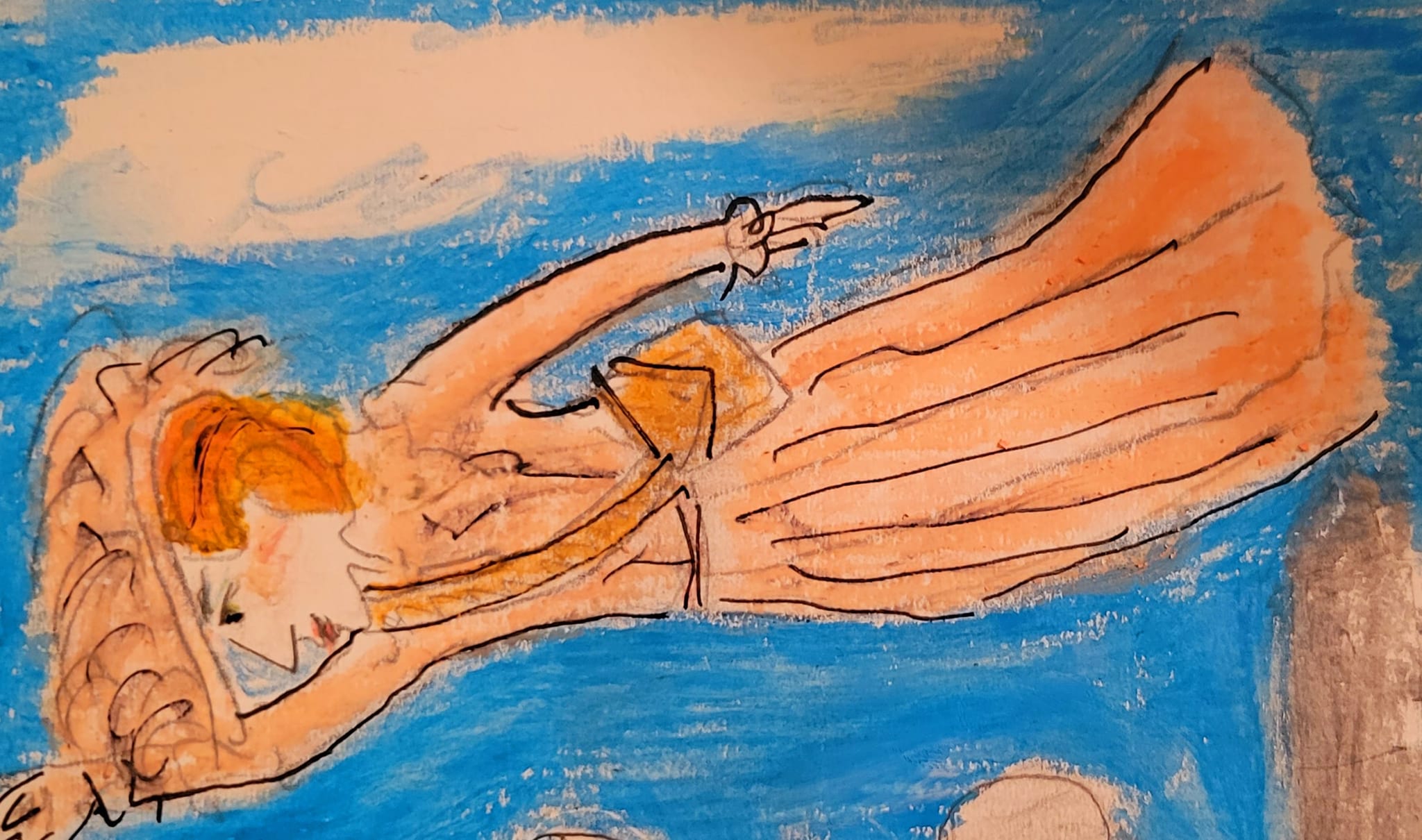
Drawing: "Bridegroom of Dreams" [Frederik van Eeden] by Robert Moss

Friday, March 10, 2023

A Dreamer's Notes: Currency of Psychical Excursions


He is wearing what look like tennis whites from an earlier era. He is brisk, upper-crust, charming - and ready to show his credential immediately. He hands me a 500 euro bill with the words "psychical excursions" written across it in a neat hand. 

I recognize the phrase. It was a term employed by the early researchers for the Society for Psychical Research to describe journeys beyond the body in which the traveler appeared to others as a "phantasm of the living". 

The tennis player's mode of introduction suggests that though the language may sound antiquated, this line of inquiry is valid today, and valuable. He did not allow me to return the banknote. I fold it and put it in my pocket. 

After returning from my dream excursion, I reopen Phantasms of the Living, the first major published work from the S.P.R. I find myself at once in the thick of accounts of "psychical excursions", in which the traveler is dreaming and is perceived by others in their own dreams - and sometimes with their physical eyes. 

One report involves a man who was on the steamship Limerick on a rough Atlantic crossing. Worried about him, his wife spontaneously projected herself from her bedroom to embrace him as he lay on his lower birth in his stateroom thousands of miles away. For him, this was a delightful dream - as it was for his wife, when she shared matching details after the trip. 

For one Mr. Tate, a librarian from Cleveland who occupied the upper berth in the cabin, it was a scandalous flouting of the rules. "You're a pretty fellow," he chastised the dreamer in the lower bunk in the morning, "inviting a woman to our room like that." Awake during the night, Mr. Tate had witnessed the visitation with open eyes. 

Next I went looking for tennis players in the early S.P.R. I seemed to recall that the Australian-born psychic investigator Richard Hodgson (famous for his sleuthing after Madame Blavatsky at one point Secretary of the Society) was a champion tennis player. I soon confirmed that he loved a hard game of hardball and died of a heart attack in an especially violent game at Boston’s Union Boat Club.


This is an unedited report from my journal dated January 6, 2023. I drew the illustration on March 10, 2023. I make a daily practice of making at least one sketch from my dreams, old and new. 


Friday, December 30, 2022

Fred and the Phantasms


“The question for man most momentous of all is whether or not he has an immortal soul; or . . . whether or not his personality involves any element which can survive bodily death.” Frederic W.H. Myers, the great Victorian psychic researcher and classical scholar, made this magnificent statement 120 years ago, on the first page of his major opus Human Personality and Its Survival of Bodily Death, published posthumously in 1903. He made it his life cause to gather evidence of the existence of a spiritual world from which soul comes into the body and to which it returns. He followed a rigorously empirical approach, declaring that “if a spiritual world exists, and if that world has at any epoch been manifest or even discoverable, then it ought to be manifest or discoverable now”. [1]

He saw "supernormal" faculties  - one of many terms he invented - as evidence that spirit operates beyond the body and therefore survives it. Telepathy and telaesthesia (clairvoyance) are “survivals from the powers which that spirit once exercised in a transcendental world” [2] ). “So soon as man is steadily conceived as dwelling in this wider range of powers, his survival of death becomes an almost inevitable corollary” [3] 

He thought that "psychical excursions" in which an aspect of the self travels beyond the body and may be perceived by others are primary evidence that consciousness is not confined to a physical vehicle and will therefore survive death. To refer to what we might call an OBE or astral projection,  Myers coined the scary term “psychorrhagy,” and referred to a propensity for this experience as a “psychorrhagic diathesis” [4] . At the high end this might be an ecstasy giving access to a spiritual world and to “communities higher than any which this planet knows” [5]

Myers described “self-projections” as “the one definitive act which it seems as though a man might perform equally well before and after bodily death” [6] 

The first major public work by Myers, with Edmund Gurney and Frank Podmore, was titles Phantasms of the Living. Based on thousands of cases collected and analyzed by the  Society for Psychical Research, this huge book was devoted to "apparitions of persons still living", received through any or all of the senses. Myers declares in his introduction that "we have no wish either to mystify or startle mankind". Yet the sheer volume of first-hand testimony of encounters with "ghosts of the living" would startle many audiences..

Myers says the authors are not aiming at any “paradoxical reversion of established scientific conclusions” but rather “working in the main track of discovery” and “assailing a problem which, though strange and hard does yet stand next in order among the new adventures on which science must needs set forth” [7]  Trying to walk a middle path between the Spiritualists and the evolutionists, Myers continues, “We held it incumbent upon us… to conduct our inquiries in the ‘dry light' of a dispassionate search for truth” [8]  

Some of my favorite cases involve experiences in the hypnagogic zone, between sleep and awake, sometimes when a visitor steps from a dream into the dreamer's physical space. Thus a minister from Bradford, the Rev. E.H.Sugden, reports a vivid dream of a person he knows well. Waking suddenly, he finds the man in his room. "I saw him in the light of early morning, standing by my bedside in the very attitude of the dream." The minister gives him a good kick and he vanishes. [9]

Myers' published oeuvre spanned a wide spectrum. He published poetry and essays on classical literature and a fascinating short autobiography that was unfortunately bowdlerized before publication by his widow. [10] Then there is all he has to tell us from the other side of death, especially the scripts recorded via two remarkable women mediums, Winifred Coombe- Tennant ("Mrs. Willett") and Geraldine Cummins. In his communications with Winifred, Myers gives the impression of a well-organized Club of psychic researchers working indefatigably to deliver evidence of the survival of physical death - from the other side of death. [11] Via Geraldine, Myers authored books describing several stages of the soul' s transitions beyond the physical plane, a comprehensive Western Bardo.  


I feel tremendous affinity for "Fred" Myers across time, and gratitude for his work, which continued after death. While I was rereading 
Phantasms of the Living I made a comment about it to a friend who exclaimed,  "Those Victorian ghost hunters really rock". I couldn't resist fooling around with an AI image generator to see what that might look like. 


References

[1] Frederic W.H. Myers, Human Personality and Its Survival of Bodily Death (London: Longmans. Green, 1903) Vol. 1, p.7
[2] ibid, Vol. 2, p. 267
[3] ibid, Vol. 2, p. 274
[4] ibid Vol. 1, p. 264
[5] ibid Vol. 2, p. 194. 
[6] Vol. 1, p. 297). 
[7] Edmund Gurney, Frederic W.H. Myers and Frank Podmore,  Phantasms of the Living (London: Society for Psychical Research/Trübner & Co, 1886) Vol. 1, p.xxxvi
[8] ibid p.xlix
[9] ibid  Vol1, pp.390-1
[10] Frederic W.H. Myers, Fragments of Prose & Poetry edited by Eveleen Myers (London: Longmans, Green, 1904)
[11] Gerald William, Earl of Balfour, "A Study of the Psychological Aspects of Mrs. Willett’s Mediumship, and of the Statement of the Communicators Concerning Process" in Proceedings of the Society for Psychical Research, Vol 43., 1935) 43-317. Geraldine Cummins, Swan on a Black Sea, A Study in Automatic Writing: The Cummins-Willett Scripts (London: Routledge and Kegan Paul, 1965
[12] Geraldine Cummins, The Road to Immortality: Being a description of the afterlife purporting to be communicated by the late F.W.H. Myers (London: Ivor Nicholson and Watson, 1933)

Illustrations 

Top: "Psychical Excursion: Edwardian Lady in Astral Flight" Drawing by Robert Moss

Bottom: "Fred and the Phantasms". Digital art by RM


Tuesday, October 4, 2022

The man who invented telepathy


F.W.H. Myers, poet, classical scholar and psychic researcher of the Victorian era, knew the power of naming things. He valued words so highly that he chose to start, rather than merely end, his magnum opus Human Personality and its Survival of Bodily Death with a glossary, which is studded with his own coinages. This essential work sits on a shelf at my right hand, its home for many years.
    Every time I open these pages, another word jumps out that was invented by Myers. Some are part of our common vocabulary, like telepathy. Myers defined telepathy as the communication of impressions of any kind from one mind to another, independently of the recognized channels of sense.” The term literally means “feeling at a distance”; he chose to emphasize the emotional tone, the importance of feelings in telling you that a message is coming through. This takes us to the wisdom of the body and the emotional charge between people who are connected and/or in crisis.
     Many of Myers’ coinages have not entered common English or even the technical lexicons of parapsychology; many will almost certainly never do so. Yet there is inspiration here for whole books:


           Psychorragy – bursting through of psychic phenomena. 

Cosmopathic – Open to the access of supernormal knowledge or emotion, apparently from the transcendental world, but whose precise source we have no way of knowing.

Methectic – of communications between one stratum of a man’s intelligence and another; as when he writes message whose origin is in his own subliminal self.

Sometimes his verbal brilliance consists in repointing or combining more familiar words to give us a way to discuss things we could not easily express before.

Subliminal – Of thoughts, feelings, &c, lying beneath the ordinary threshold (limen) of consciousness, as opposed to supraliminal, lying above the threshold.

Supernormal – Of a faculty or phenomenon which goes beyond the level of ordinary experience, in the direction of evolution, or as pertaining to a transcendental world.

Myers goes on to explain that the word “supernatural” is often misapplied to phenomena which are part of nature though beyond the norms of common observation or experience:

The word supernatural is subject to grave objections; it assumes that there is something outside nature, and it has become associated with arbitrary interference with law. Now there is no reason to suppose that the psychical phenomena with which we deal are less a part of nature, or less subject to fixed and definite law, than any other phenomena. Some of them appear to indicate a higher evolutionary level than the mass of men have yet attained, and some of them appear to be governed by laws of such a kind that they may hold good in a transcendental world as fully as in the world of sense. In either case they are above the norm of man rather than outside his nature.


I confess to a great sense of affinity with Frederic William Henry Myers (1843-1901) and his lifelong quest to demonstrate that human consciousness can operate outside the body and survives it. In his privately printed Fragments of Inner Life (1893) he declared that “It has been my lot to be concerned in a work more important and more successful than anything in my own capacity or character could have led me to expect. I have been one of the central group concerned in a great endeavor; the endeavor to pierce, by scientific methods, the world-old, never-penetrated veil.” He is referring to his work with the Society for Psychical Research, of his he was a founder and remained a moving spirit throughout his life.
    His quest to find evidence that consciousness survives the body deepened after the suicide of a woman he loved but could never have. He carried it with him to the Other Side. Before his death he promised that he would seek ways to send back reports of his experiences in the afterlife. He appears to have kept that promise in remarkable narratives recorded in sessions with the remarkable Irish medium Geraldine Cummins.
     I dreamed a decade ago that I discovered a rich trove of materials from Myers. The materials were both manuscripts and recordings. Some of the transcriptions were faulty and needed to be revised; some of the recordings sounded as if the speaker had a cleft palate. But there were riches here quite unknown to the informed public. Walking and talking with a friend about how I would honor the dream, I played with the idea that I could reenter the dream space, bring back materials and produce corrected and finished versions. I sensed a stir of supernormal activity around me as I talked, of spirits fluttering like birds or bats. There was nothing sinister about these lively shades; their presence added to my enthusiasm for my project. However, this is one of many ventures that are still in my pending box.
     I do honor Myers by trying to come up with new words to describe interesting supernormal phenomena One of my recent coinages is kairomancy, the art of divination by special moments, or navigating by synchronicity.


Portrait of Frederic William Henry Myers by William Clarke Wontner exhibited 1896; in  National Portrait Gallery. London

Talking through Frosted Glass: a Psychic Researcher Tries to Communicate after Death


An eminent psychic researcher, trying to communicate with the living from his new residence on the Other Side, complained that getting through is as difficult as trying to dictate to an obtuse secretary through frosted glass. The whole quotation is marvelous: 

"The nearest simile I can find to express the difficulties of sending a message - is that I appear to be standing behind a sheet of frosted glass - which blurs sight and deadens sound - dictating feebly - to a reluctant and very obtuse secretary. A feeling of terrible impotence burdens me - I am so powerless to tell what means so much - I cannot get into communication with those who would understand and believe me."

The speaker is the Victorian classicist, poet and pioneer parapsychologist Frederic W.H. Myers, one of the founders of the Society for Psychical Research. He used his language skills and poetic imagination to give us a rich vocabulary for the workings of consciousness, from "subliminal" and "supernormal" to "telepathy" and "psychorragy" (the last one did not catch on). He dedicated himself to producing evidence admissible by the scientific establishment of his day that would prove of the survival of consciousness after physical death. 

Like several of his colleagues engaged in psychic research around the beginning of the 20th century, he promised to report back from the other side of death after he got there. He came through to many mediums, and some of the transcriptions are fascinating. He was credited as the author of several books on conditions in the afterlife channeled by receivers such as the gifted Irish medium Geraldine Cummins.

The frustration "Fred" Myers expressed above was part of a session with the medium the S.P.R. identified as "Mrs. Holland"; she just happened to be Rudyard Kipling's sister.

I found the quote in an extraordinary book, The Eager Dead: A Study in Haunting, by Archie Roy, a founder of the Scottish Society for Psychical Research. The odd title The Eager Dead is derived from the statement of one of the early luminaries of the Society for Psychical Research (the Australian Richard Hodgson) that he could not wait to get to the afterlife in order to report from there. The book includes a passage from Jean Balfour describing a family home where there was the sense of the dead pressing in eagerly to feel out and communicate with certain visitors – and hiding away in the presence of a certain guest, the medium “Mrs. Willett” (Winifred Coombe-Tennant) who is a principal in the main story.

Roy was both a distinguished Scottish astronomer, a researcher of the paranormal, and an author of horror fiction (Devil in the Darkness). I am delighted by the novelistic skills he brings to the long prologue to The Eager Dead (“Shears of Atropos”) in which he presents his characters in vignettes, starting with Queen Victoria always sleeping with a picture of Albert on his deathbed on her own headboard.   

Archie Roy beavered away for years tracking the famous “Cross Correspondences” by which Myers and other Victorian ghosts gave partial messages to mediums in different places that made sense only when the transcripts were put together by the psychic detectives of the S.P.R.  Thus Myers gave partial notes on a place in Florence, larded with bits of Greek and Latin, to a medium in England and another in America who had no knowledge of each other. Put together, the notes made a coherent message. This sort of thing was taken to be evidence of authentic communication by a specific individual from the Other Side.

The astonishing central plot of The Eager Dead appears to be an endeavor by the dead ghost hunters to put a spirit into a body on this side – by arranging for the spirit of Edmund Gurney to be born to a spirited young woman in a conventional marriage to a much older man, whose natural psychic gifts had been enhanced through the tragic loss of her infant daughter. The woman was “Mrs. Willett”. Conception would require a living male, and Gerald Balfour, brother of  Arthur Balfour, a British Prime Minister, was chosen. A deep love affair blossomed, with a spiritual marriage in a chapel, and the result was a child who was named Augustus Henry. He grew up in ignorance of his supposed origins, was decorated for valor, escaped a Nazi P.O.W. camp and presented himself as a skeptic about survival when he enlisted a medium to talk to his mother after her death. (He is the subject of a recent biography by Welsh historian Bernard Lewis, Soldier, Spy, Monk: The Life of Henry Coombe-Tennant.) 

Archie Roy had access to a vast amount of material from the Balfour family that was not fully available to previous writers. Though all the detail on the Cross Correspondences experiments is exhausting as well as exhaustive there are gems in his book, like Fred Myers' complaint about frosted glass. 

In the spirit of his subjects, Archie Roy was quoted in his Times obituary (published on January 16, 2013) saying “If when I die, I find out I have not survived, I’ll be very surprised.”


Photo by RM

-          


Wednesday, August 10, 2016

When the dead hold seances for the living


I find myself drawn, again and again, into the world of the Victorian spirit hunters, especially that great and eloquent pioneer of psychic research and psychology, Frederic (F.W.H.) Myers, and his famous American friend William James. They joined in a great quest to provide evidence acceptable to science that consciousness can operate outside the body and survives bodily death. They drew to their cause many of the greatest minds of their era, including scientists, physicians, literary giants and a British prime minister.
     There is an amazing moment in one of James's sessions with Leonora Piper, the Boston trance medium James studied and consulted over many years and came to call his "white crow".* She was supposedly communicating on behalf of Richard Hodgson, a great friend of James who had been secretary of the American Society of Psychical Research. Though "tremendously athletic", according to James, Dick Hodgson had died suddenly playing handball, leaving two book projects unfinished - and a half-joking promise that, if he died first, he would communicate from the Other Side and provide evidence of survival.
     James grilled the Hodgson personality over and over, seeking proof positive that it was the dead man talking, through the revelation of personal secrets and codes neither the medium nor the sitter could have known. The demands this approach imposed on Hodgson's memory (assuming it was Hodgson) became ridiculous. Assessing the notes from these long sessions (James conceded) bored him "almost to extinction". 
     But then something will come through that is thrilling even to a skeptical reader more than a century later. Here's what excites me, in the transcript of a "voice-sitting" on May 21, 1906.    Speaking through Mrs Piper, Hodgson tells James that Myers (who died in 1901) is with him:

"Myers and I are also interested in the Society over here. You understand that we have to have a medium on this side while you have a medium on your side, and through the two we communicate with you."

     The "Society" mentioned is the Society for Psychical Research, which was (and is) dedicated to producing evidence of "supernormal" (Myers' phrase) phenomena, including contact between the living and the deceased. Think about the statement made via Mrs. Piper's vocal chords.
     While there is a Society for Psychical Research on this side, there is a similar Society on the Other Side. They, too, hold seances or sittings with mediums. While James is listening to the voice of his dead friend through a speaker for the dead, Hodgson is apparently listening to the voice of his living friend through a speaker for the living. 
     Was this the ultimate folie de grandeur of a psychic charlatan, promoting her own profession - that of medium - to the status of indispensability on the Other Side? I have a notion that this part of the reading, at least, can be trusted. There are sensitives among us who are more able than others to pick up presences and messages from the Other Side. It's not such a stretch to suppose that in the same way, there are people on the Other Side who are better as inter-world communicators than others, and may even have the ability to call spirits of the living for a session with relatives or colleagues who are eager to talk with them.

*  Having concluded that Mrs Piper's communications were for real, even though the sources could not be determined beyond doubt, William James declared: "If you wish to upset the law that all crows are black, it is enough if you prove that one crow is white. My white crow is Mrs. Piper." [William James on Psychical Research edited by Gardner Murphy and Robert O. Ballou. New YorK: The Viking Press, 1960, 41]

Image: Portrait of Leonora Piper by Eveleen Myers.