Showing posts with label poetry. Show all posts

Saturday, August 16, 2025

"I am your double from the jinn"


Kuthayyir 'Azzah was born in Medina and died there in 723 after many years in Egypt. He had the ear of caliphs of the Umayyad dynasty, was favored by courtiers for his flattering verses, and was no stranger to the charms of women. He became famous for his ghazals, songs of love and longing, often spiked with the absence of the lady he thirsted for, graceful as an antelope, fleeting as a raincloud over the desert - and unfortunately, wed to another man. His poems survive in palaces including the library of the Escorial in Spain.

When asked for the source of his poetic inspiration he gave a stunning response. He did not mention a lady, or the voices of birds or a rising flood inside him. He spoke of his double in the world of the jinn, a world normally invisible to humans where great games are nonetheless in play.

Asked, "When did you start reciting poetry?" the love poet replied, "I did not start reciting poetry until it was recited to me."

"And how was that?"

"One day, I was in a place near Medina. It was noon. A man on horseback rode toward me until the horse’s breath blew on me. He was hard to make out, quite bizarre. He seemed to be made of smoke, then of brass of brass.  He commanded me to recite poetry. Before I could figure out how to respond, he started speaking poetry to me.  

“I said, 'Who are you?'

“He said, ‘I am your double from the jinn.’

“That is how I became a poet."

As for those songs of longing: poets and dreamers know that yearning for a lover who is far away loosens the soul from its physical bonds and makes it easy for it to leave the body and to travel in its etheric vehicle.


Source: Amira El-Zein, Islam, Arabs and the Intelligent World of the Jinn (Syracuse NY: Syracuse University Press, 2017) 126-7.


Drawing by Robert Moss


Saturday, February 1, 2025

May Brigid's blessings be with you


Blessings to you on the day of the High One, the Exalted One. That is the meaning of Brig, from which the name Brigid (also Brigit, Brighid, Brigantia of England and Brigindo of eastern Gaul) derives. The church made the goddess a saint, one of the most beloved saints of Ireland, with various biographies, the best of which is recollected in Kildare, where the flame of Brigid burned constantly until Henry VIII, and burns again today. She is a power of the land, and of the deeper world, that the church and the people can agree on. In Ireland and in Scotland, you feel her presence in stones and trees, in high places and in deep wells.
In the stories told at Kildare, the woman Brigid is born at sunrise, as her mother stands straddling a threshold, one foot out and one foot in. When Brigid’s head comes out, the sun’s rays crown her with flame. We can see why she is the patron of people who open doors between the worlds – of shamans, seers and poets – and of all who work with fire, in the peat, in the forge, in the cauldron of imbas, the fire of inspiration.
Marija Gimbutas wrote of her (in The Living Goddesses): “Brigid is an Old European goddess consigned to the guise of a Christian saint. Remove the guise and you will see the mistress of nature, an incarnation of cosmic life-giving energy, the owner of life water in wells and springs, the bestower of human, animal and plant life.” She is “Mary of the Gael”, and she is the Triple Goddess and Robert Graves’ Three-fold Muse. She is patron of poetry, healing and smithcraft. In Scotland she is Bride, and the White Swan and the Bride of the White Hills. In the Hebrides she is the protector of childbirth.
Lady Augusta Gregory, Yeats’s friend, described Brigid in Gods and Fighting Men as “a woman of poetry, and poets worshiped her, for her sway was very great and very noble. And she was a woman of healing along with that, and a woman of smith’s work, and it was she first made the whistle for calling one to another through the night.” We are now entering the prime time of this High One, when nature awakens around February 1.
She may appear as a snake from beneath the earth, even in Ireland, the country without snakes:
This is the day of Bride the Queen will come from the mound
This is the time of Brigid’s feast of Imbolc which coincides with the lactation of the ewes and the first signs of spring. You know the lambs are coming soon. You see snowdrops pressing up from the hard earth, perhaps through its white mantle. You offer the gifts of the goddess to the goddess: you pour milk on the ground, you bake and leave out special cakes. To she who spins and weaves life itself, you offer woven fabrics or offer a cloth – a handkerchief, a scarf, a pillowcase – to be blessed as it rests on the earth overnight. To this bringer of fire, you light a candle and offer your heart’s flame.
In the old country, in the old way, young girls carry her images – straw dolls or brideogs – in procession from house to house, and the goddess is welcomed and decked with finery. The dolls are laid on in “bride beds”, with a staff or wand of power resting beside them. At Imbolc, as on other days, you may raise the High One’s energy with poetic speech. Best to do this by a stream or a spring, or (if you know one) a sacred well. She does have a fine love of poets and those who bring fresh words into the world.
There is a legend that, in one of her womanly forms, Brigid married the great poet Senchan Torpeist,  foremost among the learned fili (bards) of Ireland. It was this same Senchan, it is said, who recovered the great poem known as the Táin Bó Cúailnge (The Cattle Raid of Cooley) when it was feared lost forever, by raising the shade of the druid poet Fergus to recite all of the verses.
Among the bevy of Celtic blessings in the great repository know as the Carmina Gadelica, collected by Alexander Carmichael in the Highlands and Islands of Scotland around 1900, some of the sweetest call on Brigid. In “Womanhood of Brigit” (#263 in the Carmina Gadelica)
Brigit of the mantles
Brigit of the peat-heap
Brigit of the twining hair
Brigit of the augury.
Brigit of the white feet
Brigit of calmness
Brigit of the white hands
Brigit of the kine.
Many kinds of protection are then asked of Brigid – safety from death or injury or mishap in many forms. Next comes a verse that makes it plain that Brigid is regarded, among all else, as a guardian of sleep and dreams:
Nightmare shall not lie on me
Black-sleep shall not lie on me
Spell-sleep shall not lie on me
Luaths-luis shall not lie on me.
I need someone more learned in Scots Gaelic than myself to translate Luaths-luis. Its literal meaning seems to be something like “fast-moving lice” for which our modern phrase might be “creepy-crawlies.” In the “Blessing of Brigit” (numbered #264 in the Carmina Gadelica) we have words that might please the Lady on her feast day, or any day:
I am under the shielding
Of good Brigit each day;
I am under the shielding
Of good Brigit each night.
Brigit is my comrade woman,
Brigit is my maker of song,
Brigit is my helping woman
My choicest of women, my guide
Brigid’s Day is also a fine time for courting, and a time to dream, and seek guidance from dreams.

Brigid's Flame

I dreamed this poem at Imbolc in 2020


May the radiance of her blue mantle
surround you and protect you
May you burn with her fires:
fire of seership,
fire of craft,
fire of inspiration,
fire of healing,
fire of transformation
fire of heart.
May you always stand ready
to wrest the killing irons
from evildoers and oppressors
and to take up the Sword of Light
in defense of the weak and the just
May you always be a lover of poets
and commit poetry every day.


Wednesday, December 11, 2024

Poetry comes from flooding


Stefania Pandolfo’s beautiful but difficult Impasse of the Angels evokes the landscapes – imaginal more than physical – of rural Moroccan villagers for whom dreaming and poetry are vitally important, and always interweaving.
    “Poetry is always the result of flooding”, a younger poet tells her. A real poem bursts from an emotion that is inundating, overwhelming – until it finds creative release.
     The most respected poet in the area, one Sheikh Mohammed, was alien to poetry until he dreamed of a flood. The dream came at a time of personal trauma when he was close to despair. Previously a violent man of action, he had managed to blow off his right hand in a gun accident.
     He dreamed the river was coming down in flood, its front like a mountain, carrying everything it encountered in its path, trees and carrion and debris. Instead of fleeing, he stood there in the dry riverbed, watching and waiting. Then he opened his mouth and swallowed the flood and everything borne along by it.
    Upon waking he recounted the dream to his mother: "The river in flood entered my mouth and I swallowed it." She told him that he had become a poet. He who had never recited a verse or cared for poetry, he who had even ridiculed poets in his previous life, began to ‘speak’, to utter poetical ‘words.” [1]
    I am reminded of the counsel Anais Nin gave to a seventeen-year-old aspiring writer: “Creation comes from an overflow, so you have to learn to intake, to imbibe, to nourish yourself and not be afraid of fullness. The fullness is like a tidal wave which then carries you, sweeps you into experience and into writing. Permit yourself to flow and overflow, allow for the rise in temperature, all the expansions and intensifications. Something is always born of excess: great art was born of great terrors, great loneliness, great inhibitions, instabilities, and it always balances them.”[2]
    I am reminded of my own big dream of a flood, one of those that dream classifiers might call a watershed dream. I dreamed I was walking a deer I called Bear as I might walk my dog in the park. We came to an open plain with a view to a distant horizon. The earth was reddish and looked bare. I glanced to my right and saw a tremendous wall of water rushing towards where we stood. Instead of fleeing, I prepared myself to catch the wave and ride it. I woke charged with creative energy.
    Of course, I wanted to go back inside the dream, to enter its mysteries and to see what would happen if I managed to ride the great wave. I managed to do this in an operation I call dream reentry, in which we use a dream or personal image that has energy as the portal for a conscious journey, which may be field and focused by shamanic drumming. I did not need drumming to go back inside this dream; it was calling me.
     My animal companion was not mysterious. I have long been closely connected both to the deer and the bear as shamanic allies. I was amused that in the dream I called the deer Baer, but this, for me, simply brought into focus the healing aspects of the connection and was not a [particular focus for the lucid dream journey I was going to make. I wanted to catch the great wave.  
     I lay back in an easy chair, closed my eyes, and willed myself back inside the dream. I found myself in ancient Egypt, in Egyptian garb. I was surveying the Nile at the time of the  inundation, when the great river rose to feed the thirsty earth, bringing the crops. As the waters spilled, I saw papyrus plants in great abundance bursting from the earth, which was now black and loamy. I felt deep in my body that I was being invited to enter a fresh period of abounding creative energy. This proved to be the case. A new book, new poems, new projects poured from me and through me. Life was poetry even when I was writing in prose. Poetry comes from flooding.


 References

1. Stefania Pandolfo, Impasse of the Angels: Scenes from a Moroccan Space of Memory (Chicago: University of Chicago Press, 1998) p.265]

2. Anais Nin, The Diary of Anais Nin. Vol. 4: 1944-1947 (New York: Mariner Books 1972)


Tuesday, July 18, 2023

The sword, the silk dress and the soul


What is this voice that calls him away from life, to climb "the winding ancient stair", into "the breathless starlit air" and


Fix every wandering thought upon
That quarter where all thought is done


He calls it his Soul. Is it calling him to Death? Certainly, it is calling him to die to the natural world, the world of blood and sinew and nerve-endings.

 W.B. Yeats wrote "A Dialogue of Self and Soul" when he was over 60. As writer and thinker, he was approaching the peak of his powers, but he was very conscious that his body was failing and he sensed the nearness of Death in recurring bouts of illness. In the chill Dublin fall of 1927, hardly able to breathe, he feared he would not survive the congestion of his lungs. A year later, on vacation in Rapallo, he was stricken by what was diagnosed as "Malta fever" and confined to bed for four months, often too weak to turn his mind to anything more demanding than detective stories, fed an evening diet of serum and very dry champagne.

Sensing Death at his side, in "A Dialogue of Self and Soul", the poet chooses life, even if his choice will carry the price of recurrence of heartache and humiliations of the flesh. In the poem, as so often in Yeats' writing, he gives a personal spin to familiar terms so that we no longer quite recognize them. "Soul", here, is an austere, world-rejecting inner voice. "Self" is the man of flesh and bone, of memory and desire, not ready to cast off from the world. 

Yeats' Self has a weapon on his knees: "Sato's ancient blade", "still razor-keen, still like a looking-glass", wrapped in embroidered silk "torn from some court-lady's dress." The image of the long sword sheathed in a lady's silk dress in the poet's lap is raw and sexual; it opens like a wound, bringing a shudder of unease and excitement.

Soul argues with him. He is "long past his prime". He should forget things "emblematical of love and war". If he will only teach his imagination to "scorn the earth", he may win the prize of deliverance from the wheel of reincarnation, from what Soul denounces as "the crime of death and birth."

Self insists on what he can touch and stroke with his hands and his symbol-weaving mind. He evokes the master who made the sword, and the "heart's purple" of the silk streaming under his touch; he sets these against the austerity of the tower he has been called to ascend.

The life-denier soon quits the debate, leaving the poet to speak uninterrupted in Part II of the poem. His memories of his present life are full of hurt and shame, from the "ignominy of boyhood" to the "clumsiness" of the "unfinished man". He broods on how malicious eyes can give a false shape to a man - this man - and so distort his own vision that "he thinks that shape must be his shape."

Yet he cries out, "I am content to live it all again," even if  "it be life to pitch/ Into the frog-spawn of a blind man's ditch"

Or into that most fecund ditch of all,
The folly that man does
Or must suffer, if he woos
A proud woman not kindred of his soul.


It seems the wound of his unrequited love for Maud Gonne will never heal. Yet he affirms that he will find the way to forgive himself, cast out remorse, and move on.

We must laugh and we must sing,
We are blest by everything,
Everything we look upon is blest.


That final affirmation rings less certain, for me, than the glint of the sword, through the folds of silk, in the first part of the poem. The last lines, to my ear, are whistling in the dark. I'm for that, but what recruits my conviction is the unexpected marriage of silk and tempered steel.

Curious about the origin of that image, I tracked down Yeats' account  of how he came into possession of an antique samurai sword:


"A rather wonderful thing happened the day before yesterday. A very distinguished looking Japanese came to see us. He had read my poetry when in Japan and had now just heard me lecture. He had something in his hand wrapped up in embroidered silk. He said it was a present for me. He untied the silk cord that bound it and brought out a sword which had been for 500 years in his family. It had been made 550 years ago and he showed me the maker’s name upon the hilt.

"I was greatly embarrassed at the thought of such a gift and went to fetch George, thinking that we might find some way of refusing it. When she came I said 'But surely this ought always to remain in your family?' He answered 'My family have many swords.' But later he brought back my embarrassment by speaking of having given me 'his sword.' I had to accept it but I have written him a letter saying that I 'put him under a vow' to write and tell me when his first child is born—he is not yet married—that I may leave the sword back to his family in my will. (WBY Letter to Edmund Dulac, 22 March 1920)


The name of the Japanese donor, Sato, is in the poem, where Yeats also refers to the sword as "Montashigi". This is his rendering of Motoshigé, the name used for very special swords created with the craft and ritual of Ko Motoshigé ("Old Motoshige") a master swordmaker of the early fourteenth century.

Inspiration, from a physical object, for the double thrust of passion and of pain that defies Death and abstraction.


The making of a master blade in the illustration above dates back to the eleventh century; here we see a sword being brought alive by a fox spirit. The swordsmith is the renowned 
Kokaji Munechika, and this is also a dream story; the emperor Ichijô ordered him to forge this blade because of a dream. The story is the theme of a Noh play, and Yeats was strongly influenced by Noh in creating his own one-act plays.

Illustration: Blacksmith Munechika, helped by a fox spirit, forging the blade Ko-Gitsune Maru, by Ogata Gekkō (1887)


Wednesday, October 26, 2022

Poets of consciousness


Poets, it’s said, are shamans of words. True shamans are poets of consciousness. Journeying into a deeper reality with the aid of sung and spoken poetry, they bring back energy and healing through poetic acts, shapeshifting physical systems. When we dream, we tap directly into the same creative source from which poets and shamans derive their gifts. When we create from our dreams, and enter dreamlike flow, we become poets and artists. When we act to bring the energy and imagery of dreams into physical reality, we become poets of consciousness and infuse our world with magic.

In Birth of a Poet, William Everson raised a clamorous appeal for poets to reawaken to their shamanic calling: "O Poets! Shamans of the word! When will you recover the trance-like rhythms, the subliminal imagery, the haunting sense of possession, the powerful inflection and enunciation to effect the vision? Shamanize! Shamanize!" Across the centuries, many of our greatest poets have recognized their kinship with the shaman’s way of shifting awareness and shapeshifting reality. As his name in a spiritual order, Goethe chose the name of a legendary shaman of antiquity, Abaris, who came flying out of the Northern mists on an arrow from Apollo’s bow.

Our earliest poets were shamans. Today as in the earliest times, true shamans are poets of consciousness who know the power of song and story to teach and to heal. They understand that through the play of words, sung or spoken, the magic of the Real World comes dancing into the surface world. The right words open pathways between the worlds. The poetry of consciousness delights the spirits. It draws the gods and goddesses who wish to live through us closer. Shamans use poetry, sung or spoken, to achieve ends that go deeper than our consensual world. They create poetic songs of power to invoke spiritual help; to journey into nonordinary reality; to open and maintain a space between the worlds where interaction between humans and multidimensional beings can take place and to bring energy and healing through to the body and the physical world.

The South American paye takes flight with the help of "wing songs". These flight songs help him to borrow the wings of the kumalak bird [a kind of kite] that is a main ally of shamans. Among the Temiar-Senoi of the Malaysian rainforest, the great gift of a dream is the norng, or dream song, literally a "pathway" that can get you through the jungle or carry the soul to where it needs to go on either side of death.

Among the Inuit, the strongest shamans are also the most gifted poets. One of the reasons their spirit helpers flock around them is that they are charmed and exhilarated by the angakok’s poetic improvisations. Inuit shamans have a language of their own, which is often impenetrable to other Eskimos. It is a language that is never still. It bubbles and eddies, opening a whirlpool way to the deep bosom of the Sea-goddess, or a cavernous passage into the hidden fires of Earth.

My favorite Inuit shaman-word is the one for "dream". It looks like this: kubsaitigisak. It is pronounced "koov-sigh-teegee-shakk", with a little click at the back of the throat when you come to the final consonant. It means "what makes me dive in headfirst." Savor that for a moment, and all that flows with it. A dream, in Eskimo shaman-speech, is something that makes you dive in headfirst. Doesn’t this wondrously evoke the kinesthetic energy of dreaming, the sense of plunging into a deeper world? Doesn’t it also invite us to take the plunge, in the dream of life, and burst through the glass ceilings and paper barriers constructed by the daily trivial self?

Shamans know further uses for dream songs. They call the soul back home, into the bodies of those who have lost vital energy through pain or trauma or heartbreak. And from their journeys, they bring back poetic imagery that can help to shapeshift the body’s energy template in the direction of health.

Mainstream Western physicians agree that the body believes in images and responds to them as if they are physical events. By bringing the right images through from the dreaming, the poets of consciousness explain dis-ease in ways that help the patient get well, and interact with the body and its immune system on multiple levels without invasive surgery.

As dreamers, we tap into the same deep wells as poets and shamans and we climb ladders between the worlds. Poetry sometimes comes dancing out of dreams, in full-formed verses. When we turn our dreams into poems, we free our creative spirit, and our spirits come dancing.


Text adapted from Dreamways of the Iroquois by Robert Moss. Published by Destiny Books. 


Photo by RM

Thursday, March 3, 2022

Running to Catch a Poem: Remembering the Poet in the Story


Poems came to me
As if from far away.
I would feel them coming,
I would rush into the house,
Looking for paper and pencil.
It had to be quick,
For they passed through me
And were gone forever.
- Ruth Stone, "Fragrance" (in her collection What Love Comes To)

As a poet myself, I feel for Ruth Stone. Thanks to Elizabeth Gilbert's wonderful book Big Magic, Stone's mode of chasing poems like runaway horses is now famous, but few have read the poet herself or even remember her name. It's well worth seeking out her work and noticing, along the way, how she rose above a dark river of grief and pain, especially after her second husband (also a poet) hanged himself from a door in the family home.
There are two delicious further revelations in Gilbert's account of how she heard it from Stone. When a poem got away from her, she felt it galloping away, "searching for another poet". Then sometimes she would manage to grab an escaping poem by the tail, and would feel herself pulling it back. "In these instances, the poem would appear on the page from the last word to the first - backward, but otherwise intact." (Big Magic p.65.)
Many of us dreamers know exactly how that works, as we pull back dreams by the tail as they run away. How many of the dreams that escape go searching for another dreamer?


Image of Ruth Stone running to catch a poem by Daryl Thetford

Tuesday, February 15, 2022

Flooding, or The Making of a Poet


It is said of a people who live east of Fez that they value poetry above all other human activities. There was a man among them who despised poetry. He said it was for the weak and for women. Bashir was a warrior and a hunter, sudden and violent in his moods, given to strong drink. 

One night he was caught by a dream. The moon threw down a lasso of light. It pulled him down, spilling his wine, extinguishing the lamps. He fell into blackness that became the sound of rushing water, more water than the village had ever seen. When his sight cleared he saw that the little river where the women washed clothes had become a great torrent, waves rising mountain high. The sky sheeted heavy rain. There was no horizon except endless water. 

In the savage flood, he saw trees and houses, donkeys and camels, carried away, and a woman he might have loved and a man to whom he owed money and the witch who sold him a charm against the evil eye after setting the curse on him, and a fat grafter whose neck he had broken though the thief had been buried for three years. He wept when he heard the howls of the sight dog who had hunted with him. Then the flood took him too. He had nothing to hold onto, nowhere to stand. This was the end of the world. His life memories swirled in his head like water going down a drain. 

He was thrown up by an immense wave, and hurled down with bone-shaking force. He tasted sand and rust. He opened his eyes. He smelled coffee and warm bread. His woman was making him breakfast. He brushed this aside, more gently than he might have done on another day. This gave her the courage to ask if he was well. She did not say that the noises he was making in the night were not human, or even bestial. 

He told her he was going to see Shaykh Omar. He must go at once. He paused only to put on a clean garment and his sandals. Omar the Blind, they called him, not because he had cataracts but because he saw with inner vision. He lived in a house no better and no worse than most in the village, under a date tree. He was famous for his beautiful ghazals, lyrical poems of erotic encounters between the soul and its beloved. He was the judge of the poetry contests that were more popular here than football. 

"I've been waiting for you," the shaykh told Bashir. 

"I dreamed of a flood. It took the whole land. It was the end of the world. Does it mean I am going to die?" 

"You have died already, my son. Welcome to paradise." 

Bashir gaped, then looked carefully around. The landscape was surely the same as yesterday, and the smells, and the hot dry wind gusting from the south. Yet there was a subtle shimmer to things, as if nothing was quite fixed or tethered to the earth. The wind carried the sound of stringed instruments. With the music came birdsong that became words. The words shook their wings inside him, then took flight from his lips. 

"You broke the vessel and I became wine." 

Bashir sat open-mouthed, shocked at what he had released. 

Omar the blind sipped his glass of red tea and made a sound like a kiss with his wet mouth. "My friend, everything will be different. You have been made a poet. It is known that all poetry comes from flooding."


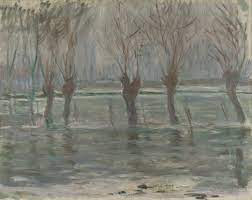
Art: Claude Monet, "Flood Waters" (1896)

Monday, May 4, 2020

Put simply

I agree with Einstein that if you cannot explain something clearly, you don't understand it well enough. You may need to use words or formulas that are outside the household vocabulary in order to state exactly what you mean but this does not remove the need to keep it clear and simple and translate those terms when that is possible.

If I want to take you into the mindset of the Hellenic world, I may speak to you of miasma or eudaimonia. If I am taking you into the dreamways of the Iroquoian peoples, you may hear me speak the old word ondinnonk. It first came to me in one of those dreams that set detective assignments; I tracked it to a report preserved in the Jesuit Relations, from a blackrobe missionary writing from Huron country during the bitter winter of 1647-8.
I avoid talking down to people. I decline to shut them out or strut my stuff by using $10 words when smaller denominations will do fine. Using thorny exclusionary jargon to keep people out of important conversation has been one of the black arts of clerisies for as far back as humans have tried to turn knowledge into privilege and power. At the same time, I refuse to dumb things down. I detest how I see this done in a certain type of self-help book. We don't grow by being spoon fed sugary baby food and plastic affirmations. What we most need to know is simple. However, in the midst of adult life, awash with half-digested knowledge from all over, and yet clogged by self-limiting beliefs, we may have to pay a price for the simplicity that is now required.

There are questions that cannot be answered they must be lived. A true teacher will take us to a certain point and leave us, to find our own way, which is likely to be inward and upward. I learned from an inner teacher when I was very young that the essential things we need to know come to us through anamnesis: remembering the knowledge that belonged to us, on the level of nous or spirit, before we came here.

Sometimes poetic speech rather than prose is required because poetry can lift us to a higher state of consciousness, to where we can see a droplet of water or the purple sheen on a raven feather or how a body can change into a tree or a swan as we never saw it before. And how life rhymes. Still, the need is simple: to stir the inner senses, to open the heart and give the spirit wings.

Image: Inspire View, the villa near Bran in Romania where I have been leading retreats for many year. Photo by Ana Maria Stefanescu.

Sunday, February 2, 2020

Brigid's flame

I dreamed overnight that I found and posted six images and blessings of Brigid beyond what I offered here in my last post. I just composed one more:

Brigid's Flame

May the radiance of her blue mantle
surround you and protect you
May you burn with her fires:
fire of seership,
fire of craft,
fire of inspiration,
fire of healing,
fire of transformation
fire of heart.
May you always stand ready
to wrest the killing irons
from evildoers and oppressors
and to take up the Sword of Light
in defense of the weak and the just
May you always be a lover of poets
and commit poetry every day.

- Robert Moss, Imbolc 2020


Icon of Brigid
One of the most powerful experiences of my life at a place of worship was at Solas Bhride in County Kildare, where the eternal flame of She who is both Goddess and Saint, joining the old religion and a newer one, is kept burning. She rose from her icon, suffusing the whole space with the blue aura of her robe. She plucked the sword from under her feet and held it up. She said, with blazing eyes, "I have kept the sword here not only to deny it to killers and evildoers but to offer it to those I call to be warriors for the Light." How can I not love a Goddess who born at a threshold in the fire of sunrise and is patron of those who work with the fires of metalwork and healing and poetic inspiration?

Tuesday, December 17, 2019

Painting with Words: The Dream Poems of Marta Aarli


Guest blog by dream teacher and poet Marta Aarli, MA, LPC 

As I hover in between the worlds, my soul swimming in the realm of dreams while my mind is scrambling to reassemble itself, there is a region where image and word exist together in harmonious balance. I often find myself racing through this passage as my mind wrestles back control and puts me into human form again.
    But sometimes I can slow this process down by softening my gaze until the boundaries blur, watching as my experiences take shape into visual phrases and verbal landscapes. From this in-between place, I allow words to flow, coming from my whole being, not just the verbal part of my brain, letting myself speak in a language of the body, the heart, the senses.
    Sometimes it sounds strange, because it’s from another place, a foreign country, the motherland of poetry. Each poem becomes its own being, expressing its unique character in its own form and dialect.
    In order to understand it, the reader must also open, allowing the language to flow in and merge with their own fluid places, translating it into their own native tongue. This is the creative process of reading or listening to poetry, similar to connecting with another’s dream. In this way we meet in the universal creative field that we share with humans and all other beings. When we listen to poetry, we receive it, rather than knowing in the same way that we comprehend things on an intellectual level.         Poetry is a wonderful art form for expressing dreams, because it is by nature a surreal, visual orientation to language. Once they’ve taken verbal form, poems reconstitute through the readers’ imagination, translated into their own images which evoke, or inspire, or move something deep inside that they had forgotten a long time ago.
    As a psychotherapist, dreamer, poet, singer, dancer, and visual artist, I’m interested in how to be the fullest, most integrated beings we can be. This includes our many parts - the analytic and emotional, verbal and non-verbal, earthly and spiritual, waking and sleeping, seen and unseen, conscious and unconscious, weaving together into fluid wholeness. I see poetry as a contemplative practice, to be with what is happening now inside our being and around us in the environment. When we express our inner worlds, we connect with others, invite them in, see our common experiences. Or perhaps we find that we are already roaming the halls of these vast universal realms together, in our dreams. The poems in this collection, Dream Worlds, my third book of poetry, are all from my dream experiences, since childhood. Some are combined dreams, some weave in waking life experiences or other peoples’ dreams. 


and as they danced 

and as they danced 
the women waved their arms 
threw their hair swirling
their black veils 
into the air 

hands touched 
in flowering gestures 
around their hips and shoulders 
their skin grew warm 
their breath deep 

and as they danced
 the snake wound around their feet 
intertwined at the ankles 
slowly binding them 
all together 


mother’s veins 

tributaries of 
mother’s veins 
flow together 
following our guide 
with the snake around his neck 

down river down path
island beach lined with boats 
dead loved-ones gathered 
singing and dancing 
at the crossing place

her mountain range breasts 
and rolling meadow hips 
upon which we gather
feather and bone ceremony 
around the fire
prepares us for journeying


through the fangs 

We drum for the journey 
because we are not from around here. 
We fast for the darkness 
for the daemons 
for the human heart. 
Unless sick, or too old
or too young, and then 
we are carried 
by the strong. 

And as we travel 
we see each other 
across other realms, 
not always recognizable 
often not what we seem.
Look closer 
and listen to the nightmares 
to the biting 
and the possibility 
of receiving medicine 
through the fangs.


also our angels 

they come to us 
each one its own animal 
ready to bite or sting 
wrestle us to the ground
 or devour us whole 
they come in need of sustenance
or understanding 
or union 

they come to love us 
wake us out of our slumber 
to get our attention 
by any means necessary 
with a kissing or a killing
 by delighting or disgusting
 pummeling us with storms 
or fire, earthquakes, tsunamis 

monsters so horrible 
only we can imagine them 
because they know us our fears, 
our worst enemies 
our hidden demons 
to conjure and thrust 
and also our angels 
our guides and our gifts


Dream Worlds: Poems is available from the author, Marta Aarli. You can also visit her psychology website

Sunday, August 11, 2019

Maxims of the Hidden Poet


Did you really say that your dreams have nothing to do with reality? Your real problems begin when your reality has nothing to do with dreams.

Instead of trying to interpret dreams according to everyday assumptions, use dreams to interpret the confused messages of everyday life.

You have a poet hidden inside you. In dreams, your poet makes worlds. He is not hiding from you, you have been hiding from him. Let him walk with you in your world and your world will change. You will smell colors. You will hear voices in stones. You will find a universe in a flower. You will meet a goddess at a traffic light..

Coming events cast a shadow before them. You have felt this, some mornings, as you emerge from a dream you may or may not remember. The shadow of a mass event can fall like a mountain, over many. Most days the shadow is softer and more intimate.. As you rub sleep from your eyes, the shadow that falls over you may be cast by your roving dream self, returning to your time with a sun that has not yet risen in your world at its back.

Dreams can be the revenge of the imagination. In ordinary life our imagination may be bound to old stories and crushed by our efforts to fulfill schedules and fit in with other people's expectations. We may have lost the power to visualize anything beyond the surface world, and to find the extraordinary in the ordinary. We may have so lost contact with our Great Imagineer, our inner child, that we reject the magic of making things up.

Dreams can blow a hole in the hard carapace of our self-limiting assumptions through which the moreness of life comes shining through. That opening can be the portal to realms of true imagination where creators, shamans and mystics have always wanted to go.


Everything is waiting for you to wake up. You thought you were dreaming in your sleep, but while your body slept your soul was awake. Right now, as you go about your day, your soul is dozing. Wake up and dream.


Drawing: "Golden Path" by Robert Moss

Monday, January 21, 2019

Fresh Words


The Inuit say that we need to entertain the spirits, including our own creative spirits, and that one of the best ways to do this is to produce “fresh words.”
   They help prevent our gods from becoming tired and dried up in the way that Rilke warned about in “Migration des Forces”, one of the poems he wrote in French:

Certains de nos dieux s’épuisent et se dessèchent,
arides, ankylosés;
dans d’autres, en murmurant, se jette la source fraiche
d’une divinité reposée.

My free version:

Some of our gods become tired and dried up,
sterile and stiff-jointed;
so into others, murmuring, rushes the fresh spring
of a refreshed divinity.


Drawing of Rilke I placed in my journal when I was 19.

    Among the Inuit, the strongest shamans are also the most gifted poets. One of the reasons their spirit helpers flock around them is that they are charmed and exhilarated by the angakok’s poetic improvisations. Inuit shamans have a language of their own, which is often impenetrable to other Eskimos. It is a language that is never still. It bubbles and eddies, opening a whirlpool way to the deep bosom of the Sea-goddess, or a cavernous passage into the hidden fires of Earth. 
    Our earliest poets were shamans. Today as in the earliest times, true shamans are poets of consciousness who know the power of song and story to teach and to heal. They understand that through the play of words, sung or spoken, the magic of the Real World comes dancing into the surface world. The right words open pathways between the worlds. The poetry of consciousness delights the spirits. It draws the gods and goddesses who wish to live through us closer.

    Yaminahua shamans in Peruvian Amazonia use complex, opaque metaphorical language in their power songs, which are their most important tools for journeying and opening an interactive space with the spirits – and for bringing energy and healing through. This is called, literally, “twisting-twisting words”. One shaman explains that with ordinary words, you’ll “crash” in this deeper reality; “twisting words” let you circle around and see.
    Wherever the old ways of dreaming and soul healing are still alive, poets of consciousness - those born and dreamed to be our shamans and Speakers - know what this means.We'll never be able to travel the song lines and the story lines into the space where worlds are made and can be recreated until we come up with our own fresh words.
    We need fresh and twisting words to change and twist the behavior of the body, in the direction of health, and to re-weave tangled or torn energy webs. We need to twist and shout our way out of the boxes, constructed by limited and self-limiting belief systems, that we sometimes mistake for home.


Photo at top: Fox Crossing on the Metuje River in Bohemia by RM

Friday, May 4, 2018

Borrowed lines

Writers enjoy the thrill of petty larceny. Though I don’t recommend grand theft, I encourage people at the start of my creative writing programs to borrow lines, images and plot ideas from each other. At the beginning of one of my 5-day adventures in "Writing as a State of Conscious Dreaming" at Mosswood Hollow, we accomplished this through a card game.
    I had everybody write a summary of a dream or a story or just a few good lines on one side of an index card. Then we took turns to pull cards from the deck and make up more of a story or script from whatever was dealt to us, pretending that the card we drew contained our own material. We also agreed that whatever was read in front of the group would be common property.
     This provided great starter dough! Here is a cycle of seven little verses I wrote that morning, riffing on seven of the cards that were shared.


Borrowed Lines

1
Turn Off

Turning, turning. They kept her turning
till she didn’t know which way to turn.
So she turned harder, the other way
and became cyclone. She carried their houses
and banks, their laptops and diamond rings
and every sure thing in the swirl of her rage
until she turned all of them off.

2

Cat People

What you most hate is what you will become
unless you agree that
what you most fear is what you must do.

3
Worker bees

On the porch, a few of us are fanning ourselves.
Most are torpid in sunlight, in a heat stupor.
Until one of us rouses and flies up counter-clockwise
and we rise to follow, filling the air with our hum.

4
Breakfast Time

I love the spring bunny in a shaft of sunlight
on the dew-glistening grass, sweet and soft.
I drop from the sky in vertical descent,
talons exquisitely precise. Breakfast time.

5
All Roads

To tell you I love you is to love myself.
I must breathe this from my gut
and sing it with lungs and belly
until all roads lead to my heart, and you.

6
Key to the Attic

May you never forget the key to granma’s attic
in the place between sleep and awake
where you found another world when you were nine
that calls you now, all these decades gone.

7
The Right Line

Take the U Train
not the Them Train
never the Should Train
not the Might-Have-Been Train
pass by the Wannabe Train
skip the Must Train
Take the U Train, you.


The card game mentioned above is a literary variant of my Coincidence Card Game, whose rules are fully explained in Sidewalk OraclesI am leading "Writing as a State of Conscious Dreaming" this year at magical Mosswood Hollow from May 21-26 and at a beautiful country hotel near Česká Skalice in the Czech Republic from September 12-16.

Art: Remedios Varo, "Sympathy" (aka "The Madness of the Cat"), 1955