Showing posts with label Inuit. Show all posts

Tuesday, May 27, 2025

When Her Husband Saw His Own Soul


After the Danish explorer Knud Rasmussen had lived for six months with the Netsilik Inuit, some of his hosts opened up about their dreams, their shamans and their sacred stories. The stories were only told to the right person at the right time, because, Rasmussen noted, “all that is described in them did really happen once, when everything in the world was different to what it is now. Thus these tales are both their real history and the source of all their religious ideas.” [1]
      Over long nights by the fire in an ice hut or a tent, the women were especially loquacious and some were formidable. Nalungiaq, a Netsilik woman, was married to her third husband, who had killed her second husband, who had killed her first husband, all from the desire to possess her. She described a time when there was no time, when the world was dark and there was no difference between humans and animals; they could take each other’s forms.
      She spoke of how the dead are alive in dreams. “We believe that dead people whom we see so vividly in dreams really are alive. In that way dreams have taught us that people live on after death. For very often our dear departed come to us while we sleep, and we see that they live, and that they are the same as when they lived together with us on earth.” [2]
      Rasmussen heard many stories of how souls wander beyond the body, and sometimes get lost or stolen, which is when the services of a shaman, an angakok. may be required.
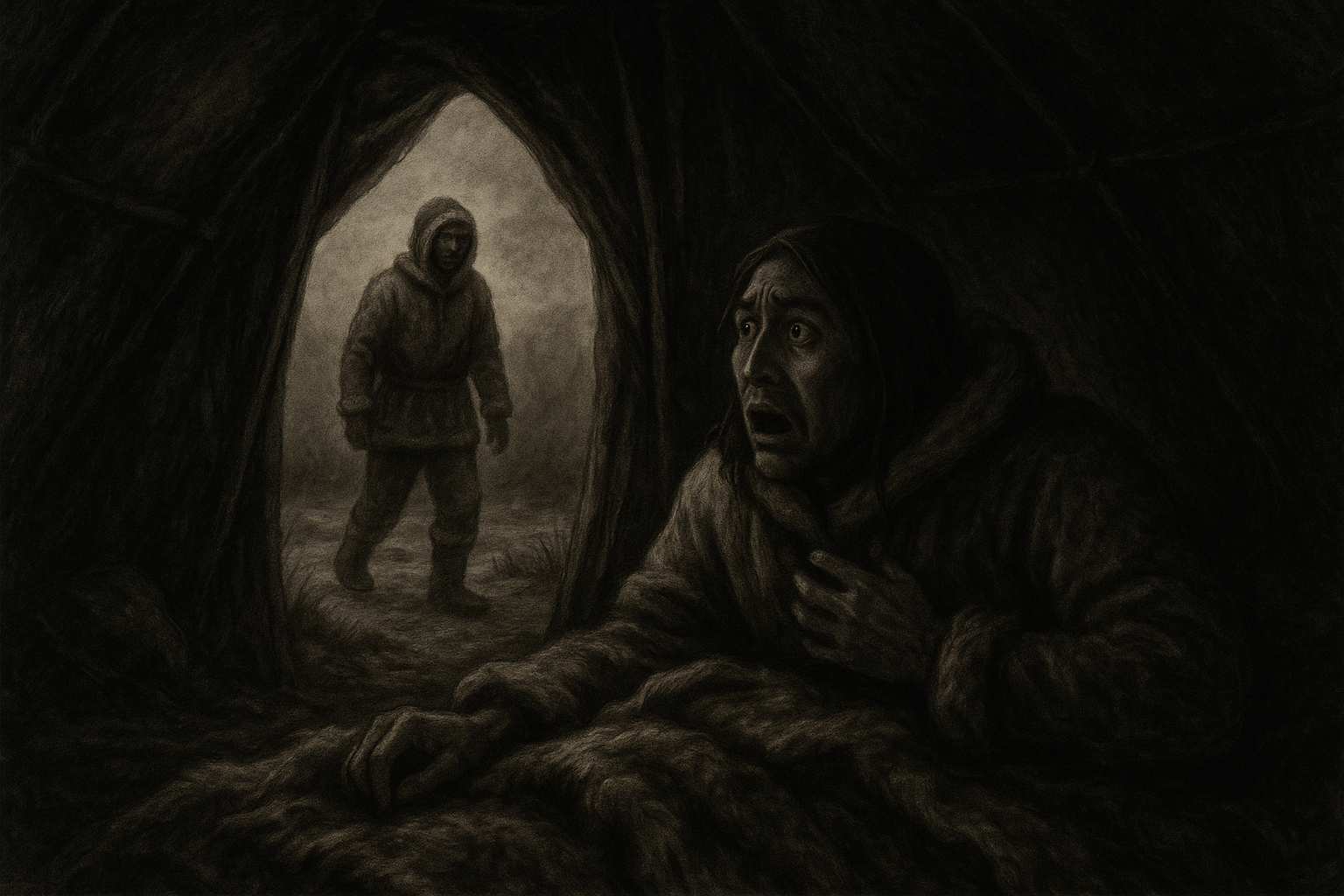
      Manelaq, the wife of Qaorssuaq, told how her husband once saw his own soul, wandering apart from his body, and where this led. Qaorssuaq had lain ill for a long time, and no one could understand what was wrong with him. Then one day, he saw "his own living self" a little way away.
      "No one else could see him. Seeing himself suddenly outside his own body he began to shiver all over. What he saw was his own soul, and it was owing to his illness that it had left his body. All trembling he stretched out his arms towards his soul and cried: 'Come nearer, come nearer. Come to me, come back to me!'
       " I could not understand what was happening to him and had to hold him by the hood when he kept on trembling. At the very moment I took hold of him the vision disappeared, but the soul did not return to his body. It had fled just at the moment it was perhaps on its way back to his body, for I was unclean and just in those days had my bleedings, and therefore the soul fled from me."
       Help came in the form of a couple who were both shamans. "When they heard what had happened, they insisted that 1 should go into a corner of the -tent, right over behind the fireplace; there I had to lie with my head hidden in a heap of caribou bones. While I remained concealed there, the two shamans conjured and summoned their helping spirits. They held a great seance in order to call the soul back to Qaorssuaq's body. And it was not long before he again saw his soul.
       "The two shamans, to whom nothing was impossible, could see it too. They uttered magic words and spoke with their helping spirits' own tongue until the soul came quite close to Qaorssuaq. Then they suddenly sprang to him and began to beat him here and there on his body, the consequence being that the soul was frightened and became so scared that it slipped into Qaorssuaq's body once more.
       "At the very same moment he was well again and I could hear him shouting and singing with joy. Only then did I venture to rise from the heap of animal bones where I had hidden my head till then, and we all sang with happiness. In that way Qaorssuaq got his soul back again." [3]
      It may seem odd that the vagrant soul was induced to get back in the body rather than go further away when the beating began, but it seems the shamans knew what they were doing. The magic words were certainly an important part of their operation. Inuit shamans have special language to do special things. Rasmussen later recounts a story of how magic words were used by an angakok to create a kind of Inuit golem , turning a neap of snow into a black bear. [4] Calling up helping spirits is central to Inuit shamanic practice, as in other traditions. An Inuit name for a spirit helper means "one that exists to be questioned" and the variety of entities that may play this role can be startling. Rasmussen mentions one shaman whose helping spirits included the moon, a sea scorpion, and one of his father’s living dogs. [5] 
     Inuit shamans were unwilling to share much of their training and practice with an outsider, and some told Rasmussen that the great shamans were no more; their tradition was in deep decay. Nonetheless, he was able to report how Inuit shamans are often called by the spirits in dreams. were prolific dreamers and "lived long in a dual world as real shamans must do". In the shaman’s calling, the spirits took the initiative, in dreams. If you could retain your dream experiences and apply them to the world around you, you had keys to mysteries impenetrable to others. [6]
     Rasmussen collected stories of shamanic soul flight, which Mircea Eliade, controversially, thought was the central feature of shamanic practice. [7] His most memorable tales came from Inuit recounting the deeds of illustrious ancestors. “I am a shaman myself,” an informant named Samik told him, “ but I am nothing compared with my grandfather Titqatsaq. He lived in the time when a shaman could go down to the mother of the sea beasts, fly up to the moon or make excursions out through space.”   
    Titqatsag was a frequent flyer. He loved spirit flight, and had a friendly rival, Muraoq, who also took to the air. They met in spirit flight over sea ice midway between their villages. As they converged, Muraoq spread his arms, like a bird gliding on its wings, but did not judge distance well and crashed violently into Tirqatsaq, who fell down onto the ice. He could not move until Muraoq called in helping spirits to get him up. Then the incident was mirrored. Back in the air, Tirqatsag crashed into Muraoq, who dropped to the ice and had to be rescued by his rival’s helping spirits in turn. Even shamans may need flight controllers. [8]


References

1.       Knud Rasmussen, The Netsilik Eskimo Social Life and Spiritual Culture. Report of the Fifth Thule Expedition 1921-24, (Copenhagen: Gyldendalske Boghhandewl, 1931) p. 207.
2. Ibid., p. 213
3. Ibid. p. 216
4. ibid., pp.288-91.
5. ibid., p. 294
6. ibid,, p.296
7. Mircea Eliade, Eliade. Shamanism: Archaic Techniques of Ecstasy. (Princeton: Princeton University Press, 1974).
8. Rasmussen op.cit., pp 299-300.


Illustration RM + AI


Friday, November 22, 2024

Where a Dog Is the Soul's Best Vehicle


I have always known that dogs are marvelous soul friends and can play a psychopomp role for those traveling beyond death. In my contunuing reserach into conceptions of soul among indigenous people, I came upon a note by a Catholic missionary suggesting that among the Inuit a dog could be not only a soul companion but a soul vehicle for the deceased.

Father Roger Buliard reported from his time among the Copper Inuit (called Eskimos in his day) that they took great care to propitiate the anernek - translated as "breath", soul or spirit - of the animals they hunted so that the caribou, for example, would remain friendly. They were no less solicitous in dealing with the anernek of dead Inuit.

"When a relative dies," Father Buliard reported, the Inuit "give his name quickly to a dog, so that the spirit will have a place to rest until a child is born to inherit it. The anernek is a fleeting thing, easily lost, and every artifice must be brought to bear to prevent its prowling and causing trouble.”

Other interesting revelations in this note (1) the breath soul is closely associated with the name; (2) the clear belief in metempsychosis, that at least one of the multiple souls of a human can occupy successive bodies.

Source: Roger Buliard, Inuk. New York: Farrar, Straus and Young, 1951. pp.264-65.


Illustration: "Esquimaux Dogs" by John James Audubon in The Quadrupeds of North America (1845-1848). Public domain.


Wednesday, October 26, 2022

Poets of consciousness


Poets, it’s said, are shamans of words. True shamans are poets of consciousness. Journeying into a deeper reality with the aid of sung and spoken poetry, they bring back energy and healing through poetic acts, shapeshifting physical systems. When we dream, we tap directly into the same creative source from which poets and shamans derive their gifts. When we create from our dreams, and enter dreamlike flow, we become poets and artists. When we act to bring the energy and imagery of dreams into physical reality, we become poets of consciousness and infuse our world with magic.

In Birth of a Poet, William Everson raised a clamorous appeal for poets to reawaken to their shamanic calling: "O Poets! Shamans of the word! When will you recover the trance-like rhythms, the subliminal imagery, the haunting sense of possession, the powerful inflection and enunciation to effect the vision? Shamanize! Shamanize!" Across the centuries, many of our greatest poets have recognized their kinship with the shaman’s way of shifting awareness and shapeshifting reality. As his name in a spiritual order, Goethe chose the name of a legendary shaman of antiquity, Abaris, who came flying out of the Northern mists on an arrow from Apollo’s bow.

Our earliest poets were shamans. Today as in the earliest times, true shamans are poets of consciousness who know the power of song and story to teach and to heal. They understand that through the play of words, sung or spoken, the magic of the Real World comes dancing into the surface world. The right words open pathways between the worlds. The poetry of consciousness delights the spirits. It draws the gods and goddesses who wish to live through us closer. Shamans use poetry, sung or spoken, to achieve ends that go deeper than our consensual world. They create poetic songs of power to invoke spiritual help; to journey into nonordinary reality; to open and maintain a space between the worlds where interaction between humans and multidimensional beings can take place and to bring energy and healing through to the body and the physical world.

The South American paye takes flight with the help of "wing songs". These flight songs help him to borrow the wings of the kumalak bird [a kind of kite] that is a main ally of shamans. Among the Temiar-Senoi of the Malaysian rainforest, the great gift of a dream is the norng, or dream song, literally a "pathway" that can get you through the jungle or carry the soul to where it needs to go on either side of death.

Among the Inuit, the strongest shamans are also the most gifted poets. One of the reasons their spirit helpers flock around them is that they are charmed and exhilarated by the angakok’s poetic improvisations. Inuit shamans have a language of their own, which is often impenetrable to other Eskimos. It is a language that is never still. It bubbles and eddies, opening a whirlpool way to the deep bosom of the Sea-goddess, or a cavernous passage into the hidden fires of Earth.

My favorite Inuit shaman-word is the one for "dream". It looks like this: kubsaitigisak. It is pronounced "koov-sigh-teegee-shakk", with a little click at the back of the throat when you come to the final consonant. It means "what makes me dive in headfirst." Savor that for a moment, and all that flows with it. A dream, in Eskimo shaman-speech, is something that makes you dive in headfirst. Doesn’t this wondrously evoke the kinesthetic energy of dreaming, the sense of plunging into a deeper world? Doesn’t it also invite us to take the plunge, in the dream of life, and burst through the glass ceilings and paper barriers constructed by the daily trivial self?

Shamans know further uses for dream songs. They call the soul back home, into the bodies of those who have lost vital energy through pain or trauma or heartbreak. And from their journeys, they bring back poetic imagery that can help to shapeshift the body’s energy template in the direction of health.

Mainstream Western physicians agree that the body believes in images and responds to them as if they are physical events. By bringing the right images through from the dreaming, the poets of consciousness explain dis-ease in ways that help the patient get well, and interact with the body and its immune system on multiple levels without invasive surgery.

As dreamers, we tap into the same deep wells as poets and shamans and we climb ladders between the worlds. Poetry sometimes comes dancing out of dreams, in full-formed verses. When we turn our dreams into poems, we free our creative spirit, and our spirits come dancing.


Text adapted from Dreamways of the Iroquois by Robert Moss. Published by Destiny Books. 


Photo by RM

Tuesday, April 7, 2020

What makes me dive in headfirst, and other words for dream


If you want to know more about what dreams can be, consider what the words for “dream” mean in different languages. You’ll find clues here to what dreaming meant to our ancestors, before we lost respect for dreamers and contact with the Dreaming..
      How about these:

- a dream is “a journey of the soul” (adekato) for a dreaming people of Venezuela, the Makiritare.

- a dream is a “zephyr”, a gentle breeze slipping through the keyhole, or the crack between the door and the lintel, to breathe in your ear, in ancient Assyria

- a dream is an “awakening” (rswt) in ancient Egypt

- a dream is also a spirit messenger (oneiros) that travels from the Commonwealth of Dreams (Demos Oneiron) in archaic Greece.

     In good Old English, a dream is “merriment” and “revelry” of the kind you might encounter from downing too many goblets in a mead-hall. But by Chaucer’s time, the same word, with a different, Northern derivation, can also imply an encounter with the dead. As in Northern Europe (German Traum, Dutch droom etc) the word “dream” we have inherited is linked to the Old Germanic Draugr, which means a visitation from the dead.
     As explained by the great Tuscarora ethnographer J.N.B.Hewitt, the old Iroquoian word katera’swas means “I dream” but implies much more that we commonly mean when when say that phrase in English. Katera’swas means I dream as a habit, as a daily part of my way of being in the world. The expression also carries the connotation that I am lucky in a proactive way – that I bring myself luck because I am able to manifest good fortune and prosperity through my dream. The related term watera’swo not only means “dream”; it can also be translated as “I bring myself good luck.” 
       Early Jesuit missionaries reported that the Iroquois believed that neglect of dreams brings bad luck. Father Jean de Quens noted on a visit to the Onondaga, that “people are told they will have bad luck if they disregard their dreams.” So if you want to get lucky, you want to dream a lot.
      In the Mohawk language, the word we translate as "shaman" is ratetshents, which literally means "one who dreams". Typically, across the indigenous North American cultures, we find the same thing. By definition, the shaman is a dreamer, one who dreams strong.
       Among the Dene, the same linguistic terms are used to designate dreams, visions and spontaneous apparitions and trance states, suggesting that they can all transport the dreamer into the same space, the space where shamans operate.
      Among the Wind River Shoshone, the word navujieip means both “soul” and “dream”; the navujieip “comes alive when your body rests and comes in any form”
       In Scots Gaelic there is a prolix and specific vocabulary for many forms of dreaming and seership and paranormal phenomena. The best literary source on these things is the work of John Gregorson Campbell, a minister of Tiree in the late nineteenth century who gathered the oral traditions of Gaelic speakers and wove them into two books, Superstitions of the Highlands and Islands of Scotland (1900) and Witchcraft and Second-Sight in the Highlands and Islands of Scotland (1902).
     The term da-shealladh (pronounced "dah-haloo"), often translated as "second sight", literally means "two sights". It refers to the ability to see apparitions of both the living and the dead. The taibshear (pronounced "tysher") is the seer who specializes in observing the energy double (
taibhs). A dream or vison is a bruadar ("broo-e-tar"). The bruadaraiche ("broo-e-taracher") is more than a dreamer in the common sense; he or she is the kind of dreamer who can see into the past or the future. That's a nugget worth close evaluation. The depth of the practice of dreaming in any culture is reflected in its working terminology for such things. I'm not sure that current English offers a single word as rich as bruadaraiche but I doubt that we can import the Scots term since (at least as it comes off my tongue) it sounds like something boiled up in a sheep's stomach.
     The Hawaiian language contains a rich vocabulary for dreaming that makes a delightful study.    A general word for dreams in Hawaiian is moe’uhane, generally translated as “soul sleep” but better understood as “night experiences of the soul”, since for traditional Hawaiians, dreaming is very much about traveling. The soul makes excursions during sleep. It slips out of the regular body, often through the tear duct, described as the “soul pit” and travels in a “body of wind”. During sleep the dreamer also receives visitations from gods (akua) and ancestral guardian spirits (aumakua) who may take the form of a bird or a fish or a plant.
     Like all practical dreamers, the Hawaiians recognize that there are big dreams and little dreams. You don’t want to pay too much attention to a “wild goatfish dream”(moe weke pahulu), which is caused by something you ate or how fast you ate it. The colorful term is derived from popular belief that eating the heads of goatfish – at other times a delicacy – in the wrong season, when bad winds are blowing, causes sickness and troubling but meaningless dreams. On the other hand, you want to recognize that a dream may contain the memory of a trip into the future that can give you information of the highest practical importance. Especially helpful is the “straight-up” dream (moe pi’i pololei) that is clear and requires no interpretation.
    There are “wishing” dreams (moemoea) that show you something you are pining for, which may or may not be attainable in ordinary reality. There are “revelations of the night” (ho’ike na ka po) that carry the power of prophecy.
     A most interesting category of Hawaiian dreams are those – believed to be gifts of the guardian ancestral spirits – that are given to promote the healing of relations within a family or community. Dreams are also given by the aumakua to promote personal healing.
The ancestral spirits also deliver “night names” (inoa po) for babies that are on the way, and cautionary tales are told of misfortune that comes when the parents ignore a baby name delivered in a dream.
    The Hawaiians pay special attention to visions that come on the cusp between sleep and waking (hihi’o) believing that these are especially likely to contain clear communication from the spirits and “straight up” glimpses of things that will unfold.
    In our dream travels, we may be united with a “dream husband” (kane o ka po)or a “dream wife” (wahine o ka po). This can be pleasurable and even compelling, but Hawaiian lore teaches caution. Spend too much time outside your regular body in your “body of wind” and the physical organism may start to weaken and languish. You also want to be alert to deceivers who may take on the form of alluring sexual partners but are actually something else, like tricky mo’o, a kind of water imp.
     We want to bring energy from our juiciest dreams into embodied life and not leave it out there. A favorite Hawaiian legend tells how a goddess accomplished this. Pele, on her volcanic island, was stirred by rhythmic drumming from far off. She left her body in her lava bed, charging her attendants not to rouse her for three days on any account. She traveled far in her “body of wind” and finally found the source of the magical drumming is a luau being held by a handsome prince. The goddess and the prince fell for each other and spent three days making love before Pele returned to the body she had left in her lava bed. Being a goddess, she was then able to arrange for her prince to be transported to the Big Island to live with her as her consort. Humans may find this kind of transfer harder to effect, but it’s always worth a try!
     My favorite word for "dream"comes from the special vocabulary of the Inuit angakok ("one who sees with inner light") or shaman. The word is transcribed like this: kubsaitigisak. It is pronounced "koov-sigh-teegee-shakk" with a little click at the back or the throat when you come to the final consonant. It means "what makes me dive in headfirst". Savor that for a few moments. A dream is something that makes you take the plunge. It takes you deep. Doesn't this wonderfully evoke how, dreaming, we may escape our consensual daily hallucinations and dive into a deeper world?


Text adapted from Dreaming the Soul Back Home by Robert Moss. Published by New World Library. Audio version narrated by Robert now available from audible.com

Art: "Broad Bands of Dreaming" by Robert Moss

Monday, January 21, 2019

Fresh Words


The Inuit say that we need to entertain the spirits, including our own creative spirits, and that one of the best ways to do this is to produce “fresh words.”
   They help prevent our gods from becoming tired and dried up in the way that Rilke warned about in “Migration des Forces”, one of the poems he wrote in French:

Certains de nos dieux s’épuisent et se dessèchent,
arides, ankylosés;
dans d’autres, en murmurant, se jette la source fraiche
d’une divinité reposée.

My free version:

Some of our gods become tired and dried up,
sterile and stiff-jointed;
so into others, murmuring, rushes the fresh spring
of a refreshed divinity.


Drawing of Rilke I placed in my journal when I was 19.

    Among the Inuit, the strongest shamans are also the most gifted poets. One of the reasons their spirit helpers flock around them is that they are charmed and exhilarated by the angakok’s poetic improvisations. Inuit shamans have a language of their own, which is often impenetrable to other Eskimos. It is a language that is never still. It bubbles and eddies, opening a whirlpool way to the deep bosom of the Sea-goddess, or a cavernous passage into the hidden fires of Earth. 
    Our earliest poets were shamans. Today as in the earliest times, true shamans are poets of consciousness who know the power of song and story to teach and to heal. They understand that through the play of words, sung or spoken, the magic of the Real World comes dancing into the surface world. The right words open pathways between the worlds. The poetry of consciousness delights the spirits. It draws the gods and goddesses who wish to live through us closer.

    Yaminahua shamans in Peruvian Amazonia use complex, opaque metaphorical language in their power songs, which are their most important tools for journeying and opening an interactive space with the spirits – and for bringing energy and healing through. This is called, literally, “twisting-twisting words”. One shaman explains that with ordinary words, you’ll “crash” in this deeper reality; “twisting words” let you circle around and see.
    Wherever the old ways of dreaming and soul healing are still alive, poets of consciousness - those born and dreamed to be our shamans and Speakers - know what this means.We'll never be able to travel the song lines and the story lines into the space where worlds are made and can be recreated until we come up with our own fresh words.
    We need fresh and twisting words to change and twist the behavior of the body, in the direction of health, and to re-weave tangled or torn energy webs. We need to twist and shout our way out of the boxes, constructed by limited and self-limiting belief systems, that we sometimes mistake for home.


Photo at top: Fox Crossing on the Metuje River in Bohemia by RM

Saturday, May 12, 2018

Poets of consciousness


Poets, it’s said, are shamans of words. True shamans are poets of consciousness. Journeying into a deeper reality with the aid of sung and spoken poetry, they bring back energy and healing through poetic acts, shapeshifting physical systems. When we dream, we tap directly into the same creative source from which poets and shamans derive their gifts. When we create from our dreams, and enter dreamlike flow, we become poets and artists. When we act to bring the energy and imagery of dreams into physical reality, we become poets of consciousness and infuse our world with magic.
      In Birth of a Poet, William Everson raised a clamorous appeal for poets to reawaken to their shamanic calling: "O Poets! Shamans of the word! When will you recover the trance-like rhythms, the subliminal imagery, the haunting sense of possession, the powerful inflection and enunciation to effect the vision? Shamanize! Shamanize!" Across the centuries, many of our greatest poets have recognized their kinship with the shaman’s way of shifting awareness and shapeshifting reality. As his name in a spiritual order, Goethe chose the name of a legendary shaman of antiquity, Abaris, who came flying out of the Northern mists on an arrow from Apollo’s bow.
      Our earliest poets were shamans. Today as in the earliest times, true shamans are poets of consciousness who know the power of song and story to teach and to heal. They understand that through the play of words, sung or spoken, the magic of the Real World comes dancing into the surface world. The right words open pathways between the worlds. The poetry of consciousness delights the spirits. It draws the gods and goddesses who wish to live through us closer.
     Shamans use poetry, sung or spoken, to achieve ends that go deeper than our consensual world. They create poetic songs of power to invoke spiritual help; to journey into nonordinary reality; to open and maintain a space between the worlds where interaction between humans and multidimensional beings can take place and to bring energy and healing through to the body and the physical world.
     The South American paye takes flight with the help of "wing songs". These flight songs help him to borrow the wings of the kumalak bird [a kind of kite] that is a main ally of shamans.
     Among the Inuit, the strongest shamans are also the most gifted poets. One of the reasons their spirit helpers flock around them is that they are charmed and exhilarated by the angakok’s poetic improvisations. Inuit shamans have a language of their own, which is often impenetrable to other Eskimos. It is a language that is never still. It bubbles and eddies, opening a whirlpool way to the deep bosom of the Sea-goddess, or a cavernous passage into the hidden fires of Earth.
      My favorite Inuit shaman-word is the one for "dream". It looks like this: kubsaitigisak. It is pronounced "koov-sigh-teegee-shakk", with a little click at the back of the throat when you come to the final consonant. It means "what makes me dive in headfirst." Savor that for a moment, and all that flows with it. A dream, in Eskimo shaman-speech, is something that makes you dive in headfirst. Doesn’t this wondrously evoke the kinesthetic energy of dreaming, the sense of plunging into a deeper world? Doesn’t it also invite us to take the plunge, in the dream of life, and burst through the glass ceilings and paper barriers constructed by the daily trivial self?
     Shamans know further uses for poetry. They use song and poetic speech call the soul back home, into the bodies of those who have lost vital energy through pain or trauma or heartbreak. From their own journeys, they bring back poetic imagery that can help to shapeshift the body’s energy template in the direction of health. Mainstream Western physicians agree that the body believes in images and responds to them as if they are physical events. By bringing the right images through from the dreaming, the poets of consciousness explain dis-ease in ways that help the patient get well, and interact with the body and its immune system on multiple levels without invasive surgery.
    After attending healing sessions of Cuna shamans in Panama, French anthropologist Claude 
Lévi-Strauss explained how the poetry of consciousness is a healing art. "The shaman provides the sick...with a language, by means of which unexpressed, and otherwise inexpressible, psychic states can immediately be expressed. And it is the transition to this verbal expression which induces the release of the physiological process." Instead of giving an explanation of disease that leaves the sufferer powerless and "patient", the shaman explains disease through words and images that help the body get well - just as our dreams do. This is healing through dream transfer, a poetic act.
    Let's recall the Inuit wisdom that with the poetic act, the worlds are joined and the sacred beings come dancing through. An old Inuit woman on Little Diomede Island explained to a Danish anthropologist that powerful spirits - like the spirit of the whale - must be summoned by "fresh words". "Worn-out songs" should never be used when you are trying to call on important spirits.


My new online adventure with The Shift Network, "Living Your Mythic Edge", is, above all, an invitation to become a poet of consciousness.
Adapted from Dreamways of the Iroquois: Honoring theSecret Wishes of the Soul by Robert Moss. Published by Destiny Books

Art: "The Poet with the Birds" by Marc Chagall

Tuesday, September 27, 2016

Secrets of Flow: creative dreamers and shaman poets


Creativity comes most deeply and naturally when we enter a state of flow. This is evoked in the Tewa Pueblo word for creativity or art. The word is po-wa-ha. The three syllables literally mean “water-wind-breath”. The understanding is that creating is a process of connecting to a deep natural flow [and that art is a process, not a product]. Rina Swentzell, an architect and artist from Santa Clara Pueblo, explains that the Tewa do not have a separate word for art because they do not experience art as an activity separate from any other in life. Creativity is as close as breathing; it is the spirit of life moving effortlessly through its cycles.

Po-wa-ha, literally “water-wind-breath” is that energy that flows from everybody and everything – plants, stones…Creativity just begins to flow out of people. [It] breaks through limits and limitations and flows through from the very source of life. [1]

Dreams can help move us into creative flow, as poet William Everson observed:

The development of the dream-life is one of the best of all possible ways of getting you into the imaginative dimension from which true writing springs…There is no real creative process without mood. It is a losing of objectivity to another dimension, a further loss of self, and it is from this loss that all authentic work springs. It is not possible to create without losing your ego-consciousness. The great thing about the dream is that it takes us into that dimension of mood. Sometimes your finest poems come out of dreams, or out of your recording of a dream. [2] 

Creators and shamans both enter a state of conscious dreaming to do their work, and bring back gifts of magic and healing. In Birth of a Poet William Everson beautifully evoked the similarity between those who reenchant the world as poets and as shamanic dreamers:

In trance [the shaman] descends to the unconscious and like a grebe or cormorant swims underwater in search of the delivering images, the spirits…It is the talent and the genius of the shaman to control the conditions of the trance until the remedy is found and the cure effected. The artist must do the same thing…The shaman enters a trance-like condition in order to engage the archetypes of the collective unconscious and stabilize their awesome power, appease the demons, as it were. This is precisely the function of the poet today. For the poet, too, can only work through trance. [3]

    The connection between the shaman and the creator goes even deeper. The Inuit say that the spirits like “fresh words”. They want to be entertained. They are easily bored with humans who go on repeating old formulas and old ways. When we bring something fresh and new into the world, we entertain the spirits and delight our own creative genius, and our lives are infused with natural magic, confirmed by the play of synchronicity about us.
    I teach an unusual creative writing retreat called "Writing as a State of Conscious Dreaming" at a magical private retreat center in the green woods east of Seattle. But I have the pleasure of watching people move into creative flow in many other situations as they learn to start their day by drifting in the fertile space between sleep and awake, and then to bring fresh dreams to the breakfast table and take action to create with the fresh energy and imagery that is with them. 


References

1. Rina Swentzell and Sandra P. Edelman,  “The Butterfly Effect” El Palacio 1, vol 95 (Fall/Winter, 1989)
2.William Everson, Birth of a Poet: The Santa Cruz Meditations edited by Lee Bartlett, (Santa Barbara: Black Sparrow Press, 1982) 41
3. ibid 133.

Art: "Mandala de l'arbre" by Annick Bougerolle.

Thursday, June 9, 2016

The shaman as poet of consciousness


Poets, it’s said, are shamans of words. True shamans are poets of consciousness. Journeying into a deeper reality with the aid of sung and spoken poetry, they bring back energy and healing through poetic acts, shapeshifting physical systems. When we dream, we tap directly into the same creative source from which poets and shamans derive their gifts. When we create from our dreams, and enter dreamlike flow, we become poets and artists. When we act to bring the energy and imagery of dreams into physical reality, we become poets of consciousness and infuse our world with magic.
    In Birth of a Poet, William Everson raised a clamorous appeal for poets to reawaken to their shamanic calling: “O Poets! Shamans of the word! When will you recover the trance-like rhythms, the subliminal imagery, the haunting sense of possession, the powerful inflection and enunciation to effect the vision? Shamanize! Shamanize!” Across the centuries, many of our greatest poets have recognized their kinship with the shaman’s way of shifting awareness and shapeshifting reality. As his name in a spiritual order, Goethe chose the name of a legendary shaman of antiquity, Abaris, who came flying out of the Northern mists on an arrow from Apollo’s bow.   
    Our earliest poets were shamans. Today as in the earliest times, true shamans are poets of consciousness who know the power of song and story to teach and to heal. They understand that through the play of words, sung or spoken, the magic of the Real World comes dancing into the surface world. The right words open pathways between the worlds. The poetry of consciousness delights the spirits. It draws the gods and goddesses who wish to live through us closer.
   
     Shamans use poetry, sung or spoken, to achieve ends that go deeper than our consensual world. They create poetic songs of power to invoke spiritual help; to journey into nonordinary reality; to open and maintain a space between the worlds where interaction between humans and multidimensional beings can take place and to bring energy and healing through to the body and the physical world.
   
     The South American
 paye takes flight with the help of “wing songs”. These flight songs help him to borrow the wings of the kumalak bird [a kind of kite] that is a main ally of shamans.   
      Among the Inuit, the strongest shamans are also the most gifted poets. One of the reasons their spirit helpers flock around them is that they are charmed and exhilarated by the angakok’s poetic improvisations. Inuit shamans have a language of their own, which is often impenetrable to other Eskimos. It is a language that is never still. It bubbles and eddies, opening a whirlpool way to the deep bosom of the Sea-goddess, or a cavernous passage into the hidden fires of Earth.
    
     
      My favorite Inuit shaman-word is the one for “dream”. It looks like this:
 kubsaitigisak. It is pronounced “koov-sigh-teegee-shakk”, with a little click at the back of the throat when you come to the final consonant. It means “what makes me dive in headfirst.” Savor that for a moment, and all that flows with it. A dream, in Eskimo shaman-speech, is something that makes you dive in headfirst. Doesn’t this wondrously evoke the kinesthetic energy of dreaming, the sense of plunging into a deeper world? Doesn’t it also invite us to take the plunge, in the dream of life, and burst through the glass ceilings and paper barriers constructed by the daily trivial self?

None of this is any secret to anyone of Celtic heritage. The arts of "goodly speech", of turning the world and stepping between the worlds with the aid of story and song, are central to the ways of Celtic magic. The song of shapeshifting is one of the great Celtic art forms. Many will remember the great Song of Amergin, in which the bard of the Milesians lays claim to Ireland. It begins like this, in Robert Graves’ elegant version:
I am a stag: of seven tines,
I am a flood: across a plain,
I am a wind: on a deep lake,
I am a tear: the Sun lets fall,
I am a hawk: above the cliff,
I am a thorn: beneath the nail,
I am a wonder: among flowers,
I am a wizard: who but I
Sets the cool head aflame with smoke?

Shamans know further uses for poetry. They use song and poetic speech call the soul back home, into the bodies of those who have lost vital energy through pain or trauma or heartbreak. From their own journeys, they bring back poetic imagery that can help to shapeshift the body’s energy template in the direction of health.
    Mainstream Western physicians agree that the body believes in images and responds to them as if they are physical events. By bringing the right images through from the dreaming, the poets of consciousness explain dis-ease in ways that help the patient get well, and interact with the body and its immune system on multiple levels without invasive surgery. This is the work of the word doctor.


Adapted from Dreamways of the Iroquois: Honoring the Secret Wishes of the Soul by Robert Moss. Published by Destiny Books.
Image: "The Bard" by John Martin (1817)