Showing posts with label dreaming. Show all posts

Tuesday, April 8, 2025

In dreams begins responsibility


I enjoy playing quote detective. The twin epigraphs in Yeats's poetry collection Responsibilities, first published by Cuala Press in 1914, make an interesting study that involves the valuation of dreams and the very nature of dreaming.
      In dreams begins responsibility. This can be read in several ways. What we choose and do in dreams has consequences. What will manifest in conscious life has its roots in what Yeats elsewhere called the "fibrous darkness". We are responsible for what we do or do not do inside the dreamworld. Or are we?
     Disowning responsibility for the actions of the dream self has been a popular cop-out among Euro-Americans for a very long time. Saint Augustine was one of  those who wanted to deny responsibility for he did in his dreams, since he was embarrassed that he continued to have sex in his dreams after taking vows of chastity. 
He tried to absolve himself by making a distinction between “happenings” and “actions.” Dreams fall into the former category. Things just happen to you and you can't be held responsible for them. [1]
     This is nonense to traditional dreaming cultures. They know the dreamworld is a real lifeworld, and hold dreamers responsible for their actions within it. Real Mystery initiates and conscious dream travelers - of whom Yeats was one - generally feel the same.
    Where did Yeats get his quotable quote? He gave the source as an "Old Play". Attributing a made-up quotation to an Old Play was a favorite ruse of Sir Walter Scott, and Yeats may have been following his lead. Some hear an echo of a passage in Nietzsche's Morgenröthe:

“Dream and responsibility. - You are willing to assume responsibility for everything! Except, that is, for your dreams! What miserable weakness, what lack of consistent courage! Nothing is more your own than your dreams! Nothing more your own work! Content, form, duration, performer, spectator - in these comedies you are all of this yourself! And it is precisely here that you rebuff and are ashamed of yourselves, and even Oedipus, the wise Oedipus, derived consolation from the thought that we cannot help what we dream!” [2]

In dreams begins responsibility. The line continues to reverberate. Delmore Schwartz, famous as the poet of Depression-era Brooklyn, wrote his story ”In Dreams Begin Responsibilities” over a weekend when he was twenty-one. He borrowed his title from Yeats's Old Play, but made "responsibility" plural. In Schwartz's story, his protagonist's dream double is in a cinema watching a grainy old silent movie. He puts us there, hearing the crackle of the projector, watching the black-and white frames. The movie watcher recognizes his mom and dad, on the hot afternoon on Coney Island when his father proposed. Seething with emotion, the young man in the cinema stands up and yells at his parents, across time, not to get married - and then later, not to break up. An usher hustles him out of the theater - and he wakes up, as the author may have done. [3]
    This gives a further slant on responsibilities that begin in dreams. In dreams, we look into secret places and travel across time. What if – more than just shouting at a screen – we could reach into a mind and situation across time and change something that might alter a whole history? Delmore Schwartz left that question unspoken but it may have occurred to Yeats, who maintained that we are required to question our dreams.   
    Yeats thought that dreams place responsibility on the dreamer to seek to understand what they offer - advice, a warning, an explanation, a deeper reality, conversation with higher beings, interaction with other dreamers. Dreams are to be questioned before sleep and to be examined on waking, to tease out their implications and the action needed. He saw the questioning of dreams as a form of divination. Yeats wrote in his mid-forties that “since I was a boy I have questioned dreams for [Maud Gonne’s] sake” [4] In the Automatic Script of 1919, on being told “don’t forget you are to have a dream,” Yeats asked, “On what shall I question?” [5]
    He was haunted across his life by the aching divide between dreams of a fully consummated love and a spiritual marriage with Maud Gonne, and her repeated refusal to accept him as her mate in ordinary life. There was the unavoidable sense that he had failed in one of the largest responsibilities his dreams had given him. Yet he never despaired of dreaming. He said that the dreams that had been “granted” to him – as opposed to the dreams he had “sought” through incubation, meditation or magical formulas - had been his truest source of knowing.[6]


The second epigraph to Responsibilities takes us to China. It is based on a misreading of a French translation of the Analects of Confucious, probably passed on to Yeats by Ezra Pound. The original text refers not to the Prince of Chang but to the Duke of Zhou, associated by the Confucians with public virtue. [7] The apothegm was originally constructed to mourn a decline in social mores and the growth of government corruption. However, the mention of a dream figure is what seized the Chinese imagination, so the Duke of Zhou came to be regarded as a patron – even a god – or dreams. The sorrow of Yeats’s second epigraph streams from the understanding that to lose contact with the greater minds that become accessible in dreams is to fall from one’s own greater self.    
     Yeats journaled his dreams and visions and engaged in many experiments to set up what we might call lucid and mutual dreaming. He spent a good deal of his time lying on his back in half-dream states. He learned the merits of entering a state of relaxed attention, open to the spontaneous flow of images. “One must allow the images to form with all their associations before one criticizes.” He agreed with Goethe that if one is critical too soon, images will not form at all. “If you suspend the critical faculty, I have discovered, either as the result of training, or, if you have the gift, by passing into a slight trance, images pass rapidly before you. If you can suspend also desire, and let them form at their own will, your absorption becomes more complete and they are more clear in color, more precise in articulation, and you and they begin to move in the midst of what seems a powerful light.” [8] He tried to stay with a dream or reenter it when he was dissatisfied or disappointed with what had been accomplished.
     He made this ringing declaration of his trust in dreams in an essay on Shelley: "I have observed dreams and visions very carefully, and am now certain that the imagination has some way of lighting on the truth that the reason has not, and that its commandments, delivered when the body is still and the reason silent, are the most binding we can ever know." [9]


References

1. Augustine Confessions  Book X Chapter 30. See discussion in Owen Flanagan (2000) Dreaming Souls: Sleep, Dreams and the Evolution of the Conscious Mind  (Oxford: Oxford University Press, 2000) pp. 18, 179-183.

2. Friedrich Nietzsche, Daybreak: Thoughts on the Prejudices of Morality. Cambridge University Press, 1997, p.78

3. Delmore Schwartz, In Dreams Begin Responsibilities and Other Stories (New York: New Directions, 1978)

4.W.B. Yeats, “PIAL Notebook” 8v, quoted in Neil Mann, “W. B. Yeats, Dream, Vision, and the Dead” in Matthew Gibson and Neil Mann (eds) Yeats, Philosophy, and the Occult (Clemson SC: Clemson University Press, 2016) p.158 n.18. The "PIAL Notebook", kept by Yeats from 1908 to 1917, was named after Maud Gonne’s Golden Dawn motto, Per Ignem ad Lucem ("Through Fire to Light") 

5. Steve L. Adams, Barbara J. Fielding and Sandra L. Sprayberry, Yeats Vision Papers Volume 2 (London and Iowa City: Macmillan/University of Iowa Press, 1992) p. 166. 

6. Collected Works of W.B. Yeats, Volume I. The Poems ed. Richard J. Finneran. (New York: Scribner, 1997) p.601.

7. The source is Confucius 7:5, as translated by Guillaume Pauthier in 1858 and then retranslated by Ezra Pound in his Canto XIII. See Mann, “W.B. Yeats, Dream, Vision and the Dead” p.155 n.1 

8. W.B. Yeats, Mythologies (London and New York: Macmillan, 1955) p. 344. 

9. W.B. Yeats, “The Philosophy of Shelley’s Poetry” Essays and Introductions. (London: Macmillan, 1961) p. 65.


Friday, March 21, 2025

What's the use of dreaming?


Most human societies until relatively recently have understood that dreaming is important for three reasons above all. First, dreams give us access to sources of wisdom beyond the ordinary mind - to the God or Goddess you can talk to, to the ancestors, to the animate powers of nature, to the greater Self. "It is an age-old fact," declared the great psychologist C.G.Jung in his last major essay, "that God speaks chiefly through dreams and visions." 

Second, dreams show us the future, in ways that can contribute to the well-being and survival of whole communities. They not only rehearse us for events that will happen; they show us possible futures,. If we are able to harvest and clarify the information, and then take appropriate action, we can improve the odds on manifesting a desirable future event, or avoiding an unwanted one.

Third, dreaming is medicine, in several senses. In somatic or prodromic dreams, we are shown what is happening inside the body and symptoms it could develop in the future. So dreams can be a source of vital, even life-saving, diagnosis.

When we do get sick, dreams are a factory of imagery that can help us to get well. Medical science is increasingly receptive to the fact that the body receives images as events, and responds accordingly. Where do we get the images that will persuade the body to adjust in the direction of health? The best images we can use for healing are those delivered by our own dreams. We know they are timely and they are authentic, or own material. The dream image may initially be scary, but I would insist that any image that belongs to us can be developed in the direction of wholeness and healing, if we are prepared to work with it.

Still on the theme of dreams in relation to healing, dreams put us in touch with multiple aspects of ourselves - with the shadow side we may have repressed or denied, with the magical child who may have parted company with us when the world seemed too cold and too cruel, with our animal spirits. Working these connections consciously can help us be stronger, and more. It can lead to soul recovery, which is what happens when we bring home vital parts of our energy and identity that went missing to live in our bodies and our lives. 

Dreaming is an essential human activity, as essential as sex or sleep. If we have lost contact with our dreams, the Iroquois say, we have lost a vital part of our souls. Dreams are important and useful for everyone.

Through our dream radar, we are able to see challenges and opportunities that lie ahead. This is part of our survival kit. Dreams hold up a magic mirror to our everyday attitudes and actions - sometimes in a quite shocking or humorous way - helping us to see ourselves from a higher perspective. In this way (as Dostoyevsky reminded us in Crime and Punishment) the dreams of the night can be a corrective to the delusions of the day.

And then there is the entertainment and refreshment value of dreams, whose gift may simply be a good story or a good laugh. You have access in dreams to a night cinema where the movies are screened  especially for you. You can sometimes step through the screen and become scriptwiter, director and star of your own productions. If you don't remember your dreams, you are missing out on the movies.

Dreaming you can travel without leaving home, not a small thing in the time of pandemic. You can come back with the memories of a delicious vacation. You can rendezvous with friends and loved ones far away, since dreaming is social as well as personal. 

Illustration: "Three Bands of Dreaming" by RM


Sunday, March 2, 2025

Cosmos of the Makiritare Dream Shamans


In the origin story of the Makiritare (or Yekuana), a dreaming people of Venezuela, there was chaos and suffering in the world after the departure of Wanadi, a primordial being, before the dream shamans arose. People ceased to have direct contact with the other world, the realms where the akato (soul) travels and the masters of animals dwell. They could no longer rescue souls of the living or send souls of the dead to the right place. Without dreams, they were helpless in a world of illusion, trapped in delusions of the day and manipulations of other beings. Rescue could only come through the journey of a dream shaman who could reenter the invisible world and change things there and bring home the souls trapped in illusory realities.

Medatia is the one who turned himself into a dream shaman. He traveled to seven worlds beyond this one and brought skills and insight from all of them. He could then travel to the houses of the spirits and the animals – even the house of Odosha, the Dark One – and retrieve the people held captive there. At one point in his journey through Upper Worlds, he had to leave his second body dead in a lake, while a guide like a huge humanoid blue butterfly helped him to rise in another body. There are lots of anacondas in the story, though not in the picture.


Source: Marc de Civrieux, “Medatia: A Makiritare Shaman’s Tale”, translated by David M. Guss in The Language of the Birds ed Guss )San Francisco: North Point Press, 1985) 55-75

Images: (top) Cosmos of the Makiritare Shaman (bottom) "Lake in the Sky" by Robert Moss


Friday, November 8, 2024

Making friends with death and French language through dream telepathy


I dreamed I was struggling to explain something important in my faulty French. I woke, checked online, and read a message (in French) from a friend in France. He reported that he had been trying to help a man who was struggling to understand what he describes as "an absurd experience for a Cartesian spirit like mine."

The "absurd experience" was a dream in which the skeptic met his departed father. His father was eating breakfast, wearing a beautiful blue shirt. In ordinary life, the man did not believe such an encounter was possible. Waking, the Cartesian did not believe that an encounter with the dead was possible, In the dream, he rushed to his father, gave him a big hug, and was deeply moved.

Trying to make sense of what happened, the dreamer exclaimed, " On devrait nous apprendre, quelque part, à apprivoiser nos rêves. We need to be taught how to make friends with our dreams."

Apprivoiser is a very interesting word. It is often translated as "to tame" or "make gentle". Its most famous use is in the beloved story of the Little Prince, who learns from the fox that in order to learn the secret of life he must "tame" the fox in the sense of making friends with something wild.

My friend thought that I might be able to help the man who had dreamed of his dead father. I could hardly refuse this appeal to help after seeing the word apprivoiser. I wrote a book called The Dreamer's Book of the Dead. It explains why contact with the deceased is neither weird nor even unusual, since they are alive somewhere else. They call on us and we visit them, especially in dreams. We discover that healing and forgiveness are always available, across the apparent barrier of death.


When foreign rights to The Dreamer's Book of the Dead were sold, my French publishers came up with this title for the translation: Apprivoiser la mort par le rêve.

I wrote to the Cartesian who had the "absurd" experience of a loving encounter with his father on the Other Side:

"I have seen it so many times: a man encounters his deceased father in a dream. He discovers that to die in this world is to live in another world. This transforms his understanding of what it means to dream, to live and to die."

I wrote this in my faulty French, My dream had rehearsed me for this minutes before. 

Telepathy, precognition, clairvoyance? Maybe all three. The categories we use for "supernormal" phenomena may blur. What is clear is that in dreams our perception reaches beyond our ordinary senses. We send and receive messages. We make visits and receive visitations. We are prepared for challnenges and opportunities that lie ahead. We have easy access to the departed. And any dream is likely to tell us something we do not already know, in the waking mind.


- Journal report from January 6, 2016


Drawing by Robert Moss


Sunday, June 16, 2024

When your dream soul goes flying


From the Teachings of Island Woman:

The memory of a dream is the memory of a journey. It may have been a short visit to a neighbor's place or a date with the lover you will meet three years from now. It may have been a journey to the spirits on the moon, or into a universe inside a stone that is as big as the universe out there.

When your dreamsoul goes flying, it visits the future and brings back memories of things that haven’t happened yet in the Shadow World. Sometimes you can stop those things from coming to pass. Sometimes you just have to live them out. Sometimes you can tame a future you don’t want by acting out a little piece of it, enough to contain the event that is trying to come through.
   Life is full of crossroads. Often you don’t even notice them until they are behind you, unless you know how to dream. Through dreaming, you can scout out the different trails you might follow and see where they lead. Through dreaming, you are already choosing the events that will take place in your waking life.

There is limitless power and beauty and healing available to us in the dreamworlds. To keep body and soul together in the surface world – and to live from the purposes of the soul – we need to bring that dream energy through. This requires action in the Shadow World.
    The first part of that action may be speech, but not the chatter of idle birds or village gossips. The speech required is an act that brings something new into a world. Dreaming gives us the songs and the magic words that can bring something up from a soupy ocean of possibilities to take root in the earth. That is why real men and women of power are poets, singers, storytellers, performers. With skeins of song and dancing needles of magic words, they reweave the fabric of reality.
   When we do this, we know that we are entertaining the spirits: our own vital spirits, the spirits of the ancestors, the great ones who reach to us from beyond space and time, the ancient and shining ones.

Nothing happens until it is dreamed. When we bring something good from the dreamworld into the surface world, we do the work of the Creator. We join in dancing a world into being, as Sky Woman danced on Turtle’s back.


-


"Island Woman" is the name I gave to an indigenous arendiwanen ("woman of power") who was born Huron and raised Mohawk some 300 years ago. She became Mother of the Wolf Clan of the Kanienkehaka, or Mohawk people, and a revered healer and dream shaman. She called me in lucid dreams in the late 1980s, after I moved to a farm on the edge of traditional Mohawk country and I had to study the Huron and Mohawk languages to understand and record her teachings. For her fuller teachings and my discoveries about her in historical records, see my book
Dreamways of the Iroquois

Drawing: "Island Woman" by Robert Moss

Wednesday, April 3, 2024

A universe inside a stone


I am intrigued by tales in which we find a universe inside a very small space, such as the space between subatomic particles. These give us a window into what physics is telling us about the nature of hidden dimensions, and they provide a context of understanding for dreams and visions in which we experience these realities directly.

In the vast Yogavasistha the sage Vasistha entertains and instructs the despondent Rama with a series of tales that include his first-hand account of his travel to and from a world of beauty and magic that he created in subatomic space.

At a certain time in his life, the sage recalled, he wished to leave the “busy world” behind and live in a quiet place “free from all imaginings, where I would be invisible to everyone.” Through “yoga and imagination” he created a little hut in a “far-distant corner of the space of emptiness” and lived there unmoving, in the lotus posture, meditating. A century passed in a flash.

In my meditation I saw the thousands of universes that are nested one within another, even inside the smallest atom of a stone.

He surfaced from meditation and heard the beautiful voice of a woman. He searched for her. “I went into the space of my mind and saw countless worlds, all unable to see one another.” After many years, he heard the sound of a lute, and followed to a beautiful young woman singing sweetly. She was a celestial magician [vidyadhari]. Vasistha wanted to know how she came to be here.

She told him her home was inside a tiny atom of a stone in a peak of the mountain called Lokaloka (World-Not-World) “which encircles the disks of the worlds on the outer rim of the universe”. She was the wife of an ascetic scholar who created her from his imagination but never consummated their marriage, because he was wholly given to his studies and meditation. As “the most beautiful woman in the world” she was frustrated. She flew to the sage to seek release for both of them.

She invited Vasistha to visit her world, and by magic, made it possible for him to fly with her to it. At the border of her realm, the sage could at first see nothing. She told him this was because he had become too remote from the worlds of manifestation. In order to see her “illusory” world of forms, he must recall his life experiences from before the time when he achieved full enlightenment. Vasistha went into trance and saw “as in a dream, a great stone and a whole universe inside it.”

In the world inside the stone, Vasistha met its creator. The creator opened his eyes and told him: “As you are to me, so I am to you; this is a mutual story. For a man who is dreaming becomes a man in another man’s dream.” The beautiful woman created an illusory world out of her own desires; now it would end. He withdrew his mind from external images, and the world collapsed in fire and flood, into stillness.

Vasistha looked at the stone again, “like a country boy standing at the door of a palace”:

Everywhere I looked, in every single atom of it, I saw a whole universe. Each of these worlds was different from the other; some had a few resemblances, some more, some no resemblance at all. Some were made entirely of rock, some of water, some of air. In one of them I saw Rama killing Ravana, and in another I saw Rama being defeated by Ravana. Then I understood that all of these worlds were the ideas of various people. Each person imagines his own world, and that becomes his world.

He went back to meditation in his hut in the corner of emptiness. His body was gone. In its place was a magician [siddha] seated in meditation.

Vasistha decided to stop imagining this place. As his mind fell “from the sky to the earth” the magician dropped from the hut that had ceased to exist, still in meditation, falling like a stone. Vasistha roused him with some difficulty, using rain and thunder and hail. They swapped life stories, become friends, and agreed to live together in a world of the magicians where each eventually found a congenial home.

Much to dream and reflect on here! We see how worlds are made by imagination and how what is conceived in the imagination takes on its own life. Vasistha creates a beautiful woman in a trance, and then she comes to him when he has emerged from his trance.

It seems that others can live in our self-created worlds. While some mental worlds ceased to exist when we cease to imagine them, others continue. The people we dream are dreaming about us. We have interesting doubles in the multiverse.

The incredibly large can be found within the incredibly small.

Parallel worlds coexist at every level of the cosmos.

Source: Yogavasistha 6.2.56-94. There is an elegant summary in Wendy Doniger O’Flaherty's Dreams, Illusion and Other Realities.

Tuesday, October 3, 2023

I dreamed I woke up


I dreamed I woke up.
In this waking life my thoughts
are agate points and deep lagoons
that make ancient cities and heroes
and bust dakinis out of lunch boxes.

Everything is alive when I am awake.
I remember to swim in air
and fly in water, and ride moon-tigers
to the Moon Cafe, and the light in my head
is the light of the blue-white star.

I went back to sleep in a world
of fewer voices and more noise. Out here
in mossy woods, sleep life is pleasant.
It's good to watch a cedar shake her frills,
good to be surprised by lime on watermelon.

There are days I don't want to wake up.
Then there are days of pain and lost delight,
city days caught in time and trivial stories
when I forget that I am asleep
and can change the game if I awaken.

I cannot say whether the person writing this
is asleep in the world, or awake in the dream


Art: "Autoscopy" by Robert Moss


This poem is published in Here, Everything Is Dreaming: Poems and Stories by Robert Moss. Published by Excelsior Editions/State University of New York Press.

Sunday, July 31, 2022

Love advice from Icelandic sagas: Don't date someone who doesn't dream


“If you don’t dream, don’t bother to call on me again.” 

   Thyri Haraldsdóttir, a noblewoman, to a medieval king of Denmark who wanted to marry her.


Iceland has always been a country of dreamers. Dreaming is important in the Icelandic sagas and in the Völuspa even the gods go to wise women for help with their dreams. A Gallup survey of 1,200 Icelanders in 2003 found that 72 percent found meaning in their dreams, and many reported dreaming the future and sharing dreams regularly within their families. The Icelandic language distinguishes vital categories of significant dreams, such as dreams of the future (berdreymi) and dream visions (draumspa).

The story of Thyri Haraldsdóttir, from the Icelandic sagas, is a beautiful example of how dreaming can make us wiser, and opens the way of the heart. Thyri [written in Icelandic as Þyri] was the daughter of an earl in Holstein, although some say she was the daughter of an English king. She was a dreamer who saw far and deep into the nature of things, and her father consulted her on all important affairs.

Gormur, king of Denmark, wanted to marry Thyri and asked her father for her hand. The earl said that he would leave his daughter to decide for herself, “since she is much wiser than I am.” Thyri told her royal suitor to go home and build himself a new house, just big enough to sleep in, where no house had stood before. In this place he must sleep alone for three nights, and pay close attention to his dreams. Then he must send a messenger to her to report on his dreams.

“If you don’t dream, don’t bother to call on me again,” Thyri told him firmly.

Gormur remembered his dreams, and the content satisfied Thyri, because she consented to marry him. The dreams were recounted at the wedding feast.

 In the first dream, three white boars came out of the sea, fed on the grass, and went back to the sea. In the second, three red boars came out of the sea, and did the same. In the third dream, three black boars with great tusks did the same, but when they returned to the sea, there was such a loud rush of the waves returning to the land that the noise could be heard throughout Denmark.

Thyri's interpretation was that the three white boars represented three very cold, snowy winters which would kill "all the fruits of the ground." The red boars meant there would next be three mild winters, while the black boars with tusks indicated there would be wars in the land. The fact that they all went back into the sea showed that their effect would not be long-lasting. The loud noise as the waves of the sea rolled back on the Danish shores meant that "mighty men would come on the land with great wars, and many of his relations would take part." 

She said that had he dreamed of the black boars and the rushing waves the first night, she would not have married him, but now, since she would be available to provide advice, there would be little injury from the wars. We might wonder whether the writer who recorded this narrative was familiar with the tale in Genesis of Pharaoh's dream and how Joseph's interpretation saved Egypt from  famine. 

In a region of strong women, Thyri became the wisest of queens, remembered as "The Pride of Denmark". Through dreaming, she helped the king to scout the future and read the true factors at work behind the surface of events. Decisions of state were based on these dreams.


Source: The story of Thyri Haraldsdóttir is in the version of Ólafs Saga Tryggvasónar in the 14th century Icelandic Flateyjarbók. While Thyri is not actually Icelandic, her story comes to us through Icelandic tradition. I am indebted to Valgerður Hjördis Bjarnadóttir, a gifted Icelandic dreamer and scholar who is helping to revive the ancient dreamways, for bringing this wonderful story to my attention, and for the translation on which this summary is based. You can read more about Icelandic dreaming, both medieval and modern. in The Secret History of Dreaming.


Image: Viking queen from "The World of the Vikings" exhibition at the National Museum of Denmark

Thursday, December 31, 2020

News from Tibet: if dreams are illusions, so is life, so dream more!


I am always astonished when Westerners drawn to Buddhism tell me that in what they know of that tradition, dreams are regarded as illusions from an unclear mind, for which the Rx is to cleanse and purify the mind, in order to dream no more. 

Serinity Young, a leading scholar of Buddhist dreamways, observes in Dreaming in the Lotus: Buddhist Dream Narrative, Imagery, and Practice, “without dreams and dreaming there would be no Buddhism”, since it was his mother’s dream of the six-tusked white elephant that announced both his coming and his nature. Especially in Tibetan Buddhism, dream yoga is a practice for raising and focusing consciousness, and a training ground for death and the afterlife journey.

There is a most instructive episode in the life of the great Tibetan spiritual teacher Milarepa (1040-1123), who has been described as “the greatest poet-saint” in Buddhist tradition.  He instructed his disciples to report their dreams. “Remember your dreams tonight and report to me tomorrow. I will then interpret them for you.”  He cautioned his followers to cleanse their minds of “habitual thoughts” that would carry over into the dream space and confine them to deceptive and illusory experiences.

In the morning, he asked his disciples to report their dreams. The most interesting narrative came from Gambopa, Milarepa interpreted Gambopa’s a rich and complex dream, explaining that it foreshadowed Gambopa’s future role as a great teacher and his spiritual heir.

Despite this revelation, Milarepa cautioned his followers not to assign excessive importance to dreams, since dreams partake  of “the illusory nature of all beings. Yet he applauded Gambopa for dreaming well: “Your dreams were marvelous, wondrous omens foretelling things to come.”

Milarepa delighted in recounting his own numinous dreams portending the growth of his lineage. “Last night I dreamed that an eagle flew from here to Weu and alighted on the top of a precious gem. Then many geese flocked around it…They disperse in different directions, each goose again gathering about five hundred more companions.”

His essential message was that dreams may be illusions, but probably less so than ordinary life – so go dream some more! 


Milarepa quotations are from Garma C.C. Chang,  The Hundred Thousand Songs of Milarepa: The Life-Story and Teaching of the Greatest Poet-Saint Ever to Appear in the History of Buddhism (Boston: Shambhala, 1977)


Text adapted from The Secret History of Dreaming by Robert Moss. Published by New World Library.


Image: Milarepa

Tibet; 18th century
Ground Mineral Pigment on Cotton Rubin Museum of Art
Gift of Shelley and Donald Rubin)


Saturday, July 18, 2020

The Warning from Ur

Lose the dreaming, and you may lose your world. There is a haunting warning about this, echoing down across the millennia, from an ancient Sumerian text. It gives voice to Ningal, the goddess-protector of Ur, who shared the central temple-palace complex with her consort Nanna, the god of the Moon. Ningal is speaking of the coming destruction of the city: 

When I was grieving for that day of storm,
that day of storm, destined for me,
laid upon me, heavy with tears...

Dread of the storm's floodlike destruction
weighed on me,
and of a sudden on my couch at night,
upon my couch at night no dreams were granted me. [1]
 

Here the loss of dreams heralds the fall of the city and the loss of an empire.
    We can only grasp the full power of Ningal's terrible complaint when we understand her vital role, and that of the succession of high priestesses who embodied her, as dreamers and dream interpreters.
    In The Treasures of Darkness, Thorkild Jacobsen made a strong case that Ningal, like her mother Ningikuga, was a goddess of reeds as well as of the Moon. For the people of ancient Sumer, reeds defined a liminal environment, between the marshes and the dry land, symbolically a place of passage between states of consciousness and reality.
    Betty de Shong Meador writes in her wonderful book Inanna, Lady of Largest Heart: "Ningal wanders in that borderland between dry ground and the watery deep of the rivers or ocean. In that transitional space between solid consciousness and the muddy unconscious, dreams emerge. Ningal is the divine dream-spinner who roams the marsh in the moonlight of her husband and taps the fertile, imaginative play of figures in the darkness that make up dreams."
    The high priestess of the Moon god of Ur, Nanna, embodied the goddess Ningal in the annual rites of sacred union in which Nanna was embodied by the king. The hieros gamos was believed to renew the fertility of the land. From day to day, a no less vital function of the high priestess was to receive and pass on to the king and the people "Ningal's gifts of dreams". The phrase comes from the first author known by a personal name in all the world's literature: Enheduanna, poet, princess and high priestess of Nanna at Ur, whose wild and lovely poems evoking the Moon couple's daughter Inanna, Queen of Earth and Heaven, still arouse and unsettle us today.
     Scholars parsing the cuneiform texts from Sumer that have survived on baked clay tablets have found extensive evidence that dreams were greatly valued as oracles for both individuals, families and the whole polity. It was believed that the gods expressed their wishes and revealed the future through dreams. Special care was taken in incubating dreams on matters of great importance.  The dream seeker would lie down on a special couch - "the shining, fruitful couch" - to seek divine guidance, or seclude herself in a specially constructed reed hut.
     In her poem of exile, Enheduanna  grieves for a people bereft of the gift of dreams. The poet priestess laments

I cannot stretch my hands
from the pure sacred bed
I cannot unravel
Ningal's gifts of dreams
to anyone [2]


References

1. trans. Samuel Noah Kramer; in  Thorkild Jacobsen, TheTreasures of Darkness: A History of Mesopotamian Religion (New Haven: Yale University Press, 1976) 87.
2. trans. Betty De Shong Meador in Inanna, Lady of Largest Heart: Poems of the Sumerian High Priestess Enheduanna (Austin: University of Texas Press, 2001) 66.


Thursday, January 2, 2020

Want to get good at dreaming? Practice, practice, practice


All of us have access to dreams, if we are willing to make space for them in our lives, and the gifts that come from dreaming can be immense. They range from course correction to wild entertainment, from contact with a Higher Self or departed loved ones, from time travel to access to a secret laboratory where we find creative solutions that escape the routine everyday mind.
   When we hear others share dreams, maybe starting just with the title or an opening line, we usually recognize something of ourselves. Yet as the details emerge, we also realize that each dream is distinct and must not be tossed into a suitcase of categorization. This is part of the beauty of dreaming. As we listen to each other's dreams, we recognize universal themes, something of our common humanity and our access to the limitless repository of shared knowledge and experience that Jung once called the collective unconscious and later, the objective psyche. At the same time, when we attend to details and feelings and context around them, we find that individual dreams are exquisitely tailored to the character and circumstances of the dreamer.
    Of course we dream in different ways and on different levels, even in a single night in the mind of a single person. And there are many levels of dream practice. When you begin to understand all that dreaming can be, you come to know that it is a discipline, a fun one, with friendlier hours than most jobs of work -since you can do so much of it during sleep. However, as with any other discipline, from piano to particle physics, you get really good through practice, practice, practice.
    As a teacher of Active Dreaming, my original synthesis of dreamwork, shamanism and creative imagination, you could say I am a full-time dreamer. As personal practice, however, I like to keep things simple and fun. My daily engagement with my night dreams is sometimes no more than this easy one-two:


1. Whatever time I surface from sleep, I check whether I have any dream recall. If I think I don't, I hit any inner pause button and wait for something to come back. At the very least I am likely to receive a stream of hypnopompic images, which may be returning dreams or new material. When I have something,I pick up my phone and I record one or more entries. I used to pick up a bedside pad but con no longer read my handwriting. Using the phone causes minimal disturbance in the bedroom and gives me a text I can transfer to my digital database later on. I may repeat this through two or three cycles of sleep-wake on any given night.

2. When I get up, before coffee and while my little dog (who has excellent manners) waits patiently for me to shower and dress and take him out for his first walk, I open a sketchbook and draw an image from my dreams. I start in pencil. I give the drawing a title, of course. I often feel wonderfully satisfied and charged with creative energy when I complete this little task, and the boy artist inside me claps his hands.

The dream may require further action. This may range from shamanic shopping to researching a curious word or phrase, to going back inside the dream (in a wide-awake exercise in shamanic lucid dreaming) to clarify information or continue the story. My action might be to turn a glimpse of the possible future into a travel advisory or to road-test a new exercise that I dreamed with a workshop group.
    Any day of the week, however, the two simple steps of recording in bed when things are fresh and then turning a dream into a quick sketch are basic and sufficient practice. If you want to get really good at dreaming, I recommend them.


Thursday, December 26, 2019

What the old ones know about dreaming worlds


Some things I have learned through dreaming that wise ancestors of all traditions knew:

The doors of the Otherworld open from wherever you are.

The visible world is the skin of the invisible multiverse.

Souls can be lost or stolen.

True shamans can heal the body and call the soul home with story, song and poetic enchantments.

We are more than body and brain: we are mind and heart and spirit, and all need care and feeding.

Dreaming is traveling. You make visits and you receive visitations.

Dreams are a field of interaction between human and more-than-human.

By entering the portal of a dream, you can find your way to worlds of magic, healing and adventure, reclaim parts of your own vital soul that went missing – and meet the beloved of your soul.

Everything is alive and conscious and we are connected with all animate life.

The distance between the living and the dead is thinner than your eyelids.

The ancestors are talking, talking. We need to discern who and what is with us and which relations we need to heal, end or affirm.

Real magic is the art of bringing gifts from another world to this one. We do this when we go dreaming and bring back guidance and energy we embody in our lives, and when we wake up to the fact that the world around us will speak to us in the manner of dreams if we pay attention.

You don't need to go to sleep in order to dream. Dreaming is not fundamentally about what happens during sleep. It's about waking up to the deeper reality.

Your Big Story is hunting you. All you need do is place yourself where you are easy prey.

You are here in this world on a mission

You had a life before you were conceived, and you’ll have a life after death.


You belong to a spiritual, as well as a biological family. You have counterparts in other times and in alternate realities, aspects of your larger, multidimensional self

Nothing happens until it is dreamed. Dreaming, whether you remember or not, you help to pluck definite events out of the quantum soup of possibility.

- from "Maxims of the Hidden Poet", a work in progress


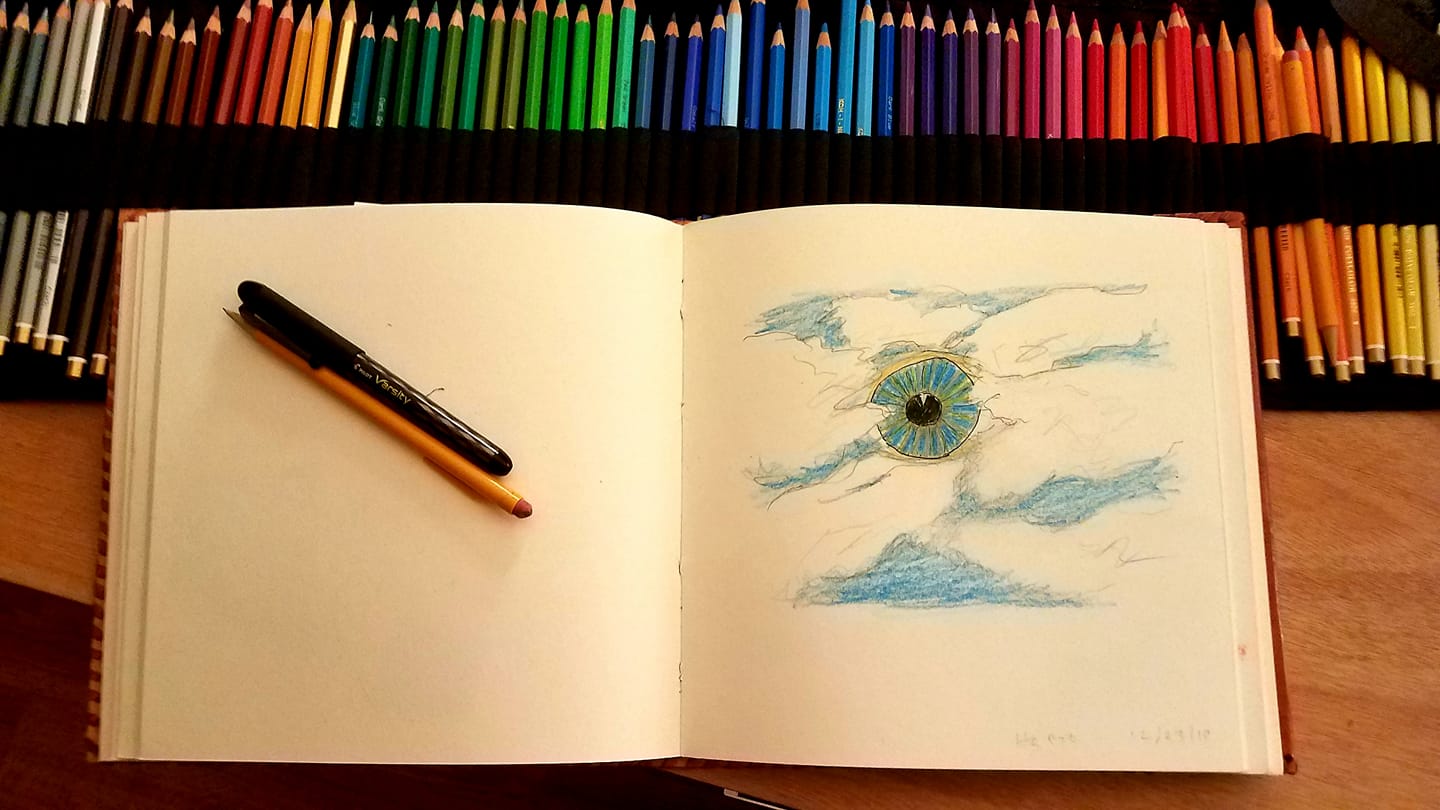
"Eye in the Sky". Drawing by Robert Moss from a spontaneous vision in the hypnagogic zone.

Friday, December 20, 2019

On leaving a dream


When I leave a dream, I often feel that I step from one room into another. It's a "just so" feeling. I was there, and now I am here.
    When I exit a dream, I avoid saying "I woke up." That is such a boring way to end a dream narrative. And it's entirely possible that when I open my eyes in one reality, I have fallen asleep in another world that is no less real. When I finish recounting a dream adventure, I may say. "then I left that scene" or, “then I came back to my bedroom”.
     Sometimes the dream stays with me, and I am in both locations - the bedroom and that other room - in a state of dual consciousness after I come back to my body.

Very early this morning, at an hour many would call the middle of the night, I came back to the body in my bed from an excursion. In my dream I was at an airport where a woman from an Islamic country needed my help to find a place where she could get halal camel meat.
     This felt like an entirely literal experience, taking place in an alternate reality. I do not rule out the possibility that I will meet that woman at an airport in the future, since I often return from a dream with  memories of the future.
    My ability to help her will be greater now that I have consulted Auntie Google about halal camel meat. I now understand that camel meat is not only halal ("allowed") for Muslims but is available in restaurants and butcher shops all over the Middle East and Central Asia. I will also reflect on the possible symbolism here. It may have something to do with taking on the strength to cross a desert while carrying your own water - quite relevant for a writer embarking on a new book project. A dream adventure can be literal, symbolic and an experience of another reality all at once.
     My gentle return from my dream outing allowed me to see the airport - a very modern one, with sweeping architectural features I did not recognize, and the strong, dark features of the woman (no headscarf, I confirmed) - as I made a note.

Other times, however, I don't so much come back from a dream as fall out of it, in a mode reminiscent of the David Bowie character in The Man Who Fell to Earth. One night I fell back into my body so hard that I thought that I had broken the bed. I made a drawing of that bumpy return. Coming back so hard and fast cost me the memories of where I had just been.


Journal drawing: "Man Who Fell to Earth" by Robert Moss