Showing posts with label Robert Moss stories. Show all posts

Sunday, February 23, 2025

At the Gate of Story


The gatekeepers cannot see where the tide of pilgrims begins. Its source lies far to the north, beyond the Pillars of Hercules, the olive groves and forests of cork, even beyond the stern keep of the man of iron dreams on a high wind-raked plateau. The travelers are so many that their feet have emptied the strait, making a land bridge between the continents. Such was the report of one who reached the Gate of Story.
      Yawning on their cushioned seats by a wall bleached to the color of smilodon bones, the gatekeepers do not rule on the veracity of this account. Like the knight of La Mancha, they know that facts can be the enemy of truth. Judging the truth of a story by whether it stirs or disturbs the hearer, they turn the man who parted the seas away. Too many others have tried to pawn this story before; it has been drained of surprise.
    "Altagracia!" croaks a man whose flesh has fallen away so his linen suit hangs off him like a flag of defeat. Some of the crowd cross themselves or finger amulets against the evil eye. An imam directs a boy to offer the parched traveler a waterskin. "Altagracia!" the man cries again, water frothing from his cracked lips.
     No one has spoken that name at this gate before. The gatekeepers motion for the man who has used it to be advanced to the front of the line. Camel drivers open a way for him with their switches, without regard for the age or gender of those they are beating back.
    "You have three minutes," says the chief keeper of the Gate of Story. He flourishes a pocket watch and spins it, on its chain, from his long pointing finger.
---"She is Altagracia," the story man begins.


She is very pale, with lustrous black hair and black eyes. Her traveling clothes are the color of sand in shadow. She wears a veil under her hat. She has pushed it back, but it can be drawn over her face to keep off blowing sand and flies. She has a good deal of luggage, including a hatbox, handled with ease by her giant black servant, Fidel, who has been assigned by her father, The Professor, to keep her safe. Fidel can speak only in little mewling sounds, which the cats of the city understand. His tongue was cut out, perhaps at his own volition, to guarantee that he will live up to his name, which means "faithful", when it comes to keeping secrets, since he is also illiterate.
---Each time the story of Altagracia is told, it expands, and the world with it. Last time I spoke of her she did not have dogs, but now she has a pair of them, resembling greyhounds, that she calls her sight hounds. I said that Fidel is illiterate and mute, but as I speak his shadow is slipping ahead of him through the city gate in the form of a black cat. It is running into the Sultan's library, where it stands on its hind legs to remove a precious copy of the seventh volume of Pliny Maior's
 Natural History from a cabinet that others always find locked. He wll go to the harem and delight his hearers all night long with the exact descriptions of dogheaded men, Triballes who kill with a look, and lions with the tails of scorpions. He will be rewarded with dishes of sherbert and leg-humping until the chief eunuch will order his tongue, or another particle, to be excised. The feline Fidel is not so easily bested. By naming - both in lapidary Latin and in the Berberous Arabic of the court- all the creatures of Pliny's hearsay, he has brought them to life. The eunuch's scimitar is no match for a manticore.
-
It became harder and harder to hear the teller of this tale, because as each word was uttered, the scene and the action around the gate became more profuse. The crowd parted and reformed as animals out of legend galloped and bulled their way through. The shadow of immense wings cooled the hot sand. A ship in full sail appeared on a canal that surely was not there before. A man with his head under a black cloth took pictures on glass of a couple of newlyweds boarding a train whose engine puffed perfect blue smoke rings. A cat that was also smoking, with the aid of an amber cigarette holder, shuffled a Marseille deck and purred, "Pick a card, any card at all."
---The head gatekeeper, invoking the Most High, ordered the man who knew Altagracia to pass through the Gate of Story, and threatened to do terrible things to his mother unless he passed through without delay.
---"The Gate is closed for today," he announced to the host of story pilgrims. They groaned and wept and raged. Many of them, desperate to be heard, tried to shout their stories over each other, producing a weird cacophony that made the keepers press their hands over their ears. Blue-eyed janissaries appeared on the battlements of the gatehouse and fired warning shots into the air.
---In the sudden silence, a voice said in a placeless accent, "You will hear me."
---The voice belonged to a short, spare man with a clipped goatee, who held an umbrella over his head.
---"We will hear no more Namers today," the head keeper spoke in a voice of thunder.
---"I am neither a Namer nor an un-Namer. I am the sculptor of the Immortal Sentence."
---These words, also, had never been heard at the Gate of Story. The keepers were bound by a rule laid down in the remotest of pasts to give the speaker a hearing.


When I first told this story, it took longer than one thousand and one nights to reach the end. Every day since then, I have shortened the story by a sentence. Now that it fills less than a page, I reduce it by one word in each telling. In this instance reducing is the opposite of reduction. With each word I remove, I approach closer to the quintessence of the tale, which is also the key to the making and unmaking of worlds. The consummation of my art will be to deliver the Immortal Sentence, which will replace the knowledge of the world and become the theme of all branches of a new literature and science. Some have thought that the Immortal Sentence will consist only of four letters. This cannot be known until all the words that veil it have been stripped away.


"Cease speaking!" the head gatekeeper commanded. His composure had been shaken. There was whiteness around his mouth. "You may enter."
---The man with the umbrella strode with long decisive steps - unusually fast for a person of small stature, but then he worked his whole legs, from the hips - through the Gate of Story. The immensely high cedar doors began to swing shut. The gatekeepers had gathered their cushions and magic carpets. But the head keeper turned back when a new voice addressed him by his secret name, the name he shared only with Khidr, the guide of those who have no earthly guide.
---It was a woman’s voice. When he faced her, he was pleased to see that she was veiled, though her features could be seen through the gauzy stuff. Her clothes were of English cut, he thought, made by the finest seamstress. Yet something about her made him think of the forbidden vineyards of Shiraz.
---"Come up on the rooftop," she invited him. "We will share a cup of wine."
---"Are you a djinn?" he demanded, now fearful.
---"I am the Sustainer. Every day, I must repeat the one story that keeps the world turning. Every syllable must be flawless, because this is the code on which the world depends."
---"Then why have we never seen you at this gate before?"
---"Do you suppose I have only one form?"
---"Whatever form you take, if you are repeating a story that has been told before, we will know it, and you will have failed the test."
---"You understand very little, and after hearing the story you will know even less. The nature of the story that sustains the world is that it is never different and never the same. By repeating it perfectly, each teller creates a new story and renews the world."
---"This defies both God and reason."
---"Then listen."
---Somehow the head keeper found he was seated beside her on the roof of the watchtower, with the sweet taste of the forbidden wine on his lips.
---The veiled woman speaks:
-
The gatekeepers cannot see where the tide of pilgrims begins. Its source lies far to the north, beyond the Pillars of Hercules, the olive groves and forests of cork, even beyond the stern keep of the man of iron dreams on a high wind-raked plateau. The travelers are so many that their feet have emptied the strait, making a land bridge between the continents. Such was the report of one who reached the Gate of Story.


"At the Gate of Story" is included in Here, Everything Is Dreaming: Poems and Stories by Robert Moss. Publshed  by Excelsior Editions/State University of New York Press. 

Illustration: "Gate of Story" by Robert Moss

Tuesday, September 3, 2024

At the Gate of Story


 The gatekeepers cannot see where the tide of pilgrims begins. Its source lies far to the north, beyond the Pillars of Hercules, the olive groves and forests of cork, even beyond the stern keep of the man of iron dreams on a high wind-raked plateau. The travelers are so many that their feet have emptied the strait, making a land bridge between the continents. Such was the report of one who reached the Gate of Story.

---Yawning on their cushioned seats by a wall bleached to the color of smilodon bones, the gatekeepers do not rule on the veracity of this account. Like the knight of La Mancha, they know that facts can be the enemy of truth. Judging the truth of a story by whether it stirs or disturbs the hearer, they turn the man who parted the seas away. Too many others have tried to pawn this story before; it has been drained of surprise.
---"Altagracia!" croaks a man whose flesh has fallen away so his linen suit hangs off him like a flag of defeat. Some of the crowd cross themselves or finger amulets against the evil eye. An imam directs a boy to offer the parched traveler a waterskin. "Altagracia!" the man cries again, water frothing from his cracked lips.
---No one has spoken that name at this gate before. The gatekeepers motion for the man who has used it to be advanced to the front of the line. Camel drivers open a way for him with their switches, without regard for the age or gender of those they are beating back.
---"You have three minutes," says the chief keeper of the Gate of Story. He flourishes a pocket watch and spins it, on its chain, from his long pointing finger.
---"She is Altagracia," the story man begins.


She is very pale, with lustrous black hair and black eyes. Her traveling clothes are the color of sand in shadow. She wears a veil under her hat. She has pushed it back, but it can be drawn over her face to keep off blowing sand and flies. She has a good deal of luggage, including a hatbox, handled with ease by her giant black servant, Fidel, who has been assigned by her father, The Professor, to keep her safe. Fidel can speak only in little mewling sounds, which the cats of the city understand. His tongue was cut out, perhaps at his own volition, to guarantee that he will live up to his name, which means "faithful", when it comes to keeping secrets, since he is also illiterate.
---Each time the story of Altagracia is told, it expands, and the world with it. Last time I spoke of her she did not have dogs, but now she has a pair of them, resembling greyhounds, that she calls her sight hounds. I said that Fidel is illiterate and mute, but as I speak his shadow is slipping ahead of him through the city gate in the form of a black cat. It is running into the Sultan's library, where it stands on its hind legs to remove a precious copy of the seventh volume of Pliny Maior's
 Natural History from a cabinet that others always find locked. He wll go to the harem and delight his hearers all night long with the exact descriptions of dogheaded men, Triballes who kill with a look, and lions with the tails of scorpions. He will be rewarded with dishes of sherbert and leg-humping until the chief eunuch will order his tongue, or another particle, to be excised. The feline Fidel is not so easily bested. By naming - both in lapidary Latin and in the Berberous Arabic of the court- all the creatures of Pliny's hearsay, he has brought them to life. The eunuch's scimitar is no match for a manticore.
-
It became harder and harder to hear the teller of this tale, because as each word was uttered, the scene and the action around the gate became more profuse. The crowd parted and reformed as animals out of legend galloped and bulled their way through. The shadow of immense wings cooled the hot sand. A ship in full sail appeared on a canal that surely was not there before. A man with his head under a black cloth took pictures on glass of a couple of newlyweds boarding a train whose engine puffed perfect blue smoke rings. A cat that was also smoking, with the aid of an amber cigarette holder, shuffled a Marseilles deck and purred, "Pick a card, any card at all."
---The head gatekeeper, invoking the Most High, ordered the man who knew Altagracia to pass through the Gate of Story, and threatened to do terrible things to his mother unless he passed through without delay.
---"The Gate is closed for today," he announced to the host of story pilgrims. They groaned and wept and raged. Many of them, desperate to be heard, tried to shout their stories over each other, producing a weird cacophony that made the keepers press their hands over their ears. Blue-eyed janissaries appeared on the battlements of the gatehouse and fired warning shots into the air.
---In the sudden silence, a voice said in a placeless accent, "You will hear me."
---The voice belonged to a short, spare man with a clipped goatee, who held an umbrella over his head.
---"We will hear no more Namers today," the head keeper spoke in a voice of thunder.
---"I am neither a Namer nor an un-Namer. I am the sculptor of the Immortal Sentence."
---These words, also, had never been heard at the Gate of Story. The keepers were bound by a rule laid down in the remotest of pasts to give the speaker a hearing.


When I first told this story, it took longer than one thousand and one nights to reach the end. Every day since then, I have shortened the story by a sentence. Now that it fills less than a page, I reduce it by one word in each telling. In this instance reducing is the opposite of reduction. With each word I remove, I approach closer to the quintessence of the tale, which is also the key to the making and unmaking of worlds. The consummation of my art will be to deliver the Immortal Sentence, which will replace the knowledge of the world and become the theme of all branches of a new literature and science. Some have thought that the Immortal Sentence will consist only of four letters. This cannot be known until all the words that veil it have been stripped away.


"Cease speaking!" the head gatekeeper commanded. His composure had been shaken. There was whiteness around his mouth. "You may enter."
---The man with the umbrella strode with long decisive steps - unusually fast for a person of small stature, but then he worked his whole legs, from the hips - through the Gate of Story. The immensely high cedar doors began to swing shut. The gatekeepers had gathered their cushions and magic carpets. But the head keeper turned back when a new voice addressed him by his secret name, the name he shared only with Khidr, the guide of those who have no earthly guide.
---It was a woman’s voice. When he faced her, he was pleased to see that she was veiled, though her features could be seen through the gauzy stuff. Her clothes were of English cut, he thought, made by the finest seamstress. Yet something about her made him think of the forbidden vineyards of Shiraz.
---"Come up on the rooftop," she invited him. "We will share a cup of wine."
---"Are you a djinn?" he demanded, now fearful.
---"I am the Sustainer. Every day, I must repeat the one story that keeps the world turning. Every syllable must be flawless, because this is the code on which the world depends."
---"Then why have we never seen you at this gate before?"
---"Do you suppose I have only one form?"
---"Whatever form you take, if you are repeating a story that has been told before, we will know it, and you will have failed the test."
---"You understand very little, and after hearing the story you will know even less. The nature of the story that sustains the world is that it is never different and never the same. By repeating it perfectly, each teller creates a new story and renews the world."
---"This defies both God and reason."
---"Then listen."
---Somehow the head keeper found he was seated beside her on the roof of the watchtower, with the sweet taste of the forbidden wine on his lips.
---The veiled woman speaks:
-
The gatekeepers cannot see where the tide of pilgrims begins. Its source lies far to the north, beyond the Pillars of Hercules, the olive groves and forests of cork, even beyond the stern keep of the man of iron dreams on a high wind-raked plateau. The travelers are so many that their feet have emptied the strait, making a land bridge between the continents. Such was the report of one who reached the Gate of Story.


Illustration: "The Gate of Story" by Robert Moss


Adapted from Here, Everything Is Dreaming: Poems and Stories by Robert Moss. Published by Excelsior Editions.

Tuesday, February 15, 2022

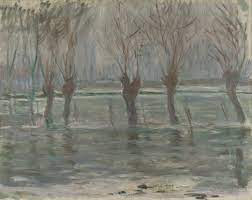
Flooding, or The Making of a Poet


It is said of a people who live east of Fez that they value poetry above all other human activities. There was a man among them who despised poetry. He said it was for the weak and for women. Bashir was a warrior and a hunter, sudden and violent in his moods, given to strong drink. 

One night he was caught by a dream. The moon threw down a lasso of light. It pulled him down, spilling his wine, extinguishing the lamps. He fell into blackness that became the sound of rushing water, more water than the village had ever seen. When his sight cleared he saw that the little river where the women washed clothes had become a great torrent, waves rising mountain high. The sky sheeted heavy rain. There was no horizon except endless water. 

In the savage flood, he saw trees and houses, donkeys and camels, carried away, and a woman he might have loved and a man to whom he owed money and the witch who sold him a charm against the evil eye after setting the curse on him, and a fat grafter whose neck he had broken though the thief had been buried for three years. He wept when he heard the howls of the sight dog who had hunted with him. Then the flood took him too. He had nothing to hold onto, nowhere to stand. This was the end of the world. His life memories swirled in his head like water going down a drain. 

He was thrown up by an immense wave, and hurled down with bone-shaking force. He tasted sand and rust. He opened his eyes. He smelled coffee and warm bread. His woman was making him breakfast. He brushed this aside, more gently than he might have done on another day. This gave her the courage to ask if he was well. She did not say that the noises he was making in the night were not human, or even bestial. 

He told her he was going to see Shaykh Omar. He must go at once. He paused only to put on a clean garment and his sandals. Omar the Blind, they called him, not because he had cataracts but because he saw with inner vision. He lived in a house no better and no worse than most in the village, under a date tree. He was famous for his beautiful ghazals, lyrical poems of erotic encounters between the soul and its beloved. He was the judge of the poetry contests that were more popular here than football. 

"I've been waiting for you," the shaykh told Bashir. 

"I dreamed of a flood. It took the whole land. It was the end of the world. Does it mean I am going to die?" 

"You have died already, my son. Welcome to paradise." 

Bashir gaped, then looked carefully around. The landscape was surely the same as yesterday, and the smells, and the hot dry wind gusting from the south. Yet there was a subtle shimmer to things, as if nothing was quite fixed or tethered to the earth. The wind carried the sound of stringed instruments. With the music came birdsong that became words. The words shook their wings inside him, then took flight from his lips. 

"You broke the vessel and I became wine." 

Bashir sat open-mouthed, shocked at what he had released. 

Omar the blind sipped his glass of red tea and made a sound like a kiss with his wet mouth. "My friend, everything will be different. You have been made a poet. It is known that all poetry comes from flooding."


Art: Claude Monet, "Flood Waters" (1896)

Friday, April 16, 2021

Stamp of reality


 "Where have you been?" He glares at me, hurt and angry. How could I have missed the big event? He slew or tamed the monster - I missed the story - just before his 12th birthday. As everyone knows this is the very best time for adventures of initiation. His birthday party became a public triumph. I can see the evidence in ribbons and exploded fireworks in the square.

How can I explain to him that we don't live in the same country? I only visit in dreams and miss out on the action when I'm away. If I tell him this he will think I am crazy, just as people in the country where I will record this over coffee will think me mad if I tell them that I travel to a land where hydras and dragons are as real as traffic lights and Ubers.
I mutter something like, "I had business on a far island. I sailed on a two-masted schooner."
I give him a postage stamp with a picture of a two-masted schooner. It slipped out of the pages of a French novel overnight. He is mollified. What boy does not love stamps from far places? Uh-oh.There is a discrepancy. The schooner in the picture is three-masted. But in the world of the novel from which it sailed, with no need of an outer wind, it is une goélette à deux mâts. Two-masted. This is important. The author inists on it again and again. Perhaps the boy won't notice. However,it is precisely the kind of thing that won't pass the scrutiny of a 12-year-old with a love of adventure.


If you are curious about the back story of the French novel that came to me via a friend's dream, you will find it here. What I have shared on this page is of course a jeu d'esprit. However, I did meet that boy monster slayer in a dream before dawm today. Embarrassed by the difficulty of explaining that I don't live in his country all the time, I did reach to the novel (L'agent de change by Jacques Bellefroid) to fumble an answer to his question.

I was reading the French novel in the early hours, my favorite time for intimacy with books. When I turned in at 4:00 a.m., the narrator had not yet realized that the unusual postage stamp commemorates Joseph Conrad (born Józef Korzeniowski). Conrad became a master of English prose despite that fact that English was  not only not his native tongue but, as I recall, the third language he learned.

Monday, December 23, 2019

We are such dreams as stuff is made on


The concourse is longer than I remember, with more turnings and more choices. Maybe I turned the wrong way when I last had the choice. Walls and ceiling are covered with little white ceramic squares, like tiles in a bathroom. Or a morgue. There are movie posters on the walls, but graphics and titles are indistinct under a changing wash of murky colors, shifting from bruised purple to poison green.
      I slow to a stop, wondering whether I should turn back. In this moment, color drains from the scene. There is only black and white. Definition is sharper. Shadows are knife-edged. I can read a sign that says BARDO. It points forward and back. Underneath it, helpfully, is a second sign I know from roundabouts in France: TOUTES DIRECTIONS. I see that indeed I am at a kind of roundabout. Tunnels go off in all directions. As I spin to appraise my situation, I lose all sense of direction. I am not sure I can find my way back now. Which way should I take.
     Ask Ka.
    
The statement is made in a precise and neutral voice, classless and accentless. I am not sure whether it comes from inside or outside my head. I don’t know what it means until something is illuminated in the tunnel ahead of me, as if caught by the flash of a camera. It looks like an old-time phone booth.
     I walk towards it and more light comes on – a crescent of brightly colored bulbs on top of the booth, a warm syrupy light inside. The sign on the box, next to a slot for coins, reads
ASK KA. Behind the glass is a round-bellied figure with curling mustaches and a turban. His eyes swivel to look at me. The illusion is remarkable. There is life – or lively death – in those eyes, and in the smile lines around them, and in the rise and fall of torso and belly.
     I have seen figures like this at fun fairs and outside magic shops. The last time was on the subterranean level of Pike Place market in Seattle, when I popped a quarter in the slot and a fortune-telling dummy named Zoltar decanted a scroll that – as I recall – was on the money if rather generic.
     I fish in my pocket for a quarter to see what Ka can deliver.
     Your money is not currency here, says that neutral voice.
     Ka is staring at me.
      Think of something that makes you want to be in a body.
     This is crazy stuff, but it gets pictures moving in my mind. Sex. Love. The kids. Swimming in the lake.
      Ka’s tongue come out of his mouth and lolls over his chin whiskers, pink and plump and obscene. He points at his tongue and I hear the word
      Bacon.
      “Bacon?” This is insane. But Ka is nodding his head vigorously.
      I look more closely at what I thought was a coin slot. It is actually designed to take something else.
       “Get your tokens here,” says a voice behind me. I turn to find a vendor on a tricycle. The handlebar supports a platter of crispy bacon.
      “How much?”
      “Just one strip for now.”
      “I mean, what is the charge?”
      “You mean, what is your charge. You are charged with eating one strip of perfectly crispy bacon for Ka every day you are in the body.”
       “But I don’t usually eat breakfast.”
       “Bacon is not only about breakfast. It is a religion.”
       “I’ll see what I can do.” I don’t want to miss the chance to ask Ka. I detach a strip of crisply bacon from its fellows, resisting the temptation to grab another for myself – I am suddenly ravenously hungry – and feed it into the slot on the front of the fortune teller’s booth.
       I watch Ka’s white-gloved hands come down to collect the bacon. As he raises it to his mouth, a second pair of hands appears. He is sprouting limbs like a Hindu deity. With his extra hands, he smooths out a piece of paper, writes on it carefully, rolls it into a scroll and drops it into a chute. The scroll comes out the bottom, neatly tied with a thread.
       I retrieve it. As I untie the thread, I glance at Ka. His jaws are definitely working. Some of his hands are now making mudras.
       I open the fortune scroll and read the impeccable Copperplate:

We are such dreams as stuff is made on.


Drawing: "Ask Ka" by Robert Moss


Wednesday, January 21, 2015

The Bloodied Hedgehog: Dream as Flash Fiction


I decide to swim the lake from bottom to top. It’s a hundred miles, I figure. I manage the distance, but there’s no way I can swim back without stopping. So I get out and find a bicycle. It must have a motor, because now I can thread the traffic on a busy road, following the median. There is a big American flag up ahead, so I think Canada must be that way, beyond a border post. I am not planning to go there today, so I find another form of transportation.
     I’m now in a huge gasoline tanker with a double cabin. I park it on a side road in the middle of the night to catch a nap. When I wake, I’m concerned maybe I don’t have enough gas to get where I want to go in the tanker. I don’t notice the irony of driving a gas tanker that is running low on gas until I look back on this. I could do with some help. I can say I just happened on the tanker and was trying to do the right thing with it.
    To support this story I paint my face to look like an American Indian from a tribe I know only by name. I come to a family farm where a father is giving instructions to his grown sons. He looks like a decent sort so I present myself to him. He’s no hayseed. He has a lawyer’s wits and he sees through my disguise. He tells me it’s the last day of a big native powwow and if I can get in there they will give me the right cover, but to do this I must stop pretending to be the wrong kind of Indian and present myself as the kind I truly am.
    So I wipe off the paint and enter a general store full of Indians where they have big pots of soup and corn mush on the cookers. A broad, flat-faced woman sizes me up, says she knows me. I tell her I often feel I have met people before, somewhere out of this time. It’s like opening a top drawer in a chest and having a bottom drawer fly open.
    She talks about someone she thinks I must know. “When other people bring a bottle of wine or a six-pack to a party, he shows up with a bloodied hedgehog.”
    “Don’t you mean a porcupine?”
    “No. A porcupine has quills you can pull out and wear. A hedgehog doesn’t.”
    “Hedgehogs are cute.”
    “Not this one.”
    No bloody use for a bloodied hedgehog, we agree. I realize that I am speaking without closing my lips, the way her people speak. We don't say “porcupine” because there is no P in Kanienka talk. We say it their way. Anen:taks.
     I guess I’m in.


Sometimes all I want to do with a dream is tell its story. The shifting modes of transportation here are fascinating to me as symbols. I am intrigued by the irony of driving a gas tanker that may be running low on gas. I am excited by the prompt to recall my connections with a Native American people whose language and customs I was led to study by big dreams many years ago. I remember once having to slam on the brakes when I was driving a Mohawk family in northern Ontario because they had spotted roadkill, a dead porcupine, and wanted to harvest the quills for jewelry. But first and last, with this report of a dream from last night, I want the satisfaction of serving up flash fiction like hot soup from that country stove.

Drawing (c) Robert Moss

Wednesday, May 2, 2012

Thanks to the dream Brownies

Osamu Tezuka, "New Treasure Island" (1947)
Robert Louis Stevenson thanked his "Brownies" for some of his best creative work. He described them as laboring away on his stories when he was asleep or in half-dream states, so that better than half his work was done when he came to put pen to paper.
    I woke with a similar delightful sense of creative assistance around 4 am today, a time when I often rise to record and research my dreams and see what wants to stream into a story, an article or a poem. My dream reports from last night include this pair, with the recurring motif of creative help:


1. I examine a typescript I've been working on. I have left gaps in the narrative. Someone has filled in these gaps and inserted some further material. I can see at a glance where the new material is, because it looks like it has been highlighted in yellow, though the highlighting effect fades as I read it. I am at first annoyed that someone unknown has been fooling around with my text, and assume that the inserts are random. But when I study the new passages more closely, I see that they are just right. The penultimate paragraph is beautifully expressed. I try to figure out who has been working on my text. In the distance, I see a beautiful woman in a yellow robe. 


2. With a woman companion, I have been encouraging an older man to take up art. We have expressed enthusiasm over some colored drawings he has done, and are looking at a folder of these. Most are incomplete, and they are not especially well executed when we look at them more carefully. There is a spill; I think it is my companion who spills water or tea over some of the drawings. This makes the colors run and the effect is quite magical. I am excited that an accident has brought the drawings to life.

I stirred from these dreams in a state of excitement and delight. 

Reality check: I am currently writing a story and have left gaps in the text. I draw a good deal, often with colors, but my technical execution could do with improvement. 

Action plan: I'll fill in the gaps in my narrative, and let the colors run - by using oil crayons and perhaps watercolors - in some of my new artwork.

And I reopened RLS' "A Chapter on Dreams", included in his book Across the Plains, where he describes in detail the role of his dream Brownies, including this celebration:

And for the Little People, what shall I say they are but just my Brownies, God bless them! who do one-half my work for me while I am fast asleep, and in all human likelihood, do the rest for me as well, when I am wide awake and fondly suppose I do it for myself. That part which is done while I am sleeping is the Brownies' part beyond contention; but that which is done when I am up and about is by no means necessarily mine, since all goes to show the Brownies have a hand in it even then. 

Tuesday, April 3, 2012

Meeting my boy authors in the Dead Poets' Library

One of the places I love to go for creative inspiration is a Secret Library. The books are alive; open any one and you are magically transported into the realm for which it is a record and a key. Some of the books fly around on their own when not leashed to a long table or placed inside the fine mesh of bird cages of exquisite design.
     This is a place of dead poets who are very much alive. I have had many encounters with W.B.Yeats in the Secret Library. I was reckless enough to describe some of these in detail in my Dreamers' Book of the Dead on the principle well stated by Mark Twain (who is also no stranger to these premises) that "I don't want to hear about the Moon from someone who hasn't been there."
     The doors to the Secret Library open in dream, and through memory, and are oiled by the practice of going there and bringing back gifts and doing something creative with those gifts. I wrote the last phrase a little nervously, because I am aware I have yet to fulfill assignments given to me by the fiercest of the mentors I have ever encountered in my Secret Library.


I go up the stones steps and through the glass doors on a fine spring day when the fruit trees are in flower and the street is full of cheerful bicyclists in bright colors. I nod to the Librarian. I notice an unusual stir of activity in the lobby and the main reading room. These spaces are crowded with people, some familiar. I see Yeats in the distance, and Tolkien and C.S. Lewis with their pipes and pots of beer, and RLS romantically attired in Scottish dress. I see Jung, with a flash of kingfisher blue in the field around his three-piece woolen suit; and the bard with the silver brooch; and Borges in the corner, with a jeweler’s glass.
    I would love to consult with all of them. I'm not going to waste a second questioning whether they are real figures or figments of my imagination, as long as they can give me some good stuff, maybe the makings of a new book.
    But three boys block my way, clamoring for my attention. I would guess their ages as six, nine and twelve. They are very familiar. I have seen them in family photo albums, and in dreams.
    "What do you want?"
    "We've been telling you," says the six-year-old.
    "We've told you again and again, in dream after dream," says the twelve-year-old.
    "And you wouldn't listen," says nine-year-old Robert. Did I really have that many freckles when I was nine?

 "I’m listening now," I tell them. "What do you want?"
“I want a train,” says Six.
“I want toy soldiers,” says Nine
“I want girls, but not the yucky kind, and Nazis to fight,” says Twelve.
“I want a Bear,” says Six.
“I want a Lion,” says Nine.
“I want an Eagle,” says Twelve.
“I want my father,” says Six.
“I want my sister,” says Nine.
“I want the Mage of the Purple Mountain,” says Twelve.
They tell me, as a chorus: “You should listen to us much more than you do. We are the ones who can help you write the best book you have ever written, the one that everyone will want to read."
     I'm listening now.

Sunday, March 18, 2012

The Fourteen


R.M., "The Moon at the Foot of My Bed"

The Fourteen

Some days, I don’t remember how I got here, or what I’m supposed to be doing. But today, on the eve of the lunar eclipse, it seems to me that my prior residence was the Moon. There was a mix-up at the time of my conception, for which I tried to press charges against the Zygote Fairy. But she convinced the court that it was my own doing, because I was excessively curious about sex.
I sit now with a ball in my hands. From it strands extend in all directions across time and space. Fourteen silver threads are attached to my body, a little above the navel. One runs to the ball, the others link me to counterparts in other places and times: to the man with skin the color of powdered ash who crouches over a mirror of water in a conical hut in Africa; to the young woman of the future who is priestess and scientist in an Order of dreamers; to the elegant flaneur who strolls with a beautiful woman on his arm through the Paris of Victor Hugo; to the feathered shaman living wild on Deer Mountain. Our work and our passions tug on the web that joins us. When I remember the pattern, I can work the strands like bell-ropes, to signal to another self. Or I may follow a thread into the mind of that other self, in his own world.
We, the Fourteen, came here in the same throw, aspects of a single purpose, operating outside time. My assignment, when I remember it, is to link consciously with my counterparts and serve the plan that unites us.

This was the product of a 10-minute timed writing exercise I led in a workshop at Mosswood Hollow, where I am leading a five-day adventure in Writing as a State of Conscious Dreaming in April.


Friday, January 20, 2012

Boiled cabbage


We were going to what had been touted as the best Mexican restaurant in south-eastern Arizona, and my palate was set accordingly. But the Mexican place was fully booked; a local Aussie who scouted the scene reported that the parking lot looked like “a can of maggots.” The fall-back choice was described on the sign as Mexican- Greek. An unlikely combo, but I was willing to adjust my palate. I told my tongue it could roll either way, from mole to dolmades.
    Inside, the Mexican-Greek place was a kitchen from the 1950s, formica under unforgiving lights. My scout got in ahead of me, and was swigging a bottle of Negro Modelo while a capering waiter finished describing the special. “I’ll have it,” declared my friend. “What’s the special?” I inquired.  “Cabbage stuffed with meat, with mashed potatoes.”
     Boiled cabbage and mashed potatoes? In a Mexican, or even a Greek, restaurant?
     I was incredulous, and my taste buds were flashing emergency signals. “Do you have a menu?” The waiter shrugged. “You can look at the menu if you like. But the special is what’s fresh.”
    Now the reek of boiled cabbage is everywhere. Under a Soviet-era leaden sky, I smell it in the barracks-like apartments, in the offices of the newspaper where the censor outranks the editor, even in the lobby of the upscale building where my Polish apparatchik hosts reside. The Warsaw restaurant resembles a funeral parlor that has seen better days. No formica in sight, but rather heavy drapes and cabinets the size of caskets. Here the menu is set before me right away, but my hosts whisper for me to ignore it. “Have the special.” What is the special? “Duck with cabbage and potatoes.” I am not too keen on duck, or cabbage. I search the menu and ask for steak. No steak. The waiter speaks as if he is spitting. How about chicken? No chicken. Now his lip curls with contempt. “Have the special.” The push is stronger. But I won’t concede defeat. I’ll have pasta. No pasta.
     “I’ll have the special,” I agreed, and the Greek waiter smiled at his little victory, half a world and forty years away from Warsaw in 1972, when I was a young journalist visiting Eastern Europe for the first time.   
     The boiled cabbage dinner was wretched. I realized that I had agreed to it because, for a critical minute or two, I was catapulted from the implausible scene in a little Mexican-Greek restaurant in Arizona into a time and place where waiters were little Gods and you ate what you were told to eat.
     “Bloody bloke!” croaked the Greek waiter’s father. He had been to Sydney at the end of World War II.
      My dreadful dinner gave me a story. You don’t have a story (it's been said) unless something goes wrong. I’ll put up with just about anything so long as it has entertainment value.
      “Bloody bloke!”
     I concede that the boiled cabbage was more entertaining in hindsight than at the table.

Wednesday, June 22, 2011

A master of the third eye


“You know what a master is like,” she cautioned me.

“Oh yeah.”

“He’s as likely to whack you as to talk to you.”

I climbed the last steps to the master’s hermitage resolved not to submit to any slap-in-the-face treatment.

I found him with his feet in a tub of hot water. Steam rose and the air was pleasantly scented with mountain herbs as one of his handmaidens palpated his feet. I was curious to see whether she would dry them with her lustrous black hair, that fell to the floor.

“Move the chest,” he directed me.

I contemplated the great iron-banded box without enthusiasm.

“Where?”

He indicated the far corner.

I half-lifted, half-carried the heavy trunk to the place he indicated, wondering what he kept in it.
“Now bring it back. And don’t drag it. Pick it up.”

I felt the veins bulge on my forehead as I struggled to carry out these instructions. I nearly made it back. Then the trunk slid from my grip, landing painfully on my left foot.

The master waited until I had stopped howling before he spoke again. “Why do you come to me?”

“Master, I come to you because I wish to see."

“Then why are your eyes open?”

“Master?”

I realized, at that moment, that the master’s eyes were closed. I understood that I was to close my own.

“Closer,” he commanded.

I felt the stir of movement. I heard the swish of the loose silk of his garment, and pictured his arm swinging back, fist clenched. Here it comes.

I intended to duck the blow, but something kept me in place, on my knees in front of him. What was that buzzing sound? It made me think of a bee, trapped behind glass. It came closer.

I felt burning pain as something pierced me at the third eye, like a drill bit. Immediately the girl was at my side, soothing my forehead with an ointment that smelled like yogurt.

When she left off, there was absolute stillness in the cabin. Then I heard the soft slap of water from the footbath.

I opened my eyes. There was no change in the scene. The black-haired girl squatted at the master’s feet, as before. I felt no surge of enlightenment. I did notice that one of the master’s eyes was now open. Above and between his closed eyelids, it fixed me with its blue light, cold and unblinking.