Showing posts with label journal. Show all posts

Saturday, February 15, 2025

Adventures through the Dream Gates: Meeting Great Turtle


This is a story about what you may gain if you stay with a dream after waking and let a fuller story unfold. I rediscovered it while engaged in a favorite pastime: opening an old journal at random and seeing what an experience I recorded years or decades ago may say to me now. Sometimes old mysteries remain unsolved. I often notice recurring themes and situations that help me to become more aware of my attitudes and behavior, providing a necessary witness perspective on my life roads.        
      Sometimes a dream I did not understand at the time has meaning and application for me today because subsequent events have provided a context. I notice again and again that I dreamed events long before they played out – hard evidence, of the only form relevant here, of long-range precognition.  I discover that I missed warnings or advisories that could have smoothed my path and try to learn from my lapses how to get better at discerning and acting on oneiric clues to the possible future.
      Sometimes a dream I recorded looks like a dramatic production, maybe an instalment of a streaming tv series, staged by a personal film crew behind the curtain of the world. Very often - and this is most interesting for me - my dream reports seem to contain memories of events in another reality: a real life world that is running on a different time continuum or in an alternate universe near or far from the ordinary one.
     The report that follows appears to belong to the latter category.The action is played out in another reality, starting with an alternate version of a country where I used to live. When I stay with the dream, something irrupts from the mythic depth, a great power of Earth and of deeper knowing acknowledged by the First Peoples of the land where I now live. The gift of connection with Great Turtle is a blessing in the ordinary world today, as it was eight years ago. 

January 3, 2017

Dream and lucid dream reentry

I save a turtle, Great Turtle saves me

My youngest daughter is driving. We are in London. I tell her to head for Green Park so I can walk the dog there. I wave in the general direction. However, she drives us into a very narrow, twisting street in an area I don’t recognize. It’s very dangerous. Cars and trucks keep rushing at us from around blind corners, in the middle of the road, which has narrowed so only one vehicle can pass at a time. We come to a stop at what is virtually a hairpin bend, and just avoid a collision with a car that shoots out from behind it. My daughter is quite upset. I persuade her to stay in the car while I walk the dog.
    The dog and I are now in a shopping area. Time has changed. It seems that shops in a colonnade at my left hand are just opening. We walk behind two short squat women. One turns into a shop; she may be going to open it. They bid each other goodbye and the second lady walks on with a dog with silky hair that hangs to the ground.
    My dog and I pass them. Unusually, he takes no interest in the long-haired dog. He is after something up ahead. I glimpse it under a lamppost. It looks like a pigeon that has gotten hold of a paper plate. My dog rushes at it, with me hurrying behind. It jumps up onto my left shoulder. I am surprised to see that it is a little turtle. The “paper plate” is its shell.
     I experiment with removing the turtle. It clings to me with determination. Since I have not figured out what to do with it – beyond keeping it away from my dog – this is okay.

My body is stirring in the bed. Grey light is spilling through the bedroom curtains. I am fully lucid. I am in London and in bed in upstate New York. I could leave the dream now, but I want to stay in it. I want to take care of the little turtle that is still clutching my shoulder. My sensations in my dream body are more acute than those of the dormant bdy in bed. 
    I walk with a protective hand over the turtle while I keep my dog on a short leash with my other hand. I look for a safe place to set down the turtle. There is a large garden on the next corner. Behind an ornamental iron fence, I see steps leading down to a pond. There is a sculpture garden and there are statues of animals – including a turtle – there. This seems like a good place to release my little refugee.
    I open the gate and walk down the steps. I tie the dog up while I set down the turtle near the pond. It seems fine now.
    But there is a tremendous stir in the waters. They fountain upwards. With a great roar an immense being rises from the water. Its great head looms over me. I look up at the leathery skin, the lures of the tongue, the ancient, heavy-lidded eyes. I know in this moment I am looking at Great Turtle, A’nonwara, the Teacher of the Deep. In its gaze, I remember the story of the Real People: how the Light Twin descended to the deep realm of Great Turtle, to learn how to wage the eternal battle with the Dark Twin.   
    Great Turtle wants me to descend to his realm. I let myself drop. I am on my back in the water, falling, falling. I have no problem breathing. I go through utter dark to a place of light. There is a world of light own here, in the depths of water. Here Turtle adjusts its form and becomes humanoid (nothing like the Teenage Ninja Mutant Turtles, however). Knowledge streams into me, of how life came from another world to the world that was danced into being on Turtle's back.
    Tosa sasa nikon'hren. "Do not let your mind fall." Do not forget the higher world, Earhth-in-the -Sky, that contains the origin and purpose of life on Earth. When humans let their minds fall, they bring down the Dark Times. 

I returned from this adventure feeling blessed.

I ran a reality check on the contents of my dream. I know Green Park and often walked there when I lived in London. I am certain I will never walk my little dog there. I have been in London with my daughter and we could make a future trip but it is most unlikely she would be driving. I don't think the dream anticipates a literal future situation, but rather an alternate reality which becoems the stage for a deeper - indeed a mythic - drama. 
    
I live on what Native Americans call Turtle Island. I have great respect for the snapping turtle (the kind in the dream) and its cousin the sea turtle. They can’t retreat into their shells. Their underbellies are not armored apart from a tiny shield piece called a plastron. I have studied the cosmology of the Iroquois (the Onkwehonwe, or “Real People”) in which Great Turtle not only offers its back as a home for Sky Woman but becomes a form of the Great Teacher of the Deep. I have swum with sea turtles. 

I immediately made a drawing of Great Turtle. His fierce appearance reflects my original nervousness as this huge creature exploded from the water. His intentions, however, were wholly benign.

When I went back through my journal, tracking all my turlte sightings in both worlds over several decades, I rediscovered a poem I wrote to honor Great Turtle in 2012, five years before our unexpected encounter in Green Park:

A'nonwara (Turtle Dreaming) 

I am the turtle that does not hide.
I wear the armor of a knight, not a skulker.
My vulnerable belly says, Get me if you can;
I stick my neck out.

You call me slow, but on water
I am faster than you, and fast on land.
Deep down, I am the teacher you need
to show you how to fight the Dark One.

I am the broad back you live on.
Ignore me for too long,
go on harming my other children
and I will shake you off my back.


Journal drawing: "Great Turtle Rises" by Robert Moss

Thursday, January 23, 2025

The Twilight Road to Mythic Worlds


When I look through old journals, I am amazed, though no longer surprised, by all the adventures and conversations I have recorded from the twilight state betwen sleep and awake, or between awake and sleep. Many of these were quite spontaneous, unplanned by me, although they were lucid episodes in which, once inside the action, I had the power to choose and navigate and to experiment with changing plots and sometimes worlds.

I have been familiar with this state for as long as I can recall, since early childhood. In many ways, it is my home base. Yet this whole area of inner experience is still largely neglected or undervalued by sleep and dream experts. I have decided to start posting more of my reports and to add quick illustrations if there are none already in my journals. Here's a short narrative from six years ago:

January 2, 2019

Lucid dream in hypnagogic zone

Unraveling the Knot

As soon as I lie down, an inner voice says, Pay attention.

A book is placed in front of me. It looks like a journal bound in brown leather. The text and pattern of the cover, however, are like tree bark. The clasp has the form of a Celtic knot. To open it I must unwind a string, flawlessly, in a certain pattern. A false move will seal the book.

Very carefully I experiment. I am making a double spiral, then a triskele, then a fourfold shape that might resemble a four leaf clover. 

The book opens into a wildly beautiful scene with a castle above a gorge. I run toward the castle, wearing skins. I am armed with a bow and a sword. A great water bird rises. Surly swamp creatures seek to oppose my path. I bat them away with my sword which blazes light. I see a waterfall in the gorge and understand that this, not the castle, is my primary objective. 

I become a falcon, swooping down into the gorge. I see a red stag above. I know this place though I am coming to it a new way. There are giants above the fall, observing. For an instant I am with them. I know these great ones as ancient allies. For now my assignment is below.

I fly through the hard spray. I am cleansed and restored to a human form. I see again the mouth of the cave of the ancients. I remember the stone that opened a portal of blue light when I braved up to a nightmare of hissing black snakes - and then accepted a call to join in an ancient battle with a dark tyrant sorcerer. I will be here again.


Illustration: "With Falcon Into the Gorge" by Robert Moss

Friday, April 19, 2024

Why You Want to Keep a Journal


When a lusty, ambitious young Scot named James Boswell first met Dr. Samuel Johnson, Johnson advised him to keep a journal of his life. Boswell responded that he was already journaling, recording "all sorts of little incidents." Dr Johnson said, "Sir, there is nothing too little for so little a creature as man."

Indeed, there is nothing too little, or too great, for inclusion in a journal. If you are not already keeping one, I entreat you to start today. Write whatever is passing through your mind, or whatever catches your eye in the passing scene around you. If you remember your dreams, start with them. If you don't recall your dreams, start with whatever thoughts and feelings are first with you as you enter the day, or that interval between two sleeps the French used to call dorveille ("sleep-wake"), a liminal space when creative ideas often stream through.

If you have any hopes of becoming a writer, you'll find that journaling is your daily workout that keeps your writing muscles limber. If you are already a writer, you may find that as you set things down just as they come, with no concern for editors, critics or consequences, you are releasing descriptive scenes, narrative solutions, characters - even entire first drafts - quite effortlessly. Some of the most productive writers have also been prodigious journal-keepers. Graham Greene started recording dreams when he was sixteen, after a breakdown in school. His journals from the last quarter-century of his life survive, in the all-but-unbreakable code of his difficult handwriting. First and last, he recorded his dreams, and - as I describe in detail in my Secret History of Dreaming, they gave him plot solutions, character development, insights into the nature of reality that he attributed to some of his characters, and sometimes bridge scenes that could be troweled directly into a narrative. Best of all, journaling kept him going, enabling him to crank out his daily pages for publication no matter how many gins or how much cloak-and-dagger or illicit amour he had indulged in the night before.

You don't have to be a writer to be a journaler, but journal-keeping will make you a writer anyway. In the pages of your journal, you will meet yourself, in all your aspects. As you keep a journal over the years, you'll notice the rhymes and loops or cycles in your life. Mircea Eliade, the great Romanian-born historian of religions, was a great journaler. In the last volume of his published journals, he reflects, during a visit to Amsterdam in 1974, on how a bitter setback to his hopes at the time he first visited that city nearly a quarter-century before had driven him to do his most enduring work. He had been hoping that his early autobiographical novel, published in English as Bengal Nights, would be a big commercial success, enabling him to live as a full-time novelist. Sales were disappointing. Had it been otherwise, "I would have devoted almost all my time to literature and relegated the history of religions to second place, even though Shamanism was at the time almost entirely drafted." The world would have gained a promising, and perhaps eventually first-class, novelist; but we might have lost the scholar who first made the study of shamanism academically respectable and proceeded to breathe vibrant life, as well as immense erudition, into the cross-cultural study of the human interaction with the sacred.

Synesius of Cyrene, a heterodox bishop in North Africa around 400, counseled in a wonderful essay On Dreams that we should keep twin journals: a journal of the night and a journal of the day. In the night journal, we would record dreams as the products of a "personal oracle" and a direct line to the God we can talk to. In the day journal, we would track the signs and correspondences  through which the world around us is constantly speaking in a symbolic code. "All things are signs appearing through all things. They are brothers in a single living creature, the cosmos." The sage is one who "understands the relationship of the parts of the universe" - and we deepen and focus that understanding by recording signs in our day journal.

Partly because I keep unusual hours, and am often embarked on my best creative work long before dawn, I don't separate my night journal from my day journal. All the material goes into one book - a leather-bound travel journal, when I am on the road, my digital data base in Word when I am home.  I try to type up my entries before my handwriting (as difficult as Greene's) becomes illegible and put the printouts in big ringback binders. I save each entry with a date and a title in my data files, so I automatically have a running index.

One of the things you'll come to see clearly, as you journal dreams over a considerable period of time, is that your dream self travels ahead of your waking self, scouting the ways. 


Robert Moss journals with lamassu, a dream friend since childhood


Tuesday, March 28, 2023

Dreaming in Greeneland


When I first traveled to Paris as a foreign correspondent, early in the 1970s, the office secretary made a reservation for me at the St James Albany, which turned out to be twin hotels - very handsome Right Bank townhouses - separated by a quiet courtyard with a fountain and flagstones and flowerbeds and shade trees. It struck me that the courtyard between the twin hotels was a liminal space, ideal for intrigue and trespass of various kinds – for games involving lovers, or spies, even players from different worlds. 
     I later discovered, to my great delight, that Graham Greene had similar feelings and had made this location a part of Greeneland, the fictive world of his novels. He used the courtyard of the St James Albany as the setting for a hilarious scene in Travels with My Aunt in which two women, meeting by chance, discuss the lovers with whom they tryst in secret in each of the twin hotels - and then discover that their lovers are the same man when M. Dambreuse arrives with his wife and children.
     Graham Greene led many lives, but first and last he was a writer, with a professional writer’s discipline. Through his many intrigues, both personal and political, he managed to sit down almost every day from 7 a.m. to 9 a.m. – on a veranda in Tahiti or a cottage in Brighton – and knock out his quota of 500 words, and he did this for seventy years, producing a steady stream of popular novels and essays.
     A crucial part of Greene’s practice was to write down his dreams. He started keeping a dream journal when he was sixteen. He often reported his dreams in letters to lovers and friends. Over the last twenty-five years of his life, he recorded his dreams with great faithfulness – though in fiendishly difficult handwriting – in notebooks that are now in an archive in Texas. His last literary project was to edit a selection of his dreams for a posthumous collection he titled A World of My Own.
     The interweaving of Greene’s dream life with his other lives makes a fascinating study, for which the primary source materials are unusually extensive.  We see how a man who chose to live on the dangerous edges of the world was able to create – richly and repeatedly – from the borderlands of dreaming. We can track many different modes in which a writer can create from dreams, from receiving the initial idea for a story, to solving a problem during sleep, to bridging a narrative gap, to dreaming deep into a character’s life.
     As a young boy, he had psychic dreams, often involving death by water, a prospect that terrified him. On the night the Titanic sank, when he was just seven, he dreamed of a shipwreck, with a man in oilskins bent double beside a companionway under the blow of a great wave. 
     He was miserable at school – nothing unusual in the lives of creative and sensitive individuals – and ran away when he was sixteen. This was highly embarrassing for the family, since Graham’s father was headmaster. They decided to send him to London to be psychoanalyzed, which was still a novel idea in 1920, especially for a teenage boy. The analyst selected, Kenneth Richmond, had no formal training; he was a writer with spiritualist leanings who followed an eclectic approach.
     While Greene was boarding with him in Lancaster Gate, Richmond instructed him to write down his dreams. In mid-morning sessions, Greene was expected to tell a dream and then give his associations to the key images while the analyst merely listened. When Greene did not recall a dream, he made something up. The whole experience – which he later described as the happiest six months of his life  – laid the foundation for Greene’s literary career by training him to write from dreams and invent stories. 
      Kenneth Richmond’s beautiful wife Zoe – about whom Greene had mildly erotic dreams – thought Graham was clairvoyant, “a natural medium”. While in Lancaster Gate, Greene dreamed of a ship going down in the Irish Sea. That same night, just after midnight, the Rowan sank in the Irish Sea
      In some of his precognitive or clairvoyant dreams, he found himself in the situation of one of the victims. Aged twenty-one, he dreamed of another shipboard disaster in which he was being ordered to jump overboard from an upper deck. He later read the news of a terrible wreck in a storm off the Yorkshire coast in which the captain ordered his men to jump into the violent sea, and all but two were drowned. Greene speculated that “on an occasion like this there must be terrific mental waves of terror, and my mind seems to be particularly attuned to the terror of drowning wave.”
     His youthful psychic ability to dream his way into someone else’s situation resembled his mature ability as a novelist to dream his way into his characters’ lives. He later observed that “sometimes identification with a character goes so far that one may dream his dream and not one’s own.” 
     Greene’s dreams were central to his writing. He said that two of his novels, It’s a Battlefield and The Honorary Consul, both started with dreams. He dreamed the plots and characters of entire short stories. When he was writing A Burnt-Out Case – which drew heavily on his diary of a trip to the Congo – Greene came to a point in the plot where he was stuck. Then the author dreamed as his character, Querry, and found he could insert his dream “without change” in the novel, “where it bridged a gap in the narrative which for days I had been unable to cross.” 
     Greene made it a habit to solve writing problems in his sleep, noting that it is not necessary to remember the content of a dream in order to receive a dream-inspired solution. “When an obstacle seems insurmountable, I read the day’s work before sleep…When I wake the obstacle has nearly always been removed: the solution is there and obvious – perhaps it came in a dream which I have forgotten.” 
      He harvested personal dreams and assigned them to characters in his novels. In a  dream reflecting his lifelong preoccupation with religion, he gave a lecture on the theme that God evolves, as well as man, and that behind their apparent duality, God and Satan are one. He later transferred this theory to a passage in The Honorary Consul where his character explains that God has a “night-side” as well as a “day-side”; the night-side will wither away (“like your communist state, Eduardo”) as God and man both evolve. 


   Graham Greene was a man of mystery who had much to hide, in his private life and in his engagement with the worlds of power and espionage. For him the great mystery, at the end, concerned what follows death. He thought – and dreamed – about this all his life. He was greatly affected by a series of dream encounters with his father after his death. 
   Greene had a disturbing dream that he might be extinguished after death through lack of belief. “I had been aware of people I had loved who called me to join them. But I had chosen, by my lack of belief, extinction. A great black cone like a candle extinguisher was to be dropped over my head.” 
     But he did not go out like that. He left sure of continuing life, ready for new travels, regretting only separation from the last woman to share his life, Yvonne Cloetta.
    A week before his death, knowing it was at hand, he said to Yvonne in the hospital at Vevey: “It may be an interesting experience; at last I shall know what lies on the other side of the fence.” 
Towards the end, he made this note in Yvonne’s “red book” of their conversations: “Perhaps in Paradise we are given the power to help the living. I picture Paradise as a place of activity. Sometimes I pray not for the dead friends but to dead friends, asking their help.” 
Yvonne recalls that “He worked every morning, as he always did, right up to the end, on his book of dreams.” Evidently he came to believe that through dreams (as one of his characters said in a different connection) “there was something in the warring crooked uncertain world he could trust beside himself.”


Adapted from The Secret History of Dreaming by Robert Moss. Published by New World Library.


Thursday, December 30, 2021

Dreaming towards Epiphany


Whatever you do as the year turns, write in your journal! Write your dreams from the night, and your dreams of life for the coming year. Write, in particular, whatever you receive from dreams, synchronicity and spontaneous revelation over the last night of the Old Year and the first day of the New Year.
    If you were up all night partying - or the effect of your New Year's Eve reveling knocked your dreams out of memory - then record and work with the first dream that comes the following night, and whatever dreamlike symbols the world around you may give you.  
    In Japan they make a special effort to catch and work with the very first dream of the new year. Many Japanese people pay close attention to Hatsuyume, the first dream of the New Year. It may come in the night of December 31-January 1 but - since many may be up late partying or suffering the after-effects - it may come in the following day or on the night of January 1-2.     
     I would counsel you to stay alert for dreams for the New Year for a slightly longer period. In my mind the turning of the year rolls from December 30 until January 6, which is Epiphany in the Christian calendar, the day of “showing forth" when the Magi come to Bethlehem following their star, to honor the Christ child. Beyond the religious context, an epiphany may be a sudden revelation or perception of the reality or essential meaning of something important. It may be the gift of a dream.

   
In hopes of a lucky dream to kick off the New Year, some Japanese invoke the Shichifukujin or "Seven Lucky Gods" and may place a picture of them under the pillow. These may not be part of our belief system, but we have other sources of guidance and blessing available, and it is always appropriate to ask for help and blessing if we do it nicely!

 If you are ready to dream in the New Year, you could set the simple intention: 


Show me what the New Year will bring


Or give this a positive spin by couching your request to your dream makers the following way: 


Show me the best that life holds for me and those I love in the year ahead. 


Be as specific or as general as you like, but ask in a way that excites you and reflects your willingness to receive guidance and enter on new adventures.
     Don't forget that dreams require action! Your first action is to record anything you remember from your dreams and the drifty state of hypnagogia. Share it with a friend, if you can, using our Lightning Dreamwork process. Walk with your dream and see how what is going on around you may illuminate the dream and how your dream may illuminate your world.
    If you saw things in your dream you don't want to manifest in the year ahead, comb through the material with the eye of a detective, asking Who, What, When, Where, How? If you can clarify the details of the dream and identify where it may play out in coming events, you may be able to take appropriate action to avoid an event you don't want to live through in your physical life. You can also try to accomplish this by going back inside your dream, in a conscious reentry journey, to see whether you can change the script where it was playing. You may want to try writing the story of your dream so it comes to a happy ending. If those approaches feel artificial, however, that may be telling you that physical action is required to reshape the probable future for the better.
    If your first dream for the New Year is full of promise, then celebrate - but make it part of your celebration, once again, to take action to embody the energy and promise of the dream and to help it to take root in the world. Don't leave the old year without your journal, and don't enter the new year without your dreams. 
    May your New Year be filled with abounding joy, and may your best dreams come true!

Art: Sassetta, Journey of the Magi (1433-35)


Sunday, April 18, 2021

The most important book I will ever read

I have kept a dream journal for many decades and I know it is the most important book  that I will ever read. I say this as a voracious reader with a personal library of nearly 14,000 books.
    My journal is my personal encyclopedia of symbols. It is my user's manual for living a fruitful life and choosing wisely between alternate possible futures that my traveling self visits every night. It is my scientific data log for incidents of precognition, telepathy and clairsentience, and for transpersonal experiences in which, for example, two or more people are engaged in the same dream activities. It is my atlas of the multiverse, my magical diary and the core of my personal mythology. It commemorates the nightly screening of gods, archetypes and daimones.
     It is starter dough for creative expression. It is the first and sometimes the best draft of pages that will appear in my books or be shared as stories in my lectures and classes. It is a book of clues, full of curious words and intriguing details that will send me off on research assignments.   

    Dreaming is not fundamentally about what happens during sleep; it is about waking up to a deeper order of reality. So my journal not only contains reports from sleep dreams, but also from shamanic journeys and special moments of synchronicity when we become vividly aware that ordinary life may be a waking dream. I take particular care to record the impressions that come in the liminal space between sleep and awake. The most important spiritual dialogues of my life have unfolded from contact with inner guides who communicate in this space, and some of my most thrilling adventures in lucid dream travel have taken off from here. 
     My journal reveals continuous lives that I seem to be leading in parallel worlds where I made different life choices. It shows me threads of connection between my present dramas and those of counterpart personalities living in other places and times, and helps me to pull gently on the web, to bind or release. My journal holds up a magic mirror to my attitudes and actions, offering course correction and restoring my inner compassIt helps me to track my progress in the practice of continuity of consciousness. This involves retaining witness perspective and awareness of choice in two or more realities simultaneously, as you cycle through states of sleep, dream, sleep-wake, waking dream and more.
     I may write my first reports of the day with a pencil or a fountain pen, in a beautiful bound journal with archival quality paper that invites me to sketch and to color as well. As soon as possible, however, I'll transcribe my reports into a digital data base. I date and title each report, so I have an instant chronological index. Saving my documents in Word gives me a search engine so if I want to track a theme or a name over all the years - "black dog", "Mircea Eliade", "HG" [hypnagogic] - all I have to do is type it in the box and all the relevant entries are there before me.
     No doubt everything is recorded somewhere - more likely in nonlocal mind than the basement of the personal subconscious - but it is essential (and can be wonderful creative fun) to develop searchable logs of this kind over time. They become the most important scientific data (in the sense of state-specific science, adequate to the field under investigation) in this area that we will ever attain.
     How much to record? My feelings will guide me on the urgency and importance of a dream - and indeed of whatever enter my field of perception - and how much detail I should include in my journal reports. On most days, I don't try record everything I remember from my dreams, just as I don't write down what I ate for breakfast or how many times my dog relieved himself in the park. A map as big as a country is no longer a map, as in the Borges story.
     There are limits to how much even the most dedicated dream journal-keeper can bring back from a night in the multiverse. On some days, my inner guidance is to write down whatever I remember as soon as possible, and let further writing and pattern recognition emerge as I do that. This works really well when I start by drawing something from the dream. On other days, my guidance is to forego journaling altogether in favor of simply writing with the energy and elements my dreams and hypnagogic experiences have given me.
    Some of the things that happen in Dreamland and stay in Dreamland have enduring effects even when we are amnesiac about what happened. 

Wednesday, December 11, 2019

From the Place between Sleep and Awake


Quite tired after recent travels and exertions, I spent many more hours than usual in bed. The Parade of Faces appeared almost whenever I closed my eyes: face after face of strangers, popping up one by one, or in crowds. I knew that some of these people were “dead”, while others were fellow dream travelers. Some of the street scenes were ones I may encounter in the future. Most of the strangers seemed unaware of my presence, but a few looked at me directly.
    I drifted in and out of dreams, often lucid, in which I found myself in two dozen social situations I remember with people I don't know in ordinary reality, though some of the locales are familiar - the Mermaid Cove, the Winter Cave of the Dreaming Bear, the scholar city of Anamnesis, London in World War II, various lecture halls - are familiar from other dreams and journeys. I tried not to control any of this, just to stay present to scenes that intrigued me. The traveling self may be in many more places in the multiverse than we are aware of in the everyday mind.

Note on Recording Practice

I make a practice of keeping a log of HG (hypnagogic) experiences as well as of dreams and experiences of synchronicity. My feelings will guide me on what details matter, and I certainly do not attempt to record everything I remember from dreams and liminal states, just as I don't write down what I ate for breakfast after waking or how many times my dog relieved himself in the park. A map as big as a country is no longer a map, as in the Borges story.
    In any event, there are obvious limits to how much even the most dedicated dream journal-keeper can bring back from a night in the multiverse. No doubt everything is recorded somewhere - more likely in nonlocal mind than the basement of the personal subconscious - but since we can't yet Google our dreams, it is essential (and can be wonderful creative fun) to develop searchable logs over time. They become the most important scientific data (in the sense of state-specific science, adequate to the field under investigation) in this area that we will ever attain. 
    On some days, my inner guidance is to write down whatever I remember as soon as possible, and let further writing and pattern recognition emerge as I do that. This works really well when I start by drawing something from the dream. On other days, my guidance is to forego journaling altogether in favor of simply writing with the energy and elements my dreams and HG experiences have given me.
    Some of the things that happen in Dreamland and stay in Dreamland have enduring effects even when we are amnesiac about what happened. 

Drawing: "Faces at the Threshold" by Robert Moss

Wednesday, August 7, 2019

The biography of a dream symbol


If you are keeping a dream journal, a great game to play from time to time is to track the evolution of a familiar symbol or theme. 

You've been dreaming of the bear, or the fox, for years; how has your relationship changed? You often dream of running into construction on the road; are you getting through, taking a detour, grinding to a halt, or remembering you can fly? Again and again, you find yourself exploring a dream house that has more rooms or levels than your regular house; can you make a floor plan, marking its changes?

I made it a homeplay assignment for members of one of my active dream circles to come prepared to present the "biography" of a dream symbol.

A man in our group tracked his dream encounters with the bear starting with a scary brush with a giant grizzly many years before, in which some of the tension lifted when he was reminded that "all mammals like to be close to warm bodies." In a later dream, he found himself snuggling with a big black bear in bed, which would have been more enjoyable had the bear not recently been in the trash, so that it stank. In the most recent of his dreams, he was playfully skipping along with his children in the tracks of a friendly bear walking in the snow.

A woman dreamer told us she was going to speak about the "cross-over" theme in her dreams. She did not mean "crossing over" in the sense of the transits of the departed; she meant situations in which she had to cross over an obstacle ranging from a mountain to a busy street. Though the details of the five dreams in which she flagged this theme were richly specific and individual, the common theme emerged in a most interesting way in her narration. 

In the first dream in the sequence, she needs to cross over a man-made mountain with rubber boulders; she manages this easily, even dancing with friends on the top. In a later dream, she has to cross over a golf course set in the side of a steep hill to get to where she wants to be. In the last dream in the series, she must cross over a busy and confusing city street and make a loop through alleys where she begins to lose her way, until three men appear to play helpful guides. We noted a promising transition from needing to deal with a series of challenges or obstacles created by men to men figuring as helpers. This seemed to resonate with major life transitions over the same period.

Running out of road

I came to this circle intending to speak about my evolving visionary relationship with the red fox over many years, though that story could easily fill a whole book. After hearing the "cross-over"sequence, I opted to talk about a different dream theme, which I defined as Running Out of Road.

It had been a recurring dream theme for me, over decades. I'm on a road that becomes progressively more difficult or simply more rustic. In some versions, I run up against construction, a barrier or a brick wall.

 In a recent dream of this kind, the paved road ends and becomes a kind of farm track that in turn peters out. Now I am driving my car cross-country, over rocks and through little streams. Soon I am on an upward slope that is getting steeper and steeper, while the rocks are becoming enormous boulders. My car is doing very well but finally it stops atop a huge boulder on a near-vertical gradient. I get out of the car and inspect the situation. I calculate that my car can make it to the top with just a little help. I need to find one or two people to give a push. This can be managed if I go to a nearby village and ask for help.

I found this dream enlightening. In my work, on many fronts, I had reached a point where I found myself very willing to ask for help and cooperation from others.

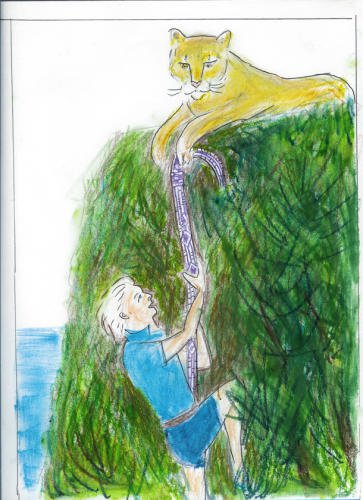
I also noticed, exploring this theme, that our dream histories are non-linear. They circle and spiral around certain themes. In the past, my dream self has resolved the challenge of running out of road by getting out of the car and picking it up like a cardboard dummy and carrying it to where he needs to go. On another occasion, confronted by a vertical, seemingly impossible cliff, my dream self was pulled up by an ally above that revealed itself - when he reached the top - as a mountain lion.


We never want to forfeit the rich detail of an individual dream, which may offer specific insight and guidance on multiple levels, relating to the possible future (for example), to the state of our mind and body and relationships and/or to our parallel lives in other times and in alternate worlds. But it's fun to track those repeating and ever transforming personal themes and symbols.

In approaching symbols, we want to remember the very useful distinction Jung made between sign and symbol. A sign stands for something known; a symbol connects us with something we do not yet know. So tracking our symbols becomes an excursion into mystery.


Drawings from Robert Moss journals


Thursday, May 30, 2019

To converse with stars


He lives in a world lit mostly by fire. The Roman Empire has recently been split into two. Rome, the capital of the West, will soon fall to the Goths. The barbarians are inside the gates of Constantinople, the capital of the East. His home city of Cyrene, in what is now Libya, is under constant attack by marauding tribes; he is often up on the walls, standing sentinel, or training his neighbors and retainers to fight back.

He comes from a noble family that can trace its lineage back to the founders of Sparta. He has the best education of his day; he studied with Hypatia, the great woman philosopher and scientist of Alexandria. In brief seasons of peace, he enjoys riding around his estates, sampling the olive oil and the honey from his bees and the milk from his goats. His great loves are books - in an age where nearly everyone is illiterate - hunting and dreaming. His name is Synesius of Cyrene, and we should know it better, because around 404 he wrote a treatise On Dreams that is (in my opinion) the most helpful book on the practice of dreamwork to appear in the West until very recent times.

In an era when the great oracles of the ancient world are being overthrown, Synesius reminds us that dreams provide us with "a personal oracle" that goes with us everywhere. All we need do is pray for a dream, wash our hands, and set our heads on a pillow. Dreaming matters because it shows us the future, provides creative inspiration, reveals different aspects of who and what we are, offers guidance on all the business of life - and above all, because it "uplifts the soul", raising us from our everyday confusion towards the level of Mind.

As a writer and orator, Synesius reports on how dreams corrected his literary style and gave him ideas for speeches that allowed him to catch the ear of an emperor. He observes, correctly, that recording and telling dreams is great preparation for public speaking, because it gives us training in telling our stories well. Some of that story material is of course extraordinary and challenges us to expand our ways of expression: "It is no mean achievement to pass on to another something of a strange nature that has stirred in one's own soul."

As everyday practice, Synesius urges us to practice dream incubation (asking our dreams for guidance), to study personal markers or "forerunners" in dreams that clue us in to whether those dreams may reveal future events, and above all to journal our experiences. He advises us to keep both a "book of the night" for dreams and a "book of the day" for our observations of signs and symbols in the world around us. By the universal law of sympatheia "all things are signs appearing through all things" and "the sage is one who understands the relationship of the parts of the universe."

For active dreamers, the very best incitement to go dreaming that Synesius offers may be this soaring passage in which he encourages us to embark on an adventure that will take us far beyond the laws of our physical universe:

There is nothing that forbids the sleeper from rising from earth and soaring above eagles, to reach a point above the loftiest spheres themselves. He may look down on the earth from far above, and explore lands that are not visible even from the moon. It is in the power of the dreamer to converse with the stars and to meet the hidden powers of the universe. [my adaptation of the 1930 translation of On Dreams by Augustine Fitzgerald]

In 410, the formidable Patriarch of Alexandria, Theophilus, persuaded Synesius to become bishop of Ptolemais. He was allowed to continue to live openly with his wife, to pursue his love of the poets who celebrated the old gods, and to practice and write about philosophy in the way of Plotinus. In the Hymns he wrote in his last years, we see Synesius making a marriage between the Christian revelation and Neoplatonist metaphysics, in verses that are sometimes very beautiful (but still await adequate translation). So we can call Synesius, at least retrospectively, the Bishop of Dreams. It is heartening to know that the early Church, in a time of violent contention, could make room for a philosopher who taught that we can become citizens of the deeper world by dreaming, and should allow no one to come between us and the sacred source that opens to us in dreams.

Image: Ruins of Ptolemais


Monday, November 26, 2018

Keep Books of Night and Day and be your own dream interpreter


We have direct access to sacred knowledge, in our dreams. Our dreams are a personal oracle that reveals the future and helps us prepare for it. We must not let anyone tell us what our dreams mean or stand between us and the direct experience of the sacred that is available in dreaming. We want to pay attention to signs from the world around us in the knowledge that everything in the universe is interconnected and constantly interweaving. We need to journal both our dreams and our waking experiences in our Books of Night and Day.
     These insights come from a fifth-century bishop of Ptolemais (in what is now Libya), Synesius of Cyrene. His treatise On Dreams is one of the wisest books ever written on how to work with dreams and synchronicity. He wrote that "Dream divination is available to all, the good genius to everyone" and that is no wonder that dreams show us the future, because dreams are experiences of soul and "the soul holds the forms of things that come into being".
      Synesius used dreams for practical navigation; he describes how dreams alerted him to plots by his enemies, counseled him on his literary style and (as a young man) on the hunt, and helped him win the ear of a Roman emperor with the right oration. He also observed, correctly, that the energy derived from dreams can be more valuable than their content; through dreams God "makes us fruitful with his own courage."

It is written, 'Others even in their dreams He made fruitful with his courage.' Do you see? One man learns while awake, another while asleep. But in the waking state man is the teacher, while it is God who makes the dreamer fruitful with His own courage, so that learning and attaining are one and the same. Now to make fruitful is even more than to teach.

He despised dream dictionaries, as popular in his time as in ours: "I laugh at all those books and think them of little use." He strongly counseled that we must not assign the interpretation of dreams to "experts" other than the dreamer: "It would be shameful for those who have lived ten years beyond adolescence to stand in need of any other diviner."
      He wrote that dreams carry us into higher worlds, and put us in direct contact with the God we can talk to. He hinted that the road of dreams is the road of the soul, on both sides of death, noting that "the soul's way of life in another world is similar to the imaginings of the dream condition."
       He was a great proponent of navigating by synchronicity, though the word he used was "sympathy". The wisest of humans are those who navigate life by reading the sign language of the world. We should keep a "day book" for our observations of signs and synchronicities as well as a "night book" for dreams.

"All things are signs appearing through all things...they are brothers in a single living creature, the cosmos...they are written in characters of every kind". 

The deepest scholarship lies in reading the sign language of the world; the true sage is a person "who understands the relationship of the parts of the universe".
     We can learn from Synesius how to practice dreamwork as real church, and track coincidence as "God's way of remaining anonymous". He deserves to be much better remembered, as a great dream teacher from the world of the early Church, one who spoke eloquently against those who seek to stand between people and the direct experience of the sacred. He wrote about dreams not on the authority of his excellent education (he studied under Hypatia in Alexandria), nor his contacts with the great, nor any high office that he held, but on the authority of his prolific first-hand experience.
     Synesius speaks to us across the centuries with the authority of experience, understanding - as do all true dreamers - that the best guides to dreaming are frequent flyers who do a lot of it.

-

Partly because I keep unusual hours, and am often embarked on my best creative work long before dawn, I don't separate my night journal from my day journal. All the material goes into one book — a leather-bound travel journal, when I am on the road. I try to type up my entries before my handwriting becomes illegible and put the printouts in big ring-back binders. I save each entry with a date and a title in my data files, so I automatically have a running index.


For more on Synesius of Cyrene, see my book The Secret History of Dreaming.

Art: Fresco from Pompeii showing a young woman with a wax tablet and stylus, cerca 50 c.e. We don't know her name. Her hair net of gold threads, as well as her literacy, suggest an upper-crust family. Today the fresco is maintained by the National Archaeological Museum of Naples (Inventory number 9084).


Monday, January 8, 2018

Deep play with the most important book you'll ever write

Your journal, kept over time, will become many things: your personal encyclopedia of symbols, your data log for experiences of supernormal phenomena like precognition, telepathy and synchronicity, your stealth writing course, a sanctuary and place of healing, a sacred space where you dialogue with your Self.  
     Journaling is a practice, and as in any true practice, you have to earn the right of admission to the more advanced levels. In
this article, you'll find wonderful games you can play with your journal any day, at any level of practice.  Now I am going to offer six deeper games to play with your journal when you’ve been keeping it for a while and have gotten into the practice of looking over "old" material that may prove to be highly relevant to your current life. I doubt that you'll understand all that your journal will be for you until you've been keeping one, with dedication, for at least five years. However, the time is always Now, and if you are ready to play, jump in!

1. Bibliomancy

“Bibliomancy” is the fancy name for opening a book at random to get guidance on a theme, or simply the quality and content of the day. In Western countries, over the centuries, the Bible has been the hand-down favorite as a book oracle. Abraham Lincoln used to open his family Bible – the one on which Barack Obama took his oath of office – to get a message for the day or a second opinion on the meaning of a dream.
    I enjoy doing bibliomancy with my old journals. One Christmas Eve, after learning that a friend had developed a serious illness and was having other major troubles in her life, I reached blindly into a shelf of 30+ old travel journals, grabbed one without looking at the date, and opened it at random, I found myself looking at a short dream report from  five years before. The dream was about my friend. It stated that she had “accepted Purgatory for a year. This Purgatory is a room in her home that opens into the same realm.” I shared this report with my friend, and we began to work with the meaning of “acceptance” and of “Purgatory”. Our mutual exploration provided assurance that “this too shall pass” and that a year in “Purgatory” would result in healing and new growth, as proved to be the case.

2. Compare Your Dream Self to Your Waking Self

Are you running away from something in your dreams? Ask yourself when you tend to run away from something – a person, an issue, a necessary conversation – in regular life.
Does your dream self have supernormal powers? Can she fly, or knock villains down like ninepins? If so, then ask yourself where you might be able to draw on her courage and powers in the rest of your life.
Comparing the behavior of the dream self and the waking self is highly instructive. We may also find that bringing gifts and qualities from one realm into the other can be tremendously healing and empowering. My waking self may be able to bring courage – the determination to brave up to a challenge – to a dream self that is frightened or frozen.
My dream self who is fluent in another language, or can breathe underwater, may be able to give me the power to expand my vocabulary of understanding, or to operate with ease in a new environment.

3. Dialogue with your other selves

Sit down with your journal and imagine yourself talking to a character from one of your dreams. Since everything is alive in dreams, you can call anything from a dream – a horse, a house, an 18-wheeler – to talk to you. You can call up every character and element from a dream to explain themselves in turn, if you like.
Start out with a question like, “Who are you?” Or: “What are you doing in my dream?”
Move onto a question like “What can you tell me?”
Be ready to be surprised! You may find you are interviewing sides of yourself you never knew were part of your family of personality aspects. You may find you are talking to a departed loved one, or an ancestor, or the guy who owned the house fifty years ago. You may even encounter a dream character who tells you, “I am dreaming you. You are in my dream.”

4. Reopen your cold case files

Dreams give us clues that require sleuthing, but sometimes our best attempts to follow up these leads don't get far and we move on to other things, leaving a mounting pile of "cold case" files. I pick up a lot of unfamiliar names, foreign words, and curious phrases in dreams and - especially - in the twilight state of hypnagogia, and I have found it extraordinarily revealing to track these verbal clues. In the era of googling, this is much easier than it was over most of the decades I've been keeping a journal, so I am now reopening dream files I had closed and making some exciting discoveries. One of those funny words, from a 1994 dream, has led me to an archeological site in Nigeria where the human remains date from 10,000 BCE. Another is guiding me, in the most practical way, on professional decisions I'll be making over the next couple of months.
   Be open to discovering that an event in an "old" dream is starting to manifest only now - months or years later - and be ready (beyond the "wow" response) to harvesting guidance from the old report on the current situation. When you see a match-up between an "old" dream and a later event, forage around the individual report; look at other dreams from around the same time and see if there are further clues there to the new situation

5. Let out the artist inside you

I often type my journal reports directly into a computer, to save the time required for transcription from a manuscript version, and to get round the problem of finding it hard to decipher my own handwriting. When I write by hand, however, I find there’s an artist in me who wants to come bursting through. Suddenly the pages facing my text reports are filled with drawings that may then demand to be colored in or painted. Some of these drawings occupy successive panels like pages from a graphic novel. The famous movie director Fellini, who started out as a cartoonist, kept dream journals that are primarily visual.
    Many dream journalers find they have a poet inside. Or a songwriter. Sometimes a whole poem or song is delivered, complete and intact, within  a dream, or in that fluid in-between zone of sleepwake, dorveille. Some dream reports turn into poems rather effortlessly, with a little editing. Every dream contains a story; some want to be stories in the fuller and finished sense, and journaling will get you there.

6. Journal from Journals

Thoreau journaled all the time. He wrote down his observations of nature, his thoughts and dreams, his notes on his constant reading. Most interesting, he journaled from his journals, picking over old volumes, plucking out promising bits and pieces, copying them out and marrying them up as fresh drafts. It became his habit “to work back over his journals…to reengage old subjects in the light of new interests, to revise and recopy his own earlier journal work, measuring, weighing, culling and sorting his materials…taking up earlier threads, reweaving and combining them.”
I can’t recommend this practice too highly. For any writer, as for Thoreau, it opens treasuries of material and above all it supports the writing habit. Playing around with old notes removes the terror of the blank page. When you dip into an old journal, you are never at a loss for a theme. The simple processes of selection, arrangement and retitling will fire the imagination. Before you know it, you’ll be in the midst of writing something new. 

As you tend your secret book over time, you'll discover more, and more will discover you.  You'll find yourself straying off the tame and settled territory of the everyday mind, into the wilder borders of imagination, where the Big story of your life can find you. You may discover, as I have done, that your journal is the most important book you will ever write, and quite possibly the most important book you will ever read.


Adapted from Active Dreaming by Robert Moss. Published by New World Library