Showing posts with label Graham Greene. Show all posts

Tuesday, September 10, 2024

The Ur-Ground of Literature


 The raw sexuality of her call to her lover is wild and shocking: “Plow my vulva!” He plunges into her like a “wild bull”. When they couple, he is the green life of all growing things and she is the Queen of Heaven. He is Dumuzi and she is Inanna.

     But she is called to go down into the dark places, and travels a terrifying path of ordeal and initiation. When she returns, transformed, to the surface world, she finds that her man has forgotten her, playing king of all he surveys. Her angry curse sucks the light out of his day. Now Dumuzi dreams that everything turns against him. Trees are uprooted, his hearth fire is doused, his drinking cup is thrown down, his shepherd’s crook is taken away. A fierce raptor seizes a lamb from his sheepfold, and he knows that something fearsome and unforgiving is coming for him.
     Death is coming for him, and his only hope lies in the love and feminine wisdom of his younger sister, Geshtin-anna. She is a reader, “a tablet-knowing scribe”, who knows the meaning of words and of dreams.
    She helps him to hide, but in the end he cannot escape his own demons. He is overpowered by galla demons and carried down to the realm of Inanna’s dark double, the Queen of the Underworld, into his own cycle of death and rebirth.. Grieving, both Inanna and his constant sister will seek him in the lower world, using drumming, like shamans. And they will make a deal by which Geshtin-anna will take her brother’s place in the Underworld for half the year, giving him time up top with the goddess in her sunnier disposition. But that is a later story in the cycle of Inanna.
    The Dream of Dumuzi is the oldest recorded dream. It was written in Sumer nearly five thousand years ago, scored with marks on baked clay that look like the tracks of a very thoughtful sandpiper. Almost certainly, it was written by a woman. We can’t miss the fact that the first dream interpreter on record is a woman who can read and write, the “tablet-knowing scribe.”
    Geshtin-anna becomes the goddess of dream divination (and of wine).

The Dream of Dumuzi, unclothed in its beauty and terror in a modern translation by Diane Wolkstein, is great writing, and takes us where great writers do not fear to go: into the inner chambers of the heart, into the demon-haunted mind, into the mysteries of death and rebirth. Thanks to its survival, we can say without hesitation that one of the first uses of writing – which was invented in Sumer – was to record dreams, and that one of the great things to emerge from recording dreams, at least five thousand years ago, was literature. Writers have always been dreamers. [1]        


Dumuzi was king of Uruk, not far from Ur, the most famous city of the Sumerians and the one from which Abraham set out to found a new people. So Bert States is doubly correct when he says “dreaming is the Ur-form of all fiction.” [2]
    States suggests that storytelling springs from the same “skill” that allows us to produce dream narrativesand compares the mental state of the creative writer to that of a lucid dreamer: “Just as the lucid dreamer is slightly awake, slightly outside the dream, while being largely inside it, so the waking author is slightly asleep, or slightly inside the fiction while being largely outside it.” [3] Many fiction writers (including me) would attest to the accuracy of this description. It probably applies to creative minds from many fields operating in a flow state of relaxed attention or attentive relaxation. In this state, as Samuel Beckett wrote of Proust, the writer may also be, for the moment, “an extratemporal being” [4] 
    Dreams provided both energy and inspiration for literary creation. As a boy, Aeschylus (born 525 BCE) was sent to watch over ripening grapes in a vineyard. When he dozed off, Dionysus, god of wine and drama, appeared to him and gave him instructions for a new kind of theatre. Prior to this, ancient Greek drama was rather static ritual, with a single actor on stage, and a chorus that did not interact directly with him. Aeschylus was inspired in his dream to introduce a second actor; this was the birth of Western theatre. He went on to write ninety plays, although only seven are extant.

“Poetry is always the result of flooding”, a young poet told Stefania Pandolfo as she journeyed among rural Moroccan villagers for whom dreaming and poetry are vitally important, and always interweaving. A real poem bursts from an emotion that is inundating, overwhelming – until it finds creative release. [5] 
   The most respected poet in the area, one Sheikh Mohammed, was alien to poetry until he dreamed of a flood. The dream came at a time of personal trauma when he was close to despair. Previously a violent man of action, he had managed to blow off his right hand in a gun accident. He dreamed the river was coming down in flood, its front like a mountain, carrying everything it encountered in its path, trees and carrion and debris. Instead of fleeing, he stood there in the dry riverbed, watching and waiting. Then he opened his mouth and swallowed the flood and everything borne along by it. He recounted the dream to his mother and she told him that he had become a poet. This became his life’s calling.[6]
     From the priestess-scribe who wrote Dumuzi’s story to the latest novels by Stephen King and Neil Gaiman, dreams have provided wonderful material for stories and novels, scripts and poems. The dream may provide the rough first sketch of a theme or a plot or a character, with everything still to be worked out and delivered – perhaps with the help of subsequent dreams – over a considerable period of time. The dream may have the structure and detail required for a finished story or poem (but is unlikely to be “finished” in the sense that it will be truly good writing until the raw report has been shaped and polished). The dream may be inserted in a narrative and attributed to one of the characters as Graham Greene did for Querry in A Burnt-Out Case). The dream may be delivered as a story without a frame, as Franz Kafka delivered a nightmare in Metamorphosis while insisting, in the tale, that the man turned into a giant bug was not dreaming.
   The literary dream has been used as a plot device in many ways. It may be used to take the reader into the inner life of a character. It may be used to set up critical narrative tension, for example between a character’s desires and his conscience, a central theme in Dostoyevsky’s use of dreams.
    The dream can be used as an architectural device, to open and frame a story that may be anything but a dream; the medieval Roman de la Rose is a classical example, from an age when dreams were greatly respected. In the classic Chinese novel The Dream of the Red Chamber novel opens with a goddess creating a mountain from 36,501 pieces of stone, one of which - rejected - is a speaking rock whose complaint is heard by two immortals and is gifted with a very mobile life, in different forms, in the mortal world – known to gods and immortals as the Red Dust - and elsewhere.[7]

     Writing and dreaming are closely related in daily practice. Writers who keep journals and record their dreams are giving themselves a warm-up, flexing the creative muscles that will work on the larger project. Writers who may not record their dreams with any regularity nonetheless rise from sleep with their heads full of words – as Dickens related in his letter to Dr. Stone – that are pressing to come out. [8]
A writer’s dream may help to “break up the great fountains of the deep” (a phrase Mark Twain used repeatedly) releasing the power of long-buried memories, or bringing through ideas that have been growing in the preconscious or the deeper unconscious for years or decade. That is how Aslan came to C.S. Lewis, giving him the key to Narnia. As “Jack” Lewis recalled 

The Lion all began with a picture of a Faun carrying an umbrella and parcels in a snowy wood. The picture had been in my head since I was about sixteen. Then one day, when I was about forty, I said to myself: ‘Let’s try to make a story about it.’
    At first I had little idea how the story would go. But then suddenly Aslan came bounding into it. I think I had been having a good many dreams about lions about that time. Apart from that, I don't know where the Lion came from or why he came. But once he was there He pulled the whole story together, and soon he pulled the six other Narnian stories in after him. [9]] 

     Finally, it is in dreams and flow states that writers come into contact with inner helpers. Robert Louis Stevenson communed with his “Brownies” in states of reverie, and gave them the credit for doing better than half his literary work. Yeats spoke of the “mingling of minds” that can bring assistance, in a creative venture, from intelligences that seem to belong to other times or other dimensions. Milton described the source of his inspiration as   

....my celestial patroness, who deigns
Her nightly visitation unimplored,
And dictates to me slumbering, or inspires
Easy my unpremeditated prose [] 

Milton spoke of “being milked” after his nights of inspiration, as – totally blind by the time he composed his most famous work – he dictated to a scribe.


Notes and References

 1. This translation of the Dream of Dumuzi is in Wolkstein, Diane and Samuel Noah Kramer, Inanna, Queen of Heaven: Her Stories and Hymns from SumerNew York: Harper & Row, 1983, pp 74-84.     Dumuzi (later called Tammuz) is a Mystery god who dies and is reborn, and the cycle of his ever-recurring death and resurrection is also the cycle of the crops in what is now southern Iraq. He dies in the spring at the time Iraqi farmers, in their hot country, harvest their wheat and barley; he is resurrected when they put seeds in the earth. In the Christian calendar, this is Easter time. The Shia ritual mourning for the martyred Imam Hussein at the site of the battle of Karbala – a rite Saddam tried to suppress – takes place at the same time. Life rhymes, and so do the life cycles of gods. See  E.W.Fernea, Guests of the Sheikh. Garden City, NY: Doubleday, 1969.

2. Bert O. States, Dreaming and Storytelling. IthacaNYCornell University Press, 1993.1993, p.3. 

3.  Bert O. States, Bert O., “Authorship in Dreams and Fictions” in Dreaming vol.4 no.4 (December, 1994) pp. 239-240

4. Samuel Beckett, Proust. New York: Grove, 1931, p. 56)

5.Stefania Pandolfo,  Impasse of the Angels: Scenes from a Moroccan Space of Memory. ChicagoUniversity of Chicago Press, 1997, p.259]

6. ibid p. 265

7. Tsao Hsueh-chin, Dream of the Red Chamber (1754). Trans. and adapted by Chichen Wang. New York: Anchor Books, 1989.

8. Charles Dickens letter to Dr Stone. February 2, 1851; see Warrington Winters, “Dickens and the Psychology of Dreams” in PMLA vol.63 no.3 (September 1948) pp. 984-1006.

9. Lewis, C.S., “It All Began with a Picture”, Junior Radio Times, vol. 68 (July 15, 1960) reprinted in Of Other Worlds. San Diego and New York: Harcourt Brace, 1975, p. 42.

10. Paradise Lost IX. 21-4


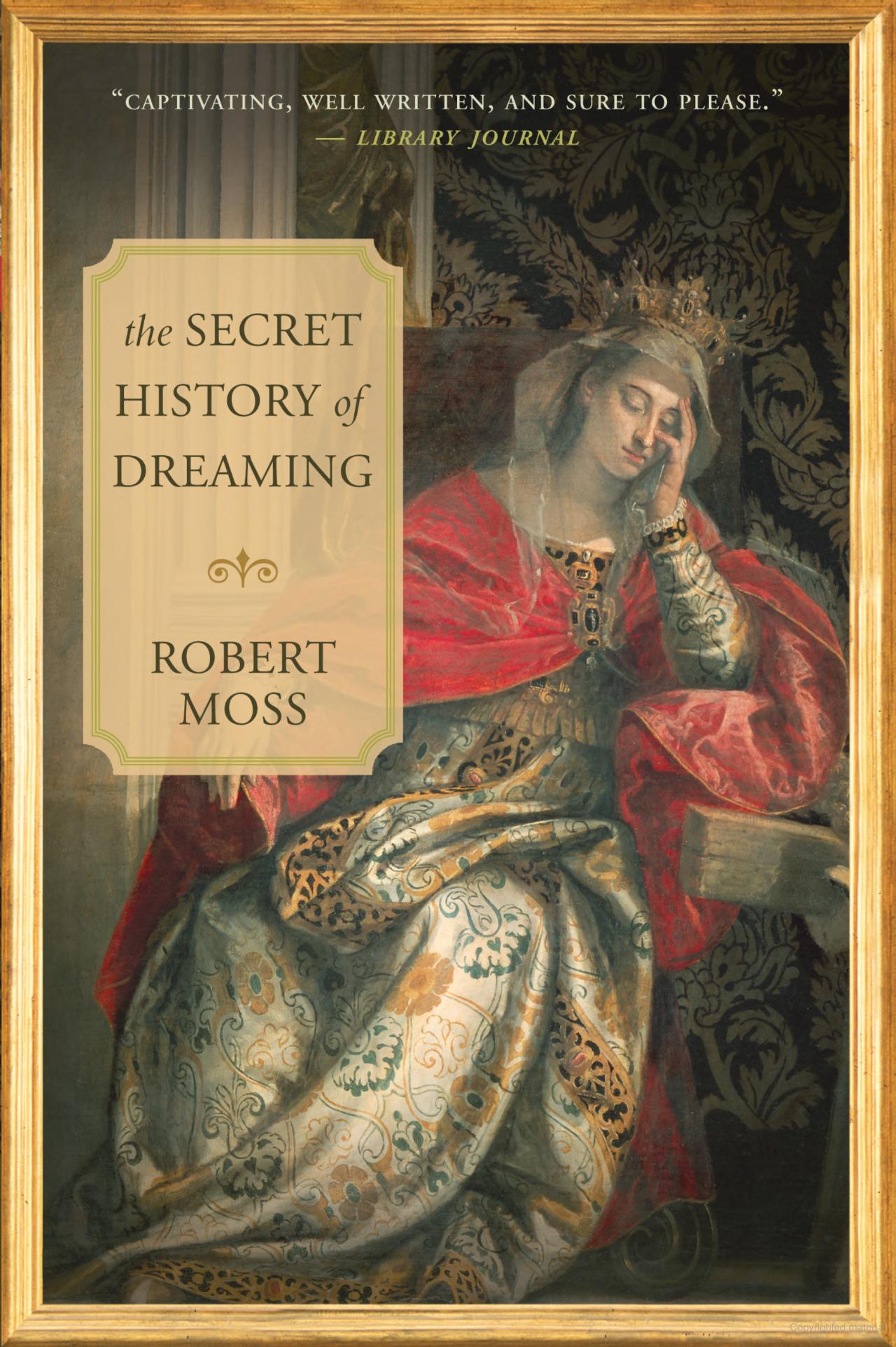
Text adapted from The Secret History of Dreaming by Robert Moss. Published by New World Library.


Friday, April 19, 2024

Why You Want to Keep a Journal


When a lusty, ambitious young Scot named James Boswell first met Dr. Samuel Johnson, Johnson advised him to keep a journal of his life. Boswell responded that he was already journaling, recording "all sorts of little incidents." Dr Johnson said, "Sir, there is nothing too little for so little a creature as man."

Indeed, there is nothing too little, or too great, for inclusion in a journal. If you are not already keeping one, I entreat you to start today. Write whatever is passing through your mind, or whatever catches your eye in the passing scene around you. If you remember your dreams, start with them. If you don't recall your dreams, start with whatever thoughts and feelings are first with you as you enter the day, or that interval between two sleeps the French used to call dorveille ("sleep-wake"), a liminal space when creative ideas often stream through.

If you have any hopes of becoming a writer, you'll find that journaling is your daily workout that keeps your writing muscles limber. If you are already a writer, you may find that as you set things down just as they come, with no concern for editors, critics or consequences, you are releasing descriptive scenes, narrative solutions, characters - even entire first drafts - quite effortlessly. Some of the most productive writers have also been prodigious journal-keepers. Graham Greene started recording dreams when he was sixteen, after a breakdown in school. His journals from the last quarter-century of his life survive, in the all-but-unbreakable code of his difficult handwriting. First and last, he recorded his dreams, and - as I describe in detail in my Secret History of Dreaming, they gave him plot solutions, character development, insights into the nature of reality that he attributed to some of his characters, and sometimes bridge scenes that could be troweled directly into a narrative. Best of all, journaling kept him going, enabling him to crank out his daily pages for publication no matter how many gins or how much cloak-and-dagger or illicit amour he had indulged in the night before.

You don't have to be a writer to be a journaler, but journal-keeping will make you a writer anyway. In the pages of your journal, you will meet yourself, in all your aspects. As you keep a journal over the years, you'll notice the rhymes and loops or cycles in your life. Mircea Eliade, the great Romanian-born historian of religions, was a great journaler. In the last volume of his published journals, he reflects, during a visit to Amsterdam in 1974, on how a bitter setback to his hopes at the time he first visited that city nearly a quarter-century before had driven him to do his most enduring work. He had been hoping that his early autobiographical novel, published in English as Bengal Nights, would be a big commercial success, enabling him to live as a full-time novelist. Sales were disappointing. Had it been otherwise, "I would have devoted almost all my time to literature and relegated the history of religions to second place, even though Shamanism was at the time almost entirely drafted." The world would have gained a promising, and perhaps eventually first-class, novelist; but we might have lost the scholar who first made the study of shamanism academically respectable and proceeded to breathe vibrant life, as well as immense erudition, into the cross-cultural study of the human interaction with the sacred.

Synesius of Cyrene, a heterodox bishop in North Africa around 400, counseled in a wonderful essay On Dreams that we should keep twin journals: a journal of the night and a journal of the day. In the night journal, we would record dreams as the products of a "personal oracle" and a direct line to the God we can talk to. In the day journal, we would track the signs and correspondences  through which the world around us is constantly speaking in a symbolic code. "All things are signs appearing through all things. They are brothers in a single living creature, the cosmos." The sage is one who "understands the relationship of the parts of the universe" - and we deepen and focus that understanding by recording signs in our day journal.

Partly because I keep unusual hours, and am often embarked on my best creative work long before dawn, I don't separate my night journal from my day journal. All the material goes into one book - a leather-bound travel journal, when I am on the road, my digital data base in Word when I am home.  I try to type up my entries before my handwriting (as difficult as Greene's) becomes illegible and put the printouts in big ringback binders. I save each entry with a date and a title in my data files, so I automatically have a running index.

One of the things you'll come to see clearly, as you journal dreams over a considerable period of time, is that your dream self travels ahead of your waking self, scouting the ways. 


Robert Moss journals with lamassu, a dream friend since childhood


Tuesday, March 28, 2023

Dreaming in Greeneland


When I first traveled to Paris as a foreign correspondent, early in the 1970s, the office secretary made a reservation for me at the St James Albany, which turned out to be twin hotels - very handsome Right Bank townhouses - separated by a quiet courtyard with a fountain and flagstones and flowerbeds and shade trees. It struck me that the courtyard between the twin hotels was a liminal space, ideal for intrigue and trespass of various kinds – for games involving lovers, or spies, even players from different worlds. 
     I later discovered, to my great delight, that Graham Greene had similar feelings and had made this location a part of Greeneland, the fictive world of his novels. He used the courtyard of the St James Albany as the setting for a hilarious scene in Travels with My Aunt in which two women, meeting by chance, discuss the lovers with whom they tryst in secret in each of the twin hotels - and then discover that their lovers are the same man when M. Dambreuse arrives with his wife and children.
     Graham Greene led many lives, but first and last he was a writer, with a professional writer’s discipline. Through his many intrigues, both personal and political, he managed to sit down almost every day from 7 a.m. to 9 a.m. – on a veranda in Tahiti or a cottage in Brighton – and knock out his quota of 500 words, and he did this for seventy years, producing a steady stream of popular novels and essays.
     A crucial part of Greene’s practice was to write down his dreams. He started keeping a dream journal when he was sixteen. He often reported his dreams in letters to lovers and friends. Over the last twenty-five years of his life, he recorded his dreams with great faithfulness – though in fiendishly difficult handwriting – in notebooks that are now in an archive in Texas. His last literary project was to edit a selection of his dreams for a posthumous collection he titled A World of My Own.
     The interweaving of Greene’s dream life with his other lives makes a fascinating study, for which the primary source materials are unusually extensive.  We see how a man who chose to live on the dangerous edges of the world was able to create – richly and repeatedly – from the borderlands of dreaming. We can track many different modes in which a writer can create from dreams, from receiving the initial idea for a story, to solving a problem during sleep, to bridging a narrative gap, to dreaming deep into a character’s life.
     As a young boy, he had psychic dreams, often involving death by water, a prospect that terrified him. On the night the Titanic sank, when he was just seven, he dreamed of a shipwreck, with a man in oilskins bent double beside a companionway under the blow of a great wave. 
     He was miserable at school – nothing unusual in the lives of creative and sensitive individuals – and ran away when he was sixteen. This was highly embarrassing for the family, since Graham’s father was headmaster. They decided to send him to London to be psychoanalyzed, which was still a novel idea in 1920, especially for a teenage boy. The analyst selected, Kenneth Richmond, had no formal training; he was a writer with spiritualist leanings who followed an eclectic approach.
     While Greene was boarding with him in Lancaster Gate, Richmond instructed him to write down his dreams. In mid-morning sessions, Greene was expected to tell a dream and then give his associations to the key images while the analyst merely listened. When Greene did not recall a dream, he made something up. The whole experience – which he later described as the happiest six months of his life  – laid the foundation for Greene’s literary career by training him to write from dreams and invent stories. 
      Kenneth Richmond’s beautiful wife Zoe – about whom Greene had mildly erotic dreams – thought Graham was clairvoyant, “a natural medium”. While in Lancaster Gate, Greene dreamed of a ship going down in the Irish Sea. That same night, just after midnight, the Rowan sank in the Irish Sea
      In some of his precognitive or clairvoyant dreams, he found himself in the situation of one of the victims. Aged twenty-one, he dreamed of another shipboard disaster in which he was being ordered to jump overboard from an upper deck. He later read the news of a terrible wreck in a storm off the Yorkshire coast in which the captain ordered his men to jump into the violent sea, and all but two were drowned. Greene speculated that “on an occasion like this there must be terrific mental waves of terror, and my mind seems to be particularly attuned to the terror of drowning wave.”
     His youthful psychic ability to dream his way into someone else’s situation resembled his mature ability as a novelist to dream his way into his characters’ lives. He later observed that “sometimes identification with a character goes so far that one may dream his dream and not one’s own.” 
     Greene’s dreams were central to his writing. He said that two of his novels, It’s a Battlefield and The Honorary Consul, both started with dreams. He dreamed the plots and characters of entire short stories. When he was writing A Burnt-Out Case – which drew heavily on his diary of a trip to the Congo – Greene came to a point in the plot where he was stuck. Then the author dreamed as his character, Querry, and found he could insert his dream “without change” in the novel, “where it bridged a gap in the narrative which for days I had been unable to cross.” 
     Greene made it a habit to solve writing problems in his sleep, noting that it is not necessary to remember the content of a dream in order to receive a dream-inspired solution. “When an obstacle seems insurmountable, I read the day’s work before sleep…When I wake the obstacle has nearly always been removed: the solution is there and obvious – perhaps it came in a dream which I have forgotten.” 
      He harvested personal dreams and assigned them to characters in his novels. In a  dream reflecting his lifelong preoccupation with religion, he gave a lecture on the theme that God evolves, as well as man, and that behind their apparent duality, God and Satan are one. He later transferred this theory to a passage in The Honorary Consul where his character explains that God has a “night-side” as well as a “day-side”; the night-side will wither away (“like your communist state, Eduardo”) as God and man both evolve. 


   Graham Greene was a man of mystery who had much to hide, in his private life and in his engagement with the worlds of power and espionage. For him the great mystery, at the end, concerned what follows death. He thought – and dreamed – about this all his life. He was greatly affected by a series of dream encounters with his father after his death. 
   Greene had a disturbing dream that he might be extinguished after death through lack of belief. “I had been aware of people I had loved who called me to join them. But I had chosen, by my lack of belief, extinction. A great black cone like a candle extinguisher was to be dropped over my head.” 
     But he did not go out like that. He left sure of continuing life, ready for new travels, regretting only separation from the last woman to share his life, Yvonne Cloetta.
    A week before his death, knowing it was at hand, he said to Yvonne in the hospital at Vevey: “It may be an interesting experience; at last I shall know what lies on the other side of the fence.” 
Towards the end, he made this note in Yvonne’s “red book” of their conversations: “Perhaps in Paradise we are given the power to help the living. I picture Paradise as a place of activity. Sometimes I pray not for the dead friends but to dead friends, asking their help.” 
Yvonne recalls that “He worked every morning, as he always did, right up to the end, on his book of dreams.” Evidently he came to believe that through dreams (as one of his characters said in a different connection) “there was something in the warring crooked uncertain world he could trust beside himself.”


Adapted from The Secret History of Dreaming by Robert Moss. Published by New World Library.


Saturday, April 11, 2020

Why you want to keep a journal


When a lusty, ambitious young Scot named James Boswell first met Dr. Samuel Johnson, Johnson advised him to keep a journal of his life. Boswell responded that he was already journaling, recording "all sorts of little incidents." Dr Johnson said, "Sir, there is nothing too little for so little a creature as man."

Indeed, there is nothing too little, or too great, for inclusion in a journal. If you are not already keeping one, I entreat you to start today. Write whatever is passing through your mind, or whatever catches your eye in the passing scene around you. If you remember your dreams, start with them. If you don't recall your dreams, start with whatever thoughts and feelings are first with you as you enter the day, or that interval between two sleeps the French used to call dorveille ("sleep-wake"), a liminal space when creative ideas often stream through.

If you have any hopes of becoming a writer, you'll find that journaling is your daily workout that keeps your writing muscles limber. If you are already a writer, you may find that as you set things down just as they come, with no concern for editors, critics or consequences, you are releasing descriptive scenes, narrative solutions, characters - even entire first drafts - quite effortlessly. Some of the most productive writers have also been prodigious journal-keepers. 

Graham Greene started recording dreams when he was sixteen, after a breakdown in school. His journals from the last quarter-century of his life survive, in the all-but-unbreakable code of his difficult handwriting. First and last, he recorded his dreams, and - as I describe in detail in my Secret History of Dreaming, they gave him plot solutions, character development, insights into the nature of reality that he attributed to some of his characters, and sometimes bridge scenes that could be troweled directly into a narrative. Best of all, journaling kept him going, enabling him to crank out his daily pages for publication no matter how many gins or how much cloak-and-dagger or illicit amour he had indulged in the night before.

You don't have to be a writer to be a journaler, but journal-keeping will make you a writer anyway. In the pages of your journal, you will meet yourself, in all your aspects. As you keep a journal over the years, you'll notice the rhymes and loops or cycles in your life. Mircea Eliade, the great Romanian-born historian of religions, was a great journaler. In the last volume of his published journals, he reflects, during a visit to Amsterdam in 1974, on how a bitter setback to his hopes at the time he first visited that city nearly a quarter-century before had driven him to do his most enduring work.

He had been hoping that his early autobiographical novel, published in English as
 Bengal Nights, would be a big commercial success, enabling him to live as a full-time novelist. Sales were disappointing. Had it been otherwise, "I would have devoted almost all my time to literature and relegated the history of religions to second place, even though Shamanism was at the time almost entirely drafted." The world would have gained a promising, and perhaps eventually first-class, novelist; but we might have lost the scholar who first made the study of shamanism academically respectable and proceeded to breathe vibrant life, as well as immense erudition, into the cross-cultural study of the human interaction with the sacred.

Synesius of Cyrene, a heterodox bishop in North Africa around 400, counseled in a wonderful essay On Dreams that we should keep twin journals: a journal of the night and a journal of the day. In the night journal, we would record dreams as the products of a "personal oracle" and a direct line to the God we can talk to. In the day journal, we would track the signs and correspondences  through which the world around us is constantly speaking in a symbolic code. "All things are signs appearing through all things. They are brothers in a single living creature, the cosmos." The sage is one who "understands the relationship of the parts of the universe" - and we deepen and focus that understanding by recording signs in our day journal.

Partly because I keep unusual hours, and am often embarked on my best creative work long before dawn, I don't separate my night journal from my day journal. All the material goes into one book - a leather-bound travel journal, when I am on the road. I try to type up my entries before my handwriting (as difficult as Greene's) becomes illegible and put the printouts in big ringback binders. I save each entry with a date and a title in my data files, so I automatically have a running index and (with Word) a search engine. I like to draw pictures from my dreams and some of these go in separate art journals.

One of the things you'll come to see clearly, as you journal dreams over a considerable period of time, is that your dream self travels ahead of your waking self, scouting the ways. You'll find you are creating a personal dictionary of symbols, far superior to any of that hand-me-down stuff you'll find in dream dictionaries in stores, because the snake in your dreams is not necessarily the snake in my dreams. You'll have starter dough for creative writing and art and a wish list for shamanic shopping.

Share what you wish to share with those who are primed to hear and give you feedback in a respectful, non-intrusive way, following the "If it were my dream" protocol but keep the journal strictly private. This is your secret book. What you write in it is between you and your soul, and you write without fear of judgment or consequences. Go back to old entries and see what is looking at you now, as dreams spill into everyday life.

Continue and deepen your practice for long enough, and you may come to feel -as Eliade did -that your journal is the most important book you will ever write, and one of the most important you will ever read.


For practical guidance on keeping a journal, and many games to play with it, please see  my book Active Dreaming.


Friday, August 9, 2019

The Strand of Imagination

I love playing architect of the imaginal realm. This means helping to design or co-create real places in the realm of true imagination where people can go - in lucid dreaming, shamanic journeys and imaginal exercises - to have adventures in discovery and healing. As a book lover, I especially like traveling and guiding people to various versions of a Secret Library or Magic Bookstore where they may have access to any kind of information or inspiration,and meet master teachers. I invite them to call up the memory of a place like a bookshop or museum where they were excited by the discovery of new ideas and images, and then use that memory as the portal for a visit to a space that will soon expand and deepen into something far beyond memory. Here is my account of what happened when I suggested to a circle of forty literate dreamers at a weekend workshop in Manhattan that we might travel together, fueled and focused by my shamanic drumming, to the iconic Strand bookstore and let it become our doorway to the Imaginal Realm where poets, shamans and mystics have always wanted to go.

THE STRAND OF IMAGINATION


We agree to meet at the Strand, the venerable, vast and lively bookstore at the corner of Broadway and East 12th Street in Manhattan. The area used to be called Book Row, but of all the bookshops that flourished here around the time the Strand opened its doors in 1927, this is the sole survivor. It has remained a family business, ownership descending through the progeny of Ben Bass, the founder. In the time when the Strand boasted that it contained eight miles of books, a wag stated that the eight miles of New York worth preserving were inside its walls. The bookstore has grown since; it now boasts no less than 18 miles of books.
    In the year I lived in Manhattan, my arms were often sore from toting big shopping bags of twice-sold tales from the Strand up to my modest apartment in Yorkville. On flying visits to the city since, I have often failed to ration my book-buying at the Strand sufficiently to pass the weight inspection for suitcases at airports. Besides the expected and unexpected treasures in all the cases of old books, the Strand is the place to get a new book at half price. The velocity at which review copies pour into the store makes it hard to believe that many of those reviewers even opened their copies before generating a little extra income.
    The Strand has long been, for me, one of those magic bookshops where the shelf elves produce exactly the right book to guide or redirect a creative intent. When I was writing a chapter of a novella in which W.B.Yeats is at home in his rooms in the Woburn Buildings, off Tavistock Square, circa 1900, my youngest daughter - who did not know about my project - visited the rare book room at the Strand and brought me back a rare prize, a memoir of Yeats by John Masefield in which the English poet evokes beautifully the experience of visiting the Irish poet in that London apartment.
    The Strand has a place in my imaginal geography, as well as my physical rambles. I go there in night dreams, and in wide-awake shamanic journeys to places in the imaginal realm, a world of true imagination beyond the physical (but not the inner) senses where we can access wise teachers and extraordinary places of healing, initiation and higher learning.
     When I was writing about Harriet Tubman, who used her dreams and visions to guide escaping slaves to freedom on the Underground Railroad before the American Civil War, I found myself roaming the Strand in the middle of the night in my astral body, in that wondrously fluid state of consciousness that sleep researchers call hypnagogia and I prefer to call the twilight zone. Down in the basement, I met Harriet Tubman, wearing a hat pulled down over her forehead and a shapeless coat. She showed me that her skills as a tracker and guide owed a great deal to the shamanic ways of the Ashante, her father's people, and especially to the leopard, the favorite animal spirit of West African shamans and shapeshifters. I used the insights I gained in the basement of the Strand that night in my chapter on Tubman in The Secret History of Dreaming.
    I shared this "old" dream with the participants in a shamanic dreaming workshop I led at the New York Open Center back in 2012. There was great excitement when I suggested that all of us could use the Strand as a portal for an adventure in the imaginal realm, with the aim of contacting master teachers or practitioners in whatever fields most interested us. Most people in the workshop knew the Strand.
    I explained that we could use our memories of the physical bookstore in order to enter a space beyond it. We might find that by opening any book, we could enter the world it contained. We might discover that a bookshop in Manhattan could become the gateway to a Secret Library, where all knowledge is accessible.
    When I was sure that everyone had been seized by the intention to explore, and the workshop participants had placed their bodies in comfortable positions for journeying, I used my gee-whiz technology - a single-headed frame drum - to provide fuel and focus for our group adventure. I always journey for myself while drumming for the group; I immediately found myself at the corner of Broadway and 12th. After a cursory look at the sale items in the stalls on the sidewalk, I headed into the store. I noticed a memorial display for Maurice Sendak, and paused to check the prices of recycled review copies of a few novels I had recently purchased: Carlos Ruiz Zafón's The Prisoner of Heaven, Alan Furst's Mission to Paris, Joseph Kanon's Istanbul Passage.
    I took the stairs to the basement and found Graham Greene waiting for me there. I have talked to that grand English novelist and entertainer (or the part of myself that relishes him) before, and he has given me excellent advice on the practice of writing, advice I have not always followed. Greene was a consummate professional, able to sit down and crank out his 750 words a day however many drinks he had shared with a Soviet agent, a whisky priest, or a bevy of filles de joie the night before. I wondered if he would nudge me towards trying my hand again at a tale of intrigue; in a former life, back in the 1980s, I published a series of popular spy novels. Ah, something more interesting. Greene offered me some tips on writing a memoir. I set my intention re-read his own autobiographical works, especially A Sort of Life and Ways of Escape.
    Behind Greene, among the stacks, I saw a dark-haired young fellow in a trenchcoat. Who was that? It gave me a shiver to realize I was looking at a much younger version of myself, the 1980s thriller writer, seen now very much as he appeared on the dust jacket of a couple of my early novels. I did not engage with him directly.
    I went to the right, down book-lined passages, and met other figures, including a magical child with a treasure chest full of stories for children that I might yet write. As I continued drumming, I found myself in a passage where books rose to the ceiling. The passage turned and turned in a spiral until - poof - I came out in a space where the first thing I saw was a spray of black feathers, and the black embroidered hem of a long woman's dress.
    I found myself in the presence of a gloriously over-the-top lady of a certain age, still desirable and very sure of her place in a social and literary world she had made for herself. She was dressed all in black, with a black feather boa and a magnificent dress with plunging decolletage. She gave me her pen name and allowed me a glimpse of her life. Her admirers include American tycoons and European counts; she allows only a very select few to share her intimate favors. There are those in high places who rely on her as a psychic medium; it is her special pleasure to connect people with their past lives. Out of this life, she has written a wildly successful series of romps that blend the metaphysical with the bodice-ripper and the policier.
    
I was astonished, though not altogether surprised, to realize that I knew this lady writer. At the end of the 1980s, when I had abandoned the commercial path, I found myself held up for a long time at a customs inspection. While I submitted to questions and inspections, I noticed a flamboyant woman in furs breezing past complaint officials at a parallel checkpoint; they whisked her Louis Vuitton bags through, uninspected. The lady in furs turned to me and blew me a kiss. She called to me, "Maybe we'll meet again."
    That was, of course, a dream. When I thought about it at the time, I chuckled, realizing that I had caught a glimpse of my inner Happy Hooker, the part of me that had been willing to put out my work for a price. Here she was again, in a black feather boa. Why?
   Write in my voice, said my Happy Hooker. Write in my name, if you likeYou can still write about the things that matter to you, while you give people even more fun.
    Hmm. I'll need to think about that.
    When I sounded the recall with the drum, our intrepid dream travelers brought back a marvelous set of personal reports, featuring encounters with dead poets and master chefs, with a children's writer and a Neoplatonist philosopher. Wonderful what one can find, in the Strand of imagination.


Art:“Upstairs at the Strand Bookstore” acrylic painting by @jontwingley

Sunday, June 3, 2018

On making the most important book you'll ever read

When a lusty, ambitious young Scot named James Boswell first met Dr. Samuel Johnson, Johnson advised him to keep a journal of his life. Boswell responded that he was already journaling, recording "all sorts of little incidents." Dr Johnson said, "Sir, there is nothing too little for so little a creature as man."
    Indeed, there is nothing too little, or too great, for inclusion in a journal. If you are not already keeping one, I entreat you to start today. Write whatever is passing through your mind, or whatever catches your eye in the passing scene around you. If you remember your dreams, start with them. If you don't recall your dreams, start with whatever thoughts and feelings are first with you as you enter the day, or that interval between two sleeps the French used to call dorveille ("sleep-wake"), a liminal space when creative ideas often stream through.
    If you have any hopes of becoming a writer, you'll find that journaling is your daily workout that keeps your writing muscles limber. If you are already a writer, you may find that as you set things down just as they come, with no concern for editors, critics or consequences, you are releasing descriptive scenes, narrative solutions, characters - even entire first drafts - quite effortlessly. Some of the most productive writers have also been prodigious journal-keepers.
     Graham Greene started recording dreams when he was sixteen, after a breakdown in school. His journals from the last quarter-century of his life survive, in the all-but-unbreakable code of his difficult handwriting. First and last, he recorded his dreams, and they gave him plot solutions, character development, insights into the nature of reality that he attributed to some of his characters, and sometimes bridge scenes that could be troweled directly into a narrative. Best of all, journaling kept him going, enabling him to crank out his daily pages for publication no matter how many gins or how much cloak-and-dagger or illicit amour he had indulged in the night before.

    You don't have to be a writer to be a journaler, but journal-keeping will make you a writer anyway. In the pages of your journal, you will meet yourself, in all your aspects. As you keep a journal over the years, you'll notice the rhymes and loops or cycles in your life.
    Because I am leading teach workshops in Romania, I have been re-reading Mircea Eliade, the great Romanian-born historian of religions. Opening the last volume of his published journals, I found him reflecting during a visit to Amsterdam in 1974 on how a bitter setback to his hopes at the time he first visited that city nearly a quarter-century before had driven him to do his most enduring work. He had been hoping that his early autobiographical novel, published in English as Bengal Nights, would be a big commercial success, enabling him to live as a full-time novelist. Sales were disappointing. Had it been otherwise, "I would have devoted almost all my time to literature and relegated the history of religions to second place, even though Shamanism was at the time almost entirely drafted." The world would have gained a promising, and perhaps eventually first-class, novelist; but we might have lost the scholar who first made the study of shamanism academically respectable and proceeded to breathe vibrant life, as well as immense erudition, into the cross-cultural study of the human interaction with the sacred.

    Synesius of Cyrene, a heterodox bishop in North Africa around 400, counseled in a wonderful essay On Dreams that we should keep twin journals: a journal of the night and a journal of the day. In the night journal, we would record dreams as the products of a "personal oracle" and a direct line to the God we can talk to. In the day journal, we would track the signs and synchronicities through which the world around us is constantly speaking in a symbolic code. "All things are signs appearing through all things. They are brothers in a single living creature, the cosmos." The sage is one who "understands the relationship of the parts of the universe" - and we deepend and focus that understanding by recording signs in our day journal.
    Partly because I keep unusual hours, and am often embarked on my best creative work long before dawn, I don't separate my night journal from my day journal. All the material goes into one book - a leather-bound travel journal, when I am on the road. I try to type up my entries before my handwriting (as difficult as Greene's) becomes illegible and put the printouts in big ringback binders. I save each entry with a date and a title in my data files, so I automatically have a running index.
    Here are some games I enjoy playing with my journals that you may want to play too:

BIBLIOMANCY

"Bibliomancy" is the fancy name for opening a book at random to get guidance on a theme, or simply the quality and content of the day. I often use old journals in this way. For example, one Christmas Eve, after learning that a friend had developed a serious illness and was having other major troubles in her life, I reached blindly into a shelf of 30+ old travel journals, grabbed one without looking at the date, and opened it at random, I found myself looking at a short dream report from December 2003, just over five years before. The dream was about my friend. It stated that she had "accepted Purgatory for a year. This Purgatory is a room in her home that opens into the same realm." I shared this report with my friend, and we began to work with the meaning of "acceptance" and of "Purgatory". I also shared other reports in that old journal on tbe page before and after the "Purgatory" entry, since I have often noticed that when events start to catch up with an "old" dream, other "old" material around that dream can prove timely and helpful. The neighboring entry in that old journal involved ways of delivering spiritual nourishment, which we found highly relevant.

DEVELOPING YOUR OWN BOOK OF SYMBOLS

Tracking how symbols feature and evolve in your dreams and your experience of the world around you will give you your own encyclopedia of symbols, better than any of those dream dictionaries, because the snake or the train in your dream is yours not theirs. While it may open into the archetypal data banks of the collective unconscious, or super-conscious, those links are for you to explore and not to receive on a hand-me-down plan.

COLLECTING YOUR OWN ANTHOLOGY OF QUOTATIONS

When I was an undergraduate, writing book reviews for a local newpaper, I was fortunate to be assigned one of the first English-language editions of the Carnets of Albert Camus. I was struck by how the great French writer was fired up by the quotes he recorded from his eclectic reading. Etched in my memory is a grim exchange in the Carnets from a Russian source. Avvakum, an archpriest, and his wife, are trudging through a frozen waste. The wife asks, "How far must we journey?" "Until death, daughter of Mark." "Then, son of Peter, we must hurry on."
    My own journals are peppered with quotes from all over, from sources celebrate an utterly obscure, ranging from the message I may have spotted in the first vanity plate I saw on a certain morning (BCRE8V) to a spell from the Egyptian Book of the Dead or a "snapper" from Mark Twain.

HELPING KIDS TO JOURNAL

If we are privileged to have access to young children, one of the greatest gifts we can give them - and in the process, ourselves - is to encourage them to record dreams and stories in a boom that will become a journal. I did this with my own daughters. When they were very young, they would do the pictures and I would write the words for them. They took over more and more of the writing, as they got older, until, at age nine, they were keeping their journals by themselves and for themselves. Then the same thing happened in each case. They said to me, in effect: "That's it, Dad. This is my secret book and you can't read it anymore."
   Now that's a journal. The secret book of your self and your soul, not to be shared with anyone without permission, which should not be given lightly.

When life deals you a tough hand, you'll find that as you write your journal, you are practicing spontaneous self-therapy. You may be able to write your way through whatever ails you. There's a great release, perhaps a catharsis, in saying what you need to say in the safe space your journal provides. When you see and state things as they are, you already begin to change them. Keep your hand moving, and you may manifest the power to re-name and re-vision symptoms, challenges and difficult situations in the direction of resolution and healing.
    As you keep your secret book, you'll discover more, and more will discover you. You'll find yourself straying off the tame and settled developments of the everyday mind, into the wilder borders of imagination, where the Big story of your life can find you.

For more games to play with your journal, please see my book Active Dreaming. For a template for keeping a dream journal, please see chapter 7 of my book Dreaming True.


Tuesday, January 2, 2018

Make dream sharing a daily social activity

One of the main reasons so many in our society are suffering from a dream drought is that we are not encouraged to share dreams and often don't find the experience rewarding when we do so. The simple four-step Lightning Dreamwork process, which I invented in 2000, gives us a way of sharing dreams that is fun and fast and orients us to give helpful, non-intrusive feedback and guide each other towards action to embody the creative and healing energy of dreams and apply their guidance. Once you have mastered and internalized this technique, you can do it just about anywhere, with just about anyone.
    If you are playing dream helper, you need to lead the person who is sharing with you through these four simple steps:


1. Get the story, with a title
Encourage the person sharing to tell their experience as simply and clearly as possible, avoiding too much autobiography or self-interpretation. We claim real power when we learn to tell our stories so that others want to hear us, and sharing dream reports this way is wonderful practice. A story needs a title, and so much from a dream pops into focus and perspective when we give it one.

2. Ask three essential questions
The first is about feelings, especially first feelings after the dream, which are the first and often the best indicators of whether the material is urgent or not, negative or positive, personal or less so. The second question is the reality check and it has two aspects. Ask what the dreamer recognizes from the dream in the rest of their life (including the life of imagination) and also whether it is possible the the dream will manifest in the future in some way, literally or symbolically. Next, ask the dreamer: What do you want to know?

3. Play the "If it were my dream" game
Now you are ready to offer feedback. It's very important that you should do this the right way. Your purpose is not to presume to tell another person what their dream (or their life) means. Your role is ti help the dreamer become author of meaning for their own dream, and their own life. You are free to offer any associations you like - including episodes from your own dreams and your own life that come to mind in the presence of the new dream that is being shared. You can take a Freudian view, or a Jungian view, or a transpersonal or shamanic view. However, you will offer your feedback by saying "if it were my dream", owning your own projections. 

4. Get an action plan
Dreams require action! If we don't do something with our dreams we do not dream well. The appropriate action may range from shamanic shopping - getting the red shoes or the stuffed giraffe featured in a dream - to doing prep for the job interview rehearsed in a dream, to writing, drawing or crafting from a dream, to going back inside a dream (through the dream reentry technique) to gather more information and possibly dream the dream onward to healing and resolution. A dream may of course require much tending. You may find yourself walking with a certain dream for days or years before it yields all of its meaning in the light of subsequent events and discoveries. However, the time is always Now, and it's good to do something with a dream right away. For temporary closure in dream sharing, you can ask the dreamer to come up with a bumper sticker, a slogan or banner that harvests something from the dream as a forward-moving statement.

But what do you do if you are dealing with a person - maybe yourself - who maintains that they don't remember dreams, from the night before or from the last three decades? You can start by suggesting, gently but firmly, that it's simply not true that they have nothing from the night. Their dreams may have left a wisp or a crumb, a sense of color, a snatch of a song. Even when no content whatsoever is recalled, there are thoughts, feelings, sensations that linger. We all have dream hangovers even when we don't recall what caused them. Such elements may give you the seeds of a conversation in which you'll find yourself playing the Lightning game.
    Another approach with the dream amnesiac is to ask them to pull up the last dream they remember, maybe from many years before, even as far back as early childhood, when something may have scared them so much in the night that - in the absence of adult support and understanding - they scared their dreams away. Recalling, tending and reentering an "old" dream of this kind can amount to trans-temporal healing, and result in soul recovery: the recovery of the magical child, the beautiful bright dreamer who went missing from a life when the world seemed too scary.
     Of course, even prolific dream recallers have dry spells. When I sit down to breakfast with a circle of dreamers, as is often the case at residential retreats, people are made to realize, very quickly, that a story is expected of them. Saying "I got nuttin" is just not acceptable. If you do not have a dream, you can bring a story anyway - from your life memories or your imagination.
     I think of Graham Greene, who became one of England's best-loved and most prolific novelists and literary entertainers. His appetite for dreams and stories was trained over the three months he was required to spend, at age 16, in the home of one of the first shrinks in London. Graham had suffered a nervous breakdown at the fancy boys' school where his father was headmaster, and had to be removed from view while he recovered. His treatment was simply this: the shrink required Graham to appear in his study at 11 a.m. every day, ready to deliver a dream report. There were days when Graham did not remember a dream, so he developed the ruse of making something up that sounded like a dream. So he acquired the gift of story, which can be the gift of making worlds.
     So we come to my plea for action, the kind of action through which we contribute to the rebirth of a dreaming society, person by person.
     Make it your practice to find someone with whom you can share a dream or story by our Lightning process every day. If you can't do this face to face, do it by phone, by Skype, by email or text, or within a private social media forum like the "secret" Facebook pages where members of my trainings and online courses are having the best time sharing dreams and life experiences.
     Your dreams are social as well as individual, personal as well as transpersonal. When you make sharing dreams a regular social activity, you'll find you bring joy and juice to any day, grow wonderful deepening friendships, and harvest essential guidance for soul and survival, for navigating your life roads in this world and the many worlds.


For much more on the Lightning Dreamwork game, see my book Active Dreaming. For the application of this process to experiences from everyday life, see Sidewalk Oracles. On trans-temporal healing with the child self, see Dreaming the Soul Back Home. For a full account of Graham Greene's dream life, see The Secret History of Dreaming.

Photo by RM:  "A wonderful nine-yer-old dreamer shares a dream with our dreaming family on Gore Mountain".

Wednesday, March 26, 2014

In praise of journaling


When a lusty, ambitious young Scot named James Boswell first met Dr. Samuel Johnson, Johnson advised him to keep a journal of his life. Boswell responded that he was already journaling, recording "all sorts of little incidents." Dr Johnson said, "Sir, there is nothing too little for so little a creature as man."
    Indeed, there is nothing too little, or too great, for inclusion in a journal. If you are not already keeping one, I entreat you to start today. Write whatever is passing through your mind, or whatever catches your eye in the passing scene around you. If you remember your dreams, start with them. If you don't recall your dreams, start with whatever thoughts and feelings are first with you as you enter the day, or that interval between two sleeps the French used to call dorveille ("sleep-wake"), a liminal space when creative ideas often stream through.
    If you have any hopes of becoming a writer, you'll find that journaling is your daily workout that keeps your writing muscles limber. If you are already a writer, you may find that as you set things down just as they come, with no concern for editors, critics or consequences, you are releasing descriptive scenes, narrative solutions, characters - even entire first drafts - quite effortlessly.
    Some of the most productive writers have also been prodigious journal-keepers. Graham Greene started recording dreams when he was sixteen, after a breakdown in school. His journals from the last quarter-century of his life survive, in the all-but-unbreakable code of his difficult handwriting. First and last, he recorded his dreams, and - as I describe in detail in my
 Secret History of Dreaming, they gave him plot solutions, character development, insights into the nature of reality that he attributed to some of his characters, and sometimes bridge scenes that could be troweled directly into a narrative. Best of all, journaling kept him going, enabling him to crank out his daily pages for publication no matter how many gins or how much cloak-and-dagger or illicit amour he had indulged in the night before.
    You don't have to be a writer to be a journaler, but journal-keeping will make you a writer anyway. In the pages of your journal, you will meet yourself, in all your aspects. As you keep a journal over the years, you'll notice the rhymes and loops or cycles in your life. 

    Mircea Eliade, the great Romanian-born historian of religions, was a great journaler. In the last volume of his published journals, he reflects, during a visit to Amsterdam in 1974, on how a bitter setback to his hopes at the time he first visited that city nearly a quarter-century before had driven him to do his most enduring work. He had been hoping that his early autobiographical novel, published in English as Bengal Nights, would be a big commercial success, enabling him to live as a full-time novelist. Sales were disappointing. Had it been otherwise, "I would have devoted almost all my time to literature and relegated the history of religions to second place, even though Shamanism was at the time almost entirely drafted." The world would have gained a promising, and perhaps eventually first-class, novelist; but we might have lost the scholar who first made the study of shamanism academically respectable and proceeded to breathe vibrant life, as well as immense erudition, into the cross-cultural study of the human interaction with the sacred.
    Synesius of Cyrene, a heterodox bishop in North Africa around 400, counseled in a wonderful essay On Dreams that we should keep twin journals: a journal of the night and a journal of the day. In the night journal, we would record dreams as the products of a "personal oracle" and a direct line to the God we can talk to. In the day journal, we would track the signs and correspondences  through which the world around us is constantly speaking in a symbolic code. "All things are signs appearing through all things. They are brothers in a single living creature, the cosmos." The sage is one who "understands the relationship of the parts of the universe" - and we deepen and focus that understanding by recording signs in our day journal.
     Partly because I keep unusual hours, and am often embarked on my best creative work long before dawn, I don't separate my night journal from my day journal. All the material goes into one book - a leather-bound travel journal, when I am on the road. I try to type up my entries before my handwriting (as difficult as Greene's) becomes illegible and put the printouts in big ringback binders. I save each entry with a date and a title in my data files, so I automatically have a running index.
     One of the things you'll come to see clearly, as you journal dreams over a considerable period of time, is that your dream self travels ahead of your waking self, scouting the ways. 

     To write my new book, The Boy Who Died and Came BackI mined my journals from many decades. There are fantastic dramas here, mythic trouble (and delight), times of terror and beauty and possible madness, and tremendous trans-temporal adventures in which sometimes I enter the situation of my counterparts in other times, and sometimes they join me in mine. We bring each other gifts and challenges, allies and adversaries from other times and other worlds.
      Reading over all these pages, I feel sympathy and compassion as I monitor how younger Roberts tried to make sense of all this while lacking any really helpful mentor in ordinary reality, and how they struggled to keep body and soul together on the roads of this world. I wonder, as I consider how “past” and “future” aspects of myself looked in on each other and sent each other mental texts, whether my present acts of observation are changing things in, say, 1987-1988.
     These journals are not really old; they confirm the idea that the only time is always Now and that all our pasts and futures and probable reality are accessible in the moment of Now, and can be re-visioned and revised for the better.