Showing posts with label astral projection. Show all posts

Sunday, June 22, 2025

Not Only by Broomstick


The Ottoman traveler Evliya Çelebi arrived in a Circassian village at the end of April, 1666. He learned from the locals that it was the night of battles with the Kara-Kondjolos (vampire witches). Çelebi went out with eighty members of his party and observed a fantastic battle in the sky. 

The sorcerers of the Abkhaz - his mother's people - rose into the sky mounted on uprooted trees, terracotta pots, axes, shovels, cartwheels, rugs and more. Circassian shamans took to the air to oppose them, sailing in fishing boats or riding horses, bulls or camels. The battle lasted six hours and was partly waged on the ground when witches and sorcerers fell from the sky. 

When roosters crowded the contenders became invisible. Çelebi said he had never believed stories of such night battles until he and thousands around him witnessed this one.

He included this episode in book VI of his Book of Travels, the Seyahatname, an enormous ten-volume work that  he compiled after forty years of travel all over the Ottoman empire, and to bordering lands. 


Illustration RM + AI

Sunday, March 2, 2025

Cosmos of the Makiritare Dream Shamans


In the origin story of the Makiritare (or Yekuana), a dreaming people of Venezuela, there was chaos and suffering in the world after the departure of Wanadi, a primordial being, before the dream shamans arose. People ceased to have direct contact with the other world, the realms where the akato (soul) travels and the masters of animals dwell. They could no longer rescue souls of the living or send souls of the dead to the right place. Without dreams, they were helpless in a world of illusion, trapped in delusions of the day and manipulations of other beings. Rescue could only come through the journey of a dream shaman who could reenter the invisible world and change things there and bring home the souls trapped in illusory realities.

Medatia is the one who turned himself into a dream shaman. He traveled to seven worlds beyond this one and brought skills and insight from all of them. He could then travel to the houses of the spirits and the animals – even the house of Odosha, the Dark One – and retrieve the people held captive there. At one point in his journey through Upper Worlds, he had to leave his second body dead in a lake, while a guide like a huge humanoid blue butterfly helped him to rise in another body. There are lots of anacondas in the story, though not in the picture.


Source: Marc de Civrieux, “Medatia: A Makiritare Shaman’s Tale”, translated by David M. Guss in The Language of the Birds ed Guss )San Francisco: North Point Press, 1985) 55-75

Images: (top) Cosmos of the Makiritare Shaman (bottom) "Lake in the Sky" by Robert Moss


Friday, January 17, 2025

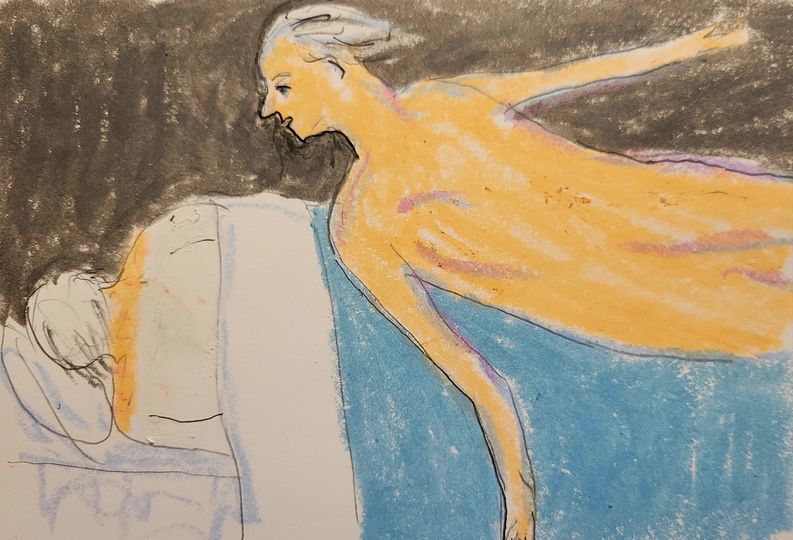
Man Who Fell to Earth syndrome


There are mornings when I look at a tee-shirt as if I’ve never seen one before, uncertain whether to put my head or an arm through first, and I find it hard to match the buttons on my shirt to the right button holes. I don't remember which way the medicine cabinet in the bathroom opens, or which side the light switch is on, and I can’t find the question mark on the keyboard.

These may, of course, be signs of senility. I think they are symptoms of what I call The Man Who Fell to Earth syndrome. You come back to the body suddenly from the other world you were visiting in a dream, maybe because someone or something pulled you back - a car backfiring in the street, a cat jumping on your belly to demand breakfast, a drunk howling at the moon. You may land with a thud. Sometimes I feel I have fallen through the bedframe and the mattress to the floor.

When you come back to the body like that, you may find you have left part of yourself still out there, needing time to catch up - and maybe not too keen on returning to a world that is crazier than your dreams. How big a part? Many indigenous and ancient peoples, from the Iroquois to the Vikings, might say you have left behind one of your souls. I'm pretty sure the soul loss, this time, is temporary. I will let it pass, like jet lag. Already I can report that I figured out how to put on a tee-shirt and find the question mark on my keyboard. I'm working on the buttons.


"Man Who Fell to Earrh" Journal drawing (c) Robert Moss

Friday, December 27, 2024

Don’t let me sleep too long


Don’t let me sleep too long.
If I leave my bed for more than a few hours
I come back jet-lagged
and sometimes with bruises and bite marks
I didn’t get in the world where I left my body.

When the body sleeps the soul travels
and it does not go naked.
It makes its excursions in a subtle form
whose adventures and misadventures
can leave astral stigmata.

In a cold land near the Northern Lights
woman preparing corpses for the funeral pyre
place moss on their tongues and caw like ravens
to scare away hungry ghosts
that gobble spirit bodies like chitlins.

If you are drinking pour a little for the thirsty dead
because the subtle body is also a body of desire.
Out there, you’ll learn that to go beyond the Moon
you must leave your astral body behind. Make sure
you put it in a locker where thieves can’t take it.

It’s late and my double is eager to go wandering.
It could come out through my toes
or through my groin, or my core.
It could fly from my mouth or rise from the fontanel -
the right way, says the yogi, to go out at death. 

Leaving my body tonight, I don’t plan
more than a temporary death.
I might go to the mermaid cove
or the island of apples or a tower in the clouds
but I’ll be back unless you let me sleep too long.


- Robert Moss


Drawing: "Autoscopy" by Robert Moss


Thursday, September 5, 2024

In Praise of Astral Travel over Astral Projection


A wise practitioner of natural magic I knew long ago made a distinction between astral travel and astral projection and recommended the first over the second. "You can be anywhere you think you are, in the mind, without needing to separate from the body".

I appreciate the simple wisdom here, following my remarkable experiences overnight. Awake around 3 am, I lay on my back and let my awareness wander in the fertile liminal space of hypnagogia. My impressions became strongly sensory, above all visual. As I moved beyond familiar locales, space seemed to open up immensely. Without specific intention, I found myself following a winding road lined with scrub and then with modest Asian market stalls. Movement was effortless, with a rocking motion that made me feel I was in a rickshaw.

I came to a magic market and the first of a series of deeply moving encounters with departed friends and relatives, rich in new information. They showed me their current residences and activities. 

I was treated to an etheric healing session by a beautiful and severe therapist I met for the first but perhaps not the last time. I was introduced to a new counselor, whose rigorous questioning led me to define a new project with clarity and forward-moving energy that was lacking until now.

I am quite sure that these were transpersonal encounters.

Through all of this, I was fully aware of my body in the bed, able to hear my cats and the city sounds outside the building without being distracted from my astral adventures. In other words, I was fully lucid in two worlds. You can travel beyond the body without leaving the body unattended and transitions don’t have to involve bumps and grinds and rolling about.  Like my friend the mage, I recommend bilocation over pursuing out of-body experiences for their own sake.

I also recommend journaling your adventures in astral travel as soon as your full attention has returned to the body. I often do this by tapping out an email to myself on my phone. I enjoy the thought that I am sending myself a message from the dreamworld. This morning, however, I wanted to record the most important statement in my travel report by hand, with a fountain pen. There is magic in hand writing, as those who work with old grimoires understand. 

However you write your report, another key rule for me is: do it before coffee. Yes, I know this is cruel, but it is part of the price for becoming a real dream magician. 


Tuesday, July 16, 2024

Vardøger: Tracking the Double Who Goes Ahead of You


I am glad to have tracked down a published source for the name of a special kind of doppelganger I have encountered a few times: a double who goes ahead of you, arriving early at a place where you will appear later - and is perceived by others. I had been told that the name in Norwegian is vardøger, but that is hard to find in any dictionary, even of the Norwegian language. [1]

In an old book about the paranormal I found a detailed account of an "apparition of the living" who showed up in Oslo a few months before its host traveled there for the first time. He was an importer with an unusual name - Gorique - and to his amazement he was welcomed by the hotel clerk as a familiar guest, and told he had stayed at the hotel months before. He was welcomed again by the wholesaler he had come to visit. who told him he had come to that office months before, though their business had not been concluded.

When he explained to his business associate that he had never been to Oslo before, the Norwegian told him that “the experience of having a vardøger or 'forerunner' as they call an apparition of this sort in Norway, was not too rare as psychic phenomena go, and that heshould not let the whole thing disturb him unduly.” [2]
The mammoth early publication of the Society for Psychical Research, Apparitions of the Living, contains several reports that appear to be examples of this phenomenon, but a specific term for them is not provoded. F.W.H. Myers, one of the coauthors of that foundational work, attributed phenomena of this kind to the effects of psychorrhagy, one of many terms he invented that has not (unlike "telepathy", or "subliminal", also his coinage) made it into our household or even professional vocabulary. He described p
sychorrhagy as the  bursting through of psychic phenomena. The word literally means a bursting or breaking loose of the psyche, as a hemorrhage is a bursting of blood. In his fuller definition psychorrhagy is “a special idiosyncrasy which tends to make the phantasm of a person easily perceptible; the breaking loose of a psychical element, definable mainly by its power of producing a phantasm, perceptible by one or more persons, in some portion of space.” [3] This might be caused by strong emotion, such as grief or fear. It may also happen under calmer circumstances, as in the case of David Leiter and some of my own experiences. 

I was delighted to find an article by Leiter, a Pennsylvania mechanical engineer in the Journal of Scientific Exploration where he describes two episodes in which his "early arriving" self was seen clearly by family members and office colleagues. In the first incident, he took the highway home on a pleasant sunny afternoon and felt completely relaxed at the wheel, almost on autopilot. When he got home, his wife was surprised. Why had he gone out again? She explained that he had come in ten minutes before. Unusually for him he had skipped his usual greeting and kiss on the cheek and gone straight upstairs. She called their son to confirm her story. Worried that there might be an intruder in the house, they checked upstairs and found no one. In the second incident, a colleague was amazed to see him in the  parking lot in a dark pinstripe suit, not usual attire for that office, on a day when he had announced he would skip work to attend a memorial service - where he was wearing the dark pinstripe suit,

Leiter speculates that these projections were the effect of (1) thinking intensely about people and places at a distance while (2) lapsing into a light state of "road trance" while driving along open roads. The Australian editor of the Journal at the time added a couple of likely vardøger sightings from his own experience. [4]

The last time I encountered a vardøger, it was the double of a woman of Norwegian descent who arrived at an airport ten minutes before her physical self. The doppelganger was so real that someone in our welcoming party went running after her. On a previous occasion, reported here, I was startled to encounter a friend of Norwegian descent in my bedroom the night before he was due to arrive as a guest. I told his double firmly that he had come a day too soon. Something about those Norwegians?


My last question received a response after I posted this blog. A Norwegian friend recalled that when he was five or six he often heard the noise of a car door closing and someone approaching the house fifteen minutes or so before his father came home. His mother had similar impressions. They both found confirmation that such things were possible in the television appearances of an "elegant professor" who talked very reasonably about paranormal phenomena. Because of "this wise, humorous and charismatic old man, we could have such experiences and recognize what is was and at the same time have some kind of explanation." His name was Georg Hygen.
I find that Professor Hygen was both a respected botanist, a leading figure in the Norwegian Parapsychological Society, and the author of a book on the vardøger published in 1987. [5] His Norwegian pride is showing when he declares in his subtitle that the vardøger is "our national paranormal phenomenon" (vårt paranormale nasjonalsfenomen).

1.
The vardøger is a specific form of the double, which takes many forms and has sevefral names in Old Norse literature. "Harbinger", "forerunner", and psychic predecessor" have been suggested as kennings of vardøger. "Advance guard" or "spirit guard" might be closer to the Old Norse roots. The derivation is from Old Norse varðhygi which combines two names for aspects of our composite nature: (1) a protector, a "guard" or watchman" (vǫrð) and (2) a mobile, separable aspect of "mind" or spirit (hugr).

2. F.S. Edsall, The World of Psychic Phenomena. New York: David McKay, 1982, p.13.
3. F.W.H. Myers, Human Personality and Its Survival of Bodily Death (London: Longmans, Green, 1903) vol.1, xx.
4. David  Leiter, L.,“The Vardøgr, Perhaps Another Indicator of the Non-Locality of Consciousness” Journal of Scientific Exploration, Vol. 16, No. 4 (2002) 621–634.
5. Georg 
Hygen. Vardøger: Vårt paranormale nasjonalsfenomen. Oslo: Cappelen, 1987.


Drawing: "Vardøgr at the Airport" by Robert Moss

Friday, April 12, 2024

Dream Bruises and Other Bleedthroughs


What if in your dream you went to heaven and there plucked a strange and beautiful flower and what if when you awoke you had that flower in your hand?


Coleridge's famous question is not a hypothetical to active and conscious dreamers, who notice various types of bleedthrough between different dimensions of reality and experience.
    A nurse who took part in one of my early dream classes later told me she had dreamed of a visitation from a being that was half woman, half deer. Waking in her second floor apartment, she found deer scat on her floor. Trying to make sense of this (nurses are no-nonsense, practical people) she recognized that a deer might have wandered onto the grounds of her apartment complex. But she was quite certain there was no way it could have gotten up her stairs or through her window! She was content to accept the unlikely deer poop as a sign from the deeper universe that her visitation had been absolutely for real. She later found the deer-woman turning up as a guide when she was caring for patients, especially the dying who needed help to prepare for their journeys beyond this world.
    In his account of his personal dreams in The Crystal and the Way of Light, Dzogchen master Nakhai Norbu gives a memoriable example of something being transferred from a dream into the hand of the dramer. 
One of his uncles was renowned as a tertön, a "treasure revealer" of hidden texts that sometimes appeared as tiny scrolls in unusual places, apparently transmitted across generations by ancient masters. While staying with his uncle in a remote area, Namkhai Nprbu dreamed he was visited by a dakini.
     She gave him a small scroll of paper containing a sacred text. She said this was very important and that on waking he should give it to his uncle. In the dream he knew he was dreaming. He gripped the scroll tightly in one fist and wrapped the other around it. It was not permitted to disturb his uncle until after his morning rituals, so he drifted off still with his fists clamped together. Waking at dawn, he opened his hand and found there really was tiny scroll within it. He was too excited to wait. He woke up his uncle and presented the scroll. His uncle took it and said “Thank you, I expecting this” as if nothing had happened.  
     On a land of marvels and siddhis, a report of this kind would have drawn respect and keen interest rather than incredulity.  
     One of the most common bleedthroughs from the realm of dream or astral experience into the world of the body is astral repercussion, to use a term favored by Dion Fortune and her peers. This is what happens when what is experienced in the astral body during its excursions outside the physical body leave physical marks when it returns.
    While Fortune described cases where this kind of thing can be seriously depleting, even life-threatening, to the experiencer, astral repercussion may be a routine side effect of getting out and about in a subtle energy body, sometimes wholly benign and even entertaining. In the first letter from Lady Valerie D'Arcy in my novel Fire Along the Sky, she protests that an amorous visit from her lover in the form of a leopard-man left her with bite marks on her body; this fictional scene was drawn from experience!
    Let me give an example from my dream life a few summers ago. I was enjoying a rather lazy week's vacation on a lake, swimming and reading a lot, spending a lot more time in bed overnight than is my typical pattern. My body's peace and ease over those summer days was balanced by the nocturnal adventures of my dream self. In a dream thriller that could easily be filmed in the style of The Bourne Identity, I went on a wild ride through the Bois de Boulogne in Paris. We have to dodge road-blocks and predatory packs that are out to stop cars and rob their drivers and passengers, or worse. The predators use all sorts of stratagems to get drivers to stop, sometimes pushing children in front of the cars. When they do that to us, I grab control of the steering wheel from my driver, managing to avoid hitting a child being used as bait, so we escape the trap. I hurt my arm making this maneuver, but pay little attention because soon I am caught up in a big-stakes international intrigue.
    I wake happy and excited. I felt like I had stepped into a movie to play an Action Man hero, and this was really enjoyable. But - uh, oh - how did that bruise come to appear on the underside of my left upper arm? There really was no physical cause I could locate. On the other hand, there was all that action in the dream, and the pain I experienced during the car chase. Someone had jabbed something at me through the window of the car, in that mad ride through the Bois de Boulogne.
   Inter-dimensional bleedthroughs bring us awake to the fact that we are engaged in more than one order of reality, and that what happens beyond our default (physical) reality may not only be no less real, but sometimes more so. If the dream gave me the bruise, then which was more real: my night escapade in Paris, or my lazy day by a lake in Vermont?
    We are also drawn to reflect on our lager anatomy. We have more than one vehicle of consciousness. Beyond the physical body, we have an etheric, or dense energy, vehicle, and an astral body in which we travel in dreams, and higher vehicles given different names in different tarditiosn. When we go dreaming, we often travel beyind the physical body and we rarely go as a disembodied thought form. We travel in the astral body, sometmes carrying a significant amount of denser etheric energy. Take too much with you, and you return depleted - and you are vulnerable to  significant etheric reopercussion on your physical body.
      In modern Western society, we are not told much about the subtle body, but understanding its reality and its requitrements is essential to or psychic wellbeing and to safe and rewarding adventures beyond the physical. 


Drawing: "Autoscopy" by Robert Moss

Saturday, January 6, 2024

Dreaming Is a Contact Sport


Many of my dreams are workaday in the sense that I am doing quotidian things: reading. writing and editing, giving lectures and workshops. Just now, in a sleep dream, that became lucid, I was selecting and posting excerpts from Chinese texts that described social interaction by dreamers traveling in their astral bodies, with distinctive terminology. I pictured bustling scenes of many soul travelers coming and going, meeting and parting in astral realities.


My first action, on getting out of bed, was to reopen relevant books from the current piles on my desk, At the top of the heap, Dreaming and Self-Cultivation in China 300 BCE-800 CE by Robert Campany, a professor of Asian and Religious Studies at Vanderbilt. The book fell open at a page I had marked up heavily in pencil in a previous reading. The passage was on my oneiric theme: how people meet up and
make trouble in dreams.

"To dream is to contact or be contacted...This notion, often implicit, occasionally emerges into clear view, as in a passage in the Qiwu lun chapter of the Zhuangzi (ca. 300-150 bce):

"While it [the heart-mind, xin 心] sleeps, the cloudsouls contact [things]
When it wakes, the bodily form opens up [to sensory contact]
Whatever we come in contact with entangles it
Each day we use that heart-mind of ours for strife.

"The view of dreaming implied here is that dreaming occurs when one of our multiple souls - cloudsouls (hun 魂 ) whitesouls (po 魄 ) or simply the dreamer's spirit (shen 神 ) - wanders outside the body during sleep. But it is specifically the souls' contacts with other beings that constitute dreaming and therein lies the risk."

Campany notes that jiao, one of the verbs used for oneiric contact, means more: it implies touching with the senses of the dreambody; it may suggest "intertwine" or "intercourse". There is a note of caution here: watch who you are with when your body is sleeping. Those multiple souls get around. In the Later Han period, Daoist sages fixed the number of hun souls at three and the number of po souls at seven. We are many, and we can be in two or more places at once.

Thursday, November 23, 2023

The Daoist Art of Perfected Sleep


Daoist Master Chen Tuan (871-989) was a celebrated sage who lived a secluded life in mountain caves in China, where he created kung fu and a profound practice of conscious dream travel.  He was an ardent student of I Ching. He reputedly wandered the country in disguise, and sometimes provided warnings of impending events such as the flooding of the Yellow River. He was said to travel beyond his body for months at a time. A young monk who found him awake on Huashan, his western mountain sacred to the Goddess, received the following instruction:


I practice the sleep of the perfected
Store up the breath of gold and drink the juice of jade
I lock the golden gate within, so it cannot be opened,
I close the door of earth within, so it cannot be broken.

The green dragon guards the Eastern Palace,
Perfected energy circles in my Pond of Cinnabar
The white tiger stands before the Western Hall.
And spirit water revolves around my five inner orbs.

I call the gods of Jia and Ding to adjust the time;
I summon all the hundred spirits to guard the inner chamber.

Then my spirit
leaves to ascend to the Nine Palaces above
Frolics in the sky's azureness
With it, I step on emptiness as if on solid ground,
Rise up as easy as if falling down.

I inhale the flowery essence of the sun and moon
I sport in the wondrous landscape of vapors and of haze
I visit the perfected and discuss the principles beyond
I join immortals and we go off to visit strange worlds.

Delighted I wish to return
My feet step on clear wind
My body floats on rays of light -
This is perfected sleep!

Master Chen has taken elaborate precautions to ward his body while his spirit travels, but his practice did not always involve special postures. In this account, "he slept while lying flat on his back." He did not appear to be breathing, but his face was rosy and healthy-looking.

However, he was famous for arranging his body in the Sleeping Tiger position.* There is a cave at the Jade Clear Spring Monastery where he lived his later years, with a statue of him in this classical pose, lying on his right side, right hand supporting the head.

 Chen Tuan also said this:

Superior beings do not dream
They sport with the immortals.
The perfected never sleep
They float up through the clouds.

With our attenuated understanding of what dreaming can be, we must not misunderstand this. Master Chen makes it clear that "great dreams" are the heart of the practice:

Great dreams have great awakening
Small dreams have only small.
Sleep the sleep of all that is perfection
Dream the dreams of wide eternity.

* Sleeping Tiger  You lie on your right side. Your left arm is extended along your left leg. Your right hand may be cupped over your right ear, or tucked under the pillow. The right knee is bent; the left leg is loosely extended. This posture shifts breathing to the left nostril and this is believed to activate right brain activity, facilitating strong visual and intuitive experiences and smoothing the way to states of brainwave activity associated with dreaming or meditation.

This posture is not unique to Daoists; it has been widely adopted and recommended in many dreaming traditions, sometimes as an ideal posture for entering death. The Buddha, at the moment of death, is always depicted in Asian art as lying in the posture of the sleeping tiger.


Source: Biography of Chen Tuan in Lishi zhenshuan tidao tongjiang ("Comprehensive Mirror Through the Ages of of Perfected Immortals and Those Who Embody the Dao") compiled around 1300. translation in Livia Kohn (ed) The Taoist Experience: An Anthology (Albany: State University of New York Press, 1993) pp. 272-6.

Sunday, September 24, 2023

Dream readers and Raven shamans


I always scratch my head when I see dream researchers reporting that reading is a rare activity in dreams, or that if you start to read in a dream the text will blur and you won't be able to bring anything away. Perhaps these conclusions are based on the fact that the typical survey group is college kids, who may be less enthusiastic about reading than other sections of the population. Anyway, for as long as I can recall I have read at least as much in dreams as in ordinary reality and this have given me extraordinary leads for my own research, mystery words that prove to be keys to previously unsuspected cultural treasuries, and paragraphs - sometimes pages - of fresh material for my books.

Opening an old journal at random, as I often do., I found an entry from 1996 that put me on the trail of an ancient Hellenic shaman who was reputed to be able to take flight from his own mouth in the form of a raven. Here is my journal entry, edited only for length:

January 28, 1996

Dream Archaeology: Keys from Mantis

I am greatly excited because I have discovered several relief carvings from Mantis, an Egyptian site. Their images were separated in an exhibition or catalog. When brought together, they hold the key to an ancient mystery. Some are fragmentary.
    I go through dictionaries and reference books, working out the connections. I look up meanings for the words Diva (or Deva), Divina and Drostic (“to do with defense of lost causes”). One of the reference books contains verses and a heroic genealogy derived from the Arimaspea.

Waking, I recognize the last reference. The Arimaspea is a lost epic poem attributed to Aristeas of Proconnesus. It describes a people of the north, the Arimaspi, who live in mountains that may be the Carpathians and battled with griffins for access to gold. We know the work through fragments preserved by Herodotus, who says that Aristeas journeyed to fierce northern peoples, “possessed by Apollo”.

 Aristeas was a Greek shaman, living on an island near modern Istanbul, who projected a second body from his mouth in the form of a raven, and was credited with the power of bilocation. I own a book about him by an English classical scholar.

Aristeas was said to have dropped down dead in a fuller’s shop in Proconnesus, on the Sea of Marmara. At the same time, he was seen alive and well at Cyzicus, four hours away by boat, on the mainland. When the news reaches his town, his body – already prepared for burial – is found to have disappeared. 

 In book IV of  the Histories, Herodotus reported of "the birthplace of Aristeas, the poet who sung of these things", 


I will now relate a tale which I heard concerning him both at Proconnesus and at Cyzicus. Aristeas, they said, who belonged to one of the noblest families in the island, had entered one day into a fuller's shop, when he suddenly dropped down dead. Hereupon the fuller shut up his shop, and went to tell Aristeas' kindred what had happened. The report of the death had just spread through the town, when a certain Cyzicenian, lately arrived from Artaca, contradicted the rumor, affirming that he had met Aristeas on his road to Cyzicus, and had spoken with him. This man, therefore, strenuously denied the rumor; the relations, however, proceeded to the fuller's shop with all things necessary for the funeral, intending to carry the body away. But on the shop being opened, no Aristeas was found, either dead or alive. Seven years afterwards he reappeared, they told me, in Proconnesus, and wrote the poem called by the Greeks The Arimaspeia, after which he disappeared a second time. This is the tale current in the two cities above-mentioned. [trans. George Rawlinson]


Two centuries after his death, Aristeas appeared in Metapontum in southern Italy. He commanded that a statue of himself be set up and a new altar dedicated to Apollo, declaring that since his death he had been travelling with Apollo in the form of a sacred raven.

Other details from the dream remain obscure or mysterious. Mantis is a familiar word. In Greek, a mantis is "one who divines, a seer, prophet,"(from mainesthai "be inspired," related to menos "passion, spirit"). But does this correspond to a site in Egypt? Seventeen years after I journaled my report, I have not found confirmation of the meaning of "drostic" (not drastic) that was given in the dream. 


Illustration: "From the Mouth of Aristeas" by Robert Moss


Monday, August 7, 2023

Open Secrets of the Dreamtime


Here are the open secrets of the Dreamtime, insights shared by many dreaming traditions and indigenous peoples that challenge the ruling paradigms of a culture that confuses the real with the physical


1. Dreams are real experiences.

There are big dreams and little dreams. “Bottom-line it for me,” bulled a radio host over the phone from North Dakota. “Aren’t dreamed caused by spicy pizza?” Well, yes, some dreams are. But we will not expend much space here on the surface bubbles of the dozing brain and belly.

In big dreams — in what Sri Aurobindo called “the sleep of experiences” — we are dealing with events, encounters, and challenges that are entirely real on their own level of reality. Our dream memories may be garbled or muddy, but the dream is a real experience whose meaning lies within the dreamscape itself. The dream experience, fully remembered, is its own interpretation. But we must do more than interpret dreams; we must manifest their energy and insight in our waking lives.

Shamanic dreamers tend to be quite literal-minded about dreams. If you dreamed you fell off a rock-face, you’d better remember to check your safety harness if there is any chance you might go rock climbing. If you flew with the eagle, you discovered a powerful spiritual ally — and your own ability to transcend the limitations of your physical body. If you dreamed of your dead uncle, before you start asking yourself what part of you he might represent, you should consider the possibility that you had a visit with him. Is he bothering you — maybe trying to cadge a drink or a smoke — or offering you help? If you dreamed you received instruction at a mountain shrine, you should be open to twin possibilities: that you may go there someday, in physical reality; and that you may have been called in your dreams to one of the many “invisible schools” where training and initiation on the higher planes are conducted.


2. Dreams are flights of the soul.

During one of the final presentations at a hectic conference in Berkeley, I regretted that I had not taken that Saturday morning off to explore the Bay area. I closed my eyes, slipped free from my physical focus, and felt myself gliding over the Bay on the wings of an eagle. It was a wholly tactile sensation. I was drawn to a wild, lightly wooded area with intriguing stone formations that looked from the air like volcanic rock. As I dipped into a fold in the hills to examine the area more closely, I saw another interesting formation, shaped by human hands: a circular labyrinth, or spiral, at the edge of a pond.

At lunch, I casually described the scene I had explored. “It could be the Sibley Volcanic Preserve,” one of the local conferees piped up. “I can take you out there this afternoon if you have time.” She did not know about the spiral path, but we found it fairly easily, at the edge of a swampy pond.

From a shamanic perspective, there was nothing extraordinary about my experience. It was just a routine scout — a Middle World journey — in which I moved beyond the range of my physical senses to check out my environment. I was traveling beyond my body, but I kept a firm connection with it, maintaining awareness of the activity in the lecture room even as I flew across the Bay.

Shamans say that in real dreams (waking or sleeping) one of two things is happening. Either you are journeying beyond your body, released from the limits of space-time and the physical senses; or you receive a visitation from a being — god, spirit, or fellow dreamer — who does not suffer from these limitations. In the language of the Makiritare, a dreaming people of Venezuela, the word for dream, adekato, means literally a “flight of the soul.”

The open secret is that consciousness if never confined to the body and brain. We discover this in spontaneous night dreams and intuitive flashes, when our left-brain inhibitions are down. As we become active dreamers, we can hone the ability to make intentional journeys beyond the body at any time of day or night.


3. You have a dreambody as well as a physical body.

I am leading one of my Active Dreaming circles. We are squatting around a centerspread with a white candle. Someone asks whether there is any way to prove that we are not dreaming. I pick up the candle and pour hot wax onto my hand. I feel a sting of pain as the wax sears the web of skin between my thumb and forefinger, and I tell the group, “I guess that proves I’m not dreaming.” Then I wake up.

What is this dream telling me? That I am a nitwit because I can’t tell whether I’m dreaming? If so, I will take solace from the fact that in most sleep dreams, most people are completely unaware that they are dreaming. Actually, I think this dream has a more interesting and specific message, related to the theme that dreams are real experiences. In my dreambody, I can know pleasure and pain just as vividly as in my physical body. I have more than one body, or vehicle of consciousness, and when I go into the dreamworld and other worlds, I go embodied. And so do you.

As we will soon discover, the importance of this statement — in relation to our ability to operate in nonordinary reality and to access spiritual sources of insight and healing — can hardly be overstated.


4. Dreams may be memories of the future.

I dreamed of a silly little dog decked out with fake antlers for some kind of Christmas pageant. The dog ran out on the road and was killed, but was magically revived by a dubious, utterly amoral character who seemed remote from the normal range of human emotions.

The dream had a movielike quality. I had no idea what was going on here, but because I had no particular feelings about it, I was content to record it in my journal before rushing off to the airport to catch a plane to Denver.

I missed my connection and later found myself on a different flight form the one schedules. Whenever my travel planes come unstuck, I am alert for the play of the Trickster. On the “wrong” plane, I found myself seated next to a woman who turned out to be best friends with a person in publishing to whom I had been introduced only the day before, and I was able to glean some useful insights. Our conversation was interrupted by the screening of the in-flight movie. I looked up to see a silly little dog decked out in fake antlers for a Christmas pageant. Later in the movie, the dog is killed on the road and magically revived — by a low-flying angel portrayed by John Travolta. The title of the movie is Michael, and I highly recommend it. What interested me most was that I seemed to have attended an advance screening in my dream the night before.

We dream things before they happen in waking life. If you work with your dreams and scan them for precognitive content, you can develop a superb personal radar system that will help you to navigate in waking life. You can also learn to fold time and travel into the possible future by the methods explained in this book. For even the most active dreamers, however, the meaning of many dreams of the future may be veiled until waking events catch up with the dream.

I dreamed of a garden in Manhattan, modest in size, but beautifully designed. A place for quiet meditation, a refuge from big-city noise and hustle. A place where I felt I could do good work with good people. I was intrigues by this dream, which came to me at a time when I was quite resistant to leading programs in New York City because of the energy required to clear out all the static and psychic clutter and create a safe space for soulwork. The dream left me feeling bright and happy. I was curious about the location of my dream garden. Did it exist in ordinary reality? When I reentered the dream, I found myself on a block in the East Fifties, between Third and Second. This satisfied me that I had visited a locale that existed in physical reality. Lacking an exact address, I forgot about the dream after logging it in my journal. 

Yet the dream continued to exercise an influence: to my mild surprise, I said yes when several groups subsequently invited me to conduct workshops in New York. Nine months after the dream — the period of an average pregnancy — I entered the meeting room of the New York Theosophical Society, on East Fifty-third Street, for the first time. I stopped short. Through the picture window at the end of the room, I looked out into the garden from my dream. As I stepped out into the garden, an austerely elegant man in a black tunic followed me out. He introduced himself as the society’s program director, who had invited me. He explained that he had also designed and now tended my dream garden.

If dreams are memories of the future, is much of waking like the experiencing in the physical body what we have already lived in the dreambody? What would we become if we participated more consciously in this process? There is an Iroquois story of a great hunter who always scouted ahead, in conscious dream journeys, to locate the game and rehearse the kill. In one of his dream scouts, he located an elk and sought its permission to take its life to feed his extended family. He killed the elk in his dream and noted the red mark on its chest where the arrow had gone in. The following day, he walked to the place he had visited in dreaming and identified his elk by the red mark on its chest. He then replayed an event that had already taken place, by killing the elk again with a physical arrow.


5. Dreaming, we choose events that will manifest in our waking lives.

The fact that we dream things before they happen does not mean everything is predetermined. People who are not active dreamers can get quite confused about what is going on when they wake up to the fact that we are dreaming future events, both large and small, all the time. I think it’s like this. If you do not remember your dreams, you are condemned to live them. (If you don’t know where you’re going, you will likely end up where you are headed.) If you remember some of your dreams and screen them for messages about the future, you will find yourself able to make wiser choices. You will discover that by taking appropriate action you can often avoid the enactment of a “bad” dream or bring about the fulfillment of a happy one. As you become a conscious dreamer, you will find yourself increasingly able to choose inside the dreaming the events that will be manifested in your waking life.

It’s not about predestination. It’s about the spiritual secrets of manifestation — and your ability to become cocreator of your life.

Meister Eckhart tells us how it is the razor-sharp clarity of the practical mystic who has seen and experienced for himself: “When the soul wishes to experience something, she throws an image of the experience out before her and enters her own image.”

Indigenous peoples tell a recurring story of how the material world is spun from the dream of a deity. For the Guajiro of Ecuador, the physical universe is the product of conscious dreaming. The Guajiro say that the Creator-god made this world after the divine Dreamgiver, Apusanai, made him aware that he was dreaming and he began to experiment with molding and solidifying the fluid forms he perceived endlessly aborning and transforming on another plane of reality.<6>

It is not merely that we dream things (maybe everything) before they happen; dreams make them happen.


6. The path of the soul after death is the path of the soul in dreams.

Your dreambody does not die when your physical body loses it vital signs. You will live on in your dreambody for a shorter or greater time, according to your ruling passions and personal evolution. You will find yourself, as you do each night in dreams, in a realm where thoughts are things, and imagination, the great faculty of soul, can create whole worlds.

You come from the Dreaming, and you are released into the Dreaming when you drop your sack of meat and bones.

Conscious dreaming is excellent preparation, not only for the challenges that lie before you on the roads in this life, but for the challenges of the journey you will make after physical death. How do you know for sure? By doing it.


Text adapted from Dreamgates: Exploring the Worlds of Soul, Imagination and Life Beyond Death by Robert Moss. Published by New World Library. 


Illustration: "Green Flight" by Robert Moss

Friday, January 13, 2023

Astral projection and bilocation in the early Renaissance church


In the mid-15th century, the monks of San Francesco, in Borgo San Sepolcro in Tuscany, allotted 510 ducats - a fantastic sum at that time - for a double-sided altarpiece. The lead artist was Stefano de Giovanni, known as "Sassetta", already recognized as the master of the Siena school. The altarpiece was constructed over the grave of of the Blessed Ranieri Rasini, and a series of panels on the predella depicted scenes from his life.
    The Blessed Ranieri (just short of sainthood) was a Franciscan friar who died in Umbria in 1304. His reputation clearly long survived his death. He was revered locally as a miracle maker with the ability to project an energy double that could work wonders while his body was engaged somewhere else. Thus he ranks as an all-but-patron-saint of dream travel and astral projection.
    Anyone interested in the history of dream travel would do well to look very closely at two surviving paintings of the Blessed Ranieri, by the great Sassetta. The one above is titled "The Blessed Ranieri Freeing the Poor from Jail", and it is in the Louvre. It shows Ranieri whizzing around like a rocket man.


The second painting shows Ranieri appearing to a cardinal in a dream; this panel is now in the Staatliche Museen in Berlin. It depicts Ranieri floating in mid-air above the sleeping body of a well-fed cardinal, pointing to a flask containing a healing balm.
     It was a good thing for those who saw the Blessed Ranieri (d. 1304) flying about in this way that they were living in a Catholic country where bilocation and astral projection were welcomed, at least when practiced by the religiously correct. In the Puritan theocracy of colonial Massachusetts, a couple of centuries later, a snitch who claimed to have seen you flying around in your dream body could get you hauled into a Salem witch trial.


I'll be interested in further information on the flying holy man in Sassetta's paintings. His aerial visit to the rotund cardinal is mentioned in Sassetta: The Borgo San Sepolcro Altarpiece, edited by Machtelt Israels, but it seems that the identity of the cardinal is a matter for speculation.
    A pleasant legend survives in a later account (1622) by a printer named Giovanni Antonio Castiglione, according to which the monks had emissaries sent to a certain cardinal to request balm to preserve the Blessed Ranieri's body after he died "in the odor of sanctity." The flying Ranieri got to the cardinal first, offering a deal: balm for his body in return for healing for the cardinal. So, in the painting, he has gone in ahead of the emissaries waiting outside the cardinal's bedchamber. Ranieri was the subject of a religious play that was popular in Tuscany.


Art:

"The Blessed Ranieri Frees the Poor from a Prison in Florence" (c.1440) by Sassetta, in the Musée du Louvre, Paris

"The Blessed Ranieri of Borgo San Sepolcro Appearing to a Cardinal in a Dream" (1444) in the Staatliche Museen, Berlin.


Friday, December 30, 2022

Fred and the Phantasms


“The question for man most momentous of all is whether or not he has an immortal soul; or . . . whether or not his personality involves any element which can survive bodily death.” Frederic W.H. Myers, the great Victorian psychic researcher and classical scholar, made this magnificent statement 120 years ago, on the first page of his major opus Human Personality and Its Survival of Bodily Death, published posthumously in 1903. He made it his life cause to gather evidence of the existence of a spiritual world from which soul comes into the body and to which it returns. He followed a rigorously empirical approach, declaring that “if a spiritual world exists, and if that world has at any epoch been manifest or even discoverable, then it ought to be manifest or discoverable now”. [1]

He saw "supernormal" faculties  - one of many terms he invented - as evidence that spirit operates beyond the body and therefore survives it. Telepathy and telaesthesia (clairvoyance) are “survivals from the powers which that spirit once exercised in a transcendental world” [2] ). “So soon as man is steadily conceived as dwelling in this wider range of powers, his survival of death becomes an almost inevitable corollary” [3] 

He thought that "psychical excursions" in which an aspect of the self travels beyond the body and may be perceived by others are primary evidence that consciousness is not confined to a physical vehicle and will therefore survive death. To refer to what we might call an OBE or astral projection,  Myers coined the scary term “psychorrhagy,” and referred to a propensity for this experience as a “psychorrhagic diathesis” [4] . At the high end this might be an ecstasy giving access to a spiritual world and to “communities higher than any which this planet knows” [5]

Myers described “self-projections” as “the one definitive act which it seems as though a man might perform equally well before and after bodily death” [6] 

The first major public work by Myers, with Edmund Gurney and Frank Podmore, was titles Phantasms of the Living. Based on thousands of cases collected and analyzed by the  Society for Psychical Research, this huge book was devoted to "apparitions of persons still living", received through any or all of the senses. Myers declares in his introduction that "we have no wish either to mystify or startle mankind". Yet the sheer volume of first-hand testimony of encounters with "ghosts of the living" would startle many audiences..

Myers says the authors are not aiming at any “paradoxical reversion of established scientific conclusions” but rather “working in the main track of discovery” and “assailing a problem which, though strange and hard does yet stand next in order among the new adventures on which science must needs set forth” [7]  Trying to walk a middle path between the Spiritualists and the evolutionists, Myers continues, “We held it incumbent upon us… to conduct our inquiries in the ‘dry light' of a dispassionate search for truth” [8]  

Some of my favorite cases involve experiences in the hypnagogic zone, between sleep and awake, sometimes when a visitor steps from a dream into the dreamer's physical space. Thus a minister from Bradford, the Rev. E.H.Sugden, reports a vivid dream of a person he knows well. Waking suddenly, he finds the man in his room. "I saw him in the light of early morning, standing by my bedside in the very attitude of the dream." The minister gives him a good kick and he vanishes. [9]

Myers' published oeuvre spanned a wide spectrum. He published poetry and essays on classical literature and a fascinating short autobiography that was unfortunately bowdlerized before publication by his widow. [10] Then there is all he has to tell us from the other side of death, especially the scripts recorded via two remarkable women mediums, Winifred Coombe- Tennant ("Mrs. Willett") and Geraldine Cummins. In his communications with Winifred, Myers gives the impression of a well-organized Club of psychic researchers working indefatigably to deliver evidence of the survival of physical death - from the other side of death. [11] Via Geraldine, Myers authored books describing several stages of the soul' s transitions beyond the physical plane, a comprehensive Western Bardo.  


I feel tremendous affinity for "Fred" Myers across time, and gratitude for his work, which continued after death. While I was rereading 
Phantasms of the Living I made a comment about it to a friend who exclaimed,  "Those Victorian ghost hunters really rock". I couldn't resist fooling around with an AI image generator to see what that might look like. 


References

[1] Frederic W.H. Myers, Human Personality and Its Survival of Bodily Death (London: Longmans. Green, 1903) Vol. 1, p.7
[2] ibid, Vol. 2, p. 267
[3] ibid, Vol. 2, p. 274
[4] ibid Vol. 1, p. 264
[5] ibid Vol. 2, p. 194. 
[6] Vol. 1, p. 297). 
[7] Edmund Gurney, Frederic W.H. Myers and Frank Podmore,  Phantasms of the Living (London: Society for Psychical Research/Trübner & Co, 1886) Vol. 1, p.xxxvi
[8] ibid p.xlix
[9] ibid  Vol1, pp.390-1
[10] Frederic W.H. Myers, Fragments of Prose & Poetry edited by Eveleen Myers (London: Longmans, Green, 1904)
[11] Gerald William, Earl of Balfour, "A Study of the Psychological Aspects of Mrs. Willett’s Mediumship, and of the Statement of the Communicators Concerning Process" in Proceedings of the Society for Psychical Research, Vol 43., 1935) 43-317. Geraldine Cummins, Swan on a Black Sea, A Study in Automatic Writing: The Cummins-Willett Scripts (London: Routledge and Kegan Paul, 1965
[12] Geraldine Cummins, The Road to Immortality: Being a description of the afterlife purporting to be communicated by the late F.W.H. Myers (London: Ivor Nicholson and Watson, 1933)

Illustrations 

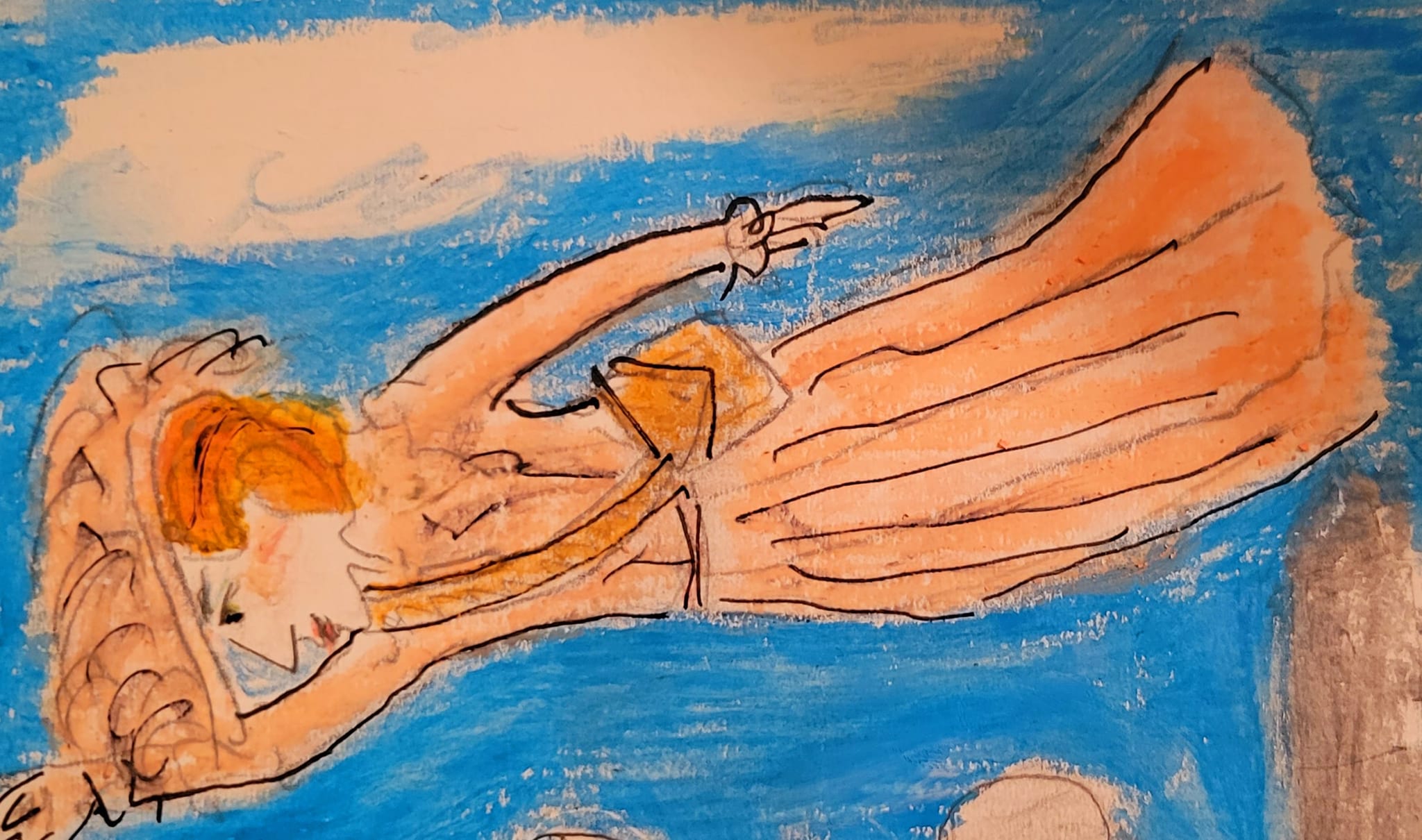
Top: "Psychical Excursion: Edwardian Lady in Astral Flight" Drawing by Robert Moss

Bottom: "Fred and the Phantasms". Digital art by RM


Saturday, December 10, 2022

A Dreamer's Notes: Dream Hotels and Dream Bodies


The Dream Hotel


I find myself in dream hotels several times a week. Sometimes I have trouble finding my room or getting back to the hotel from a walk in a city. Often I am leading a workshop or attending a meeting or dinner, engaging with many people. Sometimes, for reasons I don't yet understand, I am staying in one hotel while renting a room in another. The hotels are typically well-appointed, even luxurious, and I often have a suite.

I am frequently able to identify the location (typically in Europe) but these are not hotels where I have stayed or am likely to stay in the future.

I ask myself: what is a hotel? For me, it is a generally comfortable lodging for a traveler. Dreaming is often traveling and I am usually content to track the excursions of my traveling self in alternate realities while my body is at home. From a larger perspective, in this life we are in temporary lodgings, coming from the soul's home in a previous existence, on our way to the soul's home in the next world. We are passing through. 


Dream Bodies


I am endlessly fascinated by accounts of experiences in the subtle body, a term that came into the English language through the Cambridge Platonists, notably Ralph Cudworth, in the 17th century. Other names for it from the older Neoplatonist tradition include the astral body, the shining body, the imaginal body, the soul vehicle, the soul garment. 

I am generally content to call it the dreambody. I know, through long experience and observation, that when we go dreaming we may leave the physical body quite effortlessly and travel in another vehicle. When I go looking for visual portrayals of travel in the subtle body, I'm not generally impressed. You can easily find pictures of soul leaving the body at the moment of death - Blake's illustration to a poem is one of the best - but not much that convincingly portrays the operations of consciousness in a second body in life. 

Father Arsenio Boca, the Romanian Orthodox mystic, painted a few; I saw them in a monastery in his home country. The illustrations in Hereward Carrington's old book on astral projection show a second body floating above the body on the bed, linked by a silver cord that seems to run from the fontanel.  The Marvel multiverse gave us a thrilling sequence in the first Doctor Strange movie in  which Benedict Cumberbatch gets pushed out of his body, into a second one, by a Tibetan master. 


Kupka's Dream Lovers


My favorite artistic portrayal of dreambodies is an early work by the great Czech artist František Kupka. He wrote in a notebook that creative people have "psychic films" running in their minds. He painted a screenshot from one of these films in "The Dream" (1909) which shows lovers joined in their subtle bodies while their physical bodies lie dreaming below. The painting is modest in size, rendered in oil on a cardboard square about one foot on each side. However, the implications are enormous, and speak of Kupka's abilities - honed through years of practice in various esoteric schools - to see beyond the veils of consensual reality.

Two nude figures, male and female, lie on the ground in a sleep-dream state. Their second bodies dominate the scene on the upper left, overlapping each other in a sensual, translucent embrace. Their colors and forms shift across a spectrum of blue, purple and green. On either side diagonal lines in blue and purple give the sense of upward movement. Kupka employs a kind of transparent light to spotlight the subtle bodies of the lovers. Rather than reflecting light like solid three-dimensional figures, the dreambodies are suffused with light.

It's perhaps not surprising to find that Kupka was inspired by his own dream of astral love. He wrote on the lower left corner:

     Ma Chère Ninie, Voici ébauche le reve que J’ai eu-nous deux—Ton Franc.

“My dear Ninie, Here I sketch the dream that I had of the two of us—Yours, Franc.”

Ninie is Eugénie Straub.They began living together in 1906 and married in 1910.

Kupka is best-known as a pioneer of abstract art. However, if you look over a retrospective of his whole career you find that he mastered many styles. From the lavish symbolism of early works through Cubist flourishes to spare Mondrian-like geometries. You see his love of color and form. You sense, perhaps, his fervent quest to render visible what is invisible to the ordinary senses, to pluck at the veils between the world of appearances and what lies beyond. He declared this cause in his manifesto Creation in the Plastic Arts, published in Prague in 1927:

Great art makes the invisible and intangible, purely and simply felt, a visible and tangible reality — a reality that is not a simple pictorial replica of the ideal mechanism common to everyone, but that has, as a created work, a soul and a life of its own, which imposes itself supremely on the viewer’s senses.

Images

1.  Dream Check-in by RM with AI assistance

2. Out the Window by RM with AI assistance

3. “The Dream” by František Kupka (1909)