Showing posts with label time travel. Show all posts

Sunday, November 10, 2024

Arnold Toynbee, Time Traveler


The great English historian and philosopher of history Arnold Toynee,who gave us a theory of the rise of civilzations, sometimes found hiself visiting the distant periods he studied as an eye witness. In section XIII of volume X of A Study of History, he departs from his familiar narrative style. He called this section “The Inspirations of Historians”. He titled  part E “The Quest for a Meaning Behind the Facts of History”. He opened with this statement:

A tenuous long-distance commerce exclusively on the intellectual plane is an historian's normal relation to the objects of his study; yet there are moments in his mental life -- moments as memorable as they are rare -- in which temporal and spatial barriers fall and psychic distance is annihilated; and in such moments of inspiration the historian finds himself transformed in a flash from a remote spectator into an immediate participant, as the dry bones take flesh and quicken into life.

Mulling over dry research – a prĂ©cis of one of the lost books of Livy’s History – Toynbee was hurled into the blood and thunder of  war between Rome and confederate Italian states. By his own acount, he was “transported, in a flash, across the gulf of time and space from Oxford in A.D. 1911 to Teanum in 80 B.C., to find himself in a back yard on a dark night witnessing a personal tragedy that was more bitter than the defeat of any public cause." He witnessd the fate of Mutilus, a proscribed confederate leader denied sanctuary at his home by how own wife, who killed himself with his own sword.
    Toynbee's experiences of mental transport across time quickened as he traveled to ancient sites. He enteed the perspective of Philip of Macedon checking his battle lines. He was among a roatring criwd at Ephesus. He fell into “the deep trough of Time” after climbing to a ruined citadel in Laconia.
    In London, soon after the Great War, walking by Victoria Station, he was gripped by a sense of the universal movement of time streaming through him and around him. He felt himself "in communion, not just with this or that episode in history, but with all that had been, and was, and was to come." He felt history flowing through him in a mighty current, with his own life rolling like a wave within this vast tide. With this torrent inside him, he could still note the granular details of the station wall - the Edwardian red bricks and white stone facings. He wondered why what he felt was tremendous illumination had opened for him in this pedestrian seting.
     Perhaps, in addition to visiting the past, Toynbee was tapping into the future. A year or so after his experience near the station, on January 8, 1920, Victiria replaced Charing Cross as the main London station for contnental services. The service to Paris via Dover and Calais started the same day. 

Monday, September 2, 2024

Have a Close Encounter with Death, Wake Up in a Different Life


I went back to Philip K. Dick’s Flow My Tears, the Policeman Said. An engaging sci fantasy yarn about a future American police state. The protagonist, TV celebrity and alpha “Six”, Jason Taverner, is hurled out of his privileged life by a familiar plot ruse that works: he has a close brush with death and finds himself in a different reality.
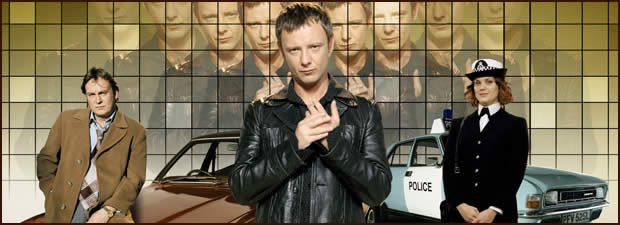
    The device is used beautifully in The Kin of Ata Are Waiting for You and in the BBC Wales series Life on Mars. In Kin, the protagonist wakes up in another world where he regains his humanity and sense of life’s purpose before being sent back to the reality he came from, where he has bills to pay.
    In Life on 
Mars, a cop is thrown back to 1973 while his body lies in a coma after a near-fatal accident. He has an identity here, close to the one he has in the present. He is again a police inspector, with transfer papers that say he was reassigned from “Hyde”. In 1973 he was (and is) four years old, and catches a glimpse of his child self. He gets engaged in cleaning up a corrupt police department and introducing methods for collecting and handling evidence that no one has heard about. From time to time – through a voice on TV or a phone call no one else can hear - he learns about his situation in the present. Will he die in 1973 as well as the present if they turn off the respirator?


In Flow My Tears
the close call is delivered by an otherwise unexplained 
monster from a B horror, a “cluster sponge” with fifty feeding tubes flung at him by a psychotic girlfriend. He kills the thing with whisky, but some of the feeding tubes stay in. When he comes round, he’s not in hospital but in a cheap hotel in a bad part of L.A., minus all the I.D. that makes life possible in this reality. The people he knows – agent, lawyer, official mistress – are all in this reality but they don’t know him and when he manages tocheck, there is no record of his birth…
      The scifi elements are charmingly creaky, like old space cowboy flicks without special effects. No cell phones or internet here. When Taverner wants to phone, he drops gold dollar coins in a public phone booth. (Where do you find public phone booths these days?)
      Great relief reading this after Dick’s Valis. Reading that requires a sojourn in a mind that is imploding. You can watch the tenements fall over and into each other.


Friday, March 29, 2024

The Time of Who Goes There

Have you dreamed you are in a different body, even that of someone of a different gender? Have you noticed that you are a time traveler in dreams? Do you have the sense that you may be leading a parallel life? Do you feel you know far more than you can remember about a deeper reality?
    These themes and more - the liminal state of adolescence, and twilight zones of reality and consciousness - are beautifully explored in a recent Japanese animated movie I discovered when a friend shared a dream that had the visual quality of a film in this genre.
    "I was riding a train to the Moon," she told me. "The train crossed a bridge that was a long, bright crescent. I knew I had to get off at the third stop. You looked different - older but strong and sharper-featured - and I became aware I was dreaming."
    The train to the Moon made me think of Hayao Myazaki's animated films. I went online to refresh my memory and stumbled across a remarkable anime film released in Japan last year as “Your Name”. The original title was “If I Had Known It Was a Dream”, from a line in a famous ninth-century poem that ends “I would not have woken up.” Soon I had it streaming on my screen.
     "Your Name", written and directed by Makoto Shinkai, is a gorgeously-visualized story of body swapping, time travel and parallel worlds. A boy in downtown Tokyo and a girl in a mountain village wake up in each other’s bodies and each other’s lives. 


Spoiler alert  Plot surprises are revealed in the summary that follows.

    In an early scene we see the astonishment of Taki (the Tokyo boy) waking up to realize he’s in the body of a girl named Mitsuha. He’s still feeling her young breasts as her little sister comes to call her to breakfast. The grandmother tells him he’s more “normal” today. Yesterday he was “nuts” and didn’t know how to tie his hair. 
    On the way to school, someone asks if Mitsuha's grandmother had him exorcized because the day before he was acting completely possessed. In class, when a teacher calls “Mitsuha,” the boy in her body is just able to respond; the day before, he did not recognize this name.          The teacher’s blackboard lesson is fascinating. She is explaining the etymology of a Japanese word for "twilight." It literally means "Who goes there?" This is the theme of the whole story, and we will discover in the denouement that twilight is truly magic time.
    Mitsuha, in her own body, participates in a ritual at a Shinto shrine, making sacred sake the old way by masticating rice and spitting into a bowl. After, she screams her frustration at being “stuck in a weird dream, living someone else’s life.” She wishes that in her next life she will be “a handsome boy in central Tokyo.”
     Scene shift to Tokyo: Taki is wakened by his cell phone. But he's not there. Mitsuha is in his body. Now we see the girl experience the shock of discovering that she's changed sex overnight. Mitsuha is horrified when she reaches between the legs of the body she is in. She doesn't know Taki's routine - where he goes to school, where he waits tables after school. She must be dreaming of course, but she's amazed by the realism of this dream and wonders where it will end. She finds Taki's online diary and enters a message.Before sleep, she writes her name on the boy’s palm.
    Next day neither remembers the body-switching, but both boy and girl find they have messages written in markers on their hands. They go over their journals and come to the shocking conclusion that in their dreams they are switching bodies. This seems to be happening randomly a few times a week.
    They come up with a survival strategy. They’ll give each other guidelines, like "Use the right bathroom." They’ll go on posting diary notes on each other’s smartphones. Taki reads this entry in his phone diary: "Today is the day we’ll be able to see the comet". But there is no comet in the sky that day on his timeline. As we will discover, the comet appeared three years earlier. Taki and Mitsuha are not only living in different places; they are living in different times.
   Mitsuha, in her own body and her own time, watches the comet. It splits in the sky, hurling a lethal fragment straight at her village. We understands that the comet kills her and wipes out her village. After this episode, Taki stops waking up in her body. He entries in his smartphone diary fade away.
    Is it possible to bend events in the past, to save the girl from the death she experiences three years earlier? It's a crazy idea, but then it's crazy that boy and girl have been swapping bodies and living parts of each other's lives. If their destinies are that closely intertwined, maybe there's a chance that Taki can reach her across time, warn her about the coming disaster - and save her life and others.
    So the quest begins. Taki does not know the name of Mitsuha's village, but he has sketches he has made from his second life of its beautiful setting. Out in the countryside, a woman in a noodle shop recognizes the location in his pictures.
   Taki goes to the site. The village is gone, replaced by the crater made by the meteor.  All seems lost, but then then there is sake, and archaic technology for relocating spirits and stepping in and out of time. He finds his way to the place of a god, a placee where Mitsuha left “half herself” in safekeeping. The container of a vital part of her spirit is  a jug of kuchikamisake, sacred sake, made with her own spit.
     Taki drinks this. We understand that he is ingesting part of Mitsuha's vital essence. Now we see the unbraiding and re-weaving of time. This is visually compelling, bringing alive an ancient tradition. We come to understand that corded braids represent the threads of time, which can be knotted and unknotted.
      Now Taki is back in Mitsuha’s body on the day that the comet will strike. He struggles to get people to evacuate the village, without much success.
    Meanwhile Mitsuha is on a train to Tokyo in search of him. “If I see you I will know I was in your body.” But his number is unavailable (because they are living three years removed from each other, which she does not yet understand. She finds Taki on a train. He does not recognize her but she gives him her name.
     They are finally able to see each other and meet on the lip of the crater where there is the home of the old god. This begins and ends in the space of twilight. We are reminded of the blackboard early in the film, on which the teacher writes the kanji for Tasogare-doki , twilight time, and explains that it means the time of “'Who Goes There?”. The sense of the expression is that at twilight, t’s still light enough to see someone but too dark to recognize them. For much of the film, the dialect word kataware-doki is used.
    Thanks to Taki's journey across time, the people of Mitsuha's town are saved, though the town itself is destroyed.
    We can't stop without some romance. Mitsuha and Taki continue to seek each other. They finally spot each other on trains in the big city, as they travel on parallel lines. By this time, just as dreams fade, they have forgotten almost everything 
– including each other’s names – except that something restless in their souls has kept them searching for someone, somewhere.

Makoto Shinkai wrote a "light novel", also titled Your Name, while making his film, and it is well worth reading, though I recommend watching the movie first.


Monday, August 7, 2023

Open Secrets of the Dreamtime


Here are the open secrets of the Dreamtime, insights shared by many dreaming traditions and indigenous peoples that challenge the ruling paradigms of a culture that confuses the real with the physical


1. Dreams are real experiences.

There are big dreams and little dreams. “Bottom-line it for me,” bulled a radio host over the phone from North Dakota. “Aren’t dreamed caused by spicy pizza?” Well, yes, some dreams are. But we will not expend much space here on the surface bubbles of the dozing brain and belly.

In big dreams — in what Sri Aurobindo called “the sleep of experiences” — we are dealing with events, encounters, and challenges that are entirely real on their own level of reality. Our dream memories may be garbled or muddy, but the dream is a real experience whose meaning lies within the dreamscape itself. The dream experience, fully remembered, is its own interpretation. But we must do more than interpret dreams; we must manifest their energy and insight in our waking lives.

Shamanic dreamers tend to be quite literal-minded about dreams. If you dreamed you fell off a rock-face, you’d better remember to check your safety harness if there is any chance you might go rock climbing. If you flew with the eagle, you discovered a powerful spiritual ally — and your own ability to transcend the limitations of your physical body. If you dreamed of your dead uncle, before you start asking yourself what part of you he might represent, you should consider the possibility that you had a visit with him. Is he bothering you — maybe trying to cadge a drink or a smoke — or offering you help? If you dreamed you received instruction at a mountain shrine, you should be open to twin possibilities: that you may go there someday, in physical reality; and that you may have been called in your dreams to one of the many “invisible schools” where training and initiation on the higher planes are conducted.


2. Dreams are flights of the soul.

During one of the final presentations at a hectic conference in Berkeley, I regretted that I had not taken that Saturday morning off to explore the Bay area. I closed my eyes, slipped free from my physical focus, and felt myself gliding over the Bay on the wings of an eagle. It was a wholly tactile sensation. I was drawn to a wild, lightly wooded area with intriguing stone formations that looked from the air like volcanic rock. As I dipped into a fold in the hills to examine the area more closely, I saw another interesting formation, shaped by human hands: a circular labyrinth, or spiral, at the edge of a pond.

At lunch, I casually described the scene I had explored. “It could be the Sibley Volcanic Preserve,” one of the local conferees piped up. “I can take you out there this afternoon if you have time.” She did not know about the spiral path, but we found it fairly easily, at the edge of a swampy pond.

From a shamanic perspective, there was nothing extraordinary about my experience. It was just a routine scout — a Middle World journey — in which I moved beyond the range of my physical senses to check out my environment. I was traveling beyond my body, but I kept a firm connection with it, maintaining awareness of the activity in the lecture room even as I flew across the Bay.

Shamans say that in real dreams (waking or sleeping) one of two things is happening. Either you are journeying beyond your body, released from the limits of space-time and the physical senses; or you receive a visitation from a being — god, spirit, or fellow dreamer — who does not suffer from these limitations. In the language of the Makiritare, a dreaming people of Venezuela, the word for dream, adekato, means literally a “flight of the soul.”

The open secret is that consciousness if never confined to the body and brain. We discover this in spontaneous night dreams and intuitive flashes, when our left-brain inhibitions are down. As we become active dreamers, we can hone the ability to make intentional journeys beyond the body at any time of day or night.


3. You have a dreambody as well as a physical body.

I am leading one of my Active Dreaming circles. We are squatting around a centerspread with a white candle. Someone asks whether there is any way to prove that we are not dreaming. I pick up the candle and pour hot wax onto my hand. I feel a sting of pain as the wax sears the web of skin between my thumb and forefinger, and I tell the group, “I guess that proves I’m not dreaming.” Then I wake up.

What is this dream telling me? That I am a nitwit because I can’t tell whether I’m dreaming? If so, I will take solace from the fact that in most sleep dreams, most people are completely unaware that they are dreaming. Actually, I think this dream has a more interesting and specific message, related to the theme that dreams are real experiences. In my dreambody, I can know pleasure and pain just as vividly as in my physical body. I have more than one body, or vehicle of consciousness, and when I go into the dreamworld and other worlds, I go embodied. And so do you.

As we will soon discover, the importance of this statement — in relation to our ability to operate in nonordinary reality and to access spiritual sources of insight and healing — can hardly be overstated.


4. Dreams may be memories of the future.

I dreamed of a silly little dog decked out with fake antlers for some kind of Christmas pageant. The dog ran out on the road and was killed, but was magically revived by a dubious, utterly amoral character who seemed remote from the normal range of human emotions.

The dream had a movielike quality. I had no idea what was going on here, but because I had no particular feelings about it, I was content to record it in my journal before rushing off to the airport to catch a plane to Denver.

I missed my connection and later found myself on a different flight form the one schedules. Whenever my travel planes come unstuck, I am alert for the play of the Trickster. On the “wrong” plane, I found myself seated next to a woman who turned out to be best friends with a person in publishing to whom I had been introduced only the day before, and I was able to glean some useful insights. Our conversation was interrupted by the screening of the in-flight movie. I looked up to see a silly little dog decked out in fake antlers for a Christmas pageant. Later in the movie, the dog is killed on the road and magically revived — by a low-flying angel portrayed by John Travolta. The title of the movie is Michael, and I highly recommend it. What interested me most was that I seemed to have attended an advance screening in my dream the night before.

We dream things before they happen in waking life. If you work with your dreams and scan them for precognitive content, you can develop a superb personal radar system that will help you to navigate in waking life. You can also learn to fold time and travel into the possible future by the methods explained in this book. For even the most active dreamers, however, the meaning of many dreams of the future may be veiled until waking events catch up with the dream.

I dreamed of a garden in Manhattan, modest in size, but beautifully designed. A place for quiet meditation, a refuge from big-city noise and hustle. A place where I felt I could do good work with good people. I was intrigues by this dream, which came to me at a time when I was quite resistant to leading programs in New York City because of the energy required to clear out all the static and psychic clutter and create a safe space for soulwork. The dream left me feeling bright and happy. I was curious about the location of my dream garden. Did it exist in ordinary reality? When I reentered the dream, I found myself on a block in the East Fifties, between Third and Second. This satisfied me that I had visited a locale that existed in physical reality. Lacking an exact address, I forgot about the dream after logging it in my journal. 

Yet the dream continued to exercise an influence: to my mild surprise, I said yes when several groups subsequently invited me to conduct workshops in New York. Nine months after the dream — the period of an average pregnancy — I entered the meeting room of the New York Theosophical Society, on East Fifty-third Street, for the first time. I stopped short. Through the picture window at the end of the room, I looked out into the garden from my dream. As I stepped out into the garden, an austerely elegant man in a black tunic followed me out. He introduced himself as the society’s program director, who had invited me. He explained that he had also designed and now tended my dream garden.

If dreams are memories of the future, is much of waking like the experiencing in the physical body what we have already lived in the dreambody? What would we become if we participated more consciously in this process? There is an Iroquois story of a great hunter who always scouted ahead, in conscious dream journeys, to locate the game and rehearse the kill. In one of his dream scouts, he located an elk and sought its permission to take its life to feed his extended family. He killed the elk in his dream and noted the red mark on its chest where the arrow had gone in. The following day, he walked to the place he had visited in dreaming and identified his elk by the red mark on its chest. He then replayed an event that had already taken place, by killing the elk again with a physical arrow.


5. Dreaming, we choose events that will manifest in our waking lives.

The fact that we dream things before they happen does not mean everything is predetermined. People who are not active dreamers can get quite confused about what is going on when they wake up to the fact that we are dreaming future events, both large and small, all the time. I think it’s like this. If you do not remember your dreams, you are condemned to live them. (If you don’t know where you’re going, you will likely end up where you are headed.) If you remember some of your dreams and screen them for messages about the future, you will find yourself able to make wiser choices. You will discover that by taking appropriate action you can often avoid the enactment of a “bad” dream or bring about the fulfillment of a happy one. As you become a conscious dreamer, you will find yourself increasingly able to choose inside the dreaming the events that will be manifested in your waking life.

It’s not about predestination. It’s about the spiritual secrets of manifestation — and your ability to become cocreator of your life.

Meister Eckhart tells us how it is the razor-sharp clarity of the practical mystic who has seen and experienced for himself: “When the soul wishes to experience something, she throws an image of the experience out before her and enters her own image.”

Indigenous peoples tell a recurring story of how the material world is spun from the dream of a deity. For the Guajiro of Ecuador, the physical universe is the product of conscious dreaming. The Guajiro say that the Creator-god made this world after the divine Dreamgiver, Apusanai, made him aware that he was dreaming and he began to experiment with molding and solidifying the fluid forms he perceived endlessly aborning and transforming on another plane of reality.<6>

It is not merely that we dream things (maybe everything) before they happen; dreams make them happen.


6. The path of the soul after death is the path of the soul in dreams.

Your dreambody does not die when your physical body loses it vital signs. You will live on in your dreambody for a shorter or greater time, according to your ruling passions and personal evolution. You will find yourself, as you do each night in dreams, in a realm where thoughts are things, and imagination, the great faculty of soul, can create whole worlds.

You come from the Dreaming, and you are released into the Dreaming when you drop your sack of meat and bones.

Conscious dreaming is excellent preparation, not only for the challenges that lie before you on the roads in this life, but for the challenges of the journey you will make after physical death. How do you know for sure? By doing it.


Text adapted from Dreamgates: Exploring the Worlds of Soul, Imagination and Life Beyond Death by Robert Moss. Published by New World Library. 


Illustration: "Green Flight" by Robert Moss

Friday, June 9, 2023

Dreams and Ghosts


Andrew Lang, the Scottish author of the perennially popular Color Fairy Stories, also wrote one of my favorite books on dreams. Titled The Book of Dreams and Ghosts, it was first published in 1897. As the title suggests, Lang’s focus is on dream encounters with the departed. He affected a cool skepticism towards his subject material, which allowed him to slide us right into the deep end, recounting cases of timefolding and interdimensional travel in dreams.

As a consummate storyteller, Lang was always alert for the story value of his material. His main question of dreams is which dreams make the best stories. He concludes that the dreams that make the best stories are those that reveal the “unknown past”, “the unknown present” and the “unknown future”. 

Dreams only form subjects of good dream-stories when the vision coincides with an adequately represents an unknown event in the past, the present or the future…If we dreamed of being present at an unchronicled scene in Queen Mary’s life, and if, after the dream was recorded, a document proving its accuracy should be for the first time recovered, then there is matter for a good dream-story.  

His references to his own dream life, though modest and brief, suggest he had experiential insight into his subject: “In dreams…we see the events of the past (I have been at Culloden fight and at the siege of Troy”).

He collects examples of shared dreams and uses that term for them. In one case he cites, three members of the Swithinbanks family (the father and two sons) dream the mother’s death on the same night and discover in the morning that the dream was fulfilled.

 Lang gives several examples of dreams that revealed the location of lost objects. Thus a lawyer dreams that a check he has lost is curled around a street railing – and finds it at that exact place when he goes looking for it. A girl in Lang’s family dreamed that  missing ducks’ eggs were at a place in a certain field, where they proved to be. An “Irish lady” dreamed a lost key was lying at the root of a certain tree, and found it there.


Picture: Andrew Lang by W.B. Richmond for Century magazine.


Sunday, April 9, 2023

Far Memory: Lessons in Time Travel, Bilocation and Seership from Joan Grant


She is conceived in the Blue Grotto on Capri, with Carabinieri standing guard over the site. This is because her parents, traveling in royal style, are mistaken for British Royals visiting Italy incognito. So Joan Grant begins the story of her life in her memoir Far Memory.
    I discovered her through her novel Winged Pharaoh which takes us vividly into a life lived in early dynastic Egypt by a girl who is trained as a dream seer in a temple of Anubis and grows to become a warrior-queen defending her country against invaders. This remains my favorite book on the practice of dreaming in ancient Egypt, though academic Egyptologists may cavil at some of its contents. It was a bestseller in its day, and the author initially kept mum about the fact that her novel, for her, was not fiction, but “far memory” of a past life in Egypt, triggered when she was allowed to handle a blue scarab. Much of the content came through in channeling sessions recorded by her then husband.
    I first picked up her memoir Far Memory to clarify how Joan Grant received her knowledge of ancient Egypt, and of other lives in other cultures. I recently re-read it, for the sheer pleasure of its bouncy narrative and to follow, in closer detail, how central the author’s own practice of dreaming became to her gifts as a writer, a psychic and a time traveler.
    As a young child, she remembered other lives. She dreamed of a French girl who died in Paris under the guillotine, and knew – through dreaming that experience – that “beheading does not hurt at all.” She received visitations from her deceased grandmother. 
    When her father took her to  a subway station on a family visit to New York, she glimpsed the remains of a man who had thrown himself in front of a train. She dreamed that she met this man, and took the form of the daughter he loved to comfort him, washing  him clean from blood and whiskey fog, and reattached his severed feet. She did this, not as the child Joan, but as a personality that was living as a girl born in 1906, with the knowledge of many other lives and a sense of identity that transcended any single body or life situation.
      During World War I, she traveled in dreams to a battlefield, where she took on the body of a Red Cross nurse, carrying out orders to deal with casualties in one of two ways: to explain to soldiers who had just been killed that they were “safely dead”, or to encourage the wounded to return to bodies that were not yet due to die.  “I had to get close, so close to the person I was trying to help that I became part of him: feeling, seeing, fearing as he did, until I could slowly instill my own faith in him.”
     And she wakes from these dreams in the body of a girl who is now eleven and can’t get the adults around her, apart from the occasional servant, to take her dreams seriously. The disconnect is so great that for a time she seeks to cut herself off from her dreams. But this plan can’t prosper because dreaming is a vital part of her calling. She starts getting confirmation of things she has dreamed but could not otherwise know about. Finding a young man in uniform alone at the breakfast table, she dares to tell him the dream from which she has just awakened in which she was with a soldier named McAndrew when he was killed. She describes his regimental badge and the slang name his unit gave to their trench. The officer at the table identifies the regiment as Canadian, and after checking is able to confirm all the details of the dream, the name of the soldier who was killed, even the slang name of the trench.
    She makes dream excursions, and she receives visitations. Jennie, her deceased grandmother, gives her music lessons and plays through her hands – an obscure piece that a Cambridge professor recognizes because Jennie played it for him. The sheet music no longer exists, and Joan could not know the piece in any ordinary way. “Quite extraordinary but completely evidential,” pronounces C.G.Lamb, the professor of engineering and amateur psychical researcher, giving her encouragement both to grow her clairvoyant gifts and to pursue academic studies.
    Another mentor was H.G. Wells, a house guest at Seacourt, her father’s immense estate on Hayling Island. Wells urged her to write – which she had not considered – while insisting that “you must live in order to write about living”.
    She dreams of places before she goes there, and of events unfolding at a distance in space or time. The night before Esmond, the lover she plans to marry, is due to return to her, she dreams he is staring at something on the floor, puzzled and angry. In the morning the news comes that he killed himself, apparently accidentally, cleaning his revolver. Later, she dreams of a kind of honeymoon with him in a beautiful environment he says is another planet, and delights in the kind of body she can enjoy here. “It was a material body, obeying a less stringent law of gravity, able to run faster, to leap higher, to swim farther under water, but still in its own place equally solid as the one I re-entered on waking.” She is startled when Esmond tells her that dream visitors aren’t especially welcome here. The residents call them ghosts, ‘earth-ghosts”.
    She develops the discipline of a real dreamer. She wakes herself several times during the night in order to record her dreams. She learns to distinguish “true dreams” from “the fustian and tinsel so dear to psychoanalysis”. In “true dreams”, she travels across time and space. She is with people at a distance . She visits the future. She enters or reenters life experiences of other personalities.
    In her development of “far memory” of those other lives, psychometry – the art of receiving impressions while handling a physical object – becomes increasingly important, after she first establishes that she can do it. But first and last, in the education of Joan Grant, is the dreaming. Reading her, we are reminded of just how important and just how practical this is. We urgently need many more people who can do pyschopomp work of the kind Joan narrates, helping the dead to find their way, and the best training for this is in dreaming, as I explain in my own "manual for the psychopomp" (Part III of Dreamgates) and in my Dreamer's Book of the Dead.

She was quite Egyptian in her insistence on the survival of a "supra-physical" body as well as the soul, and the possibility that a living individual can have more than one of these vehicles. A true pharaoh of Egypt, as I recall, was credited with having as many as 14 kas. It is "fun" to change your energy template, Grant informs us.
    "Another advantage of having more than one active, current supra-physical [body] is that it makes it easier to appear in two places at once." She gives a personal example. She was worried about a woman who was scheduled to undergo a C-section, an operation considered highly dangerous at the time. Although she could not be with her, she thought of her intently just before the procedure. Later the woman's husband thanked Joan profusely for the visit his wife said she had made, slipping in through the french doors from the hospital garden so as to be unobserved by the nurses, comforting her to the point that her fears dissolved and she slipped gently into a state of natural sedation.
    Joan waited some time after the birth before telling the mother that her visit was not an ordinary physical event. The woman responded, "Thank goodness I didn't know you weren't solid! I should have been simply terrified if I'd known I was seeing a ghost."
    We find this story in a recent collection of her occasional writings titled Speaking from the Heart. 
There are indications in the essays and memoirs here that Joan Grant experimented at least a little with what I find to be two of the most rewarding lines of exploration of our relations with a family of counterpart personalities, living in different times and dimensions. "Two personalities in the same series communicate with each other through their Integral - the Spirit." 
    This suggests that at the hub of many lives, playing out in different worlds, is a higher self that may operate outside time and may facilitate contact between personalities living in different times. We want to try to ascend to the perspective of that higher self, with its view over many times. And we want not only to understand how the legacy of past lives may work in our present lives - and may be healed, when seen for what it is - but how we can reach back across time to heal something in the life of a previous self. 

Saturday, February 18, 2023

Borges, the Double and Dreams Deferred


I return again and again to the works of Jorge Luis Borges, my favorite essayist and short story writer and one of my favorite poets. I share his fascination with the theme of the double. Like Borges, I am intrigued by the possibility that we can encounter our past, future and parallel selves. For me, based on my social life in dreaming, this is a certainty. I and once published a story ("The Other Again") which borrows the structure of Borges" story "The Other", just as he borrowed the ideas and form of a story by Kurd Lasswitz ( which he reviewed in an essay titled "The Total Library") in order to to craft his celebrated "Library of Babel".*

Borges attributed his fascination with the double to his love of R.L.Stevenson. In one Borges story (“Borges and I”), he feels empty and abandoned, while watching a second self write his stories and claim his fame. In another (“August 25, 1983”), as a man already 70, he walks from a station to a hotel at night to find he has already checked in, to room 19, a number with great significance. The clerk recognizes him with difficulty. 

He goes up to the room and finds his older self, now blind and 84, staring up at the ceiling, with an empty bottle nearby. His older self tells him he has come here to die – he says to commit suicide – and tells Borges things he will do before he arrives at the same situation. When Borges denies that this is what his future holds, his older self insists that things will proceed as he says, but that when the younger Borges reaches this point, he will remember the encounter, if at all, only as a faded dream.

In stories like this, Borges is dreaming on paper. He gives us his opinions about dreams in an essay misleadingly titles "Nightmares" (since nightmares are not the main content). Here he teases us with the thought that life itself is a dream, La vida es sueño:

"For the savage and for the child, dreams are episodes of the waking life; for poets and mystics, it is not impossible for all of the waking life to be a dream. This was said, in a dry and laconic fashion, by CalderĂ³n: 'Life is a dream.' It was said, with an image, by Shakespeare: 'We are such stuff as dreams are made on.' And splendidly by the Austrian poet Walter von der Vogelweide, who asked, 'Ist mein Leben geträumt oder ist es wahr?' – have I dreamed my life or is it real?"

Yet as far as I am aware we don't have Borges' dream journal, perhaps because he did not keep one. I read Edwin Williamson’s long biography of Borges and found that the dreams are mostly missing. There’s mention of an early and recurring nightmare, in which Borges does not know where he is or who he is, a dream that may have anticipated his blindness but extends to his existential condition. There are a couple of references to nightmares in his later years – of being terrified by a dream that oppressed him in a book-lined basement in a professor’s house in East Lansing, so he had to be moved to a hotel; of a terrible dream in which he is crucified and glimpses a she-wolf as his oppressor. But nothing, really, about the dreams that may have inspired and fueled the poems and stories. 

Did Borges really dream only on paper? If so, this might account for his uncertainty about whether there is an afterlife, something that weighed on him into his final days. His father – who went blind long before him – sometimes spoke of his longing for death in the sense of being totally “extinguished”. Borges, bitterly and recurringly rejected by women and disappointed in love, and tied to the clumsy body of a failing, eventually sightless animal, also yearned for this, and often thought of suicide. Feeling close to his own death, three years after the death of his boyhood friend from Geneva, Maurice Abramowicz, Borges wrote 

I cannot tell whether you are still someone
I cannot tell whether you can hear me  [2]

Yet the next year in a Greek taverna in Geneva, when a certain song was playing, Borges experienced an epiphany. The song declared that while the music played, you could enjoy the love of Helen of Troy; while the music played, Ulysses could go home to Ithaca. In this moment, Borges knew that Maurice was alive and present, and raised his glass in a toast to his friend. “Tonight I can weep like a man,” he wrote that same night, “ because I know there is not a single thing on this earth which is mortal and which does not project its shadow. Tonight you have told me without words, Abramowicz, that we should enter death as we might enter a fiesta.” [3] 

Borges was now released to imagine – in a burst of visionary optimism after all the black despair – a world created by dreamers. In his prose poem “Someone Shall Dream” (“Alguien sonarĂ¡”) the future “shall dream dreams more vivid than our waking life today. It shall dream that we can work miracles, and that we won’t carry them out because it will be more real to imagine them. It shall dream worlds so intense that the voice of a single bird could kill us.” 


References

1. Jorge Luis Borges, "Nightmares" in Seven Nights trans. Eliot Weinberger (New York: New Directions, 2009)

2. "Elegy" quoted in Edwin Williamson, Borges: A Life (New York: Viking 2004) p.468

3.“Abramowicz” in Los Conjurados. Quoted in Williamson p. 470


My story "The Other Again" is published in Here, Everything is Dreaming: Poems and Stories by Robert Moss (Excelsior Editions). 


"Borges Twinned": Digital play by RM

Monday, September 19, 2022

Have a Close Encounter with Death, Wake Up in a Different Life


I reread Philip K. Dick’s Flow My Tears, the Policeman Said.  It's an engaging sci fantasy yarn about a future American police state. The protagonist, TV celebrity and alpha “Six”, Jason Taverner, is hurled out of his privileged life by a familiar plot ruse that works: he has a close brush with death and finds himself in a different reality.

 The device is used beautifully in The Kin of Ata Are Waiting for You and in the BBC Wales series Life on Mars. In Kin, the protagonist wakes up in another world where he regains his humanity and sense of life’s purpose before being sent back to the reality he came from, where he has bills to pay. 

In Life on Mars, a cop is thrown back to 1973 while his body lies in a coma after a near-fatal accident. He has an identity here, close to the one he has in the present. He is again a police inspector, with transfer papers that say he was reassigned from “Hyde”. In 1973 he was (and is) four years old, and catches a glimpse of his child self. He gets engaged in cleaning up a corrupt police department and introducing methods for collecting and handling evidence that no one has heard about. From time to time – through a voice on TV or a phone call no one else can hear - he learns about his situation in the present. Will he die in 1973 as well as the present if they turn off the respirator?

 In Flow My Tears the close call is delivered by an otherwise unexplained monster from a B horror, a “cluster sponge” with fifty feeding tubes flung at him by a psychotic girlfriend. He kills the thing with whisky, but some of the feeding tubes stay in. When he comes round, he’s not in hospital but in a cheap hotel in a bad part of L.A., minus all the I.D. that makes life possible in this reality. The people he knows – agent, lawyer, official mistress – are all in this reality but they don’t know him and when he manages to check, there is no record of his birth.

The scifi elements are charmingly creaky, like old space cowboy flicks without special effects. No cell phones or internet here. When Taverner wants to phone, he drops gold dollar coins in a public phone booth. (Where do you find public phone booths these days?)

Have a close brush with death and come back to a different world. For some of us, it's not fiction. I was pronounced clinically dead under a surgeon's scalpel during an emergency appendectomy in a Melbourne hospital when I was nine years old. In the minutes I showed no vital signs, I seemed to live a whole lifetime in another world. When I came back, my "prime ' reality seemed very strange. I wrote that story in The Boy Who Died and Came Back. Philip K. Dick was no stranger to such things. 

Tuesday, August 16, 2022

Henry James' time traveling doubles


Henry James embarked on a curious novel of time traveling doubles, The Sense of the Past, but left it unfinished. It held my attention through one of my overnight reading binges. The theme is deliciously creepy and the twist in the tale is well done. 

The protagonist, Ralph Pendrel, is a young independent American scholar who has published one small book, An Essay in Aid of the Reading of History. An aged English relative, reading this before his death, was moved by the author's "ear for stilled voices " to leave him his old London house. Ralph finds this stroke of luck "a violation of the law of prose”; this is "poetry undefiled"  

We feel the pull of the house for this 30-year-old American with a passion for history. "I dream of making it speak" Ralph declares on arrival at Mansfield Place. He wants to "remount the stream of time really to bathe in its upper and more natural waters to risk even, as he might say, drinking of them.” He wants to hear the old stopped clocks ticking again. He feels the house is "a museum of held reverberations". 

We walk the place with him, feeling the staring eyes of the family portraits and then the deeper and creepier mystery of the portrait of a man with his back turned to the viewer, the lone picture in the smallest of three drawing rooms. At 2 in the morning, Ralph enters the room again. The figure in the painting has now turned. And the face is his own. 

We are given to understand, obliquely, that the man in the picture is not only his ancestor but his counterpart or double in an earlier time, as keen to enter the future as Ralph is to enter the past. He steps through the frame and they are together in the same space and time. For a while they travel London together though only Ralph seems able to see his double. We realize, little by little that they are swapping lives. 

Henry James is a subtle seducer. He is a page puller not a page turner. He pulls you in. And slows you down. You can't rush. Either you walk at his pace or you give it up. His command of words doesn't often involve unusual words but using words in unusual ways. The word "congruity", not altogether usual, is used in a most unusual way in an early description of Mrs. Aurora Coyle, the lady Ralph has been courting unsuccessfully for ten years when the story begins. “Beautiful, different, proud, she had a congruity with things that were not as the things surrounding her." Some of James’ sentences sound like philosophy problems as well as grammatical tests: "the only way to not remain is to not go". 

He provides little description of people or places and much less dialogue than we might expect. There is little forward motion. Yet he had me, again. I was reading with an agenda - I wanted to see how he managed the themes of time travel, doubles and haunted houses. As I reached the end of Book One, a natural place to pause, at 5:30 a.m., a sensible time to sleep, I wanted more. I went to bed with the book and reentered the 1710 house on Maitland Square in the grey London light that might better be called shadow, to watch Ralph stare at the utter familiarity of the chessboard tiles of the lobby, so aged that the white squares are yellow and the black squares are blue. 

I looked again, through his eyes, at the painting in the inner room of a youngish man from the age of rakes with his back turned. Ralph indulges in the fantasy that the figure may turn to face him. He thinks of the faithful in an Italian church hoping for the miracle of a sculpted saint or Madonna shedding a tear. On a night of wild rain, he prowls his house and returns to the paneled room  and finds the miracle has taken place. The man in the picture has turned to show his face "but the face - miracle of miracles, yes - confounded him as his own." 

"I am not myself,” Ralph confesses later in the story. We learn that we are dealing with trans-temporal doubles, one obsessed by the past, the other fascinated by the future, who agree to trade places in different times.


Saturday, July 30, 2022

Dreaming Expands Our Humanity: Report from Paris, 1944


I'm in Paris early in August 1944. People are hungry and torn between hope and despair. Allied armored columns are speeding towards the capital, according to the BBC and the underground newspapers passed hand to hand. The word from Free French General Leclerc is Tenez bon. Nous arrivons. "Hold on. We're coming."

But not all the French are looking forward to the Liberation. I listen to frantic conversations of once-comfortable bourgeois merchants and functionaries who grew fatter by serving the Germans, and ordinary Parisians who obeyed Marshal PĂ©tain's appeal to "collaborate" with the Militärverwaltung in Frankreich, the German Military Administration in France.

I look in on women who were kept as mistresses by German officers. Some have been living in luxury, in swank hotels, with running champagne and silk stockings. I watch them huddled together, talking about survival plans. They are terrified of what will be done to them when their protectors are gone. I watch some of them pleading with Hans or Otto, Don't leave us. Take us with you

A Wehrmacht colonel feels sympathy, but there's nothing he can do except to give his mistress his gold cigarette case. He has no idea what will happen to him, when Paris falls, as he knows it must. His comrades will simply dump the women they used and leave them to the mercies of their countrymen. Some will be stripped of their finery and their hair, beaten and shamed and used for rough sex.

~

I woke from this dream feeling oppressed, in a hotel off the Boulevard Saint-Germain during a visit to Paris in December, 2013. To clear my feelings, I trekked out to Montparnasse to visit the Memorial MarĂ©chal Leclerc and the MuseĂ© Jean Moulin. I sat in a little theater with a wrap-around screen watching multiple images of Paris in the last days of the Occupation.

I wondered why I had dreamed into the situation of the people I had viewed the previous night, people who had made unpleasant choices and were facing unpleasant consequences, people who would not be among those jostling to cheer the Americans and the Free French as they entered Paris. Maybe one of those women was kept in a room in my hotel, under the Occupation.

It occurred to me, yet again, that one of the functions of dreaming is to expand our humanity. In a hotel bed in Paris, I traveled back across time into life situations of people who were compelled by history to make terrible choices. I was reminded that the typical Parisian during World War II was not a Resistance fighter but someone who was simply trying to survive, to put food on the table, to get through.

I was in Paris in 1970, a year after Marcel OphĂ¼ls' tremendous four-hour documentary film  Le chagrin et la pitiĂ© ("The Sorrow and the Pity") was released. The film showed how collaboration was normal for most of the French under Vichy, and all the justifications for it beyond acceptance of military defeat. A government committee ruled that the film “destroyed the myths that the people of France still need”. 

More recently, French historian Patrick Buisson has claimed in a book with the provocative title1940-1945 AnneĂ©s  Erotiques (“1940-45 Erotic Years”) that a remarkable number of French women traded sexual favors with the Germans. He floats the idea - infuriating to many - that for some French women this amounted to a kind of sexual liberation. Photos from Nazi archives, like the one above, were displayed in a big exhibition in Paris showing what look like high times shared by Nazi officers and French girls, generating more rage and disgust.

So perhaps I was dreaming not only into French lives in 1944, but into the continuing challenge, for the heirs of Occupation - in which everyone's family had a story - to come to terms with history. Mulling this, I recognize that those of us who are born and live in countries that have not suffered invasion and occupation in recent generations are truly privileged. It is a challenge to our empathy and imagination to grasp fully the history of other peoples.

I recalled a Latin tag from my school days. Homo sum, humani nihil a me alienum puto. It is from Terence (aka Publius Terentius Afer, writing around 170 BCE) and it means, "I am a human being, I consider nothing that is human alien to me."

Dreaming, nothing that is human is truly alien to us.

Sunday, May 22, 2022

Where the Dream Hunter Meets the Physicist


Writing in the early 1920s, the Russian ethnographer Waldemar Bogoras charted the remarkable convergence between the ideas of modern physics and the worldview of the ancient dream shamans.

"While perusing some works of Einstein, Minkowski, Mach, the Russian professor Umov and others, I came to notice certain coincidences, more or less unexpected. Namely, when these scientists tried to transform their abstract formulas into more concrete combinations of psychical facts the material preferred by them closely resembled some shamanistic stories and descriptions, that are spread among primitive peoples in Asia and America.  In a way one could possibly say that the ideas of modern physics about space and time, when clothed with concrete psychical form, appeared as shamanistic." [1] 

Exiled to Siberia by the Tsarist regime because of his revolutionary sympathies as a student, Bogoras (aka Vladimir Bogoraz) lived among the Chukchi and studied other indigenous peoples of the far north. He gave us a pioneer account of their multiverse where we may find many parallels with relativity theory, quantum entanglement and the Many World hypothesis. 

For the shaman as for modern physics "there exists no absolute time...The idea of time for the most part is wholly rejected" in the shaman's perception of the worlds and relations between them.[2] Contraction or dilation of time is common in dreaming and shamanic trance journeys. In less than half an hour a shaman may pass through the Upper, Lower and Middle Worlds, rescue a soul, fight with hostile spirits, and have many other adventures.  

Space, size and proportion are also infinitely malleable. A spirit visitor may appear as a giant at the start of an encounter and shrink to the size of a gnat at the end of it. 

Human beings (and other beings) have doubles in parallel worlds; what happens to one may affect all. "It is possible to assume the same thing or being as residing at the same time in two separate places. 'At the same time ' is more strictly 'outside of time'.....The same being, human or animal, natural or supernatural, material or physical, is represented as having two or several forms, separate and coinciding. The being, however, does not assume these forms in turns, at first one, then another. It possesses all of them simultaneously. The forms are like the right side and the under side of the same cloth." [3]

 To heal an illness or correct a problem, it may be necessary to travel outside time to another world to fix something there. If you need help of this kind, you want to call a dream traveler, or shaman, who may send a bird or animal alter ahead to scout the ways. 

Your best way to understand these things is through dreaming. Bogoras writes that dreams are a primary source of knowledge for the Chukchi and other shamanic peoples of the far north. Dreams are the most important source of "religious experience" which means the understanding of reality given a world view in which the sacred and the profane are everywhere enmeshed, and the extraordinary is entwined with the ordinary.

Bogoras gives an arresting account of the practical benefits of dreaming in a hunter-gatherer society in this report from a Chukchi hunter: "I have no need to visit my traps every day. I know without this when a fox is caught there. Thar very night I have a dream of a red-haired woman who wants to assault me. And when in the end she is subdued and we have love, then it is a sign that a fox is caught in the trap." [4] 

"Dream-land," Bogoras writes, "is a distinct form of being that is assumed by man every night of his life." It is an "other form of being, a double life." He demonstrates  that he is truly an anthropologist who broke the glass when he adds, as a statement about what happens in dreaming everywhere, that "every night we actually lie on our bed and withal leave for another...world." [5] 


Waldemar (aka Vladimir) Bogoras (1865-1936)  wrote that the universe of the shaman is one of constant motion between different levels of a three-tiered cosmos. That would describe his own life. Exiled to Siberia by the Tsarist regime as a revolutionary student, he lived among the Chukchi and studied their shamanic practices. He wrote exquisite pioneer works of ethnography and helped to develop an orthography for their language. For a time he was a curator at the American Museum of National History and co-leader of the museum-sponsored Jessup Expedition to study indigenous peoples of northeast Asia and Alaska. Under the pseudonym “Tan” he published popular tales of the north. Back in Russia, he survived efforts to purge him as ‘anti-Marxist” and a “class-enemy” in Stalin’s time. He died on a train near Kharkiv, Ukraine in May 1936.


References

[1]Waldemar Bogoras, “Ideas of Space and Time in the Conception of Primitive Religion” in American Anthropologist vol.27, no.2 (April, 1925) 205

[2] ibid 232-3

[3] ibid 235-6

[4] ibid 209

[5] ibid 241-2


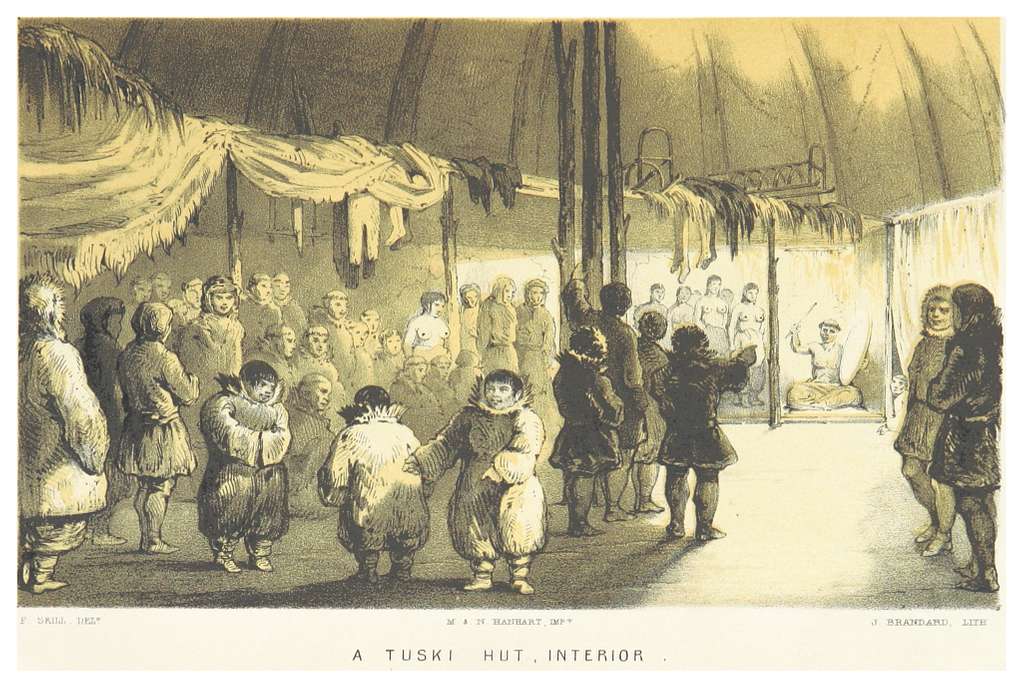
Image: Illustration by William Hulme Hooper in Ten months among the Tents of the Tuski(1853)


Sunday, April 17, 2022

Reality, Illusion and the Rupture of Time in Eliade's Strange Tales


Mircea Eliade is best known in English as a historian of religion, but he was also a prolific author of fiction and fantasy. He regarded the long novel published in English as The Forbidden Forest as his chef d'oeuvre, but many readers will find its loops and repetitions wearisome. However, his shorter fiction can be captivating while evoking some of Eliade's favorite philosophic themes: how the sacred is "camouflaged" in the profane, how at any turning we may encounter a moment of theophany, when the divine irrupts into everyday life and we are released from limits of time and space.
     I have been rereading the stories published in translation as Two Strange Tales. Perhaps we should call stories like this nonfiction fantasy rather than fiction. 
In "Nights in Serampore", Eliade makes himself a lead character. He assigns roles to actual people under their real names, in this case well-known people he encountered in India: the Russian (Eastern Orthodox) scholar of Islam Bogdanov, the Dutch Secretary of the Asia Society, van Manen, and Swami Sivananda (“Shivananda” in this version). The two Westerners, with the narrator (Eliade himself) are in the habit of driving to a rich man’s house in the woods near Serampore, sixteen miles from Calcutta, for long nights of talking, smoking and drinking in a lovely setting, in the perfumed air.
    A mystery develops. A Hindu professor reputed to be a master of tantra and yogic siddhis is seen on the road in his dhoti with the saffron stripes on his forehead. Questioned later, he denies having been there. He is spotted again, after Eliade has been discoursing on “awful” methods used to acquire occult powers in Hindu tradition, like meditating all night while seated on a corpse. That evening, as the threesome leave the rich man’s house, something strange happens during the car ride. It is taking far longer than it should to get to the highway, the trees are getting bigger and bigger. Eliade closes his eyes for a moment and when he opens them the jungle is wild and unfamiliar.
     They hear a woman’s screams. They get out of the car and follow a flickering light through the jungle. It brings them to charcoal burners, and an old, rather grand house. The owner receives them, but moves and speaks very slowly, using only an archaic form of Bengali. The visitors are confused. They forget the screams that brought them here. Then they remember something, and start to ask questions. The owner of the house informs them that they heard the screams of his wife as she was stabbed to death. Look, here is her body, being carried in on a bier.
    Eliade and his friends leave in discomfort and confusion. They can hardly stay when the lady of the house has just been murdered. Weary and drained, they pause under a tree where Eliade takes a nap. Eventually they find their way back to the car. The driver acts as though they never left. Confounded, Eliade and his companions retrace their steps. They return to the tree where Eliade took a nap. They see their footprints on the ground and follow them. They come to a clearing where the signs of their passage end. There is no grand house, no charcoal burners, no murdered woman being prepared for cremation.
    They learn that there was a great house at this place, but that was a hundred and fifty years ago, before it was burned to the ground. The case of the murdered woman, whose name was Lila, was notorious. She died resisting men who were trying to abduct her. It seems that Eliade and his friends were transported across time. Their adventure was not only metaphysical, since it produced physical effects – their torn and dirtied clothes, their footprints on the ground.
     When they seek to make sense of this, their suspicions fall on Suren Bose, the yogi magician. Could he have worked an enchantment, to distract them from spying on whatever he was doing in the forest? How could this be?
     Eliade’s question remains unanswered until he goes to a monastery in the Himalayas and tells his story to Swami Sivananda. The swami explains: “No event in our world is real, my friend. Everything that exists in this universe is illusory. Not only the death of Lila and her husband’s grief, but also the encounter between you, living men, and their shades – all these things are illusory. And in a world of appearances, in which no thing and no event has any permanence, any reality of its own – whoever is master of certain forces can do anything he wishes. Obviously he doesn’t create anything real either, but only a play of appearances.”
   When Eliade struggles with this, Sivananda stages a demonstration. The swami squeezes Eliade's arm and drags him along. Eliade staggers. Hi senses blur. Now he seems to be in a different time and place, back in the humid forest of the south. Sivananda makes him walk faster. He is again at the charcoal kilns, at the big house in the forest. “Wake me up!” Eliade pleads.

In his introduction to Two Strange Tales, Eliade discusses the importance of fiction in his work. Both stories turn on the use of supposed yogic techniques to wield occult powers. The mĂ©lange of reality and fiction in these stories, he observes, is well-suited to his concept of “camouflage”, of how the sacred is concealed in the profane. He writes that

in these two stories “camouflage” is used in a paradoxical manner, for the reader has no means to know whether the “reality” is hidden in “fiction” or the other way round, because both processes are intermingled. 
     A favorite technique of mine aims at the imperceptible yet gradual transmutation of a commonplace setting into a new “world’, without however losing its proper, everyday or “natural” structure and qualities...The parallel world of the fantastic is indistinguishable from the given ordinary world, but once this other world is discovered by the various characters it blurs, changes, transforms or dislocates their lives in different ways. 
      Each tale creates its own proper universe, and the creation of such imaginary universes through literary means can be compared with mythical processes...The imaginary universes brought to light in littĂ©rature fantastique disclose some elements of reality that are inaccessible to other intellectual approaches.

    The second story, "The Secret of Dr. Honigberger", involves another real person, a colorful German-Romanian from Brasov. The narrator (Eliade himself) receives an invitation from a Mrs Zerlendi to inspect her husband’s Oriental collection. He arrives at the kind of house that often features in Eliade’s fantastic tales, “one of those houses that I never can pass without pausing for a closer look”, an old villa behind an ironwork fence and an overgrown garden with a dried-up pool, where a world disappearing from other parts of the city is strangely preserved. The main entrance is protected by a sunroof of frosted glass, of the kind that struck me when I visited Eliade’s old neighborhood in Bucharest, on a street near Mantuleasa.
      Eliade is seduced by an immense library of 30,000 books. We learn that Mr. Zerlendi was doing research for a biography of Honigberger, a German-Romanian from Brasov who became famous for his adventures in the East. However, Zerlendi disappeared many years before. Going through Zerlendi’s notebook, Eliade finds clues to what happened. Among all his composition books, Zerlendi left a journal written in Sanskrit, correctly assuming that it would take a rarely qualified investigator to recognize and interpret its contents. In this journal he recorded his experiments with yogic techniques, including the art of invisibility.
     Central to his practice was the kind of dream yoga or lucid dreaming that places high value of maintaining continuity of consciousness between waking, dreaming and other states.

After some time I woke up sleeping, or, more precisely, I woke up in sleep, without ever having fallen asleep in the true sense of the word. My body and all my senses sunk into deeper and deeper sleep, but my mind didn’t interrupt its activity for a single instant...
     I was astounded to behold, with my eyelids closed, the very same scene as I had with my eyes open…I saw in any direction I wanted to, I saw wherever I turned my thoughts, whether or not I had my eyes open. 

He sees others moving in their dream bodies.

The unification of consciousness is attained by means of a continuous transition, that is, one without a hiatus of any sort, from the waking state to the state of dreaming sleep, then to that of dreamless sleep, and finally to the cataleptic state. 

Eliade comments: “All the Indian ascetics that I have known who have consented to give me any explanations regarded this stage, the unification of the states of consciousness, as the most important of all. Anyone who did not succeed in experiencing this could never derive any spiritual benefit from following yoga practice.” 
     Dr Zerlendi applied himself to placing himself in cataleptic trance for longer and longer periods. He believed he had proved that he stepped outside time when he rose after 36 hours to find his face as freshly shaven as when he lay down. He laid in suspended animation for 12 hours without drawing breath. He declared, in his secret book, “I know the way to Shambhala. I know how to get there.”
     He made it his aim to transport himself to Shambhala. To do this he would have to step outside time. He practiced the art of invisibility as a step towards gaining the power of teleportation, de-materializing in one reality in order to re-materialize in another.
     Seized with excitement, Eliade smuggles the journal out of the house, in order to study Zerlendi's techniques closely. He will return the book covertly before anyone notices it is missing.
    There is a slight problem. When Eliade returns to the house to interview Mrs Zerlendi again. When he succeeds, nobody remembers him. He protests that he was working in the library for two full months. This is quite impossible, they tell him. There is no library in the house. There used to be one, but it was broken up and sold off twenty years before.
   Eliade goes to the house again, hoping that it will be as he first found it. Now the whole scene is falling apart, like a broken dream. The Zerlendi house is being pulled down.
    My favorite passage in the story: "
I have always divided people into two categories: those who understand death as an end to life and the body, and those who conceive it as the beginning of a new, spiritual existence. And I never form an opinion of any man I meet until I have learned his honest belief about death." 

Nonfiction fantasy. I like the genre description I just invented. In Eliade's case, it not only means that he gives himself permission to use the identities and circumstances of "real" people, starting with himself. It means that the stories are derived from experiences in realities beyond the physical that may be no less real and sometimes intersect - magically or catastrophically -with the world of the senses. 


Quotations are from Two Strange Tales by Mircea Eliade, published (appropriately) by Shambhala (Boston, 1986). The translation is credited to Herder & Herder.

Art: "Nights in Serampore" by Christian Bode (2016)