Showing posts with label dream symbols. Show all posts

Wednesday, September 6, 2023

Why dreams set us puzzles


Artemidorus of Daldis, the most famous dream interpreter of the Greco-Roman world, is of perennial relevance. While his examples of dream content and the lives of the dreamers are of his time (the second century) his insights about how to look at dreams and dreamers often speak to us today. He wrote many books of which the soul survivor is The Interpretation of Dreams (Oneirocritica).Freud borrowed the title nearly two millennia later but I would pick the original over the later effort any time.
     Artemidorus wrote about many aspects of dreaming in other books that are now lost to us. In the Oneirocritica, his dreams in dreams that reveal the future, especially in those that do this through allegory rather than by literal depiction of possible scenes and events. Allegorical dreams are “those which signify one thing by means of another.”
     He gives us a powerful reason for looking for clues to the future in our dreams when he asserts that "the mind predicts everything that will happen in the future.” He gives several examples of precognitive dreams that presented future events in an entirely literal way. A man dreams of a shipwreck and then his boat is wrecked and he narrowly avoids drowning, as in the dream. Another dreams he is wounded in the shoulder by a friend in a hunting accident, and again the dream is played out exactly.
     If it is possible to dream the future with this kind of clarity, why do we need allegories? Artemidorus gives two reasons. The first is that we may lack the experience to understand a future event perceived in a dream – for example, because we have not yet encountered a person or situation that features in the dream. By setting us a puzzle to figure out, the “allegorical” dream gives us a rational way to access what the larger mind knows about things to come. Second, a hyped-up dream production can bring an emotional charge that leads to action; “it is the nature of the oneiros to awaken and excite the soul by inducing active undertakings.”
     Artemidorus tells us that while the gods who may be dream senders do not lie, they like to speak in riddles. This is because “they are wiser than we and do not wish us to accept anything without a thorough examination”. He gives the example of a man who dreamed the god Pan told him that his wife would poison him via his best friend. It was the relationship that was poisoned, when the wife proceeded to have an affair with the friend.
    Artemidorus recognized that every dream may be unique. The snake in your dream is not the same as the snake in mine. To read the meaning of a dream symbol correctly, you must know the dreamer’s identity, position in life, habits and medical condition. “You must examine closely the habits of men before the dream….you must inquire carefully into them.” Suppose you dream you are made of silver or gold. If you are a slave, this means you’ll be sold; if you are poor, you’ll become rich; if you’re already rich, you’ll be the victim of plots because everyone will be out to get your money. You must also question the dreamer’s feelings about a dream.
    Artemidorus observes that we dream the future for others as well as ourselves. Sometimes we receive a dream message for someone else. “Many dreams come true for those whose characters are similar to the dreamer’s and for his relatives and namesakes.”
    Artemidorus gives the example of a woman who dreamed she was married to a man who was not her husband. He observed that work with this dream could proceed in several directions, including exploring the possibility that it warned of death; “marriage and death signify each other because the circumstances surrounding a marriage and a funeral are similar.” This association, it turned out, was on the right track, but it was the dreamer’s sister, not the dreamer herself, who “married death” after the dream.   


Text adapted from The Secret History of Dreaming by Robert Moss. Published by New World Library.


Photo: Library of Celsus at Ephesus,where Artemidorus lived and read dreams for most of his life.


Monday, March 13, 2023

Walking a Dream


Jung said that one of the things he liked to do with a dream was to “circumambulate” it, wander around it, considering it from many angles. He liked to do this while in physical motion, wandering around his house on the lake, through the garden, into the woods.

This is a grand way to get greater perspective on a dream. Walking with a dream for a while, you may find that more of the dream narrative returns to you. You are almost sure to get commentary of some kind from what you notice playing around you, wherever you happen to be going.

You may find that both inner and outer perceptions accomplish what a dreaming people of central Africa say we must do with a dream. Like other cultures that value dreaming, the Yansi of Zaire have special words for dreamwork practice. According to anthropologist Mubuy Mpier, the Yansi share dreams every morning, and the core of their approach to dream exploration is embodied in the term a bumi ndoey, which means to “turn a dream.” The teaching is that we need to turn a dream carefully, as we might lift a great rock, to see what is underneath, on the side that is not initially visible.

It’s not only a matter of letting the world illuminate the dream; it’s a case of letting the dream illumine the world. “We do not always have only to sit with closed eyes, moving around in our heads, to draw closer to an image. We can put it in our pocket and carry it with us throughout days and nights,” as Mary Watkins wrote in her passionate appeal in Waking Dreams for us to let images speak to us and through us. “You not only see different things, you see things differently” when you are seized by poetic imagery, poet and scholar Kathleen Raine observed.

One of the things we want to do when we are walking a dream is to notice when it starts to play out in the world around us. There might be a considerable time gap between the dream and its unfolding in the world, so patience and a decent memory — assisted by your journal! — may be required. When a dream does begin to manifest in external reality, let an alert flash on your inner control panel. In my mind, the default version is: Dream Playing Out Now.

When the dream starts playing out, you have several options. They are not mutually exclusive. If there is no sense of danger and the original dream left you feeling happy and confident, you may be content to let the dream play again and enjoy it with all of your senses. Maybe you’ll find that a sense of “rightness” comes with this: that you have made the right choice, that you are in the right place, that at last you have found the right friend or lover or teacher. If you had a darker sense of the dream — if it involved risk or danger — you will want to be poised to change the script, solve a problem, avoid that accident or that drama at the office.

As a dream plays out in exterior reality, you may notice that its symbolism is now alive in your world. This can become a whole education on how to refresh and renew our perspectives on what is a dream and what is real. We need to take dreams more literally and waking life symbolically.

A dream may be fairly literal in the sense that it reveals something that is happening or will happen in the future in the ordinary world. Yet when the dream is enacted, we see that there is symbolism in the physical event. So a literalistic dream can point to a symbolic play in the outer world. Let’s consider an example.

A man I will call Yves dreamed that his ring finger was cut off in an accident. There was blood and pain, and he saw the splintered bone, and woke with feelings of dread and fear. When he brought the dream to me, I asked very early, as is my practice, whether it was possible that he could lose a finger in a literal accident, maybe cutting or slicing something. Did his work involve such risks? Well, yes, it did. He worked part-time pruning vines on a hillside in southern France, where he lived. He agreed that he would need to be more watchful about how he handled the secateurs.

We proceeded to discuss the symbolic levels of the dream. Hard to miss the significance of losing the ring finger in terms of a relationship. He was not married, but he had a live-in partner and felt her interest had begun to stray. This brought in the Freudian bit. Did the loss of “tall man” — the middle finger — speak of a decline in sexual performance?

Yves walked with his dream. Within the week, it began to play out when he made a false move while working in the vineyard. He only narrowly managed to avoid cutting off his own finger with the pruning shears. It was the ring finger, as in the dream. The partial fulfillment of his terrible dream led him to confront the symbolic issues. He sat down with his partner. She told him, with the sexual candor for which the French can be notable, that she was dissatisfied with his sexual performance and had already taken another lover. They agreed to separate.


Big Feet. Detail from painting by Brazilian street artist Pedrito, RM private collection. 

Saturday, December 10, 2022

A Dreamer's Notes: Dream Hotels and Dream Bodies


The Dream Hotel


I find myself in dream hotels several times a week. Sometimes I have trouble finding my room or getting back to the hotel from a walk in a city. Often I am leading a workshop or attending a meeting or dinner, engaging with many people. Sometimes, for reasons I don't yet understand, I am staying in one hotel while renting a room in another. The hotels are typically well-appointed, even luxurious, and I often have a suite.

I am frequently able to identify the location (typically in Europe) but these are not hotels where I have stayed or am likely to stay in the future.

I ask myself: what is a hotel? For me, it is a generally comfortable lodging for a traveler. Dreaming is often traveling and I am usually content to track the excursions of my traveling self in alternate realities while my body is at home. From a larger perspective, in this life we are in temporary lodgings, coming from the soul's home in a previous existence, on our way to the soul's home in the next world. We are passing through. 


Dream Bodies


I am endlessly fascinated by accounts of experiences in the subtle body, a term that came into the English language through the Cambridge Platonists, notably Ralph Cudworth, in the 17th century. Other names for it from the older Neoplatonist tradition include the astral body, the shining body, the imaginal body, the soul vehicle, the soul garment. 

I am generally content to call it the dreambody. I know, through long experience and observation, that when we go dreaming we may leave the physical body quite effortlessly and travel in another vehicle. When I go looking for visual portrayals of travel in the subtle body, I'm not generally impressed. You can easily find pictures of soul leaving the body at the moment of death - Blake's illustration to a poem is one of the best - but not much that convincingly portrays the operations of consciousness in a second body in life. 

Father Arsenio Boca, the Romanian Orthodox mystic, painted a few; I saw them in a monastery in his home country. The illustrations in Hereward Carrington's old book on astral projection show a second body floating above the body on the bed, linked by a silver cord that seems to run from the fontanel.  The Marvel multiverse gave us a thrilling sequence in the first Doctor Strange movie in  which Benedict Cumberbatch gets pushed out of his body, into a second one, by a Tibetan master. 


Kupka's Dream Lovers


My favorite artistic portrayal of dreambodies is an early work by the great Czech artist František Kupka. He wrote in a notebook that creative people have "psychic films" running in their minds. He painted a screenshot from one of these films in "The Dream" (1909) which shows lovers joined in their subtle bodies while their physical bodies lie dreaming below. The painting is modest in size, rendered in oil on a cardboard square about one foot on each side. However, the implications are enormous, and speak of Kupka's abilities - honed through years of practice in various esoteric schools - to see beyond the veils of consensual reality.

Two nude figures, male and female, lie on the ground in a sleep-dream state. Their second bodies dominate the scene on the upper left, overlapping each other in a sensual, translucent embrace. Their colors and forms shift across a spectrum of blue, purple and green. On either side diagonal lines in blue and purple give the sense of upward movement. Kupka employs a kind of transparent light to spotlight the subtle bodies of the lovers. Rather than reflecting light like solid three-dimensional figures, the dreambodies are suffused with light.

It's perhaps not surprising to find that Kupka was inspired by his own dream of astral love. He wrote on the lower left corner:

     Ma Chère Ninie, Voici ébauche le reve que J’ai eu-nous deux—Ton Franc.

“My dear Ninie, Here I sketch the dream that I had of the two of us—Yours, Franc.”

Ninie is Eugénie Straub.They began living together in 1906 and married in 1910.

Kupka is best-known as a pioneer of abstract art. However, if you look over a retrospective of his whole career you find that he mastered many styles. From the lavish symbolism of early works through Cubist flourishes to spare Mondrian-like geometries. You see his love of color and form. You sense, perhaps, his fervent quest to render visible what is invisible to the ordinary senses, to pluck at the veils between the world of appearances and what lies beyond. He declared this cause in his manifesto Creation in the Plastic Arts, published in Prague in 1927:

Great art makes the invisible and intangible, purely and simply felt, a visible and tangible reality — a reality that is not a simple pictorial replica of the ideal mechanism common to everyone, but that has, as a created work, a soul and a life of its own, which imposes itself supremely on the viewer’s senses.

Images

1.  Dream Check-in by RM with AI assistance

2. Out the Window by RM with AI assistance

3. “The Dream” by František Kupka (1909)


Friday, July 22, 2022

NINE KEYS TO UNDERSTANDING YOUR DREAMS


1.  Trust Your Feelings


Always pay attention to how you feel when you wake from a dream. Your feelings and bodily sensations may be your best guide to the relative urgency and importance of a dream, and its positive or negative implications.


2.  First Associations


In keeping a dream journal, you will want to get into the habit of jotting down your first associations with the dreams you record. What floats to the surface of your consciousness in the first minutes after waking may come from layers of the dream that have eluded, or from deeper levels of dreaming 

3.  Reality Check


Compare what is going on in the dream to the rest of your life, including the life of your imagination. Always ask whether it is possible that any part of the dream will manifest, literally or symbolically, in physical reality. Though dreams are inner experiences, they often contain accurate information about external reality. In both subtle and unsubtle ways, dreams incorporate signals from the outside environments.


4.  Dream Reentry


Dreams are real experiences, and a fully remembered dream is its own interpretation. The meaning of a dream is inside the dream itself. By learning how to re-enter dreams, you will develop the ability to clarify messages about future events, resume contact with inner teachers, and resolve unfinished business.


5.  Dialogue with Dream Characters


One of the best ways to work out what your dream characters are telling you is to ask them. You can do this through dream reentry or simply by sitting down with a pad and pen, imagining that the dream figure is in front of you, and opening a conversation.


6.  Tracking Your Dream Self


Who are you in your dreams? Are you the protagonist or simply an observer? Are you younger or older? Male or female? How does the situation and behavior of our dream self compare with that of your waking self? The character who appears in all of your dreams, even if only as a witness, is you.


7.  Symbol Exploration


Although the dream source tries to communicate with us as clearly as possible, it must often speak in symbols in order to carry us beyond the limitations of the everyday mind.  Symbols take us from what we know to what we do not yet know. You'll be inspired to track your symbols far and wide, and may discover that your personal dreams embody timeless myths from many traditions. Always remember that the best encyclopedia of dream symbols is your own journal, kept over time.*

8.  "What Part of Me?"


Dreams make us whole. They show us the many aspects of ourselves and help us to bring them under one roof. This is why it is often useful to ask "what part of me" different characters and elements in a dream might represent. However,this approach is rarely sufficient since dreams are transpersonal as well as personal. If you meet a tribal shaman in a dream, that may be an aspect of yourself and an actual shaman. If you meet your departed grandmother, that is more likely to be Granma trying to communicate than merely a part of you that is like her.


9.  Dream Enactment


Dreams require action! You may take creative action, turning a dream into a story, a picture a collage.You may do some shamanic shopping, to get shoes or earrings your dream self was wearing or a sculpture of a deity you saw in a dream. You may use the dream as GPS on your life roads. You may accept dream assignments, seeking to translate that strange word or find that obscure place on a map of this world or another world. At the least, you can harvest a bumper sticker or action phrase from the dream that will help to move its energy into life. 


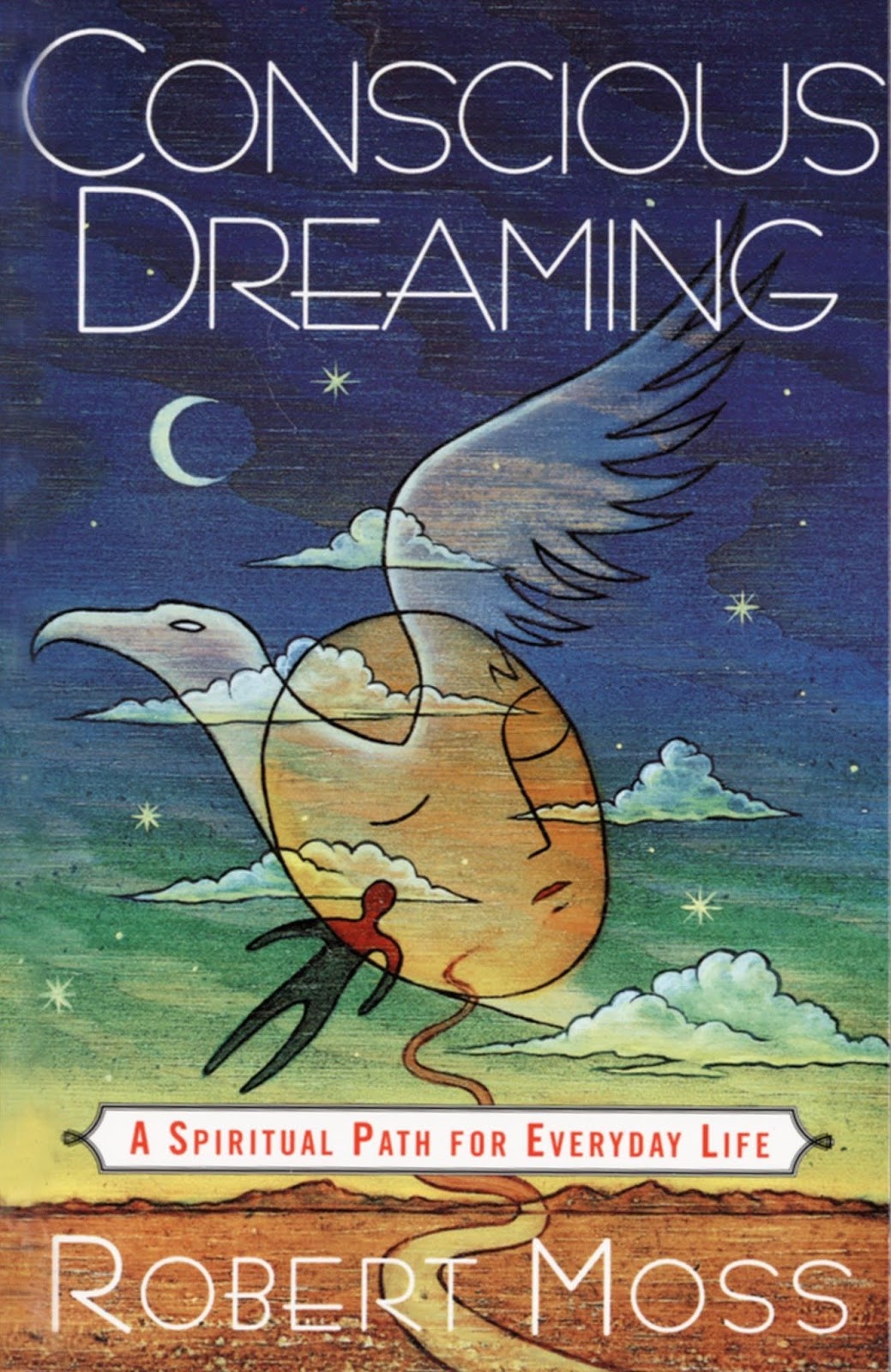
Text adapted from Robert Moss, Conscious Dreaming. Published by Three Rivers Press


Photo by RM

Sunday, July 3, 2022

What’s Going On in Your Dream House?


When you record your dreams, pay special attention to the dream locations. The settings may be familiar or completely foreign, vivid and sensory or cloudy and indistinct. You may be in a place whose physics appears quite different from ordinary reality. You may be at home with people you don't know in regular life. You might be living in a medieval castle that seems to have been constructed yesterday.

Again and again, you dream you are in the old place – back in the home you shared with your ex, or the office where you worked at the old job, or at grandma’s house, or in the school yard. Maybe you’ll want to ask yourself: did I leave part of myself behind when I left that old situation? Maybe your dream house is a hybrid, melding elements from places you recognize from the past with novel architecture. The house may seem familiar at the outset, but then proves to have more rooms and more stories than you remember. These may be stories of your life and levels of your psyche or Self.

It can be fascinating to revisit a dream structure of this kind through conscious dream reentry, and learn more about what is going on. Jung found in his dream of a many-layered house - a dream Freud insisted on misinterpreting - a model for understanding connections between the conscious mind, the personal subconscious and the collective unconscious. In his dream, he started out on a floor that looked like a normal bourgeois home. As he descended through successive floors, he found himself in primal territory, in a dirt-floor basement containing skulls and bones of distant ancestors.

I find it especially intriguing to go up on the roof of a dream house. Sometimes I find there are levels beyond what I expected. Sometimes, on a roof terrace or garden, I meet a benign figure I recognize as a slightly higher self, a witness self who can give me perspective on my life situation, since he is up above the scrum. I have called this figure the Double on the Balcony.

I dreamed I was in a house that I used to own, in another reality. It was quite familiar in the dream, but does not correspond closely to any house I have occupied in this world. My dream house was a palace, with sections open to tour groups. It has sweeping marble staircases leading up to what used to be private family apartments and my library. I tried to go up the steps, but they petered out and I realized the library and the private rooms had been long since abandoned and sealed off. I did not give up on my detective work. I took another staircase to a balcony with wonderful views over green forests and meadows. I told ladies I met there, matter-of-factly, "I used to own this house." I know I will come here again. I need to get up that staircase. And I need to understand what life story I am inhabiting in this palace that has seen better days.

By focusing on a dream location, we have an excellent portal for conscious dreaming, shamanic journeying and astral travel. If you have been to a place in a dream, you can go there again, just as you might return to a place you have visited in ordinary reality. Your dream house may be a place you will visit in the future. I have been guided, in while series of dreams, to houses I did not recognize at the outset but proved to be future homes that I purchased and occupied. We take real estate tours in our dreams. 

The dream house may be a structure that the astral architect in you has constructed for various purposes: as a place for rest and relaxation, as a sanctuary or a study, as a place of rendezvous, as a pleasure palace. Such creations may have their own stability. They may be homes that await you in the afterlife or interlife. Your dream house may be a place where you are leading a parallel life with people you may or may not know in your physical world. It may be a construction or renovation site, a place waiting for our imagination to raise the walls or put on the finishing touches.

What's that? Your memories of such things are blurry? You can take comfort from Seth, as channeled by Jane Roberts in Dreams and the Projection of Consciousness  "If you have little memory of your dream locations when you are awake, then remember that you have little memory of your waking locations when you are in the dream situation. Both are legitimate and both are realities. When the body lies in bed, it is separated by a vast distance from the dream location in which the dreaming self may dwell.” 


Graphic: Dream House by RM


Tuesday, May 3, 2022

So you're having a baby, in your dreams


"When I write, and only when I write, I have dreams about babies, and I always know that the baby is the book in my life. And whatever is happening to the baby in the dream is connected to something that is happening to the book in real life."
- Isabel Allende, in an interview with Carolyn Turgeon, editor-in-chief of Faerie Magazine (Issue 33)

I notice a similar phenomenon. For example

I am cradling a new-born baby. She is beautiful and her breath is soooo sweet. I place the baby carefully on a lambskin I have stuffed between books on a high shelf, making a kind of hutch. I arrange things so she can’t roll off the shelf.

This was my dream from an afternoon nap. I woke with a sense of joy, tenderness and wonder. In ordinary reality, it’s most unlikely that I’ll have another child. It’s also most improbable that, if entrusted with someone else’s baby, I’d think it was appropriate to treat her this way, When  I went down to my office, after my nap, I found that contracts had arrived for a book I was planning to deliver that spring. This book would be my next literary baby, and the birth announcement came in the dream.
       Baby dreams, like dreams on any theme, can be literal or symbolic. Expectant mothers dream of babies before they know they are expecting. During a pregnancy, baby dreams can rehearse both mother and child for the delivery. They can also be part of a process of “getting to know you” during which a new personality introduces itself and checks out the family it will be joining.
     It’s not unusual for pregnant mothers to dream of giving birth to animals. Indigenous peoples are quick to recognize that such dreams can bring knowledge not only of the character of the incoming soul, but of its spiritual connections. A television host in St.Louis told me on her show that when she was pregnant, she dreamed of giving birth to a lizard. “It just slid right out.” Though startling, the dream was very auspicious. The delivery was smooth and quick. We also discussed qualities of the lizard that might belong to the new child, including the ability to grow back.
      Baby dreams can be birth announcements from others in the family, advance word of a coming grandchild, for example. A dream announcing a literal birth may also be one that invites spiritual parenting. The First Peoples of my native Australia say that every soul on the way to birth needs a spiritual parent to help it find its way safely to its home in our world. The spiritual parent – a godparent in a deeper sense than that word has come to mean in English – may or may not be one of the birth parents. The connection between the incoming soul and the spiritual parent will be made in dreams.
     As in my dream of the baby on the bookshelf,  baby dreams are often about something other than a literal baby. If you dream of having a baby and you are unlikely or unable to give birth in a literal sense, ask yourself: what new thing am I getting ready to bring through in my life? What will I create? The creative act is always a process of birthing something new into the world.
      A mother dreamed she grown a huge pregnant belly. Probing gingerly, she found she was carrying twins, but there was something really strange about their anatomies. They had hard, sharp edges. She was not enthusiastic about bearing twins at her stage in life. When we discussed the dream, I asked he to explain what was “strange” about the shapes she felt inside her dream self’s swollen belly. “It was like they had hard, sharp edges.” I asked her, “Hard and sharp like what?” She responded, “Like books!” She decided she was pregnant with two books she hoped to write. Several years after the dream, she has completed the first of those books and is writing the second.
     Baby dreams can be more than birth announcements; they can suggest a care and nurturing plan we need to follow to support an initially vulnerable new life venture. A woman embarking on a new career dreamed she gave birth to a tiny, very fragile baby. She found it hard to hold the baby. It was very slippery and kept slipping from her grasp, so we would find herself struggling to maintain a safe grip or to catch it when it started to fall. This dream seemed to mirror, rather exactly, the challenges of birthing that new career.
     Another dreamer was horrified when she let a newborn baby fall because she was overloaded with a huge crate full of stuff she associated with her work situation. Studying the dream, she realized she needed to let go of a job that was interfering with a creative project she wanted to bring through; better to lose the work load than the baby.
     A birth announcement in our dreams may be about the beginning of new life in a spiritual sense. I was moved when a friend recently shared a dream in which she received a birth announcement from a deceased relative, announcing that he had been reborn on the Other Side.
     Let’s not forget that Gabriel, the archangel of the annunciation – who brings the most celebrated of all advance birth announcements – is also the angel of dreams and the patron of travel on the astral plane.

Drawing by RM: "Baby Basket at My Door". When I started sketching out ideas for a new book, I dreamed that my doorbell rang. I opened the door to find that someone had left a baby basket just outside. The basket held the neatly stacked typescript of a book. The dream gave me confidence to push ahead with the book that was published as Growing Big Dreams.


Wednesday, October 6, 2021

Toilet dreams


“Shit is good!” The elderly Italian grocery store owner’s eyes twinkled as she bagged tomatoes and homemade pasta for me. “If you crap in your dreams, it means money.”
Her reading is an ancient one, still alive in many family traditions. Josefina had carried it with her from Sicily. The association between excrement and wealth isn’t silly, when we remember that gold and silver come from under the earth, the repository of night soil. One of the names of Hades, the Greek lord of the Underworld, is Ploutos (Roman Pluto) which means The Wealthy. 
Sometimes our dream producers make the link impossible to miss. I once dreamed I was on the potty and produced a gusher. What might have been an explosion of diarrhea was a great burst of liquid gold. I woke laughing, feeling a happy release and also a terrific sense of possibility.
As with any dream symbol, the excrement in your dream isn’t necessarily the same as in mine. A good guess, with many dreams of defecation, is that you are eliminating something that needs to come out of your body or your life. To “take a dump”, in a dream, may be to dump what you need to let go. When your feelings tell you that such dreams are positive, they may indicate effective cleansing and releasing, perhaps a return to good health. A bowel movement, in a dream, may herald or accompany a move beyond a blocked or stuck situation. We sometimes say, “I’m feeling constipated” as a metaphor for the sense that things just aren’t coming out of coming through as they should do.
A common variant of the poop dream is one in which we need to go but find ourselves doing it in public. Sometimes this reflects a need for privacy in the dreamer’s life. Sometimes it’s more about whether and when it’s okay to “let it go” in front of others. Guidance on that may come from the reactions of others inside the dream. If other people in the dream don’t seem to notice or mind, that may be telling you it’s okay to let it all out. Let’s remember that in some cultures, going in public was normal bathroom procedure.
Colloquial phrases involving shit or its synonyms may give us a clue to the meaning of a dream of this ilk. Relevant phrases that plop to mind include:
I’m pooped
The shit hit the fan
I’m in deep doodoo
Shit for brains
He/she is a real shit
That’s crap
On the shitlist
Time to shit or get off the pot
This dream theme has been actively discussed for as long as people have been dreaming and needing to go. Some of the best pages in the most famous dream book of the ancient world, the Oneirocritica (“Interpretation of Dreams”) by Artemidorus, are devoted to skatá(the Greek word for shit, from which we derive the term “scatological”). Though I am no fan of dream dictionaries, I have a soft spot for Artemidorus, because he was always careful to note that similar dreams mean very different things according to the varied circumstances of the dreamer, and he checked on incidents that followed a particular dream.
  If you see a lot of human shit in a public place, according to Artemidorus, you won’t be able to accomplish anything there. In general, it doesn’t bode well if someone is shitting on your head. But that depends. “I know of a man who dreamed that a rich friend was defecating over his head. That man received a fortune and was named the heir of his friend.” On the other hand, a man who dreamed he was “befouled with dung by a poor acquaintance” later suffered great damage from the person who shat on him in the dream.
Defecating while in bed is not a good thing in a dream, says Artemidorus; it could mean you’ll be bedridden. It could also mean that your relations with a spouse or partner are in trouble, since the bad has been defiled. On the other hand to defecate copiously while seated on a toilet means “good luck for all men”, including “the alleviation of many cares and all distress. For the body is lightest after it has relieved itself.” It’s also a happy event when you dream you relieve yourself this way at a place in nature, on a road or in a river. Watch out, however, if you dream you are pooping in a temple, a place of commerce, or a public street.
I’m not sure I would be happy if I dreamed that anyone was pooping on my head although some folk traditions maintain that having a bird shit on your head in physical life is a very good omen.

From the profane to the sacred isn't necessarily a long journey. I have noticed that many toilet dreams mark an important transition in the dream experience. They may carry the dreamer out of the dream - in order to pee in the batroom instead of the bed.Alternatively, they may move the dreamer into a deeper and sometimes even magical or mystical space. Here's report form my own journals of a toilet dream that carried me into the realm of the Sufi poets.

July 27, 2009
Dream

Your Beloved Is Calling

I woke at 3:00 AM today from the following dream:


I am at a conference center where they are setting up for lunch in the huge dining area. There are wonderful freshy baked loaves of bread on  fresh white tablecloths. There's a gathering in process that includes a lot of priests or ministers. Also present is an entrepreneur who made a lot of money developing an internet search engine.


I receive several messages, as I roam the place, that a Sufi poet has been calling. He wants to get through to a number of people who are here, but they have not been receiving his messages. I am planning to tell the search engine entrepreneur that he needs to develop a device that will alert people when a spiritual teacher is searching for them.


I go through the dining area to a men's room. Several of the ministers are washing up. I go into a stall for privacy and find writing inside the door. Instead of graffiti, it is a lovely poem about spiritual union. Go up to the rooftop. Your Beloved is calling.


I woke with a sense of delight, and recognition. I thought of Rumi, and also of his spiritual teacher, Shams of Tabriz. I went questing back through old journals, and found my chronicle of nocturnal encounters with figures that appeared to carry this tradition. Over the nights that followed, I found myself traveling to many locales - including a glorious Palace of the Winds - in contact with spiritual teachers.

Photo: from the  Israel Antiquities Authority showing a rare ancient toilet in Jerusalem discovered this year. It dates back more than 2,700 years to an era when private bathrooms were a luxury.The smooth, carved limestone toilet was found in a cabin that was part of a large mansion overlooking what is now the Old City. 


Thursday, September 2, 2021

The state of our soles


In dreams, the state of our footwear often suggests the state of our souls. You can hear the echo of "soul" in "sole". A dream of lost shoes may invite us to think about where on the roads of life we may have lost or misplaced soul. Sometimes you can reach back into that kind of dream in order to look for lost shoes, and that search may take you back to a place in your life where you lost something more important - vital energy and identity - that you can now reclaim. 
 
    Shoes not only have soles. They have ties, and the state of your laces or straps in a dream may say something about connections - "old ties" or new ones. A woman getting ready to attend a high school reunion in Manhattan dreamed she was urgently seeking shoes that would be comfortable for walking yet smart enough to suit her taste. A salesman in a fancy store persuaded her to purchase a pair of sneakers with laces made of genuine, but flexible, gold. She smiled at the thought that after all the years since graduation, her ties to her classmates were "golden", and that she would be comfortable with them in the big city. 
     A Freudian psychiatrist I know dreamed that her shoes were far too tight; they were torturing her feet and making it nearly impossible for her to walk. When she reflected on this, she realized that her Freudian approach was cramping her ability to do her job. She expanded her studies, embracing Jung and other approaches to the psyche and its healing. Now, in her dreams, her shoes usually fit just right. 
     In some dreams, we find ourselves wearing shoes that would be highly unlikely in regular life, except at a costume party. We seem to be cross-dressing, or wearing the footwear of a different historical period, or dispensing with shoes altogether in a primal landscape. When we inspect the bodies we inhabit in dreams of this kind, we sometimes discover that our dream self slipped into someone else's situation, in a different place or a different era. The state of our shoes in such dreams (and other details) may be a clue to connections within a soul family that includes personalities in different times.  
      That thought has been of great interest to me since I dreamed that I visited my favorite professor at a research institution where he was doing some remarkable work that involved pairs of shoes. The professor is Manning Clark, the famous Australian historian, who was a great friend and mentor to me when I was a student and a precocious lecturer at the Australian National University. Manning died in 1991, but I have had many intriguing encounters with him since.
     In the dream involving shoes, Manning showed me that he is now busily engaged in studying "parallel lives". This meta-historical approach seems to involve tracking how choices made and actions taken by two people living in different times impact each other's fortunes, by a process of causation that you can only grasp if you can step outside linear chronology. One of the pairs Manning had selected for study was Lenin and Dionysius of Syracuse (a tyrant of ancient Greece). Each time the professor finished work on one set of parallel lives, he moved a pair of shoes to a different position on the far side of his desk. This was evidently a kind of tally, but I felt the shoes signified something more.
 
    There is an angel of shoes, or more especially sandals, the most common footwear when his name was most commonly invoked. He is Sandalphon, and his name is still important in the pathworking and astral travel protocols of certain Mystery and kabbalistic orders. He wears sandals in the presence of his Maker, and leather footgear in the presence of Shekinah, the Divine Feminine. Some say he was once the prophet Elijah, or Elias. He presides over the astral body and the soul journeys we make in this vehicle. Some believe he watches over the big journeys that precede birth and follow death, which involve putting on and discarding "garments", like soft shoes. 
     In the Terry Gilliam movie "The Imaginarium of Doctor Parnassus", a well-heeled lady is whisked away to a paradise of shoe-lovers, and stilleto heels by top designer Jerome C. Rousseau dance along the seabed. 
     Common expressions involving footwear may provide clues to where your dream is walking. A few that jump to mind:

- Goody two-shoes
- if the shoe fits...
- well-heeled
- given the boot
- pulled himself up by his own bootstraps
- to know someone, you must walk in his shoes (or moccasins)
- if you were in my shoes...
- those are big shoes to fill
- get your skates on
- put on your dancing shoes


So - what's in your shoe closet, in your dreams?


For more on dreams that show the state of our soul - and can provide portals for soul recovery healing - please see my book Dreaming the Soul Back Home.

Wednesday, August 25, 2021

When Dreams Speak in Riddles: Learning from an Ancient Dream Diviner


Artemidorus was the most famous dream interpreter in the Greco-Roman world. Operating in the second centuty, he was originally known as Artemidorus Daldianus, from his mother's city of Daldis in Lydia, but mostly practiced in the great temple city of Ephesus. He wrote many books, but only one survives: his five-volume Oneirocritica, "The Interprettion of Dreams",from which Freud borrowed the title but not the approach. 

Artemidorus states his general objective at the start of this book. He wants to make a rational and effective case for divination, based on his personal experience and the case studies he has collected.  Second, he wants to offer a practical and original guidebook that any intelligent reader can use. 

He gives his credentials in his opening pages: “I have not only taken special pains to procure every book on the interpretation of dreams, but have consorted for many years with the much-despised diviners of the marketplace…In the different cities of Greece and at the great religious gatherings of that country, in Asia, in Italy and in the largest and most populous of the islands, I have patiently listened to old dreams and their consequences.” [On 1: preface. White pp 21-22] His authority is based on experience: “Everything has been the result of personal experience, since I have always devoted myself, day and night, to the study of dream interpretation.” [On 2.70; White p.158]

Artemidorus proceeds to distinguish different types of dreams. A fundamental difference is between oneiros, which he defines as a dream that “indicates a future state of affairs” and enhypnion – stuff “in sleep” – that “indicates a present state of affairs”, ranging from the state of your digestion to your desire to be with your lover or the haunting images of things that you fear. People who lead “an upright life” try to discipline themselves to avoid being “muddled” by the fears and desires reflected in such sleep experiences, which are the stuff of much modern dream analysis [On 1.14]. In the Oneirocritica, Aretmidorus is interested only in dreams that reveal the future, and only in those that do this through allegory rather than by literal depiction of possible scenes and events. Allegorical dreams are “those which signify one thing by means of another.”

 “The mind predicts everything that will happen in the future.” [On 1.2, White p.24] Artemidorus gives several examples of precognitive dreams that presented future events in an entirely literal way. A man dreams of a shipwreck and then his boat is wrecked and he narrowly avoids drowning, as in the dream. Another dreams he is wounded in the shoulder by a friend in a hunting accident, and again the dream is played out exactly.

If it is possible to dream the future with this kind of clarity, why do we need allegories? Artemidorus gives two reasons. The first is that we may lack the experience to understand a future event perceived in a dream – for example, because we have not yet encountered a person or situation that features in the dream. By setting us a puzzle to figure out, the “allegorical” dream gives us a rational way to access what the larger mind knows about things to come. Second, the kind of dream dramas Artemidorus describes can bring an emotional charge that leads to action; “it is the nature of the oneiros to awaken and excite the soul by inducing active undertakings.” [On 1.2, White p. 23]  

 Artemidorus also notes that while the gods do not lie, they like to speak in riddles. This is because “they are wiser than we and do not wish us to accept anything without a thorough examination”. He gives the example of a man who dreamed the god Pan told him that his wife would poison him via his best friend. It was the relationship that was poisoned, when the wife proceeded to have an affair with the friend. [On 4.71, White p.224]

Thus Artemidorus sets very clear boundaries around the field of dreams he explores in the Oneirocritica. He is going to show us how to decode allegorical dreams in order to discern the future. He is well aware that other kinds of dreams require other kinds of dream work, and he wrote about other types of dreams in books that have not survived, as well as a book of augury – divination by bird-watching. [Price p.29] This approach is completely different from that of Freud, who postulated the equal status of all dreams, all formed by the same mechanisms.

Artemidorus recognized that every dream may be unique. The snake in your dream is not the same as the snake in mine. To read the meaning of a dream symbol correctly, you must know the dreamer’s identity, position in life, habits and medical condition. “You must examine closely the habits of men before the dream….you must inquire carefully into them.” [On 4.59, White pp 217-8 ] Suppose you dream you are made of silver or gold. If you are a slave, this means you’ll be sold; if you are poor, you’ll become rich; if you’re already rich, you’ll be the victim of plots because everyone will be out to get your money.. [On 1.50 White p.57] You must also question the dreamer’s feelings about a dream.

Artemidorus observes that we dream the future for others as well as ourselves. Sometimes we receive a dream message for someone else. “Many dreams come true for those whose characters are similar to the dreamer’s and for his relatives and namesakes.” Artemidorus gives the example of a woman who dreamed she was married to a man who was not her husband. He observed that work with this dream could proceed in several directions, including exploring the possibility that it warned of death; “marriage and death signify each other because the circumstances surrounding a marriage and a funeral are similar.” [On 4.30, White p.204] This association, it turned out, was on the right track, but it was the dreamer’s sister, not the dreamer herself, who “married death” after the dream.   

Artemidorus kept in touch with his clients after consultations, and apparently believed that divination through dreams is for the benefit of the whole community. This carries a burden: “If a man dreams that he has become a prophet and has been celebrated for his predictions, he…will take upon himself, in addition to his own anxieties, those of others.” [On 3.21, White p. 164]

 He wanted to raise dream divination to the level of an applied science. In the view of one modern scholar, Christine Walde, he succeeded. “The more complex aspects of divination – which is the attempt to investigate the connections underlying fate and the cosmos through natural and artificial means – constituted both an ancient mode for mastering life and a way of gaining knowledge or insight that, in the context of its time, can in no way be dismissed as irrational; at most, it might be considered extrarational.” Artemidorus devised a “demystified” approach to divination that “provides the standardized conditions that scientific distance requires” and “an imposing reservoir of knowledge about things in the world and their interdependence.” [Walde 126, 128] 


References

Artemidorus, Oneirocritica: The Interpretation of Dreams. Trans. Robert J. White. Torrance CA: Original Books, 1990, pp. 82-85. Unless otherwise noted, all quotes from Artemidorus are from this translation.

Price, S.R.F., “The Future of Dreams: From Freud to Artemidorus,” in Past and Present no.113 (November 1986).

Walde, Christine, “Dream Interpretation in a Prosperous Age? Artemidorus, the Greek Interpreter of Dreams” in David Shulman and Guy G. Stroumsa (eds) Dream Cultures: Explorations in the Comparative History of Dreaming. New York: Oxford University Press, 1999.


Text adapted from The Secret History of Dreaming by Robert Moss.Published by New World Library.


 Photo of cat at Ephesus by RM