I teach and learn by sharing stories and - especially when it comes to
dreaming - I don't want to hear from educators and experts who don't share
their personal experiences. In this respect Namkhai Norbu does not disappoint.
Especially in his book on Dzogchen, The Crystal and the Way of Light
(even more than in his book on dream yoga) he shares memorable dream
experiences.
The simplest and most endearing
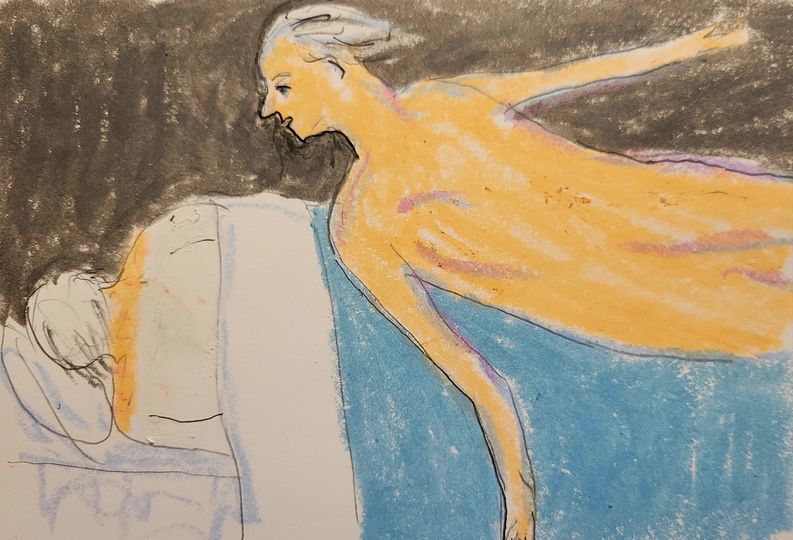
comes from very early in his life. When he was quite small, he dreamed many
times that he was riding inside the belly of a roaring beast he thought must be
a tiger. In those days no motor car had ever been seen in his remote part of
Tibet. When he encountered automobiles years later, he realized what his dreams
had prepared him for. I am so charmed by this tale that I have turned it into a
drawing.
When the dreamer is ready, the teacher will appear
Namkhai’s account of his dream education suggests a modification in a well-known
maxim. It’s not just that when the student is ready, the teacher will appear. It’s
also: when the dreamer is ready, the teacher will appear.
Aged sixteen, as a student teacher
in China, Namkhai dreamed he met a very old man he knew to be a master. The master lived in a
white Chinese-style cement house; the name Padmasambhava was written in Tibetan
over the dor. The master chanted a mantra of Padmasambhava. Then he instructed
Namkhai to go round the house to a great rock and look for the entrance to a
cave. Inside the cave, he would find eight natural mandalas. The dreamer’s
father appeared and chanted the Prajnaparamita sutra. Namkhai joined in
chanting the sutra and they walked round the inside of the cave together. He
could see the edges of the mandalas but not their full form before he woke up.
A year later, back in Tibet, Namkhai
heard a visitor talk to his father about an extraordinary old man who was
living in a village of white Chinese-style houses in the region. He felt
strongly this was the old man from his dream. Reminding his father of the
dream, he asked if they could visit the old man in the white house. They set
off on horseback and rode for four days. They came to a vialge of white
concrete Chinese-style houses and knew the master’s house because mantra of Padmasambhava
was over the door. The old man was Chamchun Dorje, a Dzogchen master; he became
Namkhai’s primary teacher.[1]
When you wake with a dream in your hand
“What if you slept,” Coleridge wrote, famously, “And
what if in your sleep you dreamed and what if in your dream you went to heaven
and there plucked a strange and beautiful flower
and what if when you awoke you had that flower in your hand, ah, what then?”
Coleridge’s question was answered
for Namkhai in his early dream education. He learned that a certain kind of
dream can spill over into the world. He woke with something he had dreamed in his
hand.
One of his uncles was renowned as
a tertön, a "treasure revealer" of hidden texts that
sometimes appeared as tiny scrolls in unusual places, apparently transmitted
across generations by ancient masters. While staying with his uncle in a
remote area, Namkhai dreamed he was visited by a dakini.
She gave him a small scroll of paper containing a sacred
text. She said this was very important and that on waking he should give it to
his uncle. In the dream he knew he was dreaming. He gripped the scroll tightly
in one fist and wrapped the other around it. It was not permitted to disturb
his uncle until after his morning rituals, so he drifted off still with his
fists clamped together.
Waking at dawn, he opened his hand and found there
really was a tiny scroll within it. He was too excited to wait. He woke up his
uncle and presented the scroll. His uncle took it and said matter-of-factly, “Thank
you, I expecting this” as if there had been a routine delivery at the door. [2]
When you are called to travel to a deceased master
When he was living and teaching in Italy, Namkhai’s guru, Chamchun Dorje, called him in a dream to return to Tibet. He traveled to his master in the dream. His guru told him that it was time for him to take up Todgal, a higher level of Dzogchen practice. For this, he needed to go to another teacher, Jigmed Linba.
I thought this was a very strange thing to say because I knew, of course, that Jigmed Linba was a great Dzogchen master of the eighteenth century who had been dead for many years. I thought perhaps I had misunderstood what my master had said so I asked him to explain, but he just said, “Jigmed Linba is up on the mountain behind the house. Go and see him right away.” [3]
Disbelieving, Namkhai scaled a sheer cliff, noticing that
the whole text of a tantra was incised on it, with the title of the text on a
standing stone at the top, He found a cave where a beautiful boy with long
flowing hair, dressed in a filmy blue garment, was seated. Could this really be
the deceased Dzogchen master? He clambered
up on top of the rock and said to the boy, “I was told to come to you.” The boy
motioned for him to sit, then took out a little scroll and began reading a
Dzogchen text on the Four Lights of Todhgal.
Look through the
Tibetan Buddhist biographies in Serinity Young’s Dreaming in the Lotus
and you will find that, again and again, gurus dream with their disciples and the
masters appear in dreams to convey essential teachings.[4] This theme is well
crystallized by Lama Choedak Yuthok:
Some people actually gain
enlightenment during dreams. Some practitioners while in the middle of dreams
which they recognized as dreams, invited great lineage masters of past ages.
They came and gave teachings, and some of these practitioners became
enlightened as a result. There are a lot of whispered teachings like this. They
are known as ‘near lineage’ teachings. Some practitioners who received these
could write, teach and transmit the teachings with amazing eloquence. They did
not have to bother about studying any texts. One master received three months’
worth of teachings in the course of a single three-hour dream.
References
1. Namkhai Norbu Crystal and the Way of Light: Sutra,
Tantra and Dzogchen ed. John Shank (London and New York: Routledge &
Kegan Paul, 1987) pp.9-10.
2. ibid pp. 51-52.
3. ibid p.102.
4. Serinity Young , Dreaming in the Lotus: Buddhist Dream Narrative,
Imagery, & Practice (Boston: Wisdom Publications, 1999).
5. Lama Choedak Yuthok ed. Pauline Westwood, Lamdre: Dawn
of Enlightenment. (Gorum Publications, 1997).
Illustration: “Riding Inside the Tiger” by Robert Moss