Showing posts with label Human Personality and Its Survival of Bodily Death. Show all posts

Friday, December 30, 2022

Fred and the Phantasms


“The question for man most momentous of all is whether or not he has an immortal soul; or . . . whether or not his personality involves any element which can survive bodily death.” Frederic W.H. Myers, the great Victorian psychic researcher and classical scholar, made this magnificent statement 120 years ago, on the first page of his major opus Human Personality and Its Survival of Bodily Death, published posthumously in 1903. He made it his life cause to gather evidence of the existence of a spiritual world from which soul comes into the body and to which it returns. He followed a rigorously empirical approach, declaring that “if a spiritual world exists, and if that world has at any epoch been manifest or even discoverable, then it ought to be manifest or discoverable now”. [1]

He saw "supernormal" faculties  - one of many terms he invented - as evidence that spirit operates beyond the body and therefore survives it. Telepathy and telaesthesia (clairvoyance) are “survivals from the powers which that spirit once exercised in a transcendental world” [2] ). “So soon as man is steadily conceived as dwelling in this wider range of powers, his survival of death becomes an almost inevitable corollary” [3] 

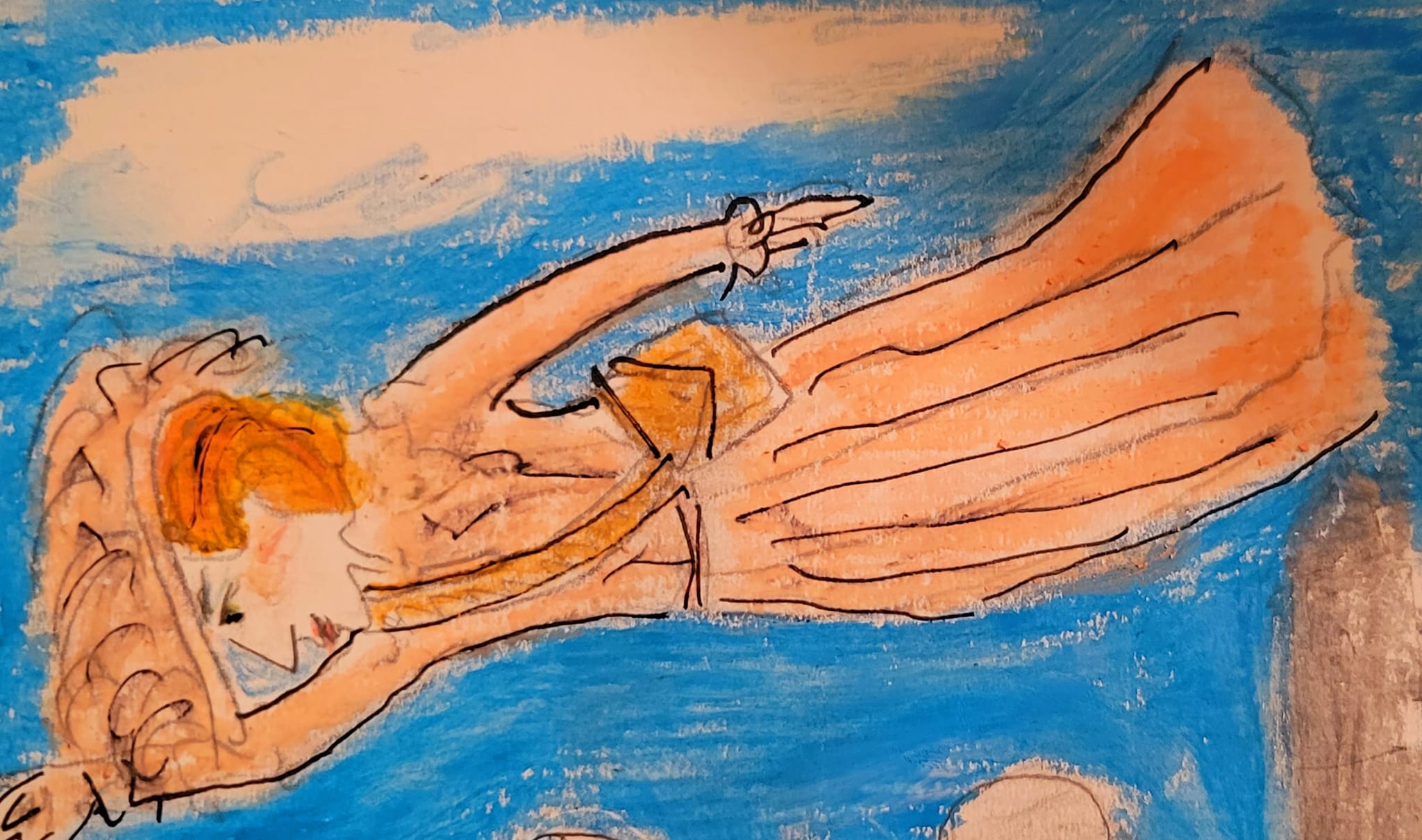
He thought that "psychical excursions" in which an aspect of the self travels beyond the body and may be perceived by others are primary evidence that consciousness is not confined to a physical vehicle and will therefore survive death. To refer to what we might call an OBE or astral projection,  Myers coined the scary term “psychorrhagy,” and referred to a propensity for this experience as a “psychorrhagic diathesis” [4] . At the high end this might be an ecstasy giving access to a spiritual world and to “communities higher than any which this planet knows” [5]

Myers described “self-projections” as “the one definitive act which it seems as though a man might perform equally well before and after bodily death” [6] 

The first major public work by Myers, with Edmund Gurney and Frank Podmore, was titles Phantasms of the Living. Based on thousands of cases collected and analyzed by the  Society for Psychical Research, this huge book was devoted to "apparitions of persons still living", received through any or all of the senses. Myers declares in his introduction that "we have no wish either to mystify or startle mankind". Yet the sheer volume of first-hand testimony of encounters with "ghosts of the living" would startle many audiences..

Myers says the authors are not aiming at any “paradoxical reversion of established scientific conclusions” but rather “working in the main track of discovery” and “assailing a problem which, though strange and hard does yet stand next in order among the new adventures on which science must needs set forth” [7]  Trying to walk a middle path between the Spiritualists and the evolutionists, Myers continues, “We held it incumbent upon us… to conduct our inquiries in the ‘dry light' of a dispassionate search for truth” [8]  

Some of my favorite cases involve experiences in the hypnagogic zone, between sleep and awake, sometimes when a visitor steps from a dream into the dreamer's physical space. Thus a minister from Bradford, the Rev. E.H.Sugden, reports a vivid dream of a person he knows well. Waking suddenly, he finds the man in his room. "I saw him in the light of early morning, standing by my bedside in the very attitude of the dream." The minister gives him a good kick and he vanishes. [9]

Myers' published oeuvre spanned a wide spectrum. He published poetry and essays on classical literature and a fascinating short autobiography that was unfortunately bowdlerized before publication by his widow. [10] Then there is all he has to tell us from the other side of death, especially the scripts recorded via two remarkable women mediums, Winifred Coombe- Tennant ("Mrs. Willett") and Geraldine Cummins. In his communications with Winifred, Myers gives the impression of a well-organized Club of psychic researchers working indefatigably to deliver evidence of the survival of physical death - from the other side of death. [11] Via Geraldine, Myers authored books describing several stages of the soul' s transitions beyond the physical plane, a comprehensive Western Bardo.  


I feel tremendous affinity for "Fred" Myers across time, and gratitude for his work, which continued after death. While I was rereading 
Phantasms of the Living I made a comment about it to a friend who exclaimed,  "Those Victorian ghost hunters really rock". I couldn't resist fooling around with an AI image generator to see what that might look like. 


References

[1] Frederic W.H. Myers, Human Personality and Its Survival of Bodily Death (London: Longmans. Green, 1903) Vol. 1, p.7
[2] ibid, Vol. 2, p. 267
[3] ibid, Vol. 2, p. 274
[4] ibid Vol. 1, p. 264
[5] ibid Vol. 2, p. 194. 
[6] Vol. 1, p. 297). 
[7] Edmund Gurney, Frederic W.H. Myers and Frank Podmore,  Phantasms of the Living (London: Society for Psychical Research/Trübner & Co, 1886) Vol. 1, p.xxxvi
[8] ibid p.xlix
[9] ibid  Vol1, pp.390-1
[10] Frederic W.H. Myers, Fragments of Prose & Poetry edited by Eveleen Myers (London: Longmans, Green, 1904)
[11] Gerald William, Earl of Balfour, "A Study of the Psychological Aspects of Mrs. Willett’s Mediumship, and of the Statement of the Communicators Concerning Process" in Proceedings of the Society for Psychical Research, Vol 43., 1935) 43-317. Geraldine Cummins, Swan on a Black Sea, A Study in Automatic Writing: The Cummins-Willett Scripts (London: Routledge and Kegan Paul, 1965
[12] Geraldine Cummins, The Road to Immortality: Being a description of the afterlife purporting to be communicated by the late F.W.H. Myers (London: Ivor Nicholson and Watson, 1933)

Illustrations 

Top: "Psychical Excursion: Edwardian Lady in Astral Flight" Drawing by Robert Moss

Bottom: "Fred and the Phantasms". Digital art by RM


Friday, March 30, 2012

Dream legacy from a Victorian psychic researcher


Dreams give us assignments. In my first cycle of sleep, I dreamed I discovered a rich trove of materials from Frederic (F.W.H.) Myers, the great Victorian researcher of the paranormal. The materials were both manuscripts and recordings. Some of the transcriptions were faulty and needed to be revised; some of the recordings sounded as if the speaker had a cleft palate. But there were riches here quite unknown to the public. Walking a familiar city street,  I announced to a friend, with high excitement, that I intended to produce a corrected version and make them known. I sensed a stir of spirits around me as I talked, fluttering like birds or bats. There was nothing sinister about these lively shades; their presence added to my enthusiasm for my project.
     This dream will drive me back to my study of Myers; I wrote a little about him in my Dreamer's Book of the Dead. The quest that drove him was to provide evidence of the soul's survival of physical death, evidence that would pass muster with the scientists of his time. "To prove that man survives death would be to transform and transfigure his whole life here now," he wrote in Human Personality and Its Survival of Bodily Death. That masterwork was unfinished at the time of his death and was published posthumously.
     Some believe that Myers continued his work on the Other Side, and fulfilled his promise to his colleagues in the Society for Psychical Research in England to supply first-hand information once he got there by dictating a series of new works via psychic mediums in the years after he passed over. The most interesting of these channeled works, received via Geraldine Cummins, are titled The Road to Immortality and Beyond Human Personality, and describe a series of transition zones after physical death.

     I have long felt an affinity for Myers not only because of his quest, but because of his love of words and of wordplay. A poet and classical scholar, he tried to give us a fresh vocabulary to describe interactions of mind and matter, levels of consciousness, and transits of spirit. His love of words and his sense of the importance of how we name things was so great that he inserted a glossary at the beginning, rather than at the end, of his magnum opus Human Personality. It is studded with terms that are his own invention. Some of his coinages, like "telepathy" have become household words. Some will probably never enter common English or even the technical lexicons of parapsychology, but stimulate all sorts of ideas, as with:

           Psychorragy – a bursting through of psychic phenomena. 
Cosmopathic – Open to the access of supernormal knowledge or emotion, apparently from the transcendental world, but whose precise source we have no way of knowing.
Methectic – of communications between one stratum of a man’s intelligence and another; as when he writes message whose origin is in his own subliminal self.

     So, dream-directed, I return to what Myers has left us, in his own hand or through the hands of others. My eye falls on a passage in Beyond Human Personality, the second of the works received by Geraldine Cummins, in which he speaks of how we create our after-death environments according to our imagination. Speaking from the Other Side, Myers declares that it is through the imagination (or lack thereof) that man approaches paradise or falls into situations far short of that:

Imagination plays an important part in his conceptions of paradise. If it has become perverted through his deeds and thoughts when he was a man, it may create sinister surroundings for him, or perhaps, kindle the old fires of hate till they blaze again and continue to flame until their folly becomes apparent and thus, in time, he wearies of the sameness, of the monotony, of this particular kind of experience. Love, on the other hand, will draw about the soul the conditions necessary for its fulfilment. And in this world beyond death, very beautiful surroundings may be built up by the imaginations of those who truly love. These latter are not, however, as numerous as is commonly believed. If there be any soil or stain, any weakness in their love, the picture which they have created as their background will in some way be faulty, and, though it furnish temporary satisfaction, be far from the ideal of the seeker of Heaven.

All good stuff, but the style is inferior to the best of Myers' writings when he was still on the earthly plane. Maybe, as in my dream, there is need for a better transcription.


Illustration: "Fred" Myers. Drawing by Robert Moss with digital effects