Showing posts with label Odyssey. Show all posts

Saturday, March 16, 2024

Gods in disguise


When it comes to gods, human kind cannot bear very much reality. Jung, the son of a disaffected Protestant minister, observed that organized religion exists to protect humans against a direct experience of the sacred. The Hebrews appeal to Moses to speak to Yahweh on their behalf and play middleman, because he terrifies them. God counsels Joshua “I am near you, but you must hide your head or you will be destroyed." The closest Joshua can come to seeing the deity is to get a glimpse of his back as he withdraws. In the Bhagavad Gita, Arjuna begs to see Krishna’s cosmic form, but can't bear it when it is revealed.

In C.S.Lewis’ Cosmic Trilogy (published in  the United States as the Space Trilogy), the Oyarsa, planetary deities, are dizzying when they first appear to humans, seeming to rush in all directions, more directions than Earth physics allows. They must slow and gentle their manifesting forms to interact with humans.

We read in the Gnostic Gospel of Thomas, “I saw Him in the manner that I was able to perceive him.” So gods come in disguises and they use camouflage that is meant to be seen through by those who are ready. For a costume shop of disguises, check out Athena’s apparitions in the Odyssey.

As for camouflage, it’s been said that coincidence is God’s way of remaining anonymous. We might add: while tempting us to try to identify the author. When we realize that in special moments of synchronicity greater powers are in play, and seek their identity we start to construct the greater stories of our lives. Then we can riff on the old saying like this

Coincidence is God’s way of remaining anonymous, while tempting us to try to identify the author.

Photo: XIX dynasty mask of Anubis in the Louvre

Monday, January 22, 2024

Pressfield’s War of Art, and the Muse


I was sent a copy of a little book on creativity by Steven Pressfield, the author of The Legend of Bagger Vance, and found it so delicious I devoured it in a single sitting. Some readers may have trouble with the military metaphor suggested by the title, The War of Art but no writer will fail to recognize those days when the forces resisting the creative process seem to have laid minefields and blown up bridges.

Pressfield divides his little book into three even smaller books.

Book One is devoted to what blocks and derails the creative process. Pressfield itemizes many ways of self-sabotage, from booze to procrastination, from giving in to family needs to confusing the urgent with the important (for which the remedy is always to do the important stuff first). These are all activities of what he calls Resistance. I rather wish he had picked a different name (Sabotage could work) since, with the great big capital R, the word Resistance brings up thoughts of the French Resistance and we surely do not want to go to war with anything like that. But let’s soldier on.. Pressfield offers a provocative list of the ambitions and endeavors that stir up the strongest Resistance from the little everyday self. These include any creative undertaking in any field, any action that requires moral courage, any entrepreneurial venture, and any effort to embark on new learning or clean out old habits and addictions.

Pressfield is absolutely correct when he says that for writers the problem is not writing but sitting down to write. He insists that the project we most resist is the one we most need to do. I suspect he is right about this too. Our deepest fears (to paraphrase Rilke) are the dragons guarding our deepest treasures.

If it’s really helpful to see the War of Art as a military campaign (Pressfield insists on this to the point of urging us to become Marines, with a calling to “miserable” conditions) let’s observe that frontal assault, as in war, can be self-defeating or suicidal. Flank attacks and diversionary tactics may work better, if there is indeed an enemy on the field of battle. Get around him, divide his forces, distract him, and then press your attack. In tackling a book project, I find I often do best by appearing to ride off in a completely different direction – for example, by devoting hours to seemingly unrelated research or posting at my online forums - only to change course and take the enemy from behind.

Book Two is devoted to becoming a pro, and contains much good stuff. Amateurs play for the game, pros play for keeps. Pressfield gives very practical counsel on bringing to the creative project some of the same habits that are required in workaday life: you turn up, you spend the necessary hours at the workplace, you don’t call in sick or depressed or with a family emergency or a need to bar crawl every day. You make a date with your muse and you keep it. He has a lovely quote from Somerset Maugham, who was asked whether he waited until he was inspired before he wrote, or wrote according to schedule. Maugham replied that he was fortunate to be inspired at precisely nine o’clock every morning.

Book Three is about how bringing through a creative project involves engaging the muse, the daimon, the genius. Pressfield describes how he borrowed from a friend the practice of saying aloud the opening words of Homer’s Odyssey. It’s a great idea, but there are better versions than the old T.E.Lawrence (yes, Lawrence of Arabia) translation that Pressfield quotes. I’m going to borrow his idea, but recast it with the aid of the 1961 Robert Fitzgerald translation (you may wish to compare the fine 1996 translation by Robert Fagles).

The poet begins the Odyssey by invoking the creative spirit: 

Sing in me, Muse, and through me tell the story 

It is the story of a wanderer, a “man of many ways” (polytropos) who was “harried for years on end” after he plundered the sacred places of Troy. His homecoming was delayed, within sight of Ithaca, when his men killed and feasted on the sacred cattle of the sun. We read in this that we must do the work for a higher purpose than filling our bellies.The key thing is to engage a larger power.

Borrowing from the Fitzgerald version, Homer’s invocation of the Muse could be simplified as follows: 

Sing in me, Muse, and through me tell the story.

Tell us in our time, lift the great song again. 

Note that the Muse here (mousa) is not yet job-specific; the early Greeks did not divide up musing functions between the nine nymphs familiar to the Renaissance. At the oldest level of the Muse cult, there appear to have been three, not nine, Muses and their names (as preserved in Pausanias) mean Voice, Practice, and Memory. Who would not want those allies in pursuit of a creative project? They are irresistible.


Art: Edmond Aman-Jean, "Hesiod Listening to the Muse", c.1890

Tuesday, December 19, 2023

Homer's Book of Portents

The homecoming is often the hardest part of the hero's journey. Odysseus has survived sea monsters and sirens and the wrath of a sea god and is at last on his home island. But he has been away for ten years since the war he went to fight, and almost everyone believes he is dead. His palace is full of brutish and lustful men, suitors vying for the hand of his wife Penelope and with it, his kingdom. Their appetites are laying waste to his livestock, his wine cellar and his female servants.
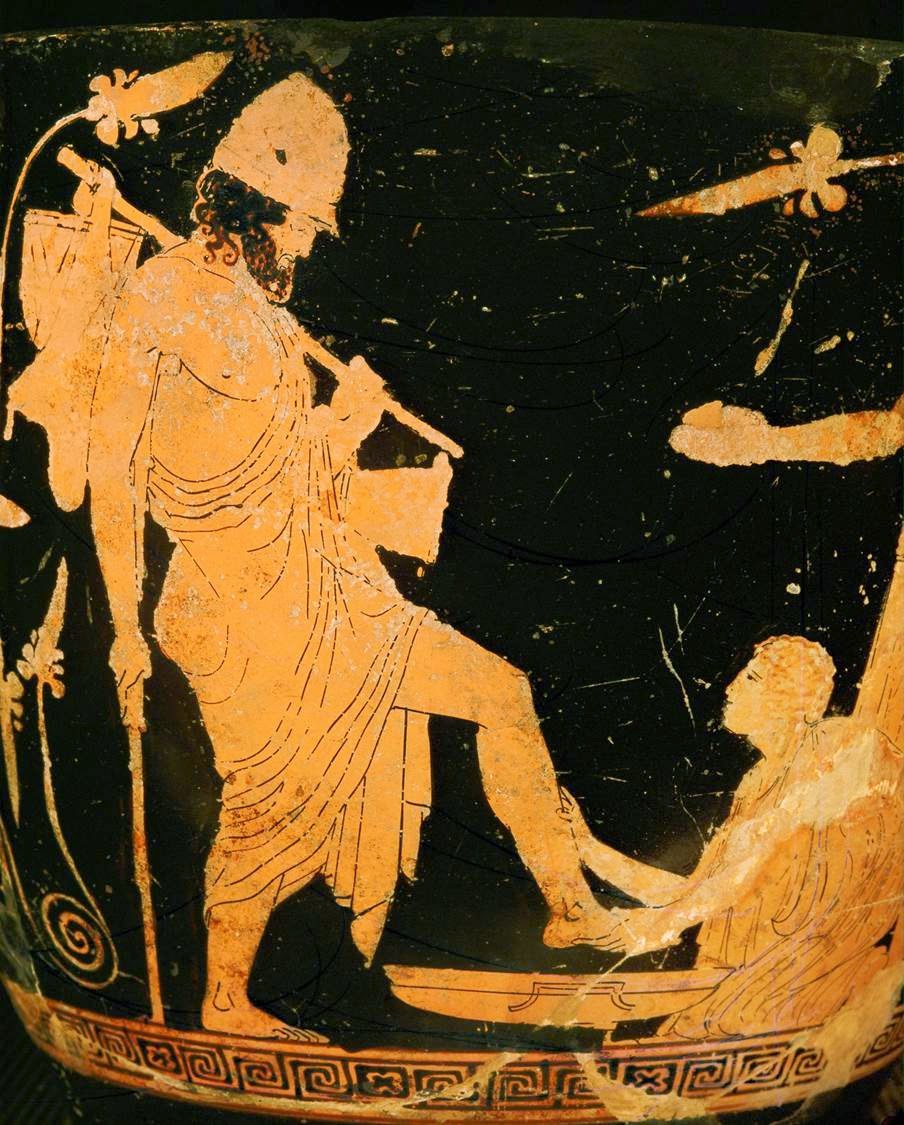
     At the prompting of his constant guide, who is no less than the goddess Athena, Odysseus has disguised himself in the rags of a beggar, with a funny traveler's hat. He is mocked and scorned by the suitors and even some of his own retainers. Nobody recognizes him. They will find it hard to recognize him even when he shows himself in a different form. His homeland seems stranger to him than the magic realms from which he has returned. He must be asking himself, Which is the dream? He may be wondering whether he is dead.
    He spends a sleepless night, tossing and turning. This is wonderfully conveyed in the muscular modern verse of Robert Fagles, which will speak to anyone who has struggled through a night like this:


...But he himself kept tossing, turning,
intent as a cook before some white-hot blazing fire
who rolls his sizzling sausage back and forth,
packed with fat and blood - keen to broil it quickly,
tossing, turning it, this way, that way - so he cast about


- Odyssey Book 20, lines 27-30, Fagles translation

    The "man of many ways" is seeking a way to expel the suitors who have taken over his home. But they are many and he is one, and even if he finds the way to kill them all, their kinsmen will come to take revenge. The goddess Athena now appears to him in mortal form, "swooping down from the sky in a woman's build and hovering at his head". She wants to know why he is still awake, fretting and exhausting himself. Why does he distrust her when she assures him that he will gain victory that day? Athena promises that "even if fifty bands of mortal fighters closed around us, hot to kill us off in battle" - because she is with him.
     Athena "showered sleep across his eyes", but when Odysseus wakes, on the morning of Apollo's feast day, even the promise of a goddess is not enough. He wants further signs. He speaks to the All-Father, Zeus. "Show me a sign." In fact, Odysseus asks for two signs, "a good omen voiced by someone awake, indoors" and "another sign, outside, from Zeus himself."
     He is answered at once by a great roll of thunder, out of a clear blue sky.
     Then he hears a "lucky word" from a woman grinding grain inside the halls. Hearing thunder from a cloudless sky, the woman recognizes a sign from Zeus. She speaks aloud to the king of the gods:


Sure it's a sign you're showing someone now.
So, poor as I am, grant my prayer as well;
let this day be the last, the last these suitors
bolt their groaning feasts in King Odysseus' house!

- Odyssey Book 20, lines 128-131

    The twin oracles - from the sky and from overheard speech - harden Odysseus' resolve, and the scene is set for the astonishing slaughter of the suitors under the rain of arrows from the bow that none but the hero (and his son) can bend. In the Fagles version, Book 20 of the Odyssey is given the title "Portents Gather", and it is a good one. Here we see oracles speak in ways the Greeks observed closely and valued highly: through brontomancy, divination by thunder, and cledonomancy, divination by overheard speech or sound.
    In the Odyssey, as in ancient Greek society, dreams and visions are the most important mode of divination. Yet our understanding of dreams may be deceptive, as Penelope explains in Book 19, when she speaks of the since-famous gates of ivory and horn. So even when blessed by a direct encounter with a goddess, the hero turns to the world around him for confirmation.


Quotations are from Robert Fagles (trans) The Odyssey published by Penguin Books.

Graphic: Odysseus in beggar's disguise, about to be identified by his childhood nurse Eurykleia, when she sees the scar on his thigh from "the wound I took from the boar's white tusk on Mount Parnassus."

Wednesday, May 18, 2022

The gods are recognizable


It's a recurring theme in world religions and mythology: it's perilous for humans to meet gods face-to-face, yet the gods may show up in manageable forms, including disguises that don't quite hide what is behind them. In his study of Greek mythology Mortals and Immortals Jean-Pierre Vernant puts it like this: “As well-camouflaged as a god may be in the skin of a mortal, there is something ‘off’, something in the otherness of the divine presence that remains strange and disconcerting even when the god is in disguise."

Thus, when Poseidon disguised himself as a man (Kalchas the diviner) to give support to the two Ajaxes, the son of Oileus recognized that he was dealing with a god by the “trace” Poseidon left as he moved away. In the Iliad, the mortal exclaims, “No, that is not Kalchas the seer. Without difficulty, I recognized from behind the trace of his feet and legs, while he was going away. The gods are recognizable.” Poseidon’s step was like that of “a quick winged falcon pursuing a bird across the plain” 

The body of a god concealed as a human can reveal itself to be both the heaviest and lightest of vehicles. When Athena gets into her chariot, it groans and buckles under her weight. Yet when she leaps from place to place her feet do not even touch the ground and she glides over water with the lightness and speed of a sea bird. 

One reason the gods veil themselves – in the semblance of mortal bodies, or in a concealing mist – is that it is dangerous and often fatal for humans to see gods as they really are. This is the inner meaning of the tales of heroes who suffered because they saw a goddess naked, as Actaeon paid with his life for seeing Artemis bathing nude. The seer Tiresias lost the use of his eyes as the penalty for seeing Athena as she is. 

In the Hometric Hymn to Demeter, we read that Metaneira was terrified when Demeter shed the disguise of an old woman and revealed herself in splendor, The immortal body of the goddess gave out a light that spread far; her shining hair streamed over her shoulders and the stronghold was illuminated as if by a bolt of lightning.

Herakles wanted to see Zeus, but found he was unable to look at the god’s face until Zeus covered it  with an animal skin.  

Vernant comments: “The paradox of the divine body consists in the fact that in order to appear to mortals, it must cease to be itself; it must clothe itself in a mist, disguise itself as a mortal, take the form of a bird, a star, a rainbow. Or if the god chooses to be seen in all its majesty, only the tiniest bit of the splendor of the god’s size, stature, beauty and radiance can be allowed to filter through, and even this is already enough to strike the spectator with thambos, stupefaction, to plunge him into a state of reverential fear. But to show themselves openly, as they truly are – enarges – is a terrible favor the gods accord to no one."

Phaeacian sightings

In the Odyssey, Alkinous claims that the Phaeacians saw the gods in their true forms – enargeis – hundreds of times in the past. The suggestion is that this was possible because the Phaeacians, in contrast to ordinary people, belonged to the family of the gods, who therefore do not need to guide their faces from them. No wonder that in the Mystery traditions, group journeying to the Phaeacian shore - the liminal territory where Odysseus washes up after his dramas with sea monsters and seductive goddesses - was a destination for group journeying. Worth remembering, also, that when Athena speaks to Nausicaa to prepare her for the stranger who she will find naked on the beach, the goddess does not appear in her true form but in the guide of a girl friend of the princess.  

Astride the worlds 

When Poseidon goes to feast with the Ethiopians in “the land of the rising and setting sun” he is described in the Odyssey as traveling, in a single motion, to both opposite extremities of the earth. he description of his movement suggests the nature of the gods as multidimensional beings. They project the semblance of physical form, and may use forms invented by humans, but their bodies are not subject to space and time and they are in no way bound by the rules of physical reality.


Friday, September 24, 2021

The Cave of the Nymphs


The Neoplatonist philosopher Porphyry wrote a commentary on a scene in Homer's Odyssey that offers a remarkable allegory of the soul's comings and goings from embodiment in this world. A translation of Porphyry's text, new to the English language at that time, inspired William Blake to paint a picture full of codes for the awakening spirit.

For  Porphyry the Cave of the Nymphs is a “harbor of the soul”, a waystation between the worlds. Porphyry insisted that nous (mind, spirit) is never contained in the body, but only “acts in it” through affinity or gravitation. An affinity for what is moist and humid brings souls back into incarnation; a tendency towards what is dry and light and fiery carries the soul into the realms of the immortals. In the Cave of the Nymphs, Naiads (spirits of fresh waters and fountains) weave “moist envelopes” – “purple tissues” – on stone, and bees deposit their honey in stone urns. Images of taking on flesh, of coming into generation. 

The word-picture fascinated William Blake, who gave it visual form in a watercolor painting found only in 1947 in the clutter atop a cabinet in a stately home in Devonshire. The first experts to examine the picture decided to give it a title from one of Blake’s letters: “The Sea of Time and Space”. Kathleen Raine explains in fine detail that the picture is an illustration of the Cave of the Nymphs. It seems that Mystery rituals dedicated to Odysseus and the Naiads – and the soul? – were actually held in a cave near the beach of Dexa in Ithaca where Odysseus is said to have returned to his homeland, dreaming. 

Kathleen Raine discusses Blake's imagery in an essay in her book Blake and Antiquity. She finds ithat even with self-taught, self-driven Blake, it is true (as Yeats declared) that poetry is “the traditional expression of certain heroic and religious themes, passed on from age to age, modified by individual genius, but never abandoned.”  

In 1947 a stately home in Devonshire called Arlington Court was taken over by the National Trust. Among broken glass and junk on the top of a pantry cover was found a painting by Blake clearly dated 1821. The art experts provisionally titled it “The Sea of Time and Space”, after a phrase in one of Blake’s letters and in his poem “Milton]. Its actual nature – as an illustration to Porphyry and Homer – was not recognized for a long time because of the tendency to regard Blake as an “untaught original” rather than an autodidact who devoured and integrated huge bodies of literature. The symbols appear again and again in Blake’s own work, yet we see that they also have deep roots in mythic experience and Neoplatonist tradition. For Raine, 

Neoplatonism may be compared to an underground river that flows through European history, sending up, from time to time, springs and fountains; and wherever its fertilizing stream emerges, there imaginative thought revives, and we have a period of great art and poetry. [1] 

Blake was a contemporary of Thomas Taylor, who brought the Neoplatonists into the English language (and was often ridiculed for it). Taylor was a crusader for the philosophy of Plotinus, calling on the young men of his time to take up its “weapons of truth”. He published the first English translation of Porphyry’s De antro nympharum

Blake's picture gives s nymphs, weavers at a loom, a sea-god, souls entering incarnation, bright spirits reborn -  perpetual cycle of the descent and ascent of souls between an eternal and a temporal world. 

In Mystery traditions, the  voyage of Odysseus in its entirety was read as the type of such a journey of soul. The sea, in constant flux, is the world. The watery cave of Calypso is the world’s enchantments. The beggar’s rags in which Odysseus returns home are the body, which the soul discards when they are no longer needed. The sea crossing, as in many legends and myths, is the type of the soul’s journey to the Otherworld. 

Blake incorporates the image of Odysseus throwing something out to sea, his face averted. This borrows an image from Book V of the Odyssey where the  hero is washed up on the Phaeacian shore. Odysseus is the soul survivor of the wreck of his ship; the goddess Ino takes pity on him and lends him her girdle, urging him to swim to shore. When he lands he must throw her girdle back to her, turning his face away. In Blake’s painting, the hero has thrown the girdle; the goddess has caught it, and she is dissolving back into a spiral of radiant cloud.

Athena stands behind Odysseus, a figure of Divine Wisdom, pointing to the shining realm of the sun.

Things to look for in Blake's painting:

The source of life in the underground river or spring. 

The dry and the moist. Heraclitus sas “a dry soul is the wisest” although “moisture appears delightful to souls”. 

Womb and tomb: Birth into the cave is a death from eternity. The Cave of the Nymphs is the womb through which humans are born into the physical world. 

Bowls and urns: Blake shows them carried like water pots on the heads of winged nymphs in the depths of the cave. 

Bees: These winged nymphs are Porphyry’s bees, winged souls about to descend into the cave of the world through womb-like vessels. 

Weavers: Blake has borrowed from his own Daughters of Albion, who ply their shuttles to bind immortals into mortal bodies. In Homer, there are marble looms and purple garments. Porphyry’s gloss is that “the formation of the flesh is on or about the bones, which in the bodies of animals resemble stones.” There is a hint of cruelty in the faces of the weavers. 

The child enmeshed: To the right of the looms, in Blake’s image, a little girl is enmeshed in what the nymphs are weaving – she is being woven into a body. 

The tubs: borrowed from Porphyry (who in turn borrowed from the Gorgias and Hesiod): the tub or bucket of the evolved, temperate and “dry” soul that is intact and can hold its contents, and the one of the person ruled by passion that is pierced and spills everywhere. Seen in two figures in the right foreground of Blake’s painting: a resolute woman turns her back on the swirl and climbs the steps, holding a bucket in her right hand while her left is raised towards the heavenly world. She is opposed by the nymphs. Close to her, a “moist soul” lolls half-immersed in a tub which lies on its side, forever spilling and unfilled even as water streams into it; she looks happy but she disgusts Blake, because she is caught in the “deadly sleep” of physical life and is on her downward journey. 

The river’s mouth: the lowest stage of descent into matter in Blake’s painting. Here he introduces Fates who control the entry of souls into the Sea of Time and Space. Savage and cruel, one unwinds the thread, a second measures it, a third waits with shears to cut it off. Phorcys (who Raine sees as a variant of Proteus) bears the phallic distaff from which the thread is unwound. 

The sleeping sun god – when this world wakes, the other world sleeps.


1. Kathleen Raine, "The Cave of the Nymphs" in Raine, Blake and Antiquity: The A.E. Mellon Lectures in the Fine Arts (Princeton N.J.: Bollingen, 1977) 4


William Blake, "Sea of Space and Time" (1821)


Thursday, March 4, 2021

Ten Books That Gave Roadside Assistance on My Soul Journey


Books have been faithful and essential friends all my life. I had a difficult and lonely boyhood, an only child who suffered double pneumonia twelve times between the ages of three and eleven. Books were my portals to realms of imagination and wonder as I lay in the half light of sick rooms. I thrived on good historical novels and on scifi and fantasy.

I like to own paper copies of all the books I read so I can sniff them and caress them and interact with a pencil. I live with an extended book family of around 14,000 volumes. My best finds are often mediated by dreams and by lively shelf elves of the kind that make books materialize and dematerialize in magical ways. My cat Lucy has recently asserted herself as a shelf elf or more - a supervising librarian- on four paws 

Like my favorite writer, Jorge Luis Borges, I sometimes picture paradise as an Infinite library. Like another of my favorite writers, Mircea Eliade, I also know that the most important book I will ever write - and one of the most important I will ever read - is my own journal. Recording dreams, observations and reading reports in my journal is essential daily practice for me.

I was recently invited to identify ten books that have provided guidance and inspiration in my spiritual odyssey and share what was happening in my life when they came to me. My journal was there to remind me what restored my inner compass and put gas in my tank in the critical passages.


1

The Odyssey 

Since I was boy, the Odyssey has been my favorite vision of life as a mythic journey. Beyond the thrill of sea monsters and angry gods and one-eyed monsters, the tale of Odysseus, the “man of many ways” is the story of a wounded warrior who is healed in the realm of the Divine Feminine. This is why Robert Graves thought it was created by a woman, and I believe he is right. In the Odyssey we see what it means to travel consciously in the presence of a guiding spirit, in this case the goddess Athena. We see that dreams are a field of interaction between gods and humans and transit lounge between the Otherworld and the physical world. Has it been made clearer anywhere else that the hardest part of the heroic quest is the homecoming? A large part of the epic is devoted to the struggles of the returning traveler to find their feet on home ground. I have used many translations over the years, not least for occasional bibliomancy; my favorite now is the most recent; the clean, spare poetic version by Emily Wilson.


2

W.B.Yeats, Collected Poems 

I knew many of Yeats’ poems by heart before I was presented with my first copy of his collected poems at my graduation from Canberra Grammar School as a prize for writing verse.  In his “Song of Wandering Aengus” I thrilled to the bardic voice of one who lived close to the Otherworld, who knew the secrets of shapeshifting and understood soul loss and soul recoveryI learned much more from Yeats’ other writings, especially Mythologies and A Vision and from walking in his footsteps in Ireland, where it is easy to understand his statement that “the visible is the skin of the invisible”. He appeared to me during a shamanic journey, saying “What better guide to the Other Side than a poet?” and I was enchanted to let him play that role in my inner life as I wrote The Dreamer’s Book of the Dead. I learned the truth of his conviction that kindred spirits reach to each other across time and may generate a “mingling of minds”. I shared his experience of a creative daimon that is forever driving us to attempt the things that are most difficult, short of the impossible.


3

Dion Fortune, Secrets of Dr Taverner 

She was a true priestess of the Wester Way. I came to her first through her important book Psychic Self-Defence, which is not for the faint-hearted. I proceeded to read, over the years, everything that I could find by her. I was excited to discover that she regarded her fiction as her most important writing on the practice of real magic A character in her novel The Goat-Foot God says that "writers will put things into a novel that they daren't put in sober prose." Dion Fortune herself said "the novels give the practice." While I love The Sea Priestess and her other novels, it is the stories collected in The Secrets of Dr Taverner that I return to again and again. The central character is a soul doctor in tweeds who deals with such complains as reincarnational dramas, astral repercussion, psychic attack, soul theft and energy vampirism. The Taverner stories are both entertaining and a valuable source of practical guidance on psychic protection and spiritual cleansing. In its fictional wrapping, The Secrets of Dr Taverner is a practitioner's casebook and perhaps the most accessible of all Dion Fortune's works for the contemporary reader.


4

Jesuit Relations and Allied Documents *

When I moved in the 1980s to a farm on the edge of traditional Mohawk country in upstate New York, because of a hawk and a white oak, I started dreaming in a language I did not know, which proved to be an archaic version of the Mohawk language. The speaker was an ancient arendiwanen, or “woman of power”. Our encounters recalled me to ancient ways of dreaming and healing and gave me immense research assignments. In the way of synchronicity, a used book dealer turned up at my door with all 73 volumes of the Jesuit Relations in the back of his truck. These are the reports of blackrobe missionaries from Indian country in the 17th century. Read carefully, drawing aside the veils of religious prejudice and fear, we have here an extraordinary source on the spiritual practices of Native Americans in Northeast America at the time of first contact. The Iroquois taught their children that dreams are the single most important source of both practical and spiritual guidance. They believed that dreams show us “the secret wishes of the soul.” In a time of war and imported disease, they recognized dreaming as a key survival tool and sent their dream shamans to scout the future. You’ll find the essential things I learned from the Jesuit reports -and the direct teachings of the Mother of the Wolf Clan who led me to use them – in my book Dreamways of the Iroquois: Honoring the SecretWishes of the Soul.


5

C.G. Jung, Memories, Dreams, Reflections 

I discovered Jung in high school and devoured many volumes of his Collected Works when I was an undergraduate. In the midst of my own psychic storms in 1987–1988, I turned to Jung again, to see how he made sense of his own “confrontation with the unconscious.” My main source was Memories, Dreams, Reflections, his life story as recorded and edited by Aniela Jaffé. We did not yet have the Red Book, and the memoir is in any event a more accessible account of what was essentially the Underworld ordeal and initiation of a shaman-scholar of the West. Central to Jung’s ability to restore his inner compass was his daily recording of dreams. “Dreams are the facts from which we must proceed” is one of the most helpful statements that has ever been made about dreams and dreamwork, and confirmation for me of the method I was obliged to improvise in my own time of testing. He confirmed for me that engaging with images in your inner life – including the terrifying ones – is a path to healing and self-empowerment. I felt the deep truth of his ringing assertion that “anyone who takes the sure road is as good as dead.” I write about Jung as “The Dream Shaman of Switzerland” in my book Dreaming the Soul Back Home.


6

Jane Roberts, Seth Speaks 

When I was going through a crisis of spiritual emergence at midlife, a friend prevailed on me to read Seth Speaks, a book channeled by Jane Roberts from an intelligence who describes himself as “ an energy personality essence, no longer focused in physical matter”. Previously somewhat resistant to channeled material, I found myself gifted with the clearest model of multidimensional reality and the multidimensional self that I had encountered. The book was a life ring for me in my efforts to understand and navigate “past life” and parallel life connections. Seth confirmed for me that we may live many existences at one time. We are connected to personalities living in the past and the future and in parallel realities, ane it is all happening Now.  Reincarnation is for real, but only one of many after-death options, and we mustn't get trapped in linear conceptions of karma and in past-life "passion plays" because any past or future is a probable reality that can be accessed and changed Now.


7

Joan Grant, Winged Pharaoh 

Winged Pharaoh thrilled me with its vivid depiction of the practices of a dream school in ancient Egypt operating in the precinct of Anubis. Joan Grant published it as a novel, but revealed later that it is actually a book of “far memory” of a life in early dynastic Egypt. We follow Grant’s alter ego, Sekeeta, as she learns to go scouting in dreams to find lost objects, look into the future, observe things happening at a distance, and discover what is going on behind the scenes. As a child, she sleeps with a wax tablet beside her bed, and her first task each morning is to record her dreams. She takes her reports to the priest of Anubis, her dream teacher. Some days she must carry out assignments he gave her inside a dream – for example to bring him a certain flower, or bird feather, or colored bead. She learns to travel in dreaming beyond time and space, to scout the possible future, and to communicate with the deceased. She encounters people who have died and are confused about their condition and moves into the role of psychopomp. In the language of ancient Egypt, a dream (rswt) is literally an “awakening”. Winged Pharaoh reawakened me to what it means to dream like an Egyptian and I have used it as a handbook in guiding others.  


8

Henry Corbin, The Man of Light in Iranian Sufism 

A lifelong student of the medieval Sufi philosophers, French scholar Henry Corbin brought the term Imaginal Realm into currency in the West. In Arabic, the term is Alam al-Mithal and it refers to the realm of true imagination, an order of reality that is at least as real as the physical world, with cities and schools and palaces where human travelers can interact with master teachers. Corbin’s great work Creative Imagination in the Sufism of Ibn ‘Arabi is a marvelous essay in visionary spirituality that embodies his driving purpose of helping to free the religious imagination from all types of fundamentalism. Corbin regarded study as a quest. In The Voyage and the Messenger looking back on his scholarly journey, he wrote that “to be a philosopher is to take to the road, never settling down in some place of satisfaction with a theory of the world…The adventure is…a voyage which progresses towards the Light". His books were with me, to anchor and orient, through the incandescent nights when I found myself in dialogue with Persian philosopher mystics and riding with the heaven bird of Persian mythology, the Simurgh. The Man of Light is Corbin’s most accessible work and one to which I return again and again. The subtitle of my book Mysterious Realities is Tales of a Dream Traveler from the Imaginal Realm.


9

W.T. Stead, The Blue Island 

I love the Victorian ghost hunters, especially F.W.H. Myers, W.T. Stead and William James. They were passionately dedicated to producing evidence of the survival of consciousness after physical death that would meet the scientific standards of their day. They promised that after their deaths they would continue their work by trying to communicate in exact detail from the Other Side. Among all the channeled books that resulted, my favorite is The Blue Island,in which Stead (who went down with the Titanic) recounts his early after death experiences to male mediums sitting in the presence of his daughter. As a former journalist, Stead is especially interested in how news is transmitted in the transition zone where he finds himself. He describes a communications center, “an amazingly well organized and businesslike place” constantly filled with ex-physicals. “Those who had on earth believed and those who had not, came to try and wire a message home.” The ones who feel a “heart call” always get priority. They have a system of “travelers”, who can reach receptive minds on Earth. Stead describes how the living can reach to the departed in a similar way. You concentrate on an individual in the spirit world, and if you put enough energy into that thought, the individual you have in mind will feel you and you may be able to open a communications channel. This beautiful little book is one of the essential Western books of the dead.


10

Viktor Frankl, Man’s Search for Meaning 

I reread this extraordinary book every few years. A successful Jewish psychiatrist in Vienna, Viktor Frankl was carried off to Auschwitz and reduced to a walking skeleton with a tattoo on his arm. In one of the darkest nightmares of history, he applied his imagination. He grew an impossible dream: of a scene in the future when the Nazis were a memory and he was standing in front of a well-fed audience in a good suit giving a lecture on “The psychology of the Concentration Camps”. In his vision the Nazi evil was so thoroughly destroyed – and he so thoroughly restored – that he could lecture about it from an objective perspective. Frankl not only survived the Holocaust. His dream played out a year after the war, in every detail. I have derived three life-orienting lessons from this. First, that however tough our situation may seem to be, we always have the freedom to choose our attitude, and this can change everything. Second, that our problems, however bad, are unlikely to be quite as bad as the situation of someone who has been sent to a Nazi death camp. That thought may help us to gain perspective, and to stand back from a welter of grief and self-pity and rise to a place where we can start to dream up something better.Third, we can make inner movies, and if they are good enough it is possible that they will play in the theater of the world.


 I look over this list and wonder why it does not include so many other books and authors that have affected me deeply: Albert Camus, Rilke, Herman Hesse, the Upanishads, Dostoyevsky, Christopher Brennan, The Tibetan Book of the Dead, Hilda Ellis Davidson, Ursula Le Guin, Mary Oliver, AE (George Russell), the (for me) inescapable Borges and Eliade. Again, my journal shaped my selections, reminding me how certain books converged with critical passages of spiritual emergence in my life, when I needed confirmation even more than inspiration.


*I'm not expecting anyone to read the 73 volumes of the Jesuit Relations that are on my shelves although today you can no doubt find them onlne. I was looking over the books that gave me anchors and life rings in decisive passages in my journey.In this case, I needed confirmation of what I was learning from the Mother of the Wolf Clan I call "Island Woman"in my books. In another book that was very important to me, The Journal of Major John Norton, a half-Cherokee British officer in the war of 1812, I confirmed the historical identity of Island Woman as the grandmother of Molly and Joseph Brant, born Huron (Wendat) and adopted into the Mohawk natoion after she was captured by a Mohawk raiding party aged about five.


Thursday, October 12, 2017

Gates of Horn and Ivory


In Homer’s
Odyssey, we first learn, with Penelope, about the two gates of dream: the Gate of Ivory and the Gate of Horn. Dreams that come through the Gate of Ivory are “dangerous” and may not be manifested; dreams that come through the Gate of Horn are clearer, and may be embodied in events. The difference seems to be a matter of clarity rather than deception. Carved ivory is totally opaque; polished horn is translucent.

Synesius of Cyrene wrote a marvelous treatise on dreams around 405 in which he asserted that it is the weakness of our understanding, not confusion or deception in dreams themselves, that makes some dreams seem false. "The Penelope of Homer assumes that there are two gates of dreams, and makes half of them deceptive dreams, only because she was not instructed in the matter. For if she had been versed in their science, she would have made them all pass out through the gate of horn." Penelope was "guilty of ignorance" about her own power of inner sight, distrusting her dreams without reason. Therefore "we should not confuse the weakness of the interpreter with the nature of the visions themselves". 

The Gates of Horn and Ivory reappear in the Aeneid but Virgil changes the characterization in his account of Aeneas’ descent to the underworld to visit his dead father Anchises. Now dreams that come through the Gate of Ivory are designated “false”, while those that come through the Gate of Horn are “true”. This becomes a standard distinction for centuries in the minds of Westerners raised on the classics.

However, there is a mind-trap in Virgil's story. Anchises sends his son back from the Underworld through the Gate of Ivory. Aeneas and the Sybil return to the regular world through the gate of empty dreams. Is the poet hinting that our ordinary experience of reality is the false dream?

Image: Aeneas and the Sybil return to the ordinary world through the Gate of Ivory. 
 Codex Vaticanus Folio 57r  


Sunday, February 1, 2015

Of Kairos and sea shells


Paradise Island, Bahamas

Kairos is jump time, opportunity time, the special moment that you seize or miss. In Kairos moments you may feel you have been released from linear time, or that powers from outside time have irrupted into your world. The Greeks personified Kairos as a young, fleet-footed god, completely bald except for a curling lock falling over his forehead. Hence the phrase, "seize time by the forelock." If you meet this fellow on the road and fail to seize the moment, you'll find him very hard to catch. Kairos is slippery.
    Brutus talks about Kairos time, the time of opportunity, in a famous passage in Shakespeare's Julius Caesar:


There is a tide in the affairs of men,
Which, taken at the flood, leads on to fortune;
Omitted, all the voyage of their life
Is bound in shallows and in miseries.
On such a full sea are we now afloat,
And we must take the current when it serves
Or lose our ventures.

    Kairos, in Greek, has related meanings in two interesting contexts: in archery and in weaving. In archery, kairos means an opening in the specific sense of a long aperture through which the archer must make his arrow pass, as Odysseus, at the start of the battle with the suitors, must fire an arrow through the holes in a dozen ax heads to prove himself. Meeting the test of this kind of Kairos requires fine precision and the force to drive the arrow all the way. In the art of weaving, kairos is the moment when the weaver must draw the yarn through the gap that opens - just for that moment - in the warp of the fabric that is being woven.
    On the last day of my visit to the Bahamas, where I was teaching at the Sivananda Ashram over the past week, I had an experience of Kairos that touched my heart. I had packed my bags. I was due at the dock on the other side of the ashram in a couple of minutes, to catch the boat to Nassau en route to the airport. My hand was moving to shut down my laptop and tuck it away in my carry-on bag.
   In this instant, I received a message from a dear friend and student. Could I possibly offer a sea shell to the ocean for her deceased mother, who loved the ashram and stayed here many years ago?
   There was no tick-tock time to do this, but Kairos - and the heart - take precedence over Chronos. I ran down the steps to the white sand beach in front of the ashram and hunted up and down until I found a small white shell. I padded into the shallows and released the shell, gently, into the streaming hair of the sea goddess, with a prayer for my friend's mother.
   May her paths be open.
   I caught my boat. When Kairos is in play, ordinary time is either suspended, or elastic.
   May we always be available to the Kairos moments when immediate action is required. 


Thursday, January 15, 2015

Elemental divination with the Odyssey


..So the man prayed
and the god stemmed the current, held his surge at once
and smoothing out the swells before Odysseus now,
drew him safe to shore at the river's mouth.

- Odyssey Book 5, lines 497-500 Fagles translation

This was the result of my morning stoicheomancy.
    The term combines the Greek words 
Greek stoikheion, "element", and manteia, prophecy. Ancient Greeks used this term for a very special branch of bibliomancy or book-dipping: consultation of the works of Homer, considered "elemental" among literature. You open the Iliad or the Odyssey anywhere, and read aloud the first lines that you see. As I opened the Odyssey today, my left thumb fell on the lines I quoted. 
    I felt a warm shiver as I recognized the blessing. After all his misadventures, shipwrecked Odysseus has been washed up safe on the shore of Phaecia, the land of a people of dreams. Princess Nausicaa, alerted by a dream in which the goddess Athena speaks to her in the guise of a girlfriend, will meet the naked stranger and give him safe haven.

Art: "Ulysses and Nausicaa" by Louis Gauffier (1798)

Tuesday, December 2, 2014

Sing in me, Muse


When embarking on a creative project, I often think of the Greeks, who thought it was always a good idea to invoke the muse, or creative spirit.
    Homer's Odyssey is a famous example. At the very beginning, the author invokes the muse of poetry, "daughter of Zeus".  In Robert Fitzgerald's version, he prays, “Through me tell the story." In the more recent Robert Fagles translation, he says,


Sing to me of the man, Muse, the man of twists and turns
driven time and again off course, once he had plundered
the hallowed heights of Troy. 

The Odyssey is the tale of a wanderer, a “man of many ways” (polytropos) who was “harried for years on end” after he plundered the sacred places of Troy. His homecoming was delayed, within sight of Ithaca, when his men killed and feasted on the sacred cattle of the sun. We read in this that we must do the work for a higher purpose than filling our bellies. The key thing is to call in the larger power. In the Fitzgerald version:

Of these adventures, Muse, daughter of Zeus,
Tell us in our time, lift the great song again.

Perhaps the Homeric invocation, borrowing the Fitzgerald version, could be simplified as follows:

Sing in me, Muse, and through me tell the story.
Tell us in our time, lift the great song again. [Odyssey I, lines 1 & 18]

Note that the Muse here (mousa) is not yet job-specific; the early Greeks did not divide up musing functions between the nine nymphs familiar to the Renaissance. At the oldest level of the Muse cult, there appear to have been three, not nine, Muses.
    Pausanias, greatest of ancient travel guides, preserves a tradition of two generations of Muses; the first were daughters of Uranus and Gaia, the second of Zeus and Mnemosyine. He named the three primal Muses as Melete (Practise), Aiode (Song), and Mneme (Memory). In both versions, as mother goddess (Mnemosyne) or as muse (Mneme), Memory is a primary force in creation.
    This inspires me to remember to call on a greater power - call it muse or creative spirit or daimon - to favor and help in creative work. To do this well, we can't just borrow old words, however grand, from a dead poet, even if he stands above almost all the others in the ranks of the Dead Poets Society. We must come up with fresh words to entertain and engage those greater powers.
    Before writing my most recent book, The Boy Who Died and Came Back, I wrote an invocation, clearly influenced by the way Homer addressed his Muse, but fresh and original and true to the new material. Indeed, this poetic "Offering" became a plan for the whole book:

Offering

Sing in me, creative spirit
of the boy who died and came back
and the man who flew through the black sun
and returned to walk the roads of this world
as the envoy of a deeper world;
and of how (being human)
he falls down and gets up, over and over,
forgets and remembers,
remembers and forgets.

Let me explain through his story
how the world is a playground, not a prison
when we awaken to the game behind the games.
Let this story help those who read it
to find their bigger and braver stories
and live them, and tell them well enough
to entertain the spirits,
win the indulgence of the gods
and bring through effortless healing.

   On the way to writing my current book, I wrote a poem as an initial offering to my creative spirit. For now, that is between me and the Muse. If you have a creative venture in mind, you might want to consider finding your own words to invite the participation of your own creative spirits.


 Image: Dante Gabriel Rossetti's vision of Mnemosyne.

Saturday, May 4, 2013

Living the epic


Boulder, Colorado, and the wine-dark sea

"That's the end of it, my story. May the next who tells it tell it better."
    This is the way I once heard a traditional Irish storyteller conclude a spoken tale. What a lovely encouragement for us to improvise and claim the power of a story that calls us by making it our own.
     Great stories are like this. They are more than twice-told tales; they may be neverending in their variants. Over the past two weeks, I've been recalled by dreams, bursting through in synchronicity, reincidence and mythic irruptions in daily life, to revisit the world of the epic poems beloved of the Greeks and of many who have heard them since.  I dreamed I discovered an epic poem, in a neat typescript of maybe 200 pages, that I had started composing in 1987. This seemed just-so. I emerged from that dream feeling that the epic was complete; it was just a matter of reclaiming those pages and getting them to the write people. Why 1987? Well, that was a year when I started keeping very copious and detailed journals that helped me to write my way through a period of immense shamanic crises of ordeal and initiation that involved braving monsters and sirens and clashing rocks, on the inner planes and sometimes in the physical world too.
     I dreamed that I had brought through a book - perhaps the same one - that delighted me and many others, and that this accomplishment had required me to make an offering in words. So I composed a short poem ("Sing in me, creative spirit") that I offered last weekend in a fire ceremony in the midst of a circle of 30 active dreamers on the mountain where we have been gathering for many years.
     Reflecting on all we have shared on that mountain last Sunday, many of us recalled the weekend we devoted to bringing alive the wild odyssey of Jason and the Argonauts in quest of the mysterious Golden Fleece. We thrilled to the tale of passion, sorcery and jealousy in the romance of Jason and Medea. I found myself cast in the role of Phineus, once a king and always a truth-seer, who was punished by the gods because he always aw true and thus exposed secrets of heaven. They set the Harpies on him, to steal his food and crap on the remnants, until Argonauts drove the Harpies away. No shortage of volunteers in our group to play those Harpies!
     Though the best-known version of the Argonautica comes from the Greeks - specifically from the Hellenistic writer Apollonius Rhodius - the story is much, much older, at least as old as a Hittite tablet from the 14th century BCE, now in an Ankara museum, that contains a tale remarkable similar to that of Jason and Medea. And since Apollonius (and before Hollywood) there have been other retellings that are worthy of close study. In my favorite used bookstore in my home neighborhood, last week I chanced upon a book that had just been paced in New Arrivals: David Slavitt's remarkable translation of the Argonautica of Gaius Valerius Flaccus, composed in the 1st century.
     Little is known of Valerius except that he was a member of the group that had custody of the Sibylline Books and the supervision of foreign cults. His special knowledge must have helped him to present fascinating descriptions of many ancient modes of divination. And he is no slouch at describing what happens when a goddess becomes enraged! Through his lines - as rendered into supple, sinewy English by Slavitt - I was transported to the nightmare battle at Cyzicus, and into a dream of Hercules grieving for his lost boyfriends, and to the deck of the Argo on stormy seas, hearing Athena's voice in the timbers of the ship she has infused with her power.
     In all the versions that count, those early poets and storytellers remembered to invoke the Muse. Valerius calls on Clio, the muse of history, as well as Calliope, the muse of epic poetry. Famously, Homer begins the Odyssey with the words


Sing in me, O Muse, of the man of many ways.

The adventures of the Argonauts are rich, and the mystery of the Golden Fleece - stripped from a ram that could take its rider flying and swimming - is something to dream on. Yet Jason, sent on a suicide mission by a paranoid tyrant, is a less interesting protagonist than Odysseus, the homecoming warrior who must be healed and cleansed in the world of the Feminine, and transit a land of dreams, before he can reach his native shore, where his hardest ordeal, that of truly coming home, yet awaits him.


with Odysseus at the Boulder Bookstore

So when I arrived at the Boulder Bookstore on Thursday evening to read poems in my new collection Here, Everything Is Dreaming, I was delighted to be welcomed at the desk by a young lady named Athena. "Where's Odysseus?" I demanded, recalling how he was guided and saved by that goddess. "Odysseus is in the store," said a manager. "I'll call him." Within minutes, Odysseus appeared, a well-built young man with the flowing hair and beard appropriate for "the strong-greaved Achaeans, breakers of horses." He works for the bookstore. How did he come by the name of Odysseus polytropos, the "man of many ways"? his parents lived in Greece and chose his name.
     There are moments when it is impossible not to notice that powers of the deeper worlds are pushing through the curtain walls of our consensual hallucinations, enjoy interplay with humans. When I arrived at the Gaiam TV studios on Friday morning to record an interview, I was offered a cup of espresso by a young lady named Gaia, with a magnificent tattoo of the great Earth Goddess on her arm. Then I was introduced to a studio producer whose middle name is Icarus. "I hope you don't fly too close to the sun," I quipped. He heard me, and raised me. "I don't think Icarus fell to earth," he told me. "He shed something and went on shining."
     That's my Boulder epic, for now. May the next installment be even better.


Lorenzo Costa's version of the Argo (16th century)