Showing posts with label Viktor Frankl. Show all posts

Tuesday, January 23, 2024

The Stronger the Imagination, the Less Imaginary the Results


The greatest crisis of our lives is a crisis of imagination. We come to a dead stop because there is a barrier in front of us and we can’t imagine a way to get around or over it. Our work space feels like it is walled with cement blocks that are closing in tighter every day, but we can’t imagine where we would go if we quit. We can’t breathe in an airless relationship but can’t imagine how to take off.  We look in the mirror, when we dare, and see the age lines, the skin blemishes, maybe the thinning hair, not the beauty that we may carry inside.   

We go on repeating to ourselves the tired old stories, strapped on to us by family or past histories of defeat and disappointment. Or we cling to past memories of brighter days, or that win on the high school sports field, or that sweet summer romance, or that medal for valor or that early success that was never repeated. Either way, by nursing grief or guilt or nostalgia, we manage to go through life looking in the rear vision mirror, stuck in the past, never fully available to the present moment.

Or we miss the moment by carrying anxiety about the future, playing scenarios for what could go wrong. We give ourselves a hundred reasons not to take the risk of doing something new, something that would take us beyond the gated communities of the mind into the wilds of creative adventure.

Conscious of it or not, we go around playing our negative mantras. I’m too old. I’m not pretty enough. I don’t have the money. People always let you down. People don’t change. I’m so tired. You don’t think you do this? Pause for a moment. Take off the headphones. Listen to what’s playing on your inner soundtrack. It may be a song. Am I blue?

I confess there are days, especially between snowstorms in a Northeastern winter, when my mood can slump and go the color of the dirty grey ramparts of ice on the curb in my small gritty city. And more days like these in the shut-up times of pandemic I don’t want to get out of bed even to walk the dog, who is waiting for me patiently. I may be stirred back to life by a dream or a cheering message from a loved one or a plan for an ocean beach vacation or a foreign adventure. But when I find it is still hard to rise above a low, lethargic mood and dump those negative mantras – My legs hurt, I’m played out, I can’t walk on the ice – I call in one of the greatest life coaches I know.

I know him from his most famous book. Maybe you do too. His book is titled Man’s Search for Meaning. His name is Viktor Frankl. He was an Existentialist – which is to say, someone who believes that we must be authors of meaning for our own lives – and a successful psychiatrist in Vienna before Nazi Germany swallowed Austria in 1938. He was a Jew and a free-thinking intellectual, two reasons for the Nazis to send him to a concentration camp. For several years he was in Auschwitz, the most notorious of the Nazi death camps.
      In the camp, every vestige of humanity was taken from him, except what he could sustain in his mind and his heart. He was in constant pain, reduced to a near-skeleton with a tattooed number on his arm, liable to be beaten or killed at any moment on the whim of a guard. He was there to be worked to death. He watched those around him shot or beaten or carted off to the gas chambers every day.
     He made an astonishing choice. He decided that, utterly deprived of freedom in the nightmare world around him, he would tend one precious candle of light within. He would exercise the freedom to choose his attitude. It sounds preposterous, if you don’t know the story of what unfolded. When people tell us we have a bad attitude in ordinary circumstances, we are usually not grateful. The suggestion that we can choose our attitude when the world around us seems cold and bleak, or we have suffered a major setback, even heartbreak, sounds cruel, and maybe preposterous. But let’s stay with Viktor Frankl.
     When the light went out in his world, he managed to light that inner candle of vision. Despite the pain in his body and the screams and groans around him, he made an inner movie, a film of a possible life in a world where the Nazis had been defeated and Hitler was a memory. It was an impossible vision of course, an escapist fantasy. There was no way he was going to survive Auschwitz.
     But he kept working on his inner movie, night after night, as director, scriptwriter, and star. He produced a scene in which he was giving a lecture in a well-filled auditorium.. His body had filled out, and he was wearing a good suit. The people in the audience were intelligent and enthusiastic. The theme of his lecture was “The Psychology of the Concentration Camps.” In his movie, not only were the death camps a thing of the past; he had retained the sanity and academic objectivity to speak about what went on during the Holocaust from a professional psychiatric perspective.
    This exercise in inner vision, conducted under almost unimaginably difficult circumstances, got Viktor Frankl through. One year after the war, in a good suit, he gave that lecture as he had seen himself doing in his inner movies.
     What do we take away from this?
     First, that however tough our situation may seem to be, we always have the freedom to choose our attitude, and this can change everything.  Let’s allow William James to chime in: “The greatest weapon against stress is our ability to choose one thought over another.”
     Second, that our problems, however bad, are unlikely to be quite as bad as the situation of someone who has been sent to a Nazi death camp. That thought may help us to gain perspective, and to stand back from a welter of grief and self-pity and rise to a place where we can start to dream up something better.
     Third, we can make inner movies, and if they are good enough it is possible that they will play in the theater of the world.
     Would you like to make your own life movies, in which you enjoy the satisfaction of your deepest desires? Are you willing to grow a vision of bright possibility so rich and alive that it wants to take root in the world?
      Here are some secrets of the imagination that will get you on your way.


Dreams Show You the Secret Wishes of Your Soul

Every night, if you make the effort to catch some of what is going on, you will find that your dreams take you beyond what you already know. You already have a personal film production company, behind the curtain of the world, that is making dreams exclusively for you. That comedy or horror flick, that romance or action adventure, may be screened in the night to help you see where you are and how you are, or to give you a glimpse of other life possibilities. In other dreams, you get out and about, you socialize, you make visits and receive visitations.
      Dreaming, you travel without leaving home and can be as social as you like. You are also a time traveler. You travel to past times, parallel times and into the possible future. You scout out challenges and opportunities that lie ahead. Beyond seeing the future, it is possible that, dreaming, the observer effect noted in physics comes into play and you take part in the selection of events that will manifest from a quantum soup of possibilities.
     There is even more going on in your nights. Indigenous wisdom teaches that through dreams we learn the secret wishes of the soul.. There is even a word for this in the Huron/Iroquois language: ondinnonk. We are called to follow our heart’s desires, as opposed to the calculations of the ego and other people’s agendas and expectations. We are recalled to our deeper life purpose, and given sources and resources in a deeper reality that will help us to follow our path with heart.


Your Great Imagineer Is Your Magical Child

Don’t doubt for a moment that you have the imagination required to grow a vision of manifesting your heart’s desires that can carry you beyond the stuck places and the dark dreary times. Your inner child is a master of dreams and imagination. She knows the magic of making things up. She engages effortlessly in the deep play that generates creative ideas without regard for consequences. Maybe you lost contact with her as you started to grow up and the adult world trod on her dreams. Maybe there was a time when her world seemed so cold and cruel that she wanted to run away, and may actually have succeeded in running away, so a safe space in Granma’s house or a garden behind the Moon. Maybe this is why you have been in a dream drought for so long; when she went away, you lost the beautiful bright dreamer in you. In chapter 2, you are going to learn how to reclaim that Magical Child, how to convince her that you are safe and you are fun so that you can bring her energy and joy and imagination into your current life.


What Is in Your Way May Be Your Way


The philosopher emperor Marcus Aurelius came to accept, as a rule for his own life, that the obstacle may be the way. When you find yourself blocked or challenged on your life road, that may be a prompt for you to look for a better way, or develop needed skill or the pluck and perseverance to see something through. you’ll want to look again at what you feel is blocking or opposing you on your life road. Sometimes a block is a pause button, indicating, Not right now. Try later. You may discover that a block has been placed in your way to induce you to find a better way. For every door that won’t open or slams shut in your face, look for one that maybe opening. For every setback, search for opportunity. Look for a gift in every wound or challenge though this can be hard and may require hindsight from some distance away. 


Your Big story is hunting you

Australian Aborigines say that the Big stories are hunting the right people to tell them, like predators stalking in the bush. The trick is to put ourselves in a place where the Big stories can find us. We do that when we attend to our dreams and the dreamlike play of symbols and synchronicity in the world around us. We want to learn to step out of the tired old stories we have inherited from family, from other people telling us who we are, from personal histories of failure and defeat. When we are seized by the Big story, we step beyond limiting definitions and beliefs. Great healing becomes available because we can now draw on the immense energy that is generated by the sense of serving a larger purpose and living a mythic life. The muse, or creative genius, and the intelligences of the world-behind-the-world come to support our life projects, because we are following a deeper call.

Your world is as rich or poor, as alluring or dull, as you can imagine. Listen to your dreams, let your inner child out to play, put yourself in a place where you bigger story can grab you. When you move in the energy field of a big dream of life, the world responds to you, because you are magnetic. You generate events and encounters that open new doors, and your days sparkle with a champagne fizz of magic. Your dreams speak louder and brighter and the extraordinary comes to meet you on any street corner.

On days when you feel down and defeated, remember Viktor Frankl, dreaming his way out of the nightmare of the death camps. On any day, you have the freedom to choose your attitude, and this is an exercise in creative imagination that can change everything.
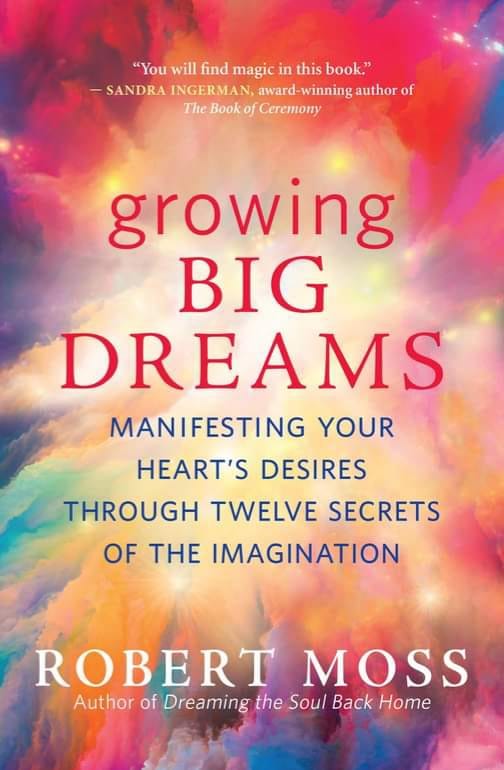


Adapted from Growing Big Dreams: Manifesting Your Heart’s Desires through Twelve Secrets of the Imagination by Robert Moss. Published by New World Library.


Photo (c) Robert Moss


Sunday, June 26, 2022

You Always Have the Freedom to Change Your Attitude, and That Can Change Everything


Terrible things are happening in our world. The worst nightmares of the mind-twentieth century seem to be returning. There are days when we might find it hard to rise above despair or escape a low, lethargic mood freighted with our own negative mantras. On days like that, I often call on one of the greatest life coaches I know.

I know him from his most famous book. Maybe you do too. His book is titled Man’s Search for Meaning. His name is Viktor Frankl. He was an Existentialist — which is to say, someone who believes that we must be authors of meaning for our own lives — and a successful psychiatrist in Vienna before Nazi Germany swallowed Austria in 1938. He was a Jew and a free-thinking intellectual, two reasons for the Nazis to send him to a concentration camp. For several years he was in Auschwitz, the most notorious of the Nazi death camps.

In the camp, every vestige of humanity was taken from him, except what he could sustain in his mind and his heart. He was in constant pain, reduced to a near-skeleton with a tattooed number on his arm, liable to be beaten or killed at any moment on the whim of a guard. He was there to be worked to death. He watched those around him shot or beaten or carted off to the gas chambers every day.

He made an astonishing choice. He decided that, utterly deprived of freedom in the nightmare world around him, he would tend one precious candle of light within. He would exercise the freedom to choose his attitude. It sounds preposterous, if you don’t know the story of what unfolded. When people tell us we have a bad attitude in ordinary circumstances, we are usually not grateful. The suggestion that we can choose our attitude when the world around us seems cold and bleak, or we have suffered a major setback, even heartbreak, sounds cruel, and maybe preposterous. But let’s stay with Viktor Frankl.

When the light went out in his world, he managed to light that inner candle of vision. Despite the pain in his body and the screams and groans around him, he made an inner movie, a film of a possible life in a world where the Nazis had been defeated and Hitler was a memory. It was an impossible vision of course, an escapist fantasy. There was no way he was going to survive Auschwitz.

But he kept working on his inner movie, night after night, as director, scriptwriter and star. He produced a scene in which he was giving a lecture in a well-filled auditorium in New York City. His body had filled out, and he was wearing a very fine custom suit. The people in the audience were intelligent and enthusiastic. The theme of his lecture was “The Psychology of the Concentration Camps.” In his movie, not only were the death camps a thing of the past. He had retained the sanity and academic objectivity to speak about what went on during the Holocaust from a professional psychiatric perspective.

This exercise in inner vision, conducted under almost unimaginably difficult circumstances, got Viktor Frankl through. Not only did he survive the death camp; in 1946, one year after the war, he gave that lecture in his nice new suit in the New York auditorium from his inner movie set.

What do we take away from this?

First, that however tough our situation may seem to be, we always have the freedom to choose our attitude, and this can change everything. Let’s allow William James to chime in: “The greatest weapon against stress is our ability to choose one thought over another.”

Second, that our problems, however bad, are unlikely to be quite as bad as the situation of someone who has been sent to a Nazi death camp. That thought may help us to gain perspective, and to stand back from a welter of grief and self-pity and rise to a place where we can start to dream up something better.

Third, we can make inner movies, and if they are good enough it is possible that they will play in the theater of the world.

If we take Viktor Frankl’s example to heart, we see that choosing your attitude can be an exercise in creative imagination that is much more practical and original than trying to edit your inner soundtrack (though that is worth trying) or telling yourself that you can’t afford the energy of a negative thought (you can learn to use the energy of any strong emotion, including grief and rage).


Text adapted from Growing Big Dreams: Manifesting Your Heart's Desires through the Twelve Secrets of Imagination by Robert Moss. Published by New World Library

Thursday, March 4, 2021

Ten Books That Gave Roadside Assistance on My Soul Journey


Books have been faithful and essential friends all my life. I had a difficult and lonely boyhood, an only child who suffered double pneumonia twelve times between the ages of three and eleven. Books were my portals to realms of imagination and wonder as I lay in the half light of sick rooms. I thrived on good historical novels and on scifi and fantasy.

I like to own paper copies of all the books I read so I can sniff them and caress them and interact with a pencil. I live with an extended book family of around 14,000 volumes. My best finds are often mediated by dreams and by lively shelf elves of the kind that make books materialize and dematerialize in magical ways. My cat Lucy has recently asserted herself as a shelf elf or more - a supervising librarian- on four paws 

Like my favorite writer, Jorge Luis Borges, I sometimes picture paradise as an Infinite library. Like another of my favorite writers, Mircea Eliade, I also know that the most important book I will ever write - and one of the most important I will ever read - is my own journal. Recording dreams, observations and reading reports in my journal is essential daily practice for me.

I was recently invited to identify ten books that have provided guidance and inspiration in my spiritual odyssey and share what was happening in my life when they came to me. My journal was there to remind me what restored my inner compass and put gas in my tank in the critical passages.


1

The Odyssey 

Since I was boy, the Odyssey has been my favorite vision of life as a mythic journey. Beyond the thrill of sea monsters and angry gods and one-eyed monsters, the tale of Odysseus, the “man of many ways” is the story of a wounded warrior who is healed in the realm of the Divine Feminine. This is why Robert Graves thought it was created by a woman, and I believe he is right. In the Odyssey we see what it means to travel consciously in the presence of a guiding spirit, in this case the goddess Athena. We see that dreams are a field of interaction between gods and humans and transit lounge between the Otherworld and the physical world. Has it been made clearer anywhere else that the hardest part of the heroic quest is the homecoming? A large part of the epic is devoted to the struggles of the returning traveler to find their feet on home ground. I have used many translations over the years, not least for occasional bibliomancy; my favorite now is the most recent; the clean, spare poetic version by Emily Wilson.


2

W.B.Yeats, Collected Poems 

I knew many of Yeats’ poems by heart before I was presented with my first copy of his collected poems at my graduation from Canberra Grammar School as a prize for writing verse.  In his “Song of Wandering Aengus” I thrilled to the bardic voice of one who lived close to the Otherworld, who knew the secrets of shapeshifting and understood soul loss and soul recoveryI learned much more from Yeats’ other writings, especially Mythologies and A Vision and from walking in his footsteps in Ireland, where it is easy to understand his statement that “the visible is the skin of the invisible”. He appeared to me during a shamanic journey, saying “What better guide to the Other Side than a poet?” and I was enchanted to let him play that role in my inner life as I wrote The Dreamer’s Book of the Dead. I learned the truth of his conviction that kindred spirits reach to each other across time and may generate a “mingling of minds”. I shared his experience of a creative daimon that is forever driving us to attempt the things that are most difficult, short of the impossible.


3

Dion Fortune, Secrets of Dr Taverner 

She was a true priestess of the Wester Way. I came to her first through her important book Psychic Self-Defence, which is not for the faint-hearted. I proceeded to read, over the years, everything that I could find by her. I was excited to discover that she regarded her fiction as her most important writing on the practice of real magic A character in her novel The Goat-Foot God says that "writers will put things into a novel that they daren't put in sober prose." Dion Fortune herself said "the novels give the practice." While I love The Sea Priestess and her other novels, it is the stories collected in The Secrets of Dr Taverner that I return to again and again. The central character is a soul doctor in tweeds who deals with such complains as reincarnational dramas, astral repercussion, psychic attack, soul theft and energy vampirism. The Taverner stories are both entertaining and a valuable source of practical guidance on psychic protection and spiritual cleansing. In its fictional wrapping, The Secrets of Dr Taverner is a practitioner's casebook and perhaps the most accessible of all Dion Fortune's works for the contemporary reader.


4

Jesuit Relations and Allied Documents *

When I moved in the 1980s to a farm on the edge of traditional Mohawk country in upstate New York, because of a hawk and a white oak, I started dreaming in a language I did not know, which proved to be an archaic version of the Mohawk language. The speaker was an ancient arendiwanen, or “woman of power”. Our encounters recalled me to ancient ways of dreaming and healing and gave me immense research assignments. In the way of synchronicity, a used book dealer turned up at my door with all 73 volumes of the Jesuit Relations in the back of his truck. These are the reports of blackrobe missionaries from Indian country in the 17th century. Read carefully, drawing aside the veils of religious prejudice and fear, we have here an extraordinary source on the spiritual practices of Native Americans in Northeast America at the time of first contact. The Iroquois taught their children that dreams are the single most important source of both practical and spiritual guidance. They believed that dreams show us “the secret wishes of the soul.” In a time of war and imported disease, they recognized dreaming as a key survival tool and sent their dream shamans to scout the future. You’ll find the essential things I learned from the Jesuit reports -and the direct teachings of the Mother of the Wolf Clan who led me to use them – in my book Dreamways of the Iroquois: Honoring the SecretWishes of the Soul.


5

C.G. Jung, Memories, Dreams, Reflections 

I discovered Jung in high school and devoured many volumes of his Collected Works when I was an undergraduate. In the midst of my own psychic storms in 1987–1988, I turned to Jung again, to see how he made sense of his own “confrontation with the unconscious.” My main source was Memories, Dreams, Reflections, his life story as recorded and edited by Aniela JaffĂ©. We did not yet have the Red Book, and the memoir is in any event a more accessible account of what was essentially the Underworld ordeal and initiation of a shaman-scholar of the West. Central to Jung’s ability to restore his inner compass was his daily recording of dreams. “Dreams are the facts from which we must proceed” is one of the most helpful statements that has ever been made about dreams and dreamwork, and confirmation for me of the method I was obliged to improvise in my own time of testing. He confirmed for me that engaging with images in your inner life – including the terrifying ones – is a path to healing and self-empowerment. I felt the deep truth of his ringing assertion that “anyone who takes the sure road is as good as dead.” I write about Jung as “The Dream Shaman of Switzerland” in my book Dreaming the Soul Back Home.


6

Jane Roberts, Seth Speaks 

When I was going through a crisis of spiritual emergence at midlife, a friend prevailed on me to read Seth Speaks, a book channeled by Jane Roberts from an intelligence who describes himself as “ an energy personality essence, no longer focused in physical matter”. Previously somewhat resistant to channeled material, I found myself gifted with the clearest model of multidimensional reality and the multidimensional self that I had encountered. The book was a life ring for me in my efforts to understand and navigate “past life” and parallel life connections. Seth confirmed for me that we may live many existences at one time. We are connected to personalities living in the past and the future and in parallel realities, ane it is all happening Now.  Reincarnation is for real, but only one of many after-death options, and we mustn't get trapped in linear conceptions of karma and in past-life "passion plays" because any past or future is a probable reality that can be accessed and changed Now.


7

Joan Grant, Winged Pharaoh 

Winged Pharaoh thrilled me with its vivid depiction of the practices of a dream school in ancient Egypt operating in the precinct of Anubis. Joan Grant published it as a novel, but revealed later that it is actually a book of “far memory” of a life in early dynastic Egypt. We follow Grant’s alter ego, Sekeeta, as she learns to go scouting in dreams to find lost objects, look into the future, observe things happening at a distance, and discover what is going on behind the scenes. As a child, she sleeps with a wax tablet beside her bed, and her first task each morning is to record her dreams. She takes her reports to the priest of Anubis, her dream teacher. Some days she must carry out assignments he gave her inside a dream – for example to bring him a certain flower, or bird feather, or colored bead. She learns to travel in dreaming beyond time and space, to scout the possible future, and to communicate with the deceased. She encounters people who have died and are confused about their condition and moves into the role of psychopomp. In the language of ancient Egypt, a dream (rswt) is literally an “awakening”. Winged Pharaoh reawakened me to what it means to dream like an Egyptian and I have used it as a handbook in guiding others.  


8

Henry Corbin, The Man of Light in Iranian Sufism 

A lifelong student of the medieval Sufi philosophers, French scholar Henry Corbin brought the term Imaginal Realm into currency in the West. In Arabic, the term is Alam al-Mithal and it refers to the realm of true imagination, an order of reality that is at least as real as the physical world, with cities and schools and palaces where human travelers can interact with master teachers. Corbin’s great work Creative Imagination in the Sufism of Ibn ‘Arabi is a marvelous essay in visionary spirituality that embodies his driving purpose of helping to free the religious imagination from all types of fundamentalism. Corbin regarded study as a quest. In The Voyage and the Messenger looking back on his scholarly journey, he wrote that “to be a philosopher is to take to the road, never settling down in some place of satisfaction with a theory of the world…The adventure is…a voyage which progresses towards the Light". His books were with me, to anchor and orient, through the incandescent nights when I found myself in dialogue with Persian philosopher mystics and riding with the heaven bird of Persian mythology, the Simurgh. The Man of Light is Corbin’s most accessible work and one to which I return again and again. The subtitle of my book Mysterious Realities is Tales of a Dream Traveler from the Imaginal Realm.


9

W.T. Stead, The Blue Island 

I love the Victorian ghost hunters, especially F.W.H. Myers, W.T. Stead and William James. They were passionately dedicated to producing evidence of the survival of consciousness after physical death that would meet the scientific standards of their day. They promised that after their deaths they would continue their work by trying to communicate in exact detail from the Other Side. Among all the channeled books that resulted, my favorite is The Blue Island,in which Stead (who went down with the Titanic) recounts his early after death experiences to male mediums sitting in the presence of his daughter. As a former journalist, Stead is especially interested in how news is transmitted in the transition zone where he finds himself. He describes a communications center, “an amazingly well organized and businesslike place” constantly filled with ex-physicals. “Those who had on earth believed and those who had not, came to try and wire a message home.” The ones who feel a “heart call” always get priority. They have a system of “travelers”, who can reach receptive minds on Earth. Stead describes how the living can reach to the departed in a similar way. You concentrate on an individual in the spirit world, and if you put enough energy into that thought, the individual you have in mind will feel you and you may be able to open a communications channel. This beautiful little book is one of the essential Western books of the dead.


10

Viktor Frankl, Man’s Search for Meaning 

I reread this extraordinary book every few years. A successful Jewish psychiatrist in Vienna, Viktor Frankl was carried off to Auschwitz and reduced to a walking skeleton with a tattoo on his arm. In one of the darkest nightmares of history, he applied his imagination. He grew an impossible dream: of a scene in the future when the Nazis were a memory and he was standing in front of a well-fed audience in a good suit giving a lecture on “The psychology of the Concentration Camps”. In his vision the Nazi evil was so thoroughly destroyed – and he so thoroughly restored – that he could lecture about it from an objective perspective. Frankl not only survived the Holocaust. His dream played out a year after the war, in every detail. I have derived three life-orienting lessons from this. First, that however tough our situation may seem to be, we always have the freedom to choose our attitude, and this can change everything. Second, that our problems, however bad, are unlikely to be quite as bad as the situation of someone who has been sent to a Nazi death camp. That thought may help us to gain perspective, and to stand back from a welter of grief and self-pity and rise to a place where we can start to dream up something better.Third, we can make inner movies, and if they are good enough it is possible that they will play in the theater of the world.


 I look over this list and wonder why it does not include so many other books and authors that have affected me deeply: Albert Camus, Rilke, Herman Hesse, the Upanishads, Dostoyevsky, Christopher Brennan, The Tibetan Book of the Dead, Hilda Ellis Davidson, Ursula Le Guin, Mary Oliver, AE (George Russell), the (for me) inescapable Borges and Eliade. Again, my journal shaped my selections, reminding me how certain books converged with critical passages of spiritual emergence in my life, when I needed confirmation even more than inspiration.


*I'm not expecting anyone to read the 73 volumes of the Jesuit Relations that are on my shelves although today you can no doubt find them onlne. I was looking over the books that gave me anchors and life rings in decisive passages in my journey.In this case, I needed confirmation of what I was learning from the Mother of the Wolf Clan I call "Island Woman"in my books. In another book that was very important to me, The Journal of Major John Norton, a half-Cherokee British officer in the war of 1812, I confirmed the historical identity of Island Woman as the grandmother of Molly and Joseph Brant, born Huron (Wendat) and adopted into the Mohawk natoion after she was captured by a Mohawk raiding party aged about five.


Tuesday, October 6, 2020

The Stronger the Imagination, the Less Imaginary the Results


The greatest crisis of our lives is a crisis of imagination. We come to a dead stop because there is a barrier in front of us and we can’t imagine a way to get around or over it. Our work space feels like it is walled with cement blocks that are closing in tighter every day, but we can’t imagine where we would go if we quit. We can’t breathe in an airless relationship but can’t imagine how to take off.  We look in the mirror, when we dare, and see the age lines, the skin blemishes, maybe the thinning hair, not the beauty that we may carry inside. 
    We go on repeating to ourselves the tired old stories, strapped on to us by family or past histories of defeat and disappointment. Or we cling to past memories of brighter days, or that win on the high school sports field, or that sweet summer romance, or that medal for valor or that early success that was never repeated. Either way, by nursing grief or guilt or nostalgia, we manage to go through life looking in the rear vision mirror, stuck in the past, never fully available to the present moment.
     Or we miss the moment by carrying anxiety about the future, playing scenarios for what could go wrong. We give ourselves a hundred reasons not to take the risk of doing something new, something that would take us beyond the gated communities of the mind into the wilds of creative adventure.
    Conscious of it or not, we go around playing our negative mantras. I’m too old. I’m not pretty enough. I don’t have the money. People always let you down. People don’t change. I’m so tired. You don’t think you do this? Pause for a moment. Take off the headphones. Listen to what’s playing on your inner soundtrack. It may be a song. Am I blue?
     I confess there are days, especially between snowstorms in a Northeastern winter, when my mood can slump and go the color of the dirty grey ramparts of ice on the curb in my small gritty city. And more days like these in the shut-up times of pandemic I don’t want to get out of bed even to walk the dog, who is waiting for me patiently. I may be stirred back to life by a dream or a cheering message from a loved one or a plan for an ocean beach vacation or a foreign adventure. But when I find it is still hard to rise above a low, lethargic mood and dump those negative mantras – My legs hurt, I’m played out, I can’t walk on the ice – I call in one of the greatest life coaches I know.
      I know him from his most famous book. Maybe you do too. His book is titled Man’s Search for Meaning. His name is Viktor Frankl. He was an Existentialist – which is to say, someone who believes that we must be authors of meaning for our own lives – and a successful psychiatrist in Vienna before Nazi Germany swallowed Austria in 1938. He was a Jew and a free-thinking intellectual, two reasons for the Nazis to send him to a concentration camp. For several years he was in Auschwitz, the most notorious of the Nazi death camps.
      In the camp, every vestige of humanity was taken from him, except what he could sustain in his mind and his heart. He was in constant pain, reduced to a near-skeleton with a tattooed number on his arm, liable to be beaten or killed at any moment on the whim of a guard. He was there to be worked to death. He watched those around him shot or beaten or carted off to the gas chambers every day.
     He made an astonishing choice. He decided that, utterly deprived of freedom in the nightmare world around him, he would tend one precious candle of light within. He would exercise the freedom to choose his attitude. It sounds preposterous, if you don’t know the story of what unfolded. When people tell us we have a bad attitude in ordinary circumstances, we are usually not grateful. The suggestion that we can choose our attitude when the world around us seems cold and bleak, or we have suffered a major setback, even heartbreak, sounds cruel, and maybe preposterous. But let’s stay with Viktor Frankl.
     When the light went out in his world, he managed to light that inner candle of vision. Despite the pain in his body and the screams and groans around him, he made an inner movie, a film of a possible life in a world where the Nazis had been defeated and Hitler was a memory. It was an impossible vision of course, an escapist fantasy. There was no way he was going to survive Auschwitz.
     But he kept working on his inner movie, night after night, as director, scriptwriter, and star. He produced a scene in which he was giving a lecture in a well-filled auditorium.. His body had filled out, and he was wearing a good suit. The people in the audience were intelligent and enthusiastic. The theme of his lecture was “The Psychology of the Concentration Camps.” In his movie, not only were the death camps a thing of the past; he had retained the sanity and academic objectivity to speak about what went on during the Holocaust from a professional psychiatric perspective.
    This exercise in inner vision, conducted under almost unimaginably difficult circumstances, got Viktor Frankl through. One year after the war, in a good suit, he gave that lecture as he had seen himself doing in his inner movies.

What do we take away from this?
     First, that however tough our situation may seem to be, we always have the freedom to choose our attitude, and this can change everything.  Let’s allow William James to chime in: “The greatest weapon against stress is our ability to choose one thought over another.”
     Second, that our problems, however bad, are unlikely to be quite as bad as the situation of someone who has been sent to a Nazi death camp. That thought may help us to gain perspective, and to stand back from a welter of grief and self-pity and rise to a place where we can start to dream up something better.
     Third, we can make inner movies, and if they are good enough it is possible that they will play in the theater of the world.
     Would you like to make your own life movies, in which you enjoy the satisfaction of your deepest desires? Are you willing to grow a vision of bright possibility so rich and alive that it wants to take root in the world?
      Here are some secrets of the imagination that will get you on your way.


Dreams Show You the Secret Wishes of Your Soul

Every night, if you make the effort to catch some of what is going on, you will find that your dreams take you beyond what you already know. You already have a personal film production company, behind the curtain of the world, that is making dreams exclusively for you. That comedy or horror flick, that romance or action adventure, may be screened in the night to help you see where you are and how you are, or to give you a glimpse of other life possibilities. In other dreams, you get out and about, you socialize, you make visits and receive visitations.
      Dreaming, you travel without leaving home and can be as social as you like. You are also a time traveler. You travel to past times, parallel times and into the possible future. You scout out challenges and opportunities that lie ahead. Beyond seeing the future, it is possible that, dreaming, the observer effect noted in physics comes into play and you take part in the selection of events that will manifest from a quantum soup of possibilities.
     There is even more going on in your nights. Indigenous wisdom teaches that through dreams we learn the secret wishes of the soul.. We are called to follow our heart’s desires, as opposed to the calculations of the ego and other people’s agendas and expectations. We are recalled to our deeper life purpose, and given sources and resources in a deeper reality that will help us to follow our path with heart.


Your Great Imagineer Is Your Magical Child

Don’t doubt for a moment that you have the imagination required to grow a vision of manifesting your heart’s desires that can carry you beyond the stuck places and the dark dreary times. Your inner child is a master of dreams and imagination. She knows the magic of making things up. She engages effortlessly in the deep play that generates creative ideas without regard for consequences. Maybe you lost contact with her as you started to grow up and the adult world trod on her dreams. Maybe there was a time when her world seemed so cold and cruel that she wanted to run away, and may actually have succeeded in running away, so a safe space in Granma’s house or a garden behind the Moon. Maybe this is why you have been in a dream drought for so long; when she went away, you lost the beautiful bright dreamer in you. In chapter 2, you are going to learn how to reclaim that Magical Child, how to convince her that you are safe and you are fun so that you can bring her energy and joy and imagination into your current life.


What Is in Your Way May Be Your Way


The philosopher emperor Marcus Aurelius came to accept, as a rule for his own life, that the obstacle may be the way. When you find yourself blocked or challenged on your life road, that may be a prompt for you to look for a better way, or develop needed skill or the pluck and perseverance to see something through. you’ll want to look again at what you feel is blocking or opposing you on your life road. Sometimes a block is a pause button, indicating, Not right now. Try later. You may discover that a block has been placed in your way to induce you to find a better way. For every door that won’t open or slams shut in your face, look for one that maybe opening. For every setback, search for opportunity. Look for a gift in every wound or challenge though this can be hard and may require hindsight from some distance away. 


Your Big story is hunting you

Australian Aborigines say that the Big stories are hunting the right people to tell them, like predators stalking in the bush. The trick is to put ourselves in a place where the Big stories can find us. We do that when we attend to our dreams and the dreamlike play of symbols and synchronicity in the world around us. We want to learn to step out of the tired old stories we have inherited from family, from other people telling us who we are, from personal histories of failure and defeat. When we are seized by the Big story, we step beyond limiting definitions and beliefs. Great healing becomes available because we can now draw on the immense energy that is generated by the sense of serving a larger purpose and living a mythic life. The muse, or creative genius, and the intelligences of the world-behind-the-world come to support our life projects, because we are following a deeper call.

Your world is as rich or poor, as alluring or dull, as you can imagine. Listen to your dreams, let your inner child out to play, put yourself in a place where you bigger story can grab you. When you move in the energy field of ta big dream of life, the world responds to you, because you are magnetic. You generate events and encounters that open new doors, and your days sparkle with a champagne fizz of magic. Your dreams speak louder and brighter and the extraordinary comes to meet you on any street corner.

      On days when you feel down and defeated, remember Viktor Frankl, dreaming his way out of the nightmare of the death camps. On any day, you have the freedom to choose your attitude, and this is an exercise in creative imagination that can change everything.


Adapted from Growing Big Dreams: Manifesting Your Heart’s Desires through Twelve Secrets of the Imagination by Robert Moss. Published by New World Library.


Thursday, October 3, 2019

At home with the philosopher emperor


I have been rereading the Meditations of Marcus Aurelius in the excellent recent translation by Gregory Hays. I opened the book at random and found my favorite line (“A man’s life is dyed in the color of his imagination”) rephrased in different English: "Your soul takes on the color of your thoughts." On the next the page, I came to essential counsel: what seems to be in your way may be your way. Marcus Aurelius, in the Hays version, puts it like this:

"Our actions may be impeded...but there can be no impeding our intentions or their dispositions. Because we can accommodate and adapt. The mind adapts and converts to its purposes the obstacle to our acting. The impediment to action advances action. What stands in the way becomes the way." [Book 5, 20]

               
Stoic encouragement, from 19 centuries ago, to make friends with our blocks and look for opportunity in any setback.


I turned back to the beginning of the book, possibly not to be recommended since the contents are not structured in any way. Book 1 might seem to belong at the beginning, since it is mostly composed with the emperor's testimonials to mentors (above all Antoninus, the previous emperor). But after this we get recurring ideas and no apparent evolution in personal thinking. The division of the books was probably dictated by the space available on a single papyrus scroll; you come to the end of one and start a new book.
    In his introduction, Hays reminds us that Marcus was not writing for publication and maybe only for an audience of one: himself. He did not give his reflections a title. He wrote a New Thought book for himself, to remind him how to respond to adversity and why he should get out of bed in the morning.
    Throughout he insists that we can come to no real harm if we follow the Logos in ourselves and in the cosmos. It seems that Logos here means something similar to the Dharma in Eastern thought.
     Life is short, Marcus reminds us again and again. And at the end, it seems, we either dissipate as atoms or stream into a greater light. There is no indication here that Marcus believed in a personal afterlife. He certainly did not believe that it matters whether we are remembered by others. They will die too, and those who come later will forget all of us.
There is the stern military injunction: stand at your post, fulfill your assignments, be a Roman. Not surprising in a man compelled to spend so much time with the legions – fighting in Germania, suppressing the Sarmatians, containing the Parthians, dealing with the revolt of Cassius.
   Knowledge has three divisions for him: physics, logic, ethics. His writings are devoted to the third: to mortal duty towards others and towards the order of the universe. He affirms – no doubt against all external evidence – that whatever happens in the world is for the best, that God or gods have a secret plan in conformity with Logos.
    Like Viktor Frankl in Man's Search for Meaning, the Stoic emperor contends that whatever our circumstances, we always have the power to choose our attitude. We can go into an inner fortress that is unassailable from without.


Illustration: Teasing the HG Curtain


I lay down the book, stretch out on the bed,and close my eyes.I immediately see a beautiful woman in a red dress. She swings on theater curtains, opening and closing my view of the space beyond. I see a giant head in profile. It looks like a Roman portrait bust. Beyond it, the scene is bright and warmly lit but undefined from where I am observing. Shall I go through the curtain?


Wednesday, August 14, 2019

Dream Growing in Auschwitz

Every human being has the freedom to change at any instant.
-
- Viktor Frankl, Man's Search for Meaning

He has been reduced to a number tattooed on his arm. His ability to survive until tomorrow depends on being able to dig stones for a long day without collapsing from malnutrition and fatigue, and on being able to get a few peas at the bottom of a bowl of soup, and at not falling foul of one of the SS guards or the no less brutal Capos, fellow-prisoners selected to act as wardens and help select who will be sent to the "bathhouse" that leads to the crematorium. He reaches into the storehouse of memory for images that can help him to live. He cherishes little things from the life that has been taken from him, like taking a bus ride, or turning on the lights in his apartment, or finding real food in the kitchen. Most of all, he cherishes the image of his wife. He doesn't know whether she is still alive, but the great love between them is real, and helps to sustain him.
    When he can get scraps of paper, he tries to reconstruct the book manuscript that was torn from him by a Capo when he came here. He dreams of seeing it published. In the indeterminate state of a death camp prisoner, with no way of knowing whether he will live or die within the next hour, he chooses to grow a vision of the future in his mind. It is an extraordinary vision, and it takes a terrific act of will for him to turn his mind from his bleeding feet and aching stomach to inhabit a future that very few could begin to imagine. The emaciated prisoner of Auschwitz transports himself to a warm and comfortable lecture room, in a civilized time and place in which the horrors of World War II lie in the past. The speaker is the prisoner himself, Dr Viktor Frankl. From the platform, he surveys an attentive audience, seated on handsomely upholstered chairs. His topic? The psychology of the concentration camp.
-   After his release from Auschwitz and the fall of the Third Reich, Viktor Frankl recalled the effect of this remarkable exercise in active imagination. "All that oppressed me in that moment became objective, seen and described from the remote viewpoint of science. By this method I succeeded somehow in rising above the situation, above the sufferings of the moment, and I observed them as if they were already of the past. Both I and my troubles became the object of an interesting psychoscientific study undertaken by myself." [1]
-   This is a stellar example of the power of dream growing - of developing a creative vision powerful enough to carry you beyond adversity. Inside one of the worst of history's nightmares, Viktor Frankl reclaimed the identity and the future that had been torn from him. He not only saw himself surviving the death camps; he saw himself emerging to found a new approach to psychology on what he had learned from them. In doing this, he stepped outside and above his appalling circumstances to adopt the perspective of a witness and a scientist. He transported himself to a future time in which the hideous collective nightmare was in the past. In doing this, he succeeded in escaping, mentally, from the camp. But he did more: he reached for a possible future so powerfully that it seems than an answering force helped to pull him towards it.
-  Whatever the pain and adversity of our lives, we can all take heart from Viktor Frankl's tremendous example. Even when all other freedoms are denied to us - he later insisted - we can never lose one final freedom, the freedom to choose our attitude. We can choose to give up, or to struggle on. We can choose to find meaning in our suffering, or to pronounce our world unfair and meaningless (as too many people do under circumstances that look quite comfortable to most of the world's poor, let alone a death camp inmate). It is our choice. If we choose to believe that we have no choice, we are still making a choice. If Viktor Frankl could say yes to life in Auschwitz, and find meaning in what life threw at him, even there, who are we to go about with the misery-guts attitude that life is unfair, or meaningless?
-   Frankl founded the method he called logotherapy, sometimes described as the third of the great Viennese schools of psychology (after Freud and Adler). As the name suggests, this is therapy based on the need for logos or meaning. The central thesis is that many of our ailments are noögenic - that is to say, they have their origin in the realm of noös, or mind, rather than in the psyche as observed by psychiatrists, or the body as diagnosed by physicians. The human animal needs meaning as well as food and air and sex and water. The sense that life is meaningless is at the root of a great deal of depression, aggression and addiction, which can only be addressed by a restoration of the sense that life is meaning-full.
-   How do we find meaning in our lives? We find it in work, especially through creative action. We find it as we engage in the world, and with other people. We find it - Frankl insisted over and over - in the attitude we adopt in the face of unavaoidable suffering.
    Let me add that we also find meaning through our engagement with our dreams. Our dreams, and the powers that speak to us in dreams, are forever inviting us to reclaim the knowledge of who we are, why we are here, and what our purpose is in our current life experience.
-  I read Man's Search for Meaning when I was a student. I've read it four times since, and I expect I'll read it again. It offers perennial wisdom. Frankl deploys several of my favorite quotes that are relevant to his theme.
-   From Nietzsche, he borrows this celebrated and telling truth: "He who has a why to live can cope with almost any how."
    From Dostoyevsky, this: "My only fear in life is of not being worthy of my suffering."
    From Spinoza: "Suffering ceases to be suffering as soon as we produce a clear and precise picture of it."
    And then he quotes the Viennese writer, Arthur Schnitzler, a contemporary of Freud and author, inter alia, of a novella titled "A Dream Story". Schnitzler maintained that there are really only three virtues, which he itemized as follows: objectivity, courage, and the sense of responsibility. An interesting choice for a poet.
     We saw something of the merit of "objectivity" in the way Frankl was able to take himself out of his situation in the death camp and look down - and back - from the viewpoint of a scientific observer. Courage, certainly, is a fundamental virtue. It is not the absence of fear; that could be psychosis or reckless stupidity. Courage is fear conquered by something stronger than fear, by love, or belief, or duty, or a cause. The sense of responsibility - of being responsible for our own lives, first and last, and for exercising our power to choose our responses to whatever life gives us - is clearly of vital importance in a life that meets the existential challenge:

Ultimately, man should not ask what the meaning of his life is, but rather he must recognize that it is he who is asked. In a word, each man is questioned by life; and he can only answer to life by answering for his own life; to life he can only respond by being responsible. [2]

Not a bad exercise, in our own quest for meaning, to name the three virtues that count for most in our own experience. Whatever selection we make, for me, as for Frankl (thinking of his beloved wife in the death camp) the fundament of all is love. This is what makes us human, and sustains us daily, even when we dare not say its name.


[1] Viktor Frankl, Man's Search for Meaning (New York: Pocket Books, 1985) p.95.
[2] ibid p.131.

Sunday, March 17, 2019

Choose the Day


Carpe diem, goes the old Latin tag. “Seize the day.”  The sole commandment of conscious living is no less proactive, but more conscious: choose the day.
What we encounter on any day has a great deal to do with what we bring to that day. We draw or repel different events and encounters according to our attitudes and the basic energy we are carrying. We find doors open or closed according to our willingness or refusal to change our expectations and our plans as circumstances change.
We choose every day, whether we are aware of this or not. If we tell ourselves we have no choice, that is a choice we are making. If we tell ourselves that we have no choice because a situation is beyond our control, we forget that we can still choose our response to the world, and that can change everything. Whenever I hear someone — perhaps a voice within myself — bleating or protesting that the world is cruel and can't be changed, I think of Viktor Frankl in the nightmare of Auschwitz.
At the close of a beautiful week of soul healing and shared dreaming in one of my Active Dreaming workshops, I asked the members of our circle to choose the day, in a personal statement. Here's a sampling of what they said:
“I choose to be present today with all of my senses.”
“I choose to have Tiger in my heart.”
“I choose to follow my soul's purpose.”
“I choose to see my waking life as a dream.”
“I choose to travel with the energy of the group.”
“I choose to be compassionate.”
“I choose to be a survivor.”
“I choose to soar with the bird and see my roads from a higher perspective.”
“I choose the fire.”
My own statement, on that day: “I choose to live as if everything matters.”
Truth, in our lives, is what we remember and act upon. Lists of rules or intentions can become like grocery lists; we are forever in danger of forgetting items or getting what matters mixed up.  So my list of personal commandments reduces to this: Choose the day. The content of that choice is less important than the consciousness that we have a choice and need to approach life, on any day, as choosers, not spectators, victims, or consumers.


Text adapted from Active Dreaming by Robert Moss. Published by New World Library.

Photo: Path of Magic at Mosswood Hollow by RM. This is where I lead extraordinary adventures and trainings, including my five-day residential retreat "Writing as a State of Conscious Dreaming", one of the most unusual creative writing workshops on the planet.