Showing posts with label Athena. Show all posts

Tuesday, December 19, 2023

Homer's Book of Portents

The homecoming is often the hardest part of the hero's journey. Odysseus has survived sea monsters and sirens and the wrath of a sea god and is at last on his home island. But he has been away for ten years since the war he went to fight, and almost everyone believes he is dead. His palace is full of brutish and lustful men, suitors vying for the hand of his wife Penelope and with it, his kingdom. Their appetites are laying waste to his livestock, his wine cellar and his female servants.
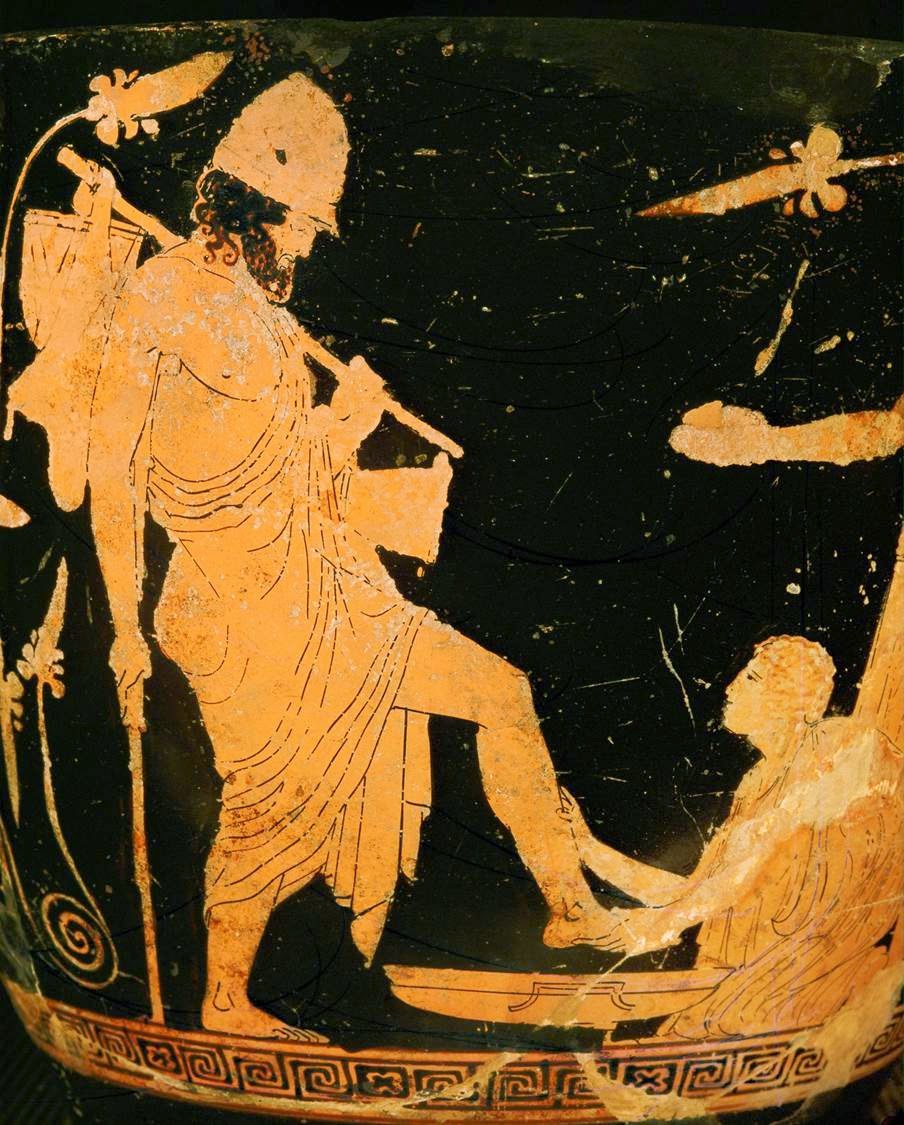
     At the prompting of his constant guide, who is no less than the goddess Athena, Odysseus has disguised himself in the rags of a beggar, with a funny traveler's hat. He is mocked and scorned by the suitors and even some of his own retainers. Nobody recognizes him. They will find it hard to recognize him even when he shows himself in a different form. His homeland seems stranger to him than the magic realms from which he has returned. He must be asking himself, Which is the dream? He may be wondering whether he is dead.
    He spends a sleepless night, tossing and turning. This is wonderfully conveyed in the muscular modern verse of Robert Fagles, which will speak to anyone who has struggled through a night like this:


...But he himself kept tossing, turning,
intent as a cook before some white-hot blazing fire
who rolls his sizzling sausage back and forth,
packed with fat and blood - keen to broil it quickly,
tossing, turning it, this way, that way - so he cast about


- Odyssey Book 20, lines 27-30, Fagles translation

    The "man of many ways" is seeking a way to expel the suitors who have taken over his home. But they are many and he is one, and even if he finds the way to kill them all, their kinsmen will come to take revenge. The goddess Athena now appears to him in mortal form, "swooping down from the sky in a woman's build and hovering at his head". She wants to know why he is still awake, fretting and exhausting himself. Why does he distrust her when she assures him that he will gain victory that day? Athena promises that "even if fifty bands of mortal fighters closed around us, hot to kill us off in battle" - because she is with him.
     Athena "showered sleep across his eyes", but when Odysseus wakes, on the morning of Apollo's feast day, even the promise of a goddess is not enough. He wants further signs. He speaks to the All-Father, Zeus. "Show me a sign." In fact, Odysseus asks for two signs, "a good omen voiced by someone awake, indoors" and "another sign, outside, from Zeus himself."
     He is answered at once by a great roll of thunder, out of a clear blue sky.
     Then he hears a "lucky word" from a woman grinding grain inside the halls. Hearing thunder from a cloudless sky, the woman recognizes a sign from Zeus. She speaks aloud to the king of the gods:


Sure it's a sign you're showing someone now.
So, poor as I am, grant my prayer as well;
let this day be the last, the last these suitors
bolt their groaning feasts in King Odysseus' house!

- Odyssey Book 20, lines 128-131

    The twin oracles - from the sky and from overheard speech - harden Odysseus' resolve, and the scene is set for the astonishing slaughter of the suitors under the rain of arrows from the bow that none but the hero (and his son) can bend. In the Fagles version, Book 20 of the Odyssey is given the title "Portents Gather", and it is a good one. Here we see oracles speak in ways the Greeks observed closely and valued highly: through brontomancy, divination by thunder, and cledonomancy, divination by overheard speech or sound.
    In the Odyssey, as in ancient Greek society, dreams and visions are the most important mode of divination. Yet our understanding of dreams may be deceptive, as Penelope explains in Book 19, when she speaks of the since-famous gates of ivory and horn. So even when blessed by a direct encounter with a goddess, the hero turns to the world around him for confirmation.


Quotations are from Robert Fagles (trans) The Odyssey published by Penguin Books.

Graphic: Odysseus in beggar's disguise, about to be identified by his childhood nurse Eurykleia, when she sees the scar on his thigh from "the wound I took from the boar's white tusk on Mount Parnassus."

Sunday, May 7, 2023

Know the myth you are living


We all conceal
A god within us, we all deal
With heaven direct, from whose high places we derive
The inspiration by which we live.
 

-          Ovid, Ars Amatoria III, 549–550 (trans. James Michie)


As some people use the word, myth is synonymous with fake news, or superstition, or outmoded hand-me down beliefs. A myth may be a prevailing worldview – that the earth is flat or the still center of the turning universe, that humanity begins with Adam and Eve, that the world is enthralled by a dark Demiurge. For the Greeks, mythos was the spirit of the play, familiar to the audience yet as unpredictable as the gods in how it would unfold in a fresh drama.

A myth may be a sacred teaching story that explains how the world came into being – and what is beyond it – and why bad things, as well as good, things happen, and what it means to be human. A myth may justify the ways of gods to humans, or those of humans before their Creator. A myth may introduce you, like the major arcana of tarot, to essential members of your archetypal family: to personified forces at play in your life and your universe.

A myth may invite you to consider who among the gods defends you, and who has it in for you. A myth may also be a living reality beyond the realm of facts, a source of truth that cannot be confirmed in a laboratory experiment but may be evidenced by the data of raw experience.

Your dreams can be a nightly screening of gods and archetypes. A dream may be your place of encounter with a Big story that is looking for you. It may call you to a tradition about which you previously knew nothing ."In the absence of an effective general mythology, each of us has his primary, unrecognized, rudimentary, yet secretly potent pantheon of dream," as Joseph Campbell wrote in The Hero with a Thousand Faces. Psychologist Betsy Meador was called to study Inanna and her priestess after a dream that involved the prayer flags of the great Sumerian goddess, Queen of Heaven and Earth, that were previously unknown to her.

I was seized by Kali in a terrifying night vision – beginning with sleep paralysis – when I was fourteen. I wrote a cycle of poems in her honor. Later her brother-consort Kala, better known as Yama, became one of my principal mentors, reminding me to consider every life choice in the presence of Death. A little-known Celtic deity came into my ken in a series of dreams in which I was defending my property with a long-handled hammer, like a weaponized croquet mallet. Some shelf elf produced a Gallo-Roman statue of a god with a similar hammer, named in the inscription as Sucellos, which means the Good Striker. He seems to share some qualities with Thor. He is also the consort of a great goddess of abundance, called Rosmerta by the Gauls and Abundantia by the Romans.

We confirm our relationship with a patron deity, or power animal, when it comes to our aid. Athena came to me like this in Anatolia and loaned me her owl eyes. The Bear has come to me like this many times since it claimed me when I found the courage to step back into the space of a dream where it had terrified me.

Myths are a cauldron of stories and symbols that hold superabundant energy for life. You want to become conscious of the myth you are living. If you are unconscious about this, then the myth is living you and you may be driven into confusion and disaster, like Odysseus when his men lose control of the winds. In different phases of life, we may inhabit – and be inhabited by – different myths. We may find ourselves in the play of rival stories. We may be able to match and mix.

The great scholar of religions Wendy Doniger writes about the “seed text”, bija mantra. In her book Splitting the Difference: Gender and Myth in Ancient Greece and India, she describes how she found this in the story of an Indian goddess, Saranyu, who cloned herself in order to get away from a husband she detested, leaving a compliant Hindu version of a Stepford Wife at home while she ranged free as a wild mare. This story kept after Doniger for decades, prompting her to reach deeper and deeper into its well. Whenever she heard it, she would say, “That’s the story of my life.”

“Myth, by design, makes it clear that we are meant to be something more than our personal history,” declared P.L.Travers, the author of Mary Poppins who was inspired to make Mary a star traveler by a childhood vision of her deceased father turning into a star.

The myths we are living now swing on hinges into other lives, whose myths swing back at us. Because our present life dramas are connected with those of other personalities, in other places and times, within our multidimensional family, it is not surprising that “old” gods and “dead” religions feature in our spontaneous mythology, as mediated by dreams and visions and by moments on the roads of this world when we experience a hidden hand, pushing us forward or holding us back, or rearranging the stage set.


Illustrations by Robert Moss. Original mixed media paintings.

Top: Eyebrows of Zeus

Bottom: Faces of Yama

Monday, February 6, 2023

Through the dream gates to initiation


True initiation involves both ordeal and ecstasy. “The majority of initiatory ordeals more or less clearly imply a ritual death followed by resurrection or a new birth,” commented the great religious historian Mircea Eliade. “The novice emerges from his ordeal endowed with a totally different being from that which he possessed before his initiation; he has become another.”[1] The initiate is a made man or woman.

The hunger for transcendence, through a primal, direct encounter with the sacred, leads people down strange and dangerous byways: into experiments with hallucinogenic drugs, into dubious cults and ersatz Nativism. Yet the authentic call to initiation continues to resonate in our dreams. And through the dream gates, it can be followed to a genuine consummation. Arguably, it can hardly be pursued in any other way since — whatever the externals of ceremony and culture — true spiritual initiation and apprenticeship always take place on the inner planes, in a deeper order of reality.

Even in societies where Mystery initiation was regarded as central to human fulfillment, and its gates and secrets closely guarded, the validity of an individual dream calling and initiation was honored. There is a fascinating story about this from the Hellenistic world, preserved by Sopatros, a teacher of rhetoric. A man dreamed he had attended the epopteia, the crowning revelation of the Eleusinian Mysteries. He recounted the secret rituals of the Telesterion in vivid and accurate detail to an initiate of the Greater Mysteries. But in ordinary reality, the dreamer was not a “made man.” 

The initiate to whom he told his dream was shocked that he was speaking openly about things he had no right to know and denounced him for sacrilege. He was dragged into court, where his accusers demanded the death penalty. However, the defense argued successfully that the gods themselves had played a part of the hierophant in his dream. His dream of initiation was recognized as true initiation; the dreamer would now be respected as an epoptes — one who had “seen” and gone through the sacred fire.[2]

Contemporary dreamers who have never heard of Eleusis have dreams of the same quality.

At the winter solstice, just after her twelfth birthday, Rebecca had a powerful dream that carried her deep into the Otherworld. In her dream, she was invited to enter an immense hall. It was filled with robed figures she described as “wizards.” They came from many races and traditions; she recognized a “Merlin” character among a Celtic contingent. 

A woman robed in white sat enthroned above the throng. She beckoned to Rebecca to approach her. The male wizards ignored Rebecca except for the forbidding figure who moved to block her path. He challenged her to pass a test. Only when she had passed the test was she allowed to ascend the steps to the throne. “The High Priestess was slim and dark-haired. She seemed to be in her late twenties. She spoke to me by thought rather than words. She appeared outwardly solemn as she held court over all the male wizards, but kept cracking mental jokes that only the adepts caught.”

The High Priestess wore a striking pendant, which I asked Rebecca to draw for me. Her drawing showed an equal-armed cross, set within a circle. Crossed staves behind it make the pattern of a diagonal cross within a much larger circle, bordered by a two-headed serpent. The body of the serpent is engraved with writing in Greek characters. There are more inscriptions on scrolls that flank the central cross, which has four crystals in its setting. The wizard who challenged Rebecca wore a simpler version of the same pendant.

For a girl approaching puberty, this dream might carry many levels of meaning. But we spent no time in dream analysis. We celebrated the sense of strength and magic and possibility that Rebecca had drawn from it. She reveled in her special dream relationship with the High Priestess seated above all those powerful men. When I asked Rebecca to sum up the feeling of the dream, she said with little hesitation, “I am coming into my power.”

Nearly three years later, in another spontaneous sleep dream, Rebecca reentered the great hall where she had encountered the High Priestess: 

"This time everything is different. Instead of everyone ignoring me, all the high priests from all the worlds bow down to me and hold out their arms to me.

"The High Priestess stands and holds out her arms. She says, Come, let me show you my mind. Only she does not exactly say it; she suggests it.

"She takes my hand. From her forehead a bright light emerges, and in the bright light I see a gate. I walk toward this gate. When I pass through it, I encounter three beings. The first is a bird-headed man who has given me guidance before. He shows me what happens to people who sell out their values in life. The second is a woman I know to be an immortal. She wears a crowned helmet and carries a shield and spear. She tells me, We are one and the same. The third is a man I do not know. I have the feeling this man will be important in my future life.

"When I finish observing this man, I see another gate to walk through. I travel in this way until the bright light dims and all I can see are the eyes of the High Priestess, shining against a dark rectangle that may be a mask."

These dream experiences accompanied Rebecca’s passage from girlhood into womanhood. In her outer life, no sacred ritual was conducted to mark this passage. But she was called through the dream gates, into a larger life.


References

1. Mircea Eliade, Rites and Symbols of Initiation (New York: Harper & Row, 1975) pp. xii. x.

2. Carl Kerenyi, Eleusis: Archetypal Image of Mother and Daughter (Princeton: Bollingen, 1991) pp.82-83


Text adapted from Dreamgates: Exploring the Worlds of Soul, Imagination and Life Beyond Death by Robert Moss. Published by New World Library.


Photo: Marble head of a priestess of Athena from Pergamon, early 2nd century CE. She seemed very familiar when I met her again in the Pergamon Museum in Berlin. 

Tuesday, July 26, 2022

The dream calling of a Neoplatonist philosopher


Proclus (412-485) , one of the greatest of the Neoplatonist philosophers, taught that the true philosopher should become "a priest of the entire universe", honoring all forms of the divine. He was an immensely prolific author, whose collected works - many of which were destroyed by religious book burners - were longer than those of Plato and Aristotle combined. He instructed that there are two basic aspects of soul in each human being: the "fallen" terrestrial soul, focused in physical reality, and the "celestial" soul or "true self" that transcends time and space and is the source of creativity and spiritual wisdom. As a teacher, he sought to guide his students into ever-closer alignment with this higher self, or "good daimon". 

According to Marinus, his student and biographer, Proclus was called to his vocation in dreams. It was not an easy calling, since it connected him with gods and goddesses the triumphant Church was seeking to proscribe. But he believed that his dreams put him in contact with a lineage of teachers - the "hermetic chain" - who were able to communicate with each other across time and space.

The goddess Athena "appeared to him in a dream inducing him to follow philosophy". Proclus was born in Constantinople, but spent his early years at his family home in Lycia, the country of Homer's hero Sarpedon, beloved of Zeus. He had moved on to the great university city of Alexandria and was embarked on a promising career as a rhetorician when he accepted a friend's invitation to accompany him on a trip back to Constantinople. When Proclus reached his native city, the goddess Athena appeared to him in a dream in the form in which she was traditionally worshipped in the eastern capital. She instructed him to devote himself to philosophy and prepare himself for admission to the great school of Plato in Athens.

He had already received the gift of dream healing. When he was suffering from a serious illness as a child, a radiant boy appeared above his head. Leaning over Proclus' bed, his visitor announced his name - Telesphoros - and touched the child's head, releasing him from his sickness. 

On his return to Alexandria from Constantinople, Proclus applied himself to the study of philosophy and mathematics under new teachers. Later he followed his dreams of the goddess to Athens, and studied with Plutarch, Syriacus, and other renowned philosophers. When he had completed his apprenticeship, he applied himself to seeking to understand the mythologies and Mystery traditions of both East and West through direct visionary experience. Much of his creative work flowed directly from meditative states, conscious dreaming and the twilight zone of hypnagogia. Long before he rose to greet the sun, "alone, in his bed, he composed hymns, and examined certain theories, and searched for ideas, which he later committed to writing at the coming of the day." [1]

Proclus continued to be guided by Plutarch after his teacher's death. In dreams, Plutarch gave him advice on the commentaries Proclus was writing on the Chaldean Oracles - and on the probable length of his own life. His later teacher, Syriacus, with whom he had disagreed over the interpretation of Orphic materials, appeared in a second cycle of dreams that deterred him from continuing with his work in this area. [2]

In other dreams, Proclus communed with earlier philosophers and received training in the school of Pythagoras. These powerful dreams convinced him that he had experienced a previous incarnation as a member of Pythagoras' circle.

Through dream travel, he experienced dimensions beyond the physical and evolved a personal model of the subtle bodies as vehicles of consciousness. At the age of 42, he returned from one of his dream excursions shouting these lines:

I am possessed by a spirit that breathes into me the forms of fire, which, enfolding and entrancing my spirit in a whirl of flame, flies towards the aether, and with its immortal vibrations reaches in the starry vaults. [3]

In his later years, racked by arthritis, severe headaches and bouts of depression - partly induced by Church attempts to suppress the cult of the old gods and Plato's Academy - Proclus again received the gift of dream healing. His headaches and his despair were lifted when a serpent sacred to Asklepios wrapped itself around his head. When he asked for a healing dream to relieve extreme pains in his legs, he was rewarded by a dream in which "someone returning from Epidaurus" (the most famous temple of Asklepios) kissed his knees. He woke free of pain and reportedly did not suffer "even a twinge" of arthritis throughout the rest of his life.

When he traveled, Proclus asked his dreams to guide him. He especially sought dream guidance on the spirits of the land: on the names, rites and sacred sites of the guardian spirits of each place. In Lydia, the gods or daimons of a defunct shrine revealed lost rituals to him through a dream.

Proclus even allowed dreams to dictate the manner of his burial. His old teacher Syriacus appeared in a dream to remind him that though they had had disagreements, they had once lived together as family and had agreed to share a double grave. Proclus gave the appropriate instructions and their remains were interred together in a double sepulchre. 

While Proclus' major life choices and most enduring work were inspired by dreams, his biographer notes that he did not allow himself much conventional sleep, regarding long periods of sleep as a symptom of "psychic laziness". His most powerful experiences appear to have unfolded in hypnagogia - the fertile space between sleep and awake - and in conscious dream excursions beyond the body.

In his commentary on Plato's Timaeus and in other surviving works, Proclus left us a precise anatomy of soul and spirit, a Western counterpart to descriptions of subtle bodies or "sheathes of soul" in Eastern literature. Proclus may have been the first writer to use the term "astral body" though its meaning for him was different from its common usage today. For Proclus, the astral or "starry" body (astroeides) is a vehicle in which the soul descends from higher planes to animate a physical body, and also a vehicle in which it ascends after death or in transcendent experiences. 

In its descent towards physical incarnation, the soul takes on various garments (chitones) or vehicles (ochemata). These are material, as the body of flesh and bone is material, but woven of finer stuff. Among them is a subtle body associated with the breath (soma pneumatikon) that is also a vehicle of appetite and desire. It survives physical death but will decompose, in the natural course of thigs, when the soul has moved higher in its "starry" form. In this view, what follows physical death is a kind of spiritual striptease: an ascending soul casts off garments one by one, to rise higher in its vehicle of light. [4]

Proclus' insights are not the product of abstract speculation. He seeks to describe what he has experienced through direct vision, especially in the most natural form of altered consciousness: dreams and half-dream states. His language is difficult, but it is well worth the effort too recover the essence of his teachings. He is one of the lost teachers who can help us relate our contemporary adventures in the multiverse to ancient Mystery traditions and the kind of philosophy that is truly the love of Sophia. 


References

1. Marinus of Samaria, The Life of Proclus trans. Kenneth S. Guthrie (Grand Rapids MI: Phanes Press, 1986) 41.

2. ibid 43-44.

3. ibid 45

4. cf. E.R. Dodds, "The Astral Body in Neoplatonism". Appendix 2 to Proclus, Elements of Theology (Oxford: Clarendon Press, 1992. For a pioneer attempt to restore these teachings, see G.R.S. Mead, The Doctrine of the Subtle Body in the Western Tradition (London: John M. Watkins, 1919).
Wednesday, May 18, 2022

The gods are recognizable


It's a recurring theme in world religions and mythology: it's perilous for humans to meet gods face-to-face, yet the gods may show up in manageable forms, including disguises that don't quite hide what is behind them. In his study of Greek mythology Mortals and Immortals Jean-Pierre Vernant puts it like this: “As well-camouflaged as a god may be in the skin of a mortal, there is something ‘off’, something in the otherness of the divine presence that remains strange and disconcerting even when the god is in disguise."

Thus, when Poseidon disguised himself as a man (Kalchas the diviner) to give support to the two Ajaxes, the son of Oileus recognized that he was dealing with a god by the “trace” Poseidon left as he moved away. In the Iliad, the mortal exclaims, “No, that is not Kalchas the seer. Without difficulty, I recognized from behind the trace of his feet and legs, while he was going away. The gods are recognizable.” Poseidon’s step was like that of “a quick winged falcon pursuing a bird across the plain” 

The body of a god concealed as a human can reveal itself to be both the heaviest and lightest of vehicles. When Athena gets into her chariot, it groans and buckles under her weight. Yet when she leaps from place to place her feet do not even touch the ground and she glides over water with the lightness and speed of a sea bird. 

One reason the gods veil themselves – in the semblance of mortal bodies, or in a concealing mist – is that it is dangerous and often fatal for humans to see gods as they really are. This is the inner meaning of the tales of heroes who suffered because they saw a goddess naked, as Actaeon paid with his life for seeing Artemis bathing nude. The seer Tiresias lost the use of his eyes as the penalty for seeing Athena as she is. 

In the Hometric Hymn to Demeter, we read that Metaneira was terrified when Demeter shed the disguise of an old woman and revealed herself in splendor, The immortal body of the goddess gave out a light that spread far; her shining hair streamed over her shoulders and the stronghold was illuminated as if by a bolt of lightning.

Herakles wanted to see Zeus, but found he was unable to look at the god’s face until Zeus covered it  with an animal skin.  

Vernant comments: “The paradox of the divine body consists in the fact that in order to appear to mortals, it must cease to be itself; it must clothe itself in a mist, disguise itself as a mortal, take the form of a bird, a star, a rainbow. Or if the god chooses to be seen in all its majesty, only the tiniest bit of the splendor of the god’s size, stature, beauty and radiance can be allowed to filter through, and even this is already enough to strike the spectator with thambos, stupefaction, to plunge him into a state of reverential fear. But to show themselves openly, as they truly are – enarges – is a terrible favor the gods accord to no one."

Phaeacian sightings

In the Odyssey, Alkinous claims that the Phaeacians saw the gods in their true forms – enargeis – hundreds of times in the past. The suggestion is that this was possible because the Phaeacians, in contrast to ordinary people, belonged to the family of the gods, who therefore do not need to guide their faces from them. No wonder that in the Mystery traditions, group journeying to the Phaeacian shore - the liminal territory where Odysseus washes up after his dramas with sea monsters and seductive goddesses - was a destination for group journeying. Worth remembering, also, that when Athena speaks to Nausicaa to prepare her for the stranger who she will find naked on the beach, the goddess does not appear in her true form but in the guide of a girl friend of the princess.  

Astride the worlds 

When Poseidon goes to feast with the Ethiopians in “the land of the rising and setting sun” he is described in the Odyssey as traveling, in a single motion, to both opposite extremities of the earth. he description of his movement suggests the nature of the gods as multidimensional beings. They project the semblance of physical form, and may use forms invented by humans, but their bodies are not subject to space and time and they are in no way bound by the rules of physical reality.


Friday, July 30, 2021

When fake dreams are funny - and not


Aristophanes (c.446-c.386 B.C.) has been called the father of comedy. He was a brilliant satirist, artfully skewering the greed and corruption of leading politicians, and seeking to use his wordpower to undercut the warmongering of demagogues in the era of the Peloponnesian War. Divination was a frequent theme in his plays, almost inevitably, since omens and oracles were of great importance throughout ancient society, and the effort to enlist or confirm the favor of the gods was a constant objective for even the most rational minds. 

Aristophanes does not challenge the religious explanation of oracles - that gods speak through a special person and/or a special place, when asked nicely. However, he frequently mocks the crooks who traveled in the guise of a seer (mantis) or an oracle speaker (chresmologos), delivering mesages that wealthy clients or partisan audiences wished to hear. His particular targets are the false prophets who borrow partial texts from oracle books - collected sayings from various sites - and then rework them to suit their agendas, quoting the Pythia or the Sybil as if they are speaking through them, and with them the gods they channel. 

In his comedy The Knights, Aristophanes depicts, with savage  humor, a duel between two contenders for power. One, under thin disguise, is his arch enemy the demagogue Cleon, here given the barbarous name of Paphlagon and presented as the Boss of the slaves on an estate. His rival is a lowly Sausage-seller, recruited by slaves to challenge the Boss' authority. The winner must gain the approval of Demos, "The People", represented on stage by the actor playing a lone elderly citizen.

The contenders hurl supposed oracles at each other. These sometimes begin in the solemn hexameter of famous utterances, but crumple quickly into burlesque absurdity. Paphlagon isn't as skilled at invention as the Sausage-seller, so he suddenly shifts the substance of the debate from oracles to dreams.

Paphlagon: Wait! I had a dream! I had a dream! I dreamed that our goddess Athena was pouring health and wealth all over Demos’ head! With a giant ladle!

The Sausage-seller is not going to be trumped by what the audience can see is a fake dream invented for the occasion by a desperate mind. He produces a dream of his own. 

Sausage-seller: Me, too! I dreamed a dream as well, Demos! Our goddess Athena appeared in person! She came out of the Acropolis with an owl on her shoulder. She poured an amphora of ambrosia on your head and a jug of pickle juice over the Boss!

Demos - that is, The People - laughs till his sides ache. He may or may not believe the dream, but he commends the teller; there is "none sharper". He appoints the sausage man his manager and chief adviser, the new Boss.  "You will look after me in my old age and it is now your duty to teach me the new ways of the world."

Through the fun and the ancient politics, we can detect traces of what it means to live in a society where dreams are understood to be a field of interaction between gods and humans. What a deity says and does in a dream can make or break a king, if the dream is believed. So there will be an incentive to fabricate or "improve" dream reports for public consumption. 

It is hard for us to imagine a top politician basing their  appeal to the electorate on a dream from the night, though not hard to imagine them speaking of a dream as Dr Martin Luther King did. Aristophanes is careful never to impugn the possible veracity of dreams, and he never presents dream interpeters as charlatans. However, in the competition for The People's vote he tips us a wink that what wins the day is not a dream but creative improv: not the Sausage-seller's dodgy dream report but the art with which he crafted it.

Friday, July 16, 2021

Invoked or uninvoked, gods are present


"I was just walking Zeus,” the lady dogwalker greets me on the sidewalk. “He’s in a very good mood today.”
     This is excellent news, even (or especially) if the Zeus in question is a large black lab mix. “God” is “dog” spelled backwards. Anyone who knows anything about gods knows that they don’t stay in one form.
     The mug on my desk has the motto, Vocatus atque non vocatus deus aderit. “Invoked or uninvoked, the god is present.” This is the inscription Jung carved over the entrance to his home on Lake Zurich. He found it in a text among the papers of Erasmus it is said to be a Latin version of an oracular message to the Spartans. My mug holds pens and pencils I reach for every day.
     Coincidence is God’s way of remaining anonymous, goes that old saying. This is certainly the view of ancient and indigenous peoples, though they would prefer the plural version. The Stoics maintained that divination is possible because there are gods and they wish to communicate with humans. “If there is divination, there are gods; if there are gods, there is divination,” Cicero summarized the argument in his treatise De divinatione. [1]
     Living in the vicinity of Zurich, city of bankers and cuckoo clocks, and mentored by Freud, a self-declared atheist and skeptic, Jung invented a language of “archetypes” for public use, in place of the old talk of gods and spirits. But the old gods continued to dominate his imagination, and they even exerted a hold on Freud, who surrounded himself with an army of statuettes of deities from all over the ancient world and refused to travel without at least a platoon of these “old and grubby gods”. [2]
     When Jung speaks of archetypes as dynamic forces emerging from the collective unconscious and working effects in the mind and in the world, he is talking about powers that most human cultures have recognized as gods or spirits. In his essay "The Spirit of Psychology", Jung describes an encounter with the archetypes as an experience of the “holy”. He observes that it can be both healing and destructive and that no one who has gone through this experience remains unchanged. The archetypes are not subject to time and space.[3]
     Canadian dream teacher Nance Thacker recalls, “When I was a kid I used to think the gods, goddesses and our ancestors were playing with us, setting up the scenarios and making bets as to what we'd do. Sometimes they'd slip us a little hint about something that was to come or give us a little nudge to remind us that they were there in the form of synchronicities, déjà vu and the like (though I didn't have words for the experience at the time).”
     Perhaps we need to return to the wisdom of the child, and the ancients. While the world around us is alive and spirited, it is also the playground or boxing ring for spirits whose home is in other realities. Some have been worshipped as gods, invoked as angels or feared as demons, and still are by many. A passage in the Puranas informs us that there are forty thousand orders of beings, humanoid to human perception, that are within contact range of humans. They may be friendly, hostile or inimical to humans and human agendas.
     For the ancients, the manifestation of a god did not necessarily remove the need to do some fact-checking or at least get a second opinion. There is a most illuminating story about this in the Odyssey. The hero Odysseus has survived sea monsters and sirens and the wrath of a sea god and is at last on his home island. But he has been away for ten years since the war he went to fight, and almost everyone believes he is dead. His palace is full of brutish and lustful men, suitors vying for the hand of his wife Penelope and with it, his kingdom. Their appetites are laying waste to his livestock, his wine cellar and his female servants.
     At the prompting of his constant guide, who is no less than the goddess Athena, Odysseus has disguised himself in the rags of a beggar, with a funny traveler's hat. He is mocked and scorned by the suitors and even some of his own retainers. Nobody recognizes him. They will find it hard to recognize him even when he shows himself in a different form. His homeland seems stranger to him than the magic realms from which he has returned. He must be asking himself, Which is the dream? He may be wondering whether he is dead.
    He spends a sleepless night, tossing and turning.  The "man of many ways" is seeking a way to expel the suitors who have taken over his home. But they are many and he is one, and even if he finds the way to kill them all, their kinsmen will come to take revenge. The goddess Athena now appears to him in mortal form, "swooping down from the sky in a woman's build and hovering at his head". She wants to know why he is still awake, fretting and exhausting himself. Why does he distrust her when she assures him that he will gain victory that day? Athena promises that "even if fifty bands of mortal fighters closed around us, hot to kill us off in battle" — because she is with him.
     Athena "showered sleep across his eyes", but when Odysseus wakes, on the morning of Apollo's feast day, even the promise of a goddess is not enough. He wants further signs. He speaks to the All-Father, Zeus. "Show me a sign." In fact, Odysseus asks for two signs, "a good omen voiced by someone awake, indoors" and "another sign, outside, from Zeus himself."
     He is answered at once by a great roll of thunder, out of a clear blue sky.
     Then he hears a "lucky word" from a woman grinding grain inside the halls. Hearing thunder from a cloudless sky, the woman recognizes a sign from Zeus. She speaks aloud to the king of the gods:

Sure it's a sign you're showing someone now.
So, poor as I am, grant my prayer as well;
let this day be the last, the last these suitors
bolt their groaning feasts in King Odysseus' house! [4] 

    The twin oracles — from the sky and from overheard speech — harden Odysseus' resolve, and the scene is set for the astonishing slaughter of the suitors under the rain of arrows from the bow that none but the hero (and his son) can bend. In the Fagles version, Book 20 of the Odyssey is given the title "Portents Gather", and it is a good one. Here we see oracles speak in ways the Greeks observed closely and valued highly: through brontomancy, divination by thunder, and by listening for kledons, overheard speech or sound. 
    In the Odyssey, as in ancient Greek society, dreams and visions are the most important mode of divination. Yet our understanding of dreams may be deceptive, as Penelope explains in Book 19, when she speaks of the since-famous gates of ivory and horn. So even when blessed by a direct encounter with a goddess, the hero turns to the world around him for confirmation.
    Consciously or unconsciously, we walk on a kind of mythic edge. Just behind that gauzy veil of ordinary understanding, there are other powers, beings who live in the fifth dimension or dimensions beyond. To them, our lives may be as open as the lives of others would be to us if we could fly over the rooftops — and nobody had a roof on their house and we can look in and see it from every possible angle.
   A kairomancer [5] is always going to be willing to look for the hidden hand in the play of coincidence, and to turn to more than one kind of oracle to check on the exact nature of the game.


Text adapted from Sidewalk Oracles: Playing with Signs, Symbols and Synchronicity in Everyday Life by Robert Moss. Published by New World Library.

Picture: Athena counsels Odysseus. From red-figure pelike c.450 B.C. in Staatliche Museen, Berlin.


References

1. Cicero, Cicero on Divination: De Divinatione, Book 1 trans. David Wardle (Oxford: The Clarendon Press, 2006) 108.

2. Janine Burke, The Gods of Freud; Sigmund Freud’s Art Collection. (Milford Point NSW: Knopf Australia, 2006)

3. C.G. Jung, "The Spirit of Psychology". English translation of Der Geist der Psychologie in Joseph Campbell (ed) Spirit and Nature: Eranos Yearbook 1954 (Princeton NJ: Princeton Universty Press, 1954). 

4. Odyssey Book 20, lines 128-131 trans. Robert Fagles (New York: Penguin Books, 1997)

5. A kairomancer [my coinage] is someone skilled in divination by special Kairos moments of opportunity and synchronicity.


Friday, June 11, 2021

Birth of Athena


If you devour a mother goddess
make sure you have loyal friend nearby
armed with the ax of the crescent moon.
It’s like this: the feminine power
you thought you could master
is going to stir and swell in you
until your whole being is a trembling womb
that can only open at the top
like a volcano rising from the ocean floor.
It will blow out your brains
unless your head is opened.
So keep a helper with the right tool handy
and be ready for the bright fury
with owl eyes and blazing mind
who will burst from your head fully armed
and love you to death, setting her spear
at the throat of your certainties.


This poem is in my collection Here, Everything Is dreaming: Poems and Stories published  by State University of New York Press/Excelsior Editions.

Image: Attic black figure vase c.560 bce, in British Museum. Hephaestus splits the skull of Zeus with a two-headed mallet or ax to birth the goddess Athena from his head. Zeus is seated on a swan-backed chair and holds a lightning bolt in his hand. Athena springs from his head, shield in hand, ready for action. Hephaestus waves his hand in the style of an Eileithyia, a birth-goddess.

Tuesday, July 14, 2020

Freud among his "old and grubby gods"


When the young Freud visited the Louvre for the first time, he felt he had walked into a dream. He could not get enough of the "Assyrian kings, tall as trees, holding lions like puppies" and their tremendous winged guardians. He was captivated by the Egyptian rooms. Here, among the ancient statues, he discovered a passion that became one of his ruling drives for the rest of his life. He longed to possess these mysterious and potent images. While no apartment within his means could ever hold a lamassu or a full-size Sekhmet, there were smaller versions available, of the kind the ancients kept as talismans, life-protectors, and vehicles for daily communion with powers of the invisible world made visible through the makers' arts.
    Freud became a dedicated collector of antiquities, haunting the shop of Robert Lustig, the foremost dealer in Vienna, using every holiday or conference abroad to ransack other stores. This was the great age of the tomb robbers, and Freud had no qualms about purchasing what had been taken out of Egypt or Greece or Etruscan lands by questionable means. Tutankhamon's tomb was opened in 1925, and Freud was able to buy a piece from that. In his seventies, he declared that if he only had enough money, he would like take on the complete excavation of a new archaeological site. He considered himself an archaeologist of the mind, but he would have liked to be an archaeologist of the earth as well,
    The rooms reserved for his consulting and study in the apartment at Berggasse 19 where he lived with Martha and their many children for decades struck visitors as a museum, indeed an over-stuffed museum. On her first visit in 1933, the feminist poet H.D. (Hilda Doolittle) was stunned by the immense number of items, above all statuettes. Freud had a battalion of gods and goddesses arrayed on his desk. As he talked, he would handle them and sometimes choose one to hand to a patient. He passed H.D. a statue she did not immediately understand. Its general shape made her think of a lotus, with the stamen rising within the petals. It was an ivory carving of Vishnu standing below the five cobra heads of a serpent, a piece commissioned by the Psychoanalytic Society of India to honor Freud - and the only Hindu statue in his collection.
    His favorite, among all his treasures, was a little bronze statue of Athena. "She is perfect," he told H.D., "but she is missing the spear." No doubt he saw a sexual metaphor, in the context of his theories. But Athena was more to him than that. All his "old and grubby gods" - as he once called them - were more than anything explained in his theories. There, on his desk, was a head of Osiris. It had been severed from the body of a bronze statue and was missing the jeweled eyes as well as the high crown. Nonetheless, Freud explained to visitors, this was his "Answerer", the one who answered his deepest questions. Here, was Isis, rather formally posed as she suckled her child, a queenly and hieratic mother. Here were falconed-headed gods like the ones that Freud saw in a childhood dream that stayed with him, carrying his mother to the gates of the Netherworld. Here was the Chinese figure of a scholar before an exquisitely carved jade screen, an alter ego from a culture that Freud understood incompletely.
    I had heard about Freud's art collection, but nothing I had read prepared me for the amazing sight of his army of gods and sacred beings on display in his last home at 20 Maresfield Gardens in Hampstead when I visited in 2011. Whatever you think you know about Freud, prepare to be taken in deeper and unexpected directions. I felt an eager desire to understand the relations of the great psychoanalyst - who gleefully called himself a "godless Jew" - to all these idols and magical artifacts. Nothing in his collection (except the fakes that escaped detection by his keen eye and those of his friends at the Kulturhistorisches Museum in Vienna) was made simply for the sake of art and ornament. These statues were regarded as "breathing images" (as the Greeks put it); some part of the deity or daimon represented was believed to have taken up residence.
    Freud's greatest compulsion, second only to the addiction to chain-smoking cigars that killed him, was his collection. Later in life, he insisted on having the entire collection carefully boxed and sent by train to join him and his family on their long summer vacations. He would bring favorite statues, and new acquisitions, to the dinner table. He was forever talking to his little gods, stroking them, handling them. He knew that they were alive, though this sentiment did not fit very readily into his secular humanism. He denied or ignored the one God, but he lived among many gods. In his feelings, he was quite at home in the pagan world. After visiting the overgrown site of the Forum in Rome for the first time, he wrote that he was perfectly prepared to worship at the ruined temple of Minerva.

    When H.D. called on him in London, in the year before his death, she was amazed that he still had most of his gods, over 2,000. How did he manage to keep them out of the clutches of the Nazis who now ruled in Vienna? “I did not bring them," he told her. "The Princess had them waiting for me in Paris, so that I should feel at home there.” The Princess was Marie Bonaparte, his patient and patron. With the help of a friend at the museum, who gave an appraisal of Freud's collection that grossly undervalued its worth, she had helped to pull the strings that got the Reich bureaucracy to let Freud leave with his gods as well as his family. H.D. found gardenias, Freud's favorite flowers, and had them delivered with a card that read, “To greet the return of the Gods.”
     Freud's collection included many objects from Egyptian tombs, not only statues of gods but shabti representing bound spirits expected to work for the dead, mummy cases and painted mummy bandages. He surrounded himself with evidence of cultural beliefs in the soul's survival of death, while strongly suggesting that he did not personally believe in an afterlife. I suspect that he knew better in his dreams, especially when the "breathing images" came alive, as the ancients expected and prayed for them to do.
     Freud's ashes were placed in a superb red-figured Greek urn from the 4th century b.c.e., one of many gifts from the Princess. His wife Martha's ashes joined him there after her death. On the vase is the image of Dionysus, a god who dies and comes back, with a maenad, one of his ecstatic female worshippers. An interesting choice of a resting place. On New Year's day,2011, robbers tried to steal the vase from Golders Green Crematorium, where it was on public display. They did not succeed, but caused major damage to the urn. It is not clear what exactly happened to Freud's ashes. 


~

There is an excellent book on Freud and his collection by Australian art historian Janine Burke. The first (Australian) edition is titled The Gods of Freud (Sydney: Knopf, 2006). It was republished in the U.S. as The Sphinx on the Table. It amounts to a top-notch biography of Freud seen through the art that spoke to him. The most vivid account of his relations with his "old and grubby gods" is H.D.'s Tribute to Freud, essentially a narrative of and reflection on her five-times-a-week sessions with Freud in Vienna in 1933-4. H.D.'s classical education and knowledge of the myths and the sites made her a fascinating conversation partner for Freud, the collector. For other intriguing and lesser-known aspects of Freud's life please see my book The Secret History of Dreaming.


At top: Sigmund Freud at his desk. 1914 etching by Max Pollack.
Below: RM at Freud's last home in Hampstead


For a journey inside Freud's relationship with his gods,please see my story "A God of Freud" in Mysterious Realities: A Dream Traveler's Tales from the Imaginal Realm.

Thursday, January 24, 2019

Know the myth you are living

As some people use the word, myth is synonymous with fake news, or superstition, or outmoded hand-me down beliefs. A myth may be a prevailing worldview – that the earth is flat or the still center of the turning universe, that humanity begins with Adam and Eve, that the world is enthralled by a dark Demiurge. For the Greeks, mythos was the spirit of the play, familiar to the audience yet as unpredictable as the gods in how it would unfold in a fresh drama.
      A myth may be a sacred teaching story that explains how the world came into being – and what is beyond it – and why bad things, as well as good, things happen, and what it means to be human. A myth may justify the ways of gods to humans, or those of humans before their Creator. A myth may introduce you, like the major arcana of tarot, to essential members of your archetypal family: to personified forces at play in your life and your universe.
      A myth may invite you to consider who among the gods defends you, and who has it in for you. A myth may also be a living reality beyond the realm of facts, a source of truth that cannot be confirmed in a laboratory experiment but may be evidenced by the data of raw experience.
      Your dreams can be a nightly screening of gods and archetypes. A dream may be your place of encounter with a Big story that is looking for you. It may call you to a tradition about which you previously knew nothing ."In the absence of an effective general mythology, each of us has his primary, unrecognized, rudimentary, yet secretly potent pantheon of dream," as Joseph Campbell wrote in The Hero with a Thousand Faces. Psychologist Betsy Meador was called to study Inanna and her priestess after a dream that involved the prayer flags of the great Sumerian goddess, Queen of Heaven and Earth, that were previously unknown to her.
       I was seized by Kali in a terrifying night vision – beginning with sleep paralysis – when I was fourteen. I wrote a cycle of poems in her honor. Later her brother-consort Kala, better known as Yama, became one of my principal mentors, reminding me to consider every life choice in the presence of Death. A little-known Celtic deity came into my ken in a series of dreams in which I was defending my property with a long-handled hammer, like a weaponized croquet mallet. Some shelf elf produced a Gallo-Roman statue of a god with a similar hammer, named in the inscription as Sucellos, which means the Good Striker. He seems to share some qualities with Thor. He is also the consort of a great goddess of abundance, called Rosmerta by the Gauls and Abundantia by the Romans.
       We confirm our relationship with a patron deity, or power animal, when it comes to our aid. Athena came to me like this in Anatolia. The Bear has come to me like this many times since it claimed me when I found the courage to step back into the space of a dream where it had terrified me.
       Myths are a cauldron of stories and symbols that hold superabundant energy for life. You want to become conscious of the myth you are living. If you are unconscious about this, then the myth is living you and you may be driven into confusion and disaster, like Odysseus when his men lose control of the winds. In different phases of life, we may inhabit – and be inhabited by – different myths. We may find ourselves in the play of rival stories. We may be able to match and mix.
        The great scholar of religions Wendy Doniger writes about the “seed text”, bija mantra. In her book Splitting the Difference: Gender and Myth in Ancient Greece and India, she describes how she found this in the story of an Indian goddess, Saranyu, who cloned herself in order to get away from a husband she detested, leaving a compliant Hindu version of a Stepford Wife at home while she ranged free as a wild mare. This story kept after Doniger for decades, prompting her to reach deeper and deeper into its well. Whenever she heard it, she would say, “That’s the story of my life.” 

      “Myth, by design, makes it clear that we are meant to be something more than our personal history,” declared P.L.Travers, the author of Mary Poppins.
       The myths we are living now swing on hinges into other lives, whose myths swing back at us. Because our present life dramas are connected with those of other personalities, in other places and times, within our multidimensional family, it is not surprising that “old” gods and “dead” religions feature in our spontaneous mythology, as mediated by dreams and visions and by moments on the roads of this world when we experience a hidden hand, pushing us forward or holding us back, or rearranging the stage set.

Art: Frantisek Kupka, "The Path of Silence"

Saturday, June 30, 2018

The myths we are living swing on hinges into other lives


As some people use the word, myth is synonymous with fake news, or superstition, or outmoded hand-me down beliefs. A myth may be a prevailing worldview – that the earth is flat or the still center of the turning universe, that humanity begins with Adam and Eve, that the world is enthralled by a dark Demiurge. A myth may be a sacred teaching story that explains how the world came into being – and what is beyond it – and why bad things, as well as good, things happen, and what it means to be human. A myth may justify the ways of gods to humans, or those of humans before their Creator.
    A myth may introduce you, like the major arcana of tarot, to essential members of your archetypal family: to personified forces at play in your life and your universe. A myth may invite you to consider who among the gods defends you, and who has it in for you. A myth may also be a living reality beyond the realm of facts, a source of truth that cannot be confirmed in a laboratory experiment but may be evidenced by the data of raw experience.
    Your dreams can be a nightly screening of gods and archetypes. A dream may be your place of encounter with a Big story that is looking for you. It may call you to a tradition about which you previously knew nothing. Psychologist Betty De Shong Meador, author of Inanna: Lady of Largest Heart was called to study Inanna and her poet-priestess after a dream that involved the prayer flags of the great Sumerian goddess, Queen of Heaven and Earth, that were previously unknown to her.
     I was seized by Kali in a terrifying night vision – beginning with sleep paralysis – when I was fourteen. I wrote a cycle of poems in her honor. Later Kala, better known as Yama, became one of my principal mentors, reminding me to consider every life choice in the presence of Death.
     A little-known Celtic deity came into my ken in a series of dreams in which I was defending my property with a long-handled hammer, like a weaponized croquet mallet. Some shelf elf produced then image of a Gallo-Roman statue of a god with a similar hammer, named in the inscription as Sucellos, which means the Good Striker. He seems to share some qualities with Thor. He is also the consort of a great goddess of abundance, called Rosmerta by the Gauls and Abundantia by the Romans. 
   
    We confirm our relationship with a mythic power when it comes to our aid. Athena came to me like this in Anatolia when I incurred the wrath of another ancient deity, a story told in my new book Mysterious Realities. The Bear has come to me like this many times since it claimed me when I found the courage to step back into the space of a dream where it had terrified me.
     Myths are a cauldron of stories and symbols that hold superabundant energy for life. You want to become conscious of the myth you are living. If you are unconscious about this, then the myth is living you and you may be driven into confusion and disaster, like Odysseus when his men lose control of the winds. In different phases of life, we may inhabit – and be inhabited by – different myths. We may find ourselves in the play of rival stories. We may be able to match and mix.
    The great scholar of religions Wendy Doniger writes about the “seed text”, bija mantra. In her book Splitting the Difference: Gender and Myth in Ancient Greece and India, this is the story of the goddess Saranyu (later called Samjna). Her father is the great Maker. He compels her to marry a hot, misshapen lump (who happens to be the Sun) who sires twins on her, Yama and Yami.  She can’t stand the male or the marriage, so she abandons her family. She makes sure that her defection will go unnoticed by creating a double, called Shadow (Chhaya) or Look-Alike and gives her copy clear instructions that she is never to reveal the swap to her husband. 
      Beyond the Indian names and exotic trappings, many of us may find a mirror for certain life situations in this myth. You can't abide a soul-crushing situation. So the spirited part of you takes off to run free, leaving a compliant copy in the house. Maybe no one will notice that you are soul-gone unless you overdo the Stepford Wife performance or do something completely out of character with the earlier you they remember. Wendy Doniger says that this story has kept after her for decades, prompting her to reach deeper and deeper into its well. Whenever she hears it, she says “That’s the story of my life.” 
      The myths we are living now swing on hinges into other lives, whose myths swing back at us. Because our present life dramas are connected with those of other personalities, in other places and times, within our multidimensional family, it is not surprising that “old” gods and “dead” religions feature in our spontaneous mythology, as mediated by dreams and visions and by moments on the roads of this world when we experience a hidden hand, pushing us forward or holding us back, or rearranging the stage set.


Image: The goddess Yami (also called Yamuna) and attendants, red sandstone sculpture from Rajasthan c.800 in the Los Angeles County Museum of Art.

I am leading a high-octane weekend adventure in "Living on the Mythic Edge" in Berkeley, California on October 27-28, 2018/