Showing posts with label kledon. Show all posts

Tuesday, December 19, 2023

Homer's Book of Portents

The homecoming is often the hardest part of the hero's journey. Odysseus has survived sea monsters and sirens and the wrath of a sea god and is at last on his home island. But he has been away for ten years since the war he went to fight, and almost everyone believes he is dead. His palace is full of brutish and lustful men, suitors vying for the hand of his wife Penelope and with it, his kingdom. Their appetites are laying waste to his livestock, his wine cellar and his female servants.
     At the prompting of his constant guide, who is no less than the goddess Athena, Odysseus has disguised himself in the rags of a beggar, with a funny traveler's hat. He is mocked and scorned by the suitors and even some of his own retainers. Nobody recognizes him. They will find it hard to recognize him even when he shows himself in a different form. His homeland seems stranger to him than the magic realms from which he has returned. He must be asking himself, Which is the dream? He may be wondering whether he is dead.
    He spends a sleepless night, tossing and turning. This is wonderfully conveyed in the muscular modern verse of Robert Fagles, which will speak to anyone who has struggled through a night like this:


...But he himself kept tossing, turning,
intent as a cook before some white-hot blazing fire
who rolls his sizzling sausage back and forth,
packed with fat and blood - keen to broil it quickly,
tossing, turning it, this way, that way - so he cast about


- Odyssey Book 20, lines 27-30, Fagles translation

    The "man of many ways" is seeking a way to expel the suitors who have taken over his home. But they are many and he is one, and even if he finds the way to kill them all, their kinsmen will come to take revenge. The goddess Athena now appears to him in mortal form, "swooping down from the sky in a woman's build and hovering at his head". She wants to know why he is still awake, fretting and exhausting himself. Why does he distrust her when she assures him that he will gain victory that day? Athena promises that "even if fifty bands of mortal fighters closed around us, hot to kill us off in battle" - because she is with him.
     Athena "showered sleep across his eyes", but when Odysseus wakes, on the morning of Apollo's feast day, even the promise of a goddess is not enough. He wants further signs. He speaks to the All-Father, Zeus. "Show me a sign." In fact, Odysseus asks for two signs, "a good omen voiced by someone awake, indoors" and "another sign, outside, from Zeus himself."
     He is answered at once by a great roll of thunder, out of a clear blue sky.
     Then he hears a "lucky word" from a woman grinding grain inside the halls. Hearing thunder from a cloudless sky, the woman recognizes a sign from Zeus. She speaks aloud to the king of the gods:


Sure it's a sign you're showing someone now.
So, poor as I am, grant my prayer as well;
let this day be the last, the last these suitors
bolt their groaning feasts in King Odysseus' house!

- Odyssey Book 20, lines 128-131

    The twin oracles - from the sky and from overheard speech - harden Odysseus' resolve, and the scene is set for the astonishing slaughter of the suitors under the rain of arrows from the bow that none but the hero (and his son) can bend. In the Fagles version, Book 20 of the Odyssey is given the title "Portents Gather", and it is a good one. Here we see oracles speak in ways the Greeks observed closely and valued highly: through brontomancy, divination by thunder, and cledonomancy, divination by overheard speech or sound.
    In the Odyssey, as in ancient Greek society, dreams and visions are the most important mode of divination. Yet our understanding of dreams may be deceptive, as Penelope explains in Book 19, when she speaks of the since-famous gates of ivory and horn. So even when blessed by a direct encounter with a goddess, the hero turns to the world around him for confirmation.


Quotations are from Robert Fagles (trans) The Odyssey published by Penguin Books.

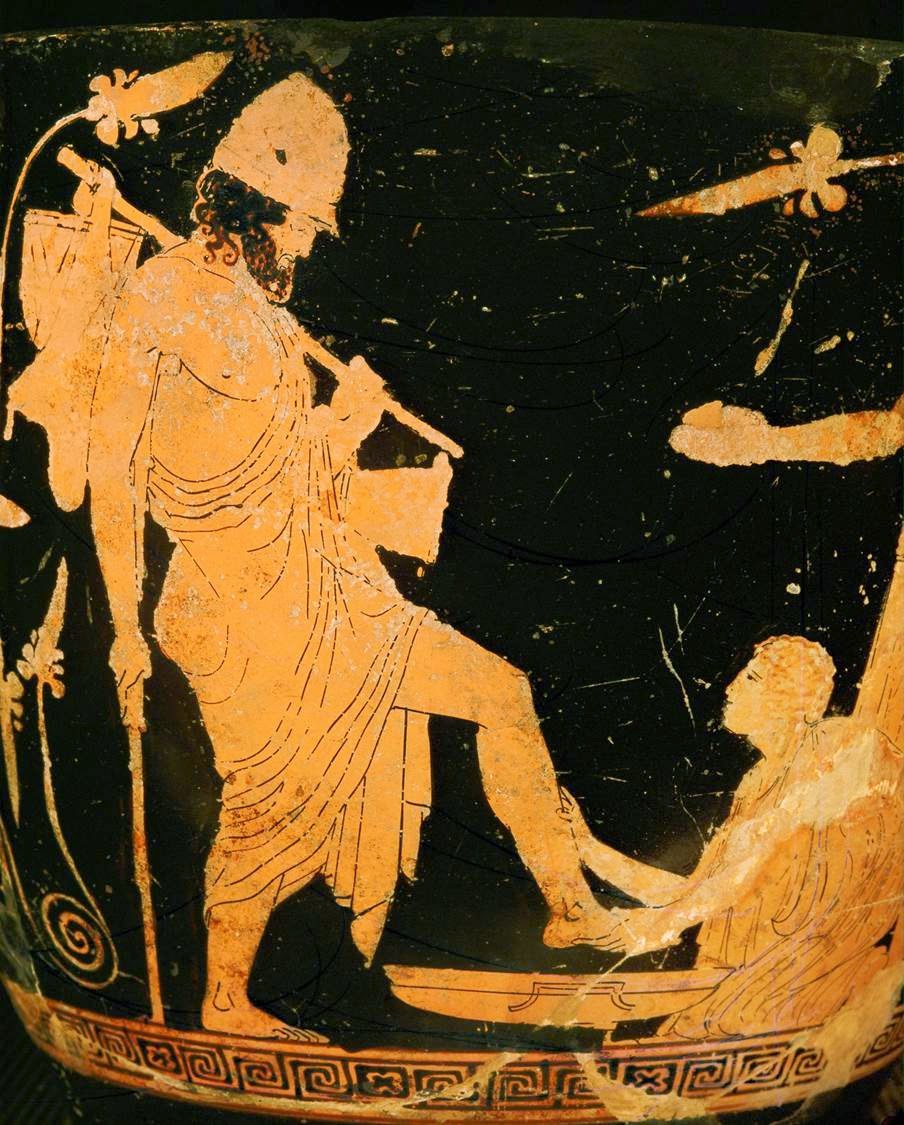
Graphic: Odysseus in beggar's disguise, about to be identified by his childhood nurse Eurykleia, when she sees the scar on his thigh from "the wound I took from the boar's white tusk on Mount Parnassus."

Sunday, March 7, 2021

SIDEWALK ORACLES: An Interview


You begin Sidewalk Oracles by saying, “We are embarking on a path of real magic.”  Please explain.

Real magic is the art of bringing gifts from another world into this world. We do this when we go dreaming and when we remember to bring something back.  We can also walk the roads of everyday life as conscious or lucid dreamers, learning to recognize how the world is speaking to us in signs and symbols. In night dreams and conscious excursions, we get out there; we go near or far into other orders of reality where the rules of linear time and Newtonian physics do not apply. Through synchronicity, powers of the deeper reality come poking and probing through the walls of our consensual hallucinations to bring us awake. Sometimes they work to confirm or encourage us in a certain line of action; sometimes they intercede to knock us back and discourage us from persisting in the worst of our errors.

Sidewalk Oracles is full of fun everyday games. You call one of them Sidewalk Tarot. What is Sidewalk Tarot and how do you play it?

I invented the phrase Sidewalk Tarot after I noticed that things keep literally popping up, like tarot cards, on the streets and sidewalks of the small city where I live. Anything that enters your field of perception, through any of your senses, within your chosen time frame may count as a card in play, even as one of the greater trumps.
     There are two basic ways to play the game of Sidewalk Tarot. The first is to put your question to the world. Do you have a question or theme in your life on which you would like help or guidance right now? Then try to state that theme as clearly as possible. A simple way to that is to fill in the blank in the following statement: “I would like guidance on……”      The game now is to be ready to receive the first unusual, striking thing that enters your field of perception as the tarot card the world is dealing you in response to your question.
      The second basic way to play Sidewalk Tarot is to schedule ten or twenty minutes of unscheduled time to let the world put its question to you. Using all your senses, you gather impressions during that short period of time and then study them as you would look at a tarot spread.
I make it my intention, the first time I leave the house (or wherever I am staying) in the course of a day, to gather three observations from my external environment. These do not need to be extraordinary in any way, just things that pop up on the street. As in drawing from a tarot deck, you can choose to play with as few or as many cards as you like. The big difference is that a tarot deck offers you only 78 cards; the number of cards in the world deck cannot be counted.

You invented a new word – kairomancy – for the practice of navigating by synchronicity. Please explain.

I invented the word “kairomancy” to describe the practice of navigating by synchronicity. It builds on the idea that a key feature of the experience of meaningful coincidence is that we know this is a special moment when things operate differently. The Greeks have` a word for a special moment of this kind. They call it a Kairos moment. Kairos is also a god, the antithesis of Chronos, the old god of tick-tock linear time. Kairos is jump time, opportunity time, the special moment you have to seize before it is lost.
    So: Kairomancy. The word literally means divination by special moments. But it means more. It means being poised to seize time by the forelock – to recognize a special moment of opportunity (or warning) and act on it tight away.

You invite us to become kairomancers, which sounds romantic and mysterious. What is a kairomancer and how does someone become one?

A kairomancer is someone who is ready to recognize the special moments when synchronicity is at work – and to seize on the revelation or opportunity that is now available. To be a kairomancer, you must be:

Open to new experience
Available, willing to set aside plans and step out of boxes
Thankful, grateful for secret handshakes and surprises, and ready to
Honor your special moments by taking appropriate action.


If you want to become a kairomancer you need a poet in your soul. You need to grow your ability to recognize what rhymes in a day, or a week, or a life and to build that “talent for resemblances” that was held to be the primary requirement for a dream interpreter in ancient Greece. So, yes, this is quite romantic. Walk this path, and you’ll find there is a champagne fizz of excitement in the air any day.

Explain what you mean when you say “coincidence multiplies when we are in motion”.

When you are on the road, outside your regular commute, you are more likely to notice novel things around you. When your plans get screwed up, and you can avoid Type A personality disorder, you may find that  Trickster energy comes into play, making new connections.
     Synchronicity often becomes especially strong when we are going through major life passages, involving birth or death, falling or out of love, losing a job or taking a creative leap. Our emotions are stirred up, and the world seems to be stirred to move in different ways around us.

You give us a synchronicity game called “Listen for Your Daily Kledon”. What is a kledon and how does this work?

I borrowed the word kledon from the ancient Greeks. A kledon is sound or speech coming out of silence or undifferentiated noise. Sounds and voices heard in this way were one of the most important oracles in ancient Greece. A kledon is often something you overhear — a snatch from a stranger’s conversation, a song from a passing car radio, the croak or cry of a bird, the siren of an ambulance.

Another everyday game you suggest is bibliomancy. What is that and how does it work?

Bibliomancy is literally “divination by the book”. You have a theme on your mind, and you open a book at random and look for guidance in what you see on the page. People of faith have often used sacred books in this way, as Abe Lincoln turned to his family Bible (the one on which Preseident Obama swore his oath) for a second opinion on his prophetic dream of his assassination. You can use any book you like, and instead of setting an intention you can simply let the text in front of you offer a spontaneous message for the day.

One of your rules for navigating by synchronicity is “Notice What’s Showing through the Slip”. You say this even led you to your present publisher. Talk to us about that.

When I first spoke to Georgia Hughes, the wonderful editorial director of New World Library, on the phone, she spoke to me as if we had been close friends for ages. I was surprised, and asked if she knew who I was. “You are Robert Moss,” she told me. “You are the author we are publishing.” This was strange, because I had never discussed any book project with Georgia, though I now had one in mind. When I mentioned this, she realized she had confused me with Richard Moss, one of her stable of authors. I begged her not to apologize. “There are Freudian slips and then there are cosmic slips. This one is an opportunity.” I was now emboldened to lay out the idea for the book that was published as The Three “Only” Things. A day later, we had a contract. I have stayed with New World Library ever since. An editor’s slip turned me into a constant author. So: if you hear a name misspoken, or spot a typo, pay attention. Something may be showing through the slip.

Physicists speculate that we are living in Many Interactive Worlds. You say that through dreaming and monitoring synchronicity, we can acquire evidence of the existence of parallel worlds and use this to do some good. Please explain.

It is an emerging consensus in physics that we live in one of numberless parallel universes and that the “many worlds” are interactive in ways that escape our ordinary attention, Synchronistic encounters and moments of déjà vu can help to awaken us to these possibilities. When we keep dream reports over time we sometimes notice that we seem to be living continuous lives in other realities, near or far from our present one. Once you awaken to this possibility, you may start to observe how choices you are making now are bringing you nearer or farther from parallel selves who made different choices in the past. This discovery can equip you to make the conscious effort to draw gifts and lessons from those parallel selves

How do you explain what you do to people who are meeting you for the first time?

When I am asked by a stranger on a plane, "What do you do?" my favorite answer is this: "I am a storyteller, and one of my greatest pleasures is to help people discover their bigger stories, and live those stories and tell them so well that they want to take root in the world."

What is the most important thing you have learned about reality?

The only time is Now. All other times - past, present and parallel - can be accessed in this moment of Now, and may be changed for the better.

-

Sidewalk Oracles: Playing with Signs, Symbols and Synchronicity in Everyday Life by Robert Moss is published by New World Library.


Thursday, November 14, 2019

If You Don't Have a Dream, Ask for One from the World

One morning when I woke with no dream recall, I stepped out into the street to walk my dog saying, "I would love the world to give me a dream."
     A man walking his own dog across the street called out to me immediately, "Robert, do you have a moment? I'd like to tell you a dream." He was a neighbor I knew slightly. Our previous conversations were usually about our dogs.
    Of course, I hastened across the street. He was very excited. He had just dreamed that he was riding on a train with a bear, sharing a basket of apples. The train divided and he found himself in a different railroad car. He said, "I was glad I still had the basket of food, but sorry that the bear and I parted ways."
   We had a lively discussion about how the dream might reflect choices he would need to make about his job, and the need not to part company with all that the bear meant to him - healing, play, living a natural life - while earning his meal ticket. He was grateful for our dreamplay, and told me later that it helped him to push for - and arrange - the right job transfer.
    I was grateful that the world had literally given me a dream when I needed one.
    The incident was also an example of the workings of one of the favorite oracles of the ancients. They believed that voices from the deeper reality are heard in a kledon - sounds or speech coming out of silence or the undifferentiated hubbub of everyday life. In my book Sidewalk Oracles I explain how to listen for a kledon as daily practice.
   Whatever your relationship with your night life, when you step out into the day make it your intention to be alert and alive to the dreamlike symbolism of what is going on around you.
   If you have a theme for guidance, carry that with you. Get a statement clear in your mind, "I would like guidance on...." [you fill in the blank].Then be willing to receive the first unusual or unlikely thing that enters your field of perception as a message from the world, a dream delivered on the street.

photo credit: Bear on BART

Wednesday, May 2, 2018

Asking the Synchronicity God


In the ancient Greek city of Pharai  there was a busy market, enclosed by a high stone wall. At the very center of the market, among the press of grain merchants and fish sellers, was a rough-hewn statue of the god  Hermes, the divine messenger. This was a popular oracle that offers a practice we can use in our modern lives - of listening for a kledon, sounds or speech coming out of silence or undifferentiated hubbub.

The Greeks called Hermes "the friendliest of gods to men." He is the herald and interpreter for more remote Olympians, speeding back and forth between the surface world and the spirit worlds in his winged sandals. He presides over chance encounters and happy coincidences. He is lord of journeys, the special patron of travelers, including merchants, gamblers, and thieves. You will often encounter him in border areas, places of transition: at crossroads, gateways, and on the road itself. He also presides over the border zone between sleep and waking--he frequently communicates with humans through dreams and dreamlike states--and over the liminal zone between the living and the dead.

The oracle of Hermes worked like this:

THE MARKET ORACLE

Around dusk, when business is winding down and the last vendors are closing up shop, you bring your question to the statue of Hermes, a simple stone pillar with a face and a phallus. Your question might range from "Will I be healed?" to "Is my husband cheating on me?" or "What will be the price of olive oil next season?"--perfectly appropriate, since Hermes is also the patron of commerce. All that matters is that your question reflect what is truly important to you at this time.

You will want to bring some oil for the lamps, to show respect for the god. You might burn a little incense. But there are no dues to pay, and no priests to collect them. What is going on here is between you and the god, one to one, and between the two of you and the world You have made your modest offerings.

You are ready to approach the statue. You will speak your question directly into the right ear of the god. This should be shared with no one else. Your next step is to stuff your hands over your ears, blocking out external sounds. You will walk like this all the way to the gate through which you entered the walled market. As soon as you have stepped outside the market, you will unblock your ears. The first words of human speech you overhear will give you the answer to your question. The words might be a simple yes or no, or an enigmatic phrase that will set you scrabbling for associations, as you might do with a fragment from a dream. Whatever you pick up will relate to your question. You have made sure of that by evoking the Hermes energy, the power of synchronicity.


Text adapted from my book Conscious Dreaming: A Spiritual Path for Everyday Life  Published by Three Rivers Press. 


Image: Ancient Greek vase painting of Hermes with his caduceus and his petasos (traveler's hat).


Saturday, October 3, 2015

Playing Sidewalk Tarot: "He Can't Kill Both of Us, Can He?"


One of the everyday oracles the Greeks valued most highly was the kledon. A kledon is sound or speech coming out of silence or undifferentiated noise. On a gritty city street, I received a kledon that gave me exact guidance on how to handle a conflictive situation.
     My kledon that day was inspired by my little dog Oskar.
     Oskar is a miniature Schnauzer who weighs about twenty pounds. Walking my little dog towards the park, I was debating with myself whether I could manage to take on two big new projects. Each would demand a great amount of time, energy and focus. Worse, it was possible that they could prove to be mutually competing.
      I had this theme on my mind when a stranger got out of his truck. As he approached me, he pointed his chin at my dog and said, "He can't kill us both at the same time, can he?"
     I felt that behind the joke, a joker of a larger kind was in play.
     I had been asking myself:  Can I handle two new projects at the same time? The kledon I received was “He can't kill us both at the same time, can he?” It did not cause brain damage to figure out the connection. I had been told I could not tackle more than one project at a time.
     I would have to “kill” one of the new projects. I made an instant choice, but now had to find a way to break the news to the project manager I was about to disappoint.
     When I made the call, he was not happy at all. The conversation was strained until I told him my dog story. When I repeated the line, “He can't kill both of us at the same time,” the manager roared with laughter. He shouted, "I get it!"
      I thanked him, and gave a nod to the joker I sensed behind the joke on the street that day.
      This is an example of one of the ways I play the game I call Sidewalk Tarot. I started using the phrase after I noticed that things keep literally popping up, like tarot cards, on the streets and sidewalks of the small city where I live. Anything that enters your field of perception, through any of your senses, within your chosen time frame may count as a card in play, even as one of the greater trumps.


Adapted from SidewalkOracles: Playing with Signs, Symbols and Synchronicity in Everyday Life by Robert Moss. Published by New World Library.

Friday, May 1, 2015

The faery of the avocado tree


Esalen Institute, Big Sur, California

The mist from the sea has been burned away by the early sun. I am walking the path through the gardens at Esalen, apple in hand, among red and gold poppies. I pass the pond where a little water snake is swimming, and the easel of an artist who has almost captured bright blue wildflowers.
    At the crest of the gentle slope, I hear a voice singing from inside a tree,


In the avocado tree

That is where you'll find me.

    I look for the source of the lovely song. I see a lithe, olive-skinned girl with long ringlets.
    "Thank you," I call to her. "That is a beautiful kledon to start any day." I explain that a kledon is a sound, sometimes a song or a snatch of conversation, coming out of silence or undifferentiated noise. A most important oracle for the ancient Greeks, and one I value highly.
     "Come into the tree," she invites me.
     I step under the mantle of broad green leaves.
     "Would you like some avocados?"
     "I would love some." 
     
     She shinnies high up the trunk and out along the branches with simian grace , dropping grenades of green joy around me. 


       Now she is hanging upside down like a fruit bat, singing and inviting me to take all I want. I take only one, but later she finds me on the terrace outside the dining hall and tells me she wants me to take more. She brings me three more green avocados, and lays them on the table next to my black dog. A wonderful start for any day.


Saturday, August 30, 2014

Sidewalk Tarot: Gotta Try for the Big One

The experience of meaningful coincidence can come like a slap in the face or a passionate embrace. It can leave you gasping, knowing that the universe has become very personal and is speaking directly to you. Such big encounters with the deeper order, in which there is really no separation between mind and matter, can leave you stunned, or aroused.
    However, I love the smaller encounters with synchronicity that may do no more than give a little fizz or tickle to the day. When I am home, I start my morning by walking my little dog up a street of brownstones in a small city to the park where we take a path around a lake. Coming and going, I'm mildly alert - in a relaxed, undemanding way - for signs and symbols from the world about us.
   I will note the first kledon of the day. "Kledon" is the Greek word for speech or sounds coming out of silence. I wrote here recently about how deeply I was aroused by a man whistling for his dog who made what sounded to me like the call of a rainbird.
    Today's little story starts with a kledon from the path around the lake.
 "Gotta to try for the big one!" the cheery mother of a large family greets me. They have set up a veritable fishing camp on the path round the lake: canvas fold-out chairs, hampers, rods and reels, jars of bait, drinks and snacks. I've never seen anything big that has gills and fins caught in this lake, but then there are many kinds of "big ones" in life.

    Walking my dog back from the park, I'm open to playing what I call Sidewalk Tarot. This means noticing things that pop up on the street - a kid's chalk drawing on the sidewalk, the logo on a van, a dropped coin or earring or an abandoned shoe - and seeing whether they are offering a message or image for the day, or at least the moment.
     I notice the huge fish banner flapping from a brownstone near my home. It's been here for a couple of weeks, but today, as it blows back and forth, it seems to reinforce the theme that we want to try for the Big One. At the least, there is something fishy going on.
    Just down the block, a young man is strumming a guitar on one side of a car, singing what sounds like an original - but imperfect - composition. His girlfriend watches and listens from the other side of the car, which is full of stuff. They are moving in, or moving out. Could be a big one.

    A few paces further, and I come to the Reject Books of the day. In my neighborhood, where there are quite a few transient college kids, unwanted books are frequently left out on stoops or steps or on the sidewalk, So I have made Reject Books a subcategory of my Sidewalk Tarot.
    Today's spread is pretty interesting. It takes no imagination to see the books laid on on a neighbor's steps as a five-card spread. What do we have here? A princess card, surely (lower left). The suit of Jewels is dominant.  Is that Children's Bible the Hierophant, or High Priest? Is "I Do" the Lovers card?
    I love outrageous correspondence, when we know we are dancing or teetering on the mythic edge, and that the powers of the world-behind-the-world are poking or thrusting through the curtain walls of our limited everyday understanding. I love it when I walk into a bookstore in Boulder to read from some of mythic poems and am greeted by a young woman named Athena who introduces me to Odysseus. I am thrilled and chilled when a fox-cursed demon driver takes me half-way over a cliff in the Carpathian mountains. I can never forget what it meant to me when I had written down a theme for guidance that included the name "Indiana Jones" and a man dressed as Indiana Jones sat down next to me on a plane, a story I tell in full detail in my book The Three "Only" Things.
    Yet I also love the little patterns of resemblance and connection, the way life rhymes in smaller ways. Noticing these things is essential to poetic health, and we need poetic consciousness to come fully alive to the rhyming universe.
    It's enough for me, for now, that I have my bumper sticker for the day: Gotta Try for the Big One. Yes, ma'am.


Sequel: Landing the Big One

The next morning, I come upon another fisherman, casting his line from a gap in the bull rushes at the western end of the lake. "Have you ever caught anything in this lake?" I ask him.
   "Oh yeah. I just caught a bass as big as my tackle box. The biggest fish I ever caught in my life."
   The tackle box is large and chunky. A bass that size would certainly be a Big fish. My inner skeptic tells me I'm listening to a wannabe fisherman's wishful tale. I have never seen anyone catch anything big in these waters.
   I am rounding the end of the lake when I hear shouts, "Hey! Hey! I got one!"
   I can't see clearly through the rushes, but when I walk a little further on I see the fisherman hoisting his rod high in the air, for me to see what he's hooked. That fish really is as long as his tackle box. He unhooks the fish and lets it drop back in the water.
    Has he got a bass trained to appear on command? Is this the Law of Eternal Return (in two senses)?
    Whatever. I'll carry yesterday's catch phrase with me today. "Gotta Try for the Big One."
    A snatch of Ovid returns to me. 

   Chance is always powerful. Let your hook always be cast; in the pool where you least expect it, there will be fish.

Tuesday, August 26, 2014

Call of the rainbird


There it is again, the call of the rainbird. But it can't be. I have never heard this bird in any part of North America, let alone this urban park in the Northeast. It has to be someone whistling for his dog. The whistle changes, a happy dog with flapping ears materializes through the maples, and my guess is confirmed.
    But for a moment, I am transported, back to a another park, in Surfers Paradise, Queensland, where my parents retired. I walked a path there, slowly, with my father when I visited him before his death. He loved to hear the call of the rainbird and would imitate it perfectly. even after his stroke. The Pacific koel - as ornithologists and bird-watchers call this kind of cuckoo - derives its familiar name from the fact that it is often heard before rain and storm. The males are black with red eyes, and their calls in mating season are very demanding.
    Strange and welcome, this vivid reminder of a scene from the other side of the world in the whistle of a dog walker. When I heard the rainbird, I was thinking about the content of a class I leading this evening in a teleseminar for The Shift Network. The theme tonight is "Partnering with Spiritual Guides." I was reminded that our spiritual guides include loved ones who have gone to the Other Side before us, and that they can become extraordinary life counselors.
    My father played a very direct role in healing old family wounds within days of his death. After the funeral, I sat out on a balcony with my mother. Emotions were raw, we were drinking rather heavily, and my mother started voicing an old list of complaints. When I responded curtly, she rushed inside the apartment.  I was deeply sad, and ashamed. In desperation, I spoke to my father. I begged him to forgive me for getting drawn into old, petty family disputes. “Dad, if you can, please speak to Mum. Please lift the burden and the bitterness from her.”
     The next instant, my mother flew through the door to the balcony like a leaf being blown by a strong wind. She stood behind me, placing her right arm over my shoulder, and her left hand over my heart. She spoke to me of love and forgiveness. She spoke of the deep love she had always felt for me, and apologized that she had so often found it impossible to demonstrate that love, and had been so prone to get distracted by things that really weren’t important.
     All the while, she had her left hand on my heart. When I mentioned this later, she was stunned. She found it hard to believe what I was telling her. She was never one for physical contact and had no idea that her hand was on my heart. This gust of emotion, this tremendous release, had come from someone who had been emotionally bottled up since I was very young, who avoided showing her feelings and did not hold me like a mother. She said, “I came back out on the balcony because something grabbed me and pushed me outside.”
    I was certain it was my father who had blown her back to me, and held her hand over my heart, to make peace between us, and bring us back to the heart center. I felt the depth of my father’s blessing, and deep gratitude for what becomes possible when we recognize that our dead are alive, and that we can help each other to live better and remember what matters.
    In the year that followed, my father visited me, and another family member, repeatedly. He confirmed the reality of life beyond physical death. He delivered messages for the family that helped us to navigate life issues. For example, concerned that my mother needed to move to a more sheltered environment, he visited me and insisted that I tell her to get in touch with someone named "Rodriguez." I had no idea who this might be, but when I duly phoned my mother, she told me that she knew a Ron Rodriguez quite well. He was a real estate agent. She followed my father's advice and Rodriguez helped her to sell her apartment and move to a new home in a retirement community where she made new friends and was happy in her last years.
    My father showed me something of his transitions on the side, and his eventual choice of a new life situation where he would no longer be available for communication on a regular basis. I think of him now, with deep love and gratitude for playing the role of family angel in so many ways. Thank you, Dad. And I thank whatever inspired that other dog walker to make the call of the rainbird today.


Part of this article is adapted from The Boy Who Died and Came Back by Robert Moss. Published by New World Library.

Photo of Pacific koel by Aviceda

You can listen to the call of the rainbird here


Thursday, August 7, 2014

"He can't kill both of us, can he?"


Listening for the first kledon of the day is one of my favorite synchronicity games. The word "kledon" is Greek. It refers to the first sounds you hear coming from silence, maybe a snatch of conversation, or the cry of a bird, or the sigh of wind in the trees.
    Monitoring kledons was a favorite form of divination in the ancient world. At Pharai in the Peloponnese there was a marketplace oracle that delivered messages through sounds received in this way. If you were seeking guidance, you approached the statue of Hermes, the divine messenger, in the center of the walled market. You whispered your request for counsel in the rough-hewn ear of the god. Then you clapped your hands over your ears, shutting out the noise of the market, until you reached the outer gate. There you took your hands away from your ears, ready to receive the first sounds that came to you as the response of the divine messenger, "the friendliest of gods to men".

    In everyday life, the stir and bustle of a gritty city street may deliver a kledon as effectively as preceding silence, when a message becomes audible through undifferentiated white noise.
    I received a kledon this morning that is very much on my mind. It was not simply something overheard in the street. It was addressed to me, and inspired by my little dog Oskar.

   Oskar is a miniature Schnauzer who weighs all of 22 pounds. He has hosts of admirers. It is not unusual for him to draw three cries like "What a cutie!" in a single block. Today, he drew a different kind of remark.
    Walking Oskar towards the park around breakfast time, I had a question on my mind. I was debating with myself whether I can really manage to take on two big new projects this fall. They will both demand considerable time, energy and focus, and it is possible that they could prove to be mutually competing.
    I was not resolved to put my question to the world in the sense of asking for direct guidance. But I had the theme on my mind when a stranger got out of his car a few houses up the street from my home, He hoisted a huge carton of stuff out of his vehicle, raising it to shoulder height. As he approached me, he pointed his chin at my dog and said, 
"He can't kill us both at the same time, can he?"
    Could this odd, unsolicited little joke be a comment on my theme - the matter of whether I can handle both of those projects? If so, what is the guidance? "Can't kill both" could mean that I can't "execute" - in the sense of accomplish, bring to fruition - both projects. The remark could also mean that two are stronger than one. Then again, as a friend pointed out, the message may be that the dog (and his master) can't focus on more than one target at a time.
     Oracles are known to be ambiguous. That's how they stay in business long-term.
     But the more I thought about it, the more it seemed to me that my friend's suggestion was wise. The dog has to focus on one person at a time. I need to focus on one project at this time. And I know which one that is.
    So: a couple of hours after the doggy encounter, I talk on the phone to the manager of the second project. He's disappointed when I tell him that I don't think I can go ahead with our plan this fall. Then I tell him the dog story. As soon as I quote the stranger who said, "He can't kill both of us at the same time," the manager roars with laughter and shouts, "I get it!" We are able to agree to defer our fall project for later discussion and a possible date next year.
    The doggy kledon not only gave me the guidance I needed to make a decision. It gave me an entertaining and effective way to communicate that decision, making what could have been a difficult conversation into a very cordial one.


Note: For a full account of the market oracle at Pharai, please see my book Conscious Dreaming.

photo (c) Robert Moss

Friday, May 30, 2014

Daily Kledon: What to do when they take your world away


First old guy on the sidewalk: "They took your world away from under you."
   Second old guy, on walker: "Yeah, they took my world away."
   "What you gotta do is tell everyone, like everyone."
   "Or get a gun and shoot somebody. That's what I feel like doing."
   "Forget the gun. Tell your story. That's more powerful."


The first old guy got that right.
   I logged this exchange, overheard as I walked to a neighborhood store this morning, as my first kledon of the day.
   Monitoring kledons is one of my favorite daily synchronicity games. A kledon is words or sounds coming out of silence or out of the cacophony of urban noise bands. In ancient Greece, kledons were highly valued as portents.
    It was believed that the gods, who love disguises, might communicate in this way. This

was thought to be especially likely when a hush falls in the midst of a social event, like a dinner party. The first words to break that social silence were inspected as a possible hermeion, which is to say an act of Hermes, the messenger god who personifies the play of synchronicity.  
   I am content to receive daily kledons as part of life's patterns. I notice that sometimes a theme that is raised rhymes with something that comes up later in the day, in the kind of riff of coincidence for which I have coined the word reincidence.
   Oh yes. There is often great material for creative writing in bits of conversation harvested in this spontaneous way.