Showing posts with label divination. Show all posts

Monday, February 10, 2025

Oracles Full of Omphê


There's oomph and then there's omphê. In ancient Greek, omphê [ὀμφή] is the divine voice. It may speak through an inspired priestess, or through a special tree, or the cry of birds, or a lightning storm. Before you can hear it, you may feel your world shaking.

Philostratus wrote of Dodona, the place of the great oak oracle of Zeus and Dione, "this place is full of omphê."  It is un univers sonore, Stella Georgoudi takes up the chorus. [1]

The divine voice is different from the human voice though it may use human vocal chords. Homer's gods might seem to feel and behave like humans, especially in their domestic dramas, but they have powers that mortals cannot understand: amazing speed and strength; an endless capacity to shapeshift or disguise themselves; invisibility. Then there is the voice thing. The voice of a god can be thunder or leaping fire or the roar of ocean or a graveyard hiss that stills the breath. "Whereas gods have the power to imitate the voices of mortals, no mortal without divine assistance can speak with the voice of a god: a mortal voice (Homer uses the term audê) is different from omphê or ossa, a divine voice. Gods not only have different and remarkable powers of voice production, they also have (or once had) their own language." [2]

Omphê is the voice of the Pythia when she speaks for Apollo. In the Argonautica it is also the voice of a talkative crow who speaks to the seer Mopsos [Apollonius of Rhodes III 927-939]. Even at Delphi, famous for prophecies delievred in poetic speech, omphê could be heard in the voices of birds, especially crows and herons and wrens. [Plutarch, Pythia].

In the Odyssey,the hero visits Dodona to ask the oak whether he should go home or remain in hiding. Zeus speaks to him from the oak. It is not specified whether the divine voice was heard through the rustling of leaves or the creaking of bark or the birds among the branches. One way or another, the will of Zeus was audible from the oak.

In Ovid, an oak at Aegina sprung from an acorn from Dodona speaks when it starts to tremble and its branches shake without wind. [Metamorphoses VII 629-630]

Athena, the daughter of Zeus who sprang fully-armed from his head, carved an oak bough from Dodona into the prow of the Argo, endowing Jason’s ship with prophetic power in the perilous voyage for the Golden Fleece.

Sophocles calls the oracle oak poluglossos: polyglot, many-tongued, many-voiced. To hear it can be like hearing a crowd. The voices may rise and swirl in any language, and of course in the language of the birds. Wasn't the oracle founded by three black doves who flew here from Egypt?

The Hesiodic Catalogues speak of three doves who lived in the oak tree. They may correspond to three female shaman-seers known as the Black Doves. The far-seers at Dodona prophesied in a shamanic ecstasy, and “afterwards they do not know anything about what they have said.” [3] Herodotus called them the Black Doves, Peleia Mêlaina. [Herodotus II.55]

The oracle at Dodona was older than the Olympians, always dedicated to the Goddess as well as the God. In its heyday, it was full of noises at the trembling edge of omphê. There were the many voices of the variable winds in the leaves, the rush or babble of nearby streams, the chanting of barefoot priests sworn to live close to Earth Mother, the prophetic speech of the black doves advising clients. In later times there was also the  clash and clang of bronze cauldrons suspended from the trees. They sounded like gongs when the winds pushed them together. 

References

1. Stella Georgoudi, “Des sons, des signes et des paroles : la divination à l’oeuvre dans l’oracle de Dodone”in Stella Georgoudi et al (eds) La raison des signes. (Leiden: Brill, 2012). P.71

  • 2. Elizabeth Minchin, "The words of gods: Divine discourse in Homer's Iliad" in Sacred Words: Orality, Literacy and Religion (Leiden: Brill, 2011)  pp.17-35.

  • 3. Walter Burkert, Greek Religion. trans. John Raffan. Cambridge MA: Harvard University Press, 1985) p.114

    Photo: Remains of the oracle of Zeus and Dione at Dodona in Epirus


      Wednesday, January 22, 2025

      Become a Kairomancer and Navigate by Synchronicity


       Synchronicity is when the universe gets personal. Though the word “synchronicity” is a modern invention — Jung made it up because he noticed that people have a hard time talking about coincidence — the phenomenon has been recognized, and highly valued, from the most ancient times. The Greek philosopher Heraclitus maintained that the deepest order in our experienced universe is the effect of “a child playing with game pieces” in another reality. As the game pieces fall, we notice the reverberations, in the play of coincidence.
            When we pay attention, we find that we are given signs by the world around us every day. Like a street sign, a synchronistic event may seem to say Stop or Go, Dead End or Fast Lane.  Beyond these signs, we find ourselves moving in a field of symbolic resonance which not only reflects back our inner themes and preoccupations, but provides confirmation or course correction. A symbol is more than a sign: it brings together what we know with what we do not yet know.
          Through the weaving of synchronicity, we are brought awake and alive to a hidden order of events, to the understory of our world and our lives. You do not need to travel far to encounter powers of the deeper world or hear oracles speak. You are at the center of the multidimensional universe right now. The extraordinary lies in plain sight, in the midst of the ordinary, if only you pay attention. The doors to the Otherworld open from wherever you are, and the traffic moves both ways. 
          I invented the word kairomancer to describe someone who is ready to recognize and act in special moments of synchronicity when time works differently and opportunity strikes. It incorporates the name of Kairos, a Greek god who personifies a kind of time that is altogether different from tedious tick-tock time: that special moment of jump time when more is possible than you imagined before.
          To become a kairomancer, you need to check your attitude as you walk the roads of this world, because your attitude goes ahead of you, generating events around the next corner. You need to develop your personal science of shivers. You want to take dreams more literally and the events of waking life more symbolically. You need to take care of your poetic health, reading what rhymes in a day, or a season. You want to expect the unexpected, to make friends with surprises, and never miss that special moment when the universe gives you an invisible wink or handshake.


      My book Sidewalk Oracles offers eighteen kairomancy games you can play any day.


      Photo: The Houses Have Eyes. Taken in Sibiu, Romania by Robert Moss 

      Tuesday, December 31, 2024

      Bibliomancy for the New Year


      I bet you have done this some time: opened a book at random to get a thought for the day. Maybe you have done it with a question or theme in your mind, to see what response the book will give you. You can do this to get a second opinion on a dream, or on why your partner hasn't called you to day, or on what the quality of the day will be.
            Doing divination by the book has been going on as long as humans have had anything resembling pages that could be turned or shuffled. The Sybilline books of ancient Rome were actually a stack of loose leaves. Many, across the centuries have turned to a sacred book, as Lincoln turned to his family Bible. Many have consulted books that are reverenced in a certain culture, like the works of Homer or Virgil, Dante or Rumi.
           The formal name for divination by the book is bibliomancy. When you are content to work with just a line or two on the page in front of you, the exact learned name is stichomancy, meaning divination by the line or verse. You can play the game with any book at all, one you notice in the New Arrivals at a library or bookstore, one that a shelf elf pushes off a bookcase at home, one a friend is reading on the bus or the airplane.
           Sometimes it's fun to give yourself coordinates. You'll pick a book - any book at all - and go to a certain page and find a certain line and see what is there for you. Typically, you'll need to read around the line you selected, up and down a line or two, to get a finished sentence or thought from the book. At the turning of the year, I like to play games that offer a chance to sneak a peek at coming attractions over the next twelve months. Dreams remembered on or around New Year's Day are especially interesting. You can set the intention to dream into the coming year. I like to do this by setting an intention along these lines:


      Show me the best things I can manifest in my life over the coming year,


      Often, I will cast I Ching or tarot, or both, on New Year's Eve or New Year's Day, for a first flavor of the coming year. This year, I am recommending to dreamers who play with me that we all do bibliomancy by the number, on or around the first day of 2025, The number, of course, is the number of the coming year: 2025. Applied to book divination, it gives us a few options. You could go to page 20, line 25 Or to page 202, line 5. Or to chapter 20, line 25. You get the idea.


      Give it a try. And yes, you're allowed to do it more than once.


      Tuesday, November 26, 2024

      Words of Counsel from an African Divination Priest


      Many years ago, I received some counsel from a babalawo, a high divination priest of Ifa, from the Yoruba tradition. He offered three insights on how we should approach oracles (including our dreams) and life possibilities that have stayed with me, indelibly. I will offer them here as things all of us may want to consider in posing questions about our life issues. They may help to enlarge our understanding of the issues themselves.

      ONE
      Don't ask what you already know!

      TWO
      There are two things in your life it is difficult to change: your basic character and your maximum allotment of time and energy in this world. Everything else is open to negotiation.

      THREE 
      You must find out who defends you before the greater powers.

      I can hear questions flocking. Apply these insights and find your own way.

      Friday, November 15, 2024

      Book of Shadows


      Between you and the world
      falls a screen
      that holds the fingerprints of possibility.
      Study them like a detective
      and you find clues to the future
      you can use to change it
      or embrace it.

      Look carefully and you may find
      the screen is smudged 
      by old habits and regrets
      and must be cleansed
      before you can trust the patterns.

      On some days, in many lives,
      you don't see that the screen is there.
      That's when movies start playing
      that you confuse with the world.
      You can get stuck in a Book of Shadows
      not knowing how to turn the page.
      You may be caught in the threads
      of an ancient tapestry
      of a sleeping king and a red boar.

      The trick is to touch
      the friable ridges of fate
      tenderly and harvest fine powder
      to make inks and paints
      to create your own designs for life.
      Since the screen between you and the world
      becomes your world
      use it to make your own reality.
      The time is Now.


      - Robert Moss


      Thursday, April 18, 2024

      Stoic Divination through Sympathy and Soul Travel


      The Stoics had an optimistic belief in divine pronoia: that the gods sent forewarning to humans out of benevolence. They defined divination as “the foreknowledge and foretelling of things that happen fortuitously” (Cicero De Divinatione 2.13). The future that can be foreseen for them is not predetermined.

      Two modes of divination described by the far-traveled philosopher Posidonius (c. 135-51 bce) are observation of the "affinity of all things" and the close study of dreams. He spent time with druids in Gaul and wrote five books on divination, of which only fragments survive, mostly in the pages of De Divinatione, a philosophical dialogue by CiceroThe concept of sympatheia - the “affinity of all things” (συμπάθεια τον όλον) – presents the world, including the gods, as a unified organism with mutually interrelated parts that turn on each other. Everything is part of a cosmic body. Just as your whole body may respond to the lightest touch on your little toe, what happens to any part of the cosmos may resonate with the whole and generate an event far away. 

      Posidonius taught that the soul travels free from the body during sleep. “Divination finds a positive support in nature, which teaches us how great is the power of the soul when it is divorced from the bodily senses as it is especially in sleep and in times of frenzy or inspiration: (Cicero de div 1.129). The Stoics held that dream divination is open to all, a view resoundingly espoused by Synesius of Cyrene in his wonderful little book On Dreams around the year 404.

      With the name of a sea-god inside his own, perhaps it is not surprising that Posidonius was wedded to the sea. He confirmed his sense of pattern in the cosmos as an oceanographer, studying the effect of the Moon on the tides. He set up his own school of philosophy on the island of Rhodes, a hub for travelers and traders from all over the Hellenistic world. He traveled on boats to Spain, Gaul, Italy, Sicily, Dalmatia and Greece. He was fond of maritime metaphors to describe the voyage of life, sailing on fortune’s wind, seeking safe harbor.


      Rhodes, island of Posidonius the Stoic philosopher


      Tuesday, December 19, 2023

      Homer's Book of Portents

      The homecoming is often the hardest part of the hero's journey. Odysseus has survived sea monsters and sirens and the wrath of a sea god and is at last on his home island. But he has been away for ten years since the war he went to fight, and almost everyone believes he is dead. His palace is full of brutish and lustful men, suitors vying for the hand of his wife Penelope and with it, his kingdom. Their appetites are laying waste to his livestock, his wine cellar and his female servants.
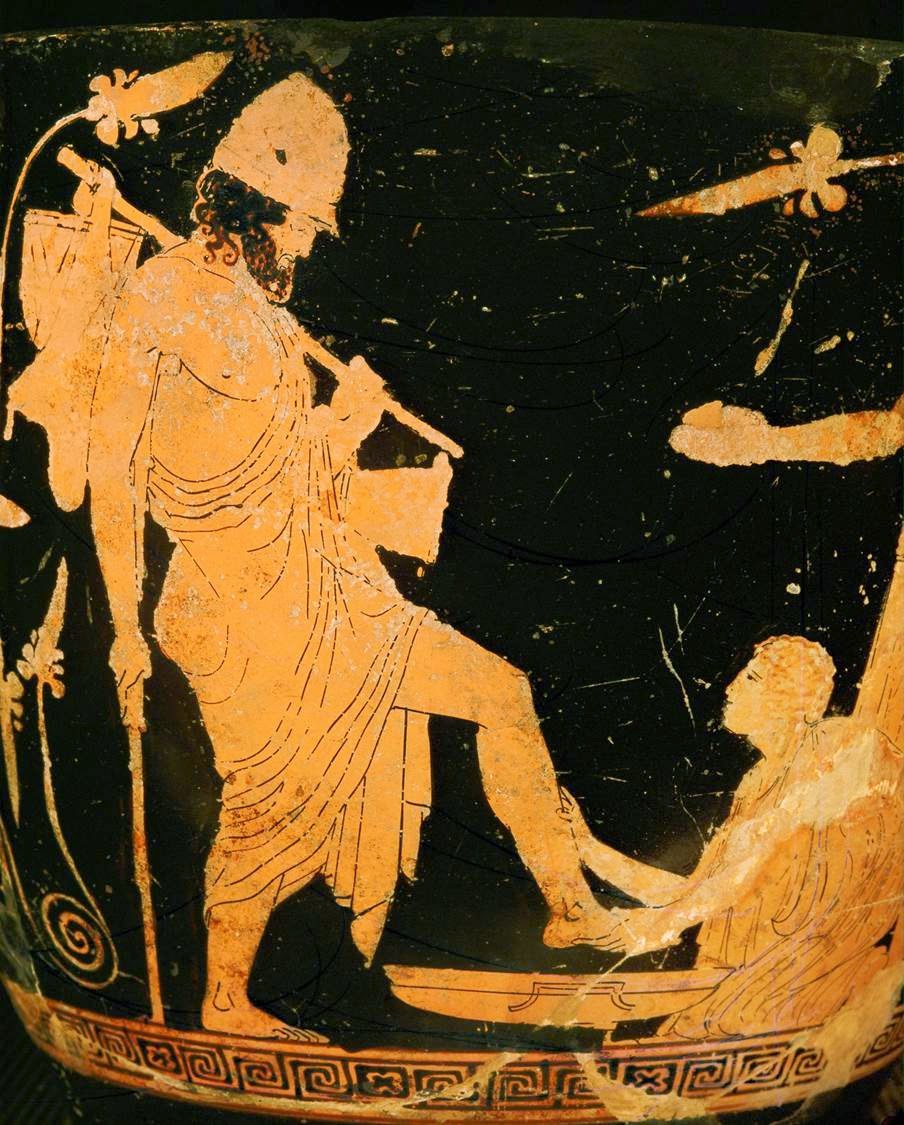
           At the prompting of his constant guide, who is no less than the goddess Athena, Odysseus has disguised himself in the rags of a beggar, with a funny traveler's hat. He is mocked and scorned by the suitors and even some of his own retainers. Nobody recognizes him. They will find it hard to recognize him even when he shows himself in a different form. His homeland seems stranger to him than the magic realms from which he has returned. He must be asking himself, Which is the dream? He may be wondering whether he is dead.
          He spends a sleepless night, tossing and turning. This is wonderfully conveyed in the muscular modern verse of Robert Fagles, which will speak to anyone who has struggled through a night like this:


      ...But he himself kept tossing, turning,
      intent as a cook before some white-hot blazing fire
      who rolls his sizzling sausage back and forth,
      packed with fat and blood - keen to broil it quickly,
      tossing, turning it, this way, that way - so he cast about


      - Odyssey Book 20, lines 27-30, Fagles translation

          The "man of many ways" is seeking a way to expel the suitors who have taken over his home. But they are many and he is one, and even if he finds the way to kill them all, their kinsmen will come to take revenge. The goddess Athena now appears to him in mortal form, "swooping down from the sky in a woman's build and hovering at his head". She wants to know why he is still awake, fretting and exhausting himself. Why does he distrust her when she assures him that he will gain victory that day? Athena promises that "even if fifty bands of mortal fighters closed around us, hot to kill us off in battle" - because she is with him.
           Athena "showered sleep across his eyes", but when Odysseus wakes, on the morning of Apollo's feast day, even the promise of a goddess is not enough. He wants further signs. He speaks to the All-Father, Zeus. "Show me a sign." In fact, Odysseus asks for two signs, "a good omen voiced by someone awake, indoors" and "another sign, outside, from Zeus himself."
           He is answered at once by a great roll of thunder, out of a clear blue sky.
           Then he hears a "lucky word" from a woman grinding grain inside the halls. Hearing thunder from a cloudless sky, the woman recognizes a sign from Zeus. She speaks aloud to the king of the gods:


      Sure it's a sign you're showing someone now.
      So, poor as I am, grant my prayer as well;
      let this day be the last, the last these suitors
      bolt their groaning feasts in King Odysseus' house!

      - Odyssey Book 20, lines 128-131

          The twin oracles - from the sky and from overheard speech - harden Odysseus' resolve, and the scene is set for the astonishing slaughter of the suitors under the rain of arrows from the bow that none but the hero (and his son) can bend. In the Fagles version, Book 20 of the Odyssey is given the title "Portents Gather", and it is a good one. Here we see oracles speak in ways the Greeks observed closely and valued highly: through brontomancy, divination by thunder, and cledonomancy, divination by overheard speech or sound.
          In the Odyssey, as in ancient Greek society, dreams and visions are the most important mode of divination. Yet our understanding of dreams may be deceptive, as Penelope explains in Book 19, when she speaks of the since-famous gates of ivory and horn. So even when blessed by a direct encounter with a goddess, the hero turns to the world around him for confirmation.


      Quotations are from Robert Fagles (trans) The Odyssey published by Penguin Books.

      Graphic: Odysseus in beggar's disguise, about to be identified by his childhood nurse Eurykleia, when she sees the scar on his thigh from "the wound I took from the boar's white tusk on Mount Parnassus."

      Wednesday, September 6, 2023

      Why dreams set us puzzles


      Artemidorus of Daldis, the most famous dream interpreter of the Greco-Roman world, is of perennial relevance. While his examples of dream content and the lives of the dreamers are of his time (the second century) his insights about how to look at dreams and dreamers often speak to us today. He wrote many books of which the soul survivor is The Interpretation of Dreams (Oneirocritica).Freud borrowed the title nearly two millennia later but I would pick the original over the later effort any time.
           Artemidorus wrote about many aspects of dreaming in other books that are now lost to us. In the Oneirocritica, his dreams in dreams that reveal the future, especially in those that do this through allegory rather than by literal depiction of possible scenes and events. Allegorical dreams are “those which signify one thing by means of another.”
           He gives us a powerful reason for looking for clues to the future in our dreams when he asserts that "the mind predicts everything that will happen in the future.” He gives several examples of precognitive dreams that presented future events in an entirely literal way. A man dreams of a shipwreck and then his boat is wrecked and he narrowly avoids drowning, as in the dream. Another dreams he is wounded in the shoulder by a friend in a hunting accident, and again the dream is played out exactly.
           If it is possible to dream the future with this kind of clarity, why do we need allegories? Artemidorus gives two reasons. The first is that we may lack the experience to understand a future event perceived in a dream – for example, because we have not yet encountered a person or situation that features in the dream. By setting us a puzzle to figure out, the “allegorical” dream gives us a rational way to access what the larger mind knows about things to come. Second, a hyped-up dream production can bring an emotional charge that leads to action; “it is the nature of the oneiros to awaken and excite the soul by inducing active undertakings.”
           Artemidorus tells us that while the gods who may be dream senders do not lie, they like to speak in riddles. This is because “they are wiser than we and do not wish us to accept anything without a thorough examination”. He gives the example of a man who dreamed the god Pan told him that his wife would poison him via his best friend. It was the relationship that was poisoned, when the wife proceeded to have an affair with the friend.
          Artemidorus recognized that every dream may be unique. The snake in your dream is not the same as the snake in mine. To read the meaning of a dream symbol correctly, you must know the dreamer’s identity, position in life, habits and medical condition. “You must examine closely the habits of men before the dream….you must inquire carefully into them.” Suppose you dream you are made of silver or gold. If you are a slave, this means you’ll be sold; if you are poor, you’ll become rich; if you’re already rich, you’ll be the victim of plots because everyone will be out to get your money. You must also question the dreamer’s feelings about a dream.
          Artemidorus observes that we dream the future for others as well as ourselves. Sometimes we receive a dream message for someone else. “Many dreams come true for those whose characters are similar to the dreamer’s and for his relatives and namesakes.”
          Artemidorus gives the example of a woman who dreamed she was married to a man who was not her husband. He observed that work with this dream could proceed in several directions, including exploring the possibility that it warned of death; “marriage and death signify each other because the circumstances surrounding a marriage and a funeral are similar.” This association, it turned out, was on the right track, but it was the dreamer’s sister, not the dreamer herself, who “married death” after the dream.   


      Text adapted from The Secret History of Dreaming by Robert Moss. Published by New World Library.


      Photo: Library of Celsus at Ephesus,where Artemidorus lived and read dreams for most of his life.


      Sunday, July 23, 2023

      Winging It from a Land of Seers


      We have personal styles of dreaming, and content - like the content of any day - will reflect our interests and desires. Because I love reading and research, I do a lot of it in my dreams, as in regular life. I'm posting this "old" report as an example, and also because I've been playing around with illustrations.

      December 2, 2021
      Dream
      Winging It from Molossian Country
      I am boning up on Molossian divination from a bulky typescript that contains fragments of an epic, trying to get a clear picture before I go to a dinner where this information will be greatly valued. There were many oracles in ancient Epirus, including the sacred oak at Dodona. I am intrigued by an account of how crucial messages traveled rapidly to and from the East, as far as Asia Minor. Seers could accomplish this mind to mind. I suspect that oracles also used carrier pigeons.
      Dreaming inside the dream, I fly like a bird, over wild, windy country, East towards Attica. When I land I find a silver tetradrachm with the owl of Athena. I bite into it, testing the purity of the metal.

      Feelings: Enjoyment. Certainty that this is a real experience. Been there, done that.
      Reality check: My dream activity here is very similar to my ordinary days, in the combination of literary research and shamanic lucid dreaming that I call dream archaeology. The document I am reading resembles academic papers on divination at Dodona and other sites in Molossia/Epirus I studied when preparing a new class on Greek oracles.
      I read in dreams very much as I do in ordinary life. My attention wobbled a bit with the dream typescript not because the text broke up (as some dream researchers say happens with reading material in dreams) but because of the difficulty of digesting a lot of academic writing at high speed.

      Journal drawing by RM with digital effects

      Tuesday, March 7, 2023

      A Gift for Resemblances


      Divination is the effort to discern the divine will: to identify what supports and what opposes an individual or a community. When properly conducted and interpreted, what comes through may show the shape of things to come. Divination has never been out of style.

            The oldest and most effective forms of divination are those in which you look very carefully at what the world, and your dreams, telling you. You have a question on your mind and you pick up a stone, or examine the bark of a tree, and see what patterns they suggest to you that may hold an answer. The women seers of the German tribes, who gave Roman commanders plenty of trouble, liked to find pictures and hear voices in running water. Plutarch wrote in his biography of Caesar: “Their holy women used to foretell the future by observing eddies in the rivers, and by finding signs in the whirling and in the noise of the water.” When the Romans themselves needed guidance on whether the divine will was favorable or unfavorable to a certain undertaking, they sent their augurs up onto the Capitoline hill to monitor the behavior of birds.

            From very early times, humans have constructed divination kits to limit the answers the world can give you to manageable numbers, that can be read according to an agreed and teachable method of understanding. African diviners carry pouches containing stones and pieces of bones and other objects and artifacts that represent certain themes or outcomes. They can be cast as lots, like runes, to make a story.   

            The world’s great divinatory systems, such as China’s I Ching, West Africa’s Ifa, and Europe’s Tarot, are more than tools for fortune-telling. In their design, the hexagrams, the odu and the cards bring together symbols representing all the forces and processes at work in the world, including those that emanate from a deeper world. The magnitude of the design is clear in the oldest text of the I Ching, from Mawangdui, where it is written that the ancient sages “drummed” the patterns of heaven and earth into the hexagrams. Such patterns give form to the ever-shifting dynamics of manifestation. The world is before you, with all of its players, marshaled in finite numbers adapted to the finite understanding of humans: the sixty-four gua of I Ching, the sixteen master odu and 256 derivative patterns of the Ifa diviner, the 78 cards of Tarot.

            A reading is designed to show what forces and factors are at play in a given moment of time, and which are absent. For a devoted reader of one of these systems, what is missing from the field may be as significant as what is present. If you do a daily card reading, for example, and you find that a certain card or suit never seems to show up, you will want to ask yourself why that element or power is absent from your life. A recurring pattern of absence may be comparable to a medical test that reveals, for example, that you do not have enough iron in your body.

           Great readers, using any of these systems, rely on memory, intuition and a gift for resemblances. Phenomenal memory is required to learn and carry the poetic oral recitations that hold the possible meanings of Ifa. A great babalawo (“father of the mysteries”, the title of the Ifa divination priest) may carry in his head a hundred poetic stories about each of the odu, and will scan his memory banks in a reading to see which of these, in which combinations, are relevant to his client in that moment. A great reader of I Ching will remember, as coins or yarrow sticks reveal a hexagram, not only the commentaries of past masters that he has memorized, but incidents that followed when a certain hexagram came up before. In the presence of the Hanged Man, the Queen of Cups or the Seven of Swords, a great Tarot reader may wander through a personal memory palace where each of the rooms holds a living history of each of the cards – its transformations, its consequences – and there is a great room where the cards move together and interact, as in a medieval pageant with its mystery plays.

           Intuition may involve courting, or at least being receptive to, the guidance of past masters. In China, for many generations, the yarrow stalks preferred for casting the I Ching were plucked from the gravesites of previous masters, including Confucius. The babalawo recognizes that certain odu not only feature the ancestors or the orishas (the gods and demigods of the Yoruba) but may announce their irruption into the space. When the pattern of Ogun, the iron lord of justice and retribution, is revealed, everything comes to a stop while his praise-names are chanted. Those who work deeply with variants of Tarot based on Kabbalah or the work of Western esoteric orders may come to feel they are in contact with the intelligences of some of those who traveled before them on the roads of the Tree of Life.

          In all cultures, attitudes to divination range from superstitious credulity to impatient skepticism. The most pragmatic approach may be the one the great Roman statesman and advocate Cicero attributed to his brother Quintus in a celebrated treatise in which he argues both for and against divination: eventa non causae – pay attention to “outcomes, not causes.” If it works, use it.

      From time immemorial, dreams have have been the favorite source of divination, for amateurs and professionals. The dream interpreter is never likely to lack business – even in a society that disparages dreams – because people know that their dreams are important, but need help in three important ways: to figure out the meaning of dreams, to determine appropriate action to be taken, and to disperse or ward off bad energies that may be operating during the night.

      The prime requirement for a dream interpreter, according to Artemidorus, the most famous practitioner of this trade before Freud, is “a gift for resemblances.”

      The meaning of dreams is often mysterious, and in many societies it has been maintained that a professional - shrink or priest or seer - is required to interpret them. The truth is that dreams are a personal oracle that travels with us everywhere, and we don't need someone else to tell us what they mean if we are prepared to do our own work. Asked why dream symbols can be so difficult to read, a wise ancient interpreter responded that the gods who are kindly to humanity want us to get smart, so they set us puzzles to figure out. This was also sometimes cited as a reason why the pronouncements of the Delphic oracle were famously mysterious and ambiguous.


      Graphic: Ifa divination tray


      Text adapted from The Secret History of Dreaming by Robert Moss. Published by New World Library.


      ;


      Wednesday, February 22, 2023

      Godspace, between sleep and awake


      Preparing new classes, I am rereading the 3rd century classic "On the Mysteries", by the Syrian Platonist and theurgist Iamblichus. He surveyed all major forms of divination known in his times and assigned highest importance to what the soul learns in dreams and in liminal states between sleep and awake. Writing about visionary experience in twilight states, he makes it sound like Godspace, prime time for divine encounters:

      "Either when sleep departs, just as we are awakening, it is possible to hear a sudden voice guiding us about things to be done, or the voices are heard between waking and going to sleep, or even when wholly awake. And sometimes an intangible and incorporeal spirit encircles those lying down, so that there is no visual perception of it, but some other awareness and self-consciousness.

      "When entering, it makes a whooshing sound, and diffuses itself in all directions without any contact, and it does wondrous works by way of freeing both soul and body from their sufferings. At other times, however, when a light shines brightly and peacefully, not only is the sight of the eye possessed, but closed up after previously being quite open. And the other senses are awake and consciously aware of how the gods shine forth in the light, and with a clear understanding they both hear what they say, and know what they do."

      - Iamblichus, De mysteriis trans. Emma C. Clarke John M. Dillon and Jackson P. Hershbell (Atlanta: Society of Biblical Literature, 2003)


      Graphic: First-century helmet from Emesa (modern Homs) in Syria. Iamblichus was descended from priest-kings of Emesa and kept the non-Hellenic form of his name. Iamblichus (Ἰάμβλιχος)  is the Greek transliteration of Syriac or Aramaic ya-mlku, meaning “He is king”), 

      Monday, February 20, 2023

      Reading the handwriting of the gods


      Our early ancestors knew the magic of writing. In ancient Mesopotamia, to depict something or to say its name is to give existence to that fish, that ox, that measure of grain. “The scribe made or produced what he wrote down.” [1]

      The gods write on this world through things they create or move around. “Creating things was the writing of the gods, for they made objects the bearers of a definite meaning, of a message they wanted to communicate to humans...They called the starry sky 'celestial writing'”. [2] Before cutting open a sacrificial animal, the haruspex asks Shamash, god of divination, to be present in its entrails. 

      “Through deductive divination the future was not pronounced by the gods themselves talking to a human medium, it was inscribed in things that they created. Humans had only to read the future in them, to decipher it, to deduce it, like any written message.” [3]

      In Akkadian, diviners were called baru, “examiners". They scrutinized signs and noted what followed the appearance of a certain sign, developing an experience-based registry of what you needed to prepare for if, for example, a liver was striated in a certain way. They developed the idea that “the second event was not only forecast by the first but in a certain sense was in some way included in the first by the gods and was thus announced in it.” [4]


      References

      1. Jean Bottéro. Religion in Ancient Mesopotamia trans Teresa Lavender Fagan (Chicago: University of Chicago Press, 2004) p. 178. 

      2. ibid

      3. ibid, p.179

      4. ibid, pp. 179-80


      Graphic: "Shamash Is Golden" digital play by RM

      Sunday, December 11, 2022

      Corvid oracles in ancient Alexandria


      In my current research on Hypatia of Alexandria and her circle - notably Synesius of Cyrene - I came upon some interesting facts about the lady philosopher's father Theon, sometimes called Theon Aigyptos (335-405).. He was famous as a mathematician and astronomer. His editions of Euclid and Ptolemy have survived and were a mainstay of learning in the Mediterranean world for centuries. 

      Less well known today is Theon's work in other fields, including divination, dream interpretation and theurgy ('literally, "divine working"). He looked to the stars for guidance, not unusual in a time and a city where astrology was taught in schools. He studied the play of signs and symbols in the world around him for clues to the hidden order of events, practicing the magic of the world.  He wrote commentaries on the books of Hermes Trismegistus and the hymns of Orpheus that have not survived. 

      Among his other lost works, according to the Suda (a tenth-century Byzantine encyclopedia) was one with this intriguing title:

      On Signs and the Examination of Birds and the Croaking of Ravens [1]

      It's interesting to picture Hypatia growing up in this environment, to match her father as a mathematician and exceed him (many said) as an astronomer and philosopher. They would both have been well aware that the raven is the bird of Apollo, in whose name the most famous oracle of the Hellenic world delivered its messages. Hypatia seems to have been less interested in the old gods - as opposed to the Neoplatonic ascent to the One beyond the many - than her father, However, she too, may have heard the language of birds. Listening to ravens and crows was something of a tradition in Alexandria.

      Theon and his daughter were probably familiar with the story of another famous Alexandrian Greek for whom the croaking of corvids was literally a life preserver. 

      Appian of Alexandria (c.95-c.165) was a famous historian in the heyday of the Roman empire. He wrote in Greek, but was a Roman citizen and very definitely one of the ruling caste.

      So when a violent rebellion broke out in Roman-ruled Egypt in the time of Trajan, Appian was one of those targeted by the rebels — Jews who believed that a new Messiah had come. He fled across the marshes of the Nile delta, with an Arab guide, heading for a ship that was waiting for him on one of the branches of the river. He had arranged for the ship to take him to safety in the port of Pelusium.

      Appian and his guide traveled all night through the marshes. At dawn, a crow shrieked and the guide said, “We are lost.”

      The crow squalled again, and the Arab said grimly, “We are utterly and completely lost.”

      Appian, believing his life was at risk and that his pursuers were close behind, fell into despair.

      The crow shrieked for a third time. The Arab’s expression turned to complete joy. “Ah, but it is such good luck that we became lost. There is a shortcut just ahead.”

      Though Appian may not have understood this, he was fortunate to have a guide who knew the language of crows. In many traditions, corvids are messengers, and close attention is paid to their actions.

      The Arab led the way decisively, and very soon they came to a branch of the Nile and saw a galley in full sail. However, this was not the expected meeting place nor the same ship on which Appian had arranged passage.

      “Where are you going?” Appian called to the captain.

      “Pelusium!” the captain called back.

      Of course, Appian boarded the galley, which carried him to Pelusium safely. By his own account, his life was saved because he got lost and took the “wrong” boat. The ship that had been engaged to take him to Pelusium was captured by the rebels, and its passengers and crew were held as prisoners or killed.

      This is an example of how sometimes we must get lost in order to find the right way. It helps then. more than ever, to have a crow or raven to help us with roadside assistance. 


      1. Maria Dzielska, Hypatia of Alexandria (Cambridge, Mass.: Harvard University Press, 1996) 74


      2. The story of Appian and the crows is adapted from my book The Three "Only" Things: Tapping the Power of Dreams, Coincidence and Imagination (Novato, CA: New World Library, 2009). The original source is "Fragment A: Concerning the Divination of the Arabs" in The Roman History of Appian of Alexandria trans. Horace White (London: Macmillan, 1899) vol.2, p.489.


      Raven drawing by RM

      Tuesday, August 9, 2022

      Tarot Cards from the World


      I have the sense that the world is sometimes slipping us a Tarot card, from an infinite deck. On the literal roads of everyday life, I'm often struck by how the first thing that comes on the car radio, or the first vanity plate or bumper sticker I spot on a car, may contain a clue to the quality of the day. One morning the first vanity plate I noticed while walking my dog read WAT U WISH. This got me thinking long and deep about the nature of wishcraft. What we encounter in life has a great deal to do with what we wish - or fail to wish - and whether our wishes come from the head or the heart, from the little self of the big Self. 

      A friend reported that the first bumper sticker she saw that day read "I Won the Time War". That feels to me like an nod of approval from the universe, whether you read it in the mundane sense of managing to get things done in allotted tick-tock time, of in the larger sense of inhabiting a more spacious time in the multiverse (which my friend had been discussing at the moment she spotted the bumper sticker). 

      The behavior of birds and animals sometimes has the quality of one of the Major Arcana coming into play. Once when I was speaking to a group about the character of the Trickster in mythology, a fox appeared on a grassy knoll behind my head, visible to everyone in the meeting space except me. Every time I turned my head, he would vanish, only to reappear when I wasn't looking, until that session was done. Hard to miss the fact that the Trickster card was in play that day - as proved to be the case, richly, beyond that workshop session.


      For many games of Sidewalk Tarot, please see my book Sidewalk Oracles


      Fox oracle card by Robert Moss

      Friday, July 30, 2021

      When fake dreams are funny - and not


      Aristophanes (c.446-c.386 B.C.) has been called the father of comedy. He was a brilliant satirist, artfully skewering the greed and corruption of leading politicians, and seeking to use his wordpower to undercut the warmongering of demagogues in the era of the Peloponnesian War. Divination was a frequent theme in his plays, almost inevitably, since omens and oracles were of great importance throughout ancient society, and the effort to enlist or confirm the favor of the gods was a constant objective for even the most rational minds. 

      Aristophanes does not challenge the religious explanation of oracles - that gods speak through a special person and/or a special place, when asked nicely. However, he frequently mocks the crooks who traveled in the guise of a seer (mantis) or an oracle speaker (chresmologos), delivering mesages that wealthy clients or partisan audiences wished to hear. His particular targets are the false prophets who borrow partial texts from oracle books - collected sayings from various sites - and then rework them to suit their agendas, quoting the Pythia or the Sybil as if they are speaking through them, and with them the gods they channel. 

      In his comedy The Knights, Aristophanes depicts, with savage  humor, a duel between two contenders for power. One, under thin disguise, is his arch enemy the demagogue Cleon, here given the barbarous name of Paphlagon and presented as the Boss of the slaves on an estate. His rival is a lowly Sausage-seller, recruited by slaves to challenge the Boss' authority. The winner must gain the approval of Demos, "The People", represented on stage by the actor playing a lone elderly citizen.

      The contenders hurl supposed oracles at each other. These sometimes begin in the solemn hexameter of famous utterances, but crumple quickly into burlesque absurdity. Paphlagon isn't as skilled at invention as the Sausage-seller, so he suddenly shifts the substance of the debate from oracles to dreams.

      Paphlagon: Wait! I had a dream! I had a dream! I dreamed that our goddess Athena was pouring health and wealth all over Demos’ head! With a giant ladle!

      The Sausage-seller is not going to be trumped by what the audience can see is a fake dream invented for the occasion by a desperate mind. He produces a dream of his own. 

      Sausage-seller: Me, too! I dreamed a dream as well, Demos! Our goddess Athena appeared in person! She came out of the Acropolis with an owl on her shoulder. She poured an amphora of ambrosia on your head and a jug of pickle juice over the Boss!

      Demos - that is, The People - laughs till his sides ache. He may or may not believe the dream, but he commends the teller; there is "none sharper". He appoints the sausage man his manager and chief adviser, the new Boss.  "You will look after me in my old age and it is now your duty to teach me the new ways of the world."

      Through the fun and the ancient politics, we can detect traces of what it means to live in a society where dreams are understood to be a field of interaction between gods and humans. What a deity says and does in a dream can make or break a king, if the dream is believed. So there will be an incentive to fabricate or "improve" dream reports for public consumption. 

      It is hard for us to imagine a top politician basing their  appeal to the electorate on a dream from the night, though not hard to imagine them speaking of a dream as Dr Martin Luther King did. Aristophanes is careful never to impugn the possible veracity of dreams, and he never presents dream interpeters as charlatans. However, in the competition for The People's vote he tips us a wink that what wins the day is not a dream but creative improv: not the Sausage-seller's dodgy dream report but the art with which he crafted it.

      Friday, July 16, 2021

      Invoked or uninvoked, gods are present


      "I was just walking Zeus,” the lady dogwalker greets me on the sidewalk. “He’s in a very good mood today.”
           This is excellent news, even (or especially) if the Zeus in question is a large black lab mix. “God” is “dog” spelled backwards. Anyone who knows anything about gods knows that they don’t stay in one form.
           The mug on my desk has the motto, Vocatus atque non vocatus deus aderit. “Invoked or uninvoked, the god is present.” This is the inscription Jung carved over the entrance to his home on Lake Zurich. He found it in a text among the papers of Erasmus it is said to be a Latin version of an oracular message to the Spartans. My mug holds pens and pencils I reach for every day.
           Coincidence is God’s way of remaining anonymous, goes that old saying. This is certainly the view of ancient and indigenous peoples, though they would prefer the plural version. The Stoics maintained that divination is possible because there are gods and they wish to communicate with humans. “If there is divination, there are gods; if there are gods, there is divination,” Cicero summarized the argument in his treatise De divinatione. [1]
           Living in the vicinity of Zurich, city of bankers and cuckoo clocks, and mentored by Freud, a self-declared atheist and skeptic, Jung invented a language of “archetypes” for public use, in place of the old talk of gods and spirits. But the old gods continued to dominate his imagination, and they even exerted a hold on Freud, who surrounded himself with an army of statuettes of deities from all over the ancient world and refused to travel without at least a platoon of these “old and grubby gods”. [2]
           When Jung speaks of archetypes as dynamic forces emerging from the collective unconscious and working effects in the mind and in the world, he is talking about powers that most human cultures have recognized as gods or spirits. In his essay "The Spirit of Psychology", Jung describes an encounter with the archetypes as an experience of the “holy”. He observes that it can be both healing and destructive and that no one who has gone through this experience remains unchanged. The archetypes are not subject to time and space.[3]
           Canadian dream teacher Nance Thacker recalls, “When I was a kid I used to think the gods, goddesses and our ancestors were playing with us, setting up the scenarios and making bets as to what we'd do. Sometimes they'd slip us a little hint about something that was to come or give us a little nudge to remind us that they were there in the form of synchronicities, déjà vu and the like (though I didn't have words for the experience at the time).”
           Perhaps we need to return to the wisdom of the child, and the ancients. While the world around us is alive and spirited, it is also the playground or boxing ring for spirits whose home is in other realities. Some have been worshipped as gods, invoked as angels or feared as demons, and still are by many. A passage in the Puranas informs us that there are forty thousand orders of beings, humanoid to human perception, that are within contact range of humans. They may be friendly, hostile or inimical to humans and human agendas.
           For the ancients, the manifestation of a god did not necessarily remove the need to do some fact-checking or at least get a second opinion. There is a most illuminating story about this in the Odyssey. The hero Odysseus has survived sea monsters and sirens and the wrath of a sea god and is at last on his home island. But he has been away for ten years since the war he went to fight, and almost everyone believes he is dead. His palace is full of brutish and lustful men, suitors vying for the hand of his wife Penelope and with it, his kingdom. Their appetites are laying waste to his livestock, his wine cellar and his female servants.
           At the prompting of his constant guide, who is no less than the goddess Athena, Odysseus has disguised himself in the rags of a beggar, with a funny traveler's hat. He is mocked and scorned by the suitors and even some of his own retainers. Nobody recognizes him. They will find it hard to recognize him even when he shows himself in a different form. His homeland seems stranger to him than the magic realms from which he has returned. He must be asking himself, Which is the dream? He may be wondering whether he is dead.
          He spends a sleepless night, tossing and turning.  The "man of many ways" is seeking a way to expel the suitors who have taken over his home. But they are many and he is one, and even if he finds the way to kill them all, their kinsmen will come to take revenge. The goddess Athena now appears to him in mortal form, "swooping down from the sky in a woman's build and hovering at his head". She wants to know why he is still awake, fretting and exhausting himself. Why does he distrust her when she assures him that he will gain victory that day? Athena promises that "even if fifty bands of mortal fighters closed around us, hot to kill us off in battle" — because she is with him.
           Athena "showered sleep across his eyes", but when Odysseus wakes, on the morning of Apollo's feast day, even the promise of a goddess is not enough. He wants further signs. He speaks to the All-Father, Zeus. "Show me a sign." In fact, Odysseus asks for two signs, "a good omen voiced by someone awake, indoors" and "another sign, outside, from Zeus himself."
           He is answered at once by a great roll of thunder, out of a clear blue sky.
           Then he hears a "lucky word" from a woman grinding grain inside the halls. Hearing thunder from a cloudless sky, the woman recognizes a sign from Zeus. She speaks aloud to the king of the gods:

      Sure it's a sign you're showing someone now.
      So, poor as I am, grant my prayer as well;
      let this day be the last, the last these suitors
      bolt their groaning feasts in King Odysseus' house! [4] 

          The twin oracles — from the sky and from overheard speech — harden Odysseus' resolve, and the scene is set for the astonishing slaughter of the suitors under the rain of arrows from the bow that none but the hero (and his son) can bend. In the Fagles version, Book 20 of the Odyssey is given the title "Portents Gather", and it is a good one. Here we see oracles speak in ways the Greeks observed closely and valued highly: through brontomancy, divination by thunder, and by listening for kledons, overheard speech or sound. 
          In the Odyssey, as in ancient Greek society, dreams and visions are the most important mode of divination. Yet our understanding of dreams may be deceptive, as Penelope explains in Book 19, when she speaks of the since-famous gates of ivory and horn. So even when blessed by a direct encounter with a goddess, the hero turns to the world around him for confirmation.
          Consciously or unconsciously, we walk on a kind of mythic edge. Just behind that gauzy veil of ordinary understanding, there are other powers, beings who live in the fifth dimension or dimensions beyond. To them, our lives may be as open as the lives of others would be to us if we could fly over the rooftops — and nobody had a roof on their house and we can look in and see it from every possible angle.
         A kairomancer [5] is always going to be willing to look for the hidden hand in the play of coincidence, and to turn to more than one kind of oracle to check on the exact nature of the game.


      Text adapted from Sidewalk Oracles: Playing with Signs, Symbols and Synchronicity in Everyday Life by Robert Moss. Published by New World Library.

      Picture: Athena counsels Odysseus. From red-figure pelike c.450 B.C. in Staatliche Museen, Berlin.


      References

      1. Cicero, Cicero on Divination: De Divinatione, Book 1 trans. David Wardle (Oxford: The Clarendon Press, 2006) 108.

      2. Janine Burke, The Gods of Freud; Sigmund Freud’s Art Collection. (Milford Point NSW: Knopf Australia, 2006)

      3. C.G. Jung, "The Spirit of Psychology". English translation of Der Geist der Psychologie in Joseph Campbell (ed) Spirit and Nature: Eranos Yearbook 1954 (Princeton NJ: Princeton Universty Press, 1954). 

      4. Odyssey Book 20, lines 128-131 trans. Robert Fagles (New York: Penguin Books, 1997)

      5. A kairomancer [my coinage] is someone skilled in divination by special Kairos moments of opportunity and synchronicity.