Showing posts with label Dreamwork. Show all posts

Wednesday, August 28, 2024

What is Active Dreaming?


Active Dreaming? The phrase is a provocation, designed to shake us free from the assumption that dreaming is a passive activity.  I am grateful for the gift of spontaneous sleep dreams, the ones we don’t ask for and often don’t want. They hold up a magic mirror in which we can see ourselves as we truly are. They serve as a voice of conscience. They preview challenges and opportunities that lie in our future. Sleep dreams show us what is going on inside the body, diagnose developing complaints before medical symptoms present themselves, and show us what the body needs to stay well. We solve problems in our sleep. And, as the First Peoples of my native Australia teach, our personal dreams may be a passport to the Dreamtime, the larger reality in which we can meet the ancestors and our authentic spiritual teachers.

I work with sleep dreams in all these varieties, and many more, and welcome them to work on me. But Active Dreaming is far more than a method for decoding sleep dreams. While the techniques involved are fresh and original, they are also very ancient. They involve ways of seeing and knowing and healing that were known to our early ancestors, kept them alive on a dangerous planet, and enabled them to communicate with each other and with other forms of life in the speaking land around them.

Active Dreaming is a way of being fully of this world while maintaining constant contact with another world, the world-behind-the-world, where the deeper logic and purpose of our lives are to be found.

Active Dreaming is a discipline, as is yoga or archaeology or particle physics. This is to say that there are ascending levels of practice. In any field, the key to mastery is always the same: practice, practice, practice.


CORE PRACTICES OF ACTIVE DREAMING

First, Active Dreaming is a way of talking and walking our dreams, of bringing energy and guidance from the dreamworld into everyday life. 

We learn how to create a safe space where we can share dreams of the night and dreams of life with others, receive helpful feedback, and encourage each other to move towards creative and healing action. We discover that each of us can play guide for others, and that by sharing in the right way we claim our voice, grow our power as storytellers and communicators, build stronger friendships and lay foundations for a new kind of community. Above all, we learn to take action to embody the energy and guidance of our dreams in everyday life.

Second, Active Dreaming is a method of shamanic lucid dreaming.  

It starts with simple everyday practice and extends to profound group experiences of time travel, soul recovery and the exploration of multidimensional reality. It is founded on the understanding that we don’t need to go to sleep in order to dream. The easiest way to become a conscious or lucid dreamer is to start out lucid and stay that way. As a method of conscious dream navigation, Active Dreaming is not to be confused with approaches that purport to “control” or manipulate dreams; it is utterly misguided to seek to put the control freak in the ego in charge of something immeasurably wiser and deeper than itself.

Third, Active Dreaming is a way of conscious living. 

This requires us to reclaim our inner child, and the child’s gift of spontaneity, play and imagination. It requires us to claim the power of naming and define our life project. It invites us to discover and follow the natural path of our energies. It calls us to remember and tell and live our bigger story in such a way that it can be heard and received by others. It is about navigating by synchronicity and receiving the chance events and symbolic pop-ups on our daily roads as clues to a deeper order. Beyond this, it is about grasping that the energy we carry and the attitudes we choose have magnetic effect on the world around us, drawing or repelling encounters and circumstances.

To live consciously is to accept the challenge to create, which is to move beyond scripts and bring something new into the world.

This approach is not only for individuals and friends and families, but for communities and for our deeper attunement to the cause of the Earth.  Active dreamers become Speakers for the Earth, and rise to full awareness of the truth of the indigenous wisdom that we must be mindful of the consequences of our actions down to the seventh generation beyond ourselves. Active dream groups can offer a model of intentional community, and can foster a new mode of leadership that empowers each member to claim her voice and play guide to others as they learn to speak and embody their own truth.


Dream art: "Conference of the Birds" by RM


See my book Active Dreaming for the fullest explanation of the basic techniques, includingh guidance on creating and growing dream sharing circles. 

Friday, June 21, 2024

If it were my dream


Don’t let anyone tell you what your dreams mean. And never do that to anyone else. This is the golden rule of dream-sharing.

None of us have the right to tell another person what his or her dream means, based on any certification or presumed authority.  We don’t need to be doctors or shrinks, gurus or experts to offer helpful comments on someone else’s dreams. In commenting on each other’s dreams, we should begin by saying, “If it were my dream,” making it clear that we are offering our personal associations and projections, not presuming to tell the dreamer the definitive meaning of his or her dream.

If you are commenting on someone else’s dream, you can do little wrong as long as you follow the simple rule that you will preface your opinions and associations by saying “if it were my dream.” You will not presume to interpret another person’s dream. You are absolutely free to give your own ideas on the meaning of the dream, but you will do that by pretending that the dream is your own. You will own your own projections instead of foisting them on the other person. You will not only help to guide the dreamer towards grasping the meaning of a dream; you will help her to claim her power to determine the meaning of her dreams, and her life, for herself.

You listen to a dream, you ask for the dreamer’s feelings on waking (which are always the first and best clues to what is going on in the dream) and you run a quick reality check, asking the dreamer what she recognizes from the dream in the rest of her life and whether any of it could manifest in the future, literally or symbolically.

Then you offer your comments, starting with the phrase, “if it were my dream”. As long as you follow this protocol, you are free to bring in any associations, feelings or memories the dream arouses in you, including dreams of your own that may come to mind. Often we understand other people’s dreams best when we can relate them to our own dream experiences.

For example: If the dreamer has told you a dream in which he/she is running away from a bear, you may recall a dream of your own in which you hid from a bear – before you discovered that the bear was an ally. Your own experience may lead you to say, “If it were my dream, I would like to go back into the dream and meet the bear again and see whether it might be an ally”. You are now doing something more useful than merely interpreting the dream; you are gently guiding the dreamer to take action on the dream.

It is very rewarding to receive a totally different perspective on a dream, so sharing in this way with strangers can be amazingly rewarding – as long as the rules of the game are respected.

The fact that we may be highly intuitive, and highly skilled as dream interpreters, does not give us the right to take people’s power away by telling them what their dreams mean – even (and perhaps especially) when we are convinced we are “right” in our reading of what is going on in the dream.

As dreamers, we also want to be open to what other people can contribute to our understanding of our own dreams. We don’t want to adopt a “know-it-all” attitude, because even if we think we have a pretty fair idea of what is going on in a dream, more than likely someone else’s take will offer fresh perspectives. Even if feedback we receive seems remote from our own feelings about a dream,  that can help us to home in on what matters for us. 

Because dreams are multi-layered, it is also possible that a different perspective can help us open up aspects of the dream we may have missed. I find it very helpful to hear from people who have a very different perspective than my own. For example, because I tend to see dreams as transpersonal experiences in which we encounter other beings, in one order of reality or another, it can be very useful for me to be prompted to ask “what part of me” are the different characters and elements in a dream.


RM journal drawing: "Lady of Colors"

With the air of a magician, the young woman artist shows me the pigment powders she has laid out in metal dishes. We agree they could be used as a benign arsenal to paint visions of healing and possibility in place of hatred and despair. I have my own set of paints but I need to learn her techniques.

Friday, September 29, 2023

Dreams belong to the dreamers


Henry Reed, one of the fathers of the American dreamwork movement, has left this world for the Dreamtime. In his honor, I am reposting this blog that first appeared here on July 7, 2010 after Henry and I recorded a conversation for my Way of the Dreamer radio show. 


I had the pleasure this week of talking to Henry Reed, one of the pioneers of the American dreamwork movement. "Forget psychology," said this PhD in psychology with winning bluntness. "Dreams belong to the dreamers, and dreaming is an experience, not a text or a theory. Dreams are natural experiences, and there are natural ways to honor and unfold them."

I asked Henry to describe how he was drawn to dreaming and dreamwork, and he recalled a time back in the late 1960s when he was a postgrad student in psychology and estranged from his dreams. He was greatly impressed by a friend who not only dreamed a lot, but was able to follow his dreams on interesting paths of manifestation. The friend dreamed he was living in a big, beautiful house in Santa Monica, and the dream led him to a wealthy couple who were willing to rent him that dream house cheap if he worked on fixing it up. When Henry asked him, "How did you learn to dream like that?" he spoke of the work of the psychic Edgar Cayce, who received messages in his sleep and taught the importance of dreams.

Henry made it his intention to start remembering and using his dreams, but it took him several months before he managed to catch even a broken fragment from the night. He was drinking hard at the time, he recalled with candor. Then one morning, after waking, he remembered he had seen a flying goat. He was able to use that surreal image, and his excitement about it, to pull back more of a dream in which he was with a wise old man in a rural location. There was also a drunk in the scene, and the evidence of his drinking and poor diet - an empty wine bottle, a crumpled potato chip bag and mayonnaise - were littered around. Coming out of his impromptu dream reentry, Henry felt a keen desire to be more like the wise old man, and less like the drunk he recognized as a version of himself.

Several decades after that dream, living on a rural property in the mountains of Virginia where he raises goats, Henry saw his dream enacted when a goat - leaping over a gorge - appeared to be flying. He notes that he has come to look somewhat like the wise old man in his dream that he agreed might have been his future self, looking in on his student self, to help pull him through.

Working with Edgar Cayce's Association for Research and Enlightenment (A.R.E.) Henry conducted many experiments in group dreamwork, starting in the 1970s. He improvised and revived rituals for dream incubation and dream sharing, and a "dream helper ceremony" in which a group of dreamers were encouraged to dream on behalf of one of their number.

More recently, Henry has encouraged a form of "memory divination". I recall experiencing this, under his guidance, in a workshop at a conference of the Association for the Study of Dreams in Oakland in the late 1990s. Henry invited us to sit with a partner and notice what personal life memory rose into our consciousness in the presence of that other person. Then we would swap dreams and see how our personal memories might illuminate the other's dreams. I use a stripped-down version of this approach in intuition games in which I simply have partners notice what life memory of their own comes to mind in the presence of the other. This tends to confirm that we know more about each other - perhaps through our overlapping energy fields - than we consciously realize.

Henry Reed has collected many of his essays and papers in Dream Medicine, from which I'll give some of my favorite quotes:

"It is difficult to continue to recall dreams if you do nothing with them."

"Dreams...have healing power; but that power is, believe it or not, independent of our ability to understand them."

"Perhaps the most significant development concerning dreams in the latter decades of the twentieth century is returning them to their rightful owner, the dreamer."

The final quote is the best:

"Our culture is opening to public discourse on another dimension of reality until such time as we can consensually inhabit non-material realms of experience."

Henry and I agreed that, for both of us, this is the heart of the matter.

Henry's dream of a flying goat led him to kick the sauce. Ironically, a flying goat is also on the label of an excellent pinot noir.

Saturday, February 18, 2023

What is Active Dreaming?


Active Dreaming? The phrase is a provocation, designed to shake us free from the assumption that dreaming is a passive activity.  I am grateful for the gift of spontaneous sleep dreams, the ones we don’t ask for and often don’t want. They hold up a magic mirror in which we can see ourselves as we truly are. They serve as a voice of conscience. They preview challenges and opportunities that lie in our future. Sleep dreams show us what is going on inside the body, diagnose developing complaints before medical symptoms present themselves, and show us what the body needs to stay well. We solve problems in our sleep. And, as the First Peoples of my native Australia teach, our personal dreams may be a passport to the Dreamtime, the larger reality in which we can meet the ancestors and our authentic spiritual teachers.

I work with sleep dreams in all these varieties, and many more, and welcome them to work on me. But Active Dreaming is far more than a method for decoding sleep dreams. While the techniques involved are fresh and original, they are also very ancient. They involve ways of seeing and knowing and healing that were known to our early ancestors, kept them alive on a dangerous planet, and enabled them to communicate with each other and with other forms of life in the speaking land around them.

Active Dreaming is a way of being fully of this world while maintaining constant contact with another world, the world-behind-the-world, where the deeper logic and purpose of our lives are to be found.

Active Dreaming is a discipline, as is yoga or archeology or particle physics. This is to say that there are ascending levels of practice. In any field, the key to mastery is always the same: practice, practice, practice.


CORE PRACTICES OF ACTIVE DREAMING

First, Active Dreaming is a way of talking and walking our dreams, of bringing energy and guidance from the dreamworld into everyday life. We learn how to create a safe space where we can share dreams of the night and dreams of life with others, receive helpful feedback, and encourage each other to move towards creative and healing action. We discover that each of us can play guide for others, and that by sharing in the right way we claim our voice, grow our power as storytellers and communicators, build stronger friendships and lay foundations for a new kind of community. Above all, we learn to take action to embody the energy and guidance of our dreams in everyday life.

Second, Active Dreaming is a method of shamanic lucid dreaming.  It starts with simple everyday practice and extends to profound group experiences of time travel, soul recovery and the exploration of multidimensional reality. It is founded on the understanding that we don’t need to go to sleep in order to dream. The easiest way to become a conscious or lucid dreamer is to start out lucid and stay that way. As a method of conscious dream navigation, Active Dreaming is not to be confused with approaches that purport to “control” or manipulate dreams; it is utterly misguided to seek to put the control freak in the ego in charge of something immeasurably wiser and deeper than itself.

Third, Active Dreaming is a way of conscious living. This requires us to reclaim our inner child, and the child’s gift of spontaneity, play and imagination. It requires us to claim the power of naming and define our life project. It invites us to discover and follow the natural path of our energies. It calls us to remember and tell and live our bigger story in such a way that it can be heard and received by others. It is about navigating by synchronicity and receiving the chance events and symbolic pop-ups on our daily roads as clues to a deeper order. Beyond this, it is about grasping that the energy we carry and the attitudes we choose have magnetic effect on the world around us, drawing or repelling encounters and circumstances.

To live consciously is to accept the challenge to create, which is to move beyond scripts and bring something new into the world.

This approach is not only for individuals and friends and families, but for communities and for our deeper attunement to the cause of the Earth.  Active dreamers become Speakers for the Earth, and rise to full awareness of the truth of the indigenous wisdom that we must be mindful of the consequences of our actions down to the seventh generation beyond ourselves. Active dream groups can offer a model of intentional community, and can foster a new mode of leadership that empowers each member to claim her voice and play guide to others as they learn to speak and embody their own truth.


 Drawing: "Levels of Dreaming"  by Robert Moss


Friday, July 22, 2022

NINE KEYS TO UNDERSTANDING YOUR DREAMS


1.  Trust Your Feelings


Always pay attention to how you feel when you wake from a dream. Your feelings and bodily sensations may be your best guide to the relative urgency and importance of a dream, and its positive or negative implications.


2.  First Associations


In keeping a dream journal, you will want to get into the habit of jotting down your first associations with the dreams you record. What floats to the surface of your consciousness in the first minutes after waking may come from layers of the dream that have eluded, or from deeper levels of dreaming 

3.  Reality Check


Compare what is going on in the dream to the rest of your life, including the life of your imagination. Always ask whether it is possible that any part of the dream will manifest, literally or symbolically, in physical reality. Though dreams are inner experiences, they often contain accurate information about external reality. In both subtle and unsubtle ways, dreams incorporate signals from the outside environments.


4.  Dream Reentry


Dreams are real experiences, and a fully remembered dream is its own interpretation. The meaning of a dream is inside the dream itself. By learning how to re-enter dreams, you will develop the ability to clarify messages about future events, resume contact with inner teachers, and resolve unfinished business.


5.  Dialogue with Dream Characters


One of the best ways to work out what your dream characters are telling you is to ask them. You can do this through dream reentry or simply by sitting down with a pad and pen, imagining that the dream figure is in front of you, and opening a conversation.


6.  Tracking Your Dream Self


Who are you in your dreams? Are you the protagonist or simply an observer? Are you younger or older? Male or female? How does the situation and behavior of our dream self compare with that of your waking self? The character who appears in all of your dreams, even if only as a witness, is you.


7.  Symbol Exploration


Although the dream source tries to communicate with us as clearly as possible, it must often speak in symbols in order to carry us beyond the limitations of the everyday mind.  Symbols take us from what we know to what we do not yet know. You'll be inspired to track your symbols far and wide, and may discover that your personal dreams embody timeless myths from many traditions. Always remember that the best encyclopedia of dream symbols is your own journal, kept over time.*

8.  "What Part of Me?"


Dreams make us whole. They show us the many aspects of ourselves and help us to bring them under one roof. This is why it is often useful to ask "what part of me" different characters and elements in a dream might represent. However,this approach is rarely sufficient since dreams are transpersonal as well as personal. If you meet a tribal shaman in a dream, that may be an aspect of yourself and an actual shaman. If you meet your departed grandmother, that is more likely to be Granma trying to communicate than merely a part of you that is like her.


9.  Dream Enactment


Dreams require action! You may take creative action, turning a dream into a story, a picture a collage.You may do some shamanic shopping, to get shoes or earrings your dream self was wearing or a sculpture of a deity you saw in a dream. You may use the dream as GPS on your life roads. You may accept dream assignments, seeking to translate that strange word or find that obscure place on a map of this world or another world. At the least, you can harvest a bumper sticker or action phrase from the dream that will help to move its energy into life. 


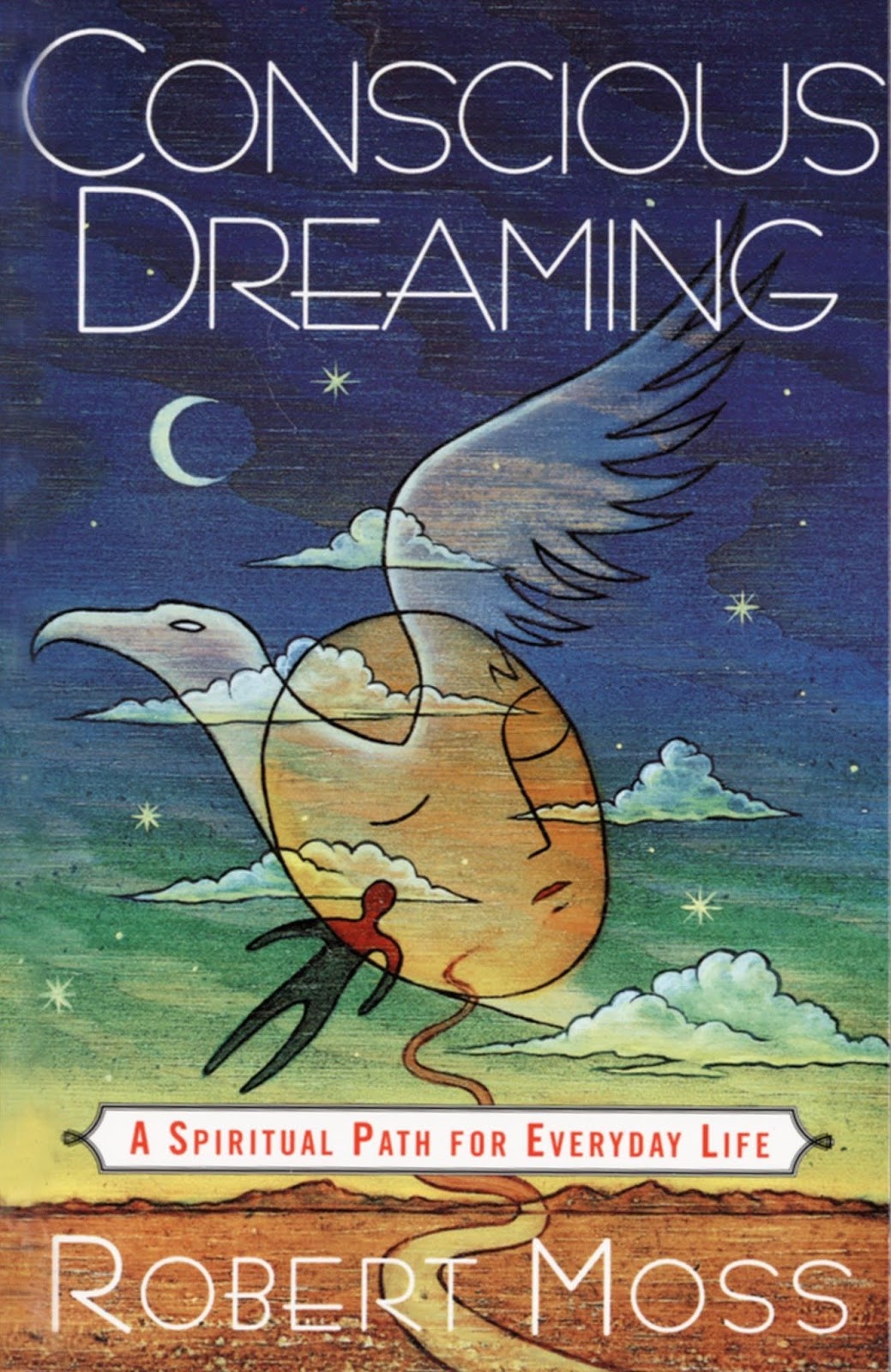
Text adapted from Robert Moss, Conscious Dreaming. Published by Three Rivers Press


Photo by RM

Thursday, July 14, 2022

Nine Ways Dreams Wake Us Up


Here’s an open secret about dreaming. It’s not fundamentally about sleeping. It’s really about waking up. Here’s how:


  1. We solve problems in our sleep 

If you want to solve a problem, or need a fresh perspective, sleep on it. Write down your intention (“I would like guidance on X”) before turning in, and be ready to record something whenever you wake up. Even if you have forgotten your dreams, you may find you have your solution.


  1. Dreams coach us for future challenges and opportunities.

We dream events before they take place; maybe nothing happens until it is dreamed. Dreams not only show us things that will come. They show us the possible future, giving us previews of future situations that may or may not play out, depending on whether we read the message correctly and take appropriate action.


  1. Dreams show us what our bodies need to stay well. 

We have a wise physician and healer available in our dreamtime every night. Our dream doctor can predict possible symptoms long before they develop, prescribe appropriate treatments, and give us images the body can believe in to make us well or keep us well. Our dream doctor makes house calls and doesn’t charge a cent!


  1. Dreams hold up a magic mirror to our actions and behavior 

Dreams give us an objective picture of our current actions and attitudes, and show us where they are likely to lead.


  1. Dreams are a secret laboratory.

Many of our greatest scientists, inventors and discoverers have been world-class dreamers. The list includes Isaac Newton, chemist Friedrich Kekule, inventor Elias Howe (who dreamed up the first practical sewing machine needle, giving us the modern garment industry) and quantum physicists Niels Bohr and Wolfgang Pauli, who said that dreams were his “secret laboratory.”


  1. Dreams are a creative studio 

To be creative is to bring something new into the world. Whatever our field of interest – from a dinner party menu to the next leap in nanotechnology – our dreams provide a creative studio where we try out new ideas and make connections that escape the everyday mind.


  1. Dreams help us mend our divided selves 

Our dreams put us in touch with many parts of ourselves, including shadow aspects we may have sought to repress or deny, and also that larger and wiser Self who can help us grow.


  1. Dreaming is a key to better relationships

Dreams can introduce our life partners. They can also put juice and depth into an existing relationship, or show us when it is time to cut our losses and move on. Sharing dreams in a family circle or among friends or workmates is a great way to build stronger connections, solve mutual problems – and have fabulous fun. Through dreams, we can also heal our relations with our departed, bringing a blessed sense of forgiveness, closure and continuing or reviving love.


  1. Dreams recall us to our larger purpose 

Australian Aborigines say that the Big stories are hunting the right people to tell them, like predators stalking in the bush. Dreams put us in touch with our bigger stories and our larger life purpose. When we can make a connection between life’s everyday dramas and a bigger story, we find courage and direction for whatever life throws at us.

-


Adapted from The Three "Only" Things: Tapping the Power of Dreams, Coincidence and Imagination by Robert Moss. Published by New World Library.


"Dream Producers" journal drawing by RM


Friday, April 22, 2022

Meeting Your Dreams in Everyday life


Do you meet your dreams on the roads of everyday life?

There are dreams you would love to meet in ordinary life because they are full of joy and romance and creative fulfillment. You want the magic to spill over into the physical world, That may require some effort on your part, to bring a map from the dream and follow clues from that map to get you to the place of happy manifestation.

There are dreams you don't want to meet in everyday life because they are full of challenge or scary stuff or mere tedium. You need to confront what you don't like in the dream in the place where you encountered it and see whether you can change things inside the dream. If not, you need to bring enough information from the dream to clarify what it may portend - and the take the necessary action to avoid meeting that bad dream on your ordinary roads.
There are dreams about which your feelings are neutral. You're not sure whether you want to meet them in physical life or leave them as memories of experiences in another reality. near or far from where you are, waking. You don't need to hurry to do anything with these dreams. You just file the information in your memory bank - and your journal - and make yourself ready to encounter a corresponding event if the dream shows up on your life road.


Photo: "Rainbow Serpent on the Sidewalk" by Robert Moss

Saturday, February 12, 2022

Inviting in your genius


The Romans never described a person as a genius. They might say, "Apollonius has a genius" - i.e., a special relationship with a tutelary spirit. The word genius is related to gignere, which means to engender or "beget". It implies reproductive energy, the power of inseminating new life. The Romans called the marriage bed genialis lectus. As observed by Jungian analyst and classicist Marie-Louise von Franz, "this referred not only to sexual potency but also to the qualities that today we would call psychic vitality, temperament, resourcefulness and a lively imagination."
    In a well-bred Roman household, a statuette representing the personal genius of the father of the family usually stood near the hearth in the kitchen. It might be the figure of a young man, holding a horn of plenty or a phallus or a snake. The woman of the house was believe to have her own guardian spirit, or "Juno", who embodied the power of giving birth. In the Roman conception, each of us is born with a personal relationship with a spiritual patron, or genius, who is the source of creative energy.
    James Russell Lowell was close to this perception when he wrote: "Talent is that which is in a man's power; genius is that in whose power a man is."
    To live and work creatively, we need to make room for this energy. The Romans were on to something. To bring something new into the world is to give birth. We see this in the pregnancy dreams that are not about physical childbirth, but about something new that is borning inside us. We can feel it in our bodies in a period of creative gestation.
    When one of my books is ready to be born, I feel pregnant. I mean that in a quite literal sense. My appetites change. I develop odd cravings at strange hours. I forget to eat or sleep for days at a time, then walk out of a dinner party to crash or feed my face with something I wouldn't normally touch. I develop morning sickness. When my new baby is ready to come out, I can't stop the contractions, even though sometimes, like a woman I once heard screaming in a maternity ward, I want to yell, "This has to stop!" There is no dope, no epidural, no C-section available to dull the experience or shortcut the labor; whatever is in me has to come out the old-fashioned way. There is an equivalent to birthing in water: the blessed gift of going into a state of flow, in which I relax into the rhythms of what is fighting its way into the world.
     As Erich Neumann remarked, "Every human being is by nature creative. Yet one of the gravest and most menacing problems in our Western civilization arises from the fact that this civilization cuts man off from his natural creativity."
    To choose and act creatively, we must be able to put our commonplace selves, with their reliance on structures and schedules,on one side, and make room for the source energy of the begetter. Creative inspiration, as all artists and discoverers know, comes through spontaneous combustion between the waking mind and other levels of consciousness. "I know now," wrote Yeats, "that revelation is from the self, but from that age-old memoried self, that shares the elaborate shell of the mollusc and the child in the womb, that teaches the birds to make their nest; and that genius is a crisis that joins the buried self for certain moments to our daily trivial mind."
     You cannot program a creative breakthrough, but you can clear a space where it may come about. Dreamwork is a wonderful aid to the creative process, because the source of dream images and the source of creative inspiration are not separate. When you resolve to catch your dreams, you are telling your creative source, "I am available. I'm listening."
     When you record your dreams, you are developing the art of storytelling. You will discover your gifts as a writer, and if you are already a writer,you will find you have done your "warm-up" exercises almost effortlessly and are ready to go he distance. Best of all, through dreamwork you are constantly learning to approach challenges from new angles, in a spirit of play. The Romans believed that a person's genius rejoices in good living, in laughter, in healthy sex, in having fun. Forget to play, and you are not working with your genius, for whom play is the only thing in mortal affairs worth taking seriously.


Adapted from Conscious Dreaming by Robert Moss. Published by Three Rivers Press


Image: Winged genius from mural in a Roman villa at Boscoreale, near Pompeii, late 1st century, now in the Louvre.

Thursday, December 30, 2021

Dreaming towards Epiphany


Whatever you do as the year turns, write in your journal! Write your dreams from the night, and your dreams of life for the coming year. Write, in particular, whatever you receive from dreams, synchronicity and spontaneous revelation over the last night of the Old Year and the first day of the New Year.
    If you were up all night partying - or the effect of your New Year's Eve reveling knocked your dreams out of memory - then record and work with the first dream that comes the following night, and whatever dreamlike symbols the world around you may give you.  
    In Japan they make a special effort to catch and work with the very first dream of the new year. Many Japanese people pay close attention to Hatsuyume, the first dream of the New Year. It may come in the night of December 31-January 1 but - since many may be up late partying or suffering the after-effects - it may come in the following day or on the night of January 1-2.     
     I would counsel you to stay alert for dreams for the New Year for a slightly longer period. In my mind the turning of the year rolls from December 30 until January 6, which is Epiphany in the Christian calendar, the day of “showing forth" when the Magi come to Bethlehem following their star, to honor the Christ child. Beyond the religious context, an epiphany may be a sudden revelation or perception of the reality or essential meaning of something important. It may be the gift of a dream.

   
In hopes of a lucky dream to kick off the New Year, some Japanese invoke the Shichifukujin or "Seven Lucky Gods" and may place a picture of them under the pillow. These may not be part of our belief system, but we have other sources of guidance and blessing available, and it is always appropriate to ask for help and blessing if we do it nicely!

 If you are ready to dream in the New Year, you could set the simple intention: 


Show me what the New Year will bring


Or give this a positive spin by couching your request to your dream makers the following way: 


Show me the best that life holds for me and those I love in the year ahead. 


Be as specific or as general as you like, but ask in a way that excites you and reflects your willingness to receive guidance and enter on new adventures.
     Don't forget that dreams require action! Your first action is to record anything you remember from your dreams and the drifty state of hypnagogia. Share it with a friend, if you can, using our Lightning Dreamwork process. Walk with your dream and see how what is going on around you may illuminate the dream and how your dream may illuminate your world.
    If you saw things in your dream you don't want to manifest in the year ahead, comb through the material with the eye of a detective, asking Who, What, When, Where, How? If you can clarify the details of the dream and identify where it may play out in coming events, you may be able to take appropriate action to avoid an event you don't want to live through in your physical life. You can also try to accomplish this by going back inside your dream, in a conscious reentry journey, to see whether you can change the script where it was playing. You may want to try writing the story of your dream so it comes to a happy ending. If those approaches feel artificial, however, that may be telling you that physical action is required to reshape the probable future for the better.
    If your first dream for the New Year is full of promise, then celebrate - but make it part of your celebration, once again, to take action to embody the energy and promise of the dream and to help it to take root in the world. Don't leave the old year without your journal, and don't enter the new year without your dreams. 
    May your New Year be filled with abounding joy, and may your best dreams come true!

Art: Sassetta, Journey of the Magi (1433-35)


Thursday, October 14, 2021

How dreaming gets us through


In our current closed-down society, people who did not previously make much room in their lives for dreams are dreaming up a storm. Unused to sharing or working with dreams, they often shout out, “Why am I having this weird dream?” As a lifelong dreamer who devotes much of his time to teaching others how to dream, let me offer a few general observations: 

1.Dreams always tell us more than we already know. Don’t dismiss any dream, or tag it as “weird” or trivial, until you have recorded it and looked carefully at what is going on here.

2. "Weirdness" in dreams may be special effects your dream producers bring in to dramatize something you need to understand or act upon, such as the need for social distancing and self monitoring.

3Dreaming may be traveling; you make visits and you receive visitations. Your social life may be very restricted in ordinary life, but you can be as social as you like in your dreams. You can go to that farmer's market or that travel destination you've been missing. I dreamed I wass in Aruba the other night, lying back under a palupa on the white sand beach with the taste of sea salt and lime daiquiri on my lips. I did not feel downcast when I reurned to my body's housebound condition. I enjoyed the full after effects of a mini vacation and did not have to pay for a plane ticket or wait for bags.

4.You have intuitive radar that comes fully alive in dreams. You see things happening at a distance in time and space. You check out the possible future. You see unwanted events in the possible future you may be able to avoid if you clarify your dream information and take appropriate action. You see desirable future scenarios -your dream home, your dream partner, your dream job – that you may be able to manifest if you follow the road map your dream has given you.

5. In dreams, you can go to a night cinema where the feature films are made especially for you. You are not confined to sitting in the audience. You can step through the screen and become scriptwriter, director an star of your own life movies.

6. You can talk to the dead in your dreams. There is nothing “weird” or unnatural about contact with the deceased, especially in dreams. We meet them because they are still around, or because they come visiting, or because in our dream travels we go to places where they are alive. Sometimes they have guidance for us. Sometimes they need our help because they are stuck or confused, and may have been hurled into the afterlife without preparation or rituals of leave-taking. With so much death around us, this is a very good time to learn, with the deceased, that consciousness survives the death of the body and that life goes on in whatever world.

7. Dreaming, you have access to wiser sources than those available to the daily trivial mind: to the god/goddess you can talk to, to the ancestors, to a Greater Self. Your dreams are a voice of conscience and course correction, showing you how your current actions and attitudes appear to an objective, witness self. Dreams are a way for your true spiritual guides to get past the cynical, reductionist skeptic in your left brain and recall you to your bigger story.

8. Your dreams are a factory of images that can help you stay well or get well.  Your body believes in images. Find the right ones and you program the amazing pharmaceuticals factory inside you to pump out the right drugs, boosting your immune system.

9. You don't need to go to sleep in order to dream. Your most powerful dreaming may unfold in the twilight zone between sleep and awake. You may journey like the ancient shamans, hyper-awake. The scales may drop from your eyes so you see that the world around you is a forest of living symbols looking at you.

10.Active dreaming is a path of real magic. In my lexicon, true magic is what happens when we bring gifts from another world into this one. We do this when we remember our dreams and act to embody their energy and guidance in everyday life. And when we wake up to the fact that dreaming is not fundamentally about what happens during sleep. Dreaming is about waking up to a deeper reality and deeper sources of meaning in our lives

To get good at dreaming, as with anything else, requires practice, practice, practice. Three things to do now:

* Keep a journal. Date each entry and give it a title. This is going to become the most important book on dreams you will ever read: your personal encyclopedia of symbols, our data log for “supernormal” phenomena like clairvoyance and precognition, a place where you dialog with your Self and your inner teachers, a workout for the writer and creator in you.
*Learn some of the core techniques of Active Dreaming, my original synthesis of dreamwork and shamanism. These include using the Nine Keys to Your Dreams explained in my book Conscious Dreaming, practicing the Dream Reentry technique, and learning to navigate by synchronicity, which is the dreamer’s way of operating 24/7/ You’ll find a short guide to my relevant books here. You may also want to check out my online video courses for The Shift Network
*Learn my Lightning Dreamwork technique, a fast, fun process by which we can share a dream or a personal story with a friend, give each other helpful feedback (without presuming to tell each other what our dreams or our lives mean) and help each other determine what action we should take to embody guidance and energy from the story.

Get to know your dreams better and you may find that if you still want to call them "weird" you will use the word in older sense. Though few of us remember its origin, weird is derived from Wyrd, which is a way of understanding how things in all the worlds are connected, and turn together. In the Scotland of my paternal ancestors, to be “weirdless” was to be unlucky or unfortunate in life. 

Photo: Under a palupa on Manchebo beach, Aruba, by RM


Sunday, September 5, 2021

You Can't Understand a Dream Without the Dreamer


Listen to Jung on this theme: “No interpretation can be undertaken without the dreamer. The words composing a dream narrative have not just one meaning, but many meanings. If, for instance, someone dreams of a table, we are still far from understanding what the ‘table’ of the dreamer signifies, although the word ‘table’ sounds unambiguous enough. For the thing we do not know is that this ‘table’ is the very one at which his father sat when he refused the dreamer all further financial help and threw him out of the house as a good-for-nothing. That is what our dreamer understand by ‘table’. Therefore we need the dreamer’s help in order to limit the multiple meanings of words to those that are essential and convincing [for the dreamer]." [*] 

In our Active Dreaming approach, we respect this cardinal rule through the first questions we put to a dreamer about their dream. The very first question is, “How die you feel on first leaving the dream?” This provides immediate – and often the best – guidance to the basic character of the dream, whether it is negative or positive, urgent and personal or something else. If a bear turns up in your dream house and you wake up feeling cheerful, your bear is clearly very different from the kind people flee from, at least in your perception and availability for interaction. If you are at work in a humdrum situation but wake with feelings of crawling dread, there is something in that scene – perhaps something that will unfold in the future – you need to understand and be ready to contain or head off.

The next question we ask is the reality check. It has two aspects:

What do you recognize from this dream in the rest of your life, including the life of your imagination; and

Could any part of this dream play out in the future, literally or symbolically?

The question about the future is vitally important because dreams often rehearse us for challenges and opportunities that lie ahead and sometimes give us very clear precognition (a phenomenon that Jung, for all his brilliance on many fronts, was slow to accept).

The first part of our reality check answers Jung’s concern by taking the elements of the dream straight to the dreamer and locating them in the context of thir outer and inner life. I will never forget listening, in a dream sharing circle, to a dream of bats. Everyone there had strong feelings and associations with bats, across a wide spectrum from bats in the belfry to witches, from speleology to being able to navigate in the dark.  Some were quivering with eagerness to offer feedback on the dream. “If it were my dream, the bats would mean…”
     But wait. First we do the feelings: cheerful, confident. Then we do the reality check. “Have you encountered bats in your life?”
    “Oh yeah,” the dreamer said nonchalantly.”I kept bats as a pet when I was a kid.”
     I don’t think we had ever met someone who kept bats as pets and regarded them as delightful childhood playmates. This took our dreamwork in an entirely different direction from where it might otherwise have gone


*  C.G. Jung, “On the Nature of Dreams” in Collected Works vol 8, p 539


Photo: Australian flyig fox (a fruit bat)