Showing posts with label Ur. Show all posts

Tuesday, September 10, 2024

The Ur-Ground of Literature


 The raw sexuality of her call to her lover is wild and shocking: “Plow my vulva!” He plunges into her like a “wild bull”. When they couple, he is the green life of all growing things and she is the Queen of Heaven. He is Dumuzi and she is Inanna.

     But she is called to go down into the dark places, and travels a terrifying path of ordeal and initiation. When she returns, transformed, to the surface world, she finds that her man has forgotten her, playing king of all he surveys. Her angry curse sucks the light out of his day. Now Dumuzi dreams that everything turns against him. Trees are uprooted, his hearth fire is doused, his drinking cup is thrown down, his shepherd’s crook is taken away. A fierce raptor seizes a lamb from his sheepfold, and he knows that something fearsome and unforgiving is coming for him.
     Death is coming for him, and his only hope lies in the love and feminine wisdom of his younger sister, Geshtin-anna. She is a reader, “a tablet-knowing scribe”, who knows the meaning of words and of dreams.
    She helps him to hide, but in the end he cannot escape his own demons. He is overpowered by galla demons and carried down to the realm of Inanna’s dark double, the Queen of the Underworld, into his own cycle of death and rebirth.. Grieving, both Inanna and his constant sister will seek him in the lower world, using drumming, like shamans. And they will make a deal by which Geshtin-anna will take her brother’s place in the Underworld for half the year, giving him time up top with the goddess in her sunnier disposition. But that is a later story in the cycle of Inanna.
    The Dream of Dumuzi is the oldest recorded dream. It was written in Sumer nearly five thousand years ago, scored with marks on baked clay that look like the tracks of a very thoughtful sandpiper. Almost certainly, it was written by a woman. We can’t miss the fact that the first dream interpreter on record is a woman who can read and write, the “tablet-knowing scribe.”
    Geshtin-anna becomes the goddess of dream divination (and of wine).

The Dream of Dumuzi, unclothed in its beauty and terror in a modern translation by Diane Wolkstein, is great writing, and takes us where great writers do not fear to go: into the inner chambers of the heart, into the demon-haunted mind, into the mysteries of death and rebirth. Thanks to its survival, we can say without hesitation that one of the first uses of writing – which was invented in Sumer – was to record dreams, and that one of the great things to emerge from recording dreams, at least five thousand years ago, was literature. Writers have always been dreamers. [1]        


Dumuzi was king of Uruk, not far from Ur, the most famous city of the Sumerians and the one from which Abraham set out to found a new people. So Bert States is doubly correct when he says “dreaming is the Ur-form of all fiction.” [2]
    States suggests that storytelling springs from the same “skill” that allows us to produce dream narrativesand compares the mental state of the creative writer to that of a lucid dreamer: “Just as the lucid dreamer is slightly awake, slightly outside the dream, while being largely inside it, so the waking author is slightly asleep, or slightly inside the fiction while being largely outside it.” [3] Many fiction writers (including me) would attest to the accuracy of this description. It probably applies to creative minds from many fields operating in a flow state of relaxed attention or attentive relaxation. In this state, as Samuel Beckett wrote of Proust, the writer may also be, for the moment, “an extratemporal being” [4] 
    Dreams provided both energy and inspiration for literary creation. As a boy, Aeschylus (born 525 BCE) was sent to watch over ripening grapes in a vineyard. When he dozed off, Dionysus, god of wine and drama, appeared to him and gave him instructions for a new kind of theatre. Prior to this, ancient Greek drama was rather static ritual, with a single actor on stage, and a chorus that did not interact directly with him. Aeschylus was inspired in his dream to introduce a second actor; this was the birth of Western theatre. He went on to write ninety plays, although only seven are extant.

“Poetry is always the result of flooding”, a young poet told Stefania Pandolfo as she journeyed among rural Moroccan villagers for whom dreaming and poetry are vitally important, and always interweaving. A real poem bursts from an emotion that is inundating, overwhelming – until it finds creative release. [5] 
   The most respected poet in the area, one Sheikh Mohammed, was alien to poetry until he dreamed of a flood. The dream came at a time of personal trauma when he was close to despair. Previously a violent man of action, he had managed to blow off his right hand in a gun accident. He dreamed the river was coming down in flood, its front like a mountain, carrying everything it encountered in its path, trees and carrion and debris. Instead of fleeing, he stood there in the dry riverbed, watching and waiting. Then he opened his mouth and swallowed the flood and everything borne along by it. He recounted the dream to his mother and she told him that he had become a poet. This became his life’s calling.[6]
     From the priestess-scribe who wrote Dumuzi’s story to the latest novels by Stephen King and Neil Gaiman, dreams have provided wonderful material for stories and novels, scripts and poems. The dream may provide the rough first sketch of a theme or a plot or a character, with everything still to be worked out and delivered – perhaps with the help of subsequent dreams – over a considerable period of time. The dream may have the structure and detail required for a finished story or poem (but is unlikely to be “finished” in the sense that it will be truly good writing until the raw report has been shaped and polished). The dream may be inserted in a narrative and attributed to one of the characters as Graham Greene did for Querry in A Burnt-Out Case). The dream may be delivered as a story without a frame, as Franz Kafka delivered a nightmare in Metamorphosis while insisting, in the tale, that the man turned into a giant bug was not dreaming.
   The literary dream has been used as a plot device in many ways. It may be used to take the reader into the inner life of a character. It may be used to set up critical narrative tension, for example between a character’s desires and his conscience, a central theme in Dostoyevsky’s use of dreams.
    The dream can be used as an architectural device, to open and frame a story that may be anything but a dream; the medieval Roman de la Rose is a classical example, from an age when dreams were greatly respected. In the classic Chinese novel The Dream of the Red Chamber novel opens with a goddess creating a mountain from 36,501 pieces of stone, one of which - rejected - is a speaking rock whose complaint is heard by two immortals and is gifted with a very mobile life, in different forms, in the mortal world – known to gods and immortals as the Red Dust - and elsewhere.[7]

     Writing and dreaming are closely related in daily practice. Writers who keep journals and record their dreams are giving themselves a warm-up, flexing the creative muscles that will work on the larger project. Writers who may not record their dreams with any regularity nonetheless rise from sleep with their heads full of words – as Dickens related in his letter to Dr. Stone – that are pressing to come out. [8]
A writer’s dream may help to “break up the great fountains of the deep” (a phrase Mark Twain used repeatedly) releasing the power of long-buried memories, or bringing through ideas that have been growing in the preconscious or the deeper unconscious for years or decade. That is how Aslan came to C.S. Lewis, giving him the key to Narnia. As “Jack” Lewis recalled 

The Lion all began with a picture of a Faun carrying an umbrella and parcels in a snowy wood. The picture had been in my head since I was about sixteen. Then one day, when I was about forty, I said to myself: ‘Let’s try to make a story about it.’
    At first I had little idea how the story would go. But then suddenly Aslan came bounding into it. I think I had been having a good many dreams about lions about that time. Apart from that, I don't know where the Lion came from or why he came. But once he was there He pulled the whole story together, and soon he pulled the six other Narnian stories in after him. [9]] 

     Finally, it is in dreams and flow states that writers come into contact with inner helpers. Robert Louis Stevenson communed with his “Brownies” in states of reverie, and gave them the credit for doing better than half his literary work. Yeats spoke of the “mingling of minds” that can bring assistance, in a creative venture, from intelligences that seem to belong to other times or other dimensions. Milton described the source of his inspiration as   

....my celestial patroness, who deigns
Her nightly visitation unimplored,
And dictates to me slumbering, or inspires
Easy my unpremeditated prose [] 

Milton spoke of “being milked” after his nights of inspiration, as – totally blind by the time he composed his most famous work – he dictated to a scribe.


Notes and References

 1. This translation of the Dream of Dumuzi is in Wolkstein, Diane and Samuel Noah Kramer, Inanna, Queen of Heaven: Her Stories and Hymns from SumerNew York: Harper & Row, 1983, pp 74-84.     Dumuzi (later called Tammuz) is a Mystery god who dies and is reborn, and the cycle of his ever-recurring death and resurrection is also the cycle of the crops in what is now southern Iraq. He dies in the spring at the time Iraqi farmers, in their hot country, harvest their wheat and barley; he is resurrected when they put seeds in the earth. In the Christian calendar, this is Easter time. The Shia ritual mourning for the martyred Imam Hussein at the site of the battle of Karbala – a rite Saddam tried to suppress – takes place at the same time. Life rhymes, and so do the life cycles of gods. See  E.W.Fernea, Guests of the Sheikh. Garden City, NY: Doubleday, 1969.

2. Bert O. States, Dreaming and Storytelling. IthacaNYCornell University Press, 1993.1993, p.3. 

3.  Bert O. States, Bert O., “Authorship in Dreams and Fictions” in Dreaming vol.4 no.4 (December, 1994) pp. 239-240

4. Samuel Beckett, Proust. New York: Grove, 1931, p. 56)

5.Stefania Pandolfo,  Impasse of the Angels: Scenes from a Moroccan Space of Memory. ChicagoUniversity of Chicago Press, 1997, p.259]

6. ibid p. 265

7. Tsao Hsueh-chin, Dream of the Red Chamber (1754). Trans. and adapted by Chichen Wang. New York: Anchor Books, 1989.

8. Charles Dickens letter to Dr Stone. February 2, 1851; see Warrington Winters, “Dickens and the Psychology of Dreams” in PMLA vol.63 no.3 (September 1948) pp. 984-1006.

9. Lewis, C.S., “It All Began with a Picture”, Junior Radio Times, vol. 68 (July 15, 1960) reprinted in Of Other Worlds. San Diego and New York: Harcourt Brace, 1975, p. 42.

10. Paradise Lost IX. 21-4


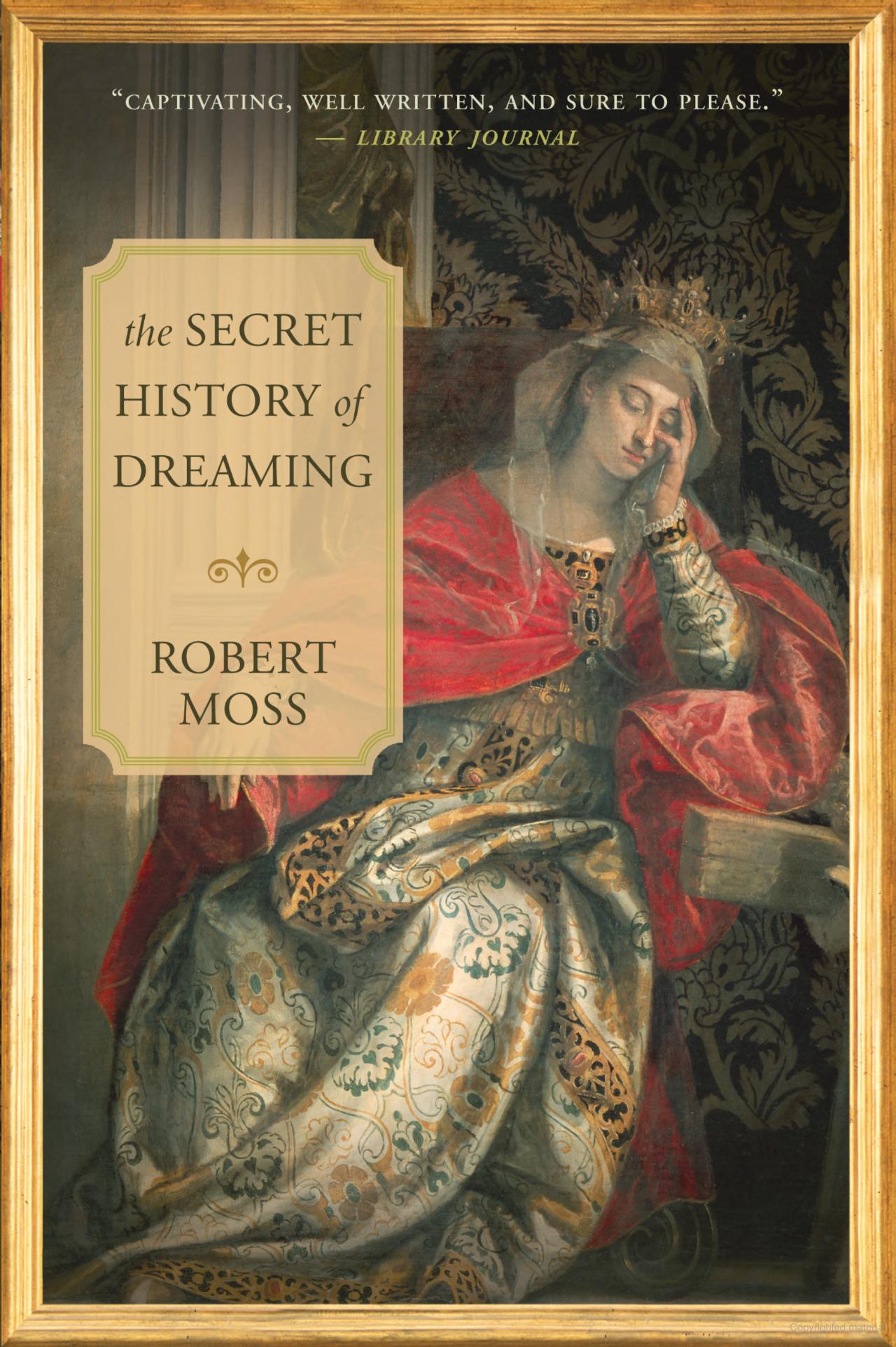
Text adapted from The Secret History of Dreaming by Robert Moss. Published by New World Library.


Sunday, April 23, 2017

The dream questioner in ancient Mesopotamia


Our earliest records of the work of a dream interpreter come from ancient Mesopotamia. Here the person you asked for help with your dream was called the “questioner”. On clay tablets from Assur and Nineveh, the “questioner” is usually a woman. The title suggests that she will put questions to the dreamer, but also, more fundamentally, to the dream itself.
     Who or what was speaking in the dream? Is the dreamer’s recollection reliable? Where did the dream experience take place? What part of the dreamer — a higher part of soul or a lower one — was active in the dream? Is the female entity “as high as the sky and as wide as the earth” who appeared to that young man in Kish truly the great goddess?  What was the context of the dream? For example, was the dreamer sleeping in a special hut, built from reeds, that was used for dream incubation after ritual purification? Or was he sleeping off a bender?
   
    A Mesopotamian term for an obscure or mysterious dream is “a closed archive basket of the gods”. Picture a woven basket used for carrying a set of clay tablets. The role of the questioner is to lift the lid and help read what is in there. One technique she might use in doing this, suggests cuneiform decoder Scott Noegel, is to record the dream and look for visual as well as auditory puns in the patterns that emerge as she scores the clay with a reed or wooden stylus. That image, from five thousand years ago, seems strangely modern: the dream as text, the dream reader looking and listening for puns.
   
    But we are in a different world from modern analysts. Literacy is still a rare skill, and the questioner will use the magic of writing. But she will bring other tools to bear. She may seek a second opinion through one of many systems of divination, which range from reading the stars to examining the entrails of a sacrificial animal to noticing what is coming into view in the landscape in a given moment — the cry of the boatman, the wind bending the reeds.
    In
 Mesopotamia, as in most human cultures, dreaming was understood to be close kin to divination. The famous Assyrian dream book in the library of King Ashurbanipal — brought to Nineveh in 647 bce from the house of an exorcist of Nippur — was filed with the omen tablets, the largest category in the royal collection. Among ordinary folk as well as in royal palaces, across most of history, dreamwork has never been separated from other ways of reading the sign language of life.   
    In
 Ur or Uruk, the questioner may decide to go beyond the dreamer’s imperfect recollection of a dream into the fuller dream experience, by transporting herself to the place where the dream action unfolded and asking questions inside that space. What would that mean? There's a clue in a tablet that describes the questioner as “one who lies at a person's head.” An Oxford scholar suggests “the method was to lie beside the sleeper in the hope of intercepting or sharing the dream as it entered his head”.
     We have a hint here that ancient dream specialists may have used a core technique of Active Dreaming that we call tracking. With permission, a practiced dreamer can make a shamanic journey through the portal of another person's dream to bring back a clear account of what is going on in the dreamspace, to solve a mystery or resolve a problem.


Text adapted from The Secret History of Dreaming by Robert Moss. Published by New World Library.

Image: Gypsum statuette from Mesopotamia c 2400 bce.

In my next online course for The Shift Network, "
Dreaming into the Dreamtime", we harvest wisdom and practice from seven world traditions of dreaming. Classes start on May 3.

Sunday, December 22, 2013

Warning from Ur: lose your dreams, lose your world


When we lose the dreaming, we may lose everything that matters. There is a haunting warning about this, echoing down across the millennia, from an ancient Sumerian text that gives voice to Ningal, the goddess-protector of Ur, who shared the central temple-palace complex with her consort Nanna, the god of the Moon. Ningal is speaking of the coming destruction of the city:

When I was grieving for that day of storm,
that day of storm, destined for me,
laid upon me, heavy with tears...
Dread of the storm's floodlike destruction
weighed on me,
and of a sudden on my couch at night,
upon my couch at night no dreams were granted me. [1]

Here the loss of dreams heralds the fall of the city and the loss of an empire.
     We can only grasp the full power of Ningal's terrible complaint when we understand her vital role, and that of the succession of high priestesses who embodied her, as dreamers and dream interpreters.
     In The Treasures of Darkness, Thorkild Jacobsen made a strong case that Ningal, like her mother Ningikuga, was a goddess of reeds as well as of the Moon. For the people of ancient Sumer, reeds defined a liminal environment, between the marshes and the dry land, symbolically a place of passage between states of consciousness and reality.
     Betty de Shong Meador writes in her wonderful book Inanna, Lady of Largest Heart: "Ningal wanders in that borderland between dry ground and the watery deep of the rivers or ocean. In that transitional space between solid consciousness and the muddy unconscious, dreams emerge. Ningal is the divine dream-spinner who roams the marsh in the moonlight of her husband and taps the fertile, imaginative play of figures in the darkness that make up dreams."
     The high priestess of the Moon god of Ur, Nanna, embodied the goddess Ningal in the annual rites of sacred union in which Nanna was embodied by the king. The hieros gamos was believed to renew the fertility of the land. From day to day, a no less vital function of the high priestess was to receive and pass on to the king and the people "Ningal's gifts of dreams". The phrase comes from the first author known by a personal name in all the world's literature: Enheduanna, poet, princess and high priestess of Nanna at Ur, whose wild and lovely poems evoking the Moon couple's daughter Inanna, Queen of Earth and Heaven, still arouse and unsettle us today.
     Scholars parsing the cuneiform texts from Sumer that have survived on baked clay tablets have found extensive evidence that dreams were greatly valued as oracles for both individuals, families and the whole polity. It was believed that the gods expressed their wishes and revealed the future through dreams. Special care was taken in incubating dreams on matters of great importance.  The dream seeker would lie down on a special couch - "the shining, fruitful couch" - to seek divine guidance, or seclude herself in a specially constructed reed hut.
    In her poem of exile, Enheduanna  grieves for a people bereft of the gift of dreams. The poet priestess laments

I cannot stretch my hands
from the pure sacred bed
I cannot unravel
Ningal's gifts of dreams
to anyone [2]

Notes
1. trans. Samuel Noah Kramer; in  Thorkild Jacobsen, TheTreasures of Darkness: A History of Mesopotamian Religion (New Haven: Yale University Press, 1976) 87.
2. trans. Betty De Shong Meador in Inanna, Lady of Largest Heart: Poems of the Sumerian High Priestess Enheduanna (Austin: University of Texas Press, 2001) 66.

Graphic: Alabaster disk showing Enheduanna, high priestess of the Moon god, in ceremony, Ur circa 2300 BCE.