Showing posts with label Dion Fortune. Show all posts

Friday, April 12, 2024

Dream Bruises and Other Bleedthroughs


What if in your dream you went to heaven and there plucked a strange and beautiful flower and what if when you awoke you had that flower in your hand?


Coleridge's famous question is not a hypothetical to active and conscious dreamers, who notice various types of bleedthrough between different dimensions of reality and experience.
    A nurse who took part in one of my early dream classes later told me she had dreamed of a visitation from a being that was half woman, half deer. Waking in her second floor apartment, she found deer scat on her floor. Trying to make sense of this (nurses are no-nonsense, practical people) she recognized that a deer might have wandered onto the grounds of her apartment complex. But she was quite certain there was no way it could have gotten up her stairs or through her window! She was content to accept the unlikely deer poop as a sign from the deeper universe that her visitation had been absolutely for real. She later found the deer-woman turning up as a guide when she was caring for patients, especially the dying who needed help to prepare for their journeys beyond this world.
    In his account of his personal dreams in The Crystal and the Way of Light, Dzogchen master Nakhai Norbu gives a memoriable example of something being transferred from a dream into the hand of the dramer. 
One of his uncles was renowned as a tertön, a "treasure revealer" of hidden texts that sometimes appeared as tiny scrolls in unusual places, apparently transmitted across generations by ancient masters. While staying with his uncle in a remote area, Namkhai Nprbu dreamed he was visited by a dakini.
     She gave him a small scroll of paper containing a sacred text. She said this was very important and that on waking he should give it to his uncle. In the dream he knew he was dreaming. He gripped the scroll tightly in one fist and wrapped the other around it. It was not permitted to disturb his uncle until after his morning rituals, so he drifted off still with his fists clamped together. Waking at dawn, he opened his hand and found there really was tiny scroll within it. He was too excited to wait. He woke up his uncle and presented the scroll. His uncle took it and said “Thank you, I expecting this” as if nothing had happened.  
     On a land of marvels and siddhis, a report of this kind would have drawn respect and keen interest rather than incredulity.  
     One of the most common bleedthroughs from the realm of dream or astral experience into the world of the body is astral repercussion, to use a term favored by Dion Fortune and her peers. This is what happens when what is experienced in the astral body during its excursions outside the physical body leave physical marks when it returns.
    While Fortune described cases where this kind of thing can be seriously depleting, even life-threatening, to the experiencer, astral repercussion may be a routine side effect of getting out and about in a subtle energy body, sometimes wholly benign and even entertaining. In the first letter from Lady Valerie D'Arcy in my novel Fire Along the Sky, she protests that an amorous visit from her lover in the form of a leopard-man left her with bite marks on her body; this fictional scene was drawn from experience!
    Let me give an example from my dream life a few summers ago. I was enjoying a rather lazy week's vacation on a lake, swimming and reading a lot, spending a lot more time in bed overnight than is my typical pattern. My body's peace and ease over those summer days was balanced by the nocturnal adventures of my dream self. In a dream thriller that could easily be filmed in the style of The Bourne Identity, I went on a wild ride through the Bois de Boulogne in Paris. We have to dodge road-blocks and predatory packs that are out to stop cars and rob their drivers and passengers, or worse. The predators use all sorts of stratagems to get drivers to stop, sometimes pushing children in front of the cars. When they do that to us, I grab control of the steering wheel from my driver, managing to avoid hitting a child being used as bait, so we escape the trap. I hurt my arm making this maneuver, but pay little attention because soon I am caught up in a big-stakes international intrigue.
    I wake happy and excited. I felt like I had stepped into a movie to play an Action Man hero, and this was really enjoyable. But - uh, oh - how did that bruise come to appear on the underside of my left upper arm? There really was no physical cause I could locate. On the other hand, there was all that action in the dream, and the pain I experienced during the car chase. Someone had jabbed something at me through the window of the car, in that mad ride through the Bois de Boulogne.
   Inter-dimensional bleedthroughs bring us awake to the fact that we are engaged in more than one order of reality, and that what happens beyond our default (physical) reality may not only be no less real, but sometimes more so. If the dream gave me the bruise, then which was more real: my night escapade in Paris, or my lazy day by a lake in Vermont?
    We are also drawn to reflect on our lager anatomy. We have more than one vehicle of consciousness. Beyond the physical body, we have an etheric, or dense energy, vehicle, and an astral body in which we travel in dreams, and higher vehicles given different names in different tarditiosn. When we go dreaming, we often travel beyind the physical body and we rarely go as a disembodied thought form. We travel in the astral body, sometmes carrying a significant amount of denser etheric energy. Take too much with you, and you return depleted - and you are vulnerable to  significant etheric reopercussion on your physical body.
      In modern Western society, we are not told much about the subtle body, but understanding its reality and its requitrements is essential to or psychic wellbeing and to safe and rewarding adventures beyond the physical. 


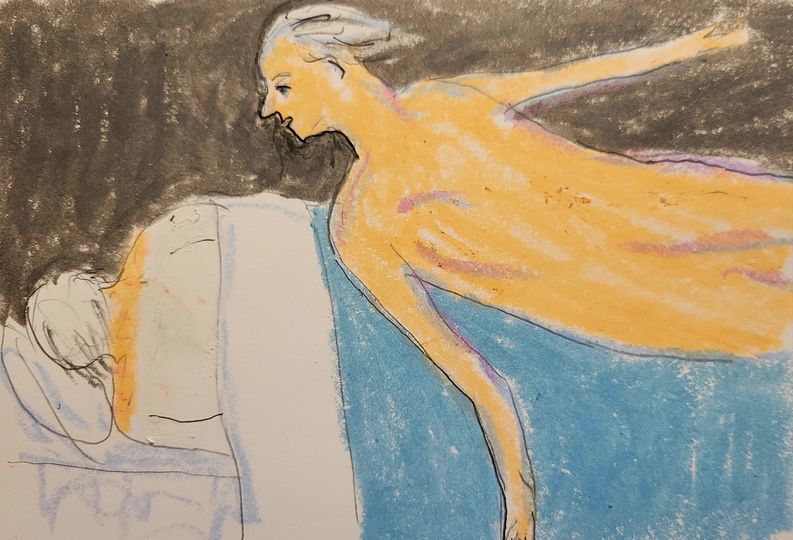
Drawing: "Autoscopy" by Robert Moss

Wednesday, April 6, 2022

Tarot Gate to Atlantis


Working the Tarot can bring us in contact with past masters of this system. On a fall evening, I had been discussing Tarot and did a personal reading in which the last two cards were the Hanged Man and the High Priestess.

When I lay down, preparing for sleep, I had a strong sense of contact with a female personality. I had no doubt she was a priestess. I associated her with a woman who had led a great esoteric order in Britain, and used the Qabalistic Tarot (as they called it) in her teachings and rituals.[1] This woman died six months before I was born, but I had often dreamed of her and her circle.

The priestess invited me to go on an astral journey, and instructed me to put on special vestments, black, white and silver. She led me to an inner temple and showed me the gateway to the path of the High Priestess on the Qabalistic Tree of Life. This is the longest and most challenging of the journeys known as Tarot pathworkings, requiring the traveler to cross the Abyss. I was told that I must on no account veer, or even look, to right or left, where there were all manner of threats, temptations and distractions.

I embarked on the journey. At the place where the road crossed the path of Strength, I learned something new about the Lion. I was required, at this point, to leave my second body – my astral body – behind, as I had left my physical body behind in the bed. This was the condition for crossing the Abyss and “shooting for Kether”, the Crown.

I survived the whirling swords of attackers who may have been very fierce Gatekeepers. I came at last to a chamber with curving walls. Here the priestess reappeared, indicating that I had earned the right to knowledge of secret and essential things. She described the chamber as a “premonistory”, a word unknown to me. Through an observation window, I looked out into an ocean in which people swam about in strange diving suits that looked like the skins of giant fish. Or perhaps they were fish-people. Some of the males were whiskered like catfish. It came to me that these might be the true people of Atlantis.

The priestess explained:

We came from the sea. The Source of Light determined to experiment with several species. Since most of the planet is covered with water, it was possible that the most propitious environment was the dominant one.
    The early Masters came from the waters, in the literal as well as the cosmic sense. This is remembered in the Chaldean stories of Ea, known to the Greeks as Oannes, and in the myths of the Dogon and other African peoples. Our form was human only by adaptation: the equivalent, on the physical plane, of the contact pictures projected by archangels and ascended Masters to greet and educate humans who are journeying into the astral on the paths of initiation.
    Hence the significance of the Hanged Man, in its reference to the element of Water, and of Nun and Tzaddi, associated with Death and the Star, in the Qabalistic Tarot.[2]
    We remember the founding priesthood as Atlantean, in the exact sense of Plato’s myth. It is recollected in a differing version in the Irish legends of Fomorians and invaders.
     To this day, the sea is the guardian and repository of the deepest mysteries. It has absorbed and transformed the effluvium of human waste and veil; this is remembered in the story of the ten thousand sealed vessels Solomon had cast beneath the waves. Great entities live far between its depths, at levels no human has plumbed – or will ever plumb – in the corporeal body.
     It is of the most urgent consequence that the sea should be appeased, its rulers propitiated. Never forget that the Moon is ruler of the sea and its tides. The seas have been ravaged by mankind. The fish are dying. It is time for humans to give back, through sacrifice.


After recording the passage above I picked up Dion Fortune's magical novel The Sea Priestess, and soon found myself reading, as if for the first time, the chapter in which the narrator picks two cards from a gypsy's Tarot deck: the High Priestess and the Hanged Man. 

I recorded this beyond-astral journey in my journal on November 17, 1994. 


Notes 

1. The magicians of the Golden Dawn and its offshoots practiced "Qabala", as distinct from the Jewish Kabbalah. The attributions of the Tarot trumps and the Hebrew letters to the paths between the sephiroth on the Tree of Life are explained by Robert Wang in Qabalistic Tarot.

2. Nun, in the Hebrew alphabet, means "fish" and in Qabalistic Tarot it is identified with trump XIII, Death. Tzaddi means "fish hook" and is associated with trump XVII, The Star. The letter Mem, meaning "water", is identified with trump XII, the Hanged Man, which was chosen by the Golden Dawn as the symbol of the Order.


Journal drawing of Oannes by RM


Thursday, March 4, 2021

Ten Books That Gave Roadside Assistance on My Soul Journey


Books have been faithful and essential friends all my life. I had a difficult and lonely boyhood, an only child who suffered double pneumonia twelve times between the ages of three and eleven. Books were my portals to realms of imagination and wonder as I lay in the half light of sick rooms. I thrived on good historical novels and on scifi and fantasy.

I like to own paper copies of all the books I read so I can sniff them and caress them and interact with a pencil. I live with an extended book family of around 14,000 volumes. My best finds are often mediated by dreams and by lively shelf elves of the kind that make books materialize and dematerialize in magical ways. My cat Lucy has recently asserted herself as a shelf elf or more - a supervising librarian- on four paws 

Like my favorite writer, Jorge Luis Borges, I sometimes picture paradise as an Infinite library. Like another of my favorite writers, Mircea Eliade, I also know that the most important book I will ever write - and one of the most important I will ever read - is my own journal. Recording dreams, observations and reading reports in my journal is essential daily practice for me.

I was recently invited to identify ten books that have provided guidance and inspiration in my spiritual odyssey and share what was happening in my life when they came to me. My journal was there to remind me what restored my inner compass and put gas in my tank in the critical passages.


1

The Odyssey 

Since I was boy, the Odyssey has been my favorite vision of life as a mythic journey. Beyond the thrill of sea monsters and angry gods and one-eyed monsters, the tale of Odysseus, the “man of many ways” is the story of a wounded warrior who is healed in the realm of the Divine Feminine. This is why Robert Graves thought it was created by a woman, and I believe he is right. In the Odyssey we see what it means to travel consciously in the presence of a guiding spirit, in this case the goddess Athena. We see that dreams are a field of interaction between gods and humans and transit lounge between the Otherworld and the physical world. Has it been made clearer anywhere else that the hardest part of the heroic quest is the homecoming? A large part of the epic is devoted to the struggles of the returning traveler to find their feet on home ground. I have used many translations over the years, not least for occasional bibliomancy; my favorite now is the most recent; the clean, spare poetic version by Emily Wilson.


2

W.B.Yeats, Collected Poems 

I knew many of Yeats’ poems by heart before I was presented with my first copy of his collected poems at my graduation from Canberra Grammar School as a prize for writing verse.  In his “Song of Wandering Aengus” I thrilled to the bardic voice of one who lived close to the Otherworld, who knew the secrets of shapeshifting and understood soul loss and soul recoveryI learned much more from Yeats’ other writings, especially Mythologies and A Vision and from walking in his footsteps in Ireland, where it is easy to understand his statement that “the visible is the skin of the invisible”. He appeared to me during a shamanic journey, saying “What better guide to the Other Side than a poet?” and I was enchanted to let him play that role in my inner life as I wrote The Dreamer’s Book of the Dead. I learned the truth of his conviction that kindred spirits reach to each other across time and may generate a “mingling of minds”. I shared his experience of a creative daimon that is forever driving us to attempt the things that are most difficult, short of the impossible.


3

Dion Fortune, Secrets of Dr Taverner 

She was a true priestess of the Wester Way. I came to her first through her important book Psychic Self-Defence, which is not for the faint-hearted. I proceeded to read, over the years, everything that I could find by her. I was excited to discover that she regarded her fiction as her most important writing on the practice of real magic A character in her novel The Goat-Foot God says that "writers will put things into a novel that they daren't put in sober prose." Dion Fortune herself said "the novels give the practice." While I love The Sea Priestess and her other novels, it is the stories collected in The Secrets of Dr Taverner that I return to again and again. The central character is a soul doctor in tweeds who deals with such complains as reincarnational dramas, astral repercussion, psychic attack, soul theft and energy vampirism. The Taverner stories are both entertaining and a valuable source of practical guidance on psychic protection and spiritual cleansing. In its fictional wrapping, The Secrets of Dr Taverner is a practitioner's casebook and perhaps the most accessible of all Dion Fortune's works for the contemporary reader.


4

Jesuit Relations and Allied Documents *

When I moved in the 1980s to a farm on the edge of traditional Mohawk country in upstate New York, because of a hawk and a white oak, I started dreaming in a language I did not know, which proved to be an archaic version of the Mohawk language. The speaker was an ancient arendiwanen, or “woman of power”. Our encounters recalled me to ancient ways of dreaming and healing and gave me immense research assignments. In the way of synchronicity, a used book dealer turned up at my door with all 73 volumes of the Jesuit Relations in the back of his truck. These are the reports of blackrobe missionaries from Indian country in the 17th century. Read carefully, drawing aside the veils of religious prejudice and fear, we have here an extraordinary source on the spiritual practices of Native Americans in Northeast America at the time of first contact. The Iroquois taught their children that dreams are the single most important source of both practical and spiritual guidance. They believed that dreams show us “the secret wishes of the soul.” In a time of war and imported disease, they recognized dreaming as a key survival tool and sent their dream shamans to scout the future. You’ll find the essential things I learned from the Jesuit reports -and the direct teachings of the Mother of the Wolf Clan who led me to use them – in my book Dreamways of the Iroquois: Honoring the SecretWishes of the Soul.


5

C.G. Jung, Memories, Dreams, Reflections 

I discovered Jung in high school and devoured many volumes of his Collected Works when I was an undergraduate. In the midst of my own psychic storms in 1987–1988, I turned to Jung again, to see how he made sense of his own “confrontation with the unconscious.” My main source was Memories, Dreams, Reflections, his life story as recorded and edited by Aniela Jaffé. We did not yet have the Red Book, and the memoir is in any event a more accessible account of what was essentially the Underworld ordeal and initiation of a shaman-scholar of the West. Central to Jung’s ability to restore his inner compass was his daily recording of dreams. “Dreams are the facts from which we must proceed” is one of the most helpful statements that has ever been made about dreams and dreamwork, and confirmation for me of the method I was obliged to improvise in my own time of testing. He confirmed for me that engaging with images in your inner life – including the terrifying ones – is a path to healing and self-empowerment. I felt the deep truth of his ringing assertion that “anyone who takes the sure road is as good as dead.” I write about Jung as “The Dream Shaman of Switzerland” in my book Dreaming the Soul Back Home.


6

Jane Roberts, Seth Speaks 

When I was going through a crisis of spiritual emergence at midlife, a friend prevailed on me to read Seth Speaks, a book channeled by Jane Roberts from an intelligence who describes himself as “ an energy personality essence, no longer focused in physical matter”. Previously somewhat resistant to channeled material, I found myself gifted with the clearest model of multidimensional reality and the multidimensional self that I had encountered. The book was a life ring for me in my efforts to understand and navigate “past life” and parallel life connections. Seth confirmed for me that we may live many existences at one time. We are connected to personalities living in the past and the future and in parallel realities, ane it is all happening Now.  Reincarnation is for real, but only one of many after-death options, and we mustn't get trapped in linear conceptions of karma and in past-life "passion plays" because any past or future is a probable reality that can be accessed and changed Now.


7

Joan Grant, Winged Pharaoh 

Winged Pharaoh thrilled me with its vivid depiction of the practices of a dream school in ancient Egypt operating in the precinct of Anubis. Joan Grant published it as a novel, but revealed later that it is actually a book of “far memory” of a life in early dynastic Egypt. We follow Grant’s alter ego, Sekeeta, as she learns to go scouting in dreams to find lost objects, look into the future, observe things happening at a distance, and discover what is going on behind the scenes. As a child, she sleeps with a wax tablet beside her bed, and her first task each morning is to record her dreams. She takes her reports to the priest of Anubis, her dream teacher. Some days she must carry out assignments he gave her inside a dream – for example to bring him a certain flower, or bird feather, or colored bead. She learns to travel in dreaming beyond time and space, to scout the possible future, and to communicate with the deceased. She encounters people who have died and are confused about their condition and moves into the role of psychopomp. In the language of ancient Egypt, a dream (rswt) is literally an “awakening”. Winged Pharaoh reawakened me to what it means to dream like an Egyptian and I have used it as a handbook in guiding others.  


8

Henry Corbin, The Man of Light in Iranian Sufism 

A lifelong student of the medieval Sufi philosophers, French scholar Henry Corbin brought the term Imaginal Realm into currency in the West. In Arabic, the term is Alam al-Mithal and it refers to the realm of true imagination, an order of reality that is at least as real as the physical world, with cities and schools and palaces where human travelers can interact with master teachers. Corbin’s great work Creative Imagination in the Sufism of Ibn ‘Arabi is a marvelous essay in visionary spirituality that embodies his driving purpose of helping to free the religious imagination from all types of fundamentalism. Corbin regarded study as a quest. In The Voyage and the Messenger looking back on his scholarly journey, he wrote that “to be a philosopher is to take to the road, never settling down in some place of satisfaction with a theory of the world…The adventure is…a voyage which progresses towards the Light". His books were with me, to anchor and orient, through the incandescent nights when I found myself in dialogue with Persian philosopher mystics and riding with the heaven bird of Persian mythology, the Simurgh. The Man of Light is Corbin’s most accessible work and one to which I return again and again. The subtitle of my book Mysterious Realities is Tales of a Dream Traveler from the Imaginal Realm.


9

W.T. Stead, The Blue Island 

I love the Victorian ghost hunters, especially F.W.H. Myers, W.T. Stead and William James. They were passionately dedicated to producing evidence of the survival of consciousness after physical death that would meet the scientific standards of their day. They promised that after their deaths they would continue their work by trying to communicate in exact detail from the Other Side. Among all the channeled books that resulted, my favorite is The Blue Island,in which Stead (who went down with the Titanic) recounts his early after death experiences to male mediums sitting in the presence of his daughter. As a former journalist, Stead is especially interested in how news is transmitted in the transition zone where he finds himself. He describes a communications center, “an amazingly well organized and businesslike place” constantly filled with ex-physicals. “Those who had on earth believed and those who had not, came to try and wire a message home.” The ones who feel a “heart call” always get priority. They have a system of “travelers”, who can reach receptive minds on Earth. Stead describes how the living can reach to the departed in a similar way. You concentrate on an individual in the spirit world, and if you put enough energy into that thought, the individual you have in mind will feel you and you may be able to open a communications channel. This beautiful little book is one of the essential Western books of the dead.


10

Viktor Frankl, Man’s Search for Meaning 

I reread this extraordinary book every few years. A successful Jewish psychiatrist in Vienna, Viktor Frankl was carried off to Auschwitz and reduced to a walking skeleton with a tattoo on his arm. In one of the darkest nightmares of history, he applied his imagination. He grew an impossible dream: of a scene in the future when the Nazis were a memory and he was standing in front of a well-fed audience in a good suit giving a lecture on “The psychology of the Concentration Camps”. In his vision the Nazi evil was so thoroughly destroyed – and he so thoroughly restored – that he could lecture about it from an objective perspective. Frankl not only survived the Holocaust. His dream played out a year after the war, in every detail. I have derived three life-orienting lessons from this. First, that however tough our situation may seem to be, we always have the freedom to choose our attitude, and this can change everything. Second, that our problems, however bad, are unlikely to be quite as bad as the situation of someone who has been sent to a Nazi death camp. That thought may help us to gain perspective, and to stand back from a welter of grief and self-pity and rise to a place where we can start to dream up something better.Third, we can make inner movies, and if they are good enough it is possible that they will play in the theater of the world.


 I look over this list and wonder why it does not include so many other books and authors that have affected me deeply: Albert Camus, Rilke, Herman Hesse, the Upanishads, Dostoyevsky, Christopher Brennan, The Tibetan Book of the Dead, Hilda Ellis Davidson, Ursula Le Guin, Mary Oliver, AE (George Russell), the (for me) inescapable Borges and Eliade. Again, my journal shaped my selections, reminding me how certain books converged with critical passages of spiritual emergence in my life, when I needed confirmation even more than inspiration.


*I'm not expecting anyone to read the 73 volumes of the Jesuit Relations that are on my shelves although today you can no doubt find them onlne. I was looking over the books that gave me anchors and life rings in decisive passages in my journey.In this case, I needed confirmation of what I was learning from the Mother of the Wolf Clan I call "Island Woman"in my books. In another book that was very important to me, The Journal of Major John Norton, a half-Cherokee British officer in the war of 1812, I confirmed the historical identity of Island Woman as the grandmother of Molly and Joseph Brant, born Huron (Wendat) and adopted into the Mohawk natoion after she was captured by a Mohawk raiding party aged about five.
 

Friday, January 4, 2019

Secrets of Dr Taverner

In his nursing home, Dr. Taverner reaches the parts that physicians and psychiatrists cannot reach. A shaman in country tweeds and a psychic Sherlock Holmes, Taverner deals with complaints that result from psychic attack, soul theft, energy vampires and diseases of the group mind. His creator, Dion Fortune (born Violet Firth) knew her stuff.     
 
  The founder of her own esoteric school, which came to be known as the Society of the Inner Light, Dion Fortune (1890-1946) modeled the hero of the stories collected in The Secrets of Dr Taverner on one of her own early mentors, an extraordinary Anglo-Irish magus named Theodore Moriarty. Some of the stories were first published in the Royal Magazine in 1922, a year before Moriarty's death. Remarkably, the illustrator made the fictional Dr Taverner look very much like Moriarty, though the artist had never seen a picture of Moriarty or even heard a description.
     Jelkes, the bookseller in Dion Fortune's novel The Goat-Foot God, says that "writers will put things into a novel that they daren't put in sober prose." Dion herself said that while books of hers like The Mystical Qabalah give the theory of high magic and spiritual reality, "the novels give the practice."
   There are five of those novels, and some of them have left a profound mark on esoteric and neo-pagan practice. The Sea Priestess contains a ritual for Drawing Down the Moon that has been much-borrowed in ceremonial work, not always with attribution. But of all her fiction, it is the stories of Dr Taverner to which I return again and again. I have asked some of my advanced classes to read several of these stories as the basis for focused discussion and investigation of such phenomena as the nature of the energy bodies, past-life connections, psychic defense and astral repercussion.
    Fortune is rather direct about what she is doing in The Secrets of Dr Taverner. She describes her tales as "studies in little-known aspects of psychology put in the form of fiction because, if published as a serious contribution to science, they would have no chance of a hearing." She wants it understood that her stories are based on fact. Her characters are mostly composites, but they are based on actual people and situations. She states that the first of the stories she completed, the tale of a hungry ghost attached to a living person that she titled "Blood-Lust", is "literally true". Noting that she was one of the first British students of psychoanalysis, she expressed the hope that the Taverner stories would be received as "a serious study in the psychology of ultra-consciousness."
     In my opinion, she succeeded beyond her ambition. The Taverner stories are both gripping and entertaining, and a valuable source of practical guidance on psychic protection and spiritual cleansing and many other facets of psychic well-being that are missed in our standard approach to healthcare and therapy. In its fictional wrapping, The Secrets of Dr Taverner is a practitioner's casebook, of the greatest value to subsequent practitioners. It is perhaps the most accessible of all Dion Fortune's works for the contemporary reader.
     Her narrator is a medical doctor named Rhodes, a supposed ingénu in regard to psychic phenomena and esoteric techniques. This makes it easy for Fortune to draw the veil over certain procedures. But enough shows through to make the story collection a kind of manual, especially when read together with Fortune's well-known later (nonfiction) work Psychic Self-Defence.


Dr Taverner releases a soldier from a hungry ghost

Dion Fortune said that she told the story titled "Blood-Lust" exactly as it was played out in physical and psychic reality.
    Captain Craigie, back from war, starts killing for blood. He starts by raiding chicken coops and works his way up to sheep. Along the way, he can't help trying to sink his teeth into his fiancee's neck. He tells Dr Taverner,that he suffered "shell-shock" in the trenches. This was a familiar term in the World War I era; today we are more likely to speak of PTSD (post-traumatic stress disorder). But in this case, "shell-shock" seems an exact description. Captain Craigie was blown out of a trench.
    The source of the problem becomes literally visible when people start seeing the apparition of a German soldier in a flat cap and field-gray uniform. This, we learn, is the etheric or dense energy body of a dead enemy soldier who has attached himself to the unfortunate Craigie, seeking to feed his "vitality hunger" (as Taverner diagnoses his condition) through his living host.
    Dr Taverner's solution involves baiting a trap, by nicking the neck of the captain's girlfriend. While Craigie is physically restrained, the hungry ghost of the German soldier leaves his body to seek the fresh blood. Taverner stands between the ghost and its host and forces it into "a psychic killing-pen" in the form of a triangle.
    Dion Fortune is discreet about what happens next. Taverner makes "a Sign and a Sound". The gray etheric form spins into a whirling spiral and disintegrates. Captain Craigie is released from the hungry ghost that was riding him,
    Dr Taverner pronounces that the source of the problem was "a corpse who was insufficiently dead."


While some parts of the plot summary may sound like the script for one of those old Hammer horror flicks, the story touches on themes of perennial importance, including the plight of veterans of foreign wars yesterday, today and tomorrow, who may be carrying unwanted energies of the dead.
     One of Dr Taverner's lessons, in this story, is that we have more than one physical body. To be specific: 


We have two physical bodies...the dense material one...and the subtle etheric one, which inhabits it, and acts as the medium of the life forces, whose functioning would explain a great deal if science would only condescend to investigate it.


By my observation, this is exactly correct. Failure to understand the nature of the etheric body and its survival of physical death confuses our relations with the dead and delays or prevents recognition of the need for spiritual cleansing and releasing in healing cases of PTSD, addiction and other disorders.
     Dr Taverner instructs that "it is possible to keep the etheric body together almost indefinitely if a supply of vitality is available". In "Blood-Lust", the supply of vital energy comes through "a human feeding bottle" that feeds on others in an effort to replenish itself.
     How common is the problem? Well, literal vampirism and blood-drinking may be rare (despite the contemporary vampire fad) but energy vampirism has never been uncommon, alas. Dr Taverner, the magician, alludes to dark side magical practices by those who seek to avoid the second death (of the etheric body) by forming "a connection with the subconscious mind of some other soul that still has a body." He cautions that "the lower type of medium" is especially vulnerable to this type of parasitism. But "higher" types can be vulnerable if in a weakened or absent condition, as when Captain Craigie was blown out of his trench, and (for a period) out of his body.
     Who ya gonna call, if you don't have a Dr Taverner down the street? Well, there is rather specific guidance on spiritual release, including staging a "second burial" for an etheric body that does not belong with the living, in The Dreamer's Book of the Dead. And we have Dion Fortune's classic Psychic Self-Defence. 


Dr Taverner reunites lovers from ancient Egypt

Dr Taverner is guided by dreams and coincidence in his work with an airman named Arnold Black, who spends his nights driving around the country at crazy speed, feeling that he is on his way to an encounter with a woman he loves but has yet to meet.
    In his first session with the wild driver, Taverner says, "If chance brought you to me, you are probably in my line." In his effort to solve the mystery of what is driving Black, Taverner asks him about his dreams, and finds that they glow with an "oriental light." He is inspired to show the airman paintings of Egypt, and Black recognizes scenes from his dreams in the ancient images.
    Taverner is encouraged to follow one of his basic procedures. When confronted with behaviors and mental states that have no adequate cause in the current life of the subject, he probes for a possible past life context, "getting the record of the previous lives of his patient by those secret means of which he was master."
    Black was in a recent airplane crash. Dr Taverner concludes that the trauma "had the effect of hypnotizing him, and he got into that particular part of his memory where the pictures of previous lives are stored."
    The woman Black is seeking may have shared a past life with him in ancient Egypt. The question now is whether she can be found - and what will happen if she is. The violent urgency of the airman's need to find his love from a previous life cannot be contained. He is in imminent danger of killing himself on the road if nothing can be done.
    "These attractions that come from the past," Taverner observes, referring here to past lives, "know no barriers. Black would drive that car through the Ten Commandments and the British Constitution to get at her. He will go till he drops."
    Coincidence comes into play again. A listless young woman is brought to see Taverner in his consulting rooms in London. He prescribes rest at his nursing home in the country, where she encounters a ghost of the living: the etheric body of the man who has been seeking her.
    Black is discovered in a car wreck close to the nursing home. The extrusion of his etheric double has left him close to death; so much of his vital energy has left his body. Taverner saves Black by leading the girl into the emergency room. At this point, the airman's etheric body rejoins the physical one. As the girl stays with him, holding his hands, he begins to revive. He eventually recovers, and the lovers who knew each other in Egypt are able to marry, reunited in their current lives.


This is a summary of a story titled "The Man Who Sought", in The Secrets of Dr Taverner.
   
It raises many interesting questions. I have no doubt that our current dramas and relationships are connected to stories that played out - and may still be playing out - in the life experiences of personalities in other times. What triggers memories of those other lives, other than something like the airman's trauma?
   How do we balance, and help others to balance, the legacy of a past life with the needs and obligations of the present one? Can karma and past-life connections be mediated a different way, perhaps by taking all of this up to the level of a Greater Self? How can we be sure that the past life is truly that of a contemporary individual, as opposed to the obsessive memory of an obsessing entity?
     These questions are central to my own work and are addressed, in part, in my book Dreamgates, in Dreaming the Soul Back Home and in my spiritual memoir The Boy Who Died and Came Back.

Wednesday, April 12, 2017

Dion Fortune's psychic detective


In his nursing home, Dr. Taverner reaches the parts that physicians and psychiatrists cannot reach. A shaman in country tweeds and a psychic Sherlock Holmes, Taverner deals with complaints that result from psychic attack, soul theft, energy vampires and diseases of the group mind. His creator, Dion Fortune (born Violet Firth) knew her stuff.     
    The founder of her own esoteric school, which came to be known as the Society of the Inner Light, Dion Fortune (1890-1946) modeled the hero of the stories collected in The Secrets of Dr Taverner on one of her own early mentors, an extraordinary Anglo-Irish magus named Theodore Moriarty. Some of the stories were first published in the Royal Magazine in 1922, a year before Moriarty's death. Remarkably, the illustrator made the fictional Dr Taverner look very much like Moriarty, though the artist had never seen a picture of Moriarty or even heard a description.
     Jelkes, the bookseller in Dion Fortune's novel The Goat-Foot God, says that "writers will put things into a novel that they daren't put in sober prose." Dion herself said that while books of hers like The Mystical Qabalah give the theory of high magic and spiritual reality, "the novels give the practice."
   There are five of those novels, and some of them have left a profound mark on esoteric and neo-pagan practice. The Sea Priestess contains a ritual for Drawing Down the Moon that has been much-borrowed in ceremonial work, not always with attribution. But of all her fiction, it is the stories of Dr Taverner to which I return again and again. I have asked some of my advanced classes to read several of these stories as the basis for focused discussion and investigation of such phenomena as the nature of the energy bodies, past-life connections, psychic defense and astral repercussion.
    Fortune is rather direct about what she is doing in The Secrets of Dr Taverner. She describes her tales as "studies in little-known aspects of psychology put in the form of fiction because, if published as a serious contribution to science, they would have no chance of a hearing." She wants it understood that her stories are based on fact. Her characters are mostly composites, but they are based on actual people and situations. She states that the first of the stories she completed, the tale of a hungry ghost attached to a living person that she titled "Blood-Lust", is "literally true". Noting that she was one of the first British students of psychoanalysis, she expressed the hope that the Taverner stories would be received as "a serious study in the psychology of ultra-consciousness."
     In my opinion, she succeeded beyond her ambition. The Taverner stories are both gripping and entertaining, and a valuable source of practical guidance on psychic protection and spiritual cleansing and many other facets of psychic well-being that are missed in our standard approach to healthcare and therapy. In its fictional wrapping, The Secrets of Dr Taverner is a practitioner's casebook, of the greatest value to subsequent practitioners. It is perhaps the most accessible of all Dion Fortune's works for the contemporary reader.
     Her narrator is a medical doctor named Rhodes, a supposed ingénu in regard to psychic phenomena and esoteric techniques. This makes it easy for Fortune to draw the veil over certain procedures. But enough shows through to make the story collection a kind of manual, especially when read together with Fortune's well-known later (nonfiction) work Psychic Self-Defence.
   
She dramatizes key principles of her work, including these, as expressed in Psychic Self-Defence:

  • "The driving forces of the universe, the framework upon which it is built up in all its parts, belong to another phase of manifestation than our physical plane, having other dimensions than the three to which we are habituated, and perceived by other modes of consciousness than those to which we are accustomed."
  • "We live in the midst of invisible forces whose effects alone we perceive. We move among invisible forms whose actions we very often do not perceive at all, though we may be profoundly affected by them." 

One of the scariest Taverner stories is titled "Blood-Lust". The author claims that this is nonfiction fiction: that it is based on true events, exactly described, and that only the names have been changed.
    Captain Craigie, back from war, starts killing for blood. He starts by raiding chicken coops and works his way up to sheep. Along the way, he can't help trying to sink his teeth into his fiancee's neck. He tells Dr Taverner that he suffered "shell-shock" in the trenches. This was a familiar term in the World War I era; today we are more likely to speak of PTSD (post-traumatic stress disorder). But in this case, "shell-shock" seems an exact description. Captain Craigie was blown out of a trench.
    The source of the problem becomes literally visible when people start seeing the apparition of a German soldier in a flat cap and field-gray uniform. This, we learn, is the etheric or dense energy body of a dead enemy soldier who has attached himself to the unfortunate Craigie, seeking to feed his "vitality hunger" (as Taverner diagnoses his condition) through his living host.
    Dr Taverner's solution involves baiting a trap, by nicking the neck of the captain's girlfriend. While Craigie is physically restrained, the hungry ghost of the German soldier leaves his body to seek the fresh blood. Taverner stands between the ghost and its host and forces it into "a psychic killing-pen" in the form of a triangle.
    Dion Fortune is discreet about what happens next. Taverner makes "a Sign and a Sound". The gray etheric form spins into a whirling spiral and disintegrates. Captain Craigie is released from the hungry ghost that was riding him,
    Dr Taverner pronounces that the source of the problem was "a corpse who was insufficiently dead."

    While some parts of the plot summary may sound like the script for one of those creaky old Hammer horror flicks, the story touches on themes of perennial importance, including the plight of veterans of foreign wars yesterday, today and tomorrow, who may be carrying unwanted energies of the dead.
     One of Dr Taverner's lessons, in this story, is that we have more than one physical body. To be specific: 


We have two physical bodies...the dense material one...and the subtle etheric one, which inhabits it, and acts as the medium of the life forces, whose functioning would explain a great deal if science would only condescend to investigate it.


By my observation, this is exactly correct. Failure to understand the nature of the etheric body and its survival of physical death confuses our relations with the dead and delays or prevents recognition of the need for spiritual cleansing and releasing in healing cases of PTSD, addiction and other disorders.
     Dr Taverner instructs that "it is possible to keep the etheric body together almost indefinitely if a supply of vitality is available". In "Blood-Lust", the supply of vital energy comes through "a human feeding bottle" that feeds on others in an effort to replenish itself.
     How common is the problem? Well, literal vampirism and blood-drinking may be rare (despite the contemporary vampire fad) but energy vampirism has never been uncommon, alas. Dr Taverner, the magician, alludes to dark side magical practices by those who seek to avoid the second death (of the etheric body) by forming "a connection with the subconscious mind of some other soul that still has a body." He cautions that "the lower type of medium" is especially vulnerable to this type of parasitism. But "higher" types can be vulnerable if in a weakened or absent condition, as when Captain Craigie was blown out of his trench, and (for a period) out of his body.
     Who ya gonna call, if you don't have a Dr Taverner down the street? Well, I give rather specific guidance on spiritual release, including staging a "second burial" for an etheric body that does not belong with the living, in The Dreamer's Book of the Dead. And we have Dion Fortune's classic Psychic Self-Defence. 


Tuesday, March 7, 2017

Our days are full of dream residue


We often wake with a dream hangover, even if we don't recall the dreams that caused it. Freud said that dreams are full of "day residue", thoughts and memories left over from waking life. It is no less true that our days are full of dream residue.
     Sometimes we become aware of this when we wake up feeling jet-lagged or even as if we have been run over by a truck, even though we seemed to sleep well enough. This is often the effect of what esoteric writers used to call "astral repercussion". You get out and about in an energy body, in night dreams, and what happens to that astral vehicle may reverberate in your physical system. In extreme cases, like those Dion Fortune made the stuff of the highly illuminating and sometimes cautionary tales in her Secrets of Doctor Taverner, bruises or apparent wounds may be left on the physical body.
    Those jetlag sensations may be caused by a lot of dream travel;  if you are flying across the world in a dream body, especially if you are crossing large bodies of water (which drain energy from the subtle body) you may have quite literal reasons to feel the way you would feel after a long flight on a plane. Frequent fliers need to learn more about the nature and care and maintenance of energy bodies, which is a major theme in my book Dreamgates.
     Our dream activity, remembered or not, often sets the tone for the day. Sometimes we rise with a terrific surge of energy and confidence or a clear sense of direction that was lacking the day before. We may say that we slept well; chances are we also dreamed well.
     The "vigilance" theory developed by Finnish dream researcher Antti Revonsuo maintains that in dreams the brain rehearses for patterns of challenge and opportunity that lie ahead, preparing us to move faster and more effectively when certain situations arise, and that this activity is important and useful whether or not we remember our dreams.
     Deja vu is one of the most striking examples of dream residue, though many of us fail to understand how it comes about. We meet a person or enter a scene that is absolutely familiar to us; we are sure we have seen this before. Most often this is because we are now catching up, in waking life, with an event that first took place in a dream.
    Sometimes dream residue is so outrageous and in our face that we can't fail to see it. In my book Conscious Dreaming I report an episode shared with me by a nurse who dreamed she received a visitation from a guide who appeared as half-woman, half-deer. In the morning, she was amazed to find deer scat on the rug in her second-floor apartment. It seemed impossible that it could be there - unless it spilled from the dream.
    We might recall Coleridge's famous questions:

What if you slept? And what if, in your sleep, you dreamed? And what if, in your dream, you went to heaven and there plucked a strange and beautiful flower? And what if, when you awoke, you had the flower in your hand? Ah, what then?

Then we would know that the dream experiences are real, and that what goes on in the dream world doesn't necessarily stay in the dream world. It happens.

Photo of Cafe Jet-Lag in Les Halles, Paris by Robert Moss


Thursday, June 2, 2016

Dream bruises, dream love-bites and other cases of astral repercussion


What if in your dream you went to heaven and there plucked a strange and beautiful flower and what if when you awoke you had that flower in your hand?

Coleridge's famous question is not a hypothetical to active and conscious dreamers, who notice various types of bleedthrough between different dimensions of reality and experience.
    A nurse who took part in one of my early dream classes later told me she had dreamed of a visitation from a being that was half woman, half deer. Waking in her second floor apartment, she found deer scat on her floor. Trying to make sense of this (nurses are no-nonsense, practical people) she recognized that a deer might have wandered onto the grounds of her apartment complex. But she was quite certain there was no way it could have gotten up her stairs or through her window! She was content to accept the unlikely deer poop as a sign from the deeper universe that her visitation had been absolutely for real. She later found the deer-woman turning up as a guide when she was caring for patients, especially the dying who needed help to prepare for their journeys beyond this world.
    One of the most common bleedthroughs from the realm of dream or astral experience into the world of the body is astral repercussion, to use a term favored by Dion Fortune and her peers. This is what happens when what is experienced in the astral body during its excursions outside the physical body leaves physical marks when it returns.
    While Fortune described cases where this kind of thing can be seriously depleting, even life-threatening, to the experiencer, astral repercussion may be a routine side effect of getting out and about in a subtle energy body, sometimes wholly benign and even entertaining. In the first letter from Lady Valerie D'Arcy in my novel Fire Along the Sky, she protests that an amorous visit from her lover in the form of a leopard-man left her with bite marks on her body; this fictional scene was drawn from experience!
    Let me give an example from my dream life during a lazy week of summer vacation on Lake Champlain. I spent my time swimming and reading, dining well, spending a lot more time in bed overnight than is my typical pattern. My body's peace and ease over those summer days was balanced by the nocturnal adventures of my dream self. 
    In a dream thriller that could easily be filmed in the style of The Bourne Identity, I go on a wild ride through the Bois de Boulogne in Paris. We have to dodge road-blocks and predatory packs that are out to stop cars and rob their drivers and passengers, or worse. The predators use all sorts of stratagems to get drivers to stop, sometimes pushing children in front of the cars. When they do that to us, I grab control of the steering wheel from my driver, managing to avoid hitting a child being used as bait, so we escape the trap. I hurt my arm making this maneuver, but pay little attention because soon I am caught up in a big-stakes international intrigue.
    I woke happy and excited. I felt like I had stepped into a movie to play an Action Man hero, and this was really enjoyable. But - uh, oh - how did that bruise come to appear on the underside of my left upper arm? There really was no physical cause I could locate. On the other hand, there was all that action in the dream, and the pain I experienced during the car chase. Someone had jabbed something at me through the window of the car, in that mad ride through the Bois de Boulogne.
   Inter-dimensional bleedthroughs bring us awake to the fact that we are engaged in more than one order of reality, and that what happens beyond our default (physical) reality may not only be no less real, but sometimes more so. If the dream gave me the bruise, then which was more real: my night escapade in Paris, or my lazy day by a lake in Vermont?

Dearest Shane,

I dream you as the leopard. Last night you came to me in his skin.You frightened me, pressing against my face. I knew you by the eyes.
     This night vision was entirely real. As I write this, I feel the places in my body you praised and fed. 
I cannot undress in front of Sir Henry tonight, even if he begs me to do it, because I have bite marks and a spectacular bruise, ovoid and empurpled as an eggplant, blooms on my inner thigh. 
     Can you cause a leopard, Shane?

- love letter from Lady Valeie D'Arcy to Shane Hardacre, the opening page of my novel Fire Along the Sky published by Excelsior Editions. Please note that only the second edition contains the letters.

Thursday, May 10, 2012

Dr Taverner releases a soldier from a hungry ghost

Dion Fortune says that she told the story titled "Blood-Lust" (in The Secrets of Dr Taverner) exactly as it was played out in physical and psychic reality.
    Captain Craigie, back from war, starts killing for blood. He starts by raiding chicken coops and works his way up to sheep. Along the way, he can't help trying to sink his teeth into his fiancee's neck. He tells Dr Taverner, the unusual practitioner who turns his attention to the case, that he suffered "shell-shock" in the trenches. This was a familiar term in the World War I era; today we are more likely to speak of PTSD (post-traumatic stress disorder). But in this case, "shell-shock" seems an exact description. Captain Craigie was blown out of a trench.
    The source of the problem becomes literally visible when people start seeing the apparition of a German soldier in a flat cap and field-gray uniform. This, we learn, is the etheric or dense energy body of a dead enemy soldier who has attached himself to the unfortunate Craigie, seeking to feed his "vitality hunger" (as Taverner diagnoses his condition) through his living host.
    Dr Taverner's solution involves baiting a trap, by nicking the neck of the captain's girlfriend. While Craigie is physically restrained, the hungry ghost of the German soldier leaves his body to seek the fresh blood. Taverner stands between the ghost and its host and forces it into "a psychic killing-pen" in the form of a triangle.
    Dion Fortune is discreet about what happens next. Taverner makes "a Sign and a Sound". The gray etheric form spins into a whirling spiral and disintegrates. Captain Craigie is released from the hungry ghost that was riding him,
    Dr Taverner pronounces that the source of the problem was "a corpse who was insufficiently dead."


While some parts of the plot summary may sound like the script for one of those old Hammer horror flicks, the story touches on themes of perennial importance, including the plight of veterans of foreign wars yesterday, today and tomorrow, who may be carrying unwanted energies of the dead.
     One of Dr Taverner's lessons, in this story, is that we have more than one physical body. To be specific: 


We have two physical bodies...the dense material one...and the subtle etheric one, which inhabits it, and acts as the medium of the life forces, whose functioning would explain a great deal if science would only condescend to investigate it.


By my observation, this is exactly correct. Failure to understand the nature of the etheric body and its survival of physical death confuses our relations with the dead and delays or prevents recognition of the need for spiritual cleansing and releasing in healing cases of PTSD, addiction and other disorders.
     Dr Taverner instructs that "it is possible to keep the etheric body together almost indefinitely if a supply of vitality is available". In "Blood-Lust", the supply of vital energy comes through "a human feeding bottle" that feeds on others in an effort to replenish itself.
     How common is the problem? Well, literal vampirism and blood-drinking may be rare (despite the contemporary vampire fad) but energy vampirism has never been uncommon, alas. Dr Taverner, the magician, alludes to dark side magical practices by those who seek to avoid the second death (of the etheric body) by forming "a connection with the subconscious mind of some other soul that still has a body." He cautions that "the lower type of medium" is especially vulnerable to this type of parasitism. But "higher" types can be vulnerable if in a weakened or absent condition, as when Captain Craigie was blown out of his trench, and (for a period) out of his body.
     Who ya gonna call, if you don't have a Dr Taverner down the street? Well, I give rather specific guidance on spiritual release, including staging a "second burial" for an etheric body that does not belong with the living, in The Dreamer's Book of the Dead. And we have Dion Fortune's classic Psychic Self-Defence.