Showing posts with label subtle body. Show all posts

Monday, April 7, 2025

News from The Secret Commonwealth


In a book titled The Secret Commonwealth of Elves, Fauns and Fairies, Robert Kirk (1644-1692), a Gaelic scholar and Anglican vicar at Aberfoyle in Scotland,  describes a “secret way of correspondence” with the invisible world: a means of crossing between ordinary and nonordinary reality at will. Kirk subtitled his work “An Essay of the Nature and actions of the Subterranean and for the most part Invisible People, heretofore going by the names of Elves, Fauns and Fairies and the like.”

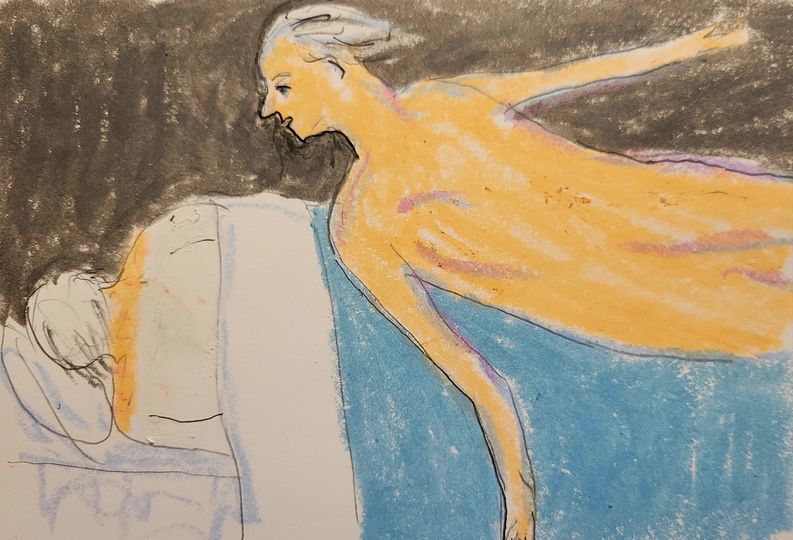
Subtle bodies The inhabitants of these realms are not disembodied. They have “light changeable bodies, like those called Astral, somewhat of the nature of a condensed cloud. They shape-shift and can make their “bodies of congealed air” appear and disappear at will.

Middle nature: The fairies are “of a middle nature betwixt man and Angel,” like the daimons of the ancient world. Kirk discusses rival opinions in his parish about whether the “good people” are spirits of the departed, clothed in their subtle bodies; “exuded forms of the man approaching death”; or “a numerous people by themselves.” He suggests that all these descriptions may be valid for different groups.

Doubles. Kirk reports that each of us has a double who is fully at home in the Otherworld. The old Scots Gaelic term for this double is coimimeadh (pronounced “coy-me-may”), which means “co-walker.” Kirk improvises a series of synonyms for the double, including: twin, companion, echo, “reflex-man,” and living picture. The double resembles the living person both before and after she or he dies. The double survives physical death, when the co-walker “goes at last to his own land.” When invited, the co-walker will make itself “known and familiar.” But most people are unaware that they have a double. Since it lives in a different element, it “neither can nor will easily converse” with the everyday waking mind.

As natural as fishing As a man of the Church, Kirk goes to great lengths to argue that there is nothing ungodly about “correspondence” with Otherworld beings, quoting reports of visionary experiences in the Bible. He also contends that it is as “natural” to encounter the inhabitants of the Otherworld as it is to go fishing; both involve moving into another element. Yeats brings this to poetic life in "The Song of Wandering Aengus", where a man fishing with a hazel rod catches a little silver trout that becomes a girl with apple-blossom in her hair.  

Kirk reassures us that we are dealing with “an invisible people, guardian over and careful of man,” whose “courteous endeavor” is to convince us of the reality of the spiritual world and of “a possible and harmless method of correspondence betwixt men and them, even in this life.” 

However, local legend has it that members of the Secret Commonwealth found the minister too mouthy about them and carried him away one summer evening when he was walking on a dun-shi, a fairy hill behind his house.  He was taken before his book was published. It remained for Sir Walter Scott to discover and publish it in 1815. The frontispiece is a watercolor drawing  hy Sir D.Y. Cameron depicting the Hill of the Faitries at Aberfoyle. Bailie Nicol Jarvie describes this hill and its legends in Rob Roy.

Kirk's successor as minister at Aberfoyle, the Rev. Dr. Grahame, in his Sketches of Picturesque Scenery, recounted that as Kirk was walking on the fairy hill, he sunk down in a swoon, which was taken for death. “After the ceremony of a seeming funeral,” Scott continued the story in Demonology and Witchcraft , “the form of the Rev. Robert Kirk appeared to a relation, and commanded him to go to Grahame of Duchray. ‘Say to Duchray, who is my cousin as well as your own, that I am not dead, but a captive in Fairyland; and only one chance remains for my liberation. When the posthumous child, of which my wife has been delivered since my disappearance, shall be brought to baptism, I will appear in the room, when, if Duchray shall throw over my head the knife or dirk which he holds in his hand, I may be restored to society; but if this is neglected, I am lost for ever." According to this story, Kirk did appear at the christening, and “was visibly seen;” but Duchray was so gobsmacked that he did not throw his dirk  and Kirk went away again.

Kirk lived in a world not yet "dispeopled of its dreams" as Andrew Lang wrote in his introduction to a 1893 edition of The Secret Commonwealth. Lang proceeded to discuss experiences of the co-walker:  "All things universally have their types, their reflex: a man’s type, or reflex, or ' co-walker' may be seen at a distance from or near him during his life—nay, may be seen after his death. The gifted man of second sight can tell the substantial figure from the airy counterpart."

Lang was especially interested in the kind of double that goes ahead of you for which the Norwegians use the term vardøger, who "was often seen of old to enter a House, by which the people knew that the Person of that Likeness was to visit them in a few days....It may have occurred to most of us to meet a person in the street whom we took for an acquaintance. It is not he, but we meet the real man a few paces farther on. Thus a distinguished officer, at home on leave, met a friend, as he tells me, in Piccadilly. The other passed without notice: the officer hesitated about following him, did not, and in some fifty yards met his man. There is probably no more in this than resemblance and coincidence, but this is the kind of thing which was worked by the Highlanders into their metaphysics."


Illustration: Robert Kirk Goes Away. RM+AI

Sunday, March 30, 2025

The Two Lilas and the Endless Worlds


Your life and your dreams are both made of stories. You won't forget this if you immerse yourself in one of the greatest storybooks ever made. The earliest version of the Yogavasistha was probably compiled in the seventh century. Its original title was the Mokshapaya, or Way of Release. Authorship has been attributed to the sage Valmiki, also credited with producing the epic Ramayana. The voice we hear is that of another sage, Vasistha. He takes on the task of restoring the spirits and the will to action of the boy prince Rama of Ayodhya. Hence the full title of the text, The great story of Rama as told by the sage Vasistha in order to expound his philosophy of Yoga. Rama’s services are urgently required to defend gods and humans against an army of demons, but he has slumped into lethargy and despair. 
    Rama asks the sage, “What is the point and purpose of this useless existence?” The whole dialogue that follows - filling more than 27,000 verses and powered by sixty-four extraordinary stories - is a response to that question. Vasistha charts the path to release from vasanas, the habitual tendencies and karmic traces that hold the soul in bondage to the wheel of repetition. He describes the way of ascension through higher worlds to the realm of pure consciousness. But this is not only a guide to moksha, or liberation. It is a call to re-engagement with the world, to live the bigger story.
    Vasistha is my kind of teacher. He offers real philosophy, deep as Advaita Vedanta or the Upanishads, but he does not teach through admonishment or abstraction; he teaches by telling really good stories. 
    One of his core teachings is that "this universe is but a long dream...There is no real difference between the waking state of reality and the dream state. What is real in one is unreal in the other - hence, these states are essentially of the same nature." [1]
     Beyond other systems of yoga, the yoga of Vasistha hinges on seeing the world as a dream. [2] In order to be truly awake, one must fully understand sleep and dream. The world appears and disappears, realities come and go like dream states.
    Make that worlds. There are countless worlds, including universes concealed inside stones or subatomic particles. "In every atom there are worlds within worlds." The Sanskrit term is jagadanantya, which literally means "the endlessness of worlds".[3] 
Hugh Everett III might want to join the conversation at thsi point; he was the atheist proponent of the Many Worlds Interpretation in quantum mechanics which holds that the universe is constantly splitting into parallel versions.
    The sage continues: "No one can count the number of universes (and consequent creations) that are arising at this minute from the Supreme Being. The mind that humans possess is ever fluctuating and gives rise to all things in these visible worlds. This external appearance which exists as a reality is a creation of human desires. It is as unreal as a goblin shown to terrify children. This world is as unstable as a stool made of banana leaves.”
    The longest story in the Yogavasistha, and one of the most wildly entertaining, is the tale of Lila, or rather The Two Lilas. Queen Lila, fearing the death of her beloved husband, King Padma, prays to the goddess Sarasvati that they should not be separated. When the goddess appears after the death of the king, she shows Lila how to preserve his body while traveling to find his soul essence in different realms. Lila is excited though incredulous when the goddess tells her than among other life experiences she and her husband have shared is the partnership of Visastha - no less - and his wife in a universe within a tiny space. How can Lila know this for sure? The goddess explains that she can go there and see for herself. But for this kind of travel, Lila must affirm to herself, “I shall leave my body here and take a body of light. With that body, like the scent of incense, I shall go to the house of the holy man." 
    Once Lila learns to drop her physical body and travel in a subtle body, she embarks on a series of fantastic journeys, involving parallel lives, reincarnation, mind-created worlds and the ascent to pure consciousness beyond the illusions of form. Lila and Sarasvati "roamed freely in their wisdom bodies. Though it seemed that they had traveled millions of miles in space, they were still in the same 'room' but on another plane of consciousness." 
   They fly to the top of Mount Meru, they see spaceships ang gods and celestial dancers and the abode of the creator. In a marvelous skirl of humor, the narrator tells us "like a couple of mosquitoes they roamed all these planes."
    In a scene made for big-screen sci fantasy, Lila meets her double - also a queen, in another life story - in a palace where they watch a futuristic battle. Rockets burst into a thousand warheads and gunships like elephants rain fire from the sky. "What looked like elephants had been propelled into the air from the battlefield and they were raining fire on the city." It seems a ninth century author is able to foresee twenty-first century battles or Star Wars scenarios from the ancient future. In this world at war King Padma is embodied as another king, Viduratha, who will be slain in battle because he has set his mind on liberation, not victory. “Whatever vision arises within one’s self is immediately experienced." 
    Lila wants to know why there is an exact double of herself in this scene. They can see and interact with each other though others may see only one of therm. Sarasvati explains that it was the longing of her deceased husband, Padma, that generated Lila’s double in this world where Padma has been reborn as Viduratha. “Due to excessive love towards you your husband Padma thought, at the moment of death, of enjoying your company without being ever separated. Accordingly he was able to get you here. Whatever is thought of by one at the time of his agonizing death, that will be realized by him afterwards."
    We are given a fascinating description of soul transfer, or body swapping. After the death of Viduratha, Sarasvati puts his jiva - his soul - into the embalmed corpse of the first Lila’s dead husband, Padma.


             Through the nose

Saraswati, removed the grip she had on the jiva of Viduratha which therefore entered into the nasal orifice of Padma's body in the form of prana and permeated the whole parched up body. Whereupon blood began to circulate freely throughout and the deceased king woke up, rubbing his eyes. Padma woke up and asked who they were.

     Lila is eventually able to remember eight hundred of her past lives and step in and out of lives that her parallel selves are living beyond the wheel of time.
     We are given hints as to the nature of the true life teacher. Sarasvati tells Lila she is more than a goddess; she is higher consciousness. Beyond the play of reality and illusion, waking and dreaming, there is the limitless nondual field of pure consciousness. This is the only reality. Both liberation and enlightened reengagement with the world require the jiva to understand this fully.
     Which brings us to Vasistha's most important teaching You must transcend the world but then return and embrace it. The aim is to become the jivanmukta, the living liberated being, who can engage with the world without being entangled with it. Lila means play. Beyond the gloom of the world, seek the divine play. If life is a dream, grow your ability to change the dream or create a new one.
     Vasistha’s purpose in telling stories to Rama is not only to awaken him to the fluid interplay of reality and illusion, and the conditions for moksha (liberation) but to help him acquire the non-attachment that will enable him to act in the world without succumbing to its entrapments “doing yet not doing what has to be done” The stories show that our lives are shaped by the mind’s capacity to create and sustain reality. Existence is a dreamlike projection of consciousness. Boundaries between waking life, dreams, past and future lives, and parallel realities are fluid.
     So, reality is not as fixed as we tend to tell ourselves. When we recognize that much of what we accept as real is a mental construct, we can change the construct.
    
 If we see life and death as illusions, perhaps we can bring more clarity and courage to our actions. Why fear death? And why get stuck in the conditions of a single life experience? We are many. Lila identified eight hundred incarnations before she stopped counting. How many doubles and counterparts does any one of us have, whether as aspects of our present personality or transpersonal counterparts in different times or dimensions?
    We are led to assume that all of this will bring Rama into the field to fight the demons. Be in the world not of it. Knowing that the world is an illusion does not mean withdrawing from it. We want to navigate with awareness and to live with awareness and non-attachment, lucid in the dream of life, taking part in life’s play while remembering that it is a playground. 
     
Vasistha teaches us that will (paurusa) can overcome fate (daiva) when exerted by a mind that has awakened. “Those who have removed the veil from reality can imagine things so precisely that those mental perceptions are actually experienced.” Certain people, of whom Vasishtha is one, have the power of making their dreams, become physical objects- objects that did not existed until a powerful dreamer dreamed them into reality. [4] Don't forget

Your real life is a dream and the dream is real

Your real life is an illusion and the illusion is real


CODA: A Crown Prince Recommends a Book of Stories to Take You Beyond This World

In the Chester Beatty Library in Dublin is a Persian translation of the Yogavasistha with 41 miniature paintings, probably commissioned by the first Mughal emperor Akbar and completed under the patronage of his son and successor Jahangir. There is a fascinating note in Jahangir's own hand in the margin of folio 1b. A recent translator gives us this version:

"God is great! - This book Ğög Bäsistha [sic] which belongs to the stories of the ancients, (and) which I translated in the time when I was crown-prince ...is a very good book. Whenever somebody hears it with the ear of understanding, and if he considers only one percent of it, it is surely to be hoped that he will make the bațin ['what is beyond this world'] his destination by the instrument of the zahir ['what belongs to the apparent world']" [5]

From his time as crown prince, Jahangiir not only claims full credit for the translation but pierces to the main intent of this astonishing Hindu text, where philosophy is animated by amazing tales of doubles, parallel worlds and oneiric adventures. The yoga of Vasistha leads to awakening to ultimate reality "beyond this world" through the magic of story - and then guides the hearer to act in the world with the clarity and courage of non-attachment. To hear or read just one of Vasistha's stories, it's been said, is to become enlightened.


References: 

1. Swami Venkatesananda. Vasistha’s Yoga. (Albany NY: SUNY Press 1993) p. 71. Unless otherwise mentioned, all quotations from the Yogavasistha in this essay are from this 800-page abridgment.

2. Christopher Key Chapple gives an elegant summary of the seven states in Vasistha’s yoga: “Vasiṣṭha’s sevenfold Yoga begins with restraint from activity (nivṛtti) leading to deep thinking (vicāraṇa) and non-attachment (asaṃsaṅga). After these three preliminaries Vasiṣṭha proclaims that in the fourth state one sees the entire world as if it were a dream. For Vasiṣṭha, this process of dissolution holds great lessons. Is the world real? According to Vasiṣṭha, the answer is a resounding no. Once one sees through the fixity of any given circumstance. In the fifth Yoga, one can descend (or ascend) into the realm of an experience of non-duality, wherein one operates as if in a state of deep sleep, translucent and transparent (advaita suṣupta). This catapults the individual into a state of true freedom (jīvan mukta), preparing one for the seventh Yoga, one’s final release from the body (videha mukta) at the time of death. Unlike any of the other Yoga systems, the Yogavāsiṣṭha process hinges on seeing the world as a dream.” Christopher Key Chapple.  “Worlds of Dream in the Yogavāsiṣṭha: Virtual and Virtuous Realities” Embodied Philosophy 2020 

3. Garth Bregman. “The Existence of an Endless Number of Worlds Jagadānantya in Mokṣopāya and the Many-Worlds Interpretation of Quantum Mechanics” in  Christopher Key Chapple and Arindam Chakrabarti (eds) Engaged Emancipation: Mind, Morals, and Make-Believe in the Moksopāya (Yogavāsistha) (Albany: SUNY Press, 2015) p.97.

4. Wendy Doniger O’Flaherty.“The Dream Narrative and the Indian Doctrine of Illusion in Daedalus  vol. 111, no. 3 (Summer, 1982),p.102

5. Heike Franke. “Akbar's Yogavāsiştha in the Chester Beatty Library” Zeitschrift der Deutschen Morgenländischen Gesellschaft 161(2) (January 2011) 359-375


Illustration: Two Lilas with the Goddess. RM + AI


Sunday, April 21, 2024

The "just so" feeling on leaving a dream


Feelings, feelings. I don’t want to discuss a dream experience unless the dreamer will talk about first feelings around it. I notice that quite often my own feelings when I leave a dream are neutral and detached. There is often a sense of “been there, done that” – that I have returned from an experience that in another world that does not have immediate consequences in this one.
    It may be an experience in one of many parallel lives. It may be a case of what the Jungians call compensation; I am engaged in a life unlived in my present reality but going on continuously in a realm of imagination. 
in Inner Work Robert Johnson reports the memorable case of a reclusive introvert who was leading a robust life with a voluptuous wife in an imagined Italy, where he spoke Italian, made love and had rows, and played with his kids, night after night. While these can be tagged as compensation dreams, we can also allow that they may be glimpses of a continuous life in a parallel reality where the dreamer made different life choices. 
    Then there are the dreams in which you seem to be in someone else’s body and situation. This is not unusual in psychic dreams.
    In a dream experience, I may engage in thrilling adventures, churning with high emotions. If I am calm and detached after coming back, I know I don't need to import these dramas and emotions into my regular life, except perhaps as stories to tell or write. Those dramas belong to another life, one of many I - and maybe you - are living in the multiverse, with varying degrees of consciousness.
     So when I record my feelings on returning from a dream excursion, the words I most often use are "just so," meaning "been there, done that" in a world and a situation that feel quite as real as everyday life, and sometimes more so. I may add the phrase "travel worn" because (for example) when I have led a three-day workshop in my subtle body while my body of meat and bones was dormant in bed for a couple of hours - and then had to fly back across oceans and continents - I can be somewhat jet-lagged. 

Journal drawing: "Bardo Hotel" by Robert Moss
        

Friday, April 12, 2024

Dream Bruises and Other Bleedthroughs


What if in your dream you went to heaven and there plucked a strange and beautiful flower and what if when you awoke you had that flower in your hand?


Coleridge's famous question is not a hypothetical to active and conscious dreamers, who notice various types of bleedthrough between different dimensions of reality and experience.
    A nurse who took part in one of my early dream classes later told me she had dreamed of a visitation from a being that was half woman, half deer. Waking in her second floor apartment, she found deer scat on her floor. Trying to make sense of this (nurses are no-nonsense, practical people) she recognized that a deer might have wandered onto the grounds of her apartment complex. But she was quite certain there was no way it could have gotten up her stairs or through her window! She was content to accept the unlikely deer poop as a sign from the deeper universe that her visitation had been absolutely for real. She later found the deer-woman turning up as a guide when she was caring for patients, especially the dying who needed help to prepare for their journeys beyond this world.
    In his account of his personal dreams in The Crystal and the Way of Light, Dzogchen master Nakhai Norbu gives a memoriable example of something being transferred from a dream into the hand of the dramer. 
One of his uncles was renowned as a tertön, a "treasure revealer" of hidden texts that sometimes appeared as tiny scrolls in unusual places, apparently transmitted across generations by ancient masters. While staying with his uncle in a remote area, Namkhai Nprbu dreamed he was visited by a dakini.
     She gave him a small scroll of paper containing a sacred text. She said this was very important and that on waking he should give it to his uncle. In the dream he knew he was dreaming. He gripped the scroll tightly in one fist and wrapped the other around it. It was not permitted to disturb his uncle until after his morning rituals, so he drifted off still with his fists clamped together. Waking at dawn, he opened his hand and found there really was tiny scroll within it. He was too excited to wait. He woke up his uncle and presented the scroll. His uncle took it and said “Thank you, I expecting this” as if nothing had happened.  
     On a land of marvels and siddhis, a report of this kind would have drawn respect and keen interest rather than incredulity.  
     One of the most common bleedthroughs from the realm of dream or astral experience into the world of the body is astral repercussion, to use a term favored by Dion Fortune and her peers. This is what happens when what is experienced in the astral body during its excursions outside the physical body leave physical marks when it returns.
    While Fortune described cases where this kind of thing can be seriously depleting, even life-threatening, to the experiencer, astral repercussion may be a routine side effect of getting out and about in a subtle energy body, sometimes wholly benign and even entertaining. In the first letter from Lady Valerie D'Arcy in my novel Fire Along the Sky, she protests that an amorous visit from her lover in the form of a leopard-man left her with bite marks on her body; this fictional scene was drawn from experience!
    Let me give an example from my dream life a few summers ago. I was enjoying a rather lazy week's vacation on a lake, swimming and reading a lot, spending a lot more time in bed overnight than is my typical pattern. My body's peace and ease over those summer days was balanced by the nocturnal adventures of my dream self. In a dream thriller that could easily be filmed in the style of The Bourne Identity, I went on a wild ride through the Bois de Boulogne in Paris. We have to dodge road-blocks and predatory packs that are out to stop cars and rob their drivers and passengers, or worse. The predators use all sorts of stratagems to get drivers to stop, sometimes pushing children in front of the cars. When they do that to us, I grab control of the steering wheel from my driver, managing to avoid hitting a child being used as bait, so we escape the trap. I hurt my arm making this maneuver, but pay little attention because soon I am caught up in a big-stakes international intrigue.
    I wake happy and excited. I felt like I had stepped into a movie to play an Action Man hero, and this was really enjoyable. But - uh, oh - how did that bruise come to appear on the underside of my left upper arm? There really was no physical cause I could locate. On the other hand, there was all that action in the dream, and the pain I experienced during the car chase. Someone had jabbed something at me through the window of the car, in that mad ride through the Bois de Boulogne.
   Inter-dimensional bleedthroughs bring us awake to the fact that we are engaged in more than one order of reality, and that what happens beyond our default (physical) reality may not only be no less real, but sometimes more so. If the dream gave me the bruise, then which was more real: my night escapade in Paris, or my lazy day by a lake in Vermont?
    We are also drawn to reflect on our lager anatomy. We have more than one vehicle of consciousness. Beyond the physical body, we have an etheric, or dense energy, vehicle, and an astral body in which we travel in dreams, and higher vehicles given different names in different tarditiosn. When we go dreaming, we often travel beyind the physical body and we rarely go as a disembodied thought form. We travel in the astral body, sometmes carrying a significant amount of denser etheric energy. Take too much with you, and you return depleted - and you are vulnerable to  significant etheric reopercussion on your physical body.
      In modern Western society, we are not told much about the subtle body, but understanding its reality and its requitrements is essential to or psychic wellbeing and to safe and rewarding adventures beyond the physical. 


Drawing: "Autoscopy" by Robert Moss

Thursday, January 11, 2024

Open Secrets of the Dreamtime


Here are the open secrets of the Dreamtime, insights shared by many dreaming traditions and indigenous peoples that challenge the ruling paradigms of a culture that confuses the real with the physical. 

1. Dreams are real experiences.

There are big dreams and little dreams. “Bottom-line it for me,” bulled a radio host over the phone from North Dakota. “Aren’t dreamed caused by spicy pizza?” Well, yes, some dreams are. But we will not expend much space here on the surface bubbles of the dozing brain and belly.

In big dreams - in what Sri Aurobindo called “the sleep of experiences" - we are dealing with events, encounters, and challenges that are entirely real on their own level of reality. Our dream memories may be garbled or muddy, but the dream is a real experience whose meaning lies within the dreamscape itself. The dream experience, fully remembered, is its own interpretation. But we must do more than interpret dreams; we must manifest their energy and insight in our waking lives.

Shamanic dreamers tend to be quite literal-minded about dreams. If you dreamed you fell off a rock-face, you’d better remember to check your safety harness if there is any chance you might go rock climbing. If you flew with the eagle, you discovered a powerful spiritual ally — and your own ability to transcend the limitations of your physical body. If you dreamed of your dead uncle, before you start asking yourself what part of you he might represent, you should consider the possibility that you had a visit with him. Is he bothering you — maybe trying to cadge a drink or a smoke — or offering you help? If you dreamed you received instruction at a mountain shrine, you should be open to twin possibilities: that you may go there someday, in physical reality; and that you may have been called in your dreams to one of the many “invisible schools” where training and initiation on the higher planes are conducted.


2. Dreams are flights of the soul.

During one of the final presentations at a hectic conference in Berkeley, I regretted that I had not taken that Saturday morning off to explore the Bay area. I closed my eyes, slipped free from my physical focus, and felt myself gliding over the Bay on the wings of an eagle. It was a wholly tactile sensation. I was drawn to a wild, lightly wooded area with intriguing stone formations that looked from the air like volcanic rock. As I dipped into a fold in the hills to examine the area more closely, I saw another interesting formation, shaped by human hands: a circular labyrinth, or spiral, at the edge of a pond.

At lunch, I casually described the scene I had explored. “It could be the Sibley Volcanic Preserve,” one of the local conferees piped up. “I can take you out there this afternoon if you have time.” She did not know about the spiral path, but we found it fairly easily, at the edge of a swampy pond.

From a shamanic perspective, there was nothing extraordinary about my experience. It was just a routine scout — a Middle World journey — in which I moved beyond the range of my physical senses to check out my environment. I was traveling beyond my body, but I kept a firm connection with it, maintaining awareness of the activity in the lecture room even as I flew across the Bay.

Shamanic dreamers say that in real dreams (waking or sleeping) one of two things is happening. Either you are journeying beyond your body, released from the limits of space-time and the physical senses; or you receive a visitation from a being — god, spirit, or fellow dreamer — who does not suffer from these limitations. In the language of the Makiritare, a dreaming people of Venezuela, the word for dream, adekato, means literally a “flight of the soul.”

The open secret is that consciousness if never confined to the body and brain. We discover this in spontaneous night dreams and intuitive flashes, when our left-brain inhibitions are down. As we become active dreamers, we can hone the ability to make intentional journeys beyond the body at any time of day or night.


3. You have a dreambody as well as a physical body.

I am leading one of my Active Dreaming circles. We are squatting around a centerspread with a white candle. Someone asks whether there is any way to prove that we are not dreaming. I pick up the candle and pour hot wax onto my hand. I feel a sting of pain as the wax sears the web of skin between my thumb and forefinger, and I tell the group, “I guess that proves I’m not dreaming.” Then I wake up.

What is this dream telling me? That I am a nitwit because I can’t tell whether I’m dreaming? If so, I will take solace from the fact that in most sleep dreams, most people are completely unaware that they are dreaming. Actually, I think this dream has a more interesting and specific message, related to the theme that dreams are real experiences. In my dreambody, I can know pleasure and pain just as vividly as in my physical body. I have more than one body, or vehicle of consciousness, and when I go into the dreamworld and other worlds, I go embodied. And so do you.


4. Dreams may be memories of the future.

I dreamed of a silly little dog decked out with fake antlers for some kind of Christmas pageant. The dog ran out on the road and was killed, but was magically revived by a dubious, utterly amoral character who seemed remote from the normal range of human emotions.

The dream had a movielike quality. I had no idea what was going on here, but because I had no particular feelings about it, I was content to record it in my journal before rushing off to the airport to catch a plane to Denver.

I missed my connection and later found myself on a different flight form the one schedules. Whenever my travel planes come unstuck, I am alert for the play of the Trickster. On the “wrong” plane, I found myself seated next to a woman who turned out to be best friends with a person in publishing to whom I had been introduced only the day before, and I was able to glean some useful insights. Our conversation was interrupted by the screening of the in-flight movie. I looked up to see a silly little dog decked out in fake antlers for a Christmas pageant. Later in the movie, the dog is killed on the road and magically revived — by a low-flying angel portrayed by John Travolta. The title of the movie is Michael, and I highly recommend it. What interested me most was that I seemed to have attended an advance screening in my dream the night before.

We dream things before they happen in waking life. If you work with your dreams and scan them for precognitive content, you can develop a superb personal radar system that will help you to navigate in waking life. You can also learn to fold time and travel into the possible future by the methods explained in this book. For even the most active dreamers, however, the meaning of many dreams of the future may be veiled until waking events catch up with the dream.

If dreams are memories of the future, is much of waking like the experiencing in the physical body what we have already lived in the dreambody? What would we become if we participated more consciously in this process? There is an Iroquois story of a great hunter who always scouted ahead, in conscious dream journeys, to locate the game and rehearse the kill. In one of his dream scouts, he located an elk and sought its permission to take its life to feed his extended family. He killed the elk in his dream and noted the red mark on its chest where the arrow had gone in. The following day, he walked to the place he had visited in dreaming and identified his elk by the red mark on its chest. He then replayed an event that had already taken place, by killing the elk again with a physical arrow.


5. Dreaming, we choose the events that will be manifested in our waking lives.

The fact that we dream things before they happen does not mean everything is predetermined. People who are not active dreamers can get quite confused about what is going on when they wake up to the fact that we are dreaming future events, both large and small, all the time. I think it’s like this. If you do not remember your dreams, you are condemned to live them. (If you don’t know where you’re going, you will likely end up where you are headed.) If you remember some of your dreams and screen them for messages about the future, you will find yourself able to make wiser choices. You will discover that by taking appropriate action you can often avoid the enactment of a “bad” dream or bring about the fulfillment of a happy one. As you become a conscious dreamer, you will find yourself increasingly able to choose inside the dreaming the events that will be manifested in your waking life.

It’s not about predestination. It’s about the spiritual secrets of manifestation — and your ability to become cocreator of your life.

Meister Eckhart tells us how it is the razor-sharp clarity of the practical mystic who has seen and experienced for himself: “When the soul wishes to experience something, she throws an image of the experience out before her and enters her own image.”

Indigenous peoples tell a recurring story of how the material world is spun from the dream of a deity. For the Guajiro, the physical universe is the product of conscious dreaming. The Guajiro say that the Creator-god made this world after the divine Dreamgiver, Apusanai, made him aware that he was dreaming and he began to experiment with molding and solidifying the fluid forms he perceived endlessly aborning and transforming on another plane of reality.

It is not merely that we dream things (maybe everything) before they happen; dreams make them happen.


6. The path of the soul after death is the path of the soul in dreams.

Your dreambody does not die when your physical body loses it vital signs. You will live on in your dreambody for a shorter or greater time, according to your ruling passions and personal evolution. You will find yourself, as you do each night in dreams, in a realm where thoughts are things, and imagination, the great faculty of soul, can create whole worlds.

You come from the Dreaming, and you are released into the Dreaming when you drop your sack of meat and bones.

In a dream, I found myself walking in a pleasant cemetery. A voice said, "You must prepare your Houses of Death". I looked and saw brightly painted cabins. I chose one - blue with yellow trim - and stepped through the door that opened for me. There was no wall on the far side. The view was of a lovely cove with a white sand beach, A beautiful dark-skinned woman in a sarong was in the water beckoning to me.

I waded out to join her. She handed me a conch shell. When I held it to my ear, I received instructions for making a crossing an island that now appeared shimmering on the horizon. I understood that I had been given a departure point for a voyage to the Other Side. I have returned to that scene often, in lucid dreaming. I would not be surprised to find myself there again when it is time to leave the body behind.

Dreaming with growing consciousness is excellent preparation, not only for the challenges that lie before you on the roads in this life, but for the challenges of the journey you will make after physical death. How do you know for sure? By doing it.


Text adapted from Dreamgates: Exploring the Worlds of Soul, Imagination and Life Beyond Death by Robert Moss. Published by New World Library


Art by Robert Moss: "You Must Prepare Your Houses of Death"

Friday, January 5, 2024

To Find the Face We Had Before the World Was Made


I'm looking for the face I had
Before the world was made.

So W.B. Yeats declared, in his poem, "Before the World Was Made". What could he mean?

The couplet is with me as I read about the life of Yeshe Tsogyel, the Guru Dakini sometimes described as the Mother of Tibetan Buddhism. The first pages of her biography, channeled by an ecstatic 18th century yogin named Taksham Nuden Dorje, put us right  there: looking at a face that existed before the world. 

When we first meet Tsogyel she is in the form of the goddess Sarasvati, revered by Hindus and Buddhists alike for her learning, her devotion to sadhana or religious practice, and her lovely singing voice. As Sarasvati, she says to  Padmasambhava, known as Guru Rinpoche, and celebrated in Tibet as the Second Buddha, "It is time to project an emanation into the savage world." This confirms the Guru's desire to bring a female partner to Tibet to complete his mission of converting that wild and warring country - a militaristic empire at the time - to the dharma teachings. 

"Let the fire burn!" exclaims the Guru.
"We are burning together! “says the Dakini.

We are told that “the Guru's vajra and the Dakini's lotus are joined" and they enter the trance of union. They are surrounded and protected by the goddesses of the five Buddha families, and legions of fierce deities and dakinis. Beams of light blaze from where their bodies are joined and rush towards Tibet like shooting stars, to enter a royal couple who are joined in lovemaking.

The name of the mother-to-be is Getso. In the arms of the prince, Getso sees a swarm of golden bees, Making the sound of lute music, they enter the prince through the fontanel. In the same moment he sees a vision of the princess with three eyes holding a beautiful young girl. The visions multiply and spill into the world. Lightning flares, thunder rolls, a spring near the castle becomes a lake. And dreams flower into majesty.

In the night the prince dreams of an eight-petalled lotus that casts light across the multiverse. A coral stupa rises from the crown of his head - where his wife saw the bees fly in - and multitudes come from all over the world to pay homage or try to steal it. He dreams that he plays a lute, and the music reverberates through countless universes. In her dreams, the princess - now pregnant - is given a rosary of coral and conch shell beads from which red and white ambrosia streams in a never-ending fountain..

Nine months later, Getso gives birth without pain to a baby girl who already has waist length hair. When she is offered the traditional knob of yak butter, Tsogyel sits up in a half-lotus posture and explains herself:

I am an apparitional being, a yogini.
After eating immaterial essences for so long
The memory of coarse food has vanished But I will eat to complete my mother's happiness.

The Dakini proceeds to swallow the whole knob of butter with one gulp, and with it "the whole of samsara”. She is now fully in the world.

This can all be read as a magnificent tale of the descent of spirit from Light through Imaginal realms, in changing vehicles of consciousness - though here I am at risk of forsaking Buddhist terminology - to settle in a vehicle in the realm of Illusion known as the physical world. 

It is time to project an emanation into the savage world. Now that's a way to embark on a journey towards incarnation. If we can presume to make some part of the story our own, it may give us clues to how we can pursue Yeats' intent: to find the face we had before the world was made.


I have drawn here from a remarkable work by Keith Dowman, Sky Dancer: The Secret Life and Teachings of the Lady Yeshe Tsogyel (Ithaca NY: Snow Lion, 1996). In a lively and creative translation, Dowman gives us the life of Yeshe Tsogyel delivered as a "mind-treasure" to a yogin on "black days in a forest hermitage". Tsogyel is credited with seeding many termas (“treasures”) on behalf of Padmansambhava, and some of her own as well. These hidden treasures might be concealed in a landscape, in the clouds, in a dream or in a mind, to be revealed at the right times across generations. Taksham claimed to have received no less than Tsogyel's autobiography, and this is how it reads in Dowman’s version. As Dowman tells us, he “took poetic license to use the first person throughout” and to “convey the precise meaning and feeling-tone of the original in fluent English, rather than to reproduce the peculiarities of the Tibetan style and diction.” In my opinion, he has succeeded brilliantly.

Far beyond the Buddhist community, the story of Yeshe Tsogyel will be of compelling interest to those of us who want to reclaim the suppressed history of women and contribute to the restoration of the Divine Feminine. If you are drawn to the Dakini, you may want  to compare the oral telling dictated by Tarthang Tulku in Mother of Knowledge, The Enlightenment of Yeshe Tsogyel (Berkeley: Dharma Publishing. 1983) and the classic early text by Namkahi Nyingpo and Gyalwa  Changchub, Lady of the Lotus Born. The Life and Enlightenment of Yeshe Tsogyal, translated by the Padmakara Translation Group (Boston: Shambala, 1999)

“The Dakini Yeshe Tsogyal is the mother of all Buddhas– the Wisdom Consort of Guru Padmasambhava. Yeshe Tsogyal possesses inconceivable primordial wisdom, compassion, and the power of protection and manifestation of the enlightened activities…From a historical point of view, it is due to Dakini Yeshe Tsogyal’s compassion, wisdom and power of total recall that we have the entire teachings of Guru Rinpoche intact." - Lama Chödak Gyatso Nubpa (1951-2009)

Sunday, October 15, 2023

Soul Sandwich


Last night, in my dream body, I went to a New York café for brunch and ordered The Alfred, a simple cheese sandwich on a garlic roll. The bread was incredibly delicious, a soft floury ciabatta. Deeply infused with garlic and olive oil, it still looked perfectly smooth and snow white. I separated the bread from the filling to savor every crumb.

The taste was in my mouth when I opened my eyes in bed. This was not an unusual experience for me. My taste buds often come alive in my dreams. I wonder whether this is related to different aspects of soul and the subtle body coming into play. The famous American psychic Edgar Cayce suggested that we need to discern whether a certain dream reflects the needs or wishes of the body, the mind or the spirit. Our dreams are often excursions, in which we travel beyond the physical body in a subtle vehicle, guided by whatever part of the self is in control.
Prior to sleep. my late night reading was the Book of Visions of the Kabbalist R. Hayyim Vital (1542-1620) , who writes at length about five levels of soul or consciousness (starting with nefesh, ruah, neshamah) and how they may follow separate trajectories between bodies and lives. He did not apply this closely to the 56 dream reports in his spiritual autobiography. However, the Persian mystic philosopher Shahabuddin Suhrawardi, whose followers called him Shaykh al-Ishraq, the Leader of Illumination, did.  He distinguished different levels of dreaming – with corresponding degrees of importance and reliability – according to which aspect of the self is the prime experiencer.

Clear dreams or “free revelation” [kashf] are experiences of soul [ruh] traveling beyond the body, or having clear communication with a visitor. The territory visited may be a separate reality or a situation in the future. “With the eye of the free soul, by the imagination, a person contemplates in dreams the state of things which is yet in the hidden.”
In this condition, the dreamer can have accurate foreknowledge of future events, and true clairvoyance. “After separation from the body, the soul knows even of the small things heard and seen of this world.” In clear dreams, the dreamer becomes a remote viewer.

This is a practice that can be developed in waking states of altered consciousness, or mukashafa. The Prophet Muhammad scouted out the progress of a caravan en route to Mecca in this way. The Caliph Umar, from afar, scouted an ambush that had been laid for his general Sariya (and sent his general a telepathic warning that was received).
The second of Suhrawardi's categories is symbolic dreams or “fancied revelations”. These he defines as dreams in which the lower self [nafs] is dominant. Clear vision is cloaked by the “fancy garments” of appetite and desire. Landscapes traveled in such dreams are “the stages of lust.” Interpretation is required to separate a message from the fancy dress.
Suhrawardi's lowest category is dreams of “pure fancy”. These unfold when “sensual thoughts” take over completely and higher consciousness [ruh] is “veiled from considering the hidden world.”
I'm pretty sure all levels of me love perfect bread - and garlic.

R. Hayyim Vital's Book of Visions  is available in Jewish Mystical Autobiographies, trans. Maurice M. Faierstein, ed. Isaac Safrin (Mahwah N.J.: Paulist Press, 1999)
Translations of Suhrawardi are from H. Wilberforce (ed. and trans.) A Dervish Textbook ('Awariful-Ma'arif) (London: Octagon Press, 1990). For more on Suhrawardi, see my book The Secret History of Dreaming.

Saturday, December 10, 2022

A Dreamer's Notes: Dream Hotels and Dream Bodies


The Dream Hotel


I find myself in dream hotels several times a week. Sometimes I have trouble finding my room or getting back to the hotel from a walk in a city. Often I am leading a workshop or attending a meeting or dinner, engaging with many people. Sometimes, for reasons I don't yet understand, I am staying in one hotel while renting a room in another. The hotels are typically well-appointed, even luxurious, and I often have a suite.

I am frequently able to identify the location (typically in Europe) but these are not hotels where I have stayed or am likely to stay in the future.

I ask myself: what is a hotel? For me, it is a generally comfortable lodging for a traveler. Dreaming is often traveling and I am usually content to track the excursions of my traveling self in alternate realities while my body is at home. From a larger perspective, in this life we are in temporary lodgings, coming from the soul's home in a previous existence, on our way to the soul's home in the next world. We are passing through. 


Dream Bodies


I am endlessly fascinated by accounts of experiences in the subtle body, a term that came into the English language through the Cambridge Platonists, notably Ralph Cudworth, in the 17th century. Other names for it from the older Neoplatonist tradition include the astral body, the shining body, the imaginal body, the soul vehicle, the soul garment. 

I am generally content to call it the dreambody. I know, through long experience and observation, that when we go dreaming we may leave the physical body quite effortlessly and travel in another vehicle. When I go looking for visual portrayals of travel in the subtle body, I'm not generally impressed. You can easily find pictures of soul leaving the body at the moment of death - Blake's illustration to a poem is one of the best - but not much that convincingly portrays the operations of consciousness in a second body in life. 

Father Arsenio Boca, the Romanian Orthodox mystic, painted a few; I saw them in a monastery in his home country. The illustrations in Hereward Carrington's old book on astral projection show a second body floating above the body on the bed, linked by a silver cord that seems to run from the fontanel.  The Marvel multiverse gave us a thrilling sequence in the first Doctor Strange movie in  which Benedict Cumberbatch gets pushed out of his body, into a second one, by a Tibetan master. 


Kupka's Dream Lovers


My favorite artistic portrayal of dreambodies is an early work by the great Czech artist František Kupka. He wrote in a notebook that creative people have "psychic films" running in their minds. He painted a screenshot from one of these films in "The Dream" (1909) which shows lovers joined in their subtle bodies while their physical bodies lie dreaming below. The painting is modest in size, rendered in oil on a cardboard square about one foot on each side. However, the implications are enormous, and speak of Kupka's abilities - honed through years of practice in various esoteric schools - to see beyond the veils of consensual reality.

Two nude figures, male and female, lie on the ground in a sleep-dream state. Their second bodies dominate the scene on the upper left, overlapping each other in a sensual, translucent embrace. Their colors and forms shift across a spectrum of blue, purple and green. On either side diagonal lines in blue and purple give the sense of upward movement. Kupka employs a kind of transparent light to spotlight the subtle bodies of the lovers. Rather than reflecting light like solid three-dimensional figures, the dreambodies are suffused with light.

It's perhaps not surprising to find that Kupka was inspired by his own dream of astral love. He wrote on the lower left corner:

     Ma Chère Ninie, Voici ébauche le reve que J’ai eu-nous deux—Ton Franc.

“My dear Ninie, Here I sketch the dream that I had of the two of us—Yours, Franc.”

Ninie is Eugénie Straub.They began living together in 1906 and married in 1910.

Kupka is best-known as a pioneer of abstract art. However, if you look over a retrospective of his whole career you find that he mastered many styles. From the lavish symbolism of early works through Cubist flourishes to spare Mondrian-like geometries. You see his love of color and form. You sense, perhaps, his fervent quest to render visible what is invisible to the ordinary senses, to pluck at the veils between the world of appearances and what lies beyond. He declared this cause in his manifesto Creation in the Plastic Arts, published in Prague in 1927:

Great art makes the invisible and intangible, purely and simply felt, a visible and tangible reality — a reality that is not a simple pictorial replica of the ideal mechanism common to everyone, but that has, as a created work, a soul and a life of its own, which imposes itself supremely on the viewer’s senses.

Images

1.  Dream Check-in by RM with AI assistance

2. Out the Window by RM with AI assistance

3. “The Dream” by František Kupka (1909)


Wednesday, March 9, 2022

The Taste of a Dream: Coffee with Centaurs


Wake up and smell the coffee? Dream on! The coffee was so good in that mysterious museum in the desert. I can still taste it. The full report fell out of my journal from a year ago.

March 9, 2021
dream
Coffee at the Museum
I am at a remarkable private museum, an elegant structure of stone and glass, standing in the desert. The name "Abba T.Izawi" stays with me; it may be on a sign by the entrance. Every piece here is extraordinary, reflecting exquisite and unusual taste.
I study a wooden high relief sculpture that rises from the floor to the skylight several stories up. It's hard for me at first to understand what is in front of me. Are those two apes with long bodies hanging their heads down from trees? Then I get it.
I am looking at two centaurs dipping their heads like horses to drink from a river. Their human heads are primal and look from another perspective like horses' muzzles. The human torsos are shaped like the horses' heads and long necks. So these are centaurs, but not like the ones I have seen in classical art. Horse and man are interfused, not separated at the waist.
I am leading a workshop in a spacious room in the museum. There are just three men in a group of 30, but they are cast in leading roles in performance and are helpful in healing work.
Now it is early morning. I don't expect that the coffee in a pot on a beautiful wooden cart will be hot. It's not only hot but amazingly good. I pour some more and find only hot water is left. But that tastes good too.
I am in no hurry to get out of bed and smell the coffee. I can still taste the coffee from my dream. My usual French roast is no match.
Feelings: Top of the world!
Reality: I am teaching at least one workshop every night in my dreams. We usually have far more women than men, as in ordinary reality in the United States (in Europe men are bolder about sharing their inner lives in mixed groups).. I don't know this museum, which seems to be in the Middle East. I like coffee in the morning but don't drink much.

I am often eating or drinking in my dreams and the taste can be wonderfully intense and often lingers on my palate as I wake. The meals are often simple. One of my favorites was a sandwich of thinly sliced Italian roast beef on ciabatta, with mesclun and dijon mustard. The dream drove me to get the ingredients on waking and make the sandwich for lunch. It remains one of my favorites.

In a recent dream, I was at an upscale pub where the bartender let me sample several locally brewed beers. I came back with the hoppy, slightly grapefruit-y taste of an IPA on my palate.

In one of the most romantic dreams of my life, which felt like a visit to a life in another time, I kissed a beautiful woman at the Gare du Nord in Paris under the shadow of the coming war. We had been eating raspberries and I woke with the taste of the juice in my mouth. When I looked in the bathroom mirror, I expected to see it still dribbling down my chin.

The ancients thought that dreams in which senses beyond sight and hearing come richly alive have special importance. They remind us, for one thing, that in dreams we don't just get around as disembodied thought forms. We travel in a subtle body of varying density, with a sensorium capable of experiencing pleasure and pain quite as intensely - sometimes even more so - than the physical body. In Indian philosophy, they speak of the kama body, the body of desire, that travels in dreams and survives physical death,

In other dreams, I have eaten books - typically parchment or papyrus scrolls - and returned with the sense that I have absorbed hidden knowledge. The ancients recognized this kind of dream too. What have you been eating or drinking in your dreams?


Research
: Back to my dream of coffee at the museum. I enjoy doing the research assignments that dreams give me. Often these require me to play word detective. "Abba" means "father" in Aramaic and is the name by which Jesus addresses God in the Book of Mark. I could not find any relevant "Izawi" in a quick search, but "Sidawi" is an Arabic name associated with Sidon.

I remember the centaurs in the Lycian sarcophagus from Sidon that I viewed in the archaeological museum in Istanbul some years ago. The centaurs in my dream were more original and almost alive, pulsing through the grain of the wood.


Journal drawing by RM: "Coffee with Centaurs"