Showing posts with label etheric body. Show all posts

Friday, April 12, 2024

Dream Bruises and Other Bleedthroughs


What if in your dream you went to heaven and there plucked a strange and beautiful flower and what if when you awoke you had that flower in your hand?


Coleridge's famous question is not a hypothetical to active and conscious dreamers, who notice various types of bleedthrough between different dimensions of reality and experience.
    A nurse who took part in one of my early dream classes later told me she had dreamed of a visitation from a being that was half woman, half deer. Waking in her second floor apartment, she found deer scat on her floor. Trying to make sense of this (nurses are no-nonsense, practical people) she recognized that a deer might have wandered onto the grounds of her apartment complex. But she was quite certain there was no way it could have gotten up her stairs or through her window! She was content to accept the unlikely deer poop as a sign from the deeper universe that her visitation had been absolutely for real. She later found the deer-woman turning up as a guide when she was caring for patients, especially the dying who needed help to prepare for their journeys beyond this world.
    In his account of his personal dreams in The Crystal and the Way of Light, Dzogchen master Nakhai Norbu gives a memoriable example of something being transferred from a dream into the hand of the dramer. 
One of his uncles was renowned as a tertön, a "treasure revealer" of hidden texts that sometimes appeared as tiny scrolls in unusual places, apparently transmitted across generations by ancient masters. While staying with his uncle in a remote area, Namkhai Nprbu dreamed he was visited by a dakini.
     She gave him a small scroll of paper containing a sacred text. She said this was very important and that on waking he should give it to his uncle. In the dream he knew he was dreaming. He gripped the scroll tightly in one fist and wrapped the other around it. It was not permitted to disturb his uncle until after his morning rituals, so he drifted off still with his fists clamped together. Waking at dawn, he opened his hand and found there really was tiny scroll within it. He was too excited to wait. He woke up his uncle and presented the scroll. His uncle took it and said “Thank you, I expecting this” as if nothing had happened.  
     On a land of marvels and siddhis, a report of this kind would have drawn respect and keen interest rather than incredulity.  
     One of the most common bleedthroughs from the realm of dream or astral experience into the world of the body is astral repercussion, to use a term favored by Dion Fortune and her peers. This is what happens when what is experienced in the astral body during its excursions outside the physical body leave physical marks when it returns.
    While Fortune described cases where this kind of thing can be seriously depleting, even life-threatening, to the experiencer, astral repercussion may be a routine side effect of getting out and about in a subtle energy body, sometimes wholly benign and even entertaining. In the first letter from Lady Valerie D'Arcy in my novel Fire Along the Sky, she protests that an amorous visit from her lover in the form of a leopard-man left her with bite marks on her body; this fictional scene was drawn from experience!
    Let me give an example from my dream life a few summers ago. I was enjoying a rather lazy week's vacation on a lake, swimming and reading a lot, spending a lot more time in bed overnight than is my typical pattern. My body's peace and ease over those summer days was balanced by the nocturnal adventures of my dream self. In a dream thriller that could easily be filmed in the style of The Bourne Identity, I went on a wild ride through the Bois de Boulogne in Paris. We have to dodge road-blocks and predatory packs that are out to stop cars and rob their drivers and passengers, or worse. The predators use all sorts of stratagems to get drivers to stop, sometimes pushing children in front of the cars. When they do that to us, I grab control of the steering wheel from my driver, managing to avoid hitting a child being used as bait, so we escape the trap. I hurt my arm making this maneuver, but pay little attention because soon I am caught up in a big-stakes international intrigue.
    I wake happy and excited. I felt like I had stepped into a movie to play an Action Man hero, and this was really enjoyable. But - uh, oh - how did that bruise come to appear on the underside of my left upper arm? There really was no physical cause I could locate. On the other hand, there was all that action in the dream, and the pain I experienced during the car chase. Someone had jabbed something at me through the window of the car, in that mad ride through the Bois de Boulogne.
   Inter-dimensional bleedthroughs bring us awake to the fact that we are engaged in more than one order of reality, and that what happens beyond our default (physical) reality may not only be no less real, but sometimes more so. If the dream gave me the bruise, then which was more real: my night escapade in Paris, or my lazy day by a lake in Vermont?
    We are also drawn to reflect on our lager anatomy. We have more than one vehicle of consciousness. Beyond the physical body, we have an etheric, or dense energy, vehicle, and an astral body in which we travel in dreams, and higher vehicles given different names in different tarditiosn. When we go dreaming, we often travel beyind the physical body and we rarely go as a disembodied thought form. We travel in the astral body, sometmes carrying a significant amount of denser etheric energy. Take too much with you, and you return depleted - and you are vulnerable to  significant etheric reopercussion on your physical body.
      In modern Western society, we are not told much about the subtle body, but understanding its reality and its requitrements is essential to or psychic wellbeing and to safe and rewarding adventures beyond the physical. 


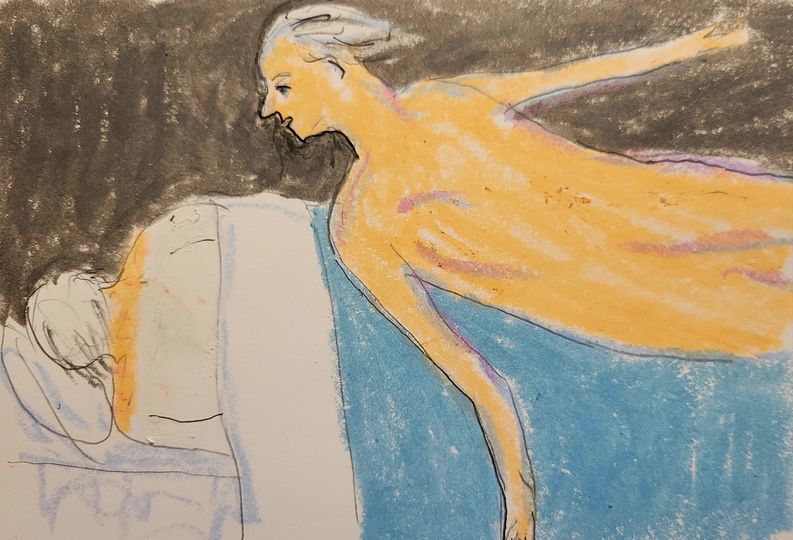
Drawing: "Autoscopy" by Robert Moss

Thursday, February 4, 2021

The double who arrives at a place ahead of you


When Fred, an engineer deeply interested in dreamwork, told me he was planning to drive across the continent to my neighborhood in upstate New York, I invited him to come and stay. The night before he was scheduled to arrive, I stirred from sleep and was startled by a ghostly form the foot of my bed. Man-sized. Peering through the grainy dark, I recognized Fred. He looked dozy and out of things.

    “Fred,” I spoke softly so as not to wake my wife. “You are not due here until tomorrow. Get back to your body and get some rest.”
     You may glean from this that the appearance of what the old paranormal researchers used to call a  “phantasm of the living” was not exotic for me. I had long been aware that consciousness can travel outside the physical body -and does so every night in dreams – and that when it does so it may be using the vehicle of a subtle or astral body. This energy vehicle may resemble the physical body closely, or take other forms.
    I assumed that Fred had slipped out of his dormant body during sleep and found his way to my house, unaware of the time or the circumstances. Uninvited callers who seek to enter my psychic space get an unpleasant reception, But Fred had, after all, been invited – only not for 3 o’clock in the morning.
    When he showed up for breakfast after sunup, I asked him if he remembered any dreams from the middle of the night. “I’ve been on the road since midnight,” he told me, holding out his coffee mug for a refill.
     This was an interesting twist. I had assumed that while Fred was asleep, his dream double went walkabout in the direction of my home. It now seemed that, cruising along the highway, he relaxed enough to release his energy double to arrive at my house early.
     The Norwegians have a word for the kind of double who arrives before you at a place where you are heading. The word is vardøgr. It is probably derived from the Old Norse vardhygi, which fuses vǫrd, ("guard" or "watchman") with hugr ("mind" or "soul"). "Early arrival" and “spirit predecessor” are suggested translations of vardøgr. The etymology might lead us to "soul watcher" or "soul guard" in the sense of advance guard.
    In the Viking era the Scandinavians were quite familiar with several forms of the double, and their ability to travel outside the physical body and shapeshift into many forms. This is such a central feature that a French scholar, 
Régis Boyer, titled a book on Old Norse magic Le monde du double, "The World of the Double". 
     When I recently returned to research on this theme, I was interested to find that my encounter with Fred the engineer has a parallel in a report from another engineer. In an article for the Journal of
Scientific Exploration, L. David Leiter, a mechanical engineer in Pennsylvania, describes how his double appeared at his home ahead of him. He took the highway home on a pleasant sunny afternoon and felt completely relaxed at the wheel, almost on autopilot.
    When he got home, his wife was surprised. Why had he gone out again? She explained that he had come in ten minutes before. Unusually for him he had skipped his usual greeting and kiss on the cheek and gone straight upstairs. She called their child to confirm her story. Worried that there might be an intruder in the house, they checked upstairs and found no one.


Engineers may survive projecting an astral double while at the wheel of a moving car, but I would strongly recommend avoiding this kind of thing while handling mechanical equipment! I have no doubt the safest and easiest way to explore these roads is in dreaming. It is quite likely that you are projecting an astral double every night in your dreams. It is also probable hat among the places you visit in your subtle body are locations that lie in your physical future.  Precognitive dreams can be “memories of the future” in the sense that your double arrived somewhere ahead of you and left you some souvenirs when they came back.


"Dream Double" drawing by Robert Moss


Friday, January 4, 2019

Secrets of Dr Taverner

In his nursing home, Dr. Taverner reaches the parts that physicians and psychiatrists cannot reach. A shaman in country tweeds and a psychic Sherlock Holmes, Taverner deals with complaints that result from psychic attack, soul theft, energy vampires and diseases of the group mind. His creator, Dion Fortune (born Violet Firth) knew her stuff.     
 
  The founder of her own esoteric school, which came to be known as the Society of the Inner Light, Dion Fortune (1890-1946) modeled the hero of the stories collected in The Secrets of Dr Taverner on one of her own early mentors, an extraordinary Anglo-Irish magus named Theodore Moriarty. Some of the stories were first published in the Royal Magazine in 1922, a year before Moriarty's death. Remarkably, the illustrator made the fictional Dr Taverner look very much like Moriarty, though the artist had never seen a picture of Moriarty or even heard a description.
     Jelkes, the bookseller in Dion Fortune's novel The Goat-Foot God, says that "writers will put things into a novel that they daren't put in sober prose." Dion herself said that while books of hers like The Mystical Qabalah give the theory of high magic and spiritual reality, "the novels give the practice."
   There are five of those novels, and some of them have left a profound mark on esoteric and neo-pagan practice. The Sea Priestess contains a ritual for Drawing Down the Moon that has been much-borrowed in ceremonial work, not always with attribution. But of all her fiction, it is the stories of Dr Taverner to which I return again and again. I have asked some of my advanced classes to read several of these stories as the basis for focused discussion and investigation of such phenomena as the nature of the energy bodies, past-life connections, psychic defense and astral repercussion.
    Fortune is rather direct about what she is doing in The Secrets of Dr Taverner. She describes her tales as "studies in little-known aspects of psychology put in the form of fiction because, if published as a serious contribution to science, they would have no chance of a hearing." She wants it understood that her stories are based on fact. Her characters are mostly composites, but they are based on actual people and situations. She states that the first of the stories she completed, the tale of a hungry ghost attached to a living person that she titled "Blood-Lust", is "literally true". Noting that she was one of the first British students of psychoanalysis, she expressed the hope that the Taverner stories would be received as "a serious study in the psychology of ultra-consciousness."
     In my opinion, she succeeded beyond her ambition. The Taverner stories are both gripping and entertaining, and a valuable source of practical guidance on psychic protection and spiritual cleansing and many other facets of psychic well-being that are missed in our standard approach to healthcare and therapy. In its fictional wrapping, The Secrets of Dr Taverner is a practitioner's casebook, of the greatest value to subsequent practitioners. It is perhaps the most accessible of all Dion Fortune's works for the contemporary reader.
     Her narrator is a medical doctor named Rhodes, a supposed ingénu in regard to psychic phenomena and esoteric techniques. This makes it easy for Fortune to draw the veil over certain procedures. But enough shows through to make the story collection a kind of manual, especially when read together with Fortune's well-known later (nonfiction) work Psychic Self-Defence.


Dr Taverner releases a soldier from a hungry ghost

Dion Fortune said that she told the story titled "Blood-Lust" exactly as it was played out in physical and psychic reality.
    Captain Craigie, back from war, starts killing for blood. He starts by raiding chicken coops and works his way up to sheep. Along the way, he can't help trying to sink his teeth into his fiancee's neck. He tells Dr Taverner,that he suffered "shell-shock" in the trenches. This was a familiar term in the World War I era; today we are more likely to speak of PTSD (post-traumatic stress disorder). But in this case, "shell-shock" seems an exact description. Captain Craigie was blown out of a trench.
    The source of the problem becomes literally visible when people start seeing the apparition of a German soldier in a flat cap and field-gray uniform. This, we learn, is the etheric or dense energy body of a dead enemy soldier who has attached himself to the unfortunate Craigie, seeking to feed his "vitality hunger" (as Taverner diagnoses his condition) through his living host.
    Dr Taverner's solution involves baiting a trap, by nicking the neck of the captain's girlfriend. While Craigie is physically restrained, the hungry ghost of the German soldier leaves his body to seek the fresh blood. Taverner stands between the ghost and its host and forces it into "a psychic killing-pen" in the form of a triangle.
    Dion Fortune is discreet about what happens next. Taverner makes "a Sign and a Sound". The gray etheric form spins into a whirling spiral and disintegrates. Captain Craigie is released from the hungry ghost that was riding him,
    Dr Taverner pronounces that the source of the problem was "a corpse who was insufficiently dead."


While some parts of the plot summary may sound like the script for one of those old Hammer horror flicks, the story touches on themes of perennial importance, including the plight of veterans of foreign wars yesterday, today and tomorrow, who may be carrying unwanted energies of the dead.
     One of Dr Taverner's lessons, in this story, is that we have more than one physical body. To be specific: 


We have two physical bodies...the dense material one...and the subtle etheric one, which inhabits it, and acts as the medium of the life forces, whose functioning would explain a great deal if science would only condescend to investigate it.


By my observation, this is exactly correct. Failure to understand the nature of the etheric body and its survival of physical death confuses our relations with the dead and delays or prevents recognition of the need for spiritual cleansing and releasing in healing cases of PTSD, addiction and other disorders.
     Dr Taverner instructs that "it is possible to keep the etheric body together almost indefinitely if a supply of vitality is available". In "Blood-Lust", the supply of vital energy comes through "a human feeding bottle" that feeds on others in an effort to replenish itself.
     How common is the problem? Well, literal vampirism and blood-drinking may be rare (despite the contemporary vampire fad) but energy vampirism has never been uncommon, alas. Dr Taverner, the magician, alludes to dark side magical practices by those who seek to avoid the second death (of the etheric body) by forming "a connection with the subconscious mind of some other soul that still has a body." He cautions that "the lower type of medium" is especially vulnerable to this type of parasitism. But "higher" types can be vulnerable if in a weakened or absent condition, as when Captain Craigie was blown out of his trench, and (for a period) out of his body.
     Who ya gonna call, if you don't have a Dr Taverner down the street? Well, there is rather specific guidance on spiritual release, including staging a "second burial" for an etheric body that does not belong with the living, in The Dreamer's Book of the Dead. And we have Dion Fortune's classic Psychic Self-Defence. 


Dr Taverner reunites lovers from ancient Egypt

Dr Taverner is guided by dreams and coincidence in his work with an airman named Arnold Black, who spends his nights driving around the country at crazy speed, feeling that he is on his way to an encounter with a woman he loves but has yet to meet.
    In his first session with the wild driver, Taverner says, "If chance brought you to me, you are probably in my line." In his effort to solve the mystery of what is driving Black, Taverner asks him about his dreams, and finds that they glow with an "oriental light." He is inspired to show the airman paintings of Egypt, and Black recognizes scenes from his dreams in the ancient images.
    Taverner is encouraged to follow one of his basic procedures. When confronted with behaviors and mental states that have no adequate cause in the current life of the subject, he probes for a possible past life context, "getting the record of the previous lives of his patient by those secret means of which he was master."
    Black was in a recent airplane crash. Dr Taverner concludes that the trauma "had the effect of hypnotizing him, and he got into that particular part of his memory where the pictures of previous lives are stored."
    The woman Black is seeking may have shared a past life with him in ancient Egypt. The question now is whether she can be found - and what will happen if she is. The violent urgency of the airman's need to find his love from a previous life cannot be contained. He is in imminent danger of killing himself on the road if nothing can be done.
    "These attractions that come from the past," Taverner observes, referring here to past lives, "know no barriers. Black would drive that car through the Ten Commandments and the British Constitution to get at her. He will go till he drops."
    Coincidence comes into play again. A listless young woman is brought to see Taverner in his consulting rooms in London. He prescribes rest at his nursing home in the country, where she encounters a ghost of the living: the etheric body of the man who has been seeking her.
    Black is discovered in a car wreck close to the nursing home. The extrusion of his etheric double has left him close to death; so much of his vital energy has left his body. Taverner saves Black by leading the girl into the emergency room. At this point, the airman's etheric body rejoins the physical one. As the girl stays with him, holding his hands, he begins to revive. He eventually recovers, and the lovers who knew each other in Egypt are able to marry, reunited in their current lives.


This is a summary of a story titled "The Man Who Sought", in The Secrets of Dr Taverner.
   
It raises many interesting questions. I have no doubt that our current dramas and relationships are connected to stories that played out - and may still be playing out - in the life experiences of personalities in other times. What triggers memories of those other lives, other than something like the airman's trauma?
   How do we balance, and help others to balance, the legacy of a past life with the needs and obligations of the present one? Can karma and past-life connections be mediated a different way, perhaps by taking all of this up to the level of a Greater Self? How can we be sure that the past life is truly that of a contemporary individual, as opposed to the obsessive memory of an obsessing entity?
     These questions are central to my own work and are addressed, in part, in my book Dreamgates, in Dreaming the Soul Back Home and in my spiritual memoir The Boy Who Died and Came Back.

Thursday, May 10, 2012

Dr Taverner releases a soldier from a hungry ghost

Dion Fortune says that she told the story titled "Blood-Lust" (in The Secrets of Dr Taverner) exactly as it was played out in physical and psychic reality.
    Captain Craigie, back from war, starts killing for blood. He starts by raiding chicken coops and works his way up to sheep. Along the way, he can't help trying to sink his teeth into his fiancee's neck. He tells Dr Taverner, the unusual practitioner who turns his attention to the case, that he suffered "shell-shock" in the trenches. This was a familiar term in the World War I era; today we are more likely to speak of PTSD (post-traumatic stress disorder). But in this case, "shell-shock" seems an exact description. Captain Craigie was blown out of a trench.
    The source of the problem becomes literally visible when people start seeing the apparition of a German soldier in a flat cap and field-gray uniform. This, we learn, is the etheric or dense energy body of a dead enemy soldier who has attached himself to the unfortunate Craigie, seeking to feed his "vitality hunger" (as Taverner diagnoses his condition) through his living host.
    Dr Taverner's solution involves baiting a trap, by nicking the neck of the captain's girlfriend. While Craigie is physically restrained, the hungry ghost of the German soldier leaves his body to seek the fresh blood. Taverner stands between the ghost and its host and forces it into "a psychic killing-pen" in the form of a triangle.
    Dion Fortune is discreet about what happens next. Taverner makes "a Sign and a Sound". The gray etheric form spins into a whirling spiral and disintegrates. Captain Craigie is released from the hungry ghost that was riding him,
    Dr Taverner pronounces that the source of the problem was "a corpse who was insufficiently dead."


While some parts of the plot summary may sound like the script for one of those old Hammer horror flicks, the story touches on themes of perennial importance, including the plight of veterans of foreign wars yesterday, today and tomorrow, who may be carrying unwanted energies of the dead.
     One of Dr Taverner's lessons, in this story, is that we have more than one physical body. To be specific: 


We have two physical bodies...the dense material one...and the subtle etheric one, which inhabits it, and acts as the medium of the life forces, whose functioning would explain a great deal if science would only condescend to investigate it.


By my observation, this is exactly correct. Failure to understand the nature of the etheric body and its survival of physical death confuses our relations with the dead and delays or prevents recognition of the need for spiritual cleansing and releasing in healing cases of PTSD, addiction and other disorders.
     Dr Taverner instructs that "it is possible to keep the etheric body together almost indefinitely if a supply of vitality is available". In "Blood-Lust", the supply of vital energy comes through "a human feeding bottle" that feeds on others in an effort to replenish itself.
     How common is the problem? Well, literal vampirism and blood-drinking may be rare (despite the contemporary vampire fad) but energy vampirism has never been uncommon, alas. Dr Taverner, the magician, alludes to dark side magical practices by those who seek to avoid the second death (of the etheric body) by forming "a connection with the subconscious mind of some other soul that still has a body." He cautions that "the lower type of medium" is especially vulnerable to this type of parasitism. But "higher" types can be vulnerable if in a weakened or absent condition, as when Captain Craigie was blown out of his trench, and (for a period) out of his body.
     Who ya gonna call, if you don't have a Dr Taverner down the street? Well, I give rather specific guidance on spiritual release, including staging a "second burial" for an etheric body that does not belong with the living, in The Dreamer's Book of the Dead. And we have Dion Fortune's classic Psychic Self-Defence.