Sunday, January 19, 2020

In the beginning was the dream


The Aborigines of the northern Kimberley ranges say that in the beginning, there was only earth and sky. In the earth was the Great Mother Ungud, in the form of a great snake. In the sky was Wallanganda, the All-Father, in the form of the Milky Way. The sky god threw water on the earth; the earth goddess made it deep. In the night, as they dreamed, life arose from the watered earth in the shapes of their dreams.
     From the sky god’s dreaming a spiritual force went forth as images that he projected on the faces of rocks and the walls of caves. These images can still be seen, painted in reds, whites, and blacks. Some say a mystical bird was the original painter, grasping the shapes of the sky-god’s dreams in his own dreaming. After the paintings were done, the sky god reproduced their forms in the bodies of living beings, which he sent out across the land.
    The paintings are the spiritual source of living beings. In the Kimberley rock paintings, Wondjina figures do not have mouths or eyes because these are the gift of Ungud. The Wondjina spirit — associated with rainmaking and fresh water — lives beneath the paintings in the waters under the earth, creating “child-germs,” spirit children. In a dream, a father-to-be will find one of these spirit children. In another dream, he will put it into his wife. It assumes human form in her body. At death, this part of the soul returns to the water hole from which it came
   Though the names may seem alien or exotic, this is a story about you and me. It reminds us that the process of manifestation begins with a movement or intention on the spiritual planes that is projected toward physical reality through images — the facts and events of the imaginal realm. By entering the imaginal world through dream travel, we can become active participants in this process and cocreators of the circumstances of our lives on Earth. As we learn to work with the hidden order of events, we come to recognize that is also reveals itself through the play of synchronicity in everyday life. As evolving beings, we come to take dreams more literally and waking life more symbolically.


Text adapted from Dreamgates: Exploring the Worlds of Soul, Imagination and Life beyond Death by Robert Moss. Published by New World Library.

Art: "Making Songlines" by Robert Moss

Happy Mad-Doctor Day


According to my Calendar of Forgotten English, which reminds me that "mad-doctor" is an early term for an alienist, now called psychiatrist, today is the feast day of St Fillan. Other calendars disagree, but I want to recollect this Irish-Scots priest who operated a healing sanctuary centered on a sacred pool in Perthshire. 
     There were healing stones, resembling major organs, where the sick hoped to secure relief from symptoms afflicting those organs.
     Fillan's Pool was used for cleansing and purification. It became famous for rituals to cure the insane. They were dunked in the water after sunset and told to bring three stones from the bottom. They had to place these on cairns in a ritual fashion. They were then conducted to a ruined chapel where they were laid out like corpses on a stone slab - Fillan's Bed - and bound tight with ropes. If they had managed to get loose from the ropes by sunrise, they were pronounced sane and well.
     I found an interesting 1863 essay on these practices by Professor J.Y Simpson in the Proceedings of the Society of Antiquaries of Scotland, quoting a man who was dunked in Fillan's pool and swore he only got free from the bonds because a dead relative turned up to help him.
     Fillan, by the way, means Little Wolf in Gaelic. His left arm was supposed to glow in the dark and was brought to Robert the Bruce, at his demand, as a charm on the eve of his victory at Bannockburn.


Saturday, January 18, 2020

Paleopsych 101


1. Spirits are real.

2. We are not alone: we live in a multidimensional universe peopled with beings — spirits of nature, gods and daimons, angels and ancestors — who take a close interest in our affairs and influence our lives for good or ill.

3. We are more than our bodies and brains, which are only vehicles for soul.

4. The soul survives the death of the body.

5. Soul journeying is the key to the spiritual worlds and the knowledge of ultimate reality. The soul makes excursions outside the body in dreams and visions. The heart of spiritual practice is to learn to shift consciousness at will and travel beyond time and space. Through soul-flight, we return to worlds beyond the physical plane in which our lives have their source and are able to explore many dimensions of the Otherworld.

6. Souls are corporeal, though composed of much finer substance than the physical body.

7. People have more than one soul. In addition to the vital soul that sustains physical life — closely associated with the breath — there is a “free soul,” associated with the dreambody, which can travel outside the body and separates from it at physical death, as well as an enduring spirit whose home is on the higher planes.

8. Souls — or pieces of soul — can be lost or stolen. This is the principal cause of disease and misfortune.

9. Some people have more souls than others and have the ability to make excursions to different places at the same time.

10. At death, different vehicles of soul go to different lots. Through conscious dreaming, it is possible to explore the conditions of the afterlife to prepare for one’s death and to assist souls of the dying and departed.

11. We are born with counterparts in nature. For example, we are born with a totem animal and a relationship with natural forces (wind or water or lightning) that are part of our basic identity and help to pattern the natural flow of our energy.

12. We are born with counterparts in other places and times, and in other dimensions of reality. When we encounter them through interdimensional travel, they become allies and sometimes teachers.


Adapted from my book Dreamgates: Exploring the Worlds of Soul, Imagination and Life Beyond Death. Published by New World Library.

Art: detail from Henri Rousseau, "The Dream" (1910)


Friday, January 17, 2020

Word Gates


Gently rising from sleep into the grey morning, I saw what looked like a child's wooden alphabet block set within a frame. The front edge of the block had an ornamental red and green border. A word rather than a single letter was inscribed. I understood that when we could come up with an adequate story or definition for this word, the block will turn, and this will reveal another word requiring description. Each turn of the block would have tumbler effect on other blocks or components of the system.
    I cannot say how many words will come up before the block moves and provides an open portal to what all seekers aspire to know. I do not know whether there is only one block, or many, or an infinite number.
    I know that, behind the frame, the block is not a three-dimensional cube but extends into other dimensions. Despite its apparent wooden solidity, the face it presents may actually be a hologram projected from another reality. As I picture this I see the surface within the frame as one end of a structure, composed of many segments and flashing many colors, that somewhat resembles the Rosicrucian cross, in which the vertical shaft is longer than the arms, although in this case the structure is laid on its back.
   I cannot say the word that first appeared within the frame.
   I can give you two words, but I cannot say where they come up in the sequence:

     TIPU
     KARANDANSKY

   I can also say that at some level of this game, instead of defining unusual words, we are required to come up with the word that fits an unusual definition.
   Many of these words are not in the dictionaries of Earth.
   For example, there is a word that exactly defines the Tail of the Lion phenomenon, as described by Einstein in his famous analogy:

Nature shows us only the tail of the lion. But I do not doubt that the lion belongs to it even though he cannot at once reveal himself because of his enormous size.

   There is also a word that fits the definition "something that is much bigger inside than outside" (and it is not TARDIS, the name of the machine disguised as an old police box in which Dr Who travels).
    Unlike Scrabble players, Dream Word players can't appeal to a dictionary. A rare few among us may have glimpsed something in the Thesaurus of Tulun - from which Einstein appears to have borrowed his description of the Tail of the Lion - but such works are not available when you need to reach across the table. So we must judge words and definitions offered in our Dream Word games by three criteria:

- The LD [Laugh Decibel] Level
- The OU [Outrageously Unexpected] quotient
- Whether they move our blocks


Sunday, January 12, 2020

The Dictionary of Funny Dream Words


In some of my workshops and online classes we are have fantastic fun playing an oneiric version of the Dictionary Game. If you've never played the Dictionary Game, it goes like this: you open a fine fat dictionary, pick an obscure word, then call on the players to come up with a definition. Sometimes an erudite or lucky player will know the precise meaning of that arcane word. But the real fun is in making something up. In scoring (at least in my family) you vote for the entertainment value of the proffered definitions, above their plausibility.
-
 In the Funny Dream Words game, the dictionaries we use are our personal journals. We start by re-viewing the old reports. We extract those mystery words, names and phrases - in known or unknown languages - that we never managed to decode. Then we offer these to others to track or define.
-
A funny word from a dream can open all sorts of territory. It can provide a clickable link to another culture or another world. It can reveal a new technology, or the grammar of elvish. It can open a connection with a person (hitherto unknown) on the other side of the world, or with a forgotten ancestor. It can be the hook that pulls in a song or a story or a painting, even a whole novel. And this is all streaming, fresh and spontaneous, from our own dream lives. But we often miss our messages, and someone else - through an intuitive flash, or a few minutes googling, or by hitting the books - can often help us hear what we couldn't make out, and see what escaped us in an apparent jumble of syllables.
-
The most fun part, as in the old Dictionary Game, is when the other players, who might otherwise be foxed by a funny word, start making things up. To give you a feel for how this goes, here are the definitions I suggested for five of the dream words posted at one of my forums over 24 hours. Only the first came with any context.
-
Morolli Novia (a dish demanded by an angry restaurant patron)

Morolli Novia [n]: odoriferous rum-drenched dessert named after the fiancee [novia] of Sal "Bankroll" Morolli, Miami restaurateur currently serving 6 months for postmortem abuse of Julia Child.
-
Sir Percy Belay
-
Belay, Sir Percy: Last baronet of Limpley-in-the-Hole, Somerset. Antiquarian and minor versifier in the style of the "silver poets" of the Elizabethan era. Best known for his "Response to the Nymph's Response to the Shepherd" (a reference to the famous poem by Sir Walter Raleigh) into which he worked his family name, of disputed (nautical and perhaps piratical) origin:
-
Belay the world and keep it young,
So we may feast with tongue to tongue,
Belay the sun so you are moved
To live with me and be my love
-
The Australian slang expression, "It's time to point Percy at the porcelain" is said to derive from his erratic bathroom habits.
-
Source: Burke's Minor Nobility and Silly Upper-Crust Names
-
Ursula Le Dean

Ursula K. Le Guin has been awarded the title of Dean honoris causa by the College of Fantasists because of her advocacy of truth-telling by fantasy as well as her own fantastic body of work. The citation refers to her Introduction to the English translation of The Book of Fantasy (compiled by Jorge Luis Borges, Silvina Ocampo and Adolfo Bioy Casares) where Dean Ursula states:
-
The central ethical dilemma of our age, the use or non-use of annihilating power, was posed most cogently in fictional terms by the purest of fantasists. Tolkien began The Lord of the Rings in 1937 and finished it about ten years later. During those years, Frodo withheld his hand from the Ring of Power, but the nations did not.
-
The judges especially commend Dean Ursula's observation that "Italo Calvino's Invisible Cities serves many of us as a better guidebook to our world than any Michelin or Fodor's."

Pay Uht
-
Pay Uht [n}: Kotror pidgin for "pay dirt." Negotiable in two forms: (1) as rolls of "cash", typically strung on cords and worn around the midriff; or (2) as dried cakes of yak dung. Most commonly used to purchase shashtree [yak offal delicacy] or swee balak [dessert custard, mixed with fermented mare's milk, sometimes resulting in death by sugar or alcoholic poisoning]. 

reference: Commercial Traveler's Pocket English-Kotror Dictionary, 3rd hipflask edition.
-
Interalicia
-
Interalicia [n]: A mode of travel in the multiverse that includes stepping through mirrors, diving down rabbit holes, and shrinking or growing at fantastic speeds, inter alia. See works of Lewis Carroll.

Saturday, January 11, 2020

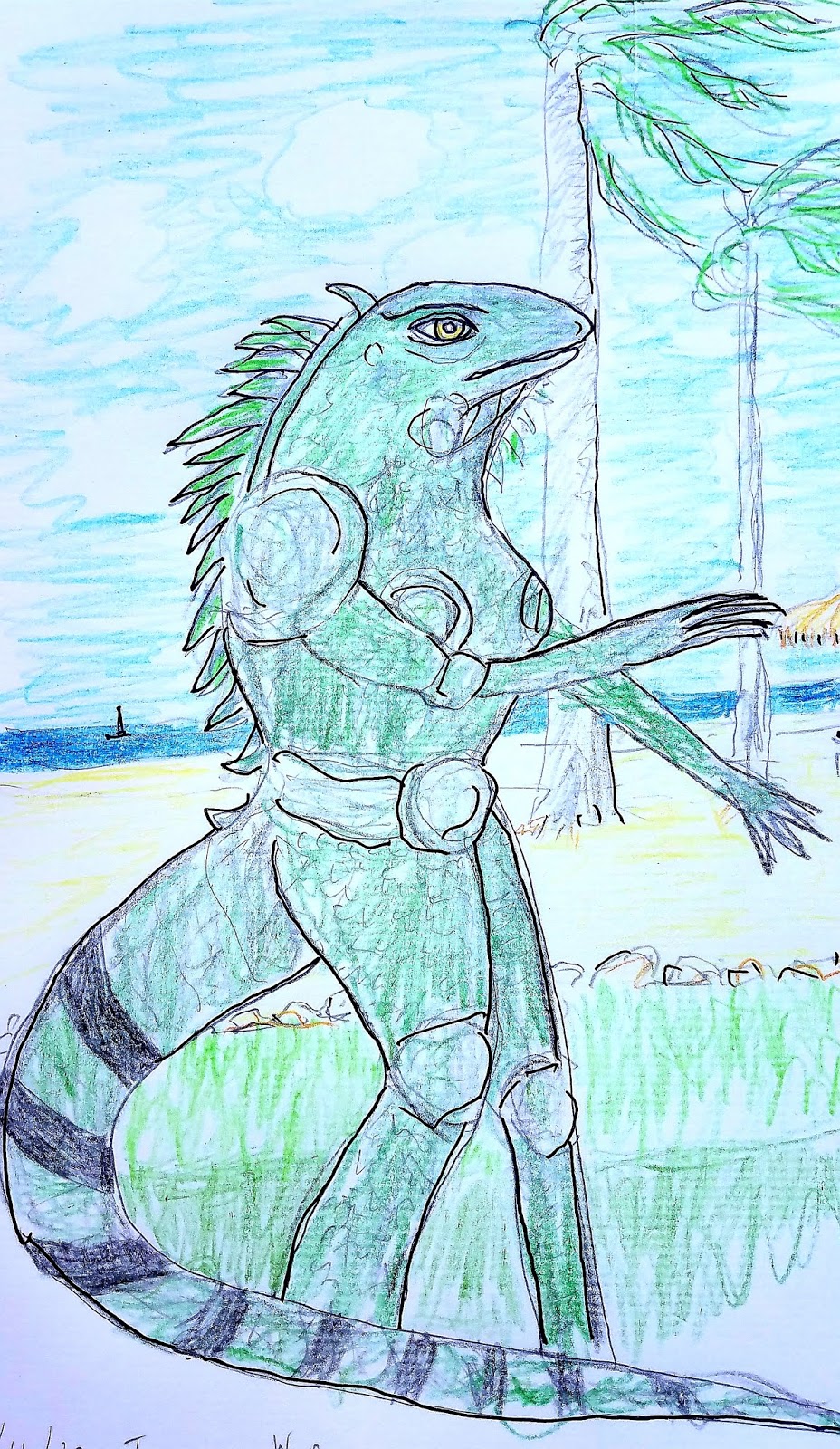
Iguana Woman


She is an armored herbivore
Who doesn't look like prey
With those razor teeth
And that bull whip tail
She can drop and grow back
Her dominant sense is sight
She reads colors and shapes over great distance
And has light sensors as well as eyes
She can drop from a tree
From forty feet up and land on her feet.
She can stay underwater for half an hour
I wonder what more she can show me
Now she has taken this hybrid form
And whether shaman artists
In ageless caves of these windy islands
Encountered her like this..
I know who to ask: the snakebird shaman
Who showed me his face on my first night
With a rattlesnake round his waist
And the eyes of socho, the burrowing owl
And the wings of a seabird.
Iguanas are his sight hounds and bodyguards
But he is not ready to show himself to you
And you are not ready to look into his eyes.


- Aruba January 11, 2020

Thursday, January 2, 2020

Want to get good at dreaming? Practice, practice, practice


All of us have access to dreams, if we are willing to make space for them in our lives, and the gifts that come from dreaming can be immense. They range from course correction to wild entertainment, from contact with a Higher Self or departed loved ones, from time travel to access to a secret laboratory where we find creative solutions that escape the routine everyday mind.
   When we hear others share dreams, maybe starting just with the title or an opening line, we usually recognize something of ourselves. Yet as the details emerge, we also realize that each dream is distinct and must not be tossed into a suitcase of categorization. This is part of the beauty of dreaming. As we listen to each other's dreams, we recognize universal themes, something of our common humanity and our access to the limitless repository of shared knowledge and experience that Jung once called the collective unconscious and later, the objective psyche. At the same time, when we attend to details and feelings and context around them, we find that individual dreams are exquisitely tailored to the character and circumstances of the dreamer.
    Of course we dream in different ways and on different levels, even in a single night in the mind of a single person. And there are many levels of dream practice. When you begin to understand all that dreaming can be, you come to know that it is a discipline, a fun one, with friendlier hours than most jobs of work -since you can do so much of it during sleep. However, as with any other discipline, from piano to particle physics, you get really good through practice, practice, practice.
    As a teacher of Active Dreaming, my original synthesis of dreamwork, shamanism and creative imagination, you could say I am a full-time dreamer. As personal practice, however, I like to keep things simple and fun. My daily engagement with my night dreams is sometimes no more than this easy one-two:


1. Whatever time I surface from sleep, I check whether I have any dream recall. If I think I don't, I hit any inner pause button and wait for something to come back. At the very least I am likely to receive a stream of hypnopompic images, which may be returning dreams or new material. When I have something,I pick up my phone and I record one or more entries. I used to pick up a bedside pad but con no longer read my handwriting. Using the phone causes minimal disturbance in the bedroom and gives me a text I can transfer to my digital database later on. I may repeat this through two or three cycles of sleep-wake on any given night.

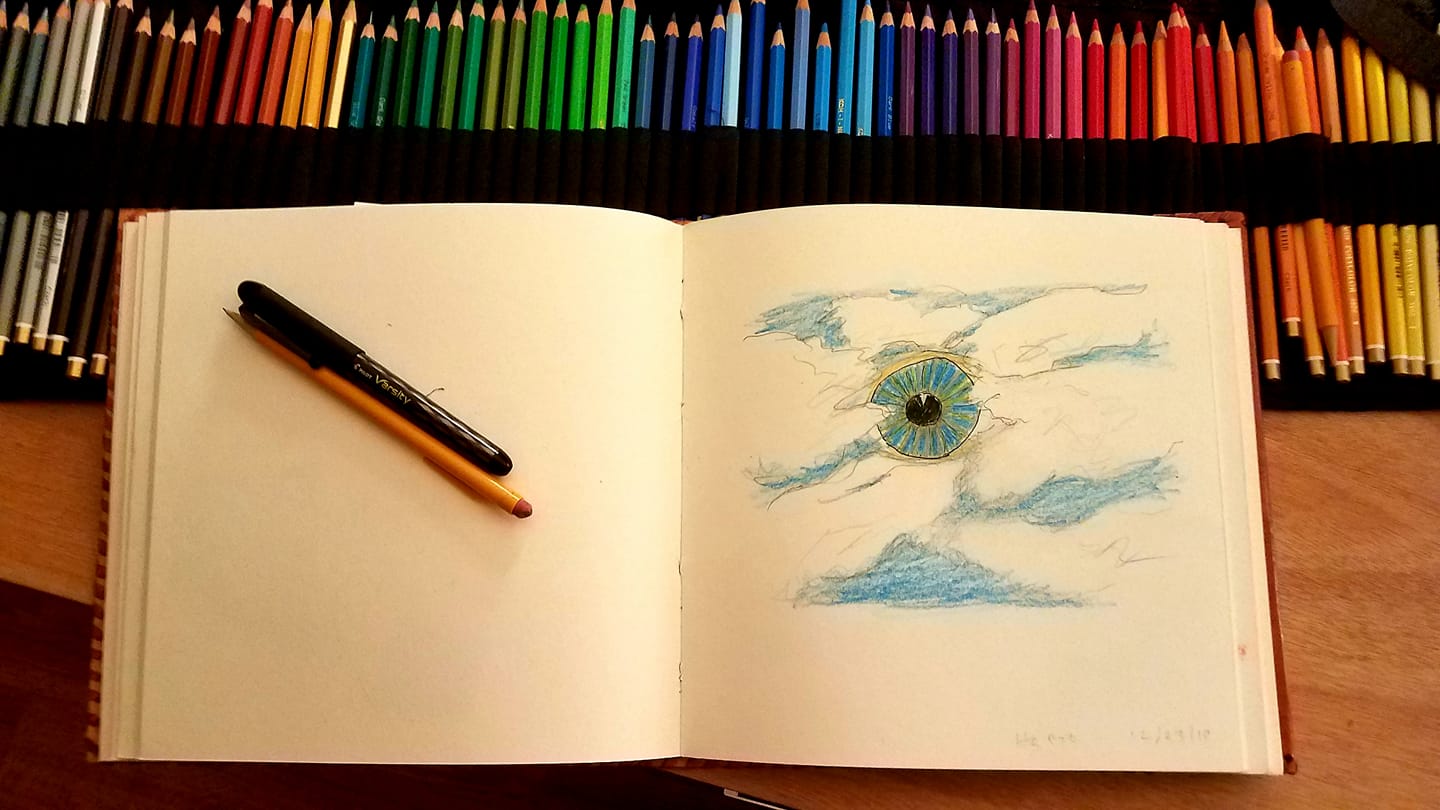
2. When I get up, before coffee and while my little dog (who has excellent manners) waits patiently for me to shower and dress and take him out for his first walk, I open a sketchbook and draw an image from my dreams. I start in pencil. I give the drawing a title, of course. I often feel wonderfully satisfied and charged with creative energy when I complete this little task, and the boy artist inside me claps his hands.

The dream may require further action. This may range from shamanic shopping to researching a curious word or phrase, to going back inside the dream (in a wide-awake exercise in shamanic lucid dreaming) to clarify information or continue the story. My action might be to turn a glimpse of the possible future into a travel advisory or to road-test a new exercise that I dreamed with a workshop group.
    Any day of the week, however, the two simple steps of recording in bed when things are fresh and then turning a dream into a quick sketch are basic and sufficient practice. If you want to get really good at dreaming, I recommend them.