Showing posts with label Australian Aborigines. Show all posts

Thursday, June 22, 2023

Called by Sea Eagle


In traditions where the importance of dreaming is understood, the right dream may be your price of admission to the good stuff.
   It is common in Tibetan tradition for spiritual teachers to ask students to bring them a dream to determine if they are ready to receive important teachings. A student without a dream is regarded as blocked and possibly unclean. He is required to undergo purification and perform practices to reopen his connection with spiritual allies. He is not allowed to continue his studies until he can produce the right dream.

    Tenzin Wangyal Rinpoche gives a personal example, from the time of his training with Lopon Rinpoche, in his book Tibetan Yogas of Dream and Sleep. The story is doubly interesting because it involves long-range dream precognition. At 13, as a student, Tenzin dreamed he was handing out slips of paper with the Tibetan syllable A written on them to people boarding a bus.    
    He brought this dream to his teacher, who did not comment, but allowed him to proceed to a further level of instruction. Fifteen years later, waking events caught up with the dream. Invited to travel to the West for the first time, Tenzin found himself assigned to hand out slips of paper with the Tibetan syllable A on them to people boarding a bus. These were to be used in a meditation exercise.
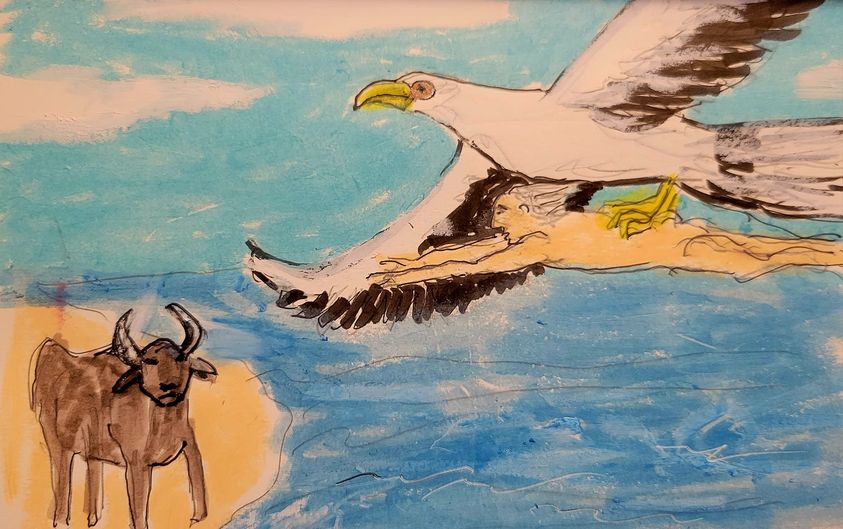
    In 1994, a dream proved to be my admission ticket to the Dreaming of an Aboriginal people in my native Australia. In a lucid dream, starting in the drifty liminal state in the middle of the night, I was joined by a giant sea eagle, an aquatic raptor native to the north-east coast of my native Australia. The sea eagle carried me across the North American continent, then over the Pacific to a reunion with my mother at her home in Queensland. We had been having some difficulties and I wanted to leave the dream excursion at this point to call her.
    However, sea eagle had other ideas. It flew me on , into the hinterland, to meet another animal power: a huge water buffalo. I remembered the water buffalo, too, from boyhood. It had been central to a terrifying shamanic initiation, in another spontaneous lucid dream.
     The bull escorted me to a muddy creek. Something immense was thrashing and rising from the waters. Nearby were Aborigines painted for ceremony. An elder told me, "This is the first of all creatures. This is the beginning of our world."
    When my mother died suddenly, three months later, I was grateful that the dream had prepared me for this event, through our loving exchange in the dream itself, and by how it inspired me to reach out to her and heal some misunderstandings.
     I flew back to my native country. After the funeral, I went "walkabout" for a few days, and found myself at an Aboriginal housing co-op in a dusty town in the hinterland called Beaudesert. When I started talking about dreams, I was told I needed to talk to Frank. Who was Frank? "Oh, he's our spirit man." Frank's place proved to be three days bush walk away, so this lead seemed like a non-starter.
    But Frank walked in as I was getting ready to go; shamans are tricky. He invited me down to the pub to talk. He sipped orange juice and sniffed me, literally, checking if I was another white fella trying to rip off his people yet again. Then I told him the dream. His manner changed radically. He sat very still, his eyes blazing like fire opals.
   "Oh, I guess you've come to me for a reason, mate. You've just told me the start of the creation story of my people, the Mununjalli, as it is told to made men. That thing you saw in the water was the bull eel. We say it is the first of all creatures."
    Yet a dream had taken me deep inside the Dreaming of an ancient and indigenous people. Because of my dream, Frank volunteered to show me the place of the Bull Eel Dreaming. Skirting quicksand and snakes, after many hours I found myself on the bank of the muddy creek from my dream. No bull eel in evidence that day, which was fine with me.


Many years later, I heard from a Kukatja grandmother that "a dream is when the spirit goes on walkabout." I know this is exactly right. 


A fuller version of this story is in the Introduction to my book Conscious Dreaming.

Drawing: "Flight with Sea Eagle" (c) Robert Moss

Sunday, January 19, 2020

In the beginning was the dream


The Aborigines of the northern Kimberley ranges say that in the beginning, there was only earth and sky. In the earth was the Great Mother Ungud, in the form of a great snake. In the sky was Wallanganda, the All-Father, in the form of the Milky Way. The sky god threw water on the earth; the earth goddess made it deep. In the night, as they dreamed, life arose from the watered earth in the shapes of their dreams.
     From the sky god’s dreaming a spiritual force went forth as images that he projected on the faces of rocks and the walls of caves. These images can still be seen, painted in reds, whites, and blacks. Some say a mystical bird was the original painter, grasping the shapes of the sky-god’s dreams in his own dreaming. After the paintings were done, the sky god reproduced their forms in the bodies of living beings, which he sent out across the land.
    The paintings are the spiritual source of living beings. In the Kimberley rock paintings, Wondjina figures do not have mouths or eyes because these are the gift of Ungud. The Wondjina spirit — associated with rainmaking and fresh water — lives beneath the paintings in the waters under the earth, creating “child-germs,” spirit children. In a dream, a father-to-be will find one of these spirit children. In another dream, he will put it into his wife. It assumes human form in her body. At death, this part of the soul returns to the water hole from which it came
   Though the names may seem alien or exotic, this is a story about you and me. It reminds us that the process of manifestation begins with a movement or intention on the spiritual planes that is projected toward physical reality through images — the facts and events of the imaginal realm. By entering the imaginal world through dream travel, we can become active participants in this process and cocreators of the circumstances of our lives on Earth. As we learn to work with the hidden order of events, we come to recognize that is also reveals itself through the play of synchronicity in everyday life. As evolving beings, we come to take dreams more literally and waking life more symbolically.


Text adapted from Dreamgates: Exploring the Worlds of Soul, Imagination and Life beyond Death by Robert Moss. Published by New World Library.

Art: "Making Songlines" by Robert Moss

Friday, February 15, 2019

"Good story this one" : Listening to Aboriginal dreamers


They say in the South Pacific that when the anthropologists arrive, the spirits leave.
    A notable recent exception is Sylvie Poirier, a social anthropology professor from the Universite Laval in Quebec, who has been tracking the dreaming of the Kukatja, a people of the Gibson desert in Western Australia, for many years. She won the confidence of a Kukatja grandmother, Nungurrayi, and was helped by her to understand not only what traditional Aborigines believe is going on in dreams, but how they share and honor dreams in their communities.   
    Sylvie Poirier writes that "in Aboriginal Australia, dreams are the privileged space-time of communication between humans and ancestral beings, as between humans and spirits of the dead.” 
     Dreaming is a way of tending the land. A fertile country is a country of good dreamers.
 Dreaming is active, not merely passive. It is a form of engagement. You can decide where you are going to go, and you can go consciously.
     Dreaming is soul travel. A dream is what happens when an aspect of soul leaves the body and has encounters and adventures. “The spirit goes on walkabout," the Kukatja grandmother explains. In the understanding of her people, “a dream occurs when, while a person is asleep, his or her kurunnpa [an aspect of soul or spirit]related to the abdominal (or umbilical) area (tjurni) leaves the body to pursue various encounters and experiences.” A good dreamer is one who knows how to “open” their tjurni.
     Dreams can be shared experiences. People can enter each other’s dreams.
     When dreams are shared in community, it is often in the morning, over a mug of tea. Yet Sylvie Poirier found that the Kukatja are far from promiscuous in their dream sharing. They know that dreams are powerful, and that it is necessary to handle this power carefully. They also recognize that dreams can provide clues to situations that require discreet investigation. Like detectives on a case, they may be unwilling to share such clues until the case is solved.
     Nonetheless, Poirier heard Kukatja people open up and tell their dream narratives fluently and spontaneously in relaxed social circumstances. This is appreciated as a chance to share and enjoy some good stories. You might here someone tell a terrifying dream and get the response, "G
ood story (palya wangka) this one”. Dreams of any kind, told well, are appreciated for their story value, as entertainment, as well as for information. A dreamer who is specially pleased with their telling may conclude by saying, "Good story sweet as tea."

     While recounting a dream, the teller may be illustrating the narrative with hand gestures and by making sketches in the dry earth, so the dream is already turning into a visual and kinesthetic art form.
     When Kukatja discuss the meaning of dreams, they ask questions like "where, who, what, when?" Tracking routes and locations in a dream is of high importance. Where were you, exactly? What landmarks do you recognize? Who else was there? Everyone is conscious that they are tracking where the dream soul, the kurunnpa, went in its nocturnal excursions.
     While dreamers make visits, they also receive visitations. So the questions may center on who came calling last night, invited or not.
     Dreams reveal malfeasance, especially sorcery, and a dream of sorcery may put an end to psychic attack. In such cases it may be judged highly desirable to tell everyone about a dream. A young Kukatja woman dreamed of sorcerers who are pointing the bone at her. The elder told her to tell the dream to everyone at the camp. "Outing” the sorcerer in this way was intended to scare him off.
     Dreams are valued as sources of creative inspiration. A Kukatja man is chased by a snake in his dream. As he tells it, he dwells on the snake’s vivid colors – and decides to use them in an acrylic painting.
     Kukatja dream sharing is directed at getting all the facts from the dream and taking appropriate action, for example, to deflect a coming danger revealed in the dream or to harness its creative energy. In contributing to discussion, others may tell dreams, stories and life experiences evoked by the first dream report. Through emerging patterns of resemblance and connection, the fuller meaning of a dream - and the appropriate action - may be revealed. 
    Poirier reports that this desert people, who appear so "poor" in terms of material culture, are far more advanced in their approach to dreams than cultures that rely on dream dictionary or dogmatic modes of analysis:  “I have not found any dream that has a fixed meaning; depending on context, any dream can be read as a good or bad omen.” 
   Aboriginal dreamwork is an antidote to Freud, who wrote that the dream “has nothing to communicate to anyone else”, meaning that dreams are entirely products of the personal subconscious and even so, unintelligible until interpreted. Aborigines know that dreams are social and transpersonal, connecting us to other people, both dead and alive, and to the animate universe of spirits and Ancestors. 

Source: Quotes are from Sylvie Poirier, “This Is Good Country. We Are Good Dreamers: Dreams and Dreaming in the Australian Western Desert,” in Dream Travelers: Sleep Experiences and Culture in the Western Pacific, ed. Roger Ivar Lohmann (New York: Palgrave Macmillan, 2003), pp. 107–126. Sylvie has also published an excellent book based on her years with the Kukatja: A World of Relationships: Itineraries, Dreams and Events in the Australian Western Desert (Toronto: University of Toronto Press, 2005).

Art: "Canning Stock Route" by Kukatja artist Rover Thomas. National Museum Australia.

Wednesday, August 8, 2018

On Dying and Coming Back


I first died in this lifetime when I was three years old. My great aunt the opera singer saw this in the tea leaves but didn’t talk about it until long after. What she did not see was that – as a doctor at the hospital in Hobart, Tasmania told my parents – I “died and came back”. That is still the term I prefer to use of these experiences. I don’t remember much of what happened when I left my body at age three, only that it was very hard to live in a body in this world after I came back, and that I felt that my home reality was somewhere else.
     At nine, I died again during emergency appendectomy in a Melbourne hospital. This time I seemed to live a whole life somewhere else, among a beautiful people who raised me as their own. I came back remembering that other life and that other world. It still wasn’t easy for me to live in the ordinary world, and I was nostalgic for that other world. The gift of these experiences,  and my persisting illness (I had double pneumonia twelve times between the ages of three and eleven) was an inner life that was rich and prolific, and an ability to move between states of consciousness and reality at will.
    The first person who gave me a model for understanding what had happened to me was an Aboriginal boy. He told me, “When we get real sick, our spirit goes away. We go and live with the spirit people. When we get well, we come back.”
    At age eleven, I had the vision of a great staff of burning bronze with a serpent wrapped around it that seemed to fill half the sky. Right after that, I came very near death for a third time, back in hospital with pneumonia. But this time, I came back healed, and was able to live a relatively normal life – except that in my mind, the dream world was my “normal”.
    I had to be fairly quiet about these things, growing up in a conservative time in Australia, in a military family. But as I grew older, I was able to do more and more with the gifts of dreaming. My dreams of ancient cultures led me to my first job, as lecturer in ancient history at the Australian National University. My dreams of possible future events enabled me to avoid death on the road, quite literally, on three occasions.

    In the mid-1980s, I left the fast-track life of a bestselling thriller writer and moved to a farm 130 miles north of New York City, thanks to a hawk and a white oak. I found myself drawn into trans-temporal dramas and the spirit world of a Native American people. I became deeply engaged in issues and dramas from the life of an 18th century Irishman, a major historical figure who knew the Mohawk very well. My engagement with him opened a link to a woman of his time, an extraordinary dream shaman, the Mother of the Wolf Clan of her people, who tried to influence him and most certainly succeeded in influencing me. She reminded me why dreaming is central to healing, and I cherish our continuing relationship across time. I learned what it means to be so deeply involved with a personality from another time that your lives turn together. I was eventually required to undergo death and rebirth in the mode of a shaman. I see now that, as with the years Jung recorded in his Red Book, all the important work of my subsequent life has flowed from this stormy period of spiritual emergence.   
    What happened to me in midlife was another experience of dying and coming back.  I learned that when you change your life, your true friends are those who will support you through that change and your worst friends are those who try to keep you in the frame of past expectations.
   
Dreams showed me how to find my way in my new life as a dream author and dream teacher.    Young children, especially my own daughters, became my most important mentors in ordinary life on what dreams require from a family or community. Time among children confirmed my understanding that dreams are for real, that there is magic in making things up, and that we change the world when we tell a better story about it.
    I started teaching what I had learned, and learned through teaching. I found, as Emerson counseled, that “there is one direction is which space is open to us.” When I followed my calling, doors opened in astonishing ways. When I slipped back and away from my path, doors stayed resolutely closed. I am grateful for that.
     I was now able to give people who were willing to share dreams and other experiences of the larger reality the confirmation and validation I had desperately needed as a lonely boy. I developed an original synthesis of contemporary dreamwork and primal shamanic methods for shifting consciousness and operating in the spirit worlds, and called this Active Dreaming. I found people everywhere were hungry for this. The more I gave them, the more happy and fulfilled I felt. I knew joy every time I saw more of spirit shining in someone’s eyes in one of my workshops.

Adapted from The Boy Who Died and Came Back by Robert Moss. Published by New World Library.


My personal relationship with Death informs much of my teaching and practice. "Going Beyond Death: The Survival of Consciousness" is Part 4 of my new online course for The Shift Network, "Quantum Dreaming". Classes begin on August 14 and run for 24 weeks.


Friday, September 29, 2017

When dreams are passports

In traditions where the importance of dreaming is understood, the right dream may be your price of admission to the good stuff.
   It is common in Tibetan tradition for spiritual teachers to ask students to bring them a dream to determine if they are ready to receive important teachings. A student without a dream is regarded as blocked and possibly unclean. He is required to undergo purification and perform practices to reopen his connection with spiritual allies. He is not allowed to continue his studies until he can produce the right dream.

    Tenzin Wangyal Rinpoche gives a personal example, from the time of his training with Lopon Rinpoche, in his book Tibetan Yogas of Dream and Sleep. The story is doubly interesting because it involves long-range dream precognition. At 13, as a student,Tenzin dreamed he was handing out slips of paper with the Tibetan syllable A written on them to people boarding a bus.  He brought this dream to his teacher, who did not comment, but allowed him to proceed to a further level of instruction. Fifteen years later, waking events caught up with the dream. Invited to travel to the West for the first time, Tenzin found himself assigned to hand out slips of paper with the Tibetan syllable A on them to people boarding a bus. These were to be used in a meditation exercise.
    I remember an occasion when a dream proved to be my admission ticket to the Dreaming of an Aboriginal people in my native Australia. I dreamed I was carried back to Australia by a sea eagle, to a reunion with my mother, and then guided into the hinterland of south Queensland, to the banks of a muddy creek. Something immense was thrashing and rising from the waters. Nearby were Aborigines painted for ceremony. An elder told me, “This is the first of all creatures. This is the beginning of our world.”
    When my mother died suddenly, three months later, I was grateful that the dream had prepared me for this event, through our loving exchange in the dream itself, and by how it inspired me to reach out to her and heal some misunderstandings. I flew back to my native country. After the funeral, I went “walkabout” for a few days, and found myself at an Aboriginal housing co-op in a dusty town in the hinterland called Beaudesert. When I started talking about dreams, I was told I needed to talk to Frank. Who was Frank? “Oh, he’s our spirit man.” Frank’s place proved to be three days bush walk away, so this lead seemed like a non-starter.
    But Frank walked in as I was getting ready to go; shamans are tricky. He invited me down to the pub to talk. He sipped orange juice and sniffed me, literally, checking if I was another white fella trying to rip off his people yet again. Then I told him the dream. His manner changed radically. He sat very still, his eyes blazing like fire opals.
   ”Oh, I guess you’ve come to me for a reason, mate. You’ve just told me the start of the creation story of my people, the Mununjali, as it is told to made men. That thing you saw in the water was the bull eel. We say it is the first of all creatures.”
    Not for the first, or the last, time in my life, it seemed that a dream had taken me deep inside the Dreaming of a Native people. Because of my dream, Frank volunteered to show me the place of the Bull Eel Dreaming. Skirting quicksand and snakes, after many hours I found myself on the bank of the muddy creek from my dream. No bull eel in evidence that day, which was fine with me.


Text adapted from The Boy Who Died and Came Back by Robert Moss. Published by New World Library.


Art: "Making Songlines" by Robert Moss

Thursday, November 24, 2016

Dreaming into the Dreamtime


Aboriginal Australians believe that we dream our way into this world, and dream our way out of it.
     "We talk to the spirit-child before a baby is born," naturopath and traditional healer Burnum Burnum explained it to me. If the father-to-be is a dreamer, he is frequently the one who first meets the spirit-child in dreams. These dream encounters often unfold at places of water that exist in the natural world - a billabong, the shallows of a river, a waterfall - where the spirit-child plays with its own kind and is not confined to a single form. It can appear as a kingfisher or a platypus, as a fish or a crocodile. The dreamer may have to negotiate with the spirit-child, giving it reasons for coming into a human body. Finally, the dreamer plays soul-guide, escorting the incoming spirit to the mother's womb.
    On the way to death, the soul-guide appears from the other side. Departed loved ones and ancestral beings who are at home in the Dreamtime come calling, in dreams, to prepare a dying person for his or her journey. When the spirit leaves the body in death, these guides from the Dreamtime escort it along the roads to the afterlife, which may involve a sea crossing, descent through a cave, and/or the ascent of a magical tree whose roots are in the World Up Top.
    Aboriginal dreaming is an antidote to Freud, who wrote that the dream "has nothing to communicate to anyone else". The first Australians know that dreaming means everything and is a highly social activity. We meet other people and other beings when we go dreaming, and sharing dreams is not a matter of puzzling over obscure "texts" but a source of wisdom, community guidance and grand entertainment. Among nomad communities, listening to a dream by the camp fire, or over a morning cup of tea, is better fun than going to the movies, and may run the whole gamut from romance to horror, from Star Trek to soaps.
     The 500-plus Aboriginal tribes of Australia share this understanding: a dream is a journey. When we dream, "the spirit goes on walkabout", says Nungurrayi, a wise woman of the Kukatja, a people of the Western Desert. A powerful dreamer, she explains, is a person who knows how to travel in spirit to interesting places, and bring back a "good story".
     If you know that your dream is a journey, or a visitation by another dream traveler, then you are unlikely to be interested in the kind of analysis that reduces dream experiences to a list of symbols and then interprets what the symbols mean. When traditional Aborigines share dreams, they want to know who, when and where. Who was that sorcerer I saw pointing the bone at me? Who was that person who came to my camp and wanted sex with me? Where is the cave where the dream ceremony took place? When will the car break down?
     When you know that a dream is a real experience, then you want to get the information clear in order to figure out what to do with it. Maybe you'll want to tell that dream of the sorcerer all over the camp to scare away the actual sorcerer, as anthropologist Sylvie Poirier saw done in the Western Desert.[1] Maybe you'll get together with your dream lover (if the experience was pleasant) or find a way to prevent that person from intruding on your psychic space (if it was not). Perhaps you'll travel to the dream cave, and celebrate a ritual to confirm and honor what has already taken place, in the Dreaming. Maybe you'll get your car fixed before it breaks down.
    Aborigines look to dreams as the place of encounter with spiritual guides and sacred healers, who often appear as totem animals but may come in many other forms.
    Aboriginal Australians are well aware that dreaming can be active; you can decide where you are going to go, and you can go consciously. You can travel across time and space, or into other dimensions. You can rendezvous with other dreamers, and embark on shared journeys. Shamans receive their calling and much of their training in this way.
    The first Australians do not live under the illusion that it is necessary to go to sleep in order to dream. They dream with a living landscape in a way that baffles urbanized, deracinated people. Everything in that landscape is alive and conscious, every place has its Dreaming.
    "Nothing is nothing," as they say in the Cape York peninsula; everything means something.
     Let's be clear: there is The Dreaming, or the Dreamtime, the realm of gods and ancestral beings, and then there is everyday dreaming. The two interweave, but are not the same. The Kukatja, in common with many other Western Desert tribes, use the word Tjukurrpa for the ancestral Dreaming, but a different term - kapukurri - for personal dream experiences. Dreamtime is creation time, and stories of the Dreamtime often tell us about the origin of things. But Dreamtime is not long ago; in Dreamtime it is always now. [2]
     Aborigines call Dreamtime the "All-at-Once". Dreamtime is the seedbed of life, the origin of everything that is manifested in the world. It is not separate from the physical world; it is the inner pulse of the land. Our personal dreams may open portals to the All-at-Once.
      The science of the 21st century may help us to grasp the Paleolithic science of the Earth's oldest ongoing tradition. Dreamtime may encompass the six (or seven) hidden dimensions of the physical universe posited by superstring theory. Dreamtime is the multidimensional matrix in which 3D reality floats. By entering Dreamtime, we may be able to reach into the quantum soup of possibilities from which the events of the 3D world bubble up.


References

1. See Sylvie Poirier's excellent essay "This Is Good Country, We Are Good Dreamers" in Dream Travelers: Sleep Experiences and Culture in the Western Pacific ed. Roger Ivar Lohmann (New York: Palgrave Macmillan, 2003) 107-126.
2. Sylvie Poirier writes that Jukurrpa is “a cosmology, an ancestral order and a mytho-ritual  structure. As a generative force, Tjukurrpa breathes life into the universe by giving it form and vital substance. Knowledge of the world emanates from Tjukurrpa and is at the same time grounded in it and its multiple expressions are embodied in the land and are intrinsic to an Aborigine’s sense of self and experience of the world.” Sylvie Poirier, A World of Relationships A World of Relationships: Itineraries, Dreams, and Events in the Australian Western Desert  (Toronto: University of Toronto Press, 2005) 52.


Parts of this article are adapted from my book The Secret History of Dreaming, published by New World Library.


Art: "Making Songlines" by Robert Moss

Wednesday, June 13, 2012

The importance of Monash

from the Yanyuwa Dreamtime, thanks to Monash IT
Again and again, in my dreams of the early morning, the word "Monash" was featured. I was on a university campus, but later in the bush, with several different groups of people.
   Waking, my first association was with Monash University in Melbourne, the city where I was born. I led a one-day dream workshop there a decade ago that was attended by nearly 600 people, giving me a grand sense of validation and a deep measure of soul healing, since I was a very lonely boy when I lived in Melbourne (before the age of 11) unable to share my dreams and experiences of the deeper reality with most of those around me. I recalled that on my darkest days of illness and loneliness, a ruddy-faced older man with white hair would appear to me, in my visions, and reassure me that I would make it through. "I promise you, you'll make it through. And that the day will come when the world will be eager to hear your dreams."
    I now know that this older man - a wise and cheery uncle I never had - was my older self (younger than I am now) reaching back to help bring my boy self through.
    But - Monash?
    Dreams require action, even if only a quick internet search.
    So I went to Auntie Google and pulled up the website for Monash University. I was gladdened to see that on the home page they declare, "Monash is a university of transformation."
    They feature a good quote from Sir John Monash, the commander of Australian forces in World War I from whom the university takes its name: "Adopt as your fundamental creed that you will equip yourself for life, not solely for your own benefit but for the benefit of the whole community."
    Then I saw it, on the right-hand side of the "About Us" page:


3D animation helps preserve indigenous history


Excited, I followed the link and discovered that teams of Monash University researchers are helping to recreate the Dreamtime stories of the Yanyuwa people, who live on the southwest coast of the Gulf of Carpentaria, using state-of-the-art 3D animation technology. 
    In conjunction with anthropologist Dr Amanda Kearney of the University of New South Wales, IT professionals Tom Chandler, Brent McKee and Chandara Ung of the Berwick Campus of Monash University have developed the Monash Country Lines Archive website. The project aims to assist indigenous people in the 3D animation of stories combining poetry, songs and language. This is done with great respect; older and younger generations of the Yanyuwa people sit together and share knowledge.
    Here is a sample of what they are doing with the Yanyuwa Dreamings:


As I watched the animated clip, and then scanned photos of Yanyuwa teritory, I felt I was slipping back into some of the landscapes of my dream.
    I am excited by the Monash project, and plan to learn more about it and to explore whether similar technology can be used to bring alive the Dreamtime stories and "mythistory" (a word I have borrowed from the poet George Seferis) of other peoples.
    I am reminded that even a scrap of a dream - in this case a single word - can be a key to interesting discoveries, as long as we are prepared to do a little work with it. Dreams set us assignments.