Friday, August 9, 2019

The Strand of Imagination

I love playing architect of the imaginal realm. This means helping to design or co-create real places in the realm of true imagination where people can go - in lucid dreaming, shamanic journeys and imaginal exercises - to have adventures in discovery and healing. As a book lover, I especially like traveling and guiding people to various versions of a Secret Library or Magic Bookstore where they may have access to any kind of information or inspiration,and meet master teachers. I invite them to call up the memory of a place like a bookshop or museum where they were excited by the discovery of new ideas and images, and then use that memory as the portal for a visit to a space that will soon expand and deepen into something far beyond memory. Here is my account of what happened when I suggested to a circle of forty literate dreamers at a weekend workshop in Manhattan that we might travel together, fueled and focused by my shamanic drumming, to the iconic Strand bookstore and let it become our doorway to the Imaginal Realm where poets, shamans and mystics have always wanted to go.

THE STRAND OF IMAGINATION


We agree to meet at the Strand, the venerable, vast and lively bookstore at the corner of Broadway and East 12th Street in Manhattan. The area used to be called Book Row, but of all the bookshops that flourished here around the time the Strand opened its doors in 1927, this is the sole survivor. It has remained a family business, ownership descending through the progeny of Ben Bass, the founder. In the time when the Strand boasted that it contained eight miles of books, a wag stated that the eight miles of New York worth preserving were inside its walls. The bookstore has grown since; it now boasts no less than 18 miles of books.
    In the year I lived in Manhattan, my arms were often sore from toting big shopping bags of twice-sold tales from the Strand up to my modest apartment in Yorkville. On flying visits to the city since, I have often failed to ration my book-buying at the Strand sufficiently to pass the weight inspection for suitcases at airports. Besides the expected and unexpected treasures in all the cases of old books, the Strand is the place to get a new book at half price. The velocity at which review copies pour into the store makes it hard to believe that many of those reviewers even opened their copies before generating a little extra income.
    The Strand has long been, for me, one of those magic bookshops where the shelf elves produce exactly the right book to guide or redirect a creative intent. When I was writing a chapter of a novella in which W.B.Yeats is at home in his rooms in the Woburn Buildings, off Tavistock Square, circa 1900, my youngest daughter - who did not know about my project - visited the rare book room at the Strand and brought me back a rare prize, a memoir of Yeats by John Masefield in which the English poet evokes beautifully the experience of visiting the Irish poet in that London apartment.
    The Strand has a place in my imaginal geography, as well as my physical rambles. I go there in night dreams, and in wide-awake shamanic journeys to places in the imaginal realm, a world of true imagination beyond the physical (but not the inner) senses where we can access wise teachers and extraordinary places of healing, initiation and higher learning.
     When I was writing about Harriet Tubman, who used her dreams and visions to guide escaping slaves to freedom on the Underground Railroad before the American Civil War, I found myself roaming the Strand in the middle of the night in my astral body, in that wondrously fluid state of consciousness that sleep researchers call hypnagogia and I prefer to call the twilight zone. Down in the basement, I met Harriet Tubman, wearing a hat pulled down over her forehead and a shapeless coat. She showed me that her skills as a tracker and guide owed a great deal to the shamanic ways of the Ashante, her father's people, and especially to the leopard, the favorite animal spirit of West African shamans and shapeshifters. I used the insights I gained in the basement of the Strand that night in my chapter on Tubman in The Secret History of Dreaming.
    I shared this "old" dream with the participants in a shamanic dreaming workshop I led at the New York Open Center back in 2012. There was great excitement when I suggested that all of us could use the Strand as a portal for an adventure in the imaginal realm, with the aim of contacting master teachers or practitioners in whatever fields most interested us. Most people in the workshop knew the Strand.
    I explained that we could use our memories of the physical bookstore in order to enter a space beyond it. We might find that by opening any book, we could enter the world it contained. We might discover that a bookshop in Manhattan could become the gateway to a Secret Library, where all knowledge is accessible.
    When I was sure that everyone had been seized by the intention to explore, and the workshop participants had placed their bodies in comfortable positions for journeying, I used my gee-whiz technology - a single-headed frame drum - to provide fuel and focus for our group adventure. I always journey for myself while drumming for the group; I immediately found myself at the corner of Broadway and 12th. After a cursory look at the sale items in the stalls on the sidewalk, I headed into the store. I noticed a memorial display for Maurice Sendak, and paused to check the prices of recycled review copies of a few novels I had recently purchased: Carlos Ruiz Zafón's The Prisoner of Heaven, Alan Furst's Mission to Paris, Joseph Kanon's Istanbul Passage.
    I took the stairs to the basement and found Graham Greene waiting for me there. I have talked to that grand English novelist and entertainer (or the part of myself that relishes him) before, and he has given me excellent advice on the practice of writing, advice I have not always followed. Greene was a consummate professional, able to sit down and crank out his 750 words a day however many drinks he had shared with a Soviet agent, a whisky priest, or a bevy of filles de joie the night before. I wondered if he would nudge me towards trying my hand again at a tale of intrigue; in a former life, back in the 1980s, I published a series of popular spy novels. Ah, something more interesting. Greene offered me some tips on writing a memoir. I set my intention re-read his own autobiographical works, especially A Sort of Life and Ways of Escape.
    Behind Greene, among the stacks, I saw a dark-haired young fellow in a trenchcoat. Who was that? It gave me a shiver to realize I was looking at a much younger version of myself, the 1980s thriller writer, seen now very much as he appeared on the dust jacket of a couple of my early novels. I did not engage with him directly.
    I went to the right, down book-lined passages, and met other figures, including a magical child with a treasure chest full of stories for children that I might yet write. As I continued drumming, I found myself in a passage where books rose to the ceiling. The passage turned and turned in a spiral until - poof - I came out in a space where the first thing I saw was a spray of black feathers, and the black embroidered hem of a long woman's dress.
    I found myself in the presence of a gloriously over-the-top lady of a certain age, still desirable and very sure of her place in a social and literary world she had made for herself. She was dressed all in black, with a black feather boa and a magnificent dress with plunging decolletage. She gave me her pen name and allowed me a glimpse of her life. Her admirers include American tycoons and European counts; she allows only a very select few to share her intimate favors. There are those in high places who rely on her as a psychic medium; it is her special pleasure to connect people with their past lives. Out of this life, she has written a wildly successful series of romps that blend the metaphysical with the bodice-ripper and the policier.
    
I was astonished, though not altogether surprised, to realize that I knew this lady writer. At the end of the 1980s, when I had abandoned the commercial path, I found myself held up for a long time at a customs inspection. While I submitted to questions and inspections, I noticed a flamboyant woman in furs breezing past complaint officials at a parallel checkpoint; they whisked her Louis Vuitton bags through, uninspected. The lady in furs turned to me and blew me a kiss. She called to me, "Maybe we'll meet again."
    That was, of course, a dream. When I thought about it at the time, I chuckled, realizing that I had caught a glimpse of my inner Happy Hooker, the part of me that had been willing to put out my work for a price. Here she was again, in a black feather boa. Why?
   Write in my voice, said my Happy Hooker. Write in my name, if you likeYou can still write about the things that matter to you, while you give people even more fun.
    Hmm. I'll need to think about that.
    When I sounded the recall with the drum, our intrepid dream travelers brought back a marvelous set of personal reports, featuring encounters with dead poets and master chefs, with a children's writer and a Neoplatonist philosopher. Wonderful what one can find, in the Strand of imagination.


Art:“Upstairs at the Strand Bookstore” acrylic painting by @jontwingley

The dream diagnosis Dr Freud missed


The most famous of all the dreams Freud analyzed was one of his own, the Irma Dream. In The Interpretation of Dreams he gives a lengthy account of this 1895 dream and his work with it. In the dream, he inspects the mouth of a patient called Irma and discusses her condition with several doctors.
     His work with this dream, by Freud’s own account, led him to invent psychoanalysis. He wanted a “marble tablet” to be placed at the house where he analyzed the Irma Dream, with the following inscription:

IN THIS HOUSE, ON JULY 24th, 1895,
  THE SECRET OF DREAMS WAS
REVEALED TO DR. SIGM. FREUD

 The tragic irony is that in all his work on this dream, Freud may have missed a health warning that could have saved his life. Dr. José Schavelzon, a cancer surgeon who is also a psychoanalyst has concluded, after careful review of Freud’s personal medical records, that the Irma Dream contained an amazingly exact preview of precise symptoms of the oral cancer that killed Freud 28 years later.
The night before the dream, Freud received a visit from a junior colleague, “Otto”, with whom he was in the habit of sitting up playing tarok (a card game related to Tarot) and smoking cigars. They discussed the case of “Irma”, whom Freud had been treating for hysteria. Freud was irritated when Otto reported, “She’s better, but not quite well.” He spent part of his evening writing up Irma’s case history.
He then dreamed that Irma arrived in a large hall where he was receiving guests. He immediately took her aside and told her. “If you still get pains, it’s really only your fault.” She was pale and puffy, and told Freud she was suffering dreadful pains, especially in her throat: “It’s choking me”. Freud was alarmed, and began to fear he had been missing “some organic trouble” in his approach. He took Irma to a window and peered into her mouth. He had a hard time getting it open because “she showed signs of recalcitrance, like women with artificial dentures.” When he got a good look inside, he found very disturbing symptoms – “a big white patch” inside the mouth on the right side, and also “extensive whitish grey scabs.” Freud gave an oddly specific description of these scabs; they reminded him of “the turbinal bones of the nose.”
He called for a second opinion on his patient. His senior colleague Dr. M. appeared looking pale and clean-shaven, repeated Freud’s examination, and gave a positive prognosis; there was certainly an “infection” but “the toxin will be eliminated.” Another medical colleague, Leopold, was less confident; he found infection had spread to the patient’s left shoulder and that there was “a dull area low down on the left.”
The dream scene became a medical gathering. Freud’s associate Otto was there too. All four doctors – including Freud himself – had no doubt of the origin of the patient’s illness. Otto had given her an injection of “a preparation of propyl, propyis…propionic acid…trimethylamin”. Freud saw the formula for the last chemical printed in heavy type, underscoring its importance. He concluded his dream report: “Injections of that sort ought not to be made so thoughtlessly…And probably the syringe had not been clean.”
In commenting on his dream, Freud began by noting that he had been thinking and writing about his patient the night before. Yet this left the content of dream totally mysterious to him, since his actual patient did not have symptoms anything like the ones that concerned him in the dream. “Constriction of the throat played scarcely any part in her illness. I wondered why I decided upon this choice of symptoms in the dream but could not think of any explanation at the moment.”
Freud wondered whether Irma, in his dream, was actually a stand-in for another patient, who had experiences of choking. Freud’s analysis wandered off through many other associations. When he pondered the names of the chemicals in his dream, he recalled a conversation in which a colleague suggested that trimethylamin might be an element in sexual arousal. This carried him away into “Freudian” thoughts about the probable source of hysteria in sexual frustration.
He wrapped up his interpretation of his Irma dream by declaring that it was a text-book example of wish fulfillment in dreams. He had been jarred the night before by Otto’s suggestion that his patient had not been fully cured. In his dream he got his “revenge” on Otto by establishing that her pains were Otto’s fault, not his own.
In all his discussion of “substitution” – how a dream character may stand in for another person, or several other people – he paused for only a heartbeat to consider the possibility that the real patient might be the dreamer himself. He wondered whether the “scabs” that resembled nasal structures could be a warning to him about the possible effects of his excessive use of cocaine – but moved briskly on from that thought without considering other substances and their possible effects.
Twenty-eight years after the Irma dream, Freud’s oral surgeons were looking at the precise symptoms he had dreamed – in Freud’s own mouth.
Early in 1923, a surgeon performed an excision of a cancerous growth resembling the “big white patch” on the right side of Irma’s mouth “at the right anterior palate.”
In a series of surgeries and treatments over the next fifteen years, Freud’s doctors worked to excise “proliferative papillary leukoplakia” inside his mouth resembling the unusual “scabs” in the 1885 dream. His many surgeries produced further scabs.
     In the Irma dream, the patient had difficulty opening her mouth. After Dr Pichler performed radical surgeries on Freud late in 1923, Freud - like the patient in his dream - had to wear "dentures", actually a removable prosthesis. Because Freud developed lockjaw during his multiple surgeries there was often difficulty inserting the prosthesis. Towards the end of his life, there were times when he “could not open his mouth.” 
     The reference to structures of the nose in the 1895 dream report may have been a preview of Freud's condition after surgery left the nasal cavity visible from the oral cavity.
     What about all the doctors who figure in the Irma dream? Stripped of their pseudonyms, they were medical colleagues who gave Freud differing advice on his smoking habit.  “Dr  M”, who gives a cheerful but wrong prognosis for the patient, was  actually Dr Joseph Breuer, a friend and mentor who was persuaded by Freud - despite misgivings - to drop his opposition to Freud's heavy cigar smoking.
   “Leopold” was a “slow but sure” medical colleague who had cautioned that smoking could contribute to serious diseases.
   “Otto” was Oskar Rie, a friend who shared Freud’s taste for cigars and may have brought him a gift of cigars the night before the dream.
    Whether Freud’s dream doctors represented aspects of himself – or their actual personalities and positions – their role in the dream held up a mirror to the dreamer’s behavior and attitude. Unfortunately, he was able to see in that glass only darkly.
   Freud thought the syringe (the German word also means “squirter”) was a penis and that the cure for the patient's symptoms was sexual intercourse. But a “dirty syringe” could also be a nicotine delivery system - one of the cigars Freud was almost certainly smoking the night before. All the chemicals named in the Irma Dream are found in cigar smoke. Though trimethylamin is not regarded as a carcinogen, when mixed with nitrites in an acidic environment (such as the smoker's mouth) it can be “nitrosated” into a very toxic carcinogen, dimethylnitrosamine (DMNA).
     The evidence suggests that Freud’s dream gave him a rather exact picture of both the origin and the histology of the oral cancer that subjected him to a painful and protracted death. Although Freud became interested in the idea that dreams can contain messages from the body, he missed this one - unlike Jung, who gave up smoking because of a dream.
     An important question for our understanding of the nature of diagnostic dreams is whether the Irma Dream may have contained a warning message from inside Freud’s cellular system, as it was at the time of the dream. In other words, could the Irma dream have been a “tumor marker”? It is possible that a single affected cell could trigger a dream, sending a distress signal out via neighboring cells, or via the endocrine system, that was shaped into a dream by the production company in the brain.
Freud may have paid an enormous penalty for forcing his own dreams to run along narrow-gauge rails of interpretation. Since the bigger story of the Irma Dream has such large resonance for dream interpretation, it seems appropriate that the pseudonym Freud chose for his patient means “universal”.
Somehow this tragic episode has escaped most of the legion of students and biographers of Freud. It suggests that Freud may have paid a terrible price for ignoring both the premonitory and the somatic aspects of dreams, and it offers a cautionary message for all of us as dreamers: let’s remember to check for diagnostic content in dreams.

Adapted from The Secret History of Dreaming by Robert Moss. Published by New World Library. All rights reserved.

Wednesday, August 7, 2019

The biography of a dream symbol


If you are keeping a dream journal, a great game to play from time to time is to track the evolution of a familiar symbol or theme. 

You've been dreaming of the bear, or the fox, for years; how has your relationship changed? You often dream of running into construction on the road; are you getting through, taking a detour, grinding to a halt, or remembering you can fly? Again and again, you find yourself exploring a dream house that has more rooms or levels than your regular house; can you make a floor plan, marking its changes?

I made it a homeplay assignment for members of one of my active dream circles to come prepared to present the "biography" of a dream symbol.

A man in our group tracked his dream encounters with the bear starting with a scary brush with a giant grizzly many years before, in which some of the tension lifted when he was reminded that "all mammals like to be close to warm bodies." In a later dream, he found himself snuggling with a big black bear in bed, which would have been more enjoyable had the bear not recently been in the trash, so that it stank. In the most recent of his dreams, he was playfully skipping along with his children in the tracks of a friendly bear walking in the snow.

A woman dreamer told us she was going to speak about the "cross-over" theme in her dreams. She did not mean "crossing over" in the sense of the transits of the departed; she meant situations in which she had to cross over an obstacle ranging from a mountain to a busy street. Though the details of the five dreams in which she flagged this theme were richly specific and individual, the common theme emerged in a most interesting way in her narration. 

In the first dream in the sequence, she needs to cross over a man-made mountain with rubber boulders; she manages this easily, even dancing with friends on the top. In a later dream, she has to cross over a golf course set in the side of a steep hill to get to where she wants to be. In the last dream in the series, she must cross over a busy and confusing city street and make a loop through alleys where she begins to lose her way, until three men appear to play helpful guides. We noted a promising transition from needing to deal with a series of challenges or obstacles created by men to men figuring as helpers. This seemed to resonate with major life transitions over the same period.

Running out of road

I came to this circle intending to speak about my evolving visionary relationship with the red fox over many years, though that story could easily fill a whole book. After hearing the "cross-over"sequence, I opted to talk about a different dream theme, which I defined as Running Out of Road.

It had been a recurring dream theme for me, over decades. I'm on a road that becomes progressively more difficult or simply more rustic. In some versions, I run up against construction, a barrier or a brick wall.

 In a recent dream of this kind, the paved road ends and becomes a kind of farm track that in turn peters out. Now I am driving my car cross-country, over rocks and through little streams. Soon I am on an upward slope that is getting steeper and steeper, while the rocks are becoming enormous boulders. My car is doing very well but finally it stops atop a huge boulder on a near-vertical gradient. I get out of the car and inspect the situation. I calculate that my car can make it to the top with just a little help. I need to find one or two people to give a push. This can be managed if I go to a nearby village and ask for help.

I found this dream enlightening. In my work, on many fronts, I had reached a point where I found myself very willing to ask for help and cooperation from others.

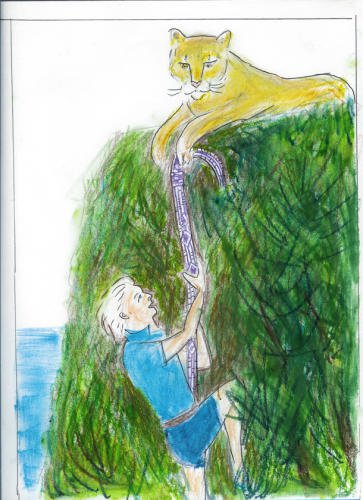
I also noticed, exploring this theme, that our dream histories are non-linear. They circle and spiral around certain themes. In the past, my dream self has resolved the challenge of running out of road by getting out of the car and picking it up like a cardboard dummy and carrying it to where he needs to go. On another occasion, confronted by a vertical, seemingly impossible cliff, my dream self was pulled up by an ally above that revealed itself - when he reached the top - as a mountain lion.


We never want to forfeit the rich detail of an individual dream, which may offer specific insight and guidance on multiple levels, relating to the possible future (for example), to the state of our mind and body and relationships and/or to our parallel lives in other times and in alternate worlds. But it's fun to track those repeating and ever transforming personal themes and symbols.

In approaching symbols, we want to remember the very useful distinction Jung made between sign and symbol. A sign stands for something known; a symbol connects us with something we do not yet know. So tracking our symbols becomes an excursion into mystery.


Drawings from Robert Moss journals


How you know your world just changed

The Many Worlds hypothesis in physics suggests that the universe is constantly splitting, that we are living at any moment in one of uncountable parallel universes. We find ourselves in parallel lives in dreams. Careful reporting of these episodes in a journal over time can provide state-specific evidence of the reality of parallel worlds. Can we catch a moment when the world shifts with our eyes open? For me, this means staying alert for anomalies, like the moment in the movie "The Matrix" when the black cat walks across the room the same way twice and you know that a world simulation is about to change. In Hiruko Murakami's magical novel 1Q84, Aomame realizes there has been a shift in her world when she goes down an emergency staircase from a clogged expressway and notices the cops are wearing different sidearms, heavy pistols instead of stubby revolvers. When did that happen? Starting with this single observation, the anomalies multiply until she - and eventually some others - are looking up at two moons in the sky and it is obvious that they are in a different world (unless they have gone crazy). I noticed an anomaly on my street this week, small in itself but of the kind that may be a marker that the world just changed. One of my everyday synchronicity games is to note unusual license plates. I spotted a plate on a silver Audi: DSB 1914. This drew my attention because "1914" carried me back to the Great War, which has often featured in my dreams and historical interests. I wondered who or what DSB might stand for. Then I noticed something more interesting about the license plate. it was German No doubt about it. To the left DSB 1914 was a panel with the twelve stars of the European Union and a D for Deutschland.
It is very unusual to see a vehicle with European plates in my small rustbelt city in Northeast America. But this bit of Sidewalk Tarot was not the kind of anomaly that sows the thought that the world just changed. That came the next day. Walking my dog along the same block, I came to the silver Audi parked in the same spot. The license plate had changed. It was no longer German. It was an orange New York plate. I was glad I had snapped a photo of the German identity the Audi had worn before the world shifted. I shall be watching the moon very closely.
Art inspired by 1Q84. Seeking artist's identity in the world with one moon.

Saturday, July 27, 2019

The Gates of Anamnesis


Essential knowledge comes to us through soul remembering: through reclaiming the knowledge that belonged to us, on the level of mind or spirit, before we came into the body in our present life experience. This has been central to my understanding of everything since I was in my early teens, when I received instruction from an interesting mentor.
    He was one of my invisible companions. He usually appeared at my bedside in the middle of the night, when I was drifting in a twilight state of consciousness in that place between sleep and awake. He presented himself as a radiant young man from the eastern end of the Mediterranean. He came from a Greek community on the coast of the country we now call Syria.
     His name was Philemon. Many years later, I
discovered another Philemon, but this was the first time I had heard this name. This beautiful young man spoke to me in the language of the Platonists. He told me, “Everything important, everything you need to know that matters comes to you by way of anamnesis.”  The brain of my fourteen-year-old self did not previously contain that difficult word anamnesis. You can actually find anamnesis in an English language dictionary. However, it is not exactly household word. It's Greek and Philemon was using it in a very special sense.
     Anamnesis literally means “remembering”, but it's about more than remembering what you put on the grocery list or what you read in that textbook. Anamnesis in the doctrine of the Neoplatonist philosophers anamnesis is about remembering what belongs to us on the level of soul and spirit. Remembering perhaps the reasons we came here in the first place, why we took on embodiment in this life. It is as important as that. To regain such essential knowledge requires the practice of soul remembering.
    I learned later that in another Greek school of philosophy, attributed to Pythagoras, anamnesis is also about remembering your connection with a series of personalities living in other times. These may be reincarnational experiences, but there may be even more going on. Through anamnesis, you come to recognize that you are connected with personalities in other times and other dimensions and you can communicate with each other. When you do that, you bring together the knowledge of many selves. You start to see how your present life story is part of a much larger pattern. You find it possible to draw together lessons and gifts from many members of your multidimensional family.
     Heady stuff for a teenage boy in Canberra, Australia. I could do a little research, and was already reading Plutarch, but I was only able to unfold what all of this was about when I got to university and had access to a real research library. We did not have Google back in those days.
     When I read Jung’s Memories, Dreams, Reflections at seventeen or eighteen, I discovered that Jung had a guide he called Philemon.  Jung’s Philemon looked very different from mine. His portrait is in the Red Book. Jung saw him as an old man with a long beard, bull horns and wings of kingfisher blue.He said that his Philemon taught him "the objective reality of the psyche"; that what we see as subjective or interior phenomenon are also out there. The contents of the psyche are also objective. They are both personal and transpersonal.

Over all the years, anamnesis has remained one of the most important words in my personal vocabulary, and soul remembering is central to my teaching and practice. We came here for a reason. We may or may not love the reason when we remember it, but we are here for a reason and we come here with stories from before this life. We want to remember those stories. We come here with soul kin, with a soul family extended over space and time. We want to remember more about that and start to connect consciously with our soul family. They will know us.  They will know us. They reach to us as we reach for them. As the Irish mystic AE affirmed, Your own will come to you.


Painting by AE (George Russell)

Wednesday, July 3, 2019

Learning the language of the birds, Australian syle


“Nothing is nothing”, they say in the Cape York peninsula. Everything speaks of something else, and to something else. The spirit world and the physical world are interfused. The distance between them is the width of an eyelid, and no distance at all if the strong eye is open.
     You know when it is the right time to do something by listening to the land, by recognizing those things that like to happen together. The Yolngu of the Northern Territory know when food is ready to be gathered in certain places because they notice things that like to happen at the same time. When flower blooms in one place you know it is time to harvest in another. When that tree blossoms you know the yams in another spot are ripe and ready to eat. You do not check the calendar for the date of that big initiation ceremony; you know it’s about time when a certain fish is jumping in the river, big and fat.

     You learn that the birds are a whole telephone system. Night hunting birds, like owls, are powerful spirits whose call can mean that someone close to you is about to die. Listen carefully to the kingfisher, who lent wings to Jung’s Philemon. Kingfisher can see ghosts. If it calls out ekwe, ekwe, ekwe, watch out for a ghost attack that could inflict illness or even death.
     Little willie wagtail is a shaman of shamans among the bird tribes, He dances like a made man in ceremony when he jitters sideways. Watch willie wagtail for any unusual behavior, because this means news is coming. “Him good telephone that fella,” a Ngarrindjeri woman of the Lower Murray told Philip Clarke, who has been helping to map the Aboriginal landscape. *
     Listen to water as well as earth, to the voices in a billabong, to the song of a river. Today the indigenous fishermen of the Torres Islands see and feel the “scars on the water” caused by boat propellers and pollutants. Their shaman, the zogo le, flies on the wings of sea eagle, and sees with his keen eyes.


*Philip Clarke, Where the Ancestors Walked: Australia as an Aboriginal Landscape. (Crows Nest, N.S.W.: Allen & Unwin, 2003) 23.

Photo: Sacred kingfisher (Todiramphus sanctus). Australian Museum

Monday, July 1, 2019

Tracking the Traveler


I can only keep up with him by becoming him. When I come home from our travels, I am not quite myself and no longer him. When we part company, I am left to pore over scraps of memory like the things I find in my pockets and on my phone after a regular plane trip: a boarding pass, a bus ticket, a foreign banknote, a scribbled love note, random photos of far-away cities and beaches and train stations.

It is now one of my ongoing undertakings to track the Traveler through my journal reports. Here he seems to be very like my present self, just two days ahead of me, on my present probable event track. Sometimes he is much further ahead, or on a different – mildly or radically – event track, or he is in another body in another time or another world. Is the traveler sometimes in a different body in this world, like the kids in  the Japanese film “Your Name”? Perhaps. I think back to the body swapping dream of many years ago when the Traveler tries on at least three different bodies – of a black athlete, a rich Republican country club type, and finally an older, eccentric scholar much like my current self.

I think of the dream in which I am dressing up in a blue satin ballgown, excited by the prospect of turning on my boyfriend. I wake wondering whether I have been in a woman’s body. This doesn’t feel quite right. My excitement in the dream is surely male arousal, within a man’s anatomy. Confused, I look out the window and see a tall black transvestite, gorgeously attired in a long blue satin ballgown, teetering down the steps on stiletto heels on the arm of her boyfriend. 

I like to play with words in English. The Traveler plays with words in many languages. One morning I was left with an unlikely phrase in French, on acccable par les hochements. This could be a newly-minted saying with the sense of “yessing someone to death”, or a commentary on the storm surge of Hurricane Irma, or both. Now I remember the Traveler’s effort to find the right words to greet Stalin at lunch in Ufa in the midst of World War II. He sought an edge of humor while trying to avoid getting his throat cut. He managed, in the Georgian language.

I am beginning to think that the moment of lucidity, in a sleep dream, is often the moment when the self that has been dormant in bed – or somewhere else altogether – catches up with the Traveler. It may be a moment of self-possession, of taking control of a vehicle that has been traveling under the direction of an autonomous self, like the captain of a ship coming back on board and taking over from a junior officer or crew member. However, the person in the wheelhouse may decline to give over control, and a sudden rebuff may result in falling out of the dream (for the person who wakes in the bed) and the Traveler’s disappearance from radar. So it could be like a horse bucking a would-be rider.

Just as I now seek to track the Traveler, I now watch the person who is writing these lines. I see him fumbling with his nautical analogy. I like the bucking horse analogy better, though we lose the notion that there may be a second rider. I am not going to play editor or critic. The writer’s attempt to model and understand what is happening in his many lives is part of his story, the one on which I will put the name we use in the ordinary world.

When I am the Traveler. leaving my body consciously on astral excursions the journey often begins at a certain threshold, a gap between the worlds, in a twilight of the mind. I may find myself floating upwards. I roll over and as I do so I feel something pulling loose from my physical body. Lights flash at the top of my head and I find myself being drawn up into a cone of light, like a pyramid with an opening at the top. 

There are days when, flat on my back under a tree, I fall upwards into the bowl of the sky, like Rumi. There are nights when I feel I am about to blast off like a rocket, or be blown from the mouth of a cannon, through circles of red within black. Or I find myself stripping off, shedding the body like a snake skin, dropping it like an old overcoat. When the travels begin, I often find myself looking at geometric pattern. It may be a glowing energy grid. It may resemble the weave of a carpet, or the strands of a net.

I find it soothing to study parallels for my dream travels, and my relations with the Traveler, in reports of anthropologists and mythographers. I find again, in A.P.Elkin's Australian classic Aboriginal Men of High Degree, conformation that the projection of a dream double was a primary skill of indigenous shamans in my native country. 

Among the Aborigines of Walcott Inlet it was believed that the high god Ungudd summons potential shamans through dreams. Those who had the courage to answer their calling faced a terrifying trance initiation in which they saw themselves killed and dismembered. The potential “man of knowledge” is reborn from this ordeal with a new brain, filled with inner light, and a new body, filled with shining quartz crystals. He now has the ability to send his dream double, or ya-yari, outside his body to gather information. His shamanic powers are described by an interesting term, miriru. Elkin explains its meaning as follows: “Fundamentally it is the capacity bestowed on a medicine man to go into a dream state or trance with its possibilities.” 

In a book of paintings by Father Arsenie Boca, a celebrated Romanian Orthodox priest and mystic whose church I once visited and who rises from his grave to visit Romanian friends in their dreams, I find clear depictions of an astral double operating beyond the physical body. In the mythology of Egypt, I find the belief that the god Ra has no fewer than fourteeen Ka souls, or astral doubles. I must have further conversation with the Traveler about these matters. I am sure he has first-hand knowledge of how things are done in Egypt, and among the casuarina trees, and in the mountains of Transyvania.


For many related adventures, see my book Mysterious Realities: Tales of a Dream Traveler from the Imaginal Realm. 


Photo "Tracking the Traveler at Ratibořice" by RM