Showing posts with label symbol. Show all posts

Wednesday, August 7, 2019

The biography of a dream symbol


If you are keeping a dream journal, a great game to play from time to time is to track the evolution of a familiar symbol or theme. 

You've been dreaming of the bear, or the fox, for years; how has your relationship changed? You often dream of running into construction on the road; are you getting through, taking a detour, grinding to a halt, or remembering you can fly? Again and again, you find yourself exploring a dream house that has more rooms or levels than your regular house; can you make a floor plan, marking its changes?

I made it a homeplay assignment for members of one of my active dream circles to come prepared to present the "biography" of a dream symbol.

A man in our group tracked his dream encounters with the bear starting with a scary brush with a giant grizzly many years before, in which some of the tension lifted when he was reminded that "all mammals like to be close to warm bodies." In a later dream, he found himself snuggling with a big black bear in bed, which would have been more enjoyable had the bear not recently been in the trash, so that it stank. In the most recent of his dreams, he was playfully skipping along with his children in the tracks of a friendly bear walking in the snow.

A woman dreamer told us she was going to speak about the "cross-over" theme in her dreams. She did not mean "crossing over" in the sense of the transits of the departed; she meant situations in which she had to cross over an obstacle ranging from a mountain to a busy street. Though the details of the five dreams in which she flagged this theme were richly specific and individual, the common theme emerged in a most interesting way in her narration. 

In the first dream in the sequence, she needs to cross over a man-made mountain with rubber boulders; she manages this easily, even dancing with friends on the top. In a later dream, she has to cross over a golf course set in the side of a steep hill to get to where she wants to be. In the last dream in the series, she must cross over a busy and confusing city street and make a loop through alleys where she begins to lose her way, until three men appear to play helpful guides. We noted a promising transition from needing to deal with a series of challenges or obstacles created by men to men figuring as helpers. This seemed to resonate with major life transitions over the same period.

Running out of road

I came to this circle intending to speak about my evolving visionary relationship with the red fox over many years, though that story could easily fill a whole book. After hearing the "cross-over"sequence, I opted to talk about a different dream theme, which I defined as Running Out of Road.

It had been a recurring dream theme for me, over decades. I'm on a road that becomes progressively more difficult or simply more rustic. In some versions, I run up against construction, a barrier or a brick wall.

 In a recent dream of this kind, the paved road ends and becomes a kind of farm track that in turn peters out. Now I am driving my car cross-country, over rocks and through little streams. Soon I am on an upward slope that is getting steeper and steeper, while the rocks are becoming enormous boulders. My car is doing very well but finally it stops atop a huge boulder on a near-vertical gradient. I get out of the car and inspect the situation. I calculate that my car can make it to the top with just a little help. I need to find one or two people to give a push. This can be managed if I go to a nearby village and ask for help.

I found this dream enlightening. In my work, on many fronts, I had reached a point where I found myself very willing to ask for help and cooperation from others.

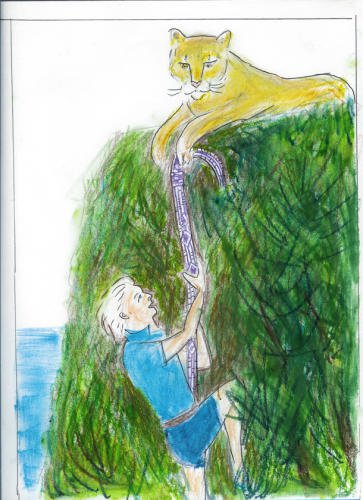
I also noticed, exploring this theme, that our dream histories are non-linear. They circle and spiral around certain themes. In the past, my dream self has resolved the challenge of running out of road by getting out of the car and picking it up like a cardboard dummy and carrying it to where he needs to go. On another occasion, confronted by a vertical, seemingly impossible cliff, my dream self was pulled up by an ally above that revealed itself - when he reached the top - as a mountain lion.


We never want to forfeit the rich detail of an individual dream, which may offer specific insight and guidance on multiple levels, relating to the possible future (for example), to the state of our mind and body and relationships and/or to our parallel lives in other times and in alternate worlds. But it's fun to track those repeating and ever transforming personal themes and symbols.

In approaching symbols, we want to remember the very useful distinction Jung made between sign and symbol. A sign stands for something known; a symbol connects us with something we do not yet know. So tracking our symbols becomes an excursion into mystery.


Drawings from Robert Moss journals


Tuesday, January 8, 2019

Symbol magnets and something fishy about Jung


The magnetic power of a symbol, in our lives, can bring together inner and outer events in ways that shift our perception of reality. We learn best about these things through direct experience, and through stories - like Jung's fish tales - that we can trust.     
    When Jung was immersed in his study of the symbolism of the fish in Christianity, alchemy and world mythology, the theme started leaping at him in everyday life. On April 1, 1949, he made some notes about an ancient inscription describing a man whose bottom half was a fish. At lunch that day, he was served fish. In the conversation, there was talk of the custom of making an "April fish" - a European term for "April fool" - of someone.
 
    In the afternoon, a former patient of Jung's, whom he had not seen for months, arrived at his house and displayed him some "impressive" pictures of fish. That evening, Jung was shown embroidery that featured fishy sea monsters. The next day, another former patient he had not seen in a decade recounted a dream in which a large fish swam towards her.

    Several months later, mulling over this sequence as an example of the phenomenon he dubbed synchronicity, Jung walked by the lake near his house, returning to the same spot several times. The last time he repeated this loop, he found a fish a foot long lying on top of the sea-wall. Jung had seen no one else on the lake shore that morning. While the fish might have been dropped by a bird, its appearance seemed to him quite magical, part of a "run of chance" in which more than "chance" seemed to be at play. 
    If we're keeping count (as Jung did) this sequence includes six discrete instances of meaningful coincidence, five of them bobbing up, like koi in a pond, within 24 hours, and all reflecting Jung's preoccupation with the symbolism of the fish. Such unlikely riffs of coincidence prompted Jung to ask whether it is possible that the physical world mirrors psychic processes "as continuously as the psyche perceives the physical world."
    In her discussion of how inner and outer events can mirror each other, Jungian analyst Marie-Louise von Franz suggested that "if the psychic mirrorings of the material world - in short, the natural sciences - really constitute valid statements about matter, then the reverse mirror-relation would also have to be valid. This would mean that 
material events in the external world would have to be regarded as statements about conditions in the objective psyche.
    Some of the greatest minds of the past century - Jung and Wolfgang Pauli and David Bohm - sought to model a universe in which mind and matter, subject and object, inner and outer, are everywhere interweaving. Events, both physical and psychic, unfold from a unified field, the unus mundus of the alchemists, that may be synonymous with Bohm's "implicate order", Their interaction escapes our ordinary perception of causation and of time and space. “Precisely because the psychic and the physical are mutually dependent...they may be identical somewhere beyond our present experience.” 
    Living symbols deeply ingrained in the imaginal history of humankind are charged with magnetic force, which can draw clusters of events together. For those familiar with tarot, it feels at such moments as if one of the Greater Trumps is at play in the world. Traditional diviners understand this, as do true priests and priestesses. Thus one of the Odu, or patterns, of Ifa, the oracle of the Yoruba, is held to bring the fierce orisha Ogun into the space, while another is believed to carry spirits of the dead into the realm of the living. When that happens, you don't just study the pattern; you move to accommodate or propitiate the power that is manifesting.
    To grasp the full power of a symbol, we need to go back to the root meaning of the word. "Symbol" is derived from the Greek σύμβολον (sýmbolon) which combines συν- (syn-) meaning "together" and βολή (bolē) a "throw" or a "cast" A symbol is that which is "thrown together" or "cast together". This is very close to the root meaning of "coincidence". In Latin, to coincide is to "fall together". So it's not surprising that when symbols are in play, coincidence multiplies.
   The first literary mention of a symbol is in the Homeric Hymn to Hermes, in which the god Hermes exclaims, on finding a tortoise, "O what a happy symbol for me", before turning the tortoise shell into a lyre. In the ancient world, sýmbolon came to mean a token, that which brings things together. Thus a symbol might be a pair of tokens that could be fitted together to make a single object. Such tokens might be broken halves of potsherd, a ring or a seal. They would vouch for the truthfulness of a messenger, or an enduring loyalty.    

-  Jung noted in his foreword to his most important work on synchronicity that "my researches into the history of symbols. and of the fish symbol in particular, brought the problem [of explaining synchronicity] ever closer to me" His experiences of symbols irrupting into the physical world led him to sympathize with Goethe's magical view that "We all have certain electric and magnetic powers within us and ourselves exercise an attractive and repelling force, according as we come into touch with something like or unlike."  Such powers are magnified when our minds and our environment are charged with the energy of a living symbol.

Graphic: Oannes, from a relief in the Assyrian city of Dur-Sharrukin, today called Khorsabad.