Showing posts with label Moon. Show all posts

Tuesday, March 4, 2025

You know when he tells you it's a redingote


I am often asked, of scenes that develop in lucid dreams and visions, "How do I know I'm not making it up?" Well of course I am in favor of making things up, of engaging in reality creation with the aid of imagination, that great faculty of soul. Nonetheless, I recognize that the skeptic in the cognitive brain needs to be appeased. Sometimes a bit of information unfamiliar to the dreamer that can later be verified serves that purpose, providing a sense of objectivity.

Early yesterday morning, in a half-dream state between sleep and awake, I found myself observing a fascinating series of events. I saw what at first looked like a giant golf ball rolling over sea mist towards the shore, where I stood on a sandy beach with dense jungle behind me.  As the ball got nearer, I saw it was a very small moon, with people singing as they rode it towards a reunion in the jungle. Intensely curious, I ran through the jungle, trying to get to the place where the moon riders would come down.

I came up behind a strapping man with a curling red beard, with a cane topped by a crystal ball, a top hat, and what I labeled in my journal a "frock coat". I knew he was a magus and that the meeting he was headed for was of huge importance. Soon he and his servant - who had a blue parrot on his shoulder - were whizzing over the undergrowth on their own magical transportation. I managed to get close enough to the magus to start picking up his thoughts. I stayed lucid and entirely resent to this adventure - while also aware of my body in bed - until the cats pulled me out by demanding breakfast yowls and thumps. 

Very early today, lying on my back in bed, I decided to reenter the scene, and seek the identity of the man in the frock coat, and see whether I could look in on the meeting with moon riders. I learned many things, including his name. At the point where I might have asked, "Am I making this up?" the word "redingote" came to me, in a clipped accent. Redingote? I wasn’t certain till I looked it up.


A redingote and a frock coat are both long coats worn by men in the nineteenth century, but differ in style, cut, and purpose. The word "redingote" derives from the English "riding coat." Fitted at the waist with a long, flared skirt, it could be double-breasted or single-breasted. It was worn for both riding or formal occasions. The frock coat, the mainstay of Victorian men's formal wear, usually double breasted and worn with a vest, was shorter (knee-length) also fitted but less waited and flared.

So, he wants me to know he is wearing a redingote, like a frock coat but not the same. Exquisite detail to which I do not normally have access soothes the skeptic in me, though it does not silence him. He hisses, “You must have read that word in Thackeray when you were a student”. Perhaps. But it was long gone from memory if so, and I am pretty sure that the voice that gave it to me was not speaking from the bargain basement of my personal subconscious. After identifying and speaking with some of them, I am certain that the people in that moon-assisted gathering are not part of me at all except in the sense of the old Latin tag attributed to Terence: 
Homo sum, humani nihil a me alienum puto, "I am a human being, nothing human is alien to me"

Tuesday, November 14, 2023

In the Garden Behind the Moon


I've been rereading The Garden Behind the Moon, by Howard Pyle, originally published in 1895. This may be quite my favorite story for younger readers.

    My friendly daimon of Luna concurs. He especially approves of the fact that a beautiful but terrible entity “whom so many people know by a different name and are so afraid of” is called the Moon-Angel. Around his face, it is bright like sunlight. He “never brings something but he takes something away from him again” - and we come to learn that this is most often the soul of someone who has died. The Moon-Angel of the story is also called the Master Cobbler, which appears to reflect the preferences of an old cobbler in a fishing village who “knows less than nothing” and thereby more than those around him. We see the old cobbler pegging soles to uppers on his last. My daimon points out that there is a crafty allusion here to Sandalphon, the Sandal-Angel or Shoe-Angel who gives and takes away soul bodies for transits to and from the Moon.

So to the story:

   A boy called David, who is not yet twelve, and is regarded as dreamy and simple (a “moon-calf”) by his peers, learns from the old cobbler that a moon-path opens across the sea a day or two after the moon is at its full. Close to shore, the first steps float in the tide as bars of light, slippery underfoot. But if you persist, the moon-path becomes a gravel road, and finally a broad shining field, until you get to the Moon.

    After an initial mishap, the boy gets to the Moon, where a man-in-the-Moon pulls him up a stair. From each window of the Moon house, he sees into different scenes, into the inside as well as the outside. He is set to polishing stars with lamb's wool, for nights when the Moon is waning. He earns a little break; he is allowed down a back stair into a lovely garden where he plays with other children. He has his time in the garden for three days every month, and falls in love with a little princess, but is then told that he cannot return to the garden because he is turning twelve, and will be too old.

     Now he is called to the Quest: to win his girl, he must find the Know All book in the Wonder Box that has been hidden since Eve and Adam (note the order) were driven form the garden. To do this, he must “go behind” the Moon-Angel, something that has almost never been done. When he confronts the Moon-Angel, we begin to feel his terror as well as his beauty. In effect the boy has to step through  his form, through unbearable cold that transforms to unbearable heat. He bursts through a great iron door into the landscape of the Quest. He is no longer a boy; he has aged ten years.

    He finds his local guide - a woman in a red shift who cleans souls and leaves them out to dry. She tells him what he will need to do to capture the black winged horse that will take him to the Iron Castle of the Iron Man where the Wonder Box has long been locked up. He catches the black horse by the forelock (like Kairos - opportunity - time). It can no longer fly with a human on its back, but it can run fast. David manages to enter the Iron Castle, and steals the Wonder Box, and rediscovers the girl - escapes from the Iron Castle, and kills the Iron Man with a stone from the sea shore.

    David and his beloved return to the “brown world” on the moon path, but find that the path branches to take each to their separate homes. So now there is another test, for the princess (she's a real one) to find her hero and for the Wonder Box she took from him to be opened with the key that he retained. A happy and triumphant ending, of course. 

     In which the most interesting feature (as my daimon observes, pointing a finger up under his left eye) is that nobody knew that David was missing all the time he spent in the house of the Moon and the lands beyond it. And nobody in Princess Aurelia's kingdom knew she was gone either; they had merely found her, from birth, strangely mute and emotion-less. She's fully alive now that her soul has come home from the Garden Behind the Moon. 

    So we may catch the hint that the story is about soul loss, when people around you may not notice you are missing, only that you are duller and quieter. And that there are places where lost souls go, from which they may be brought home by those who can muster the courage and imagination to get through some version of the Moon-Angel.


Monday, November 13, 2023

Jung and the Woman Who Lived on the Moon


Jung worked with a woman patient who said she had been living on the Moon for many years. Investigating her life history, Jung discovered that she had suffered terrible and multiple abuse of the kind that might make any of us want to check out of life on Earth. as a result of terrible abuse.

When Jung spoke of this in a public lecture, he declared matter-of-factly that she really was living on the Moon. The young Marie Louise von Franz , in the lecture audience, was shocked. How could the distinguished Herr Professor Dr. Jung talk in this way? She confronted him at the end of his talk. He couldn’t be serious, surely.

Marie-Louise suggested to Jung that what he meant to say that the patient's situation was “as if” she lived on the Moon.

Jung replied, “No, not ‘as if’. She did live on the Moon.”

By her own account, Marie-Louise thought at the time that the famous psychologist must be crazy. Later she came to understand that Jung recognized that when we suffer intolerable conditions in this world, part of us may part company with us in order to survive. Shamans call this phenomenon soul loss.

Jung did not use that language, but clearly he understood it well. If part of that young woman's soul had left her because the ordinary world seemed too cold and too cruel, why should it not go to the astral realm of Luna, which in ancient and indigenous traditions - as we reviewed - is recognized to be "thickly settled" by spirits who take a close interest in human affairs? 

Von Franz tells the story of The Woman Who Lived on the Moon in Animus and Anima in Fairy Tales (Toronto: Inner City Books, 2002). She talks about the same episode in the documentary film "The Wisdom of the Dream".


Illustration from Jung's Red Book

Wednesday, September 13, 2023

In the presence of the numen


I dive again into a thick bilingual edition of Borges' poems. [1] Like a creature of the deep, a curious poem  titled “1891”, bobs up. It describes with exactitude a shady character with a knife in his waistcoat who is on his way to collect a debt and maybe to meet his own death. I nibble at words I do not know from the street argot. Esos changangos estan siempre amolando la paciencia.”These cheap guitars,” suggests the translator, “keep gnawing at the edges of his temper.” I open the book again to an astonishing eulogy of the German language. 

Then I find, early in the book, Borges long poem for the Moon, and how it will always escape the nets of the poets. I savor this verse in particular.

Siempre se pierde lo esencial. Es una
Ley de toda palabra sobre el numen.
No la sabrá eludir este resumen
De mi large comercia con la luna. 

In Alan S. Trueblood’s translation this becomes:

The essential thing is what we always miss.
From this law no one will be immune
nor will this account be an exception,
of my protracted dealings with the moon. 

-    He vanishes the critical word “numen”, thus fulfilling Borges’ law! And how essential this word “numen” is. It is indeed quite central to our understanding – within Western tradition – of the interplay of the sacred and the profane. Partly inspired by Rudolf Otto, Jung and Eliade both sought to trace the operations of synchronicity through the game of hide-and-seek played by the numinous.

The word numen, naturally, comes from the Romans. It is used to mean the presence or the will of a sacred power. Cicero uses the term to signify the "active power" of a god. [2] Ovid has  Numen inest  meaning “there is a god (or spirit) here.” [3] Its literal meaning is a “nod”, or “given the nod”.

Nil sine numine is the state motto of Colorado. “Not without the numen”. It derives from Virgil: non haec sine numine devum eveniunt (“these things do not come to pass without the will of Heaven”) [4] 

So, back to the Borges verse. I will try this:

We always lose the essential when we try
to find words to describe the numen.
I don’t know how to escape this law
in reporting my long engagement with the moon.

 And on to Rudolf Otto, who belied his Prussian appearance – Kaiser moustache, high-collared tunic, ramrod bearing – as a deep student of mystical experience. He insists that you cannot be taught the concept of the numinous; you must feel it. It “cannot, strictly speaking, be taught, it can only be evoked, awakened in the mind; as everything that comes ‘of the spirit’ must be awakened.” [5] . “It cannot be ‘taught’, it must be ‘awakened’ from the spirit….In religion there is very much that can be taught…What is incapable of being so handed down is this numinous basis and background of religion, which can only be induced, incited, and aroused.” We require “a penetrative imaginative sympathy.” [6]

His effort is to convey “the feeling which remains when the concept fails, and to introduce a terminology which is not any the more loose or indeterminate for have necessarily to make use of symbols.” ]7]

“The numinous is felt as objective and outside the self." The feeling is of mystery edged with shudders, a mysterium tremendum. Feelings may span the spectrum from a gentle tide, through sudden eruption with spasms and convulsions, to “the strangest excitements” to “wild and demonic forms” to “hushed, trembling and speechless humility of the creature in the presence of – whom or what? In the presence of that which is a mystery inexpressible and above all creatures.” [8]

Sophocles wrote of the experience of awe in the presence of the numen in Antigone, in a line which Otto renders as

Much there is that is weird; but nought is weirder than man. [9]

Otto also quotes Goethe’s Faust:

Das Schaudern ist der Menschheit bestes Teil,
Wie auch die Welt ihm das Gefühl verteuere,
Ergriffen fuhlt tief das Ungeheuere.
[10]

My free rendition:

Shuddering is the best part of being human
though the world can stifle our feelings
we are gripped by the weird sense of the tremendous

In the presence of the numen, we are gripped in our depths by something vast and uncanny.


References

1.  Jorge Luis Borges, Selected Poems ed. Alexander Coleman. (New York: Penguin Books, 2000).

2. Cicero, De divinatione 1.20 

3. Ovid, Fasti III, 296 

4. Virgil, Aeneid II, 777.

5. Rudolf Otto, The Idea of the Holy  trans. John W. Harvey. (London: Oxford University Press, 1952) 7

6. ibid, 60

7. ibid, xxi

8. ibid, 11-13

9. ibid, 40

10. Goethe, Faust Part II, Act 1, scene v.


Magical Moon photo by Janne Loekkeberg

Sunday, April 9, 2023

The First Latvian Moon Landing


THE LATVIANS HAVE SUCCEEDED IN LANDING ON THE MOON!

This was the headline and basic content of one of my dreams on the first night of my residential workshop on shamanic lucid dreaming at a pleasant center on a rocky beach near Roja, on the Bay of Riga, over the Easter weekend. I took it as a wink from my dream producers, indicating that we would succeed in our efforts to bring back the dreaming here.  
     After all, the Moon not only has great attraction for dreamers; it was widely believed by the ancients to be the source of much interesting dream activity. In his treatise On the Face That Appears in the Orb of the Moon, Plutarch - the great biographer, initiate and priest of Apollo, who knew what he was talking about - suggested that the spirits of the Moon visit humans in their dreams, and that the souls of humans travel to the astral realm of the Moon in dreams and transit this realm on the way to birth and again after death.
     Many of the Latvians in my group are passionately engaged in reviving the knowledge and practice of the authentic ancient traditions of their country, dating back to before the invasions began in the 12th century. A folklorist and wonderful singer named Aina gifted us with dainas - traditional folk songs that celebrate oak and sun, stone and sea. The morning after my dream of the Moon landing, I asked her to help open our circle with a song of the oak tree:

I found in a field
a tall oak tree of spirit
his feet go into the earth
his head touches the sky

Oak tree, oak tree
how wide you are
the bee flies for three days
and can't get around you

In the last stanza, this song of oak teaches us to give a little in a strong wind, to avoid being broken.

The big storm boasted
"I'll break the oak."
Oak tree, stand strong
but let the wind shake your branches
.

For the first time, I introduced a circle in Latvia to the core techniques of active dreaming: how to open a safe space to share dreams and guide each other towards action to honor our dreams; how to reenter a dream in order to go beyond a fear, dialog with a dream character, penetrate a mystery, or have more fun exploring the multiverse.
    In a moving dream reentry, one of the Latvian women succeeded in going back inside a recurring dream that had previously filled her with shame and dread. In the original dream, she found herself (again and again) approaching the shack where her great-aunt had lived and died in extreme poverty in the harsh times of Soviet rule. She had loved this great-aunt and had always felt bad that the family had not been able to do more for her. In the dream reentry, she entered the shack and had a loving reunion with her great-aunt, who gave her blessings and specific personal information she could immediately use in her life.
    On Sunday, the day of requickening, we moved swiftly through a series of excellent journeys: through the gates of remembered dreams and on to a Dream Library where travelers could gain knowledge on any subject, meet a master teacher and even look at the book of their own lives; and a Magic Market where the discovery of a favorite object from childhood released the spirit horse of vital energy and provided a way to reclaim the energy and imagination of a younger self.
     The fog rolling in from the sea inspired me to offered the sea-mist as the gate for a journey to the Other Side with the dual objective of timely and helpful communication with a departed loved one or ancestor, and of gaining first-hand knowledge of the geography of the afterlife. All of these journeys succeeded beyond my wildest expectations, if not beyond my dreams.
    My own visions, during all these lucid shamanic dream adventures, powered by drumming, became a deepening adventure in dream archaeology, giving me direct access to the world of Baltic mythology and the history and spirits of the land. In a walled garden, I experienced the meaning of ancient Baltic symbols in the forms of shaped flower beds, turning in certain patterns. On a flying horse, I was called east, to a black mountain in Russia, to understand one of the long shadows over Latvia. Through an amber tunnel, I found my way to the current residence of a deceased scholar of Baltic mythology who wants me to make his work known in English.
    In the last workshop session, I helped people to open their hearts and grow a waking vision of the fulfillment of their hearts' desires, a vision so strong that it wants to take root in the world. Then I had them identify three key problems in the way of fulfilling that vision - and journey again, with the drum, for guidance on how to overcome those challenges. This produced very practical guidance, as well as the energy that comes when we carry a vision we can hold not only in the mind but in the inner senses.
     We closed the circle, arms around each other, swaying a little like the great oak in the big wind. As people continued, in high excitement, to share their experiences, I felt that the dream of the Latvian Moon landing was fulfilled.

Article first posted in April 2011

Photo: Sunrise on the Bay of Riga (c) Robert Moss

Friday, October 9, 2020

The Man in the Moon


Do you believe in the man in the Moon?

   No, not the face people imagine in the shadows of the craters, which is really the Great Rabbit, or Lunar Hare. Nor do I refer to those artful pictures, ever popular on greetings cards and in children’s stories, that add a nose and a grin and a wink to the crescent moon.

   I am speaking of something altogether different. I am inquiring whether you know anything (for worthwhile beliefs can only stem from knowledge) of the beings who live in the Moon. I am well aware that since humans in clumsy space suits first walked on the Moon, it has been commonly believed that the Moon is an astral desert, empty of organic life. This is merely a modern superstition, founded in the confusion of different orders of reality. Beyond appearances, the Moon is thickly settled. Its inhabitants do not live on the Moon in the way you live on the Earth. They cannot be found on the lunar surface from which astronauts and robots pick rock samples. The lunar population lives in the Moon, which is to say, in the Sphere of Luna, a frequency domain located a little – just a little – beyond the realm you can touch and smell and taste with your ordinary senses.

   I know what I am talking about, because the Moon is my home. If you happen to meet me tonight, because you happen to be looking up at the bright face of the Moon from under just the right tree at just the right time, or because you travel to my world on the wings of a dream, it’s quite likely you might see me as the man in the Moon, or at any rate a man in the Moon. I find it generally convenient, in my dealings with humans, to show myself as a human male, taller than average, with what I conceive to be a commanding – though not overbearing – presence, exquisitely tailored in a mode that is rarely encountered on Earth outside Jermyn Street and one or two most particular establishments in Buenos Aires. Yet I must disclose, at the beginning of my tale, that “man in the Moon” is a misnomer.

    I live in the Moon, but I am not a man. I am a daimon. I have lived very close to men, so close that I have sometimes forgotten my true identity. But I belong to a different and more ancient order of beings. When you turn to books, you will find the word daimon has several spellings. I prefer the oldest version, an accurate transliteration from the Greeks, who were close observers of traffic to and from my realm. Their witches – especially in the wild northern reaches – were adept at the dangerous art of drawing down spirits from the Moon. The most excellent shaman-philosopher, Plutarch, studied deep in our academies before he took up permanent residence and joined the faculty of one of our finest schools. Plutarch’s essay on the Sphere of Luna, De facie quae in orbe lunae apparet remains the best travel guide to our realm outside the closed stacks of the Magic Library.   

We know Plutarch well. It is a pity, for you, that his works are no longer taught in your schools, though he was read too often for what he wrote about tyrants and kings, instead of his essential work, which was all about us. He understood that the Moon and the Earth are as close as a man and his shadow. He knew that souls come and go constantly through our realm. He observed the descent of mind into the astral body in our dressing rooms, and the return of these energy suits to the suppliers when a traveler was given permission to return to the realm of mind. He watched all the souls that try to ascend to Luna after death and are rebuffed because they are dirty or confused. He saw souls that made it here, but reneged on their commitments, hurled from our ramparts through the black hole of Hecate. Do you know that great goddess’ scary sister, Melinoe. No? Well, be thankful if she does not visit you in the night with her train of spooks and nightmares.


Do please be careful with the word “daimon” now it is in the air, darting around you on dragonfly wings. Words have the power to call things into manifestation, and bring creatures from one world into another. You don’t want to say “daimon” out loud the wrong way; this can produce unpleasant effects, and sometimes unwanted visitors. I prefer to hear it pronounced “die-mon”, so it almost sounds like “diamond”, an elegant homonym. “Day-mon” is an acceptable alternative version.  To call me a “demon”, on the other hand, would be extremely rude, as thoughtless as calling a man whose chosen name is Robert “Bob”, and likely to produce more adverse effects than a frown and a growl. I did not mind being called a “demon” in demotic Greek in the age of Cleopatra, but since then a fog of fear and confusion spread by the morbid imaginations of the Dark Ages has made that version quite unusable. 


Excerpt from "Conversation with a Daimon of Luna" in Mysterious Realities by Robert Moss. Published by New World Library.


Journal drawings by Robert Moss.


Friday, January 24, 2020

To the Moon and Back and Other Things a Circle of Active Dreamers Can Do in Two Hours


The morning after I am still feeling the joy of sharing in an Active Dreaming circle where we all take turns to play dreamer and dream guide. There were ten of us yesterday evening in a local dream circle I have been leading for many years. In the space of two hours we made time for everyone to share a dream or life story and be guided by a different person through our Lightning Dreamwork process. This encourages us to give and receive helpful feedback in the "if it were my dream" mode and to come up with action plans to embody energy and insight from the dream worlds in regular life.
    "They tell me the gate has closed but I push through and get on the plane. And find I am in Africa, driving a Jeep with a friendly lion on the hood who knows where we are going."
    This report got us off to a lively start. Another dream carried us into the rainforest. A couple of dreams -of going back to the childhood home or the elementary school - carried not only nostalgia but the sense that there were gifts to be brought into adult life from a much younger self, gifts of energy and joy and imagination. A doctor's dream suggested an Rx for illness. A wildly funny dream of wearing lingerie to a gym and being celebrated by everyone around helped a man to recognize it is now safe to open up to his feminine side and show it to others.

    The action required by some dreams is to reenter the dream, do more inside that space and bring back gifts. Lasr evening we were able to make a group shamanic journey through the portal of a dream with the irresistible title "To the Moon". In her dream a woman found herself among lively children in a writing workshop being held on the far side of a fast-flowing river "at the bottom of the moon". The kids were assigned roles and started improvising stories by acting them out All of us were eager to join that writing group and the dreamer gave us permission to travel with her with the aid of shamanic drumming. 
    We did not know what "the bottom of the moon" meant, but all found our way, and had adventures in a marvelous creative space. I flew through a great round moon face like the entrance of Luna Park, a theme park I visited in my Australian boyhood. I rode with kids in a flotilla of boats on an underground river. Kids led the way to the other side of the water as the boats became dormant crocodiles that let us us their backs as a bridge. Enormous theatrical curtains, opening just a crack, promised now entertainments. Characters from children's books fluttered around us. I heard the buzzing propeller of Karlsson on the Roof, Astrid Lindgren's delightful character.
     Then I stepped through the curtains and the children started playing the roles promised in the original dream, acting out fresh stories. Right after the drumming sounded the recall,I urged everyone to write a couple of lines from their writing class on the moon. It was delightful to hear them all read aloud. I wrote in the voice of a girl complaining about a wild boy who was showing off the lunar horns he had sprouted:

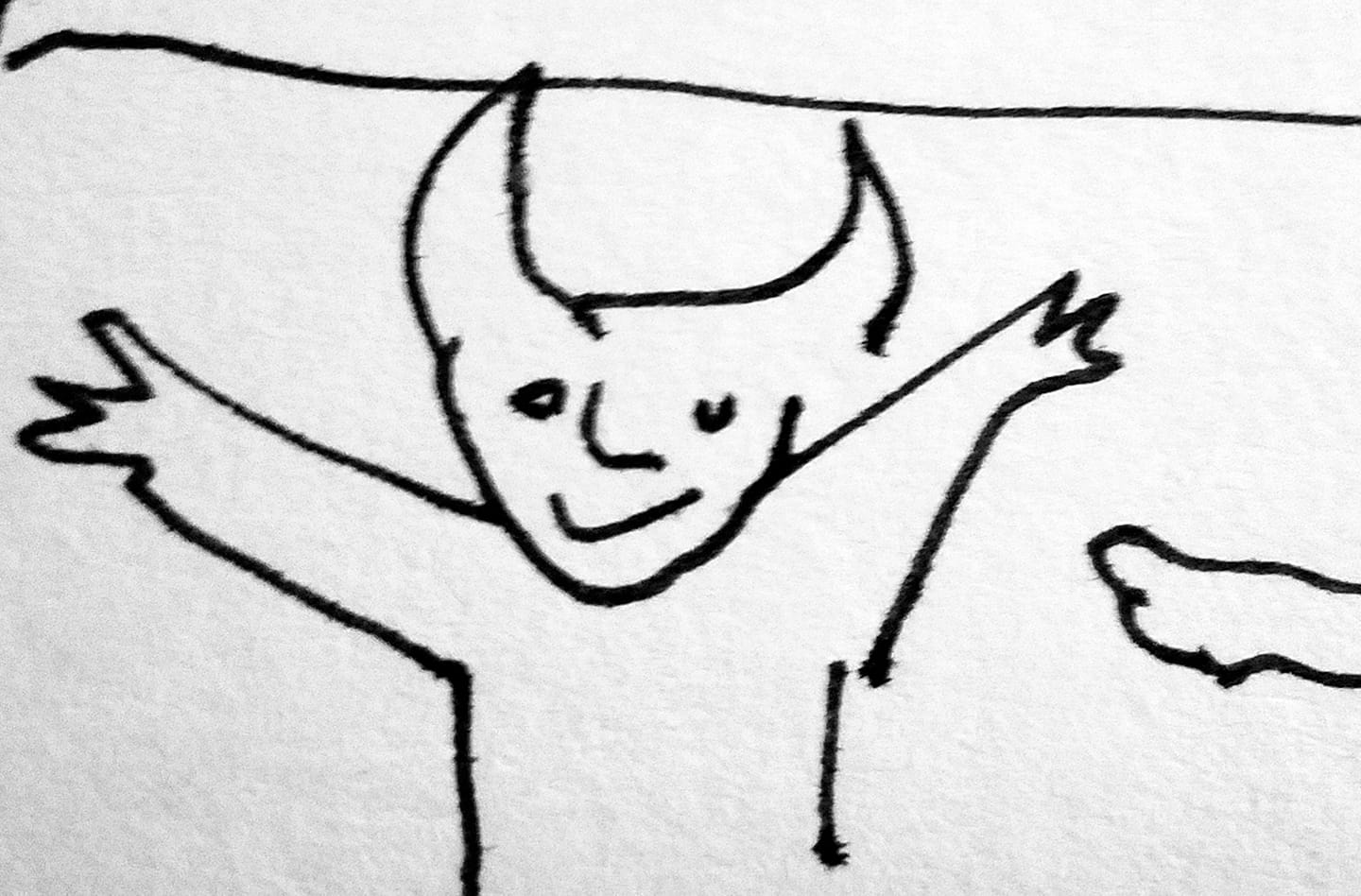
"He's doing it again," said Emma. "He's putting up horns and he doesn't know what to do with them."


One of our dream voyagers, a gifted poet named Tammie, heard the song of the moon children and recorded it in these lyrical words: “We are the children of the moon. Listen to our words. We are the poets and storytellers of the future, helping to keep dreams alive”

As we closed our circle,I recalled that Karlsson on the Roof says in one of Astrid Lindgren's stories, "It has to go bang and it has to be fun, otherwise I won't come." We delivered that in our circle. And we finished on time, to the minute. Dreamers can get it together.

Drawings: "The Nearness of the Moon"  and "Wild Lunar Boy" by Robert Moss

Tuesday, December 10, 2019

The Moon and the numen


I come again,in a thick bilingual edition of Jorge Luis Borges' Selected Poems, to his long ode to the Moon where he explains why it will always escape the nets of the poets. I am thrilled again by this verse:

Siempre se pierde lo esencial. Es una
Ley de toda palabra sobre el numen.
No la sabrá eludir este resumen
De mi large comercia con la luna. 

In Alan S. Trueblood’s translation this becomes:

The essential thing is what we always miss.
From this law no one will be immune
nor will this account be an exception,
of my protracted dealings with the Moon. [1]

I am not satisfied with the translation. It vanishes the critical word"numen", leaving not even a synonym,  thus fulfilling Borges’ law! And how essential this word “numen” is. It is indeed quite central to our understanding within Western tradition of the interplay of the sacred and the profane. Partly inspired by Rudolf Otto, Jung and Eliade both sought to trace the operations of synchronicity through the game of hide-and-seek played by the numinous.
    The word numen, naturally, comes from the Romans. It is used to mean the presence or the will of a sacred power. Cicero uses the term to signify the "active power" of a god. De divinatione 1.20  Ovid has  Numen inest (Fasti (III, 296)  meaning “there is a god (or spirit) here.” Its literal meaning is a “nod”, or “given the nod”.
    Nil sine numine is the state motto of Colorado. “Not without the numen”. It derives from Virgil: non haec sine numine devum eveniunt (“these things do not come to pass without the will of Heaven”) from Aeneid(II, 777).
    So, back to the Borges verse. Try this:

We always lose the essential when we try
to find words to describe sacred power.
I don’t know how to escape this law
in reporting my long engagement with the moon.

And on to Rudolf Otto, who belied his Prussian appearance – Kaiser moustache, high-collared tunic, ramrod bearing – as a deep student of mystical experience. 
He insists (as I am doing in my account of the experience of synchronicity) that you cannot be taught the concept of the numinous; you must feel it. He writes in  The Idea of the Holy that the numen “cannot, strictly speaking, be taught, it can only be evoked, awakened in the mid; as everything that comes ‘of the spirit’ must be awakened.”  “It cannot be ‘taught’, it must be ‘awakened’ from the spirit….In religion there is very much that can be taught…What is incapable of being so handed down is this numinous basis and background of religion, which can only be induced, incited, and aroused.” We require “a penetrative imaginative sympathy.” [2]
    His effort is to convey “the feeling which remains when the concept fails, and to introduce a terminology which is not any the more loose or indeterminate for have necessarily to make use of symbols.” He adds, The numinous is felt as objective and outside the self” 
    The feeling is of mystery edged with shudders. Mysterium tremendum. Feelings may span the spectrum from a gentle tide, through sudden eruption with spasms and convulsions, to “the strangest excitements” to “wild and demonic forms” to “hushed, trembling and speechless humility of the creature in the presence of – whom or what? In the presence of that which is a mystery inexpressible and above all creatures.”
    Sophocles wrote of the experience of awe in the presence of the numen in Antigone, in a line which Otto renders as

Much there is that is weird; but nought is weirder than man. 40

He also quotes Goethe’s Faust (Part II, Act 1, scene v):

Das Schaudern ist der Menschheit bestes Teil,
Wie auch die Welt ihm das Gefühl verteuere,
Ergriffen fuhlt tief das Ungeheuere.

Awe is the best of man; however the world’s
misprizing of the feeling would prevent us,
Deeply we feel, once gripped, the weird Portentous.


My free rendition:

Shuddering is the best part of being human
though the world can stifle our feelings
we are gripped in our depths by something vast and uncanny


1. Jorge Luis Borges, Selected Poems ed. Alexander Coleman (New York: Penguin Books, 2000) 108
2. Ruldolf Otto, The Idea of the Holy: An Inquiry into the Non-Rational Factor in the Idea of the Divine and Its Relation to the Rational. Translated by John W, Harvey. (London: Oxford University Press, 1952) 60.

Drawing: "Moon at the Foot of My Bed" by Robert Moss

Thursday, September 12, 2019

In the Garden behind the Moon


The Garden Behind the Moon, by Howard Pyle, originally published in 1895, may be quite my favorite story for younger readers and for older readers who would like to recover the magical child within themselves.
    My friendly daimon of Luna concurs*. He especially approves of the fact that a beautiful but terrible entity “whom so many people know by a different name and are so afraid of” is called the Moon-Angel. Around his face, it is bright like sunlight. He “never brings something but he takes something away from him again” - and we come to learn that this is most often the soul of someone who has died. The Moon-Angel of the story is also called the Master Cobbler, which appears to reflect the preferences of an old cobbler in a fishing village who “knows less than nothing” and thereby more than those around him. We see the old cobbler pegging soles to uppers on his last. My daimon points out that there is a crafty allusion here to Sandalphon, the Sandal-Angel or Shoe-Angel who gives and takes away soul bodies for transits to and from the Moon.
   So to the story:
   A boy called David, who is not yet twelve, and is regarded as dreamy and simple (a “moon-calf”) by his peers, learns from the old cobbler that a moon-path opens across the sea a day or two after the moon is at its full. Close to shore, the first steps float in the tide as bars of light, slippery underfoot. But if you persist, the moon-path becomes a gravel road, and finally a broad shining field, until you get to the Moon.
    After an initial mishap, the boy gets to the Moon, where a man-in-the-Moon pulls him up a stair. From each window of the Moon house, he sees into different scenes, into the inside as well as the outside. He is set to polishing stars with lamb's wool, for nights when the Moon is waning. He earns a little break; he is allowed down a back stair into a lovely garden where he plays with other children. He has his time in the garden for three days every month, and falls in love with a little princess, but is then told that he cannot return to the garden because he is turning twelve, and will be too old.
     Now he is called to the Quest: to win his girl, he must find the Know All book in the Wonder Box that has been hidden since Eve and Adam (note the order) were driven form the garden. To do this, he must “go behind” the Moon-Angel, something that has almost never been done. When he confronts the Moon-Angel, we begin to feel his terror as well as his beauty. In effect the boy has to step THROUGH his form, through unbearable cold that transforms to unbearable heat. He bursts through a great iron door into the landscape of the Quest. He is no longer a boy; he has aged ten years.
    He finds his local guide - a woman in a red shift who cleans souls and leaves them out to dry. She tells him what he will need to do to capture the black winged horse that will take him to the Iron Castle of the Iron Man where the Wonder Box has long been locked up. He catches the black horse by the forelock (like Kairos - opportunity - time). It can no longer fly with a human on its back, but it can run fast. David manages to enter the Iron Castle, and steals the Wonder Box, and rediscovers the girl - escapes from the Iron Castle, and kills the Iron Man with a stone from the sea shore.
    David and his beloved return to the “brown world” on the moonpath, but find that the path branches to take each to their separate homes. So now there is another test, for the princess (she's a real one) to find her hero and for the Wonder Box she took from him to be opened with the key that he retained. A happy and triumphant ending, of course. In which the most interesting feature (as my daimon observes, pointing a finger up under his left eye) is that nobody knew that David was missing all the time he spent in the house of the Moon and the lands beyond it. And nobody in Princess Aurelia's kingdom knew she was gone either; they had merely found her, from birth, strangely mute and emotion-less. She's fully alive now that her soul has come home from the Garden Behind the Moon.


Saturday, May 18, 2019

My second shadow


3:00 a.m. 

A malleable time, when I am often wandering between the worlds. As I walk into a neighborhood park, my shadow walks before me. A second shadow walks right behind. Who is there? I turn, and recognize the second shadow is also my own. 
    A deliciously shiverish moment, especially since I had been thinking about Egyptian forms of the the double and the multiple self.   
    I look up at the moon, and the street lamp behind me, and my rational mind concludes that their twin effect produced my twin shadows. Still, I wonder where my energy double may have been traveling in the borderlands tonight.

photo by RM


Sunday, December 16, 2018

The path of blue lotus petals


We don’t need to wait for death to remember what the soul knows: how and why we came into our present bodies, and where we will go when we leave them. Dreaming, we remember. We dream, perhaps, of death as a wedding, a cause for celebration as we move towards union with the beloved of the soul. Dreaming, I remember a funeral that preceded birth.

I hear the high, keening voices of the mourners achingly beautiful. I have never heard music so lovely on Earth; I have heard its melancholy matched only in a fado café on an old cobbled street in Lisbon. As I hear the voices, I see again the path of blue lotus petals. I suffer again the knife of regret as I share the last passionate embraces of those I must leave behind. I feel naked and cold when my garment is gently removed from me, leaving me skinless and fluid, glowing softly like a wandering light over the waveless sea. I look back and see a lion robe, lined with a sky full of stars.
    I pass before the High Ones, on their high thrones. They approve the choice I have made, and its price. They counsel me with sweet sternness not to drink too deep from the cup of forgetfulness on this side or the other. They bring forth the envoy who will track me, and will speak to me in my dreams, to help me not to lose my memory and purpose in the miasma of the Earth plane.
    She escorts me to the Pivot of the Worlds. I enter the portal and descend, quick as thought, to a place on Luna I have used many times before. The Moon priest greets me with his archaic smile, unreadable in that pale, moon-round face. There are armed guards everywhere, with the heads of jackals and the muscled bodies of armored baboons. It seems conditions have deteriorated since my last visit. Luna has always been a mixed environment, a place of illusion and swirling cross-currents. It has now become an active theater in the contest between rival forces contending for the soul of the Earth.
    The Moon priest helps me into my body suit. Part of me recoils from this limiting, this confinement to such a primitive form, with only one organ of generation. Yet this body suit is flexible and moves with my thoughts. If I want to be a lion, it will take lion form. If I want to sprout wings or extra limbs or suckers, it can do that. It pulls back into its default mode – that of a biped that cannot eat and talk safely at the same time – when my attention wavers. But this confinement is nothing to what it will be to take on a body of flesh and bones in the world below.
    I relax for a while in the pool on the high terrace. I look up at the blue-white star, high above in the sky. It is eons since the experiment on Earth began, and it is constantly imperiled. We keep coming, because we helped to begin the game and must play until the final round.
    I wonder how much of this I will be able to remember this time, in an Earth body. I swim down to the bottom of the pool. The water streams faster and faster, sucking me into a funnel. I am on my way.

This is a case of what Joan Grant called "far memory" of another life, and a space between earthly lives. Experiences of this kind  have made me understand that. I am in an afterlife situation - a bardo of becoming -right now. I died to another world in order to come here. At a certain point I will die to this world in order to be born into another. Such things are too important to take on trust, from some hand-me-down belief system or even the reports of previous soul travelers. We need first-hand experience and far memory of other lives, the kind that enables us, on clear days, to appreciate the divine comedy of it all. 


Text adapted from The Dreamer's Book of the Dead  by Robert Moss. Published by Destiny Books.


Thursday, January 18, 2018

Plutarch in the Light of the Moon

For Plutarch (c 50-120 AD), the realm of the Moon assumes huge importance as the residence or way station for some (though by no means all) spirits of the departed, and the base for a variety of daimons (many of them formerly humans) who take a close interest in Earth affairs.
Plutarch knew what he was talking about. He was not only a marvelous historian and philosopher, but a Mystery initiate, who spent his last thirty years as a priest at Delphi, communing with the gods and traveling between the worlds. He traveled in Egypt and wrote a treatise on Isis and Osiris that has a continuing influence on our understanding of ancient Egyptian religion.
He knew the importance of dreams. He wrote in his essay "Amatorius" that “Since [the soul’s] arrival in the world, it is by means of dreams that it joyfully greets and gazes upon that which is most beautiful and most divine.”
In hies essay "On the Divine Vengeance" Plutarch describes a journey to a locale in the sphere of Luna where three daimons sitting together in the shape of a triangle are mixing dreams in a cosmic krater (or mixing-bowl). Different streams flow into it, one “whiter than sea foam” another “the violet of the rainbow”. The lighter and whiter the dream that is mixed up, the more true it will be. “This is the source from which dreams derive.”
The source of this account is an ancient NDE. A dissolute man of Soli who is told by an oracle that he will do much better when he dies. Soon after he falls from a height and is believed to be dead until he revives at his burial place three days later
.
Plutarch explains how after death spirits that are able to rise beyond the lower astral plane may enjoy a pleasurable afterlife in the realm of the Moon. They may live on there for a great length of Earth time, or graduate to existence on a higher plane, leaving their astral bodies behind. Or they may become Moon-based daimons, closely engaged with human affairs, playing far-from-infallible guides to people in the physical world.
In a most remarkable tract titled" Concerning the Face that Appears in the Orb of the Moon" Plutarch gives a comprehensive account of the role of the Moon in relation to the soul history of humans. The Moon is here described as the portal through which spirits travel on their way to birth on Earth, and to which they ascend, if they pass certain tests, after physical death. Some of these spirits of the departed may be promoted to the status of daimons, with permission to interact with the living.
"Not forever do the spirits tarry upon the moon; they descend to take charge of oracles; they attend and participate in the highest of mystic rituals; they act as warders against misdeeds and chastisers of them, and they flash forth as saviors manifest in war and on the sea." [1]
These spirits of the Moon, far from omniscient or infallible, are on probation.If they act unfairly, giving in to wrath or envy, they are cast out and again confined in human bodies on earth.
Plutarch shakes up our mythic geography when he tells us that Earth is the realm of Demeter, the Moon of Persephone, and everything between Earth and Moon is the realm of Hades. Entry by the departed into the realm of Luna requires the ability to travel beyond the temptations, fears and distractions of the lower astral (Hades) and go through a clean-up, effected by “scrubbers” (maybe resembling scarab beetles).
In summary, this ancient shaman-philosopher confirms that It is in the realm of Luna that spirits take on and take off the astral body before birth and after death. And that the Moon, as an astral realm, is the base for a large population of daimons (many formerly human) who have a close engagement with human affairs.
[1] Plutarch, De facie quae in orbe lunae apparet [“Concerning the Face which appears in the Orb of the Moon”] in Moralia XII trans Harold Cherniss and William Helmbold
Image: Detail of the Moon from Donato Creti, "Astronomical Observations" (1711) in the Vatican Museum

Sunday, August 13, 2017

On the Ides of August, Honor the Goddess of the Grove


She is a huntress, at home in the wild, fleet as any animal, her quiver on her back, her hounds at her side. She is the Moon. She is queen of tides, in water and in the body. She dies every month and is reborn, so she is also queen of the Underworld.
    She is called Trivia, but don't confuse that with anything trivial. Feel her presence where three roads meet. In your life, this is where you come to a fork where a choice must be made. She is a maker of nets, a weaver of veils.
    She is a healer and midwife, the protector of pregnant mothers and newborn babies.
    She is a virgin yet she draws the passions of men. They come to her to be cleansed from guilt and released from the madness of deviant mind. If they get close to her, they pay a terrible price, but may be reborn under her aegis, as in the story of Virbius.
    She is Diana, also called Selene and Hecate and depicted with them as a triple goddess on Roman coinage. Her mirror, the Speculum Dianae, is Lake Nemi, a beautiful spring-fed lake inside the crater of a volcano. It is near the ancient town of Aricia (modern Ariccia).
    She was called Diana Nemorensis, Diana of the Sacred Wood, or Grove (nemus). Today, the Ides of August, is her special day. * This is the day of the Nemoralia, which became a holiday across Italy but was celebrated most elaborately at her temple beside Lake Nemi. Burning torches were carried in a procession around the lake, known as Diana’s Mirror. Those whose prayers had been answered at her shrine came wearing wreaths of flowers, to show their gratitude and fulfill specific promises made to the goddess. Dogs were garlanded and given special treats today. Nemoralia was a holiday for slaves, reflecting the alternations in status we see in the face of the Moon.
    We may be drawn to Diana as we are drawn to the Moon. She does not begin as Artemis, though they are closely twinned when the Romans start importing Greek deities, and their statues as young huntresses in tunics, with bows, become interchangeable. By one account, the first image of Diana, described by Ovid as  "a golden goddess fashioned by a barbaric hand" [1] was smuggled to Nemi, concealed in a bundle of sticks, from what is now the Crimea.
    The precinct of Diana did not grow into the vast world-city of Artemis of Ephesus. It remained a remote place in the wild woods, though not far from Rome if you were able to get up the steep slope of the volcano in order to get down into the crater. However, a beautiful Hellenistic temple complex developed, with baths and healing pools and a theater - where actors came up and down from a pit as from the Underworld - and granaries and the ancient version of a teaching hospital, one of the best in the world.
    Pilgrims and petitioners of all social classes came here to seek guidance and healing. As with the cult of Asklepios and his divine family, it must have been the experience of the numinous in this place - and the word that was spread about it - that kept the supplicants coming. In an excellent recent monograph, classical scholar C.M.C. Green observes that "the success of the cult was the result of the religious experiences of the people who came to the sanctuary for the goddess." [2]
    Votive statues from the temple of Diana depicting body parts and internal organs and newborn babies suggest some of medicine people came seeking. Some of the ex-votos are heads of Diana, maybe suggesting that they wanted to get the numen of the goddess into their heads. Green reminds us that supplicants did not come to the temple of Diana looking only, or even especially, for miracles. Treatments of every kind were offered here, offering state-of-the art pharmaceuticals and surgery, as well as dream incubation in the sacred night. This was a hospital for dogs as well as humans, with the best remedies for scabies and other canine complaints known in ancient times.
    The sanctuary of Diana was famous for treating or containing mental and psychospiritual complaints. We hear again and again about men who seek refuge in Diana's woods, tormented by Furies of guilt and despair, with what modern psychiatrist might call PTSD but which Horace - following the assistants of the Goddess - called fanaticus error, the obsession of the deviant mind. [3]
    Now we come to the baking. The precinct of Diana at Nemi included large granaries, the source of the flour used to form and bake untold numbers of strange deformed pastry dolls. These were sometimes called maniae, which usually means evil spirits, especially unclean spirits of the dead, and is the plural of mania, which speaks for itself.
    It seems that a key practice for spiritual cleansing and repair, in the healing rooms of Diana, was to encourage a patient to transfer the entities and energies that brought affliction into one or more of these doughboys, some of which were quite hideous. Think Fright Night gingerbread boys. The pastry figures would then be broken up, crushing and dispersing the unwanted energies. It is possible - this part is speculative - that the pieces might then be mashed together, reshaped and baked into a new and desirable form, representing the return of the patient to physical and mental health.


    Reflecting on the many faces of Diana, Green writes: "Diana's triple form...represented the multiplicity of her sacred experience. There was not one Diana. She belonged to the underworld, to the earth, and to the sky. That triple nature would also be exemplified by the sanctuary itself, the lake and the caves and the springs, leading to the underworld, and the crater as the circle of the earth, all ruled by the moon moving slowly across the sky." [4]   


References
1. Ovid, Heroides 12. 70-71
2. C.M.C. Green, Roman Religion and the Cult of Diana at Aricia (Cambridge: Cambridge University Press, 2007) 153.
3. Horace, Ars Poetica 454.
4. Green, op.cit.,291.


The Goddess and the King of the Woods

In the sacred wood, the hunter becomes the hunted. Perhaps this goes to the depth of the mystical relationship between the hunter and the game animals in hunter-gatherer cultures. It is an enduring feature of the cult of Diana, shocking to many ancient, as well as modern, minds.
   The savage ritual observed at Nemi was made famous by James George Frazer, who brought from it the title, opening chapter and ruling theme of The Golden Bough. The following brief account departs from Frazer, drawing on recent scholarship.
    In the woods at Nemi is a wild man who is nonetheless a king, rex nemorensis, the King of the Sacred Wood. He arrives here a fugitive, an escaped slave, a man without a country. Maybe only a man in his condition would be desperate enough to pay the price of kingship.
    First, he must find the evergreen oak in the depths of the forest where mistletoe hangs from an upper branch. This is called the golden bough because yellow blossoms of the mistletoe that grows on oak are that color year-round. He must separate the parasitic plant with his bare hands.
    Once he has done this, he is given a sword. Weapons are forbidden to all except the King of the Woods and his challenger in this sacred precinct. Two desperate men now stalk and hunt each other through the woods. Even if he is old, the reigning king has the advantage of knowing the forest well, The challenger has the advantage of relative youth. They meet in mortal combat and one dies.
    The survivor, maybe wounded, must drag the body of the slain contender to the funeral pyre. After, he must carry ashes and bones down into a deep cave, viewed as a mouth of the Underworld, to lay them in an ossuary of fallen kings. Down there, he will dream and see visions. When he returns to the world above he will not be the same because he has gone through the death and rebirth of the shaman.
    His reward may include becoming the mate of the Goddess - embodied by her priestess - in the hieros gamos, the sacred marriage. His life will always be lived on the edge, with death at his shoulder.


* In the Roman calendar, while the Ides of March notoriously falls on the 15th of the month, the Ides of August falls on the 13th. Julius Caesar has an interesting connection with Lake Nemi. He had a sumptuous villa built overlooking the lake. But when he came to inspect it for the first time he ordered it leveled to the ground. It may be that surveying the sacred wood, he suddenly felt fear at the sight of a place where royal succession was accomplished by assassination.


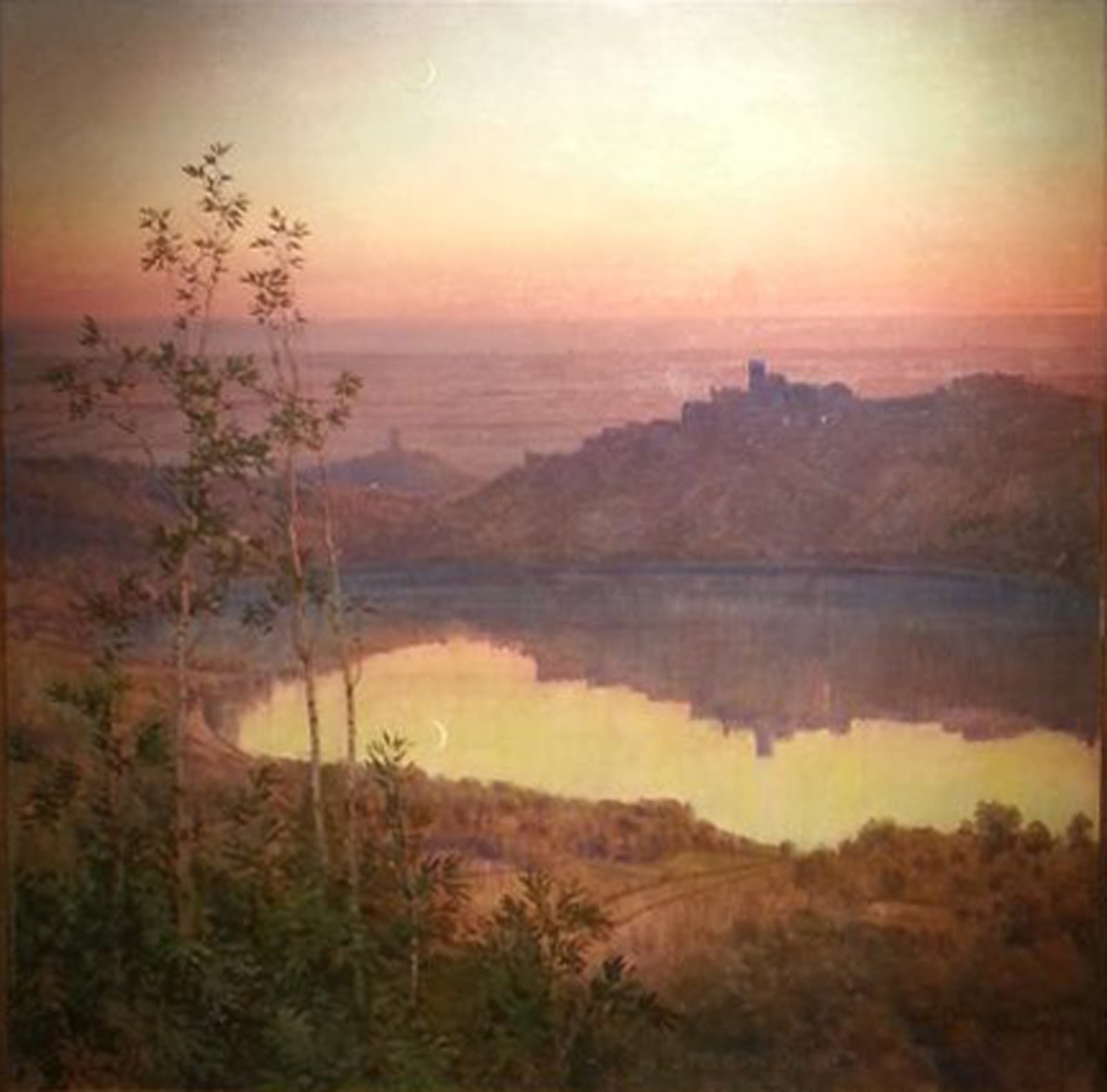
Art at top: Speculum Dianae by Enrico Coleman (1909)