Showing posts with label Shamanic dreaming. Show all posts

Friday, January 3, 2025

Meeting a Merlin of the Baltic


I
saw him again last night, in the twilight between awake and sleep. He first appeared as a giant dark eagle atop a conical hill, able to see across vast distances. He showed himself again as hybrid, eagle-man, and then as able to project the form of an iron wolf. Lyzdeika. I have not forgotten you. 
     Shall we recall our meeting at your birthplace in May, 2013? Here is my report of my quest for a Baltic shaman-priest:


The Shaman from the Eagle’s Nest

 On my second visit to Lithuania, I was taken to the old city of Kernave and shown a conical hill that was the reputed birthplace of a shaman-priest named Lizdeika. According to tradition, he was found, as a baby, in an eagle’s nest on that hill.  Lizdeika lived closed to wolves, and was reputed to be able to shapeshift into their form. He plays a central role in the unfolding of the most famous dream in Baltic history.
    Camped with an army near the present site of Vilnius, Grand Duke Gediminas dreamed of an iron wolf that howled. He consulted Lizdeika - by now the krivu krivaitis, or high priest of the old religion — on the meaning of the dream. Lizdeika told the grand duke he should build a fortified city on the hill where he had been sleeping. The city of Vilnius was founded because of this dream, and in front of the cathedral is a statue of Gediminas’ iron wolf.

 On my fifth visit to Lithiuania, several years later, I stood in the rain on Lizdeika’s green hill and asked for the blessing of the ancestors, in the midst of a circle of Baltic dreamers who were eager to reclaim the old ways. Kernave means Wet Place, setting a perennial weather forecast in a country whose name means Rain Country. We had managed to perform a traditional Baltic fire ceremony that morning, despite the unremitting rain, and I had been impressed by how greedily the fire spirits swallowed offerings of Lithuanian beer, the heavy, dark beer that is like liquid bread. Now I was drumming for our circle, to open direct communication with the spirits of this land. My personal hope was to make contact with Lizdeika. I believed I had dreamed of him, before this trip, as a Baltic Merlin whose story needed to be told.
     As soon as I tapped the drum, the landscape opened, to my inner eye, as if a zipper has been pulled from the zenith to the muddy path at my feet. I saw a windswept figure above me, at the top of the hill. He was a man wearing a feathered robe, or a bird the size of a man. I sensed his fierce determination. I understood that I was required to earn the right of entry into his realm. I must start, now, by disclosing my shamanic connections, by showing him that I was his peer. This was not so hard.
     I found I had at my left shoulder a kinsman in his own feathered cloak. It was raven black. I recognized the druid from fourteen centuries ago who had often been my companion, in my time and in his own. On my right side was a wolf pack. It seemed to have traveled here with me. I had been privileged, in this country of the wolf, to have enlisted the protection and guidance of the wolf family before, because of my connection with the ancient Mohawk Mother of the Wolf Clan. This soon proved to be extremely important.
     We were given a private tour of the archaeological museum of Kernave later that day. Kernave is an active site, with ongoing excavations. The museum director, who participated in my workshop, responded cordially to my request that she should tell us about unsolved mysteries that we might be able to investigate as dream archaeologists. 
     We heard a singularly creepy ghost story involving a mutilated corpse. On the night local archaeologists excavated a grave at the edge of the ancient burial ground, strange things happened. They had dug up the remains of a woman who had been decapitated. Her head had been buried face down in the earth. Her hands and feet had also been cut off and transposed. The archaeologists speculated that she was a witch who had been dug up and mutilated in this way to prevent her from going around bothering the living. There was a second theory; that her body had been hacked up this way to turn her into a cemetery guardian, a protector of bodies and souls and grave goods. That night one of the archaeologists heard rushing winds outside her tent on site. She went out to see the energy form of a giant stallion reared up on its hind legs. All the animals around went wild, dogs howling, birds screaming. All the archaeologists rushed out. What was going on that night? What had they released? They covered up the body in its original site.
     After lunch, I suggested to our group that we might use objects we had seen in the museum, as well as any impressions we had picked up around Lizdeika’s hill, as portals for a journey to encounter the spirits of the land and recover essential history. One of our explorers chose as her portal the skull of a princess that had impressed all of us. The princess had been buried wearing a diadem with symbols of a mother giving birth and the Tree of Life. In her journey, our dream archaeologist traveled through one of the eye holes of the skull and then looked out, through the priestess’ eyes, into scenes of her life and her world. Another brave explorer used the skeleton of a horse that had been buried alive at the center of a circle of human graves; it was buried standing, its neck and legs were broken. Another of our trackers chose to investigate the mystery of the missing swords; only one sword (and this just the hilt and pommel) was in the museum. I gently discouraged tracking the phantom of the mutilated corpse.
    My own intention for this expedition was to go back to the scene at Lizdeika’s hill when I saw the landscape opening as if it had been unzipped. After I began the drumming, however, I was distracted by the tale of the mutilated body and our discussion of the missing swords. I traveled rapidly through many scenes of violence from the past. I saw a duke hurrying down wooden stairs and ladders to fight or flee under sudden attack. I saw raganas, wood witches, as ancient masters of psychic warfare, creating Baltic versions of the golem to menace and terrify enemies. It seemed that they had used bodies like the one in the cemetery, rather than clay, in this cause. Some may even have worked with Kabbalists in times when the survival of the Lithuanian Jews was imperiled.
     I saw warriors and/or their weapons — swords and spears — and/or figures of wood or amber representing them planted vertically in the earth with the idea that in need they would spring from the ground, fully armed, to fight invaders.
      Now I was back at the place of Lizdeika. He stared at me from pale blue eyes. The human features around the eyes kept changing, and I became aware that he has occupied many bodies. Then the shape around the constant pale blue eyes became the head of a wolf. He really is a wolf as well as a man.
    He began running like a wolf, pelting across the landscape. I ran after him, adopting a similar wolf form. Then he rose from the ground and became a dark eagle. I became a bird and flew after him. There were several more animal transformations. Then he became a grass snake and slipped through a crevice among the rocks. I became a snake and slid through after him.
     We were now in a different space, a kind of sanctuary between the worlds. I felt the presence of one greater than him, a female presence. It came to me that as a wolf, he is subject to the Alpha in his pack, who is the She Wolf, the Mother of the Clan. They have relations in other forms, on other planes. He is linked to Menulas, the Moon God; she to Saule, the Sun Goddess. They seemed to enjoy my own encounter with Moon Man and Sun Woman in Paris.      It came to me that Lizdeika’s main obligations were not as counselor to dukes or high priest of the recognized pagan line, but to these hidden powers. What happened to the Lizdeika of history, who advised Gediminas? He had wanted his body to be left for the bird, up on a tree on the hill where he was found as a baby. But it was necessary to dispose of his body faster, because enemies — and maybe witches — were coming who would desecrate it or (worse) use it for sorcery. So he was burned and the ashes were dropped in the river. However, his vital soul was preserved inside a soul catcher, an amber whose natural shape resembled that as a man. It is from this container that he was able to enter and use successive human (and animal) bodies.
     I met a Merlin of the Baltic, neither good nor bad, just so, and — like the Merlin of my Celtic ancestors — never confined to one time, ever shape-shifting, through the stories he weaves and the stories that are woven around him.


Text adapted from The Boy Who Died and Came Back by Robert Moss. Published by New World Library. 


Photo: At the hill of Lizdeika, Kernave, May 2013. 


Friday, December 20, 2024

Active Imagination and Dream Reentry


By my observation, any image that belongs to us can be worked in the cause of healing and resolution and soul growing. I have seen wonders accomplished when a dreamer has resolved to confront an initially dark and terrible image and find the gift in the nightmare. The fiercest dragons guard the richest treasures, and to earn the support of greater powers we are required to brave up. I have also seen lives saved and visits to the ER avoided by getting back inside a dream, clarifying what is going on - and applying that information to avoid manifesting an unwanted future event that may be playing in the dream. This may require courage, and significant work.
     Jung said towards the end of his life that he did not want to spend time with patients who were unwilling to do the work of active imagination. His method of active imagination and my technique of dream reentry have much in common, including the recognition that “dreams are the facts from which we must proceed” and that the raw power of images coming directly and spontaneously to the perceiver must not be shackled to theory or rules of interpretation. Stay with the image, amplify it by tracking its parallels in mythology and folklore and other dreams, go back to the image and develop it through active imagination – these are three signature features of Jung’s approach to dreams, and I encourage active dreamers to practice all of them.  Amplification requires, as Jung insisted, a “wide culture”. Active Imagination, like dream reentry, may demand courage. I think of Robert A. Johnson, the author of Inner Work, a very readable introduction to Jung’s approach. He was terrified by a lion that appeared to him in his study. He knew the lion was a vision, but it was so real he could not bear to enter his normal place of work. After many efforts to reach an understanding with the lion through active imagination, he managed a deal in which the lion would appear as a statue like the ones in front of the New York Public Library, a statue holding a book.
     Our Active Dreaming approach goes to places that Active Imagination may fail to reach. By making a dream or another personal image the portal for a shamanic journey, often powered by drumming, we enter directly into the other worlds and other times where the dream action took place (and may have continuing to unfold after our attention moved elsewhere and we returned to our bodies wherever we parked them.).
     Active dreamers are more likely than most Jungians to seek clues to the future in dreams, to look at the possibility that a dream shows a future event literally or symbolically. He knew that we intuit the future – his own visions shortly before the Great War of a bloody floodtide drowning Europe left him no doubt about that -but he seems to have rarely asked whether a dream could play out in the future in everyday life despite his interest in “primitive” cultures and his familiarity with mountain peasants, for all of whom clues to the future, from a weather forecast to a death in the family,  were one of the main things to look for in dreams.
     Jung was a doctor who guided his patients through amplification and active imagination. I am a teacher who gives dreamers a process they can do by themselves or – if sociable – do with others, using a dream as a portal for an adventure in solo or mutual lucid dreaming.


Illustration: "Drumming for Dream Reentry" by Robert Moss

Wednesday, October 30, 2024

Reclaiming the Art of Dying


In most human societies, preparation for death and the afterlife is a central part of life. The practice of the ars moriendi  -the art of dying - does not reflect some morbid preoccupation. It is actually life-affirming rather than life-denying. By coming to know Death as a friend, you release the energy you have invested in trying to bottle up your darkest fears. When you establish for yourself — through personal experience — that there is life after life, you will find you take a more relaxed and generous view of the vicissitudes of everyday life. When you examine your life from the standpoint of your death, you will surely find that there is no reason to perpetuate old quarrels and jealousies. You will wish to put things right between yourself and others, to give up petty agendas and live fully and creatively for the years allotted to you.

In postindustrial Western societies, the neglect of the art of dying has led to a vogue for spiritual practices drawn from other traditions, such as Tibetan Buddhism, which offers a detailed geography of the afterlife that may or may not be relevant to you if you are not a Tibetan Buddhist. Our general neglect is fed by both fear and denial. The denial thrives on our hurry sickness, our tendency to fill up our time with compulsive, external activities — interspersed with infusions of passive consumer entertainment, IV-fed through the TV tubes — leaving no space for the inner search. Filling our lives with a bustle of responsibilities that leaves us with “no time” to commune with soul is mockingly described by a Tibetan master as “housekeeping in a dream.” Sögyal Rinpoche asks, “Would anyone in their right mind think of laboriously redecorating their hotel room every time they booked into one?

Our fear of death is bound up with our confusion about who we are. We fear losing all the props, connections, and résumés that we confuse with identity. We are terrified of being stripped of rank and title and credit cards and cell phones and being sent naked into the next world, as Inanna must descend naked into the underworld.

Your death is a rather important subject, not just the when and how, but the question of what follows, and what it all means. On a subject this vital and this intimate, you would be ill-advised to take answers on trust from other people. But how can we know before dying what lies on the other side, and know this as personal truth? In two ways: through a visitation by a resident of the Otherworld whose information can be verified; or by soul travel, by making a personal journey to the Other Side. My book Conscious Dreaming explores dream visitations by the departed. Here I want to suggest a variety of techniques by which you can embark on conscious dream journeys to explore the conditions of the afterlife for yourself.

An art of dying adequate to our needs and yearnings today must address at least these five key areas: 

        Practice in dream travel and journeying beyond the body. By practicing the projection of consciousness beyond the physical plane, we settle any personal doubts about the soul’s survival of physical death.

       Developing a personal geography of the afterlife. Through conscious dream journeys, we can visit “ex-physicals” — and their teachers — in their own environments. We can explore a variety of transit areas and reception centers, adapted to the expectations and comfort levels of different types of people, where the recently departed are helped to adapt to their new circumstances. We can tour the “collective belief territories,” some established centuries or millennia ago, where ex-physicals participate ins hared activities and religious practices. We can examine processes of life review, reeducation, and judgment and follow the transition of spirits between different after-death states. We can also study the different fates of different vehicles of consciousness after physical death.

      Helping the dying. The application of insights and techniques gained in these explorations to helping the dying through what some hospice nurses describe as the “nearing death experience.” In many of our hospitals (where most Westerners die) death is treated as a failure, or merely the loss of vital signs, followed by a pulled-out plug, a disconnected respirator, and the disposal of the remains. As we recover the art of dying, many of us in all walks of life — not only ministers and health care professionals and hospice volunteers — will be able to play the role of companion on the deathwalk, helping the dying to approach the next life with grace and courage and to make the last seasons of this life a period of personal growth. The skills required in this area include the ability to communicate on a soul level with patients who are in coma, are unable to speak or reason clearly, or have suffered severe memory loss. A vital aspect of this work is facilitating or mediating contact between the dying and helpers on the other side — especially departed loved ones — who can give assistance through the transition. Dreamwork and meditation are invaluable tools in helping the dying to prepare for the conditions of life beyond the body.

               Helping the departed. We pray for our dead in our churches and temples, and no good intention is ever wasted. However, you may have a hard time finding a priest who is willing to take on the role of psychopomp, or guide of souls, and provide personal escort service to spirits of the departed who have lost their way and gotten stuck between the worlds, causing pain and confusion to themselves and sometimes to their survivors. Yet the living have a crucial role to play in helping to release earthbound or troubled spirits. For one thing, some of these “ex-physicals” seem to trust people who have physical bodies more than entities that do not, because there is comfort in the familiar, because they did not believe in an afterlife before passing on — or quite simply because they do not know they are dead. An art of dying for our times must include the ability to dialogue with these spirits and help them to find their right path.

              Making death your ally. Finally, we are challenged to reach into the place of our deepest fears and master them: to face our own death on its own ground and re-value our lives and our purpose from this perspective. When we “brave up” enough to confront our personal Death and receive its teaching, we forge an alliance that is a source of power and healing in every aspect of life. We may now be able to carry a sense of divine comedy that can help us weather whatever life throws at us on a given day.


Art: "Storm Bird Brings Me Back" by Robert Moss


Text adapted from Dreamgates: Exploring the Worlds of Soul, Imagination and Life Beyond Death. by Robert Moss. Published by New World Library. Here you will find detailed practices and travel repots.


Sunday, June 9, 2024

Australian names of the shaman, and astral apprenticeship


Anthropologist R.M. Berndt visited the Menindee Aboriginal Station on the Darling River in New South Wales in 1943 and sat with two Wuradjeri elders who were willing to talk to him in detail about the qualities and practices of "native-doctors". Jack King belonged to the mallee hen totem, Joe Biggs to the bandicoot. Berndt's informants told him that you can always tell a medicine-man by the intelligent look in his eyes, and that great ones are enveloped in a peculiar atmosphere which causes people to feel different. In his lengthy field report Berndt noted that

"A Wuradjeri native-doctor was called wiri:nan ('powerful man') bugi:nja ('spirit' or 'spirit of the whirlwind') since it was the custom of his spirit-self to travel in a whirlwind; ki:ka:wi:lan, or more generally walemira, translated as 'the clever one.' The word walemira meant not only clever in the ordinary manner of speaking, but also intellectually clever, and having the ability, with the help of spirit and psychic agencies, to perform wondrous feats, the way in which these were carried out being incomprehensible to the lay observer.
He was also called walemira'talmai (i.e. "one to whom cleverness has been handed on" or "the passing on of cleverness") which refers to the 'power' which his forebears, through their own extraordinary capabilities and guidance, had passed on or handed down to him." Berndt observed that this language laid stress on the fact that "the initiation of the native-doctor was insufficient without the possession of that 'power' which had been derived from one's predecessors and which had its orogin in the far-distant past." [1]

The psychic power of the clever man "enabled him to thrust his mind forward into the future, into the spirit-world, or over great distances, purely for its own exercise.  With his power  he could know of some incident taking place a great distance away, at the very moment of its occurrence." [2]

The apprenticeship of a clever man began in early childhood, when the elders noticed signs of vocation - something in the eyes, dreams of the departed, how birds and bush animals behaved around the kid, lizard-quick intelligence and ability to disappear. By the age of ten, the apprentice's most important lessons were conducted in dreaming, through astral encounters with a clever man who agreed to play mentor and guardian. The guardian met the spirit (waranun) of the candidate and guided it on excursions beyond the body. One of Berndt's informants told him, "when the little fellow is asleep, the father [guardian, not necessarily a close relative] takes him every night; he has got to fix him up when the child is young. His spirit takes the spirit of the child and they go away together. Their bodies are still lying alseep in the camp." [3]

Preparation for the day when the guardian would sing one of his own spirit animals into the novice's body, joining the totem animal he had from birth. The spirit animal was visible to the receiver, who might see it being pressed betwen his ribs or into his abdomen. Master and novice could now go dreamwalking together in the form of their companion animals. 

The candidate was not yet a made man, a clever man. He would normally be between twenty and thirty years old when his guardian received a dream of calling on his behalf - a dream in which Baiami, a creation being who came from the sky and was regarded as the master of all master shamans, announced his will. Other clever men received similar dreams on behalf of postulants under their care. They met together in a special place and sang for Baiami to come out of the sky. The sky Ancestor showed himself, looking no different from other clever man except for the light that blazed from his eyes, and the sacred fluid (kali) that streamed from his mouth like liquid crystals to bathe all the candidates. As it dried, feathers sprouted from their arms, turning them into wings. 

One by one, they were called from the camp to meet Baiami up close. He gave them flying lessons. He performed shamanic implant surgery on them. He sang crystals into the third eye, so they could see inside things and across any distance. He sang fire into their chests. 

Back at the camp, they each had a magic cord, probably made from human hair (Berndt does not say) twisted around their necks, ends touching their feet. The cord was sung inside them. They learned to let it out, like a snake, and shoot it in any direction like a spider's webbing thread. On nights when there was no important clever work to be done, they could show off by seeming to walk on air, with the cord stretched invisibly between trees.  [4] Not for show was how they might use it as a psychic lasso.

Berndt observed that among the Wuradjeri there were "clever women" as well as "clever men". He stated that their roles appeared to be more restricted but then there were no doubt aspects of a female shaman's business a male white anthropologist was not permitted to see.


1. R.M. Berndt, "Wuradjeri magic and 'clever men'" Oceania vol. 17 no.4 (June, 1947) 331-2..
2. ibid, 331. 
3. ibid, 333.
4. ibid, 342 


Top: Satellite photo of Menindee Lakes. It looks so much like an Aboriginal painting that you might wonder whether some of those artists rendered landscapes they had seen in ecstatic flight. 
Botton: Eastern barred bandicoot by John Goold.

Sunday, April 14, 2024

Shamanic Lucid Dreaming


I have reservations about the term "lucid dreaming" because it has been associated with notions of "controlling" or "manipulating" dreams. Through dreaming, we have access to a source that is infinitely wiser and deeper than the everyday ego, and we want to be available to that source. I am in favor of learning to choose where we go and what we do in dreams, as in waking life, but that requires discernment, not the fantasy of control. 

Another problem I have with the term "lucid dreaming" is that it is most often associated with techniques for waking yourself up to the fact that you are dreaming while you are asleep. This is a valuable skill, especialy when it enables you to choose how a story is gong to devleop and the role you will play, exercise your cretaive imagination, dialogue with dream characters and gather and retain detailed information you can bring back. However, the easiest way to become a lucid or conscious dreamer is to start out lucid and stay that way: in other words, to enter conscious dreaming from a waking or semi-wakeful state.  

I titled my first book on all of this Conscious Dreaming. My preferred name for what I teach and practice is Active Dreaming. As the phrase suggests, we can be active in embarking on conscious adventures in dreaming, and we want to be active in bringing the energy and insight of our dreams into waking life.  

Since I am often asked whether Active Dreaming is a mode of lucid dreaming, I am going to borrow a phrase employed by one of my friends in the lucid dreaming fraternity who refers to my "shamanic lucid dream adventures." I am using the adjective "shamanic" here to describe a method for shifting consciousness to enter nonordinary reality for purposes that include the care and recovery of soul.  

How do you become a shamanic lucid dreamer? You start out conscious and you stay that way. To accomplish this, you only need three things: a clear intention, an image that can serve as a portal, and a means of focusing the mind and fueling the journey. All these things can become available naturally, in the twilight zone of consciousness that researchers call hypnagogia. You are between sleep and waking. Images rise and fall in your mindnd any one of those images can become the gateway for a conscious dream adventure.  

I somertimes find that I am able to maintain continuity of consciones through all the phases that evolve from this liminal stage. I will add that I find the twilight state between sleep and awake in the morning tat sleep reserachers call the hypno[pompic zone particularly propitious for conscious edream adventures and lucid enciunters with inner guides and transpetrsonal visitors. 

An equally simple and natural way to become a shamanic lucid dreamer is to use a remembered dream as the portal for a journey. In your night dream, you went to a place, which may resemble a site in ordinary reality or may be a locale in a separate reality where the physics are utterly different. Either way, because you were in a certain place, you may be able to find your way back there, just as you could return to a house you once visited in regular life. 

 Why would you want to do this? Maybe you've been running away from something in your dream world that scares you - from the Bear, or the Tiger, or an unknown intruder or pursuer. If you can find the courage to go back inside one of those nightmares and face what frightened you on its own ground, you may find power and healing waiting for you on the other side of the terror.  

You may want to go back inside a dream because you were with your dream lover in a tropical paradise but were interrupted by the alarm clock. You may want to talk to someone who appeared to you in a dream. You may need to clarify whether that auto accident could take place in the future, as either a literal and symbolic event, and what you need to do with that information (once you have it clear) in order to avoid an unwanted development. You may simply want to know more about a dream. The best way to understand a dream is to recover more of the experience of the dream. A dream experience, fully remembered, is its own interpretation. 

 Through the technique of dream reentry, you can pursue any of these agendas, or simply enjoy the fun and adventure of using a personal dream image as a portal to the multiverse.  

The best time to attempt dream reentry may be when the dream is fresh and you are still closely connected to it, lingering in bed after waking. But if the dream has energy for you, you can go back inside any time, even decades after the original dream.  

Shamanic drumming - a steady beat on a simple frame drum, typically in the range of three to four beats per second, but sometimes faster - will help you to shift consciousness and travel into the dreamspace. The steady beat helps to override mental clutter and focus energy and intention on the journey. The rhythms of the drum correspond to brain wave frequencies in the theta band, associated with the hypnagogic zone and its dreamlike imagery. If you want a physiological explanation of why shamanic drumming is such a powerful tool for shifting awareness, you could say that the "sonic driving" of the drum herds our brain waves into the theta band, opening us to its characteristic flow of imagery. I have made my own recording of shamanivc drumming specifivcally for shamanic lucid dreamers.  

The drumming will also help you to synchronize and focus shared adventures in dream travel. You can invite one of more partners to journey with you through the portal you have chosen and act as companions and trackers who can support you and bring you extra information. In my workshops, we frequently have 30 or more active dreamers traveling together on group adventures of this kind. Often we keep group logs, and you can read samplings from these in my book Dreamgates and in the epilogue to Dreamways of the Iroquois, where I describe how I led a group of frequent flyers on a group journey to meet the shaman-priests of the Kogi, on their sacred mountain, at the invitation of a Kogi elder. Through such experiments, we assemble truly scientific data on the reality of the dreamworlds, and what is possible within them.  

Shamanic lucid dreaming is an adventure in navigating the deeper reality that we can share with a partner, with a group, or a whole community. A caution: the side-effects may include transformation.


Journal drawing by Robert Moss: "How It Will Begin"

Friday, February 16, 2024

Location, location, location - and other keys to dream reentry


The realtor's familiar slogan applies to the technique of dream re-entry as well as the property game. The easiest way for you to back inside a dream is to hold your focus on the dream location. Your initial memories may be fuzzy, but a single landmark - even a single shape or color - may be sufficient to enable you to shift your consciousness into a vivid and complex scene.


Be open to possibility! The geography of the dream world is not that of the Times atlas or the Mobil guides. In dreams you may find yourself in familiar locales, including places from your past – Grandpa’s place, or your childhood home – that may or may not have changed. You may also visit unfamiliar but realistic locations, often clues that your dream contains precognitive or other “psychic” material. You may find yourself in scenes from a different historical epoch (past or future), in a different galaxy, in otherworldly locales, or in free-flowing situations where nothing conforms to the supposed laws of the physical world. One of the purposes of dream reentry is to establish where in the worlds you are. The typical dreamer, after waking, has no more idea where he spent the night than an amnesiac drunk.

The best time to try to reenter a dream is often immediately after you have come out of it. By snuggling down in bed and rehearsing the postures of sleep, you may be able to slide back into the dream in a gentle and natural way. But your work schedule may not allow you leisure to do this. And if your dream contains deeply disturbing material, you may need to wait until you are ready to deal with it. You may also feel you need the support of a partner or a drumming session.

But here is a simple technique for dream reentry you can use in the privacy of your bedroom or easy chair:

1. Find your question. What is your main question about the dream you wish to explore? Try to formulate that question as clearly and successfully as possible. Write it down. This will help to establish your focus. During your exploration, you will use this question like a flashlight or a miner’s lamp. It might be quite specific, or as general as, “What is this dream telling me?”

2. Focus on your target. Summon back as many details of your dream location as you can. This is the scene you are going to reenter. Maybe you have multisensory impressions of it. How does the air feel? What can you hear? Are there any distinctive smells?

3. Ask yourself who or what inside the dream can best answer your question. When you reenter the dream, you may be able to communicate directly with one of your dream figures.

4. Relax. Get into a comfortable position, sitting or lying down. Take some deep breaths. Breathe in through your nose, out through your mouth. As you exhale, try to release any pain or tension you are holding in your body and wish it outside your space. You may find it helps to count yourself down – from twenty to one – as you let your consciousness slide toward your selected locale. Or you may wish to put on meditation music or a drumming tape.

5. Move into your dream locale. Look around carefully to identify exactly where you are. You may notice many details you forgot or overlooked before. Do you know this place? Do you feel you are inside a scene from another time, or another order of reality?

6. Let the action unfold. Don’t interfere with the spontaneous flow of images. You have full power to choose how you will interact with your dream characters and respond to any challenges that are presented to you. Your dream reentry may take you beyond the point at which the original dream ended; if the first dream was unresolved or aborted, this is part of your design. Your new dream may also introduce characters and events that were not in the original dream. This is fine; your underlying purpose is not to reproduce the earlier version, but to move closer to the source from which dream images flow.

7. Dialogue with dream characters. You may find a dream character who can answer all your questions. Your selection is not confined to humans. Dreams are full of “persons other than human” (to borrow an Ojibwa phrase). There is no such thing as an inanimate object in dreams.

8. Expect the unexpected. Because the dream source is wiser than the ego, it may be telling you something more important than the question you decided to ask.

9. Map your journey. Pay attention to how you return from the dreamscape, as well as the paths you took through it.


Text adapted from Conscious Dreaming: A Spiritual Path for Everyday Life by Robert Moss. Published by Three Rivers Press.

Thursday, January 11, 2024

Open Secrets of the Dreamtime


Here are the open secrets of the Dreamtime, insights shared by many dreaming traditions and indigenous peoples that challenge the ruling paradigms of a culture that confuses the real with the physical. 

1. Dreams are real experiences.

There are big dreams and little dreams. “Bottom-line it for me,” bulled a radio host over the phone from North Dakota. “Aren’t dreamed caused by spicy pizza?” Well, yes, some dreams are. But we will not expend much space here on the surface bubbles of the dozing brain and belly.

In big dreams - in what Sri Aurobindo called “the sleep of experiences" - we are dealing with events, encounters, and challenges that are entirely real on their own level of reality. Our dream memories may be garbled or muddy, but the dream is a real experience whose meaning lies within the dreamscape itself. The dream experience, fully remembered, is its own interpretation. But we must do more than interpret dreams; we must manifest their energy and insight in our waking lives.

Shamanic dreamers tend to be quite literal-minded about dreams. If you dreamed you fell off a rock-face, you’d better remember to check your safety harness if there is any chance you might go rock climbing. If you flew with the eagle, you discovered a powerful spiritual ally — and your own ability to transcend the limitations of your physical body. If you dreamed of your dead uncle, before you start asking yourself what part of you he might represent, you should consider the possibility that you had a visit with him. Is he bothering you — maybe trying to cadge a drink or a smoke — or offering you help? If you dreamed you received instruction at a mountain shrine, you should be open to twin possibilities: that you may go there someday, in physical reality; and that you may have been called in your dreams to one of the many “invisible schools” where training and initiation on the higher planes are conducted.


2. Dreams are flights of the soul.

During one of the final presentations at a hectic conference in Berkeley, I regretted that I had not taken that Saturday morning off to explore the Bay area. I closed my eyes, slipped free from my physical focus, and felt myself gliding over the Bay on the wings of an eagle. It was a wholly tactile sensation. I was drawn to a wild, lightly wooded area with intriguing stone formations that looked from the air like volcanic rock. As I dipped into a fold in the hills to examine the area more closely, I saw another interesting formation, shaped by human hands: a circular labyrinth, or spiral, at the edge of a pond.

At lunch, I casually described the scene I had explored. “It could be the Sibley Volcanic Preserve,” one of the local conferees piped up. “I can take you out there this afternoon if you have time.” She did not know about the spiral path, but we found it fairly easily, at the edge of a swampy pond.

From a shamanic perspective, there was nothing extraordinary about my experience. It was just a routine scout — a Middle World journey — in which I moved beyond the range of my physical senses to check out my environment. I was traveling beyond my body, but I kept a firm connection with it, maintaining awareness of the activity in the lecture room even as I flew across the Bay.

Shamanic dreamers say that in real dreams (waking or sleeping) one of two things is happening. Either you are journeying beyond your body, released from the limits of space-time and the physical senses; or you receive a visitation from a being — god, spirit, or fellow dreamer — who does not suffer from these limitations. In the language of the Makiritare, a dreaming people of Venezuela, the word for dream, adekato, means literally a “flight of the soul.”

The open secret is that consciousness if never confined to the body and brain. We discover this in spontaneous night dreams and intuitive flashes, when our left-brain inhibitions are down. As we become active dreamers, we can hone the ability to make intentional journeys beyond the body at any time of day or night.


3. You have a dreambody as well as a physical body.

I am leading one of my Active Dreaming circles. We are squatting around a centerspread with a white candle. Someone asks whether there is any way to prove that we are not dreaming. I pick up the candle and pour hot wax onto my hand. I feel a sting of pain as the wax sears the web of skin between my thumb and forefinger, and I tell the group, “I guess that proves I’m not dreaming.” Then I wake up.

What is this dream telling me? That I am a nitwit because I can’t tell whether I’m dreaming? If so, I will take solace from the fact that in most sleep dreams, most people are completely unaware that they are dreaming. Actually, I think this dream has a more interesting and specific message, related to the theme that dreams are real experiences. In my dreambody, I can know pleasure and pain just as vividly as in my physical body. I have more than one body, or vehicle of consciousness, and when I go into the dreamworld and other worlds, I go embodied. And so do you.


4. Dreams may be memories of the future.

I dreamed of a silly little dog decked out with fake antlers for some kind of Christmas pageant. The dog ran out on the road and was killed, but was magically revived by a dubious, utterly amoral character who seemed remote from the normal range of human emotions.

The dream had a movielike quality. I had no idea what was going on here, but because I had no particular feelings about it, I was content to record it in my journal before rushing off to the airport to catch a plane to Denver.

I missed my connection and later found myself on a different flight form the one schedules. Whenever my travel planes come unstuck, I am alert for the play of the Trickster. On the “wrong” plane, I found myself seated next to a woman who turned out to be best friends with a person in publishing to whom I had been introduced only the day before, and I was able to glean some useful insights. Our conversation was interrupted by the screening of the in-flight movie. I looked up to see a silly little dog decked out in fake antlers for a Christmas pageant. Later in the movie, the dog is killed on the road and magically revived — by a low-flying angel portrayed by John Travolta. The title of the movie is Michael, and I highly recommend it. What interested me most was that I seemed to have attended an advance screening in my dream the night before.

We dream things before they happen in waking life. If you work with your dreams and scan them for precognitive content, you can develop a superb personal radar system that will help you to navigate in waking life. You can also learn to fold time and travel into the possible future by the methods explained in this book. For even the most active dreamers, however, the meaning of many dreams of the future may be veiled until waking events catch up with the dream.

If dreams are memories of the future, is much of waking like the experiencing in the physical body what we have already lived in the dreambody? What would we become if we participated more consciously in this process? There is an Iroquois story of a great hunter who always scouted ahead, in conscious dream journeys, to locate the game and rehearse the kill. In one of his dream scouts, he located an elk and sought its permission to take its life to feed his extended family. He killed the elk in his dream and noted the red mark on its chest where the arrow had gone in. The following day, he walked to the place he had visited in dreaming and identified his elk by the red mark on its chest. He then replayed an event that had already taken place, by killing the elk again with a physical arrow.


5. Dreaming, we choose the events that will be manifested in our waking lives.

The fact that we dream things before they happen does not mean everything is predetermined. People who are not active dreamers can get quite confused about what is going on when they wake up to the fact that we are dreaming future events, both large and small, all the time. I think it’s like this. If you do not remember your dreams, you are condemned to live them. (If you don’t know where you’re going, you will likely end up where you are headed.) If you remember some of your dreams and screen them for messages about the future, you will find yourself able to make wiser choices. You will discover that by taking appropriate action you can often avoid the enactment of a “bad” dream or bring about the fulfillment of a happy one. As you become a conscious dreamer, you will find yourself increasingly able to choose inside the dreaming the events that will be manifested in your waking life.

It’s not about predestination. It’s about the spiritual secrets of manifestation — and your ability to become cocreator of your life.

Meister Eckhart tells us how it is the razor-sharp clarity of the practical mystic who has seen and experienced for himself: “When the soul wishes to experience something, she throws an image of the experience out before her and enters her own image.”

Indigenous peoples tell a recurring story of how the material world is spun from the dream of a deity. For the Guajiro, the physical universe is the product of conscious dreaming. The Guajiro say that the Creator-god made this world after the divine Dreamgiver, Apusanai, made him aware that he was dreaming and he began to experiment with molding and solidifying the fluid forms he perceived endlessly aborning and transforming on another plane of reality.

It is not merely that we dream things (maybe everything) before they happen; dreams make them happen.


6. The path of the soul after death is the path of the soul in dreams.

Your dreambody does not die when your physical body loses it vital signs. You will live on in your dreambody for a shorter or greater time, according to your ruling passions and personal evolution. You will find yourself, as you do each night in dreams, in a realm where thoughts are things, and imagination, the great faculty of soul, can create whole worlds.

You come from the Dreaming, and you are released into the Dreaming when you drop your sack of meat and bones.

In a dream, I found myself walking in a pleasant cemetery. A voice said, "You must prepare your Houses of Death". I looked and saw brightly painted cabins. I chose one - blue with yellow trim - and stepped through the door that opened for me. There was no wall on the far side. The view was of a lovely cove with a white sand beach, A beautiful dark-skinned woman in a sarong was in the water beckoning to me.

I waded out to join her. She handed me a conch shell. When I held it to my ear, I received instructions for making a crossing an island that now appeared shimmering on the horizon. I understood that I had been given a departure point for a voyage to the Other Side. I have returned to that scene often, in lucid dreaming. I would not be surprised to find myself there again when it is time to leave the body behind.

Dreaming with growing consciousness is excellent preparation, not only for the challenges that lie before you on the roads in this life, but for the challenges of the journey you will make after physical death. How do you know for sure? By doing it.


Text adapted from Dreamgates: Exploring the Worlds of Soul, Imagination and Life Beyond Death by Robert Moss. Published by New World Library


Art by Robert Moss: "You Must Prepare Your Houses of Death"

Thursday, June 22, 2023

Called by Sea Eagle


In traditions where the importance of dreaming is understood, the right dream may be your price of admission to the good stuff.
   It is common in Tibetan tradition for spiritual teachers to ask students to bring them a dream to determine if they are ready to receive important teachings. A student without a dream is regarded as blocked and possibly unclean. He is required to undergo purification and perform practices to reopen his connection with spiritual allies. He is not allowed to continue his studies until he can produce the right dream.

    Tenzin Wangyal Rinpoche gives a personal example, from the time of his training with Lopon Rinpoche, in his book Tibetan Yogas of Dream and Sleep. The story is doubly interesting because it involves long-range dream precognition. At 13, as a student, Tenzin dreamed he was handing out slips of paper with the Tibetan syllable A written on them to people boarding a bus.    
    He brought this dream to his teacher, who did not comment, but allowed him to proceed to a further level of instruction. Fifteen years later, waking events caught up with the dream. Invited to travel to the West for the first time, Tenzin found himself assigned to hand out slips of paper with the Tibetan syllable A on them to people boarding a bus. These were to be used in a meditation exercise.
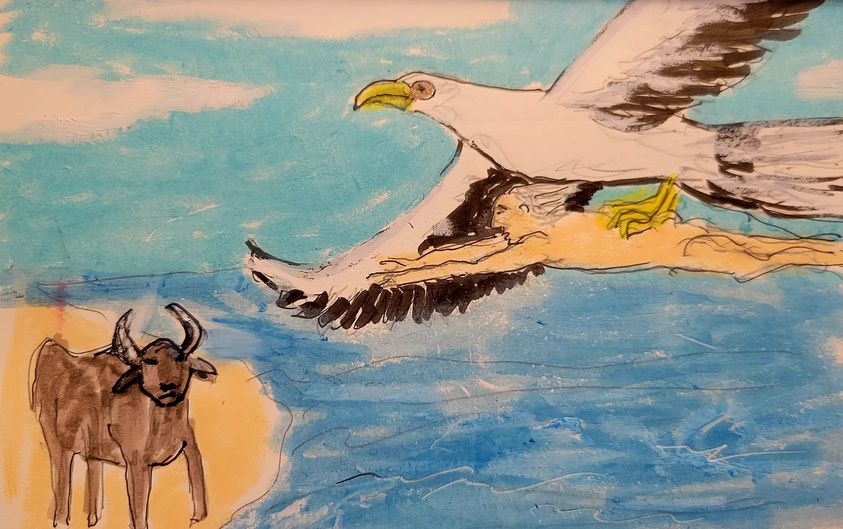
    In 1994, a dream proved to be my admission ticket to the Dreaming of an Aboriginal people in my native Australia. In a lucid dream, starting in the drifty liminal state in the middle of the night, I was joined by a giant sea eagle, an aquatic raptor native to the north-east coast of my native Australia. The sea eagle carried me across the North American continent, then over the Pacific to a reunion with my mother at her home in Queensland. We had been having some difficulties and I wanted to leave the dream excursion at this point to call her.
    However, sea eagle had other ideas. It flew me on , into the hinterland, to meet another animal power: a huge water buffalo. I remembered the water buffalo, too, from boyhood. It had been central to a terrifying shamanic initiation, in another spontaneous lucid dream.
     The bull escorted me to a muddy creek. Something immense was thrashing and rising from the waters. Nearby were Aborigines painted for ceremony. An elder told me, "This is the first of all creatures. This is the beginning of our world."
    When my mother died suddenly, three months later, I was grateful that the dream had prepared me for this event, through our loving exchange in the dream itself, and by how it inspired me to reach out to her and heal some misunderstandings.
     I flew back to my native country. After the funeral, I went "walkabout" for a few days, and found myself at an Aboriginal housing co-op in a dusty town in the hinterland called Beaudesert. When I started talking about dreams, I was told I needed to talk to Frank. Who was Frank? "Oh, he's our spirit man." Frank's place proved to be three days bush walk away, so this lead seemed like a non-starter.
    But Frank walked in as I was getting ready to go; shamans are tricky. He invited me down to the pub to talk. He sipped orange juice and sniffed me, literally, checking if I was another white fella trying to rip off his people yet again. Then I told him the dream. His manner changed radically. He sat very still, his eyes blazing like fire opals.
   "Oh, I guess you've come to me for a reason, mate. You've just told me the start of the creation story of my people, the Mununjalli, as it is told to made men. That thing you saw in the water was the bull eel. We say it is the first of all creatures."
    Yet a dream had taken me deep inside the Dreaming of an ancient and indigenous people. Because of my dream, Frank volunteered to show me the place of the Bull Eel Dreaming. Skirting quicksand and snakes, after many hours I found myself on the bank of the muddy creek from my dream. No bull eel in evidence that day, which was fine with me.


Many years later, I heard from a Kukatja grandmother that "a dream is when the spirit goes on walkabout." I know this is exactly right. 


A fuller version of this story is in the Introduction to my book Conscious Dreaming.

Drawing: "Flight with Sea Eagle" (c) Robert Moss

Thursday, March 30, 2023

Feeding Tiger, Meeting Puma


The wheeling of the stars is not infinite
And the tiger is one of the forms that returns.

- Jorge Luis Borges


In the early days of my public teaching, many people said they came to my workshops because they had dreamed of tigers. One woman dreamed again and again that she was searching in a forest for a white tiger. A man arrived at the arts center where I was then teaching and froze in the doorway, staring at the artifact I had placed at the center of our space. It was the carved head of a tiger, open-jawed, set atop a wooden staff hung with bone rattles. An artist in Colorado had started carving the head shortly before he met me, guided by a dream. After he met me, he dreamed he should set the head on a rattle-staff and give it to me. The man in the doorway at the arts center exclaimed, “I know I’m in the right place! This is my dream.”
     “For more than a year,” he explained, “I was hunted by a tiger in my dreams. I kept running away, and usually woke myself up, still terrified, trying to convince myself this was only a dream. Then the tiger was on me, snarling and snapping, and I could not get out of the dream. He drove me down a dark forest trail. I saw things there that scared me, huge snakes hanging from the trees, savage eyes in the shadows, but nothing was as scary as the tiger. He kept on me, tearing my clothes and flesh.  I was bleeding when he forced me to the edge of clearing in the jungle, where he licked my wounds. I saw he had brought me to a place where jet fighter pilots were being trained. They had been waiting for me for a long time. I went through the training and got my wings, all before breakfast back at home. I felt really good, and empowered to do stuff to help and protect other people. That’s why I came to you.”
     I loved this dream resolution. I know, as young children know, that the tiger is power that can indeed help and protect. In soul recovery work, the tiger – as well as the bear – has often been my ally in persuading lost boys and lost girls to return to an adult self from whom they separated because of pain or abuse or trauma in early life. Those child selves often trust the tiger more than the adult, to keep them safe and to make life crazy fun.
     The tiger must be gentled to purposes of this kind. The tiger must also be fed. For six weeks, in the late 1990s, I decided to go vegetarian. Towards the end of this experiment, I visited a zoo south of Montreal with my family. I was edgy as we neared the big cat enclosures. Though the zoo was well laid out, with space for the animals to roam, big cats do not belong in confinement.
I glanced through the bars at a group of Sumatran tigers dozing in the sun.
    “Look, Dad!” my youngest daughter exclaimed. “That one is looking at you.” I looked again and saw that a male tiger had sat up and was staring at me. Suddenly he bounded from the slope where he had been napping to press his face against the bars, still staring at me. I returned his stare, wondering if he felt – as I did – that we were kin.
     He sniffed me, gave a kind of shrug, and loped back up the hill to resume his nap. I got the message. He may have considered the possibility that we were related, but one whiff on my body scent had assured him we were not. Tigers are not vegetarians.
     I returned to eating meat – starting with bacon, of course, the vegetarians’ favorite kind – and one night the tiger returned to me. Reclaiming his power was not easy. I learned again that night that there is a price for gaining and maintaining a relationship with a true animal power. The tiger irrupted into my space that night as an energy form that was entirely real, more real than the darkened room around us. He made me fight with him, hand to claw. Few, if any men, could hold their own in a wrestling match with a tiger, and I was certainly not one of them. He made me fight long and hard, until I was bloodied and torn. Then, relenting, he gave me a harder assignment than combat. He told me I must eat his heart. He opened his chest, and I took out his steaming, beating heart, dripping blood. Half-gagging, I forced myself to eat the tiger’s heart. This felt exactly like eating the living organ.
     From that time, the tiger was with me again, available whenever  I needed his help. He was ready to yield pride of place to other allies, like the bear, when their talents were needed, and even to introduce new helpers. When I landed at Cuzco in Peru in 1999, I was cautioned to be careful to avoid altitude sickness. Our guidance was to take this slowly, and relax in the hotel lobby for an hour with some coca leaf tea. It was stressed that the tea would calm and strengthen us but was unlikely to have hallucinogenic effects because the coca content was so small.


I did not regard what I saw in that hotel lobby, beyond the comings and goings of tourists and staff, as a hallucination. I saw the tiger, moving in front of the desk and a wall covered with murals with Incan themes. He was a translucent form. He signaled to me that I was going to need help up here in the Andes, and that he would send the right helper to my room that night. I should make myself ready.
    Near midnight, in my hotel room, I lay on my back on my bed, looking out the window at a night full of stars in constellations whose names I did not know, or recalled only vaguely from my childhood in the Southern hemisphere. I felt an urge to go flying up among those stars, and to bring back their names, and something like a grid opened in my perception, inviting me to go through it. My body started to vibrate and I heard the kind of humming I had long associated with the run-up to conscious astral projection. An instinct of caution was still with me. Was it really safe to leave my body in an environment I had not yet tested, without defenses?


      My thought flow was interrupted by the very palpable sense of another presence in the room. I sat up in bed and saw the energy form of a big cat approaching me. As my senses adjusted, I saw it was a puma. I was certain that this was the ally the tiger had promised to send. The puma pressed its face against mind. It spoke to me, mind to mind, in words I can transliterate like this:
      “Big cats are not intended to live at these altitudes. We took millennia to adapt, following the game animals up the mountains. You have just arrived and have not time to make the necessary adaptations. So what you need to do is this. You need to open yourself at your solar plexus and let me in. I will help adjust your body systems so you will be at home in the Andes, as we are.”


      I did what the puma suggested without hesitation, since this new helper had come with the right introduction. I felt the energy of the mountain cat streaming through my blood, toning my muscles, flexing my sinews. Over the ten days that followed – though I am not athletic and do not work out – I was the fittest member of our party. I had no difficulty with the altitude,  no fear of heights, no shortage of breath.
     Tiger is not only a fierce but reliable friend. He is willing to share his whole tribe.


Text adapted from The Boy Who Died and Came Back: Adventures of a Dream Archaeologist in the Multiverse by Robert Moss. Published by New World Library.

Drawings (c) Robert Moss