Showing posts with label soul retrieval. Show all posts

Tuesday, May 27, 2025

When Her Husband Saw His Own Soul


After the Danish explorer Knud Rasmussen had lived for six months with the Netsilik Inuit, some of his hosts opened up about their dreams, their shamans and their sacred stories. The stories were only told to the right person at the right time, because, Rasmussen noted, “all that is described in them did really happen once, when everything in the world was different to what it is now. Thus these tales are both their real history and the source of all their religious ideas.” [1]
      Over long nights by the fire in an ice hut or a tent, the women were especially loquacious and some were formidable. Nalungiaq, a Netsilik woman, was married to her third husband, who had killed her second husband, who had killed her first husband, all from the desire to possess her. She described a time when there was no time, when the world was dark and there was no difference between humans and animals; they could take each other’s forms.
      She spoke of how the dead are alive in dreams. “We believe that dead people whom we see so vividly in dreams really are alive. In that way dreams have taught us that people live on after death. For very often our dear departed come to us while we sleep, and we see that they live, and that they are the same as when they lived together with us on earth.” [2]
      Rasmussen heard many stories of how souls wander beyond the body, and sometimes get lost or stolen, which is when the services of a shaman, an angakok. may be required.
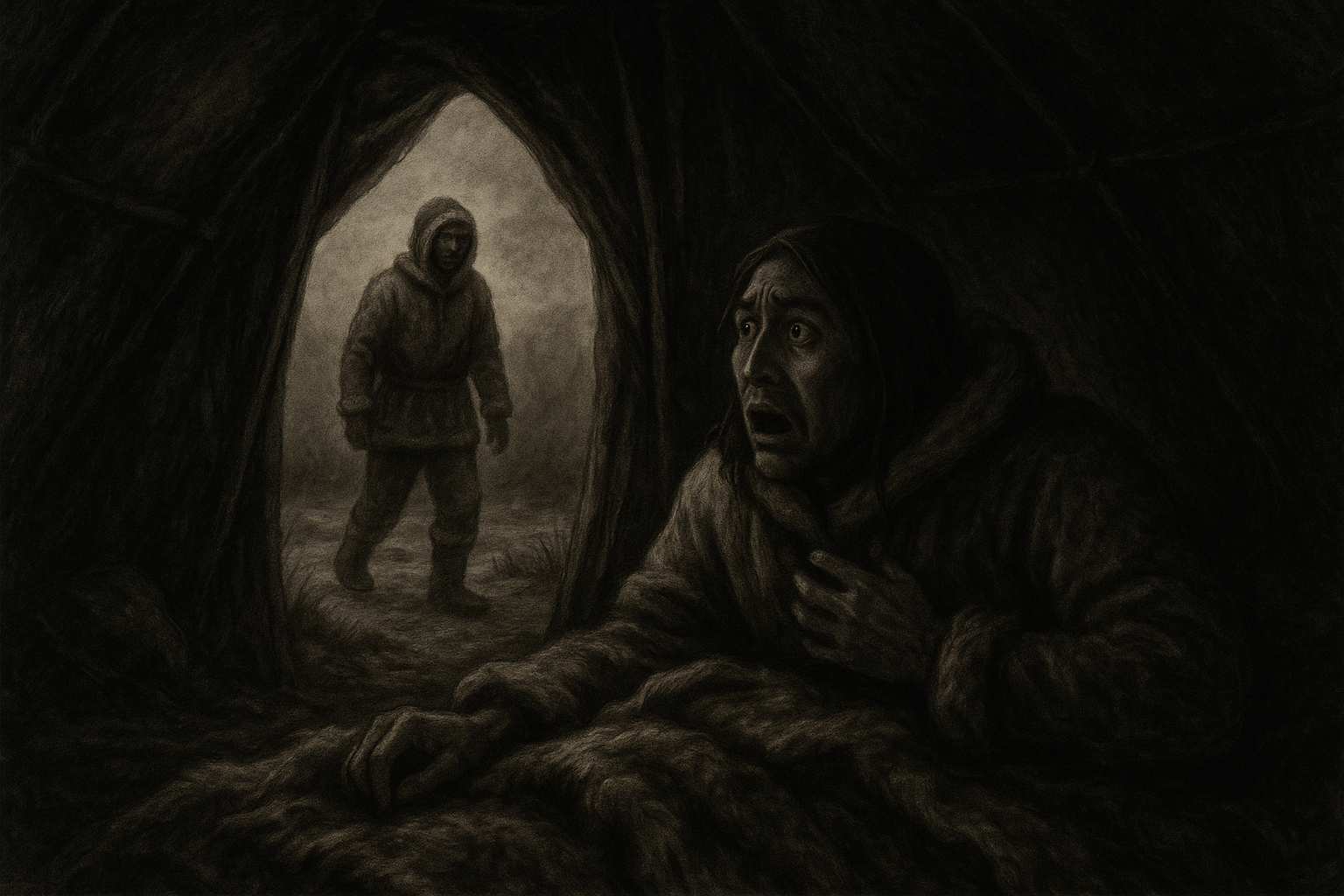
      Manelaq, the wife of Qaorssuaq, told how her husband once saw his own soul, wandering apart from his body, and where this led. Qaorssuaq had lain ill for a long time, and no one could understand what was wrong with him. Then one day, he saw "his own living self" a little way away.
      "No one else could see him. Seeing himself suddenly outside his own body he began to shiver all over. What he saw was his own soul, and it was owing to his illness that it had left his body. All trembling he stretched out his arms towards his soul and cried: 'Come nearer, come nearer. Come to me, come back to me!'
       " I could not understand what was happening to him and had to hold him by the hood when he kept on trembling. At the very moment I took hold of him the vision disappeared, but the soul did not return to his body. It had fled just at the moment it was perhaps on its way back to his body, for I was unclean and just in those days had my bleedings, and therefore the soul fled from me."
       Help came in the form of a couple who were both shamans. "When they heard what had happened, they insisted that 1 should go into a corner of the -tent, right over behind the fireplace; there I had to lie with my head hidden in a heap of caribou bones. While I remained concealed there, the two shamans conjured and summoned their helping spirits. They held a great seance in order to call the soul back to Qaorssuaq's body. And it was not long before he again saw his soul.
       "The two shamans, to whom nothing was impossible, could see it too. They uttered magic words and spoke with their helping spirits' own tongue until the soul came quite close to Qaorssuaq. Then they suddenly sprang to him and began to beat him here and there on his body, the consequence being that the soul was frightened and became so scared that it slipped into Qaorssuaq's body once more.
       "At the very same moment he was well again and I could hear him shouting and singing with joy. Only then did I venture to rise from the heap of animal bones where I had hidden my head till then, and we all sang with happiness. In that way Qaorssuaq got his soul back again." [3]
      It may seem odd that the vagrant soul was induced to get back in the body rather than go further away when the beating began, but it seems the shamans knew what they were doing. The magic words were certainly an important part of their operation. Inuit shamans have special language to do special things. Rasmussen later recounts a story of how magic words were used by an angakok to create a kind of Inuit golem , turning a neap of snow into a black bear. [4] Calling up helping spirits is central to Inuit shamanic practice, as in other traditions. An Inuit name for a spirit helper means "one that exists to be questioned" and the variety of entities that may play this role can be startling. Rasmussen mentions one shaman whose helping spirits included the moon, a sea scorpion, and one of his father’s living dogs. [5] 
     Inuit shamans were unwilling to share much of their training and practice with an outsider, and some told Rasmussen that the great shamans were no more; their tradition was in deep decay. Nonetheless, he was able to report how Inuit shamans are often called by the spirits in dreams. were prolific dreamers and "lived long in a dual world as real shamans must do". In the shaman’s calling, the spirits took the initiative, in dreams. If you could retain your dream experiences and apply them to the world around you, you had keys to mysteries impenetrable to others. [6]
     Rasmussen collected stories of shamanic soul flight, which Mircea Eliade, controversially, thought was the central feature of shamanic practice. [7] His most memorable tales came from Inuit recounting the deeds of illustrious ancestors. “I am a shaman myself,” an informant named Samik told him, “ but I am nothing compared with my grandfather Titqatsaq. He lived in the time when a shaman could go down to the mother of the sea beasts, fly up to the moon or make excursions out through space.”   
    Titqatsag was a frequent flyer. He loved spirit flight, and had a friendly rival, Muraoq, who also took to the air. They met in spirit flight over sea ice midway between their villages. As they converged, Muraoq spread his arms, like a bird gliding on its wings, but did not judge distance well and crashed violently into Tirqatsaq, who fell down onto the ice. He could not move until Muraoq called in helping spirits to get him up. Then the incident was mirrored. Back in the air, Tirqatsag crashed into Muraoq, who dropped to the ice and had to be rescued by his rival’s helping spirits in turn. Even shamans may need flight controllers. [8]


References

1.       Knud Rasmussen, The Netsilik Eskimo Social Life and Spiritual Culture. Report of the Fifth Thule Expedition 1921-24, (Copenhagen: Gyldendalske Boghhandewl, 1931) p. 207.
2. Ibid., p. 213
3. Ibid. p. 216
4. ibid., pp.288-91.
5. ibid., p. 294
6. ibid,, p.296
7. Mircea Eliade, Eliade. Shamanism: Archaic Techniques of Ecstasy. (Princeton: Princeton University Press, 1974).
8. Rasmussen op.cit., pp 299-300.


Illustration RM + AI


Monday, November 11, 2024

Coming back from the dead as a dream shaman


My retelling of a wild tale of soul retrieval and shamanic initiation among the Kwakiutl of the Pacific Northwest. After putting a dead man's vital soul back in his body and telling him he will now be a shaman, the great wolf shaman explains how he will know how to heal: "I will always make you dream".

This is what the old ones say about Lebid. He was of the people called Kwakiutl or Gwasila. Their place was up in the north of Vancouver Island, where the winters can freeze your marrow. Lebid got pretty sick and no medicine could help him. His people watched him die. They couldn't bury him the old way, because the earth was frozen hard. They just laid him outside on the ice. They would deal with his remains when the ground thawed, if nothing took care of him first. In the meantime, the next snowfall made a blanket that covered him up. 
    Wolves came around after a couple of nights. The people heard them snuffling around Lebid's mound. The wolves started to howl, maybe calling the rest of the pack for free meat. What happened next was unexpected. A man's voice joined in, and the howls began to sound like a song. Nobody went outside to see what was going on.
     Time went by. Some days you could see the sun. One morning it showed a wolf pack nearing the village. The wolves scattered at the sight of the people, but one remained. He slowly rose up on two legs and became a man. The man was rail-thin and naked except for wreaths of dark  hemlock, round his neck and waist.
    When he came close to the lodges, people saw this was Lebid, the dead man. They saw he had become a skinwalker, a shapeshifter. Some thought he was also a zombie or a witch and wanted to drive him away, or burn him. A grandmother spoke up.
     "Bring him inside. Give him soup . Let him tell his story."
     "I was dead," Lebid started with what they knew "But the wolves dragged me to their place, and their great shaman. His name is Nau'alakume.He wears a crown of red cedar."
      He described how the wolves licked him all over his body. Then the wolf shaman vomited a crystal that he inserted in Lebid’s lower sternum. The shaman opened his palms to reveal something that might have been inside the crystal, a tiny fluttering creature the size of a fly or a lightning bug. Lebid understood that this was his vital soul, that had left his body with his last breath. The wolf shaman pressed down hard on the top of Lebid’s’ head, again and again, as if to loosen the bone. He blew the tiny soul throiugh the fontanel, and sealed the opening.
     He gave Lebid his own name, with its numonous power. He told Lebid that now he had died and come back, he, too, would be a shaman, "You will be a life bringer for your people."
    Then his followers rose up, put on their wolf masks, dropped to all fours, and and escorted Lebid home.
     The revenant sang a song to honor the wolf shaman who raised him from the dead, put his soul back in his body, and gifted him with his own powers. He sang of treasure again and again. 

They took me to the edge of the world by the magical power of heaven, the treasure
I was healed when the power of Nau’alakume, the life bringer, the treasure, was really thrown into me
I come to cure with this power of healing of Nau’alakume, the treasure. Therefore I will be a life bringer.
I come with the water of life given into my hand by Nau’alakume, the means of bringing to life, the treasures 

     If his people had any doubt that he now possessed the powers of a true shaman healer, a "life bringer", Lebid reassured them that he would operate under the wisest direction, delivered in what they all knew to be the most reliable way.
     He said that the great shaman, Nau'alakume, had told him, "I will always make you dream". Lebid told his people, "When you get sick, I will dream for you and my dreams will show me what you need to be healed."


Source: I have retold a report of the narrative of a Kwakiutl informant in Franz Boas' classic work The Religion of the Kwakiutl Indians. (New York: Columbia University Press, 1930) vol 2, pp. 46-50. It is worth noting that an elder of the Kwakiutl told Boas that "dreams are the news the soul brings us when it comes back from its journeys.". Franz Boas, "Ethnology of the Kwakiutl" in F. W. Hodge (ed.) Thirty-fifth annual report of the Bureau of American Ethnology to the Secretary of the Smithsonian Institution (Washington D.C.: Government Printing Office, 1921) pp. 724-725.


Wolf Mask. A Northwest Coast wolf dance headdress in Rayna Green, The British Museum Encyclopaedia of Native North America, Bloominton: Indiana University Press, 1999, p.177. 

Sunday, October 1, 2023

Active Dreaming for Soul Recovery


Shamans understand that soul loss is the root of much illness and confusion in our lives. It may be caused by pain or trauma or heartbreak, by wrenching life choices, or by wimping out on our best and bravest dreams. It can reduce us to the condition of the walking dead, passionless and dreary, forever trying to fit in with other people's needs and expectations, lost to our own deeper purpose.


Soul retrieval is a shamanic operation in which the practitioner journeys to bring back lost soul-parts and puts them into the client's body (typically by blowing into one or more of the energy centers, most often the heart or the crown of the head). Soul recovery is a practice in which we help each other to become self-healers and function as our own shamanic practitioners - to gather and integrate our own families of selves and bring wholeness and vital energy into our lives.

Dream reentry frequently opens the road to soul recovery, because our dreams show us where our missing parts may have gone, and invite us to reach in and bring them back. When we dream again and again of the "old place" (maybe a childhood home, maybe a space we shared with a former partner) we may be learning that a part of ourselves - a part scared away by trauma, or a part that resisted a choice we made - is "stuck" in that place, or went missing at the time we lived there.

By going back inside the dream of the "old place" in a lucid shamanic journey, we may be able to locate that lost aspect of our own identity and energy and find the way to bring it back into our hearts and our lives. Typically, soul recovery of this kind will require reassurance and negotiation. Our younger self may need to be reassured that she is not going to be hurt in the way she was hurt before. She may need to be convinced that we will include things in our lives that she will enjoy and will engage her passions.

In the practice of soul recovery, we support each other without necessarily playing shamanic practitioner for each other – since the heart of this practice is to assist everyone who is able to become a self-healer. The core technique is dream reentry and tracking. This is a method of interactive shamanic lucid dreaming explained in depth in my books, especially Dreaming the Soul Back Home. As applied for soul recovery, we place the focus on locating and reclaiming lost aspects of soul energy that may have surfaced in a dream or a life memory.

The tracker may be required to play an activist role - for example, by helping the dreamer to move beyond a fear, by running interference if there are negative entities in the field, by bringing in the tracker's own animal guardians, or by negotiating directly with some of the dreamer's younger or "other" selves. Before undertaking the soul recovery journey, dreamer and tracker should try to reach a clear agreement on how far the tracker should go (or not go) in assisting the healing.

What do we do for a person who has suffered soul loss and does not have a dream? This is of course a common condition. The Onkwehonwe, or Iroquois, say that if we have lost our dreams, we have lost our souls - at least, the part of our soul-self that is the dreamer and remembers the deeper life. Several Active Dreaming techniques can help the dream-deprived to open a gateway to soul recovery – and reclaim part of themselves that is the beautiful dreamer. 

We can encourage them to call up the last dream that they remember. It may be a dream or nightmare from early childhood. I have been privileged to help facilitate profound soul recovery healing by getting an adult bereft of their dreams to revisit a dream from thirty years ago, or longer. We can help a dreamless, soul-damaged person to revisit a life memory in the same way that they might reenter a dream.

We can perform dream transfer in the service of soul recovery for someone who has lost their dreams. We journey for them and grow a dream for them that they can be helped to enter and can provide an authentic portal for self-healing. Active dreamers know we can bring a dream to someone in need of a dream.


Art: "Many Selves" by Robert Moss

Sunday, September 17, 2023

Soul loss and soul recovery: Essential Q&A


Ø  What is soul loss?

When we suffer trauma or bitter disappointment or violent shock, soul may leave the body, to escape. This produces the phenomenon that psychologists call dissociation and shamans call soul loss. It can be seen as a survival mechanism. When you can’t take any more pain, you go away in order to make it through.
          A child who has been abused, a survivor grieving for a beloved partner who has died, a lover who has been betrayed and abandoned, a soldier who  is shell-shocked, and the victim of a terrible accident are all likely to have suffered major soul loss.
          Let’s notice that soul loss need not be major, or the result of violent events. We suffer a lesser degree of soul loss when we choose one direction in life over another, or when we put our energy and focus into one thing rather than another – like holding down the job instead of pursuing a creative project, or being a mom instead of a lover (or vice versa).  Soul loss may be merely temporary and transitional “soul drift”, as when we are jet-lagged and it takes a while for us to catch up with ourselves. 

Ø  What are the symptoms of soul loss?

Common symptoms of soul loss include:  chronic fatigue;  emotional numbness; chronic depression;  spaciness;  addictive behaviors; low self-esteem; inability to let go of past situations or people no longer in your life; dissociation and multiple personality disorder; obesity or unexplained weight gain;  abusive behaviors;  absence of dream recall;  recurring dreams of locations from earlier life, or of a self separate from your present self

Ø  What is the difference, in a practical sense, between someone with a lot of soul in their bodies and someone who does not?

For people with a lot of soul, or vital energy, in their bodies, most of the symptoms of soul-loss listed above would be rare, transient, or absent. For someone who has suffered significant soul loss, three or more of these symptoms are likely to be chronic.

Ø  Why does the soul have a hard time staying in the body?

We suffer pain or abuse, grief or shame, and part of us finds the world so cruel that we want to go away. Soul loss is also caused by wrenching life choices: we decide to leave a relationship, a home, a job, a country, a lifestyle — but part of us resists that choice, sometimes to the point of splitting away and withdrawing its energy from our lives. We also lose soul energy when we give up on our dreams and settle for a life of dull compromise, refusing to trust ourselves to love or to take that creative leap.

Ø  Where does soul go when it leaves?

Sometimes we find that a part of ourselves  is stuck in the old place, in Granma’s house, or in the apartment we shared with our first love. Sometimes a soul part we lost seems to be living in a separate reality, like the land of the Lost Boys in Peter Pan. When we wish ourselves dead, a part of our soul may go far way, as far as a Land of the Dead.

Ø  Are all aspects of soul recoverable?

There are parts that are so damaged we don’t want them back. Sometime they appear burned or charred, dark or addicted. Sometimes our life choices are so radical that a part of ourselves simply cannot be persuaded to share our present situation. My inner businessman is quite disgusted with the choices I have made, and won’t stay close to me unless I make money more of a priority than I am likely to do!

Ø  What is the first step that someone who would like to experience more soul in their life to take?

You do some cleanup, and you ask for help. In my book Dreaming the Soul Back Home, as in my retreats, I offer practical guidance for psychic cleansing and release. One of my favorites is a very simple fire releasing in which we cast out any heavy energies that are holding us back and clear a space for vital soul to come back in. It’s very important to remember that we have help available, including from our spiritual allies and our own Greater Self, and that it’s always a good idea to ask for help nicely.

Ø  What role does addiction play in soul loss?

Addiction can be both a cause and an effect of soul loss. Part of our brighter energy may leave us if we fall into habits and company it doesn’t like. When we are missing a part of ourselves, things come in to fill the gap, and we reach for things to fill that gap. From a shamanic viewpoint, addictions are often worsened by spirits of the dead who are seeking to feed their own cravings through a living person. I have never met a true alcoholic, for example, who has not (from my viewpoint) been accompanied by dead drunks. In the book, as in my programs, I offer practical guidance to create healthy psychic boundaries between the living and the deceased.

Ø  What is the difference between spirit and soul? 

We can’t lose spirit, when the term means mind, higher consciousness or our spark of the Godhead.  But we can lose contact with it, and block our own access to the Greater Self.  Soul is a different matter. Soul is quite mobile and soul energy is divisible; we can lose parts of it and take on parts from others that we really don’t want around.

Ø  You have developed an original approach to healing through what you call “soul recovery”. What are the key elements in this approach?

We use the core techniques of Active Dreaming to bring more of soul into the body and help others to become whole. By learning to share dreams with others in the right way, we create a safe space where our younger and brighter selves can draw closer, and we start to build communities of soul friends. By learning to use a dream as a doorway through which we can travel — in shamanic lucid dreaming — into a deeper space, we can go to the places where lost souls can be found and reclaimed, and we help each other to do this.

Ø  Are there other ways, in addition to working with our dreams, to experience soul recovery?  If so, what are they?

Soul retrieval, as opposed to soul recovery is a shamanic operation in which the practitioner makes a journey on behalf of a client to locate lost aspects of soul, brings them back, and transfers them to the client’s body, often by blowing them into energy centers such as the heart and the crown of the head. It can be a profoundly healing event. It reaches parts that Western psychology often does not reach, and may be essential in cases where people are missing so much of themselves that they are not equipped to become self-healers until an intervention has taken place. The limitation of this is approach is that nearly everything depends on the character and skill of the practitioner, on the reality of his or her connection with spirit helpers, and on the quality and motivation of those helpers.

Ø  You say that dreams not only show us what the soul wants, they also show us where it has gone.  Please elaborate and provide an example of this.

Our dreams can tell us which parts of ourselves may be missing, and when it is timely to bring them home. Recurring dreams in which we go back to a scene from our earlier lives may indicate that a part of us has remained there. Dreams in which we perceive a younger self as a separate individual may be nudging us to recognize and recover a part of ourselves we lost at that age. Sometimes we do not know who that beautiful child is – until we take a closer look
     A middle-aged woman recently approached me for help. She told me, "I feel I have lost the part of me that can give trust and know joy." As preparation for our meeting, I asked her to start a dream journal, although she had told me she had not remembered her dreams for many years. When she came to see me, she had succeeded in capturing just one tiny fragment from a dream. She remembered that she was standing over a table, looking at three large-size "post-it" notes. Each had a typed message. But the ink had faded and she could not read the messages.
    Slowly and carefully, I helped her to relax and encouraged her to try to go back inside her dream. Quite quickly, she found herself inside a room in the house where she had lived with her ex-husband prior to their divorce, almost twenty years before. Now she could read the typed messages. The first read in bold capitals, "YOU CAN DO IT." They were all about living with heart, and trusting life.
    She realized that she had left her ability to love and to trust in that room for nearly twenty years. I asked her what she needed to do. She told me, "I need to bring my heart out of that room and put it back in my body." She gathered up the messages and made the motion of bringing them into her heart. As her hands crossed over the place of her heart, we both saw a sweet and gentle light shine out from her heart center. She trembled, eyes shining, and told me, "Something just came back. Something that was missing for twenty years."


Bear creation by Tracy Cunningham. Bear is a great ally in soul recovery.

Wednesday, September 13, 2023

Soul Loss: The Shaman’s Diagnosis of Our Existential Complaints


The greatest contribution of the ancient shamans to our medicine and healing today is the understanding that in the course of any life we are liable to suffer soul loss - the loss of parts of our vital energy and identity - and that in order to be whole and well, we must find the means of soul recovery.

     On a visceral level, we all know how soul loss comes about. We suffer pain or trauma or abuse, we are overwhelmed by grief or guilt or shame, and part of us goes away because it doesn't want to stay in a world that seems so harsh and cruel. We are compelled to make a wrenching life choice, leaving a partner or a job or a home, and part of us resists that choice and parts company with our dominant personality, clinging to the old relationship or the old place. Soul loss deepens when we fall into depression or addiction or make compromises with the world as we understand it, giving up on our big dreams of life. Lacking the courage and confidence to make that creative leap, or to trust ourselves to love, we wimp out - and part of our bright spirit, disgusted with us, goes away.

    Good analysts and therapists can help us to recognize parts of ourselves we have repressed and denied, including the famous Shadow, the term especially favored by Jungians for what we have tried to relegate to the basement of the personal unconscious because we would rather not own it as a part of ourselves. The shamanic concept of soul loss reaches further. It recognizes that soul healing is not only about recognizing and integrating aspects of the self that we have buried or denied; it is retrieving pieces of soul that have literally gone missing and need to be located and persuaded to return and take up residence in the body where they belong.

    In my own practice, I have come to distinguish five forms of soul loss or disconnection that call for healing. I have yet to encounter a human being who is immune to any of these.


Loss of vital energy

You suffer from chronic fatigue. You find yourself torpid and listless, reluctant to get out of bed. Your days seem drab and gray and joyless. Your immune system in blown and you seem to pick up every passing bug. There is something missing in you and you try to stuff the whole with sugar or booze.


Loss of younger selves

You have lost younger versions of yourself - the young child with abounding energy and that beautiful imagination, that fine romantic who was hurt or betrayed as a teen, that inner poet or businessman who wanted to make different life choices from the ones you made. These younger selves have gifts and energy you can use in your life today if only you can find out where they are and discover how to bring them back.


Loss of animal spirits

Indigenous and ancestral shamans know that we are all connected to the world of the animal powers, and that by recognizing and nurturing our relation with animal spirits, we find and follow ther natural path four eneries. Yet many of us have lost this primal connection, or know it only as a superficial wannabe symbolic thing that we look up in books and medicine cards without feeding and living every day.


Loss of ancestral soul

This is a two-edged affair. When we live oblivious to the fact that we are always in the presence of the ancestors - those of our bloodlines, those of the land where we live, and those of our spiritual kin in a broader sense - we are likely to be the plaything and even the tenement for entities we don't necessarily want to have near us. When we awaken to ancestral soul, we become ready to claim the connection with wisdom-keepers and protectors who can help us to re-establish healthy psychic boundaries and clear out what does not belong with us.


Loss of connection with the Greater Self

Ultimately we can only make peace between the many aspects of our selves, and follow a path of true spiritual evolution by opening or re-opening a direct and conscious connection with the Self on a higher level - the Self that is no stranger. When we clear the right space within our embodied selves, we may be ready for the deep and beautiful act of soul growing that I call spiritual enthronement, bringing a part of the Higher Self to live in our bodies and infuse our lives and our life choices with its radiance.


I have learned that dreams often show us where soul had gone, and offer paths by which it can be reached and encouraged to come home. Through the techniques of Active Dreaming, we can learn to help each other to become the shamans of our own souls and the healers of our own lives.


For much more on soul loss and soul recovery, please see Dreaming the Soul Back Home by Robert Moss. Published by New World Library.


Art: "Wrapped in Butterflies" by Robert Moss

Thursday, October 28, 2021

The shaman's diagnosis of our existential complaints: soul loss


The greatest contribution of the ancient shamans to our medicine and healing today is the understanding that in the course of any life we are liable to suffer soul loss - the loss of parts of our vital energy and identity – and that in order to be whole and well, we must find the means of soul recovery.
     On a visceral level, we all know how soul loss comes about. We suffer pain or trauma or abuse, we are overwhelmed by grief or guilt or shame, and part of us goes away because it doesn’t want to stay in a world that seems so harsh and cruel. We are compelled to make a wrenching life choice, leaving a partner or a job or a home, and part of us resists that choice and parts company with our dominant personality, clinging to the old relationship or the old place. Soul loss deepens when we fall into depression or addiction or make compromises with the world as we understand it, giving up on our big dreams of life. Lacking the courage and confidence to make that creative leap, or to trust ourselves to love, we wimp out – and part of our bright spirit, disgusted with us, goes away.
     Good analysts and therapists can help us to recognize parts of ourselves we have repressed and denied, including the famous Shadow, the term especially favored by Jungians for what we have tried to relegate to the basement of the personal unconscious because we would rather not own it as a part of ourselves. The shamanic concept of soul loss reaches further. It recognizes that soul healing is not only about identifying and integrating aspects of the self that we have buried or denied; it is retrieving pieces of soul that have literally gone missing and need to be located and persuaded to return and take up residence in the body where they belong.
    In my own practice, I have come to distinguish five forms of soul loss or disconnection that call for healing. I have yet to encounter a human being who is immune to any of these.

Loss of vital energy
You suffer from chronic fatigue. You find yourself torpid and listless, reluctant to get out of bed. Your days seem drab and gray and joyless. Your immune system in blown and you seem to pick up every passing bug. There is something missing in you and you try to stuff the whole with sugar or booze.

Loss of younger selves
You have lost younger versions of yourself – the young child with abounding energy and that beautiful imagination, that fine romantic who was hurt or betrayed as a teen, that inner poet or businessman who wanted to make different life choices from the ones you made. These younger selves have gifts and energy you can use in your life today if only you can find out where they are and discover how to bring them back.
Loss of animal spirits
Indigenous and ancestral shamans know that we are all connected to the world of the animal powers, and that by recognizing and nurturing our relation with animal spirits, we find and follow ther natural path four eneries. Yet many of us have lost this primal connection, or know it only as a superficial wannabe symbolic thing that we look up in books and medicine cards without feeding and living every day.

Loss of ancestral soul
This is a two-edged affair. When we live oblivious to the fact that we are always in the presence of the ancestors – those of our bloodlines, those of the land where we live, and those of our spiritual kin in a broader sense – we are likely to be the plaything and even the tenement for entities we don’t necessarily want to have near us. When we awaken to ancestral soul, we become ready to claim the connection with wisdom-keepers and protectors who can help us to re-establish heathy psychic boundaries and clear out what does not belong with us.

Loss of connection with the Greater Self
Ultimately we can only make peace between the many aspects of our selves, and follow a path of true spiritual evolution by opening or re-opening a direct and conscious connection with the Self on a higher level – the Self that is no stranger. When we clear the right space within our embodied selves, we may be ready for the deep and beautiful act of soul growing that I call spiritual enthronement, bringing a part of the Higher Self to live in our bodies and infuse our lives and our life choices with its radiance.

I have learned that dreams often show us where soul had gone, and offer paths by which it can be reached and encouraged to come home. Through the techniques of Active Dreaming, we can learn to help each other to become the shamans of our own souls and the healers of our own lives.

~


I wrote this article early in 2011 and then expanded it into key chapters of my book Dreaming the Soul Back Home: Shamanic Dreaming for Healing and Becoming Whole (New World Library). The original article elicited a tremendous response; this feels like the right time to share it again.

Art: Edvard Munch, "Lady from the
Sea" (1896)

Saturday, May 22, 2021

Healing the Fragmented Self in the Arms of Great Mother Bear


If we are to be whole, we must gather and bring together the divided aspects of our selves. Some parts of our soul may have been missing for a very long time - from the time of trauma in early childhood, or in the birth canal, or even inside the womb. Dreams will put us on the track of these lost boys and girls, as will a childhood memory. Caring friends, gifted therapists and genuine shamans can help us to bring them home.

With or without help, bringing the vital energy of our younger selves home to our present bodies can be a bumpy process. Say you have succeeded in making contact with a child self who checked out of your life many years ago because the world seemed so cold and so cruel. To persuade that younger self to come into your body and your world now, you will need to persuade her that you are safe and you are fun. To do that, you'll need to promise that she will never be shamed or abused again, and that you'll do things and eat things that please her. She may not believe your promises unless you can invoke some powerful helpers. Here the animal guardians can play an essential role, because a young child who doesn't trust you may trust the bear or the tiger that is supporting you.

If you succeed in reclaiming a younger part of yourself, the blessings may include fresh energy, imagination, skills - and joy. But to keep that part of your vital soul with you, you are going to have to make good on your promises over the long haul. There will always be the risk that if that part of you senses a recurrence of an old trauma, or simply finds you drab and boring to be around, she'll try to take off again.

In my personal work in facilitating soul recovery over many years, I have found Great Mother Bear an impeccable ally. She is renowned as a fierce protector of her young, especially against possible harm from the males of the species. On several occasions when a child self was reluctant to come home to an adult self - or was threatening to leave again - I have found that invoking Great Mother Bear can serve wonderfully to confirm or re-make the union.

In a gathering of active dreamers on a mountain in the New York Adirondacks, I introduced a group journey to work with Great Mother Bear in this cause.

We had begun, as we usually do, by finding ourselves standing with a special tree, rooted in the earth rising between earth and sky, drinking the light.

I invited our dreamers to go down through the roots of the tree, into the Cave of the Dreaming Bear. 

"You will find yourself with a family of bears of all ages. Going deeper, you will find yourself with Great Mother Bear. Let her fold you in her deep embrace. You will receive blessing and healing and nourishment in her lap.

"When you feel ready, turn around in the lap of Mother Bear so you are facing out. Extend your arms and invite a younger part of yourself - one that has been missing or tends to go absent from your life - into your own embrace.

"When you feel that younger self in your arms, let Mother Bear fold you both in her great embrace and bring you closer together, so close that you become one." 


After giving these directions, I drummed for the group and each member pursued her own journey down through the tree roots, into the Place of the Bear.

At the end of the drumming, we shared our journey reports. Most of our dreamers reported experiences that were vividly real, comforting and energizing.

"I had the wonderful sense of being rocked in the arms of Mother Bear," one of our dream journeyesrs told us. "When I extended my arms, my four-year-old self came to me. We were then blessed by an amazing family reunion. My favorite grandmother, who died when I was four, came to join us, taking on the appearance of a child of the same age. Then my two daughters, also looking as they did when they were four, came to join the party. I feel like having a birthday party for all of them."

In the Cave of the Bear, another traveler told us, she had "a kind of Goldilocks experience." She met three young bears that shapeshifted into child aspects of herself. They joined her in the family hug, and then they all proceeded to set up a tea party.

One of our dreamers  had the experience of rebirth, of being born through the generous body of Mother Bear.

Another woman in our group had tried, in the past, to reach out to her own four-year-old self who had gone missing because of abuse. In one encounter, that very young self had told her. "I can't be with you all the time because you get too distracted." Then the child self added, fiercely, "All your good ideas are from me and you have to make them happen." At the start of the drumming, the four-year-old reappeared and told her, "I'll spend the weekend with you because this stuff is really cool." She did not consent to enter the dreamer's embrace, within the arms of Mother Bear. Instead, what came was a "golden child" who seemed to be more than a younger self, carrying great gifts of creativity, innocence, and light energy.

Yet another dreamer met a younger self who was urgent for her to go beyond the Cave of the Bear, back to the childhood home where bad things had happened. She complied, and found herself intervening, as her adult self, to close and lock the bathroom door, so her child self would have safety and privacy. She felt deep closure and resolution, and commented, "If you can strengthen the adult, you can save the child."


 Art: Top "Dancing with the Bear" by Robert Moss
Middle: "Drumming Bear" by Cristina Flueras
Bottom: "Dreaming Bear" by Tracy Cunningham

Sunday, February 23, 2020

The Nishan shaman brings back a soul from the Land of the Dead

Remember Orpheus, who went down to the Underworld to try to bring back a soul from the Land of the Dead? In an epic poem recorded in the Manchu language – related to the Tungusic language family that gave us the word “shaman” – we have a story that folklorists might place in the “Orphic” category but differs from the Greek myth in three important ways. First, the shaman succeeds in retrieving the soul – because, unlike Orpheus, she refuses to look back. Second, the shaman is a woman. Third, she is not operating on behalf of a spouse or lover or even a close family member, as in many tales of this kind. She intervenes on behalf of a stranger in need. 
     By the fires of the Daur Mongols and neighboring peoples of Manchuria, they still tell the story of the Nishan shaman. In addition to the oral traditions, there is a written version, collected by Russian ethnographers before the Bolshevik Revolution; The Tale of the Nishan Shaman is the one great surviving text of Manchu literature. By harmonizing these voices, we can reclaim the extraordinary experience of a shaman who is a woman, and a dreamer who uses her gift to rescue souls, even from the Underworld. It begins like this:

A rich boy is out hunting. They call him Sergudai. He kills the animals without reverence, for sheer pleasure. Sometimes he does not even bother to send his retainers to take the hides and the meat. He revels in running down a mature female reindeer; her antlers are bigger than those of the males. He kills her with his arrows, and laughs.
     The animal spirits complain to Irmu Khan, the Lord of Death, that the order of things has been disturbed. The death lord sends his shadow to strike down the boy hunter and carry his soul down to his inner keep in his sunless domain.
     The boy’s father, a wealthy headman called Baldu Bayan, is inconsolable. A stranger tells him there is a powerful shaman, who lives on the Nishan river, who could bring back his son. Bayan is skeptical; the local shamans are greedy charlatans and the stranger is a hunchback in rags. Then the stranger performs a disappearing act on a many-colored cloud, and Bayan understands – whether or not he was dreaming – that his message came from an immortal.
     So the father sets out in quest of the shaman. People describe her house, on the east side of the river. When he comes to the western shore, Bayan looks over the water and sees a pretty young woman doing the wash. She is wearing a simple, unbelted dark blue gown, the year-round garb of any other ordinary woman. But when he swims his horse across the river, he greets her with respect. “Elder Sister, are you the shaman?”
“Not me,” she tells him. She directs him back across the river, to another house. When Bayan makes his way back, they tell him on the other side that he has been deceived. Shamans are tricky.
Bayan crosses the river for the third time. “You are a powerful shaman. Can you bring back my son?” She must consult her guardian spirits, her onggors. They can take many forms. They promise their help. She must also ask permission from her mother-in-law, because she is living with her husband’s clan, and is required to conform to their rules, shaman or not. She has been a widow for some time, and may be older than she looks. The mother-in-law says she can go.
Her personal name is Teteke; it is there in the Manchu version of the tale. But most people who tell her story call her simply “the Nishan shaman”, as if to release her from personal and family circumstances. [Note the word “shaman” is not gender specific]
The shaman’s fee is agreed. The Nishan shaman gathers her professional tools – her drum, her robe hung with bronze mirrors and horse tails, her antlered headdress – and follows Bayan back to his home, where the son’s body is laid out. She knows that her work will require a long journey, where no normal person would choose to go. Offerings will be required for the gatekeepers she must pass; bean paste and bundles of paper, a dog and a rooster.
    Her safety requires an assistant who is a powerful drummer and singer, strong enough to propel her along the roads of the Underworld – and, above all, to bring her back. She names the man she must have, Sunny Anggu. There’s an edge of excitement when he is named; we sense that they know each other body and soul.
When Sunny arrives, the Nishan shaman gets ready to journey. She is unrecognizable now as the girl with the wash, resplendent in her long fringed coat of skins, hung with bells and horsetails, with a bronze mirror hanging over her heart. In her own language, the mirror is called the “soul vessel”, a place to capture and carry soul. She pounds her skin drum, while Sunny echoes her beat. She is cantering, galloping, turning to the left, her feet almost noiseless in her high reindeer boots. A deerskin fringe flutters over her face, hiding her eyes. The antlers of her headdress sweep back and forth, in a spray of feathers.
She dances until there is foam on her lips, until she crumples into a dream as deep as death, her drum over her face. “She dies,” they say.
The hoofbeats do not slacken or tire. Her assistant is riding his drum, sending her the power.
The steady beat helps her to make a road out of a chaos of fog and sourceless shadows. The road brings her to a river. The Lame Boatman is on the other side. He is a hard bargainer. She has to promise more than is easy before he comes for her in his dugout canoe.
There are more crossings, more negotiations, and many tests of her courage. She comes to a river without a ferryman; she crosses by making her drum her boat.She descends at last to the inner keep of Irmu Khan. She sees the soul of the boy hunter playing with a youngster she knows to be the child of Death. None of her companion spirits can help her now. She must raise a cry from her heart and her gut that can reach all the way to the nest of the heaven bird that is her strongest ally.
    In some lands, they call him the Garuda. The shaman’s cry spirals up from the depths of the Underworld. In the Middle World, her assistant echoes it. The cry rises up the World Tree, and rouses the heaven bird from his nest. The great bird unfolds his long form and swoops down. At the shaman’s direction, he folds himself tight enough, like a projectile, to penetrate the fortress of Irmu Khan, snatches up the boy hunter, and delivers him to the shaman, who places the soul in her mirror.
Now she is racing back up the confusing, murky roads from the lower depths, pursued by Death’s servitors. Her animal guardians can help her now, blurring her trail, leading pursuers in the wrong directions.
Her greatest test is in front of her. From a mob of hungry spirits, twittering like bats, a man’s shape separates and becomes gruesomely familiar. It’s her ex-husband. He often out her down, when he was still living, beating her if the milk was sour or his meal was late, chasing after other women. But he wants her now, desperately. “Take me with you,” he implores, alternately cajoling and threatening. When she explains that there is nothing to be done for him – his body rotted long ago – he tries to hold her in the Underworld by laying a guilt trip on her, then by brute force. She has to fight him and silence him. “She stamps on his face and his mouth” so stop the words that are draining her strength and resolve.
She stops by a kind of registration office and bargains hard for a good long lifespan for Sergudai, the soul in the mirror. She has a moving encounter with Omosi-mama, the "divine grandmother" who "causes leaves to unfurl and the roots to spread properly," who is the giver of souls and protectress of children. We learn that it was Omosi, no less, who ordained that Teteke would become a great shaman.
The Nishan shaman loses so much energy during all of this that she might never make it back, except for the pull of the drum. Sunny is beating harder and faster, calling her back. Now she is riding his beat, back to her prostrate body. When she rises in that, she can finish her job by fanning the boy hunter’s soul from its vessel – the bronze mirror – back into his own body. The Nishan shaman has dreamed strong enough to rescue a soul even from the fortress of Death.

Her feat does not go unpunished. The Nishan shaman is not allowed to enjoy her triumph for long. In the Manchu text, her late husband’s mother brings the equivalent of a legal action against her, for failing to bring her ex back. She is forced to relinquish the tools of her trade – the antlers and the mirror, the robe and the drum – and to give up her lover, the indefatigable drummer, and becomes just another of the drab “work women” in her village, bound to the routines and taboos of her husband’s people. In this last version we encounter a perennial theme in the history of women.
     The Nishan shaman is not a solitary figure in the history of shamanism, especially in this part of Central Asia. The Chukchi say “Woman is by nature a shaman.” [1] Among the Manchus, shamans were mostly women. There is strong evidence that under the Shang dynasty in China [1766-1122 BCE], shamans again were mostly women. For the Nishan shaman, as for women of power in other cultures, the way to establish authority is to dream stronger than others, to become at home with the uncanny, and to risk herself in a soul journey from which most men would flinch. A woman with gifts like hers will be sought after in an emergency, but the guardians of the conventional order will pull her down, if they can, once the crisis is over. [2]

For more on the Nishan shaman, please see The Secret History of Dreaming, chapter 1. In this telling I have interwoven (a) the Manchu version translated in Margaret Nowak and Stephen W. Durrant, The Tale of the Nishan Shamaness: a Manchu Folk Epic. Seattle: University of Washington Press, 1977 with (b) oral traditions, especially a Daur Mongol version transcribed in Caroline Humphrey and Urgunge Onon, Shamans and Elders: Experience, Knowledge and Power among the Daur Mongols. Oxford: Clarendon Press, 1996.

References

  1. M. A. Czaplica, Aboriginal Siberia, a study in social anthropology. Oxford: Clarendon Press, 1914, p 243.
  2. Stephen W. Durrant,, “The Nišan Shaman Caught in Cultural Contradiction” in Signs, Vol. 5, No.2. (Winter, 1979), pp. 338-347.
Image: The Nishan shaman with her drum and antlered headdress. Illustration from Nowak and Durrant (trans.) The Tale of the Nishan Shamaness: a Manchu Folk Epic.


Thursday, September 26, 2019

Honoring the Secret Wishes of the Soul


The most important thing to know about humans is that they have souls, and that everybody starts out with more than one soul or else they wouldn’t be human.
   The world is getting into trouble because a lot of people have lost one or more of their souls. Sometimes, when that happens, a dark spirit gets in – something that does not belong to you – and makes you do crazy things you would never do if you belonged to yourself. Most often the soul-gone just move into the endless procession of the walking dead. They don’t feel anything truly anymore. They don’t remember that their life has any meaning beyond the little pleasures and pains they experience from day to day.
    Your world is in more danger than you know because you have lost the knowledge of soul. If you are going to make it through, you are going to have to recover the art of putting souls back in the bodies where they belong.

    You can’t know these things just because someone tells you about them. You can only know by going there and experiencing the other side for yourself. That is why dreaming is so important. It shows us where the soul is, and it opens the road for the soul to come home.
    There is more. Through dreaming, we recover the knowledge of our sacred purpose that belonged to us before we came into our present bodies. Then we can begin to live from our sacred purpose and unite ourselves to the powers of creation. We can also begin to get in touch with other members of our soul families who live in other places and times.

- from “The Teachings of Island Woman” in Dreamways of the Iroquois: Honoring the Secret Wishes of the Soul by Robert Moss. Published by Inner Traditions.


Art: "Island Woman Shows Her Credentials" by Robert Moss