Showing posts with label angakok. Show all posts

Tuesday, May 27, 2025

When Her Husband Saw His Own Soul


After the Danish explorer Knud Rasmussen had lived for six months with the Netsilik Inuit, some of his hosts opened up about their dreams, their shamans and their sacred stories. The stories were only told to the right person at the right time, because, Rasmussen noted, “all that is described in them did really happen once, when everything in the world was different to what it is now. Thus these tales are both their real history and the source of all their religious ideas.” [1]
      Over long nights by the fire in an ice hut or a tent, the women were especially loquacious and some were formidable. Nalungiaq, a Netsilik woman, was married to her third husband, who had killed her second husband, who had killed her first husband, all from the desire to possess her. She described a time when there was no time, when the world was dark and there was no difference between humans and animals; they could take each other’s forms.
      She spoke of how the dead are alive in dreams. “We believe that dead people whom we see so vividly in dreams really are alive. In that way dreams have taught us that people live on after death. For very often our dear departed come to us while we sleep, and we see that they live, and that they are the same as when they lived together with us on earth.” [2]
      Rasmussen heard many stories of how souls wander beyond the body, and sometimes get lost or stolen, which is when the services of a shaman, an angakok. may be required.
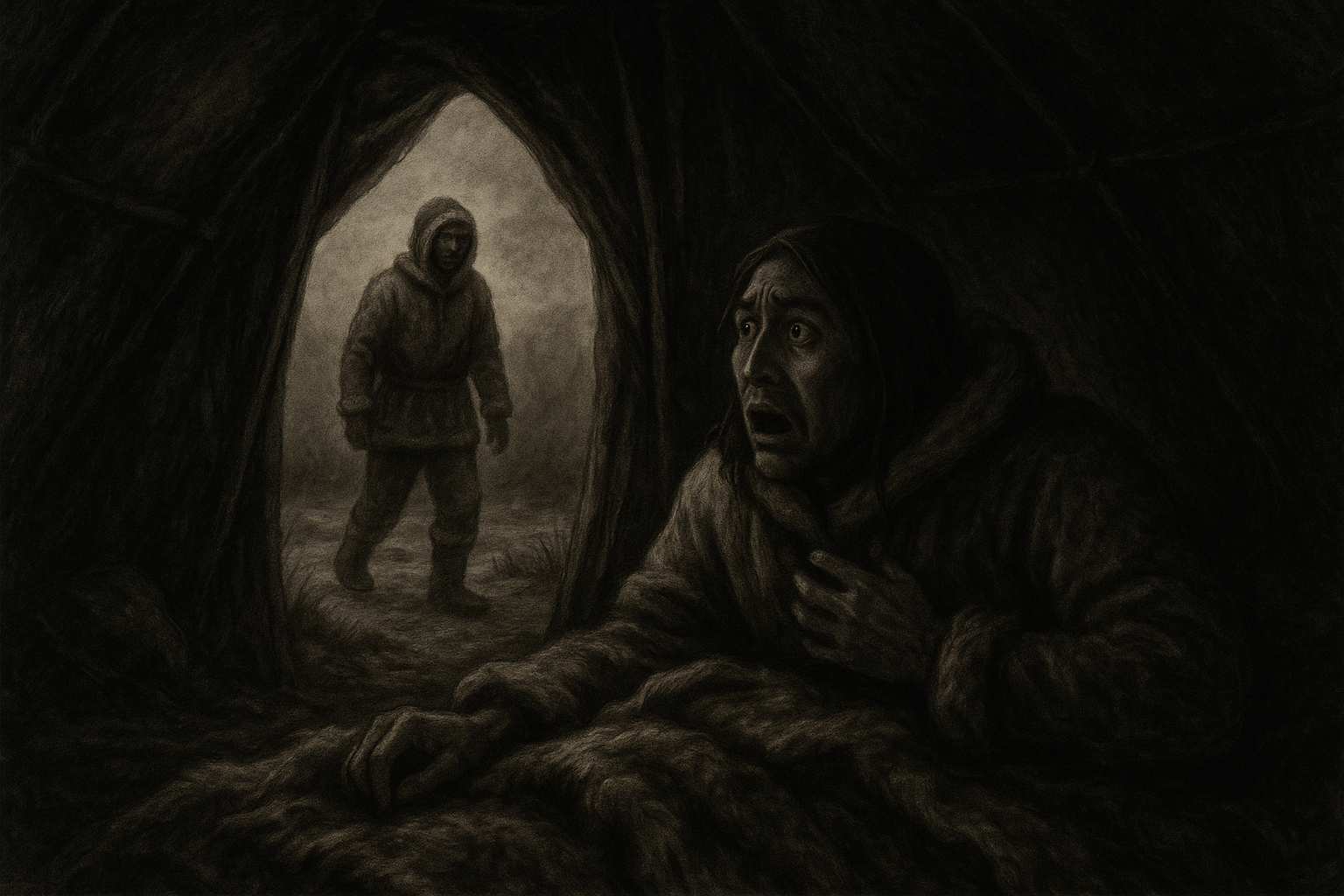
      Manelaq, the wife of Qaorssuaq, told how her husband once saw his own soul, wandering apart from his body, and where this led. Qaorssuaq had lain ill for a long time, and no one could understand what was wrong with him. Then one day, he saw "his own living self" a little way away.
      "No one else could see him. Seeing himself suddenly outside his own body he began to shiver all over. What he saw was his own soul, and it was owing to his illness that it had left his body. All trembling he stretched out his arms towards his soul and cried: 'Come nearer, come nearer. Come to me, come back to me!'
       " I could not understand what was happening to him and had to hold him by the hood when he kept on trembling. At the very moment I took hold of him the vision disappeared, but the soul did not return to his body. It had fled just at the moment it was perhaps on its way back to his body, for I was unclean and just in those days had my bleedings, and therefore the soul fled from me."
       Help came in the form of a couple who were both shamans. "When they heard what had happened, they insisted that 1 should go into a corner of the -tent, right over behind the fireplace; there I had to lie with my head hidden in a heap of caribou bones. While I remained concealed there, the two shamans conjured and summoned their helping spirits. They held a great seance in order to call the soul back to Qaorssuaq's body. And it was not long before he again saw his soul.
       "The two shamans, to whom nothing was impossible, could see it too. They uttered magic words and spoke with their helping spirits' own tongue until the soul came quite close to Qaorssuaq. Then they suddenly sprang to him and began to beat him here and there on his body, the consequence being that the soul was frightened and became so scared that it slipped into Qaorssuaq's body once more.
       "At the very same moment he was well again and I could hear him shouting and singing with joy. Only then did I venture to rise from the heap of animal bones where I had hidden my head till then, and we all sang with happiness. In that way Qaorssuaq got his soul back again." [3]
      It may seem odd that the vagrant soul was induced to get back in the body rather than go further away when the beating began, but it seems the shamans knew what they were doing. The magic words were certainly an important part of their operation. Inuit shamans have special language to do special things. Rasmussen later recounts a story of how magic words were used by an angakok to create a kind of Inuit golem , turning a neap of snow into a black bear. [4] Calling up helping spirits is central to Inuit shamanic practice, as in other traditions. An Inuit name for a spirit helper means "one that exists to be questioned" and the variety of entities that may play this role can be startling. Rasmussen mentions one shaman whose helping spirits included the moon, a sea scorpion, and one of his father’s living dogs. [5] 
     Inuit shamans were unwilling to share much of their training and practice with an outsider, and some told Rasmussen that the great shamans were no more; their tradition was in deep decay. Nonetheless, he was able to report how Inuit shamans are often called by the spirits in dreams. were prolific dreamers and "lived long in a dual world as real shamans must do". In the shaman’s calling, the spirits took the initiative, in dreams. If you could retain your dream experiences and apply them to the world around you, you had keys to mysteries impenetrable to others. [6]
     Rasmussen collected stories of shamanic soul flight, which Mircea Eliade, controversially, thought was the central feature of shamanic practice. [7] His most memorable tales came from Inuit recounting the deeds of illustrious ancestors. “I am a shaman myself,” an informant named Samik told him, “ but I am nothing compared with my grandfather Titqatsaq. He lived in the time when a shaman could go down to the mother of the sea beasts, fly up to the moon or make excursions out through space.”   
    Titqatsag was a frequent flyer. He loved spirit flight, and had a friendly rival, Muraoq, who also took to the air. They met in spirit flight over sea ice midway between their villages. As they converged, Muraoq spread his arms, like a bird gliding on its wings, but did not judge distance well and crashed violently into Tirqatsaq, who fell down onto the ice. He could not move until Muraoq called in helping spirits to get him up. Then the incident was mirrored. Back in the air, Tirqatsag crashed into Muraoq, who dropped to the ice and had to be rescued by his rival’s helping spirits in turn. Even shamans may need flight controllers. [8]


References

1.       Knud Rasmussen, The Netsilik Eskimo Social Life and Spiritual Culture. Report of the Fifth Thule Expedition 1921-24, (Copenhagen: Gyldendalske Boghhandewl, 1931) p. 207.
2. Ibid., p. 213
3. Ibid. p. 216
4. ibid., pp.288-91.
5. ibid., p. 294
6. ibid,, p.296
7. Mircea Eliade, Eliade. Shamanism: Archaic Techniques of Ecstasy. (Princeton: Princeton University Press, 1974).
8. Rasmussen op.cit., pp 299-300.


Illustration RM + AI


Saturday, May 12, 2018

Poets of consciousness


Poets, it’s said, are shamans of words. True shamans are poets of consciousness. Journeying into a deeper reality with the aid of sung and spoken poetry, they bring back energy and healing through poetic acts, shapeshifting physical systems. When we dream, we tap directly into the same creative source from which poets and shamans derive their gifts. When we create from our dreams, and enter dreamlike flow, we become poets and artists. When we act to bring the energy and imagery of dreams into physical reality, we become poets of consciousness and infuse our world with magic.
      In Birth of a Poet, William Everson raised a clamorous appeal for poets to reawaken to their shamanic calling: "O Poets! Shamans of the word! When will you recover the trance-like rhythms, the subliminal imagery, the haunting sense of possession, the powerful inflection and enunciation to effect the vision? Shamanize! Shamanize!" Across the centuries, many of our greatest poets have recognized their kinship with the shaman’s way of shifting awareness and shapeshifting reality. As his name in a spiritual order, Goethe chose the name of a legendary shaman of antiquity, Abaris, who came flying out of the Northern mists on an arrow from Apollo’s bow.
      Our earliest poets were shamans. Today as in the earliest times, true shamans are poets of consciousness who know the power of song and story to teach and to heal. They understand that through the play of words, sung or spoken, the magic of the Real World comes dancing into the surface world. The right words open pathways between the worlds. The poetry of consciousness delights the spirits. It draws the gods and goddesses who wish to live through us closer.
     Shamans use poetry, sung or spoken, to achieve ends that go deeper than our consensual world. They create poetic songs of power to invoke spiritual help; to journey into nonordinary reality; to open and maintain a space between the worlds where interaction between humans and multidimensional beings can take place and to bring energy and healing through to the body and the physical world.
     The South American paye takes flight with the help of "wing songs". These flight songs help him to borrow the wings of the kumalak bird [a kind of kite] that is a main ally of shamans.
     Among the Inuit, the strongest shamans are also the most gifted poets. One of the reasons their spirit helpers flock around them is that they are charmed and exhilarated by the angakok’s poetic improvisations. Inuit shamans have a language of their own, which is often impenetrable to other Eskimos. It is a language that is never still. It bubbles and eddies, opening a whirlpool way to the deep bosom of the Sea-goddess, or a cavernous passage into the hidden fires of Earth.
      My favorite Inuit shaman-word is the one for "dream". It looks like this: kubsaitigisak. It is pronounced "koov-sigh-teegee-shakk", with a little click at the back of the throat when you come to the final consonant. It means "what makes me dive in headfirst." Savor that for a moment, and all that flows with it. A dream, in Eskimo shaman-speech, is something that makes you dive in headfirst. Doesn’t this wondrously evoke the kinesthetic energy of dreaming, the sense of plunging into a deeper world? Doesn’t it also invite us to take the plunge, in the dream of life, and burst through the glass ceilings and paper barriers constructed by the daily trivial self?
     Shamans know further uses for poetry. They use song and poetic speech call the soul back home, into the bodies of those who have lost vital energy through pain or trauma or heartbreak. From their own journeys, they bring back poetic imagery that can help to shapeshift the body’s energy template in the direction of health. Mainstream Western physicians agree that the body believes in images and responds to them as if they are physical events. By bringing the right images through from the dreaming, the poets of consciousness explain dis-ease in ways that help the patient get well, and interact with the body and its immune system on multiple levels without invasive surgery.
    After attending healing sessions of Cuna shamans in Panama, French anthropologist Claude 
Lévi-Strauss explained how the poetry of consciousness is a healing art. "The shaman provides the sick...with a language, by means of which unexpressed, and otherwise inexpressible, psychic states can immediately be expressed. And it is the transition to this verbal expression which induces the release of the physiological process." Instead of giving an explanation of disease that leaves the sufferer powerless and "patient", the shaman explains disease through words and images that help the body get well - just as our dreams do. This is healing through dream transfer, a poetic act.
    Let's recall the Inuit wisdom that with the poetic act, the worlds are joined and the sacred beings come dancing through. An old Inuit woman on Little Diomede Island explained to a Danish anthropologist that powerful spirits - like the spirit of the whale - must be summoned by "fresh words". "Worn-out songs" should never be used when you are trying to call on important spirits.


My new online adventure with The Shift Network, "Living Your Mythic Edge", is, above all, an invitation to become a poet of consciousness.
Adapted from Dreamways of the Iroquois: Honoring theSecret Wishes of the Soul by Robert Moss. Published by Destiny Books

Art: "The Poet with the Birds" by Marc Chagall

Thursday, April 16, 2015

Poets of consciousness


Poets, it’s said, are shamans of words. True shamans are poets of consciousness. Journeying into a deeper reality with the aid of sung and spoken poetry, they bring back energy and healing through poetic acts, shapeshifting physical systems. When we dream, we tap directly into the same creative source from which poets and shamans derive their gifts. When we create from our dreams, and enter dreamlike flow, we become poets and artists. When we act to bring the energy and imagery of dreams into physical reality, we become poets of consciousness and infuse our world with magic.
     In Birth of a Poet, William Everson raised a clamorous appeal for poets to reawaken to their shamanic calling: "O Poets! Shamans of the word! When will you recover the trance-like rhythms, the subliminal imagery, the haunting sense of possession, the powerful inflection and enunciation to effect the vision? Shamanize! Shamanize!" 
     Across the centuries, many of our greatest poets have recognized their kinship with the shaman’s way of shifting awareness and shapeshifting reality. As his name in a spiritual order, Goethe chose the name of a legendary shaman of antiquity, Abaris, who came flying out of the Northern mists on an arrow from Apollo’s bow.
    Our earliest poets were shamans. 
    Today as in the earliest times, true shamans are poets of consciousness who know the power of song and story to teach and to heal. They understand that through the play of words, sung or spoken, the magic of the Real World comes dancing into the surface world. The right words open pathways between the worlds. The poetry of consciousness delights the spirits. It draws the gods and goddesses who wish to live through us closer.
    Shamans use poetry, sung or spoken, to achieve ends that go deeper than our consensual world. They create poetic songs of power to invoke spiritual help; to journey into nonordinary reality; to open and maintain a space between the worlds where interaction between humans and multidimensional beings can take place and to bring energy and healing through to the body and the physical world.
    The South American paye takes flight with the help of "wing songs". These flight songs help him to borrow the wings of the kumalak bird [a kind of kite] that is a main ally of shamans.
    Among the Inuit, the strongest shamans are also the most gifted poets. One of the reasons their spirit helpers flock around them is that they are charmed and exhilarated by the angakok’s poetic improvisations. Inuit shamans have a language of their own, which is often impenetrable to other Eskimos. It is a language that is never still. It bubbles and eddies, opening a whirlpool way to the deep bosom of the Sea-goddess, or a cavernous passage into the hidden fires of Earth.
     My favorite Inuit shaman-word is the one for "dream". It looks like this: kubsaitigisak. It is pronounced "koov-sigh-teegee-shakk", with a little click at the back of the throat when you come to the final consonant. It means "what makes me dive in headfirst." Savor that for a moment, and all that flows with it. A dream, in Inuit shaman-speech, is something that makes you dive in headfirst. Doesn’t this wondrously evoke the kinesthetic energy of dreaming, the sense of plunging into a deeper world? Doesn’t it also invite us to take the plunge, in the dream of life, and burst through the glass ceilings and paper barriers constructed by the daily trivial self?
     Shamans know further uses for dream poetry. They call the soul back home, into the bodies of those who have lost vital energy through pain or trauma or heartbreak. And from their journeys, they bring back poetic imagery that can help to shapeshift the body’s energy template in the direction of health. Mainstream Western physicians agree that the body believes in images and responds to them as if they are physical events. By bringing the right images through from the dreaming, the poets of consciousness explain dis-ease in ways that help the patient get well, and interact with the body and its immune system on multiple levels without invasive surgery.
     To heal and enrich our lives, and wrap the world around us as a magic robe, we want to grow our poetic health, and commit poetry every day, in every way.


Text adapted from Dreamways of the Iroquois: Honoring the Secret Wishes of the Soul by Robert Moss. Published by Destiny Books.

Art: Marc Chagall, "The Poet Reclining"