Showing posts with label dream exploration. Show all posts

Friday, February 16, 2024

Location, location, location - and other keys to dream reentry


The realtor's familiar slogan applies to the technique of dream re-entry as well as the property game. The easiest way for you to back inside a dream is to hold your focus on the dream location. Your initial memories may be fuzzy, but a single landmark - even a single shape or color - may be sufficient to enable you to shift your consciousness into a vivid and complex scene.


Be open to possibility! The geography of the dream world is not that of the Times atlas or the Mobil guides. In dreams you may find yourself in familiar locales, including places from your past – Grandpa’s place, or your childhood home – that may or may not have changed. You may also visit unfamiliar but realistic locations, often clues that your dream contains precognitive or other “psychic” material. You may find yourself in scenes from a different historical epoch (past or future), in a different galaxy, in otherworldly locales, or in free-flowing situations where nothing conforms to the supposed laws of the physical world. One of the purposes of dream reentry is to establish where in the worlds you are. The typical dreamer, after waking, has no more idea where he spent the night than an amnesiac drunk.

The best time to try to reenter a dream is often immediately after you have come out of it. By snuggling down in bed and rehearsing the postures of sleep, you may be able to slide back into the dream in a gentle and natural way. But your work schedule may not allow you leisure to do this. And if your dream contains deeply disturbing material, you may need to wait until you are ready to deal with it. You may also feel you need the support of a partner or a drumming session.

But here is a simple technique for dream reentry you can use in the privacy of your bedroom or easy chair:

1. Find your question. What is your main question about the dream you wish to explore? Try to formulate that question as clearly and successfully as possible. Write it down. This will help to establish your focus. During your exploration, you will use this question like a flashlight or a miner’s lamp. It might be quite specific, or as general as, “What is this dream telling me?”

2. Focus on your target. Summon back as many details of your dream location as you can. This is the scene you are going to reenter. Maybe you have multisensory impressions of it. How does the air feel? What can you hear? Are there any distinctive smells?

3. Ask yourself who or what inside the dream can best answer your question. When you reenter the dream, you may be able to communicate directly with one of your dream figures.

4. Relax. Get into a comfortable position, sitting or lying down. Take some deep breaths. Breathe in through your nose, out through your mouth. As you exhale, try to release any pain or tension you are holding in your body and wish it outside your space. You may find it helps to count yourself down – from twenty to one – as you let your consciousness slide toward your selected locale. Or you may wish to put on meditation music or a drumming tape.

5. Move into your dream locale. Look around carefully to identify exactly where you are. You may notice many details you forgot or overlooked before. Do you know this place? Do you feel you are inside a scene from another time, or another order of reality?

6. Let the action unfold. Don’t interfere with the spontaneous flow of images. You have full power to choose how you will interact with your dream characters and respond to any challenges that are presented to you. Your dream reentry may take you beyond the point at which the original dream ended; if the first dream was unresolved or aborted, this is part of your design. Your new dream may also introduce characters and events that were not in the original dream. This is fine; your underlying purpose is not to reproduce the earlier version, but to move closer to the source from which dream images flow.

7. Dialogue with dream characters. You may find a dream character who can answer all your questions. Your selection is not confined to humans. Dreams are full of “persons other than human” (to borrow an Ojibwa phrase). There is no such thing as an inanimate object in dreams.

8. Expect the unexpected. Because the dream source is wiser than the ego, it may be telling you something more important than the question you decided to ask.

9. Map your journey. Pay attention to how you return from the dreamscape, as well as the paths you took through it.


Text adapted from Conscious Dreaming: A Spiritual Path for Everyday Life by Robert Moss. Published by Three Rivers Press.

Wednesday, January 5, 2022

Lost in Dreams


Not all my dreams are mythic adventures or exotic destination travel. I sometimes find myself in frustrating repetitive situations where my dream self is very far from a master of the universe. The other morning I came back travel worn and disappointed from a dream in which I was lost and confused and looking for help in all the wrong places.

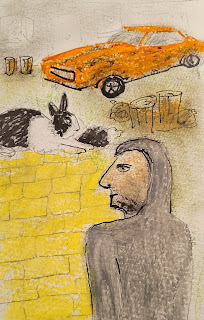
Things started out well with a big book event in California in my honor. Then for some reason I got on a bus without checking where it was going and found myself in a remote location, hiring a sketchy character off the street to drive me back to my point of departure. I realized things were off when he led me down a scruffy path among trash bins where a weird black-and-white rabbit seemed to be snacking on the bloody remains of his twin, His car turned out to be a filthy rustbucket. At that point my dream self had the minimal good sense to pull out but was still far from where he wanted to go.
I recorded all the details. I will think about the rabbits and I will pay attention if any elements start to play out in ordinary reality, because dreams can show us the future quite literally and I have been known to do book events in California.
What weighed upon me after this dream was the reprise of a familiar, recurring dream situation I will call Lost and Clueless. The details change from dream to dream but the situation repeats every so often. When it does I make myself stay with the dream and ask: where in waking life am I Lost and Clueless in the sense that I am failing to use common sense, to adopt rational solutions and to seek help in appropriate quarters?
I think my dream producers gave me another B movie because they wanted to me to receive a message and do something about it. I would have liked to slam the door on my Lost in California dream. But I don't ever let myself dismiss an uncomfortable dream, let alone shrug "It's only a dream" because I know that every dream tells me more than I already know.
So I wrote my report as an email I sent to myself, my favorite way of first documenting a dream. Then I confronted the uncomfortable question: Where in waking life am I Lost and Clueless right now?
The answer came to me at once. For many weeks I had put off doing my part to complete a family Help Book. It is both a locator for documents and services and a set of directions any of us could use to get help in an emergency, the kind of guide that tells you who to call if the pipes freeze or the internet is down. The utility of this Help Book was made very clear in physical reality on the night of my Lost in California dream; we discovered that our internet was down for several hours.
Dreams require action. I postponed other plans and sat down at my desk and did my bit to complete the Help Book. This took less time than I had feared. With that job done, I felt grateful for the dream, no longer frustrated by it. No need now to hire a sketchy character with an odd bunny off the street. Though the link between the content of my dream and the waking situation might seem obscure to an outsider, I felt the inner logic and accepted the push.
We can be lost in dreams, as in waking life, in other ways that provide another kind of course correction. There is Lost and Clueless. There is also Lost and Found. The navigational law of serendipity is that we may need to get lost in order to find ourselves. The word "serendipity" is derived from Serendib, the magical kingdom in the story of Sindbad the sailor. Everyone wants to find the kingdom but it is not on any map. Sindbad finds it only after he falls off the charts, is shipwrecked, loses his shipmates and washes up on an unknown shore. To find a place you do not know you must go by a way you do not know. You can get lost in a dream, as in life, and find yourself in a place of wonder and delight. I'm looking forward to the next dream like that.

Drawing: "Lost in California" (c) Robert Moss

Monday, March 16, 2020

From the Indisciplined Territories

March 16, 2020
In a time of lockdowns, plane cancellations and shuttered restaurants, adventures in dream travel are more welcome than ever. Last night I enjoyed the company of a fascinating group that included a prince of Persia and a French aristo who asked me to make a picture for a countess who will invite me to her villa at Cap St Jean. A very exclusive travel agency handled all the arrangements and sent me an exotically beautiful young assistant

FROM THE INDISCIPLINED TERRITORIES

I slowly take in the unusual patterns of paint and ink on her brown face. Her cheeks are covered with fine ink that may be pictographic script. Some of the symbols look like musical notes. Over her mouth are crossed diagonal bars of red paint. The shape reminds me of heraldry. Though bars over the mouth might suggest an effort to suppress the voice, the opposite effect is at play here. She speaks clearly and strongly, in British Empire English with an island lilt.

She tells me she is from The Indisciplined Territories. Is she joking? Oh no. "They call us the Indisciplined Territories because no one dares to take us on." Her enunciation is precise. Indisciplined, not merely Undisciplined. She describes a small group of islands and atolls defined as dependencies of a recognized group with a double name I don’t quite get; it sounds like Bones-and-Something....

I emerge from this encounter excited and intrigued. As usual, my dream sets me research assignments, tracking names of places and people and of the strange conveyance, like a miniature carousel on wheels, that took us through a forest.  It was called a "coneebo", possibly written as conibo. I may look into indigenous traditions of face paint and tattoos. 

I will not waste a moment on analysis. A dream like this is, first and last,an adventure in another world. Some elements may spill over into my physical reality but I am satisfied with the adventure in its own right. I will draw on its creative energy with pencil and colors and keyboard. Maybe I can draw and paint the relief map I was showing people in the dream. Perhaps it will reveal the location of The Indisciplined Territories.

I wonder whether I have made the picture the countess wants. If so, can I expect an invitation to Cap St. Jean Ferrat? I am unlikely to get there by plane in the near future, but dream flight is always available and I do have a very special travel agent to call.

Follow-up: dream directed research

I was soon reminded that the Conibo are an Amazonian people and rapid research online produced many photos of elaborate face painting, for which women are the artists. Catalog copy for an exhibition at the Museum of Natural History in New York titled "Body Art:Marks of Identity" included this:


"The intricate rectilinear and curvilinear designs that cover the faces, clothing, houses, ceramics and other objects of the [Shipibo-Conibo] cultures on the Ucayali River of the upper Amazon in Peru derive from the origin of the world, when everything in the universe was covered with such lines in a continuous unified design. The original patterns were lost, or obscured, due to misdeeds of failed proto-humans, but they are still present everywhere if one can see them. Male shamans can reclaim the patterns through hallucinogenic visions and relay them to artists who bring them back into the world through the decorations they create on objects. The women artists are aided in realizing the intricate patterns by placing the colorfully veined leaf of the iponquene plant over their eyelids before they start — the plant is named after a complexly patterned armor-headed catfish. These harmonious designs are associated with human cultivation and prosperity. In rituals, shamans can sing the tunes of songs from this labyrinth of lines."

I have not yet found an image of the barred pattern over the mouth and chin displayed by the exotic travel assistant in my dream.


Journal drawing by Robert Moss

Tuesday, April 26, 2016

A dream is a place


Most of our dreams don’t play out in a formless void, or some Cloud 9. We were with our dream lover in a certain house, the tiger chased us (or licked our face) in a certain landscape, we lost or found our luggage at a certain airport or train station.
    In regular life, we understand fairly well that if we have been to a place, we can probably go their again, even if we have lost the exact directions and may need to turn to GPS or an old-fashioned maps. It is the same with dreams. If you were in a certain place in a dream, you may be able to go there again, by the technique I call dream reentry, which means taking a remembered dream and using it as the portal for a journey in which you will travel, wide awake and lucid, into the space where the dream action unfolded.
    Why would you want to do this? For all sorts of excellent reasons. To understand your dream from the inside, by gaining access to the full experience of the dream, which is likely to go far beyond your initial memory of the dream. To dialogue with someone in the dream. To solve a mystery or brave up to a fear. To carry the dream onward to a place of healing, beauty or resolution. To go to the place where a part of your vital energy that has been missing can be found and reclaimed, so you can be whole and live a fuller, juicier life.
    We dream of an old place – grandma’s house from childhood, perhaps, or the home we shared with a former partner – and those dreams may give us a way to connect with a younger self, or a series of younger selves, who parted company at the time we were living in that old place, maybe because of pain or trauma or disappointment or bitter frustration over life choices we made.  When we make that connection with a younger self, quite wonderful things become possible. We can bring vital energy and joy and imagination back into our life, with that “wonder-child” or that beautiful teen self we have discovered again. We can reach back across time and be the mentor and cheer leader for a younger self that person may have desperately needed in that time, speaking mind to mind across the years.

Photo: Bench overlooking Thirteenth Lake by RM