Showing posts with label bad dreams. Show all posts

Wednesday, January 5, 2022

Lost in Dreams


Not all my dreams are mythic adventures or exotic destination travel. I sometimes find myself in frustrating repetitive situations where my dream self is very far from a master of the universe. The other morning I came back travel worn and disappointed from a dream in which I was lost and confused and looking for help in all the wrong places.

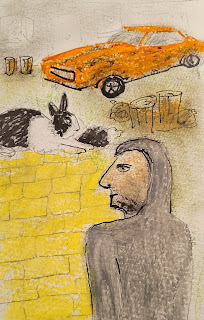
Things started out well with a big book event in California in my honor. Then for some reason I got on a bus without checking where it was going and found myself in a remote location, hiring a sketchy character off the street to drive me back to my point of departure. I realized things were off when he led me down a scruffy path among trash bins where a weird black-and-white rabbit seemed to be snacking on the bloody remains of his twin, His car turned out to be a filthy rustbucket. At that point my dream self had the minimal good sense to pull out but was still far from where he wanted to go.
I recorded all the details. I will think about the rabbits and I will pay attention if any elements start to play out in ordinary reality, because dreams can show us the future quite literally and I have been known to do book events in California.
What weighed upon me after this dream was the reprise of a familiar, recurring dream situation I will call Lost and Clueless. The details change from dream to dream but the situation repeats every so often. When it does I make myself stay with the dream and ask: where in waking life am I Lost and Clueless in the sense that I am failing to use common sense, to adopt rational solutions and to seek help in appropriate quarters?
I think my dream producers gave me another B movie because they wanted to me to receive a message and do something about it. I would have liked to slam the door on my Lost in California dream. But I don't ever let myself dismiss an uncomfortable dream, let alone shrug "It's only a dream" because I know that every dream tells me more than I already know.
So I wrote my report as an email I sent to myself, my favorite way of first documenting a dream. Then I confronted the uncomfortable question: Where in waking life am I Lost and Clueless right now?
The answer came to me at once. For many weeks I had put off doing my part to complete a family Help Book. It is both a locator for documents and services and a set of directions any of us could use to get help in an emergency, the kind of guide that tells you who to call if the pipes freeze or the internet is down. The utility of this Help Book was made very clear in physical reality on the night of my Lost in California dream; we discovered that our internet was down for several hours.
Dreams require action. I postponed other plans and sat down at my desk and did my bit to complete the Help Book. This took less time than I had feared. With that job done, I felt grateful for the dream, no longer frustrated by it. No need now to hire a sketchy character with an odd bunny off the street. Though the link between the content of my dream and the waking situation might seem obscure to an outsider, I felt the inner logic and accepted the push.
We can be lost in dreams, as in waking life, in other ways that provide another kind of course correction. There is Lost and Clueless. There is also Lost and Found. The navigational law of serendipity is that we may need to get lost in order to find ourselves. The word "serendipity" is derived from Serendib, the magical kingdom in the story of Sindbad the sailor. Everyone wants to find the kingdom but it is not on any map. Sindbad finds it only after he falls off the charts, is shipwrecked, loses his shipmates and washes up on an unknown shore. To find a place you do not know you must go by a way you do not know. You can get lost in a dream, as in life, and find yourself in a place of wonder and delight. I'm looking forward to the next dream like that.

Drawing: "Lost in California" (c) Robert Moss

Thursday, August 6, 2020

On "bad" dreams and trash dreams


I've often said that dreams - including scary dreams and nightmares - are not on our case but on our side, in the sense that they show us things we need to see and to deal with.
    However, I am not of the opinion that all night experiences come in the service of health and wholeness, except in the sense that we can regard anything that comes up in life as a possible learning experience.
    Every ancient and indigenous culture that I know teaches that there are bad things that can try to enter our space in the night, and bad neighborhoods in the dreamworld in which we can get mugged. Hence the dreamcatcher, originally a spider web, intended to catch and keep out bad dreams and bugs, and other apotropaic rituals and procedures, including prayer to divine guardians. Hence traditional rituals for dispersing the energy of a bad dream right away.
   The ancient Assyrians sought to remove the contamination of bad dreams by rubbing the body with a lump of earth that was believed to absorb the unwanted energy. The lump would then be destroyed, preferably by breaking it up and scattering it over running water, so the river would dissolve it and carry it away. In the Assyrian Dream Book, we read that someone who experienced a "dark" dream should pray and then

He shall take a lump of earth, he shall recite three times the conjuration over it, he shall throw it into water. His misfortune will depart. [1] 

    The Egyptians employed similar rituals for cleansing the dreamer of from the pollution of an evil dream. In the Chester Beatty papyrus, this involved (1) telling the dream to the Great Mother - here the goddess Isis - and invoking her help and protection and (2) rubbing the face and body with bread soaked in beer and infused with myrrh and herbs. This bread-sponge was believed to be highly effective for psychic cleansing. The ingredients may seem odd, until we remember that in the ancient mind, bread and beer are both the gift of the Goddess. In the Gardiner translation, Isis says: “Come out with what you have seen, in order that the afflictions you saw in your dreams may vanish.” The ritual ends with a triumphal cry from the dreamer that he has dispelled an evil dream sent against him and is now ready to receive pleasant dreams. “Hail to thee, good dream that is seen by night or day!” [2]
    Some traditional dreaming cultures teach that it is not a good idea to share a certain type of bad dream with others, because you don't want to dwell on it and feed it with the energy of your attention, or risk spreading psychic infection. In West Africa, a traditional practice to avert the evil of a dark dream is to spit it out right away, within telling anyone about it. In Bali, in Anatolia, and in other places, there are traditional practices that involve telling - and sometimes expectorating - "bad" dreams into running water.
    Then there are dreams that are not necessarily "bad" but don't deserve attention because they are trash left over from the night before. Hawaiians have a marvelous term for trash dreams. They call them "wild goatfish dreams". Goatfish is something Hawaiians like to eat, in the right way, in the right season. But a "wild goatfish dream" - like a spicy pizza dream - is occasioned by eating the wrong way at the wrong time, and is not to be valued, but rather thrown away among the leavings of the previous night.
    As everyday practice, I would counsel anyone who feels oppressed by a bad dream to spit it out. I do mean literally. Spit it out on the ground or down the toilet. If you feel that's not enough, draw the dream image and burn it. Then think carefully about whether you really need to spend more time with that troubling night experience, and whether it is really necessary to inflict it on others. I am reminded that it was the wisdom of some Irish grandmothers, on both sides of the big pond, that you should not tell your dreams before breakfast unless you want them to come true.


1. A. Leo Oppenheim, The Interpretation of Dreams in the Ancient Near East (Philadelphia: American Philosophical Society, 1956) p.301
2. A.H. Gardiner, Hieratic Papyri in the British Museum. Third Series. Chester Beatty Papyrus. London: British Museum, 1935, in Oppenheim, op.cit., p.244.

Photos: Clay effigies of "bad" dreams, destined for release in flowing water, made by Xander Cloudwalker for a contemporary version of the ancient Mesopotamian apotropaic ritual.


Sunday, April 26, 2015

My black dog's first plane trip


I took my black dog walking stick on his first plane trip on Saturday. Waiting for our connection at Baltimore airport, we pause for refreshments and are immediately invited to play dream ambassadors.
    "What do you do?" asks a lady who strikes up conversation when she notices the black dog.
  . "I teach people how to dream." "Oh my God I need to sign up for that. I've been having all these bad dreams."
    I reassure her that dreams are not on our case, they are on our side. I explain how to go back inside a scary dream to confront the challenge and resolve it on its own ground. 

    Now my black dog deserves a beer. I scan the draft selections. They have an IPA on tap  called Flying Dog Snake Dog. How perfect is that?
    The lady pays for her wine and leaves, but rushes back a few minutes later, saying, "I want to know all about you and which of your books to read." 
     She makes eye contact with my black dog and tells me her family got a black dog for her brother in law because he was depressed. They called the dog Søren Kierkegaard because he was a cross between a Great Dane and a black lab. I observe that this is a doubly appropriate name since Kierkegaard was not only a Dane but a somewhat depressing philosopher He compared life's joys to the momentary thrill experienced by insects who die at the moment of fertilization. Happily, Kierkegaard the dog is apparently a cheery fellow.
     Now the lady tells me her "bad" dream from last night. In it she cut open her husband's skull and hacked his brain to pieces, trying to understand how he thinks. She woke up feeling terrible.
   ."If it were my dream", I say gently, "I would compare what my dream self was doing with the behavior of my waking self. Do I pick at my husband in a way that leads to pain and conflict. I need to understand him better, but the dream is telling me I need to go about that in a subtler and more effective way. Maybe the dream is showing me how he feels about some of our interactions."
     She blushes and nods.

     I talk about how to go back inside a dream to try to work things through. And how -, when she feels the time is right and can do this with humor - recounting the dream to the husband could actually help them to establish better communications.
     Now she is off to her gate, with my books
The Three 'Only" Things and Conscious Dreaming on her immediate to-buy list.
     When I join the line for departure at my own gate, I find my neighbor is a cat named Magnolia, going to California in her crate. The conversation with the humans around me immediately turns to the character of cats and dogs as life companions and  therapeuts. My black dog is pleased.