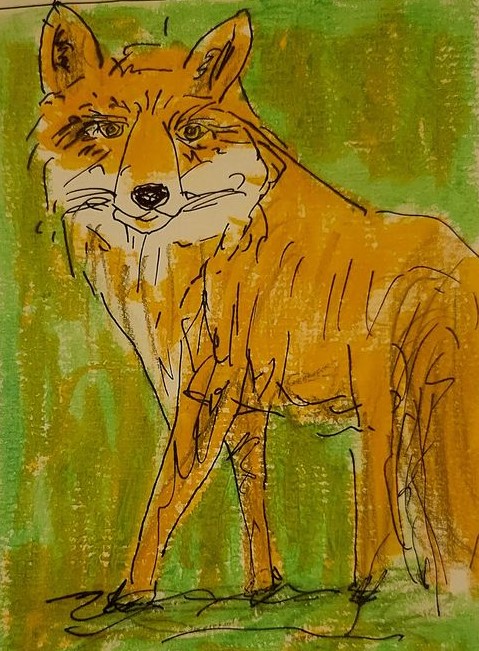
Showing posts with label fox. Show all posts

Wednesday, May 15, 2024

A Seat at the Fox's Bar


I land at Washington's Dulles airport late, on a little prop plane that is not the one I was scheduled to take, after one of the bumpiest rides I have ever experienced outside a war zone. 
    I have time before my connecting flight to 
São Paulo, and I am starving. The only halfway decent place for a sit-down lunch on my concourse is a pub called The Fox and Firkin. It is jam-packed. But wait: a woman is getting up from the bar. A young man helps her to disentangle her luggage. I thank her for providing me with a seat at the right moment. "You'll enjoy this young man," she tells me.

    The young man at the bar is behaving oddly, hopping back and forth between the now vacant seat and the one he was sitting on. He finally decides I may have his previous seat. Clearly there is going to be some kind of engagement here. His baby-blue eyes float up out of a pale and desperate face. "I know you are an elder." 
    He asks me to guess his age. I do. Now he is almost beseeching. "What can you tell me about life?"
    "Never leave home without your sense of humor."
    "I know. But I get so intense, so aggressive. Like, if someone bumps the back of my seat -" he bumps the back of my seat to make his point ["-I want to get up and get in that guy's face."
     "I'll tell you something else I have learned about life," I remark after he hits the back of my seat a second time. "We always have the freedom to choose our attitude."
     He stops banging my seat. "Oh my God, you're right. It's amazing you just sit down next to me and say that."
     He pushes his face close to mine as if he needs to be petted. I am trying to think who he reminds me of. Got it. He resembles Smeagol, the Gollem in Lord of the Rings. The absence of hair on his head is the least notable point of resemblance.
     He wants something from me I can't yet fathom.
     But as he goes on talking, questioning, I begin to sense its shape. He talks about his military Virginia family, his estrangement from his dad. It is clear this has left a deep wound. My guess is that his father has not been able to accept that his son is gay.
     I tell him that, I too, come from a military family and that I was estranged from my father until three years before his death, when we became the best of friends. I tell the young man that if it were my life, I would make it my game to make all well with my dad while he is still in the world.
    "You're giving me goosebumps." He shows me. His whole arm is chicken skin.
    "Truth comes with goosebumps."   

    He is crying now. "You come into the bar, you take a seat, and you tell me the most important things I've ever been told."
     "Here's something else I've learned. The world speaks to us through coincidence and chance encounters. It's a kind of magic."
     "Is that what you are? A magician? You got me crying at the bar for chrissake."

    "Well that lady who gave me her seat did give you a good review."
    He wants to pay for my burger and beer. Of course I won't let him. He asks for a hug. I do give him that. 

    As usual, when plans get scrambled the Trickster comes into play. There is more than what we understand as chance going on in chance encounters. And sometimes they take place for the benefit of someone else.


Drawing by Robert Moss  


Text adapted from Sidewalk Oracles: Playing with Signs, Symbols and Synchronicity


Monday, October 10, 2022

Meet the Trickster


Trickster, in your life, is that power that makes sure your path will never go straight and you will never lose your soul in your plans. Trickster challenges the established order, and in so doing renews it. He tricks in order to transform.

There is a close connection between the Gatekeeper and the Trickster. In mythology, they are often one and the same. Trickster is the mode the Gatekeeper — that power that opens doors in your life — adopts when you need to change and adapt and recover your sense of humorIf you are set in your ways and wedded to a linear agenda, the Trickster can be your devil. If you are open to the unexpected, and willing to turn on a dime (or something smaller), the Trickster can be a very good friend.

Trickster will find ways to correct unbalanced and overcontrolling or ego-driven agendas, just as spontaneous night dreams can explode waking fantasies and delusions. Our thoughts shape our realities, but sometimes they produce a boomerang effect. Trickster wears animal guise in folklore and mythology, appearing as the fox or the squirrel, as spider or coyote or raven.

To make friends with Trickster, we want to be ready to make a story out of whatever happens in life and to recognize the bigger, never-ending story that may be playing through our everyday dramas. If nothing goes wrong, it has been said, you do not have much of a story. Trickster knows all about that.

We are most likely to meet Trickster at liminal times and in liminal places, because his preferred realm is the borderlands between the tame and the wild. He invites us to live a little more on the wild side. He approves when we make a game or a story out of it when our plans get upset, our certainties scrambled.

Trickster insists on a sense of humor. Trickster is

A boundary-crosser

He shakes things up

He is a humorist who doesn't respect piety or correctness.

He gets you out of tight places

I’d rather be a Trickster than a martyr, as Elizabeth Gilbert declares in a paean to Trickster: “The trickster (represented forever in world mythology as the fox, the crow, the coyote, the monkey) sees through our delusions of seriousness and exposes the play underneath all our drama… The trickster understands that all this world is temporary, all of it is shifting, all of it is nonsense, all of it is fair game for delight. The trickster just keeps on playing. The trickster is slippery and sly, wry and wise, always looking for the secret door, the hidden stairway, the funhouse mirror, the sideways way of looking at things — and the trickster always endures.    I choose the path of the trickster, not the path of the martyr." [1]

 Trickster figures are liminal lords, barons of in-between. Trickster is the spirit of the doorway and the crossroads and the edge of town. The name Hermes once meant “he of the stone heap” and evoked the little cairns of stones, placed as offerings more than markers, along roads between settlements. Trickster is most active where borders are porous and perilous and offers wit and cunning to navigate these edgy spaces. Hitchhikers in the galaxy must walk close to the Trickster if they are going to make it.

Hermes is one of the great mythic Tricksters and Gatekeepers and World Bridgers. Through him, every house opens into the Otherworld. One of his names, sotheos, means The Socket, as in the socket of a hinge that enables the pin to turn and the door to open and close. So we can think of him as a Hinge guy – as in “hinge of fate” – or a Pivot. As he swings, so do our fortunes.

Trickster is lord of the road, of spirit roads as well as earthly ones. He can guide traveling souls between the worlds, and open passages when none seem to exist. He can escort the dead to the Underworld or raise them from their graves to walk among the living.

He may be a thief, but he is the kind of thief who steals fire from heaven for the benefit of humans.

Trickster breaks down the wall between time and eternity, between mortals and immortals. When he steals Idunn and the apples of immortality, as Loki, he gives mortals (Giants) a taste of eternity and immortals (Aesir) a taste of the ravages of time.

He doesn’t allow a static order.

Trickster is Lord of Loopholes. An old Norse kenning of the name Loki is “a loop in a thread” - a loophole. 

Among the many animal forms of the Trickster - Raven, Coyote, Spider, Monkey - I have special affection for Fox.


Sympathy with Fox


You live on the edges of my life
           at the margin between the tame land and the wild
           and your appearances are always edgy for me.

You know when to hide and when to hunt.
           Men chase you on horseback, with dogs,
           yet turn chicken when you turn up unannounced.

You are tricky. I doubt I’ll ever be at ease with you.
           But you are a determined messenger
           and a necessary link to old and sacred things

You call women I care for to reclaim lost soul
           and become foxy girls, immune to glass ceilings,
           setting their own boundaries, living unbounded life. [2]


I refer to Trickster as “he” because he is depicted as male in most mythologies, and often ithyphallic and lustful to boot – with the significant exception of Fox spirit, who may be Monsieur Renard or Mr. Fox in the West, but is more often Fox Woman, Kitsune (a name that means Come and Sleep) in Japan.

Lewis Hyde reminds us that “in spite of all their disruptive behavior, trickster are regularly honored as the creators of culture.” [3] When Hermes steals cattle from the gods, he presents humans with a domesticated supply of meat on the hoof.

Trickster keeps things lively, in an individual life or the life of a people. The intriguing paradox in the myth is that “the origins, liveliness and durability of cultures require that there be space for figures whose function is to uncover and disrupt the very things that cultures are based on.” 

Trickster breaks down hard-and-fast distinctions between good and bad, black and white, order and chaos. When you are blocked because you have put yourself in a box, in the surface of you mind, he comes to remind you that (as Paul Valéry wrote) “the bottom of the mind is paved with crossroads” and you have plenty of other options. 


References

1. Elizabeth Gilbert blog July 7, 2014 http://www.elizabethgilbert.com/its-better-to-be-a-trickster-than-a-martyr-i-recently-did-a-radio-interview-o/

2. "Brushes with the Red Fox" in Robert Moss, Here, Everything is Dreaming: Poems and Stories. (Albany NY: Excelsior, 2013)

3. Lewis Hyde, Trickster Makes this World. (New York: Farrar, Straus and Giroux, 1998) 8,9.


Please read my book Sidewalk Oracles for guidance on how to navigate life in the play of Trickster.

Journal drawings by Robert Moss


Monday, July 18, 2022

Why We Dream


"Why do we dream?" asked the blue butterfly girl, looking around the circle of animals she had invited to her tea party by the garden gate. 

"You dream so we can always be together," said Bear, without hesitation. "You dream so you will always have a friend. " 

"You dream so you can see," said Hawk. His golden eyes flashed. 

"You dream so you can learn to be brave like me," said Lion. 

"Nonsense," said Mr. Fox. "You dream so you can tell stories about me." 

"Grandfather," the girl looked into the tea water. "Why do we dream?" 

Grandfather Teller's voice bubbled like a pot about to boil. "You dream because humans are the animals that tell stories about all the others."


RM journal drawing: Garden Gate

Tuesday, July 13, 2021

The price of Fox's secret


The Little Prince is sad. He has left his planet and the rose he cared for. Now on Earth, he is devastated to find there are thousands of roses, when he thought his was unique.
    He meets a strange, pretty animal that greets him from under an apple tree. It is a fox.
    The Little Prince asks the fox to play with him. Fox tells him, "I cannot play with you because I have not been tamed."
    The Little Prince does not know the meaning of this word "tamed".
    He has to ask three times before the fox tells him that "to be tamed" is "to establish ties."
    How is that done? It takes time, the fox instructs. If the Little Prince wishes to tame him, he must meet him in the meadow at a certain time every day and sit at a certain distance. Each day, the Little Prince may move a little closer. In this way, the fox is eventually tamed and is able to reveal the secret of life.


It's a lovely story, from Antoine de Saint-Exupéry's beloved fable The Little Prince, known to most of us from childhood. The secret the fox is about to give is one of the great moments of clear and simple revelation in world literature. But he can only give it when he has been "tamed".
     Now it seems improbable that any fox would ask to be tamed in the sense of being house-broken or put on a leash or made to obey commands. The critical word "tamed" is a correct, but imperfect, translation of Saint-Exupéry's original term apprivoisé. In French, “to tame” an animal (or person) in the sense of making them submissive is dompter; to turn something wild into a domesticated being is domestiquer.
     Apprivoiser
has a different lilt. In early medieval French usage, it means to make something  less savage (but not domesticated), to make something alien more familiar. For the poet-prince Charles d’Orléans, apprivoiser is to make someone gentler, softer, more tractable. The fox tells the Little Prince that the way to bring this about is créer liens, to make links or ties.
      Synonyms for apprivoisier might include “to gentle” or “to befriend”. As the fox uses the word, it is about establishing the kind of connection that will make your relationship unique.  Once gentled (apprivoisé) the fox is no longer one of a thousand foxes that hunt chickens and are pursued by hunters; he is your special friend. Once a rose has befriended you, it is no longer one of a hundred thousand roses; it is your rose.
     “Here is my secret,” the fox, befriended, says to the Little Prince. “It is very simple. You can only see clearly with the heart. The essential is invisible to the eyes."
     Fox has two more secrets, all of them things that humans have forgotten.
    “It is the time you lost for the sake of the rose that made the rose so important.”
    Then, never to be forgotten: Tu deviens responsible pour toujours de ce que tu as apprivoisé. “You are responsible, forever, for everything you have gentled. You are responsible for your rose.”

I think of an old white oak, a tree that I know that knows me. Its image shines in my mind as the Little Prince’s rose shines in his. When I need to know whether other thoughts or visions are to be trusted, I sometimes let the oak rise and rustle in my inner senses, to confirm or caution.
    I think of the red-tailed hawk who dropped from the sky to guide me and, as I came to know, to do something more: to befriend me and, in its own wildness, to gentle me.
Elle m’a apprivoisé.    
    I think of how Death has come to me, over and over, in personal guise, sometimes as a Hindu god who speaks in the accent of an Oxbidge-educated maharajah. In gentling me, Death has found it amusing to play the gentleman. Now I see the brilliance of the French translators of The Dreamer’s Book of the Dead in devising the title Apprivoiser la Mort par le Rêve for my book. “To Gentle Death through Dreaming.”  

Available from Éditions AdA

Graphic: Watercolor by Antoine de Saint-Exupéry from Le Petit Prince

Thursday, May 28, 2020

Brushes with the red fox


When the fox is around, the message for me is always Pay attention. The fox is a liminal animal, and its appearances suggest that we are entering an edgy time. I feel a Trickster energy in play when the fox is about.
     Once, when I was talking about the fox in front of a workshop circle in the Big House at Esalen, a fox popped up behind me, clearly visible to the group through the window. When they started laughing and pointing, I turned around. The fox promptly disappeared. This scene was repeated several times. That fox seemed to enjoy performing for the group while playing hide-and-seek with me. I became quite careful about monitoring the shifting energies of the group that week.
     I pay special attention to the comings and goings of the red fox. In my personal mythology, the red fox connects me to ancestral dramas. In shamanic lucid dreaming, I once tracked a red fox, glimpsed in dreams, to a scene in ancient Britain involving a tragic love affair and a druid sacrifice and the issues these raised in my current life.
     The oldest evidence we have of shamanism in Europe is the remains of a woman of power who was buried inside a crypt of mammoth bones in the wooded Pavlov hills of what is now the Czech Republic. She was interred 30,000 years ago. Her body was painted red, and in her hand was placed the body of a fox,apparently her spirit ally.
     Similar clues to the importance of the fox in early magic come from other parts of Europe. The druid prince dug out of the Lindow Moss in northern England, preserved by the chemical stew of the bog, was found to be wearing a collar of red fox fur.
     As a power animal, fox brings many gifts, of craft and cunning and camouflage. Fox knows when to hide and when to hunt, and how to wait in concealment for the right opportunity.
     There are clues in language to the qualities associated with the fox. To "outfox" someone is to outsmart them. "Foxy" can mean crafty, or sexy, or simply red-haired. "Shenanigan" - an act of mischief - is derived from the old Irish sionnachuighim, meaning "play the fox".The Trickster character of the fox is central to countless folk tales, fables, and children's stories.
      East Asian cultures are uneasy about the fox, and especially about foxy women. In traditional Japanese and Chinese culture, possession by a fox spirit is held to account for many problems, especially in women. In folk tales there are women who are foxes, putting on human disguise to seduce men.
     Here are some verses from a long poem I wrote from a hundred encounters with the red fox, on the roads of two worlds:

From Brushes with the Red Fox

You live on the edges of my life
at the margin of the tame land and the wild
and your appearances are always edgy for me.

You know when to hide and when to hunt.
Men chase you on horseback, with dogs,
yet turn chicken when you turn up unannounced.

You are tricky. I doubt I'll ever be at ease with you.
But you are a determined messenger
and a necessary link to old and sacred things

You call women I care for to reclaim lost soul
and become foxy girls, immune to glass ceilings,
setting their own boundaries, living unbounded life.

- from my collection Here, Everything Is Dreaming


Drawings (c) Robert Moss

Friday, November 16, 2018

The Scarab and the Fox: How Jung Navigated by Synchronicity

Jung’s life practice of paying attention to coincidence and symbolic popups in the world around us is a model of how to navigate by synchronicity.
    In his work with patients, he paid close attention to the interplay of dreams and signs from the world. He was encouraged to do this by his celebrated breakthrough work with a female patient who had been seriously blocked until she dreamed of a scarab, the dung beetle of the Nile Valley. Despite its lowly origins, the scarab was one of the most important Egyptian symbols of rebirth and transformation; it had been deified as Khepri and was placed over the heart of the soul traveler to guide journeys beyond the body and beyond death.
    As the woman discussed her dream with Jung, a flying beetle known as a rose chafer appeared at the window. It was the nearest match for the Egyptian scarab you could hope to find in Europe. Jung caught it and presented it to his patient, saying, "Here is your scarab." Her eyes widened in recognition. She experienced a sense of confirmation of her dream and the work she was doing with Jung that carried her to deep healing.
     When he saw patients in his house at Küsnacht, on Lake Zurich,, he liked to sit so that they both faced the garden, the poplars at the edge of the lake, and the water beyond, noticing what the world was saying.  He found significance in every shift in the environment — a sudden wind whipping up the lake water, the shape of a cloud, the cry of a bird.
     He was especially intrigued by how animals or birds sometimes seemed to participate in a human exchange.  On one occasion, he walked in his garden with a woman patient. As they wandered beyond the garden into light woods, she was talking about the first dream of her life that had major impact on her; she said it made an “everlasting” impression. “I am in my childhood home,” she recalled, “and a spectral fox is coming down the stairs.” She paused and put her hand on Jung’s arm, because at this moment a real fox trotted out of the trees, less than forty yards in front of them. The fox padded softly along the path in front of them for several minutes.  Jung noted that "the animal behaved as if it were a partner in the human situation.”
     Jung’s willingness to trust an unexpected incident — and accept it immediately as guidance for action — was evident in a meeting he had with Henry Fierz, who visited him in hopes of persuading him to support the publication of a manuscript by a recently deceased scientist. Jung had reservations about the book and opposed publication. The conversation became increasingly strained, and Jung looked at his watch, evidently getting ready to tell his guest he was out of time. Jung frowned when he saw the time.
     “What time did you come?” he demanded of his visitor.
     “At five o’clock, as agreed.”
     Jung’s frown deepened. He explained that his watch had just been repaired, and should be keeping impeccable time. But it showed 5:05, and surely Fierz had been with him for much longer. “What time do you have?”
    “Five thirty-five,” his visitor told him.
    “Since you have the right time and I have the wrong time,” Jung allowed, “I must think again.”
     He then changed his mind and supported publication of the book.

Thursday, November 30, 2017

The case of the headless bear

I was leading a workshop at Maitrea in Prague, on a cobbled street just off Old Town Square, in February. Snow was falling outside. A thoughtful man named David told us he wanted to understand the illness of a family member. This was on his mind as he left our first evening session. I had suggested to everyone in our lively group that they should experiment with “putting a question to the world.” This meant formulating a theme on which they wanted guidance and carrying it with them, in the mind, as they went out into the external environment. The game would then be to receive the first unusual, unexpected thing that turned up in their field of perception in the world around them as a possible response from the oracle of the world.
David walked down the snowy street and turned left into Old Town Square. He saw an amazing scene unfolding in front of him. A headless bear was being pursued across the square by a pack of animals of various kinds. The headless bear was a man in a bear outfit, missing the head. As David tried to grasp the nature of this astonishing theater, he saw a fox being chased by a second pack of animals.
When he shared the episode with us in our morning session, we all felt that the world had staged a special production, a dream theater, just for him. There was a fine run of coincidence at work. On my first evening in Prague, I had taken a table at a restaurant in front of the astrological clock in the Old Town Hall, waiting for six o’clock to chime and the procession of sainted figures to emerge from behind their shutters. I heard these words in English wafting from a nearby table: “It was the time when the fox drank water with the bears.” Though tempted to get up and ask the speaker for the context, I was content to let the mystery words hover in the air. They had the quality of an enchanted children’s story, full of wonder, and also gave me a sense of confirmation the animal powers would be very active with my workshop group in Prague, in harmonious ways, as indeed proved to be the case.
During my first drumming on the first evening of the Prague workshop, I saw Bear and Fox standing on either side of a great tree, urging me to invite the group to enter the tree without delay, through a door among the roots, to seek consultation with the animal doctors in the way that had proved wonderfully successful in my workshop in Utrecht the previous weekend.
Now I proceeded to discuss what the theater of the headless bear and the running fox would mean to me if I were seeking guidance on someone’s illness and the way to healing. I suggested that our dreamer might want to help his sick relative find ways to connect with Bear and Fox, perhaps by growing a story for him that would carry the energy. We talked about the Bear as a great medicine animal and about the cleverness of Fox as an animal that must be able both to hunt and to hide and that has been — for me — an impeccable guide to ancestral matters, which can carry the code for contemporary complaints and also their cure. I have noticed that people who are attacking bears in their dreams, or running away from them, are often avoiding their personal medicine.
At night, in dreams, we sometimes feel that a company of players and scriptwriters are staging productions to dramatize certain themes in our lives. The case of the headless bear confirmed what Shakespeare taught us: that all the world’s a stage, as well.


Text adapted from The Boy Who Died and CameBack by Robert Moss. Published by New World Library.


Photo of Old Town Prague by RM. February 2013.


Wednesday, July 19, 2017

The Scarab and the Fox: How Jung Navigated by Synchronicity


Jung’s life practice of paying attention to coincidence and symbolic popups in the world around us is a model of how to navigate by synchronicity.
    In his work with patients, he paid close attention to the interplay of dreams and signs from the world. He was encouraged to do this by his celebrated breakthrough work with a female patient who had been seriously blocked until she dreamed of a scarab, the dung beetle of the Nile Valley. Despite its lowly origins, the scarab was one of the most important Egyptian symbols of rebirth and transformation; it had been deified as Khepri and was placed over the heart of the soul traveler to guide journeys beyond the body and beyond death.
    As the woman discussed her dream with Jung, a flying beetle known as a rose chafer appeared at the window. It was the nearest match for the Egyptian scarab you could hope to find in Europe, and as the patient’s eyes widened in recognition, she experienced a sense of confirmation of her dream and the work she was doing with Jung that carried her to deep healing.
     When he saw patients in his house at Küsnacht, on Lake Zurich,, he liked to sit so that they both faced the garden, the poplars at the edge of the lake, and the water beyond, noticing what the world was saying.  He found significance in every shift in the environment — a sudden wind whipping up the lake water, the shape of a cloud, the cry of a bird.
     He was especially intrigued by how animals or birds sometimes seemed to participate in a human exchange.  On one occasion, he walked in his garden with a woman patient. As they wandered beyond the garden into light woods, she was talking about the first dream of her life that had major impact on her; she said it made an “everlasting” impression. “I am in my childhood home,” she recalled, “and a spectral fox is coming down the stairs.” She paused and put her hand on Jung’s arm, because at this moment a real fox trotted out of the trees, less than forty yards in front of them. The fox padded softly along the path in front of them for several minutes.  Jung noted that "the animal behaved as if it were a partner in the human situation.”
     Jung’s willingness to trust an unexpected incident — and accept it immediately as guidance for action — was evident in a meeting he had with Henry Fierz, who visited him in hopes of persuading him to support the publication of a manuscript by a recently deceased scientist. Jung had reservations about the book and opposed publication. The conversation became increasingly strained, and Jung looked at his watch, evidently getting ready to tell his guest he was out of time. Jung frowned when he saw the time.
     “What time did you come?” he demanded of his visitor.
     “At five o’clock, as agreed.”
     Jung’s frown deepened. He explained that his watch had just been repaired, and should be keeping impeccable time. But it showed 5:05, and surely Fierz had been with him for much longer. “What time do you have?”
    “Five thirty-five,” his visitor told him.
    “Since you have the right time and I have the wrong time,” Jung allowed, “I must think again.”
     He then changed his mind and supported publication of the book.

Saturday, July 8, 2017

Journal bricolage: We are far from perfection in the sphere of Luna


Looking over a forest of antlers under a downy sky
I make the sign of the Enterer
I come from an Order of the Western Way
A Hasid offers to lend me his sidelocks
I bring home a bear cub on my shoulder
I dive through jaguar’s jaws to play doctor
Time has no secrets from the blue-white mirror
I am making a spiral labyrinth with a silk slip
A scorpion astrologer stabs a paper napkin with hexes
I am docking at Broceliande in outer space
There is a treasure chest at the door of my house
Jung gives me the Book of Heaven, his posthumous master work
A pregnant red fox is clinging to me
Demons are roosting in the cliffs but can be distracted by raw meat
She says she had a hard time staying asleep after she died in 1630
I defend the deer with a long-handled wooden mallet
We are far from perfection in the sphere of Luna


Just for fun, I played a game with my journals over the past half hour. I plucked one report, at random, from journals I had kept over one year. I took one line from that report, with no editing, and made it a line in an emerging poem. I repeated this, year by year, until my mind and my belly told me I had enough. Above you can read the result. The lines appear in chronological order from my journals from 1988 to 2005. Seventeen years, seventeen lines. I did not count as I was plucking, but seventeen is perfect because in tarot it is the Star, for me the card of dreaming with the greater Self. I did not change the order of the lines except for putting Luna (from 2000) at the end.
     This is a poetic version of what I have called journal bricolage. 
I've given up trying to translate this marvelous French word, sometimes rendered as "tinkering". It's about putting together bits and pieces on a whim, rather than approaching a project as a solid, stolid work of engineering. It's about following oneiric logic rather than plans and structures.
     Claude Lévi-Strauss,who made the word at home in French, found that this approach is central to the making of myths and the workings of "the savage mind". In his celebrated book La pensée sauvage he observed that the bricoleur employs "devious means". His game is "always to make do with whatever is at hand, that is to say with a set of tools and materials which is always finite and is also heterogeneous because what it contains bears no relation to the current project, or indeed to any particular project, but is the contingent result of all the occasions there have been to renew or enrich the stock or to maintain it with the remains of previous constructions or destructions."
     Found objects, junk shops, storage basements, words overheard from strangers...these are materials for bricolage. So are your journals.
     As I look over my instant poem, I am fired up to play games of memory and investigation. Has Jung in the afterlife really written the Book of Heaven with a purple cover that he showed me in a corner bookshop? Do I need to examine what was going on in my life when that pregnant red fox started clinging to me? Why do I find myself in dream after dream, defending the vulnerable with the weapon of Sucellos, the Good Striker, a Celtic boundary guardian? What more does the daimon of Luna want to share with me and through me?


Sketch of Sucellos in RM journal, July 1996

Monday, March 6, 2017

Why do we dream?


"Why do we dream?" asked the blue butterfly girl, looking around the circle of animals she had invited to her tea party by the garden gate.
    "You dream so we can always be together," said Bear, without hesitation. "You dream so you will always have a friend. "
    "You dream so you can see," said Hawk. His golden eyes flashed.
    "You dream so you can learn to be brave like me," said Lion.
    "Nonsense," said Mr. Fox. "You dream so you can tell stories about me."
    "Grandfather," the girl looked into the tea water. "Why do we dream?"
    Grandfather Teller's voice bubbled like a pot about to boil. "You dream because humans are the animals that tell stories about all the others."


Drawing by Robert Moss


Wednesday, July 27, 2016

Fox's edge


In The Secret History of Dreaming, I write about an incident when Jung was talking to a patient who had dreamed of a fox, and a fox appeared in their line of sight:


The woman is talking about the first dream of her life that had a huge impact on her; she calls this an "everlasting" impression. "I am in my childhood home," she recalls, "and a spectral fox is coming down the stairs." She stops and puts her hand on Jung’s arm, because in this moment a real fox trots out of the trees, less than forty yards in front of them. The fox proceeds to walk quietly along the path in front of them for several minutes.

The passage made a strong impact on a reader who sent me the following message:

"Fox is very important to me, a personal totem, so when  I read about that moment between Jung and his patient, I copied and printed the book passage to show my friend. Later I was at her place on the ocean. We were sitting on the deck with a pre-dinner glass if wine and I read her the story. How amazing is that I asked her. She couldn't respond because she was looking all agog and pointing. 
     "Coming around the corner of the building was a grey fox. It looked rather mangy and ran slowly, bent low, head hanging. I was too stunned to take a photo. "


Fox drawing by RM

Monday, June 13, 2016

How do you look in the dreams of your parallel self?


I slip in and out of the lives of parallel selves, and others, in dreams and in reverie. I am open to the idea that they are leading continuous lives, on parallel event tracks, and that from their points of view, I am a character that exists in their dreams, when they remember dreams.
    It requires little imagination for me to picture a worldly-wise Robert with a much fatter bank account and a different view of reality sitting down to Sunday brunch and talking about a dream in the following way: “I had the strangest dream last night. I was in Dracula country, in the mountains of Transylvania, or some such place. I was persuaded to hire some evil-looking road cowboy to drive me up a crazy one-lane road to see some natural feature the locals call their Sphinx. They said he boasted that he had killed a fox on that road and cut off the head as a trophy. The next moment, he had driven us halfway off a cliff.”
    What my parallel Robert might recall as an odd dream was a quite literal, physical event for me. On a dream archaeology expedition in Romania in October 2012, I set off with local friends to see the Sphinx of Bucegi, a celebrated natural rock formation regarded as a major energy spot, near a cave associated with an ancient shaman-god of the Dacians and the mystical White Wolf said to watch over this land.   
     We walked through the woods from the pleasant
pensiune we had booked for my workshop, facing the  Caraiman monastery, whose construction was inspired by a priest who dreamed of a church that needed to be built around a fir tree at this site. We intended to ride up the mountain to the Sphinx by cable car, but a road cowboy with a four-wheel drive persuaded us to hire him. This proved to be the wildest ride of my life, up a steep, narrow road with hairpin bends and no railings at the edge of dizzying cliffs. The road was often partly blocked by construction or landslides, and we frequently encountered cars and trucks rushing down in the middle of the road as if bent on a head-on collision.   
     The road cowboy drove as if possessed, but I assumed this was local custom and he knew what he was doing. I could not follow his conversation with my Romanian friends, but I was struck by his hand-waving animation as he recounted a story at a point where the road was only dirt and craters and lumps of rock. Soon after, the driver made a wild swerve to the right to get around a protruding boulder, taking us to the edge of the cliff — and then partway over. We were now stuck in the dirt, hanging over the cliff, as the driver gunned the car back and forth, succeeding only in getting us deeper into the dirt, while the Jeep leaned, little by little, further over the cliff.
    “Time to get out of the car,” I said quietly.   
     We left the driver with the vehicle, phoning for help, and walked for twenty minutes down the winding road to a
cabină— a rustic inn and restaurant — to recover with Ursus beer and spicy sausages. On the walk, my friends told me that just before he nearly took all of us over the cliff, the driver had been boasting about how he had killed a fox on that section of mountain road and then decapitated the fox to mount its head on a wall as a trophy.   
     It seemed we had traveled that day with a man under a fox’s curse. Through it all, I felt oddly detached, and never in real danger, as if we had been under the protection of an unseen hand. Perhaps it was the man who had taken the fox’s head who was under the real danger on that high and stony road.
   
    My parallel Robert, remembering this as a dream, might discuss it as a set of symbols, seeking a Freudian or a Jungian interpretation. He might shrug off the dream as simply "bizarre", or attribute it to something he ate. He might give some thought to foxes and fox hunters, and the possibility that he might travel to Romania and should consider his transportation options carefully. If he has read Jung, he may study the fox-cursed driver as the Shadow, and the Romanian girls as anima figures, and the Sphinx of the mountains as a form of the Self that is hard to attain.
    Wherever his mind turns, my parallel self is likely to miss the fact that what is a dream for him was a physical experience for me. But wait - who am I to judge? Some mornings, when I return from his life, I talk as if he is my creation. When I share dream reports in French, I say, "J'ai fait un 
rêve", "I made a dream", which implies that I made him.  I don't know whether his French is better than mine (I hope so!), but I can hear him talking as if he made me.

I suggest the following thought experiment: Imagine you are in the situation of a parallel self who is trying to make sense of events in your day as scenes from a dream.


Text adapted from The Boy Who Died and Came Back: Adventures of a Dream Archaeologist in the Multiverse by Robert Moss. Published by New World Library.


Photo: In the Bucegi Mountains of Romania, 2012


Monday, July 13, 2015

The Salmon, the Fox and The Little Prince at the Boarding Gate


A lady in line  behind me at the Southwest gate at BWI asks about things to do in Seattle. "Start at Pike Place Market," I suggest. "It is a synchronicity magnet. Eat wild fresh salmon."
    She asks whether I am going home or traveling for business or on vacation. "At Mosswood Hollow, it's all three, I tell her." She is amazed that my surname is enfolded in the name of my favorite retreat center in North America, and wants to know what I teach there.
    Soon we are talking about the magic of chance encounters, and how the powers behind the curtain of the world reveal their presence through synchronicity, and how we dream the future and can change it for the better.
   The kid behind her leans in, apparently looking for a way to join our conversation. He finds his moment when the lady asks, "What is the best season for fresh salmon in the Pacific Northwest?"

    "Year round," he says. He got that right. Clearly a native of the Northwest.
     I notice the logo on his sweatshirt. Naval Academy Wrestling. Really? He explains he has spent six days wrestling Navy Seals with his high school team. The Seals gave them the sweatshirts as souvenirs.
    "They gave us Le Petit Prince to read in French class in school," he tells me. "I thought you might know it."
     Indeed. In no time we are talking about alternative translations for the word apprivoisé  in Saint-Exupéry's beloved fable. The fox tells the little prince he cannot reveal the most important secret until he has been apprivoisé. The standard translation is "tamed" but the sense in more like "until we have become close" or "until we have gotten to know each other."
     When the fox delivers the secret it goes like this: “You can only see clearly with the heart. The essential is invisible to the eyes."
     The eyes of the high school wrestler are dancing. Such an intelligent, sensitive face in such a strong frame. A young prince of the Pacific Northwest.
     Our conversation ends when we board because after six days wrestling with Seals, he has to sleep. A friendly wink from the universe: the Little Prince and the wild salmon at the boarding gate.

Monday, April 27, 2015

Where worlds meet


Esalen Institute, Big Sur, California

A seal is basking in the sun on a rock
below the Place of Leaping
where sweet water joins the salt

This is a place where worlds meet.
I remind a woman who may be a selkie
to be careful where she leaves her skin.
I follow a path of monarch butterflies
to the bridge over the ravine
where a woman comes swinging a broom;

she left her other ride at home.

New altars to ancient gods are flowering
Poppies are the color of blood and of desire.
I offer tobacco and spirit to the head 

of an African gatekeeper
I give breath to a goddess of the sea.
I walk a plank hung with prayer flags

where they say it is not safe to walk alone,

Fox showed a laughing face in a pink cloud.
A flighty bear weathered a cyclone 
in my birth country to join us. 
A latecomer arrived from the hot land
where the Dogon remember the blue star.
Stag instructed a dreamer to shoot him
and when her arrow touched his heart
she vomited frogs, and was healed.


A dead Romanian scholar got a message to me
through a traveler who came here because
she found a book she dreamed  
where he instructs that it is not only shamans
who go through crises of initiation.
I met him in Transylvania and in Chicago  
and he suggested books for me to read and write.
He had been dead twenty years at the time,
but only in one of the many worlds.

A brave woman plunged into a mountain lake
where a man left her baby self to drown
and brought her back with the help

of a king-sized salmon and a star child
who showed her how to play with sun and moon.

A faery gave me a message for the morning
singing, "Look for me in the avocado tree,

that is where I'll be." When I thanked her
she invited me to come inside the tree
and shinnied up the trunk with simian grace
and threw down grenades of green joy.


In the baths a benign conspiracy of sisters
is plotting to soak this world in dreaming.
Eight cormorants on their own rock

pause from their exquisite fishing
to tell me it is time to communicate
with those I love in all worlds.