Showing posts with label Celtic shamanism. Show all posts

Thursday, May 28, 2020

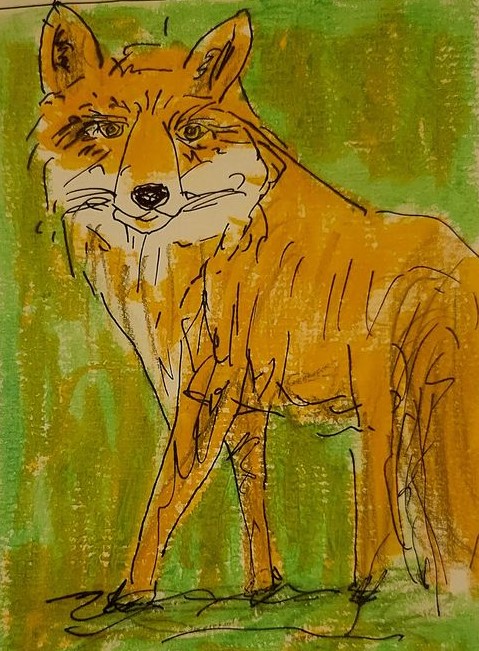
Brushes with the red fox


When the fox is around, the message for me is always Pay attention. The fox is a liminal animal, and its appearances suggest that we are entering an edgy time. I feel a Trickster energy in play when the fox is about.
     Once, when I was talking about the fox in front of a workshop circle in the Big House at Esalen, a fox popped up behind me, clearly visible to the group through the window. When they started laughing and pointing, I turned around. The fox promptly disappeared. This scene was repeated several times. That fox seemed to enjoy performing for the group while playing hide-and-seek with me. I became quite careful about monitoring the shifting energies of the group that week.
     I pay special attention to the comings and goings of the red fox. In my personal mythology, the red fox connects me to ancestral dramas. In shamanic lucid dreaming, I once tracked a red fox, glimpsed in dreams, to a scene in ancient Britain involving a tragic love affair and a druid sacrifice and the issues these raised in my current life.
     The oldest evidence we have of shamanism in Europe is the remains of a woman of power who was buried inside a crypt of mammoth bones in the wooded Pavlov hills of what is now the Czech Republic. She was interred 30,000 years ago. Her body was painted red, and in her hand was placed the body of a fox,apparently her spirit ally.
     Similar clues to the importance of the fox in early magic come from other parts of Europe. The druid prince dug out of the Lindow Moss in northern England, preserved by the chemical stew of the bog, was found to be wearing a collar of red fox fur.
     As a power animal, fox brings many gifts, of craft and cunning and camouflage. Fox knows when to hide and when to hunt, and how to wait in concealment for the right opportunity.
     There are clues in language to the qualities associated with the fox. To "outfox" someone is to outsmart them. "Foxy" can mean crafty, or sexy, or simply red-haired. "Shenanigan" - an act of mischief - is derived from the old Irish sionnachuighim, meaning "play the fox".The Trickster character of the fox is central to countless folk tales, fables, and children's stories.
      East Asian cultures are uneasy about the fox, and especially about foxy women. In traditional Japanese and Chinese culture, possession by a fox spirit is held to account for many problems, especially in women. In folk tales there are women who are foxes, putting on human disguise to seduce men.
     Here are some verses from a long poem I wrote from a hundred encounters with the red fox, on the roads of two worlds:

From Brushes with the Red Fox

You live on the edges of my life
at the margin of the tame land and the wild
and your appearances are always edgy for me.

You know when to hide and when to hunt.
Men chase you on horseback, with dogs,
yet turn chicken when you turn up unannounced.

You are tricky. I doubt I'll ever be at ease with you.
But you are a determined messenger
and a necessary link to old and sacred things

You call women I care for to reclaim lost soul
and become foxy girls, immune to glass ceilings,
setting their own boundaries, living unbounded life.

- from my collection Here, Everything Is Dreaming


Drawings (c) Robert Moss

Monday, November 27, 2017

The dream that is a song that is a road


Dreams bring us images and energy for healing and revitalizing our lives. These gifts may be delivered through the vehicle of a song.
    My Celtic ancestors lay in tomb-like spaces in the dark, sometimes with heavy stones on their bellies, hoping for the gift of awen - poetic inspiration - to burst through in song.
    For the Temiar-Senoi people of the Malaysian rainforest, the greatest gift of a dream is the kind of song they call a norng. The word literally means a "roadway". The dream song can open a road between the worlds. It can also help to open a path through the thickets and obstacles of everyday life.
    In the Mohawk language, which my dreams required me to study, the word for song is karenna, which literally means "I am putting forth my power." In my book Dreamways of the Iroquois, I describe the experience of a Mohawk grandmother of the Turtle Clan who received a healing song in a dream and was able to transfer its energy to a whole circle. As she sang, the veils between the worlds thinned. The whole group became vividly aware of the presence of spirits of the land, including Great Turtle, a form of the teacher of the Deep in the Iroquoian tradition.
    I have been gifted with many songs in my dreams. Sometimes I have to reenter a dream in order to capture all of the words and elements. Once I awakened from a dream in which I was bouncing across lush grass towards an immense tree that resembled a beech. I knew, in the dream, that secrets of life were waiting for me in a world below the roots of that tree. And that there was an entry price. To enter the gate of this tree, I must bring a song. When I rose from my dream, I had the music of this song humming in my mind, but not the words.
    Urgent to move with the dream, I called a close friend who has traveled with me in the way of the shamans over many years. "Can you come over at once? I need you to drum for me." She jumped in her car and was with me in less than an hour.
    As she drummed, I traveled back into my dream. I enjoyed the springiness of the grass under my bare feet, the clean smell of woods and water. Over the drumming, through the drumming, I hummed the little hum that had stayed with me after the original dream. Now the words came too:


Praise and serve the Mother
and let her grace unfold
Praise and serve the Mother
and re-enchant the world. *

The way to the world of our Great Mother Earth now opened to me, through the roots of a world tree. I was healed and nourished in her generous embrace. I found specific guidance, for myself and others, in a kind of creative cave that opened to me, within her realm. This is a place to which I have returned, again and again, to restore my inner compass and replenish my energy.
     The dream song may be a wing song, a song that can help you journey beyond the body, into other worlds, at any time you choose. My dreams have given me many songs of this kind, some of which I share with the circles I lead to power our group shamanic adventures.
     One morning I woke with this song streaming in my mind:

We are sleeping till we're dreaming
We are dreaming till awakening
We're awakening for our homecoming
      into the Land

Anxious that I might lose the tune, I phoned two friends and sang it to them over the line. One made a recording; the other had her musician husband listen in and write down the notes. We have sung this song in many of the adventures I have led since the dream, including our shamanic gathering up on a mountain in the New York Adirondacks last weekend.
     In the Celtic way, we sing to call lost spirit home. In some of the old tales, a part of soul that has left the body is up in a tree, in the form or a bird, and must be charmed by the power of the right song into returning to the heart and the body of the person. In recent gatherings, I have encouraged participants to go to a special tree, with a special song, and call back whatever parts of their spirit may need to come into their bodies and their current lives - a child part lost when the world seemed very cruel, a counterpart personality from another time, an aspect of a greater Self, a bright shining winged soul.
     But what if you have no song?
     Sometimes it will be gifted to you. We have journeyed on wings borrowed from the old ones - songs of the Highland and Islands, and of W.B.Yeats, chants from Africa and Native America, through Baltic dainas and Romanian doinas, rhythms of the orishas. We also share the fresh songs that come through members of our dreaming family. On the way to a workshop on Celtic Dreaming that I was leading, my friend Wanda Burch shared a marvelous song for soul healing that had come to her.

I am calling my spirit back home

She readily agreed to invite the group to use this when they traveled to the special tree to call spirit back home. It worked like a charm then, and has been charming spirits ever since.


Picture: Path of magic at Mosswood Hollow, where I lead many of my retreats in North America.

Thursday, September 10, 2015

Follow Your Own Merlin


Merlin has a thousand faces. He is magician, enchanter, poet, trickster, prophet, wise or scheming adviser to kings, the hero or anti-hero of countless dramas and several TV series. In the Four Ancient Books of Wales, his name is Myrddin, but in later texts an L was substituted for the Ds – it is said – because in the ears of the Anglo-Norman nobles who read Geoffrey of Monmouth’s version in the 12th century, the old form sounded too close to the French merde. In Geoffrey’s Vita Merlini (c.1150) “ He was a king and a prophet, to the proud people of the South Welsh he gave laws, and to the chieftains he prophesied the future.” He is Welsh, he is Briton, he is Scots, he is universal.
     Merlin is a dreamer, though in some of the ages in which he was remembered this was no term of praise. In Thomas Malory’s Morte Darthur, his enemies denounce him as “a wytche and dreme-reder”. In Shakespeare’s King Henry IV, Hotspur sneers at Welsh boasts about “the dreamer Merlin and his prophecies” and “such a deal of skimble-skamble stuff.” Merlin’s company is that of the awenyddion, or “inspired ones”, of whom Gerald of Wales wrote that “their gifts are usually conferred upon them in dreams.”
      Merlin is a shaman, perhaps the very model of the Celtic shaman. I was greatly helped, back in 1985, by Nikolai Tolstoy’s book The Quest for Merlin, in which he tracks the shamanic Merlin’s phosphorescent footsteps not only through the literature but through the landscapes of the Scottish Borders, all the way to Hart Fell (“Deer Mountain”) where one of the Merlins ran wild with the deer, conversed with a tame wolf and a little pig, and shamanized by a chalybeate spring where the waters bubbled rust-red. This Dumfriesshire landscape is that of my paternal ancestors. Many  years ago – using Tosltoy as my Baedecker – I walked from the site of a ruinous battle whose expense of blood and kin drove this Merlin temporarily mad to Hart Fell, the mountain of his dreaming
     As the legends and landscapes stream together in my mind, I see the Merlin I know and love as shaman – which is to say, arch-dreamer – in the following essential ways:

- he is born different from others (some say the spawn of an incubus, some of a golden one) yet cares for and helps and counsels those in need
- his calling is renewed by a spiritual emergency (his distress over a terrible battle and then the noise of the world)
- he is at home with the trees (he finds sanctuary inside an ancient apple tree, and feeds on apples and nuts, and shamanizes among oaks and hazels and birches)
- he knows the animals and can take their forms (he rides from his wooded mountain on the back of a stag, surrounded by a herd of deer)
- he knows the gates and paths of the Otherworld and can guide others along them (in one telling, he makes a narrow bridge between this world and an island on the Other Side)
- he sees the future, and can bring accurate knowledge of what is to come that is valued by others (a primary function of true shamans, as far back as we can know or imagine)
- he is master of story, poetry and song, through which bardic arts he can redefine and so remake the world around him
- through his own wounds, he finds the power to heal the wounds of others (he loses his mind, but regains it when his shining double, Taliesin, reminds him of the courses of heaven and earth in poetic speech, and so opens a magical spring – so Merlin can then offer the same waters of healing to another, to help him bring his spirit back into the body).

We are drawn to him by his company, of warring kings and lustful queens and questing knights. Yet Merlin, for me, rises beyond Arthur and Guinevere and Lancelot and the company of the Round Table, and even Morgan le Fay, though I dream of them too, and felt close to the knightly band when I stopped in Carlisle en route to the Scottish Borders.
     We dream of Merlin, and it may be he brings dreams to us. My Merlin, lover of woods and deer and poetic speech, is not confined to the  ”glass house” where a lovely female apprentice is said to have confined him after she tricked him out of his master spells.
     My Merlin travels with a magic orchard that goes with him everywhere. If you are very lucky, he may offer you an apple, either silver or gold. When you bite down, you’ll taste not only the sweet juice of the apple, but the heady power of a story – a story that will inspire you and give juice to your life – slipping into you. The dream shaman who gives us the right stories is the Merlin I follow.

Adapted from Dreaming the Soul Back Home by Robert Moss. Published by New World Library.

Art: Druid in Raven Cloak by Robert Moss


Thursday, April 3, 2014

Follow Your Own Merlin


Merlin has a thousand faces. He is magician, enchanter, poet, trickster, prophet, wise or scheming adviser to kings, the hero or anti-hero of countless dramas. In the Four Ancient Books of Wales, his name is Myrddin, but in later texts an L was substituted for the Ds - it is said - because in the ears of the Anglo-Norman nobles who read Geoffrey of Monmouth's version in the 12th century, the old form sounded too close to the French merde. In Geoffrey's Vita Merlini (c.1150) " He was a king and a prophet, to the proud people of the South Welsh he gave laws, and to the chieftains he prophesied the future." He is Welsh, he is Briton, he is Scots, he is universal.
     Merlin is a dreamer, though in some of the ages in which he was remembered this was no term of praise. In Thomas Malory's Morte Darthur, his enemies denounce him as "a wytche and dreme-reder". In Shakespeare's King Henry IV, Hotspur sneers at Welsh boasts about “the dreamer Merlin and his prophecies” and “such a deal of skimble-skamble stuff." Merlin's company is that of the awenyddion, or "inspired ones", of whom Gerald of Wales wrote that "their gifts are usually conferred upon them in dreams."
      Merlin is a shaman, perhaps the very model of a shaman of the West. I was greatly helped, back in 1985, by Nikolai Tolstoy's book The Quest for Merlin, in which he tracks the shamanic Merlin's phosphorescent footsteps not only through the literature but through the landscapes of the Scottish Borders, all the way to Hart Fell ("Deer Mountain") where one of the Merlins ran wild with the deer, conversed with a tame wolf and a little pig, and shamanized by a chalybeate spring where the waters bubbled rust-red. This Dumfriesshire landscape is that of my paternal ancestors, and many years ago - using Tosltoy as my Baedecker - I walked from the site of a ruinous battle whose expense of blood and kin drove this Merlin temporarily mad to the mountain of his dreaming, a story I may one day publish in extenso.
     As the legends and landscapes stream together in my mind, I see the Merlin I know and love as shaman - which is to say, arch-dreamer - in the following essential ways:
- he is born different from others (some say the spawn of an incubus, some of a golden one) yet cares for and helps and counsels those in need
- his calling is renewed by a spiritual emergency (his distress over a terrible battle and then the noise of the world)
- he is at home with the trees (he finds sanctuary inside an ancient apple tree, and feeds on apples and nuts, and shamanizes among oaks and hazels and birches)
- he knows the animals and can take their forms (he rides from his wooded mountain on the back of a stag, surrounded by a herd of deer)
- he knows the gates and paths of the Otherworld and can guide others along them (in one telling, he makes a narrow bridge between this world and an island on the Other Side)
- he sees the future, and can bring accurate knowledge of what is to come that is valued by others (a primary function of true shamans, as far back as we can know or imagine)
- he is master of story, poetry and song, through which bardic arts he can redefine and so remake the world around him
- through his own wounds, he finds the power to heal the wounds of others (he loses his mind, but regains it when his shining double, Taliesin, reminds him of the courses of heaven and earth in poetic speech, and so opens a magical spring - so Merlin can then offer the same waters of healing to another, to help him bring his spirit back into the body).
We are drawn to him by his company, of warring kings and lustful queens and questing knights. Yet Merlin, for me, rises beyond Arthur and Guinevere and Lancelot and the company of the Round Table, and even Morgan le Fay, though I dream of them too, and felt close to the knightly band when I stopped in Carlisle en route to the Scottish Borders.
     We dream of Merlin, and it may be he brings dreams to us. My Merlin, lover of woods and deer and poetic speech, is not confined to the  "glass house" where a lovely female apprentice is said to have confined him after she tricked him out of his master spells.
      My Merlin travels with a magic orchard that goes with him everywhere. If you are very lucky, he may offer you an apple, either silver or gold. When you bite down, you'll taste not only the sweet juice of the apple, but the heady power of a story - a story that will inspire you and give juice to your life - slipping into you. The dream shaman who gives us the right stories is the Merlin I follow.

Adapted from Dreaming the Soul Back Home by Robert Moss. Published by New World Library.
The Bard by John Martin (1817)

Saturday, May 28, 2011

The dream secret of Celtic inspiration


Awen - inspiration - was, as Caitlin Matthews reminds us, "the supreme preoccupation of Celtic poets, especially among those who had inherited the ancient prophetic and visionary arts of the ovate or faith - probably the earliest form of Celtic shaman." [1] The word awen derives from the Indo-European root -uel, meaning 'to blow', and is kissing cousin with the Welsh, awel meaning "breeze". In contemporary druidism, awen is depicted as three rays emanating from three points of light.

We have a precious twelfth-century account of the importance of dreaming in the access to awen for the ancient Celtic poets and prophets. The source is Gerald of Wales (Giraldus Cambrensis) in his Itinerary of Wales. Gerald describes the practice of the awenyddion, or "inspired ones". In a key passage, he writes:

Their gifts are usually conferred upon them in dreams, Some seem to have sweet milk or honey poured on their lips; to others [it seems] that a written document is applied to their mouths, and immediately on rising up from sleep, after completing their chant, they publicly declare that they have received this gift. [2]

1. Caitlin Matthews, "The Three Cauldrons of Inspiration" in Caitlin & John Matthews, The Encyclopaedia of Celtic Wisdom. Shaftesbury, Dorset and Rockport MA: Element, 1994, p. 219.
2. Translation from Gerald of Wales in Nikolai Tolstoy, The Quest for Merlin. : Little, Brown, 1985, p. 140.