Showing posts with label awen. Show all posts

Thursday, November 19, 2020

Three Kinds of Seers


 There are three kinds of seer: the receivers, the travelers, and the far-seers.

Receivers know things because they come to them or come through them, in the way of the medium. They receive visitations, both waking and sleeping. They may be “speakers for the dead”, passing on messages from the departed. This type of receiver is in great demand, because there are so many people on the other side who are desperate to communicate with the living. Receivers may also be empaths who pick up what is going on in other people’s bodies and energy fields. The very first kind of training receivers need is instruction in shielding and screening, and above all in discernment. They must learn how to pick up things it is useful to know without being swamped by someone else’s feelings and psychic litter. They need help in establishing healthy psychic boundaries. They need fully functional BS detectors that will help them to screen out false or misleading information.

The traveler knows things by going to the places where knowledge is to be found, in this world or in other dimensions of reality. This is the shaman’s way, and the journeys beyond the body may be assisted by drumming or other forms of “sonic driving”. Some indigenous cultures use hallucinogens to facilitate astral travel, and there is a lively New Age tourist traffic that involves going into the jungle to ingest rather nasty stuff like ayahuasca. Drugs are not recommended for Western journeyers, and they are not required. A practiced traveler requires only two things to embark on a journey, once the body is relaxed in a quiet and protected space: a picture and an intention. Essential training for the traveler includes learning to recognize the nature and the needs of the different energy vehicles that can operate outside the physical body. And it involves developing a strong working relationship with guardians who can protect and guide the journeys. As young children and shamans know, there is no better escort for these journeys than an animal guardian.

The far-seer knows by expanding his or her sight to include whatever he or she needs to know. This may be like turning on an inner light and directing it — like a searchlight with X-ray properties — on a target that may be on the other side of the world, or inside the molecular structures of the body, or in another dimension. Or far-seeing may be a process of mental expansion, in which the field of consciousness grows until everything it is necessary to know is inside it. This is profoundly simple, once we understand that if we think of something or someone, we are with the object of our thoughts. Thought travels faster than light, so the connection is instantaneous. The trick is to get out of our own way — to sideline the clutter and confusion of the trivial everyday mind — to we can see and operate in the larger field.

Seers may also be skryers. Skrying means using an object — or a series of objects — as a focusing device. We may recall how, as children, we used to stare at a certain spot on the surface of a creek or a lake, where the light struck just so, and would stare and stare until pictures came to us, in the mirror-bright surface of the water. Or we found shapes inside a rough rock crystal, or peering through a hole in a stone and saw the Other Side as well as the other side.

 In our time, as in other times, the core training of the seer will come through paying the closest attention to dreams, coincidence and the symbolic language of the world.


Text adapted from The Secret History of Dreaming by Robert Moss. Published by New World Library.


Photo: At the threshold of St Columba's church in Drumcliffe, a symbol from an older religion: the Celtic AWEN.  W.B.Yeats' headstone is in the churchyard, though it is not clear that his remains are in the ground there.

Friday, February 28, 2020

The Dream Secret of Celtic Inspiration


Awen - inspiration - was, as Caitlin Matthews reminds us, "the supreme preoccupation of Celtic poets, especially among those who had inherited the ancient prophetic and visionary arts of the ovate or faith - probably the earliest form of Celtic shaman." [1] The word awen derives from the Indo-European root -uel, meaning 'to blow', and is kissing cousin with the Welsh, awel meaning "breeze". In contemporary druidism, awen is depicted as three rays emanating from three points of light.

     We have a precious twelfth-century account of the importance of dreaming in the access to awen for the ancient Celtic poets and prophets. The source is Gerald of Wales (Giraldus Cambrensis) in his Itinerary of Wales. Gerald describes the practice of the awenyddion, or "inspired ones". In a key passage, he writes:

Their gifts are usually conferred upon them in dreams, Some seem to have sweet milk or honey poured on their lips; to others [it seems] that a written document is applied to their mouths, and immediately on rising up from sleep, after completing their chant, they publicly declare that they have received this gift. [2]

1. Caitlin Matthews, "The Three Cauldrons of Inspiration" in Caitlin & John Matthews, The Encyclopaedia of Celtic Wisdom. Shaftesbury, Dorset and Rockport MA: Element, 1994, p. 219.
2. Translation from Gerald of Wales in Nikolai Tolstoy, The Quest for Merlin. : Little, Brown, 1985, p. 140.

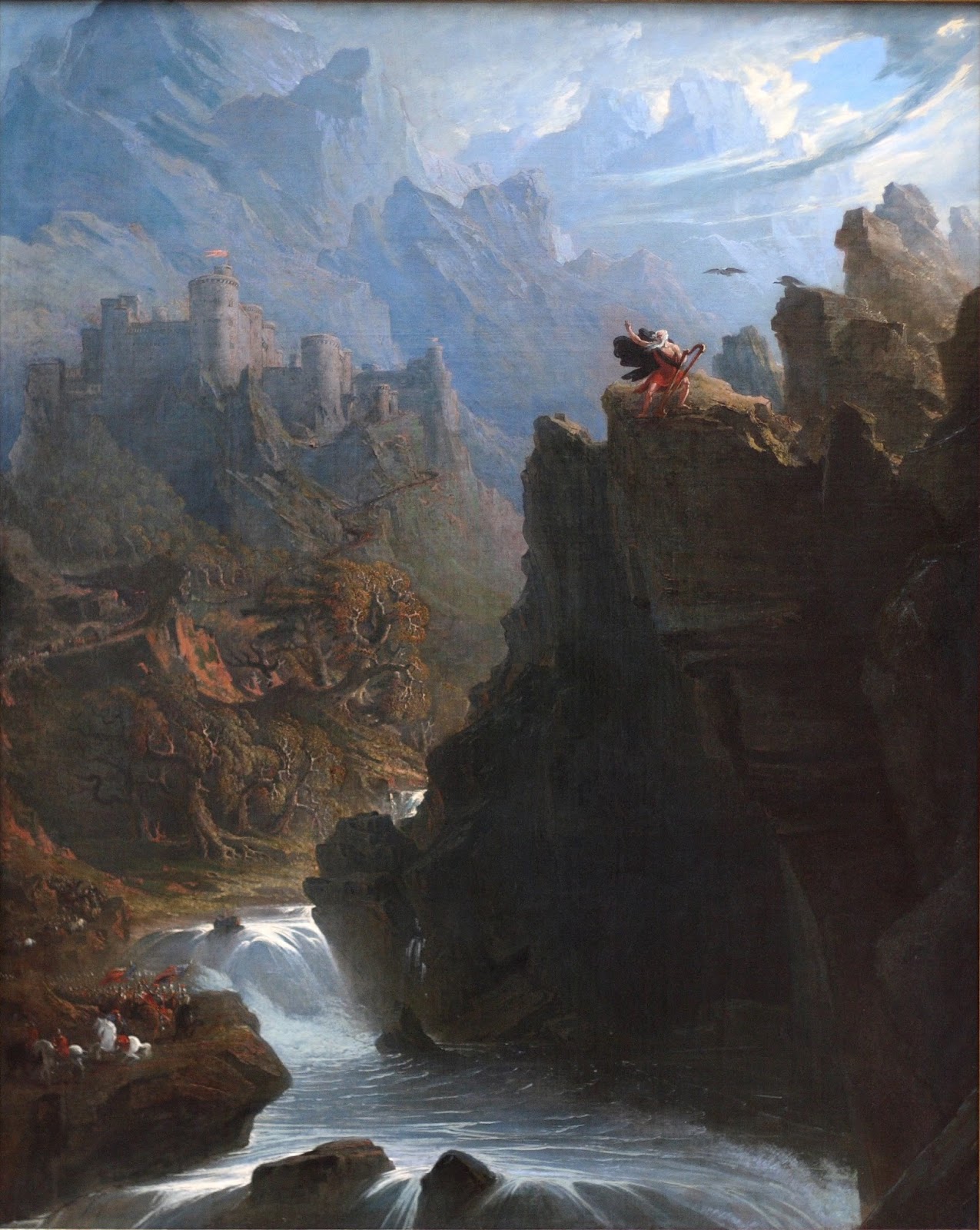
Art: John Martin, "The Bard" (1817)

Monday, November 27, 2017

The dream that is a song that is a road


Dreams bring us images and energy for healing and revitalizing our lives. These gifts may be delivered through the vehicle of a song.
    My Celtic ancestors lay in tomb-like spaces in the dark, sometimes with heavy stones on their bellies, hoping for the gift of awen - poetic inspiration - to burst through in song.
    For the Temiar-Senoi people of the Malaysian rainforest, the greatest gift of a dream is the kind of song they call a norng. The word literally means a "roadway". The dream song can open a road between the worlds. It can also help to open a path through the thickets and obstacles of everyday life.
    In the Mohawk language, which my dreams required me to study, the word for song is karenna, which literally means "I am putting forth my power." In my book Dreamways of the Iroquois, I describe the experience of a Mohawk grandmother of the Turtle Clan who received a healing song in a dream and was able to transfer its energy to a whole circle. As she sang, the veils between the worlds thinned. The whole group became vividly aware of the presence of spirits of the land, including Great Turtle, a form of the teacher of the Deep in the Iroquoian tradition.
    I have been gifted with many songs in my dreams. Sometimes I have to reenter a dream in order to capture all of the words and elements. Once I awakened from a dream in which I was bouncing across lush grass towards an immense tree that resembled a beech. I knew, in the dream, that secrets of life were waiting for me in a world below the roots of that tree. And that there was an entry price. To enter the gate of this tree, I must bring a song. When I rose from my dream, I had the music of this song humming in my mind, but not the words.
    Urgent to move with the dream, I called a close friend who has traveled with me in the way of the shamans over many years. "Can you come over at once? I need you to drum for me." She jumped in her car and was with me in less than an hour.
    As she drummed, I traveled back into my dream. I enjoyed the springiness of the grass under my bare feet, the clean smell of woods and water. Over the drumming, through the drumming, I hummed the little hum that had stayed with me after the original dream. Now the words came too:


Praise and serve the Mother
and let her grace unfold
Praise and serve the Mother
and re-enchant the world. *

The way to the world of our Great Mother Earth now opened to me, through the roots of a world tree. I was healed and nourished in her generous embrace. I found specific guidance, for myself and others, in a kind of creative cave that opened to me, within her realm. This is a place to which I have returned, again and again, to restore my inner compass and replenish my energy.
     The dream song may be a wing song, a song that can help you journey beyond the body, into other worlds, at any time you choose. My dreams have given me many songs of this kind, some of which I share with the circles I lead to power our group shamanic adventures.
     One morning I woke with this song streaming in my mind:

We are sleeping till we're dreaming
We are dreaming till awakening
We're awakening for our homecoming
      into the Land

Anxious that I might lose the tune, I phoned two friends and sang it to them over the line. One made a recording; the other had her musician husband listen in and write down the notes. We have sung this song in many of the adventures I have led since the dream, including our shamanic gathering up on a mountain in the New York Adirondacks last weekend.
     In the Celtic way, we sing to call lost spirit home. In some of the old tales, a part of soul that has left the body is up in a tree, in the form or a bird, and must be charmed by the power of the right song into returning to the heart and the body of the person. In recent gatherings, I have encouraged participants to go to a special tree, with a special song, and call back whatever parts of their spirit may need to come into their bodies and their current lives - a child part lost when the world seemed very cruel, a counterpart personality from another time, an aspect of a greater Self, a bright shining winged soul.
     But what if you have no song?
     Sometimes it will be gifted to you. We have journeyed on wings borrowed from the old ones - songs of the Highland and Islands, and of W.B.Yeats, chants from Africa and Native America, through Baltic dainas and Romanian doinas, rhythms of the orishas. We also share the fresh songs that come through members of our dreaming family. On the way to a workshop on Celtic Dreaming that I was leading, my friend Wanda Burch shared a marvelous song for soul healing that had come to her.

I am calling my spirit back home

She readily agreed to invite the group to use this when they traveled to the special tree to call spirit back home. It worked like a charm then, and has been charming spirits ever since.


Picture: Path of magic at Mosswood Hollow, where I lead many of my retreats in North America.

Friday, September 4, 2015

The dream key to Awen


Awen - inspiration - was, as Caitlin Matthews reminds us, "the supreme preoccupation of Celtic poets, especially among those who had inherited the ancient prophetic and visionary arts of the ovate or faith - probably the earliest form of Celtic shaman." [1]
     The word 
awen derives from the Indo-European root -uel, meaning 'to blow', and is kissing cousin with the Welsh, awel meaning "breeze". In contemporary druidism, awen is depicted as three rays emanating from three points of light.


     We have a precious twelfth-century account of the importance of dreaming in the access to awen for the ancient Celtic poets and prophets. The source is Gerald of Wales (Giraldus Cambrensis) in hisItinerary of Wales. Gerald describes the practice of the awenyddion, or "inspired ones". In a key passage, he writes:

Their gifts are usually conferred upon them in dreams, Some seem to have sweet milk or honey poured on their lips; to others [it seems] that a written document is applied to their mouths, and immediately on rising up from sleep, after completing their chant, they publicly declare that they have received this gift. [2]


Notes:

1. Caitlin Matthews, "The Three Cauldrons of Inspiration" in Caitlin and John Matthews, The Encyclopaedia of Celtic Wisdom. Shaftesbury, Dorset and Rockport MA: Element, 1994, p. 219.
2. Translation from Gerald of Wales in Nikolai Tolstoy, The Quest for Merlin. : Little, Brown, 1985, p. 140.


Art: "The Bard" by John Martin (1817)

Saturday, May 28, 2011

The dream secret of Celtic inspiration


Awen - inspiration - was, as Caitlin Matthews reminds us, "the supreme preoccupation of Celtic poets, especially among those who had inherited the ancient prophetic and visionary arts of the ovate or faith - probably the earliest form of Celtic shaman." [1] The word awen derives from the Indo-European root -uel, meaning 'to blow', and is kissing cousin with the Welsh, awel meaning "breeze". In contemporary druidism, awen is depicted as three rays emanating from three points of light.

We have a precious twelfth-century account of the importance of dreaming in the access to awen for the ancient Celtic poets and prophets. The source is Gerald of Wales (Giraldus Cambrensis) in his Itinerary of Wales. Gerald describes the practice of the awenyddion, or "inspired ones". In a key passage, he writes:

Their gifts are usually conferred upon them in dreams, Some seem to have sweet milk or honey poured on their lips; to others [it seems] that a written document is applied to their mouths, and immediately on rising up from sleep, after completing their chant, they publicly declare that they have received this gift. [2]

1. Caitlin Matthews, "The Three Cauldrons of Inspiration" in Caitlin & John Matthews, The Encyclopaedia of Celtic Wisdom. Shaftesbury, Dorset and Rockport MA: Element, 1994, p. 219.
2. Translation from Gerald of Wales in Nikolai Tolstoy, The Quest for Merlin. : Little, Brown, 1985, p. 140.