Tuesday, June 27, 2023

Jung wrestles with the prince of the Casbah


I accustomed myself to living always on two planes simultaneously, one conscious, which attempted to understand and could not, and one unconscious, which wanted to express something and could not formulate it any better than by a dream.

The voice is that of Jung, reflecting late in life on his early travels (in 1920) in North Africa, where he was fascinated to find himself among people whose language he did not know, whose culture was initially utterly foreign to him, and who had a very different relationship to their bodies and their emotions (he thought) than Northern Europeans.
     He felt that beyond surface differences he was dealing with a different collective spirit, a spirit of the land itself. He told himself that his feelings were more than a tourist's projections, that there was something out there, a spiritus loci that he needed to explain to himself and eventually to others. He had deeply emotional reactions to everyday scenes: to the buzz of Arab conversation in the casbah in Algiers, to a haughty, magnificent rider on a black mule hung with silver, to Arab men walking hand-in-hand at an oasis in the Sahara, to the sudden riot of color and noise of a market setting up in the early morning.
    He feared that he was falling "under the spell of the primitive", that he had been "psychically infected", a condition he saw reflected in his body when he succumbed to a form of infectious enteritis.
    He began to fear that his rational mind and identity might be overwhelmed by what "primitive" peoples called ghosts and spirits. He had read Inside Australia, a 1912 book about Aboriginal beliefs and customs by anthropologists Baldwin Spencer and Francis Gillen. His imagination was seized by the reported Aboriginal belief that the ancestral spirits of the land lie in wait for newcomers, and can reincarnate themselves through their progeny. Jung returned this idea again and again. In his essay "Mind and Earth", he wrote that "Certain Australian Aboriginals assert that one cannot conquer foreign soil, because in it there dwell strange ancestor spirits who reincarnate themselves in the new-born. There is a great psychological truth in this."
    In North Africa, Jung wrestled with the sense that there was something wild and primal and "barbaric" that could take possession of him now, not in a future generation. He was moving towards a theory of the "objective reality of the psyche", about how just as each of us has a world within, the world outside us is full of spirit, for good or otherwise. But more immediately, he was groping for a way to stay in balance, to master and integrate archetypal forces that threatened to overwhelm him.
    In Tunis in 1920, it was a dream that was his mentor and his proving-ground, as was so often the case in his life. Jung dreamed he was in an Arab city with a casbah whose walls formed a perfect square, with a gate on each side, and a moat around (an unlikely element in a North African city). He stood before a wooden bridge leading to a dark, arched portal.             Eager to explore, he stepped onto the bridge. At the mid-point, he was challenged by "a handsome, dark Arab of aristocratic, almost royal bearing". This prince of the casbah attacked him. They fought and fell through the railing of the bridge together. The dark prince tried to force Jung's head under water to drown him, but Jung resisted. "No, I thought, this is going too far." He succeeded in pushing his assailant's head under water. "I did so although I felt great admiration for him. I had no intention of killing him. I wanted only to make him unconscious and incapable of fighting."
     After this struggle, the scene changed and the adversary reappeared as as a companion. They stood together in a vaulted octagonal room in the center of the citadel. Everything was white, simple and beautiful. On the floor below him, Jung discovered an open book with black letters written in splendid calligraphy on milky-white parchment. He was reminded of the Uigurian script of western Turkestan, familiar to him from the Manichean fragments of Turfan  "I did not know the contents, but nevertheless I had the feeling that this was 'my book', that I had written it."
     He told the young prince that now he had overcome him, he must read the book. The prince resisted, but Jung overcame him again, this time with kindness and patience.
     Recalling this turning-point dream in his later years, as he dictated the materials for Memories, Dreams, Reflection, Jung analyzed it in terms that today sound almost stereotypically "Jungian" and yet go beyond. The shape of the casbah or citadel is a perfect mandala, within which the dreamer is journeying to the center of the self. The adversary on the bridge is a "shadow", but in a larger sense that is often understood when that term is used. The Arab prince is "not the personal shadow, rather an ethnic one associated not with my persona but with the totality of my personality, that is, with the self. As master of the casbah, he must be regarded as a kind of shadow of the self."
    In his own view, Jung's struggle with the dark prince - like Jacob's struggle with the dark angel - was more than a battle with a denied or suppressed aspect of his ordinary personality. It was a contest in which consciousness, awakened to the power and allure of a previously unrecognized archetype, is challenged to fight in order to befriend.


Art: Henry Ossawa Tanner, "Gate of the Casbah" (1914)

Thursday, June 22, 2023

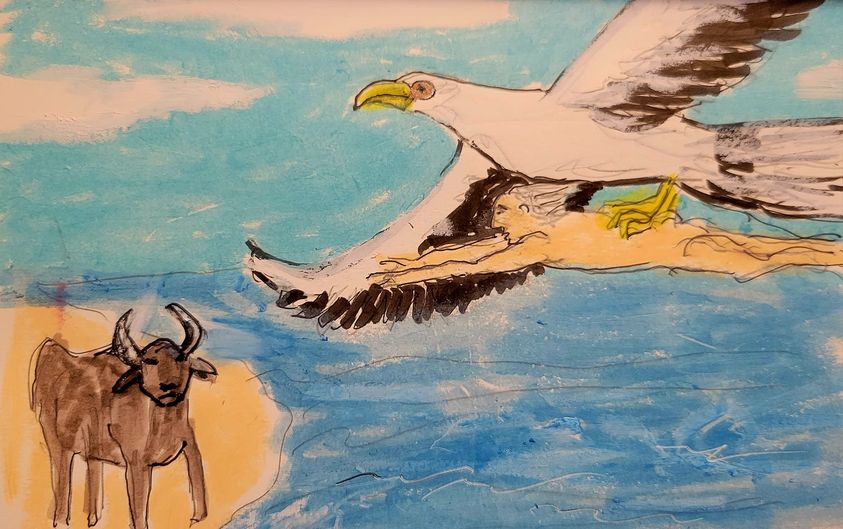
Called by Sea Eagle


In traditions where the importance of dreaming is understood, the right dream may be your price of admission to the good stuff.
   It is common in Tibetan tradition for spiritual teachers to ask students to bring them a dream to determine if they are ready to receive important teachings. A student without a dream is regarded as blocked and possibly unclean. He is required to undergo purification and perform practices to reopen his connection with spiritual allies. He is not allowed to continue his studies until he can produce the right dream.

    Tenzin Wangyal Rinpoche gives a personal example, from the time of his training with Lopon Rinpoche, in his book Tibetan Yogas of Dream and Sleep. The story is doubly interesting because it involves long-range dream precognition. At 13, as a student, Tenzin dreamed he was handing out slips of paper with the Tibetan syllable A written on them to people boarding a bus.    
    He brought this dream to his teacher, who did not comment, but allowed him to proceed to a further level of instruction. Fifteen years later, waking events caught up with the dream. Invited to travel to the West for the first time, Tenzin found himself assigned to hand out slips of paper with the Tibetan syllable A on them to people boarding a bus. These were to be used in a meditation exercise.
    In 1994, a dream proved to be my admission ticket to the Dreaming of an Aboriginal people in my native Australia. In a lucid dream, starting in the drifty liminal state in the middle of the night, I was joined by a giant sea eagle, an aquatic raptor native to the north-east coast of my native Australia. The sea eagle carried me across the North American continent, then over the Pacific to a reunion with my mother at her home in Queensland. We had been having some difficulties and I wanted to leave the dream excursion at this point to call her.
    However, sea eagle had other ideas. It flew me on , into the hinterland, to meet another animal power: a huge water buffalo. I remembered the water buffalo, too, from boyhood. It had been central to a terrifying shamanic initiation, in another spontaneous lucid dream.
     The bull escorted me to a muddy creek. Something immense was thrashing and rising from the waters. Nearby were Aborigines painted for ceremony. An elder told me, "This is the first of all creatures. This is the beginning of our world."
    When my mother died suddenly, three months later, I was grateful that the dream had prepared me for this event, through our loving exchange in the dream itself, and by how it inspired me to reach out to her and heal some misunderstandings.
     I flew back to my native country. After the funeral, I went "walkabout" for a few days, and found myself at an Aboriginal housing co-op in a dusty town in the hinterland called Beaudesert. When I started talking about dreams, I was told I needed to talk to Frank. Who was Frank? "Oh, he's our spirit man." Frank's place proved to be three days bush walk away, so this lead seemed like a non-starter.
    But Frank walked in as I was getting ready to go; shamans are tricky. He invited me down to the pub to talk. He sipped orange juice and sniffed me, literally, checking if I was another white fella trying to rip off his people yet again. Then I told him the dream. His manner changed radically. He sat very still, his eyes blazing like fire opals.
   "Oh, I guess you've come to me for a reason, mate. You've just told me the start of the creation story of my people, the Mununjalli, as it is told to made men. That thing you saw in the water was the bull eel. We say it is the first of all creatures."
    Yet a dream had taken me deep inside the Dreaming of an ancient and indigenous people. Because of my dream, Frank volunteered to show me the place of the Bull Eel Dreaming. Skirting quicksand and snakes, after many hours I found myself on the bank of the muddy creek from my dream. No bull eel in evidence that day, which was fine with me.


Many years later, I heard from a Kukatja grandmother that "a dream is when the spirit goes on walkabout." I know this is exactly right. 


A fuller version of this story is in the Introduction to my book Conscious Dreaming.

Drawing: "Flight with Sea Eagle" (c) Robert Moss

Wednesday, June 21, 2023

A Mirror for the Sun Goddess


At the solstice, a story from Japan about the sun goddess. In Japan, as in many world cultures, the sun is feminine. The tale is a profound teaching story about soul loss and soul recovery comes from Japan. It is a mythic tale of Amaterasu Omikami, the Japanese sun goddess, and it offers a wonderful script for soul healing. Perhaps you can find yourself - and more of your soul - inside it.
     The beloved sun goddess Amaterasu is shamed and abused by a raging male, her stormy brother/consort Susanowo, who is a hero when is comes to fighting monsters but is no hero in the family home. They have had children together, born magically from gifts they have given each other – three girls from Susanowo’s sword and five boys from the jewels of Amaterasu.
     But Susanowo plays spoiler, smearing excrement where Amaterasu made fertile fields and crops, throwing a horse that is sacred to the goddess into the midst of her intimate weaving circle, and so on. The storm god’s violence reaches the point where Amaterasu takes refuge in a rock cave. And the light goes from the world.
      In her dark cavern the once radiant goddess sits brooding on the past, sinking deeper and deeper into feelings of guilt and shame. Maybe she starts telling herself that what has happened is somehow her fault, that she failed her consort in some important way, that she failed to give what was needed. In the depths, she has lost her inner light, while the world has lost her radiance. The myriad gods and goddesses are desperate to call the sun back.
     They try many ruses to lure Amaterasu out of the dark cave. They call on a wise god, whose name means Keeper of Thoughts, to advise them. He usually keeps his best ideas to himself, but the cold and darkness in the world have got him worried too. So he counsels the gods to gather all the roosters than can be relied to crow at dawn. He tells the gods to hang a mirror with strands of jewels on the branches of a Sakaki tree at the entrance of Amaterasu’s cave. The gods do this, decorating the tree with bright cloth banners, without fully understanding the plan. The cocks crow, the gods whoop and howl. And Amaterasu stays in her cave.
      Now one of her sister goddesses, Uzume, comes up with a plan of her own. Uzume is the goddess of mirth and revelry. She is also called the Great Persuader and the Heavenly Alarming Woman. Now we see why. Uzume overturns a tub near the mouth of the rock cave, strips off her clothes like a professional, and moves into a wild, sexy dance that has the gods laughing and bellowing with delight. Amaterasu is curious. Why is everyone having so much fun? She approaches the mouth of her cave and demands to know what is going on. Uzume calls back to her, “We’ve found you the perfect lover. Come and see.”
     Suspicious, Amaterasu peeks around the edge of the boulder she placed at the cave mouth to shut out the world. And she is awed and fascinated to see a figure of radiant beauty looking back at her. She is drawn, irresistibly, to this beauty, and comes up out of the darkness – to discover that the radiant being is her own beautiful self, reflected in the mirror the gods have hung in a tree near the cave. Now the god of Strength rushes out and holds Amaterasu, gently but firmly, to restrain her from going back into the dark. Another god places a magic rope across the entrance to the cave.
    Gods of passion and delight lead Amaterasu back into the assembly of the gods, and her light returns to the world. This is a marvelous collective dream of how soul recovery and soul healing become possible when we help each other to look in the mirror of the greater Self.
     Mirrors hang in the temples of Amaterasu today, to remind us to look for the goddess or god in ourselves. When we locate the drama of Amaterasu in our own lives, we begin to make a mirror for the radiance of the larger Self that can help to bring us, and those we love, up from the dark places.
     In some of my workshops, we have taken the story of Amaterasu's descent to the Underworld and turned it into a shamanic theater of soul recovery, with amazing results. However, the unfortunate cast as Susanowo must be depossessed of his role, and then welcomed back into the circle as a "new man", healed and enlightened. This can be profoundly healing too.

Illustration (c) Robert Moss

Monday, June 19, 2023

Birth of a Songline


A song is bursting from me. I sit on a rise overlooking the coast, and sing the first couplet:

We are singing till we're flying
We are flying till we're swimming

The last part comes in an easy flow

We are swimming till we're traveling
into the Land

A woman singer-songwriter is beside me now, carrying the melody in her lovely voice, laughing with me as I experiment with additional lines.

We are laughing till we're bouncing
We are bouncing till we're flying

Then comes the most important verse

We are sleeping till we’re dreaming
We are dreaming till awakening
We’re awakening for our homecoming
into the Land

I know what this is. It's a wing song, a journey song. I am excited to think that I can share it with the people who join me for adventures in the dreamtime and in the dream of everyday life.

I know what the Land of the song is. It is a happy Otherworld, a land of heart's desire. And the song can help to take us there. We are making songlines. 


- This account of how a song was born in one of my dreams is excerpt from my 2013 journal. We have sung the last verse of that song in many of my workshops and retreats, and it has helped us unfold our wings.


Photo (c) Romy Needham


Saturday, June 17, 2023

Take Your Liminal Complaints to Kali Ma


I'm fourteen years old and I've never been kissed. In the middle of the night, I feel a presence in my room. It's a woman, and she's coming towards me. She's little more than a dark cloud to begin with, but when she reaches my bed she is fully defined. She is a hideous, black-skinned hag, with multiple arms. Jouncing against her withered dugs is a necklace composed of rotting human heads.
     I want to flee from this apparition, but I can't move. My body is completely paralyzed, except for my eyes, which are taking in everything. 

The memory of this episode came flooding back while I was reading a lucid and helpful book on Sleep Paralysis by Ryan Hurd, Ryan writes from first-hand experience, and he makes a careful study of the varying explanations for this phenomenon, in which the sufferer lies dormant, unable to move, while ghosts and demons may appear to menace him, pressing down on his chest.  This condition is by no means unusual. At least half the population are estimated to have suffered from sleep paralysis at some point in their lives.

Ryan identifies high-risk communities (workers on night shift, insomniacs, the jet-lagged, college kids) . He offers clear, commonsensical guidance on how to minimize your risk of finding yourself in this state, basically: keep regular hours, get enough sleep, stay grounded, don’t forget to breathe. I confess that some of this was lost on me since I have never kept regular hours, fly constantly, sleep in two or three short bursts in a 24-hour cycle, and have been accused of having “no body clock whatsoever”.

We are coming to the most exciting part of Ryan’s book, in which he distinguishes himself from much of the literature by asking: What if sleep paralysis is not a curse, but an opportunity? What if this state is “a gateway for lucid dreaming”, even a spiritual initiation? What if the demon or the night hag is actually a guide who can take us on an amazing astral journey if we can go beyond our fear – and stop worrying about the body? Ryan knows that all these things are possible, and more, because he’s been there. So have I, but I’ll come back to that in a moment.

A word about words. “Sleep paralysis” is actually a major misnomer. Why? Because everyone who has experienced this condition knows that they were awake at the time.

It resembles sleep in two respects. First, in the muscular atopia – paralysis – which is a benign and indeed necessary state during sleep because it prevents us from acting out our dreams at the expense of the furniture and the family. Second, shapes from dream or nightmare may fill the space. We might add that “sleep paralysis” is most commonly experienced near sleep, coming or going. Still, it is not a state of sleep. 

I would like to see us develop the verbal imagination to call it something more exact. If we are going to focus on the physiology, we could speak of muscular dyschrony, which would be to say that the muscles are out of kilter with time. A better term for the larger phenomenon would be liminal paralysis, which would feature its identity at a threshold state, on the border (for example) of being in and out of the body.

Let’s return to Ryan Hurd’s proposition – which will be shocking to many – that we can learn to love what I will now call liminal paralysis.
    My terrified fourteen-year-old self can attest to this.
    His experience with the night hag did not end with the scene above. When she approached his bed and mounted him, he discovered that not every part of his body below the eyes was paralyzed. His story continues:

.
The black hag is on my bed, stamping on my chest. She lowers herself on her haunches. Despite my disgust, I am erect and now she is riding me. Her teeth are like daggers. My chest is spattered by blood and foulness from the rotting heads.
     There is nothing for me to do but stay with this. I tell myself I will survive.
      At last, the act is done.
     Satisfied, the nightmare hag transforms into a beautiful young woman. She smells like jasmine, like sandalwood. She takes me by the hand to a forest shrine. I forget about the body I have left frozen in the wood. 
      She tells me, I am Time, and I give you power to step in and out of time. You can call me Kali Ma.
      When I return, I am different. 

In the days that followed, in then back of my classroom and in my bedroom late at night, I wrote a cycle of poems that I titled Creatures of Kali. More than half a century later, I remember the first stanza of my adolescent verse:

In the darkness, a dark woman comes to me
softly, as the ticking of a clock.
I, in panic, cry out, "Go! I have no head for horror!"

But she smiles and wraps her four black arms around me
beating her bleeding necklace of skulls around my neck
and holds me captive through the night.


If we are willing to face our night terrors, we may find that the alien in the room is what is truly most alien to us, our own greater power. If we can endure the night hag, we may earn an encounter with the Goddess.
     ,

The book discussed is Ryan Hurd, Sleep Paralysis: A Guide to Hypnagogic Visions and Visitors of the Night (Hyena Press)


Art: "Kali Black and Blue" (c) Robert Moss


The Paths All Taken


Instead of thinking about paths not taken in this life, we might reflect on the possibility that, in our greater self, we have experienced all possible paths, and can tap into that, embracing the gifts and lessons of many possible lives.

This was the working conclusion of a group of frequent fliers I led in an experiment in tracking an alternate self. I asked each member of the group to start by traveling back along the road of their earlier life and finding a crossroads where they had made a significant decision but might have chosen differently. This crossroads would become the point of departure for a longer journey, powered by shamanic drumming. I gave the following instructions for the larger journey:
-
When the journey begins, you will find yourself approaching that crossroads you remember from your earlier life. This time, you will take a different road. You will follow your alternate self along that alternate life path, all the way to the present moment in time.
-
We used live shamanic drumming to fuel and focus the journey.

One traveler pursued an alternate event track on which, instead of marrying and having kids early, she pursued career and higher education, becoming a U.N. interpreter and eventually founding her own successful business. She saw herself giving speeches in no fewer than five languages. She had some romance and excitement on this trail, but found herself - at her present age - living alone and feeling lonely, amid the trappings of success and affluence that surrounded her. She told us this experience left her glad she made the choice that she made, and also glad she could now feel she had not missed out on that alternate life as the international career woman. "Now I really feel I've lived both lives."

Asked whether she could bring gifts of her alternate self into her present life, she said she'd get on with working with some French language tapes, with the aim of making herself fully bilingual, as her parallel self had succeeded in doing decades earlier. She felt that her language skills might grow faster now that there was some conscious convergence with that other self, the globe-trotting linguist.
-
Another traveler who had never married or become a mother found herself going back to a crossroads she reached in her teens, when - in the life she remembered - she decided not to go back to the boyfriend who was waiting for her in California after spending the holidays with her family on the East Coast.

Following her alternate self who did go back to the boyfriend, she found herself participating, very vividly, in a life that included going to grad school with him, getting married and having kids, running a psychology practice, and then finally breaking up after her husband developed a "roving eye." She reported, with calm certainty, "I've done that now, and I don't need to carry on having any regrets." She thought she would try to bring some of her parallel self's gifts in research and writing into a new phase of her present creative life.
=
A woman who made a commitment to service in ministry and chose not to marry, returned to a time when she might have responded to the invitation of a colleague to pursue a romantic relationship. On the alternate life path she chose to track, she made a different choice, pursued the relationship and entered into a loving marriage. She gave birth to a girl and later to a boy. She developed a professional career in counseling on a university campus. She experienced wrenching grief when her husband died leaving her widowed in her mid-forties. She had a sense of the loving care of this man that reached from the other side to her on both life paths. 

This traveler returned with a deep sense of peace and satisfaction. The alternate life and the one she now inhabited both required courage to navigate challenges. She spoke about a sense of both lives being lived well, and of both offering service and love to others. "Both paths are of great value," she said. "Knowing that, I feel deep peace and satisfaction."
-
Not all the experiences that were reported brought calm and closure. Bravely, one of our travelers returned to the night when she had gone out on a motorbike and suffered a terrible accident that put her in hospital for a long time and left her scarred. What if she had not gone out that night? She found that, on the alternate track that avoided the accident, her marriage still collapsed, and this released her from some of her second-guessing. 

She also met another self, a double who had made the same choice to go out on the bike but had never gotten herself together after the accident. "I call her the Sad One. She's the one who carries her disability through life as her permanent excuse for not trying and not really living. I thought I'd parted company with her but she's still around and I want to send her away."
-
Part of the secret logic of our lives may be that our paths constantly interweave with those of numberless parallel selves, sometimes converging or even merging, sometimes diverging ever farther. The gifts and failings of these alternate selves - with all the baggage train of their separate lives - may influence us, when our paths converge, in ways that we generally fail to recognize. Yet a sudden afflux of insight or forward-moving energy may be connected with joining up with an alternate and lively self, just as a sour mood of defeat or a series of otherwise inexplicable setbacks may relate to the shadow of a different parallel self, a Sad One or a Dark One.
-
Alternate reality tracking of the kind I have reported here may become alternate reality therapy - worthy of the acronym ART - if we can rise to greater consciousness of who is stepping where in our life gardens of forking paths.


Illustration: "Forking Paths" (c) Robert Moss

Dog as God and Psychopomp in Dream Archaeology


A small example from my journals of one mode of dream archaeology: following clues from a dream to an ancient culture and turning up evidence or documentation for something that was previously unknown or  incompletely known. It may also be an example of dream precognition:  

May 8, 2022

Dream  

Power of the Dog in Dream Archaeology 

I'm excited by essays and materials I find in what at first seems to be a big white-bound bound volume. They include maps and charts and line drawings on an archaeology theme: The Dog. I reflect on related sources I have available to go further on this theme in my own research and writing, including Barry Lopez's fine work Of Wolves and Men.

Later I am out in the woods with a man who lives close to wolves. He leads the way off the main path to the right. He says the wolves are out, moving clockwise. It seems to be his plan to meet them face to face. I notice he hasn't brought his rifle. I'm willing to trust that he knows what he's doing and that if we meet the wolves face to face it will be a sociable encounter.


Where Dog=God and Psychopomp

After recording my, I opened my email and found my daily pdf from an academic website, a paper on canine burials at Saqqara during the Graeco-Roman period.. [*] It describes the mass burial and mummification of dogs in ancient Egypt, 1,350 at this site alone, tens of thousands at Abydos.

The authors suggest that the primary reason for canine burial here was to provide an organic embodiment of Anubis in his role as psychopomp, guiding souls between this world and the afterlife. The dog buried beside or near humans becomes "an amuletic animal mummy... considered to be either an adequate replacement for, or a valuable complement to the Anubis amulet to ensure the continuing and unbroken assistance of Anubis for the deceased."

The article contains maps and charts and line drawings including one of a 2nd century funerary stele from Terenouthis (Kom Abu Bellou), where the deceased is seen in the company of a dog and a falcon, aspects of Anubis and Horus.

So my dream of the archaeology of the dog seems to be a minor example of precognition or clairvoyance. The incoming email enabled me to fulfill part of my dream research assignment right away. I would probably not have made time to read that scholarly article without the dream; I had a few other reading assignments. 

It is interesting to reflect on where the wolves are circling. Their presence off-stage in that part of my the dream leads me to reflect on the evolution of the human-canine connection, In the Egyptian context, it may be relevant that Anubis and his two jackal-headed brothers, Wepwawet and Duamutef, are especially associated with wild canids. 

In one of my big dreams of Egypt twenty years earlier, my two beloved black dogs (both deceased) came out of a hollow tree, dripping with what looked like amniotic fluid and might have been resin or honey. They guided me through the pylon gate of an Egyptian temple that was both ancient and newly constructed. A beautiful cupbearer gave me wine infused with blue lotus. In an inner chamber I received profound revelations about soul and self that are indelible. Recalling my guides, the two black dogs, I think of how in some funerary stelae from Egypt, like one in the picture above, twin canids share the role of psychopomp. 

[*] Mary Hartley, Alanah Buck, Susanne Binder, "Canine Interments in the Teti Cemetery North at Saqqara during the Graeco-Roman period" in Miroslav Bárta, Filip Coppens and Jaromír Krejãí (eds) Abusir and Saqqara in the year 2010/1 (Prague: Czech Institute of Egyptology, Charles University, 2011) 17-29.


Photo: Funerary stela of Kopres. Roman Period, late 2nd century from Terenouthis. University of Michigan Excavations, 1935